This is a repository copy of
Near-optimal pilot allocation in sparse channel estimation for
massive MIMO OFDM systems
.
White Rose Research Online URL for this paper:
http://eprints.whiterose.ac.uk/88974/
Version: Accepted Version
Proceedings Paper:
Nan, Y, Sun, X and Zhang, L (2015) Near-optimal pilot allocation in sparse channel
estimation for massive MIMO OFDM systems. In: Proceedings IEEE International
Symposium on Wireless Communication Systems (ISWCS 2015). Twelfth International
Symposium on Wireless Communication Systems, 25-28 Aug 2015, Brussels, Belgium.
IEEE . ISBN 9781467365406
https://doi.org/10.1109/ISWCS.2015.7454372
[email protected] https://eprints.whiterose.ac.uk/
Reuse
Unless indicated otherwise, fulltext items are protected by copyright with all rights reserved. The copyright exception in section 29 of the Copyright, Designs and Patents Act 1988 allows the making of a single copy solely for the purpose of non-commercial research or private study within the limits of fair dealing. The publisher or other rights-holder may allow further reproduction and re-use of this version - refer to the White Rose Research Online record for this item. Where records identify the publisher as the copyright holder, users can verify any specific terms of use on the publisher’s website.
Takedown
If you consider content in White Rose Research Online to be in breach of UK law, please notify us by
Near-optimal pilot allocation in sparse channel
estimation for massive MIMO OFDM systems
Yang Nan
Beijing Jiaotong University, 100044 Email: [email protected]
Xin Sun
Beijing Jiaotong University,100044 Email: [email protected]
Li Zhang
University of Leeds, LS2 9JT Email: [email protected]
Abstract—Inspired by the success in sparse signal recovery,
compressive sensing has already been applied for the pilot-based channel estimation in massive multiple input multiple output (MIMO) orthogonal frequency division multiplexing (OFDM) systems. However, little attention has been paid to the pilot design in the massive MIMO system. To obtain the near-optimal pilot placement, two efficient schemes based on the block coherence (BC) of the measurement matrix are introduced. The first scheme searches the pilot pattern with the minimum BC value through the simultaneous perturbation stochastic approximation (SPSA) method. The second scheme combines the BC with probability model and then utilizes the cross-entropy optimization (CEO) method to solve the pilot allocation problem. Simulation results show that both of the methods outperform the equispaced search method, exhausted search method and random search method in terms of mean square error (MSE) of the channel estimate. Moreover, it is demonstrated that SPSA converges much faster than the other methods thus are more efficient, while CEO could provide more accurate channel estimation performance.
Keywords—Massive MIMO, optimal pilot allocation,
compres-sive sensing.
I. INTRODUCTION
The combination of massive (or large-scale) multiple-input multiple-output (MIMO) and orthogonal frequency division multiplexing (OFDM) is expected to be the key technology for future communications [1]. However, this technique suffers from high complexity load in channel estimation due to the high dimensional channel matrix to be estimated. To solve this problem, more and more attentions have been focused on the sparse recovery algorithms in compressive sensing (CS), which could estimate the sparse channel by relatively less pilots [2]. One of the challenges in sparse channel estimation is pilot pat-tern design, which significantly affects the channel estimation performance. To optimize the pilot allocation, a promising idea is to utilize the restricted isometry property (RIP) [3], which demonstrates that random sampling may guarantee the sparse recovery with a decent probability, indicating that an optimal way to design the pilot pattern is random search. However, this method encounters difficulties in implementation due to its large storage and low efficiency [4].
In [5] and [6], two near-optimal pilot allocation schemes based on the mutual incoherence property (MIP) are proposed. In [7] a pilot allocation method based on the mean square error (MSE) is proposed. However, all of these schemes are based on the single-input-single-output (SISO) OFDM. To the best of the authors’ knowledge, few works have been done on the near optimal pilot allocation for the massive MIMO OFDM systems.
In this paper, we investigate the block coherence (BC) of the measurement matrix of the massive MIMO systems [8] and then propose two efficient pilot allocation methods for the sparse channel estimation. The first method obtains the near-optimal pilot pattern by minimizing the BC through the simul-taneous perturbation stochastic approximation (SPSA) method [9]. The second method combines BC with a probability model and then employs the cross-entropy optimization (CEO) [10] to solve the minimization problem of BC. The proposed schemes are compared with the equispaced search method, exhaustive search method and random search method. Simulation results show that the SPSA has advantage in convergence speed while the CEO is superior to the others in terms of the BC performance and the mean square error (MSE) performance.
The rest of the paper is organized as follows. We first describe the massive MIMO OFDM system model and define the problem in Section II. Then the proposed pilot design methods are addressed in Section III. Numerical experiments are presented in Section IV. Finally, section V concludes the paper.
The notations used in this paper are concluded as follows. Matrices and vectors are denoted by symbols in bold letters. Operators (·)T,⌈·⌉,| · | andk · k represent transpose, ceiling
function, complex modulus and norm function, respectively.
II. SYSTEMMODEL ANDPROBLEMDEFINITION
Considering a downlink massive MIMO OFDM system where the receiver and transmitter are equipped withNr and
Nt antennas, respectively. Theith MIMO OFDM symbol for
thekth transmitting antenna (1≤k≤Nt) is composed ofN
subcarriers, among whichNp subcarriers are used to transmit
the pilot signals. The transmitting pilots of thekth antenna can be expressed as x(ik) = [x(ik)(P1), xi(k)(P2),· · ·, xi(k)(PNp)] where p = [P1, P2,· · · , PNp] (1 ≤ P1 < P2 < · · · <
PNp ≤ N) contains the corresponding indices of the pilots. To distinguish the channels corresponding to different transmit antennas at the receiver, the pilot sequencex(ik)(1≤k≤Nt)
is generated respectively, based on the identically and indepen-dently distributed (i.i.d) random Bernoulli distribution (±1) [11]. Therefore, we havexm
i 6=xni ifm6=n.
In wireless communications, the channel impulse response (CIR)h(ik)of theith OFDM symbol between thekth transmit-ting antenna and a certain receiving antenna can be represented as
h(ik)= [h(0k,i), h
(k) 1,i, . . . , h
(k)
L−1,i]T,
whereL is the maximum channel spread. Note that identical channel estimation processing will be adopted on every re-ceiving antenna, so we have omitted the index of rere-ceiving antennas in this paper. On the receiver side, we have
yi= Nt X
k=1
diag{x(ik)}Fp,Lh(ik)+w
(k)
i
=
Nt X
k=1
D(ik)Fp,Lh(ik)+w
(k)
i ,
(1)
whereyiis theith received pilot sequence coming fromNt
dif-ferent transmit antennas,D(ik)=diag{x
(k)
i }is a diagonal
ma-trix withx(ik)on its diagonal,Fp,Lis a partial discrete Fourier
transform (DFT) matrix indexed by p = [P1, P2,· · ·, PNp] in row and [1,2,· · · , L] in column from a standard N ×N
DFT matrix, w(ik) denotes the additive white Gaussian noise
(AWGN). For the sake of brevity, we hereafter omit part of the scripts in (1) and rewrite (1) as [11]
y= Ψ˜h+w, (2)
where Ψ = [D(1)i Fp,L,D(2)i Fp,L,· · · ,D(iNt)Fp,L] of size
Np × NtL and ˜h = [(h(1)i )T,(h
(2)
i )T,· · · ,(h
(Nt) i )T]T is
the CIR vector of size NTL × 1. Moreover, we
rear-range h˜ as b = [bT0,· · ·,blT,· · · ,bTL−1]T with bl =
[h(1)l,i,· · · , hl,i(k),· · · , h(Nt)
l,i ]. Then the system can be modeled
by
y=
L−1
X
l=0
Albl+ ˜wl=Ab+ ˜w, (3)
whereAl = [Ψl,ΨL+l,· · · ,Ψ(Nt−1)L+l] is the lthNp×Nt block (submatrix) of Ψ with Ψl the lth column of Ψ, A =
[A0, ,· · ·,Al,· · · ,AL−1]. In the same way,w˜lis thelth block
of the reordered AWGNw˜.
It has been proved that the wireless channel of massive MIMO system is sparse in nature, where the significant paths (non-zero taps) of the channel, denoted asS, is much smaller than the maximum channel spreadL, e.g.,S≪L. Moreover, it is shown recently in [11] that the CIR of different trans-mit antennas shares a common support in downlink massive MIMO systems since the antenna spacing at the BS side is negligible compared to the long distance between BS and the receivers. In other words, although the paths amplitudes and phases may be distinct, the path delays of different transmit antennas are identical, e.g.,
supp(h(im)) =supp(h
(n)
i ), m6=n. (4)
As a result, we can jointly consider the channel estimation problem of massive MIMO systems by exploiting their joint sparsity.
According to the recent progress in CS, a necessary condition for successfully reconstructing b from y is that measurement matrix A satisfies the RIP [8]. However, it is computationally complex to validate whether a given matrix could satisfy the RIP. To solve this problem, former works have utilized the MIP ofAas an alternative, which obtains the near-optimal pilot allocation by minimizing the mutual coherence of A, denoted as [12]
popt= arg min
p µ(p), (5)
wherepopt denotes the near-optimal pilot pattern, and
µ(p) = max
1≤m<n≤L|ham,ani|, (6)
wheream is themth column of A, and h·i is the correlation
function.
In traditional SISO or MIMO systems, orthogonal pilot pattern is always adopted, which could be optimized according to the MIP. However, the superimposed pilot pattern based on the block CS [11] becomes more popular in massive MIMO systems since the overhead of orthogonal pilot pattern increas-es with the number of transmit antennas, which reducincreas-es the spectral efficiency significantly in the massive MIMO system. Note that MIP is no longer applicable for the superimposed pilot pattern, we exploit the block coherence as an alternative in this paper.
III. PILOT DESIGN METHODS
A. Analysis of block coherence
We first define the block coherence ofAas [8]
µB(p) =
1
Nt0≤m<nmax≤L−1ρ(A
H
mAn), (7)
whereρ(X)is the spectrum norm of a given matrixXdefined as ρ(X) = λ1max/2 (XHX), with λ1max/2 (XHX) denoting the
largest eigenvalue of the positive semi-definite matrix XHX. It is obvious that computing the spectrum norm of AHmAn is
computationally expensive. To solve this problem, we need to simplify the expression in (7). Note that |x(ik)(Pj)| = 1
(1≤j≤Np) and
Fp,L=
1 ϕP1 . . . ϕP1×(L−1)
1 ϕP2 . . . ϕP2×(L−1)
..
. ... ...
1 ϕPNp . . . ϕPNp×(L−1) ,
whereϕκ=e−j2κπ/N, we have
µB(p) = 1
Nt
max
0≤m<n≤L−1ρ(A
H mAn)
≤ 1
Nt
max
0≤m<n≤L−1|Ψ
H
mΨn| (8)
= 1
Nt
max
0≤m<n≤L−1
Np X
j=1
|ϕPj×(n−m)|
= 1
Nt
max
1≤d≤L−1
Np X
j=1
|ϕPj×d|, (9)
whered=n−m. Note that (8) is derived fromGerˇsgorin′s
disc theorem in [14, Corollary 6.1.5]. Therefore, we could
obtain the near-optimal pilot allocation by solving the follow-ing optimization problem
popt= arg min
B. Pilot allocation method based on the block coherence
By observing (9) and (10), it is obvious that the most intuitive approach to optimize the superimposed pilot pattern is to perform an exhaustive search over all the possible pilot patterns. However, the effort for computingµB(p)with
different pilot patterns is prohibitive due to the huge number of ways to allocateNp pilots inN subcarriers. For example, we
have5.82×1040 possible pilot allocations whenNp= 32and
N = 256are considered. Therefore, we propose two efficient methods to search the near-optimal pilot pattern.
1) Simultaneous Perturbation Stochastic Approximation (SP-SA)
The simultaneous perturbation stochastic approximation (SPSA) algorithm has been proved to be efficient for solving the multivariate optimization problems [9]. By using a rela-tively small number of measurements of the objective func-tion, SPSA could provide a desirable solution without direct reference to the first derivative of the objective function. As an alternate method for calculating the first derivative, it uses two performance function observations whose variables are simultaneously varied randomly to approximate the gradient during each iteration, regardless of the dimension of target signals. Due to this essential feature of SPSA, it could become a powerful and efficient tool for the pilot pattern design in massive MIMO systems.
Assume ̺t = [̺t
1,· · · , ̺tj,· · ·, ̺tN] where ̺tj denotes the
probability of thejth subcarrier to be the pilot subcarrier (e.g.,
j ∈p) at thetth iteration. Starting from ̺t=0
j = 0.5 for 1≤
j ≤ N, at the tth iteration we perturb all the elements in
̺t−1 simultaneously according to a vector δt whose elements
are generated following Bernoulli distribution. After that, we update̺tas
̺t=̺t−1+αtµB(̺
t−1+βtδt)−µ
B(̺t−1−βtδt)
2βt (δ
t)−1,
(11) where all the parameters are set empirically as follows [14]:
αt,α/(B+t+ 1)γ withα= 1,B= 1000andγ= 0.602;
βt , β/(t+ 1)λ is a positive time-varying constant where
β = 0.01andλ= 0.101; the inverse of (δt)−1 is equal toδt
since δt follows Bernoulli distribution. The inverse function
here is defined to be element-wise inverse. Moreover, since the probability is finite, we set 0 and 1 as the lower bound and upper bound of ̺t, respectively. The SPSA terminates
when the maximum number of iterations tmax is reached.
After that, we can obtain the near-optimal pilot allocationpopt
by collecting the Np indices with the maximum probability
in̺. The detailed algorithm is summarized in Algorithm 1.
2) Cross Entropy Optimization (CEO)
Consider equation (10) as an minimization problem,
popt= min
p∈ΛµB(p), (12)
where popt is the near optimal pilot pattern and Λ is the
set of pilot patterns with cardinality Np. Firstly we define
the probability distribution function (PDF) ofp based on the
Algorithm 1 Initialization:
̺0= 0.5, andt= 1.
whilet≤tmax do
1. Generateδtfollowing Bernoulli distribution, 2. Setαt=α/(B+t+ 1)γ andβt=β/(t+ 1)λ,
3. Update̺t according to (11).
end while
Obtain the near-optimal pilot allocation popt by collecting
theNp indices with the maximum probability in̺.
Output: popt.
Bernoulli distribution as
f(p;v) =
N Y
n=1
(vn)pn(1−vn)1−pn, (13)
wherevis a probability vector containsN elements{vn}Nn=1,
pn equals to 0 or 1 with probability P(pn = 0) = 1−vn
or P(pn = 1) = vn respectively. In each iteration, we only
concern the probability that µB(p) is lower than or equal to
some real numberΓ, which can be denoted as
ℓ=Pu(µB(p)≤Γ) =Eu
I{µB(p)≤Γ}
, (14)
where Pu and Eu represent the probability operator and
ex-pectation operator, respectively, andI{·}is a indicator function whereI{µB(p)≤Γ}= 1if µB(p)≤ΓandI{µB(p)≤Γ}=
0 if µB(p)>Γ. To solve (14) efficiently, we adopt the CEO
method which makes adaptive changes to the probability vector
vtowards the direction of the theoretically optimal PDFf(p;v∗) wherev∗ is the optimal probability vector ofp[10]. In details, we choose a sample quantile factorρ, e.g., ρ= 0.1, and then proceed the algorithm as follows:
1. UpdatingΓt. For somevt−1 at thetth iteration, let Γt be
the (1−ρ) quantile of µB(p)under PDFf(p;vt−1). Thus we
have
Pvt−1(µB(p)≤Γt)≥1−ρ,
Pvt−1(µB(p)≥Γt)≥ρ.
To update Γt, we first draw a random sample p1,p2,· · ·,pz
from f(p;vt−1). After that we calculate their BC respectively
and then sort them in ascending order. Thus we can get the quantileΓˆteasily from
ˆ
Γt=µ⌈(1−ρ)z⌉, (15) where{µj}z
j=1 is the BC in new order.
2. Updatingvt. WithΓˆtandvt−1, we can obtain the optimal
vtby solving the the following program [10]
1
z
z X
j=1
I{µB(pj)≤Γˆt}∇lnf(pj;vt) = 0. (16)
Note that aspis generated based on the Bernoulli distribution [7], we could obtainvtby substituting (13) into (16) as
vt,n= PN
n=1I{µB(pn)≤Γˆt}I{pn = 1} PN
n=1I{µB(pn)≤Γˆt}
, (17)
Consequently, we can update the vt,n iteratively to raise
the possibility ofµB(p)≤Γ. However, once a vt,n turns to 0
or 1, it will be fixed so forever, which is undesirable. One of the efficient ways to solve this problem is to update the vt,n
fromvt−1,nsmoothly, e.g.,vt=ι×vt+ (1−ι)×vt−1, where
ι is a small positive constant. This method is summarized in Algorithm 2.
Algorithm 2
Input:sample size z, sample quantile factor ρ, smoothing rateι, and the maximum iterationstmax.
Initialization:
v0,n=Np/N for 1≤n≤N, andt= 1.
whilet≤tmax do
1. Generatez random samples p1, . . . ,pz based on PDF f(p;vt−1),
2. Calculate the BCµB(pj)for each1≤j≤z, and then
sort them in ascending order,
3. LetΓˆtbe the(1−ρ)sample quantile asΓˆt=µ⌈(1−ρ)z⌉, 4. Calculatevt,n according to (17), forn= 1,2, . . . , N,
5. Smooth outvtby
vt=ι×vt+ (1−ι)×vt−1,
6.t=t+ 1.
end while
Obtain the near-optimal pilot allocation popt by collecting theNp indices with the maximum probability in vt.
Output: popt.
IV. SIMULATION RESULTS
In this section, simulation studies are conducted to inves-tigate the performance of the proposed pilot design schemes. Consider a16×16MIMO configuration withN = 256OFDM subcarriers, among whichG= 32subcarriers are used as pilot subcarriers. Suppose the maximum channel spreadL= 60, the sparsity S = 6 while ρ = 0.1, ι = 0.8 and tmax = 10000.
Note that the BC values have been normalized for brevity. Moreover, all the simulations are performed using MATLAB 2012a, running on a standard computer with an Intel Core i3-2100 CPU at 3.10GHz and 4GB of memory.
In Fig. 1 we show the BC performance of the CEO method for different values of the sample sizez. It is obvious thatz
has a significant influence on the BC performance. In details, the CEO withz= 50 has the poorest performance due to its limited sample size. Meanwhile we observe thatz= 150 has a slight edge over z = 100, indicating CEO converges to its best performance withz= 150when the number of iterations reaches 21. Therefore, we choosez= 150for the CEO method in the following simulations.
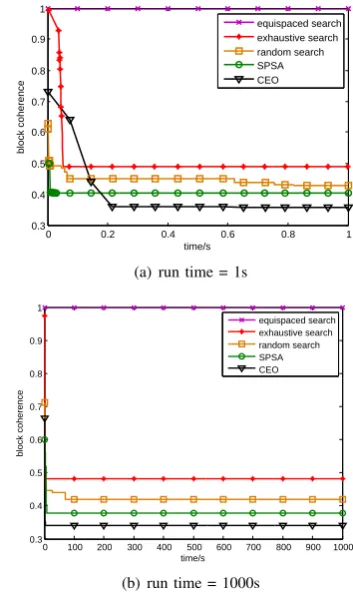
Next, we evaluate the updating process of BC as a function of running time for both of the proposed methods in Fig. 2. Meanwhile, the conventional equispaced search method, exhaustive search method as well as random search method are included for comparison. It is observed in Fig. 2(a) that the SPSA converges much faster than the other methods. In details, it exceeds the best BC performance of random search could achieve in 1 second by using no more than 0.03 second. On
5 10 15 20 25 30 35 40
0.3 0.4 0.5 0.6 0.7 0.8 0.9 1
Iterations
Block coherence
[image:5.595.346.519.54.192.2]CEO Z=50 CEO Z=100 CEO Z=150
Fig. 1. Convergence of the CEO method for different values of z.
0 0.2 0.4 0.6 0.8 1 0.3
0.4 0.5 0.6 0.7 0.8 0.9 1
time/s
block coherence
equispaced search exhaustive search random search SPSA CEO
(a) run time = 1s
0 100 200 300 400 500 600 700 800 900 1000
0.3 0.4 0.5 0.6 0.7 0.8 0.9 1
time/s
block coherence
equispaced search exhaustive search random search SPSA CEO
(b) run time = 1000s
Fig. 2. BC performance comparisons of different pilot design methods.
the other hand, though CEO takes more time for convergence, it outperforms the other method in BC performances within 0.2 second. From Fig. 2(b) where the run time is set to 1000 seconds, we can see that similar performances are achieved for all the evaluated methods. Specifically, both of the proposed methods maintain their advantages over the conventional meth-ods, which confirms the reliable performance of the proposed methods. Moreover, we observe that although the exhaustive search can obtain the optimal pilot pattern in theory, it is unable to find a desirable solution within the given time.
[image:5.595.341.518.225.522.2]0 5 10 15 20 25 30 35 40 10−5
10−4 10−3 10−2 10−1
100
SNR
MSE
[image:6.595.82.247.54.188.2]equispaced pilot pattern exhaustive pilot pattern random pilot pattern SPSA CEO
Fig. 3. MSE performance comparisons of channel estimation for different pilot design schemes.
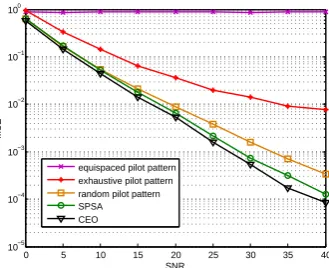
estimation [11]. We observe from Fig. 3 that the pilot pattern obtained from CEO performs slightly better than that of SPSA, while both of the proposed schemes outperform the other conventional schemes. For example, at the MSE of= 10−3, the
SPSA outperforms the conventional schemes by more than 5.1 dB signal noise ratio (SNR) gain while CEO performs at least 6.4 dB better than those schemes. Moreover, it is noticed that there is no benefit using the equispaced pilot pattern for sparse channel estimation although it is proved to be the best choice in traditional channel estimation. This result is also consistent with its bad BC performance in Fig. 2.
V. CONCLUSION
In this paper, we have investigated the pilot allocation for sparse channel estimation in massive MIMO OFDM systems. Based on the BC, we have proposed two pilot design methods for searching the near-optimal pilot pattern off-line. Simulation results have shown that both of the proposed methods are superior to the conventional methods in terms of MSE per-formance. Moreover, it has demonstrated that SPSA converges much faster than the other methods while CEO provides better BC performance and thus MSE performance.
ACKNOWLEDGMENT
The authors would like to thank the support by the “Research Funds for the Central Universities (2014YJS006)” and the “National Natural Science Foundation of China (61201199)”.
REFERENCES
[1] G. Stuber, J. Barry, S. Mclaughlin, Y. Li, M. Ingram, and T. Pratt, “Broadband MIMO-OFDM wireless communications”,Proceeding of the IEEE, vol. 92, no. 2, pp. 271-294, Feb. 2004.
[2] W. Ding, F. Yang, C. Pan, L. Dai, J. Song, “Compressive Sensing Based Channel Estimation for OFDM Systems Under Long Delay Channels”,
IEEE Transactions on Broadcasting, vol. 60, no. 2, pp. 313-321, Jun. 2014.
[3] E. J. Candes and T. Tao, “Near-optimal signal recovery from random projections: universal encoding strategies?”IEEE Transactions on Infor-mation Theory, vol. 52, no. 12, pp. 5406-5425, Dec. 2006.
[4] C. Qi, G. Yue, L. Wu, Y. Huang and N. Arumugam, “Pilot Design Schemes for Sparse Channel Estimation in OFDM Systems”, IEEE Transactions on Vehicular Technology, vol. 64, no. 4, pp. 1493-1505.
[5] C. Qi and L. Wu, “Optimized pilot placement for sparse channel estimation in OFDM systems”,IEEE Signal Processing Letters, vol. 18, no. 12, pp. 749-752, Dec. 2011.
[6] C. Qi and L. Wu, “A Study of Deterministic Pilot Allocation for Sparse Channel Estimation in OFDM Systems”,Communications Letters, IEEE
vol. 16, no. 5, pp. 742-744, May. 2012.
[7] J.C. Chen, C.K. Wen, and P. Ting, “An efficient pilot design scheme for sparse channel estimation in OFDM systems”,Commmunications Letters, IEEEvol. 17, no. 7, pp. 1352-1355, Jul. 2013.
[8] Y. Eldar, P. Kuppinger and H. Bolcskei, “Block-space signals:uncertainty relations and efficient recovery”,IEEE Transactions on Signal Process-ing, vol. 58, no. 6, pp. 3042-3054, Nov. 2010.
[9] J. Spall, “Stochastic optimization and the simultaneous perturbation method”, Simulation Conference Proceedings, vol. 1, pp. 101-109, 1999.
[10] P. T. Boer, D. P. Kroese, S. Mannor and R. Y. Rubinstein, “A Tutorial on the Cross-Entropy Method”, Annals of Operations Research, vol. 134, no. 1, pp. 19-67, Feb. 2005.
[11] Z. Gao, L. Dai, and Z. Wang, “Structured compressive sensing based superimposed pilot design in downlink large-scale MIMO systems”,
Electronics Letters, vol. 50, no. 12, pp. 896-898, Jun. 2014.
[12] J. A. Tropp, “Greed is good: algorithmic results for sparse approxi-mation”,IEEE Transactions on Information Theory, vol. 50, no. 10, pp. 2231-2242, Oct. 2004.
[13] R. Horn, C. Johnson, “Matrix Analysis”, New York, NY:Cambridge Press, 1985.