2017 2nd International Conference on Wireless Communication and Network Engineering (WCNE 2017) ISBN: 978-1-60595-531-5
Single Relay Selection and Power Allocation Based on Energy Efficiency
in Cooperative Cognitive Radio Network
Lu-yong ZHANG, Xuan LI
*and Jin-hua CHEN
School of Information and Communication Engineering, Beijing University of Posts and Telecommunications, Beijing, China
*Corresponding author
Keywords: Cooperative Cognitive Radio Network, Relay selection, Power allocation, Energy efficiency, Residual Energy.
Abstract. In cooperative cognitive network (CCNs), relay selection generally depends on the channel state information (CSI). However, over-reliance on the relay with good channel condition may result in excessive energy consumption and lower network lifetime. Most previous works focused on improving system capacity without considering energy efficiency and residual energy information (REI). In this paper, a joint single relay selection and power allocation scheme based on energy efficiency is proposed. First, we propose a novel single relay selection scheme considering both REI and CSI to balance the energy consumption and performance. Then, we formulate a maximizing energy efficiency convex problem as the optimization model under limited total transmission power of secondary users (SUs) and power constraints to primary users (PUs). According to the convex optimization theory and the Karush-Kuhn-Tucker (KKT) condition, we obtain the optimal power allocation factor and the maximum energy efficiency. It is shown through the simulation that new scheme can dynamically select the appropriate relay and adjust the power allocation. Our scheme can effectively reduce the energy consumption and improves the system lifetime.
Introduction
From the perspective of low spectrum utilization, Cognitive Radio (CR) was proposed by Federal Communications Commission (FCC) as a key technology to achieve dynamic spectrum access and improve spectrum utilization [1]. In underlay mode, unlicensed secondary user (SU) can access to licensed primary user (PU) with interference below a tolerable threshold [2]. This can achieve spectrum reuse and alleviate the tension of spectrum resources. However, the performance is affected by shadow effect and multipath fading problems. Cooperative communication, as a powerful tool to mitigate multiple fading, improves the system channel capacity and quality of service by obtaining cooperative diversity gain. In light of this two promising technologies, leveraging cooperative communication within the context of CR networks has aroused much research interests [3]. The existed research focused on cooperative spectrum sensing. While, research on relay cooperative transmission has also received attention, which can effectively improve data throughput and data rate.
With the promotion of green communication concept and requirement of communication energy saving, more and more attention has been paid to energy efficiency (EE) and power allocation. Relay selection and power allocation is very meaningful in CCNs. A joint scheme is proposed for cooperation transmission in [6], working on the system capacity maximization. This scheme can ensure the improvement in performance while energy consumption increases. In [7], a maximum energy efficiency cooperative strategy is proposed in cooperative communication between PUs and SUs. SUs can decide whether to join into cooperative communications by channel condition and their own energy requirement. However, the EE between SUs is ignored. With the residual energy information (REI) and channel conditions, the relay selection in [8] can dynamically adjust the relay. Inspired by these three literatures, the REI and EE maximization are both considered.
In this paper, we propose a joint single relay selection and transmission power allocation scheme to maximize system energy efficiency in CCNs. Unlike optimal relay, we introduce REI to achieve the trade-off between performance and energy consumption. Relay selection is dynamically determined by channel conditions and available residual energy. Both direct and relay transmission are considered. We propose the optimal power allocation algorithm according to relay selection results. The optimal value of the utility function is obtained by the convex optimization theory under power limitation.
The paper is organized as follows. In section II, the system model description is introduces. We establish the EE optimization problem. Section III gives the relay selection and power allocation scheme. Section IV shows simulation result and analysis. Finally, section V concludes this paper.
Cognitive Cooperative Networks Model
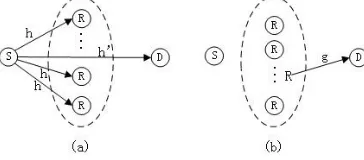
In this paper, secondary network is a distributed system access to CCN in underlay paradigm. SUs are allowed if the interference to PUs is below a given threshold. In secondary system, we consider an AF cooperative communication network with one SU acting as sourceS, one SU acting as destinationD, and other N SUs Ri(1≤ ≤i N) serving as cooperative partners as shown in Figure 1.
We assume Rayleigh fading channels with , ,h h g′ respectively denoting the instantaneous channel gain of node S to D link, S.to. Ri link and Ri.to. D link in Figure 1. In the first phase, node S
[image:2.612.214.396.502.582.2]broadcasts message to relays and destination. In the secondary phase, the selected relay amplifies and forwards its received message to destination D. Here we assume that the time slots of the two phases are equal in length in Figure 1.
Figure 1. Cooperative transmission with one source, one relay and one destination.
In the direct link from S to D, the received signal and received SNR are presented as follows, respectively.
sd
y = P h xs ′ +u′ (1)
2 2
| | /
sd s
SNR =P h′ σ (2) Where Ps is transmission power at the source, x is the transmitted signal, u′ is white Gaussian
In the relay link from Ri to D, the received signal at Ri and D, the SNR received at destination
are presented as follows, respectively.
sr s
y = P hx+u (3)
rd sr
y = δgy +v (4)
2 2
2 2 2 2
| | | | ( | | | | )
s r r
s r
P P h g SNR
P h P g σ σ
=
+ +
(5)
Where Pr is the transmission power at relay Ri,u and
υ
are white Gaussian noise with variance 2σ , δ is the amplification gain of relay power amplifier, and δ =Pr / (Ps| |h 2+σ2).
Assuming that the destination node uses a coherent receiver, all channel state information (CSI) is known, and the relay network implements global synchronization. The destination node can apply the most merged method to handle the signal.
According to the two link to destination, SNR of the received signal at D can be given by
sd r
SNR=SNR +SNR . (6) The throughput of the system is
2
log (1 ) / 2
R=W +SNR . (7) Where W is a fixed channel bandwidth, 1 / 2 refers to D only in the second phase to receive data. Energy consumption and system performance are considered when measuring energy efficiency. However, because the system performance is related to many elements, it is difficult to define standards. Here we are using the widely accepted definition. The energy efficiency equivalent to the transmission rate per unit power consumption, ratio of throughput and power consumption [9] [10].
2
log (1 )
c s s r r
W SNR
R
P P P P
η
ε ε
+
= =
+ +
(8)
Where P is total power consumption without considering the power consumption of the baseband processing circuit, and P=(Pc+εsPs+εrPr) / 2 , where 1 /εs,1/εr are power amplifier energy
conversion efficiency of source S and relay Rs , 1 / 2 indicates that the source and relay only send data and consume power within half a frame, Pc is circuit power.
Scheme of Single Relay Selection and Power Allocation in CCNs
Relay Selection Algorithm based on REI and CSI
Our assumption is that destination has full knowledge of all channels and can decide which relay is best for transmission. The author proposed the optimal single relay selection (SRS) by selecting the maximum received SNR in [6]. It did not consider residual energy information (REI) and relay energy consumption. The system always chooses the relay with best channel condition for cooperative transmission. This scheme is likely to cause excessive energy use. Based on the above consideration, a single relay selection based on REI (SRS-REI) is proposed to determine which relay is selected.
Step1: we make a judgment on direct link state. When the channel state is good, the destination can correctly receive the information in the first phase. Node D send a confirmation signal, telling the relay not need to forward the information. Otherwise, we need to make relay selection scheme.
Step2: initializing residual energy of relay node as Er, initial energy as
0
E , minimum residual
energy threshold as th
Er and Candidate relay set U R( ) satisfies
( ) { i| i th}, 1, 2, ,
U R = R Er >Er i= N. If Eri is lower than the threshold Erth, we removed Ri from the set U R( ).
Step3: we can get final selected relay with maximum SNR byRselected ={ | max(R SNRr),R⊂D R( )}. After each relay cooperative transmission, we get the power allocation factor ϕ. The residual energy of Rselected can be updated by
0 (1 ) 0 selected
Er =E − −ϕ P T. (9)
Where T is the second phase time. When all relays’ residual energy is less than Erth, U R( ) is empty set and the cooperative transmission process is completed.
Cooperative Power Allocation Algorithm
According to Eq. 8, we can see the energy efficiency is a function of channel gain, cooperative relay and the transmit power. Due to the total power constraint, we denote the power allocation factor
0
/
s
P P
ϕ = . Also, we assume εs =εr =ε. The purpose of power allocation is to maximize the system
energy efficiency by dynamically allocating transmit power of the source and relay. When the spectrum is used by PUs, the maximum transmission power of the source S and relay R is limited to
th s
P and th r
P respectively in the underlay paradigm. The total power for secondary users is
constrained toP0.
According to the previous discussion, power allocation can be formulated as the optimization problem as follows.
2
0
log (1 ) max
c
W SNR
P P
ϕ η ε
+ =
+ (10)
. . 0 1
s t ≤ϕ≤ (10-a)
0 th s
P P
ϕ ≤ (10-b)
0
(1 ) th r
P P
ϕ
− ≤ (10-c)
We can know from Eq. 10 that optimization function and constraint conditions make a convex problem. We assume that W, ,ε P Pc, 0 are constants. Then we can convert the problem to maximize
SNR:
2 2
2 2 2 2
2 2 0 0 2 0 0 |h| |g| ( | |
| | (1 )
max
(1 )| | )
P h P
S
P h P g
ϕ
ϕ ϕ ϕ
σ ϕ ϕ σ σ
′ −
=
+ −
+
+ . (11)
Using the Lagrange multiplier method, we set µ≥0,υ≥0,α ≥0,β ≥0 and obtain as follows:
( , , , , ) ( ) ( 1)
L ϕ µ υ α β = − +S α −ϕ +β ϕ−
0
( th)
s
P P
µ ϕ
+ − ((1 ) 0 )
th r
v ϕ P P
+ − − . (12)
( , , , , ) 0
( , , , , ) 0
( , , , , ) 0
( , , , , ) 0
( , , , , ) 0 L L L L L ϕ µ υ α β
ϕ µ υ α β
µ ϕ µ υ α β
υ ϕ µ υ α β
α ϕ µ υ α β
β ϕ µ υ α β
∇ = ∇ = ∇ = ∇ = ∇ =
. (13)
According to Eq. 13, we can get the power allocation factor ϕ and maxS
ϕ
.
maxS C1 C2 (1 ) / ( C3)
ϕ = ϕ+ ϕ −ϕ ϕ+
(14)
Where
2 2 2 2 2
0 0 0
2 2 2 2 2
0
| | | | | | | |
1 , 2 , 3
| | | | (| | | | )
P h P h g P g
C C C
h g P h g
σ σ ′ + = = = − − .
Then according to Eq. 8, the maximum energy efficiency is obtained by
2
0
log (1 max ) max
c
W S
P P
ϕ
ϕ η ε
+ =
+
. (15)
Result and Discussion
In this chapter, we simulate the relay cooperative communication process in the secondary network on MATLAB. The simulation result is presented to investigate the performance of relay selection and power allocation. In simulation, we set circuit power Pc =5Wand total transmission power P0 =5W .
The transmission power threshold of source S and relay R is set as th th 4
s r
P =P = W . The noise power and bandwidth are respectively normalized to be 2 1
σ = and W =1. Meanwhile, we set energy
conversion efficiency of power amplifier 1 /ε =0.38. The initial energy of each relay is set E0 =20.
The normalized residual energy threshold is set th 0.3
Er = . For each cooperative transmission process, we select one relay to assist to transmit with an appropriate power. Suppose that there are 10 relays between S and D. Each transmission link channel in this process is Rayleigh fading channel.
Performance and Analysis of Relay Selection
Figure 2 show the residual energy and SNR. According to the relay selection given in Chapter III, the relay R6 is selected instead of the optimal relay
8
R . This is because the residual energy
8
Er has been
below the threshold Erth.
8
R is no longer in candidate set U R( ). Meanwhile, we can see the residual
energy of the SRS-REI algorithm fluctuate smaller than SRS algorithm. By prejudgment of remaining energy, our scheme does not excessively use the same relay channel.
We assume parameter M as average relay number with residual energy higher than threshold th
Er . As shown in Table 1, the normalized average relay residual energy Er and the average relay number
M are much higher than the original algorithm when all the relays’ residual energy is less than Erth. That is to say, there are more relays available in the candidate set U R( ).
Table 1. Relay energy consumption under different relays schemes
Function SRS SRS-REI
normalized Er 0.08644 0.426215
relay number M (Er≥Erth) 1.9300 7.6900
energy efficiency. This is because the SRS-REI algorithm proposed in this paper is more likely to choose the relay with relatively more residual energy rather than the optimal relay, in exchange for the fairness of relay selection, stable cooperative communications and longer network lifetime.
[image:6.612.337.508.117.250.2]Figure 2. Residual energy of SRS and SRS-REI with different relay.
Figure 3. Energy efficiency with different relay selection schemes.
Results and Analysis of Cooperative Power Allocation Scheme
The result shows that the power allocation factor =0.6447ϕ according to Eq. 13. Each relay’s EE is different as power allocation factor changes as shown in Figure 4. When =0.66ϕ , EE of relay
6
R reached the maximum value. Therefore, the simulation results are consistent with the theoretical
calculation.
In Figure 4, optimal power allocation (OPA) and fixed power allocation (EPA) scheme are compared after determining the relay node. We allocate power dynamically to each relay node using corresponding optimal power allocation factor. Meanwhile, we set Ps =Pr, namely using equal power
allocation as contrast. The optimal power allocation achieves a high energy efficiency over equal power allocation. The energy efficiency of relay R6 in Fig. 5 and Figure 4 is identical. In particular,
under the adverse channel conditions of relay R R1, 4,R9 as shown in Figure 2, the corresponding energy efficiency is substantially improved in Fig. 5.
Besides, even though the energy efficiency of R1 and
8
R are higher than
6
R in Fig. 5, we still
select R6 because the residual energy
1
Er and
8
Er are both already below the threshold Erth. This
result is consistent withthe previous analysis in relay selection schemes.
[image:6.612.95.268.529.669.2] [image:6.612.342.509.533.664.2]Conclusion
This paper has addressed the joint relay selection and energy allocation in CCNs. In the relay selection, we take into account the residual energy and channel condition. The relay with maximum SNR is selected among the candidate relay whose residual energy is higher than the threshold. In power allocation scheme, we use the convex optimization theory and the KKT condition to obtain the optimal power allocation factor and the maximum energy efficiency under limited power conditions. The simulation result shows that our scheme can dynamically select the appropriate relay and adjust transmission power, which effectively reduces the energy consumption, improves the system lifetime.
Acknowledgements
The research is under the support of National Natural Science Foundation of China (61379016).
References
[1] A. Baker, S. Ghosh, A. Kumar and M. Bayoumi, "Notice of Violation of IEEE Publication Principles LDPC decoder: A cognitive radio perspective for next generation (XG) communication," in IEEE Circuits and Systems Magazine, vol. 7, no. 3, pp. 24-37, Third Quarter 2007.
[2] A. Goldsmith, S. A. Jafar, I. Maric and S. Srinivasa, "Breaking Spectrum Gridlock With Cognitive Radios: An Information Theoretic Perspective," in Proceedings of the IEEE, vol. 97, no. 5, pp. 894-914, May 2009.
[3] S. S. Kalamkar, J. P. Jeyaraj, A. Banerjee and K. Rajawat, "Resource Allocation and Fairness in Wireless Powered Cooperative Cognitive Radio Networks," in IEEE Transactions on Communications, vol. 64, no. 8, pp. 3246-3261, Aug. 2016. Yindi Jing, and Hamid Jafarkhani.
[4] Y. Jing and H. Jafarkhani, "Single and multiple relay selection schemes and their achievable diversity orders," in IEEE Transactions on Wireless Communications, vol. 8, no. 3, pp. 1414-1423, March 2009.
[5] Binh Van Nguyen and Kiseon Kim, "Single relay selection for secure communication in a cooperative system with multiple full-duplex decode-and-forward relays," 2015 IEEE International Workshop on Information Forensics and Security (WIFS), Rome, 2015, pp. 1-6.
[6] Z. Ma, S. Ban, W. Yan, Y. Li and L. Liu, "Optimal Relay Selection and Cooperative Power Allocation in Cognitive Radio Networks," 2015 IEEE 12th Intl Conf on Ubiquitous Intelligence and Computing and 2015 IEEE 12th Intl Conf on Autonomic and Trusted Computing and 2015 IEEE 15th Intl Conf on Scalable Computing and Communications and Its Associated Workshops (UIC-ATC-ScalCom), Beijing, 2015, pp. 839-845.
[7] J. Liu, H. Ding, Y. Cai, H. Yue, Y. Fang and S. Chen, "An Energy-Efficient Strategy for Secondary Users in Cooperative Cognitive Radio Networks for Green Communications," in IEEE Journal on Selected Areas in Communications, vol. 34, no. 12, pp. 3195-3207, Dec. 2016.
[8] C. Luo, F. R. Yu, H. Ji and V. C. M. Leung, "Distributed Relay Selection and Power Control in Cognitive Radio Networks with Cooperative Transmission," 2010 IEEE International Conference on Communications, Cape Town, 2010, pp. 1-5.
[9] Miao, Guowang, N. Himayat, and G. Y. Li. "Energy-efficient link adaptation in frequency-selective channels." IEEE Transactions on Communications 58.2(2010):545-554.