A 32-year Perspective on the Origin
of Wind Energy in a warming Climate
The Harvard community has made this
article openly available.
Please share
how
this access benefits you. Your story matters
Citation Huang, Junling, and Michael B McElroy. 2015. A 32-year perspective on the origin of wind energy in a warming climate, Renewable Energy 77, no. May: 482-492.
Published Version http://www.sciencedirect.com/science/article/pii/ S0960148114008726
Citable link http://nrs.harvard.edu/urn-3:HUL.InstRepos:13919173
Terms of Use This article was downloaded from Harvard University’s DASH repository, and is made available under the terms and conditions applicable to Other Posted Material, as set forth at http://
1
A 32-year Perspective on the Origin of Wind Energy in a warming Climate
1
Junling Huang a, b*, Michael B. McElroya
2
a
School of Engineering and Applied Sciences, Harvard University, Cambridge, MA 02138, USA
3
b John F.
Kennedy School of Government, Harvard University, Cambridge, MA 02138, USA
4
*Corresponding author
5
Tel.: 617-955-6282
6
Email: [email protected]
7
2
Abstract
20
Based on assimilated meteorological data for the period January 1979 to December 2010, the
21
origin of wind energy is investigated from both mechanical and thermodynamic perspectives,
22
with special focus on the spatial distribution of sources, historical long term variations and the
23
efficiency for kinetic energy production. The dry air component of the atmosphere acts as a
24
thermal engine, absorbing heat at higher temperatures, approximately , releasing heat at
25
lower temperatures, approximately . The process is responsible for production of wind
26
kinetic energy at a rate of sustaining thus the circulation of the atmosphere against
27
frictional dissipation. The results indicate an upward trend in kinetic energy production over the
28
past 32 years, indicating that wind energy resources may be varying in the current warming
29
climate. This analysis provides an analytical framework that can be adopted for future studies
30
addressing the ultimate wind energy potential and the possible perturbations to the atmospheric
31
circulation that could arise as a result of significant exploitation of wind energy.
32 33
Keywords: origin of wind energy; warming climate; thermal engine; interannual variability
3
1. Introduction
43
Global installed wind capacity reached an unprecedented level of more than at the end
44
of 2013, of which approximately were added in 2013, the highest level recorded to date.
45
Wind power contributes close to 4 % to current total global electricity demand. In total, 103
46
countries are using wind power on a commercial basis. Based on current growth rates, the World
47
Wind Energy Association estimates that global wind capacity could increase to as much as
48
by 2020 [1].
49
A number of studies have sought to assess the ultimate potential for wind-generated electricity
50
assuming that the deployment of turbines should not influence the potential source [2-8]. Using
51
data from surface meteorological stations, Archer and Jacobson [4] concluded that 20 % of the
52
global total wind power potential could account annually for as much as of electricity,
53
equivalent to 7 times total current global consumption. They restricted their attention to power
54
that could be generated using a network of turbines tapping wind resources from
55
regions with annually averaged wind speeds in excess of at an elevation of 80 m. Using
56
assimilated meteorological data, Lu et al. [5] argued that a network of land-based
57
turbines restricted to non-forested, ice-free, non-urban areas operating at as little as 20 % of their
58
rated capacity could supply more than 40 times current worldwide demand for electricity, more
59
than 5 times total global use of energy in all forms.
60
Numerous groups have argued that large scale deployment of wind farms could potentially
61
influence the circulation of the atmosphere, altering consequently the global wind energy
62
resources [9-16]. For example, Adams and Keith [16] tried to quantify the limitation of wind
63
energy extraction using a mesoscale model and compared their results with other studies using
4
global atmospheric models. The energetics of the entire atmosphere is different from the
65
energetics of the mesoscale region considered by Adams and Keith [16]. It is essential to
66
understand how kinetic energy of wind is created in the entire atmosphere.
67
Wind energy is essentially the kinetic energy held by the center-of-mass movement of a volume
68
element of air. The movement of the air is driven primarily by the spatial gradient in heat input.
69
Diabatic heating occurs mainly in the warm tropics, with diabatic cooling dominating at
70
relatively cold mid and high latitudes. In this sense, following Carnot, the dry air component of
71
the atmosphere acts as a thermal engine, converting heat to kinetic energy to sustain the general
72
circulation against the force of friction. The standard approach to investigate the energetics of the
73
atmosphere was introduced by Lorenz in 1955 [17]. A number of groups have analyzed the
74
energetics of the atmosphere based on the Lorenz Energy Cycle [18-22]. However, the
75
geographic distribution of kinetic energy production and the temporal variability have not as yet
76
been quantified.
77
This study investigates the origin of wind energy, with a specific focus on the spatial distribution
78
of sources, historical long term variations and the efficiency for kinetic energy production. From
79
a mechanical perspective, kinetic energy can be produced or destroyed only by real forces [23].
80
In the case of an air parcel in the atmosphere, the real forces are: gravity, the pressure gradient
81
force, and friction. From a thermodynamic perspective, the creation of wind energy in the
82
atmosphere involves absorption of heat at high temperature and release at low temperature,
83
following the operational principle of a thermal engine. The paper also analyzes the
84
thermodynamic processes within the atmosphere, quantifying the key thermodynamic variables
85
including the net rate of heat absorption and the efficiency for kinetic energy production. The
86
analysis provides a historical perspective on the production of kinetic energy in the atmosphere
5
and an analytical framework for future studies exploring the ultimate potential for wind energy
88
and potential for significant change in the circulation of the atmosphere as a consequence of
89
future large scale turbine deployment.
90
2. MATERIALS
91
The study is based on meteorological data from the MERRA compilation covering the period
92
January 1979 to December 2010. Kinetic energy of wind, wind speeds, air temperatures,
93
geopotential heights and surface roughness were obtained on the basis of retrospective analysis
94
of global meteorological data using Version 5.2.0 of the GEOS-5 DAS. We use the standard
3-95
hourly outputs of the free atmosphere conditions and the standard hourly outputs of the boundary
96
layer conditions [24]. The multivariate ENSO index is from the National Oceanic and
97
Atmospheric Administration (available at: http://www.esrl.noaa.gov/psd/enso/mei/).
98
3. Atmospheric kinetic energy
99
The kinetic energy corresponding to unit mass of the atmosphere is given by where is
100
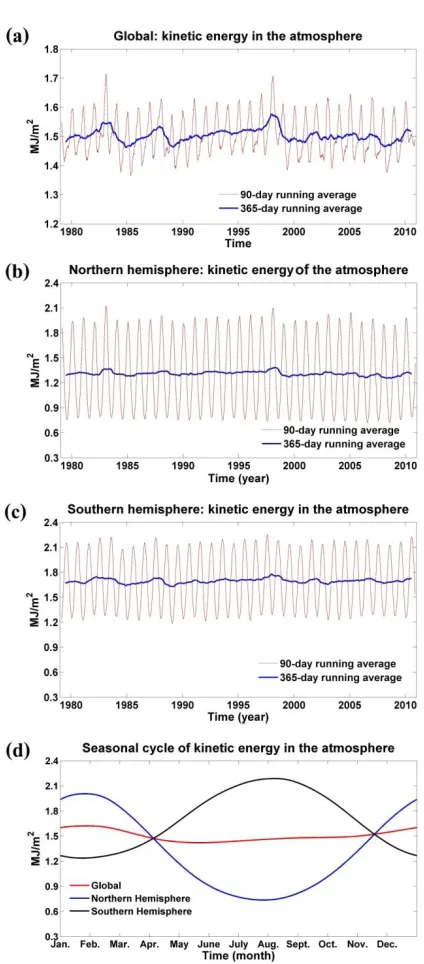
the wind speed. The total and hemispheric atmospheric kinetic energy stocks may be obtained by
101
integrating over the appropriate spatial domains. Composite results for monthly mean values and
102
for the long-term variation of global kinetic energy are shown in Fig. 1. The inter-annual
103
variation of the total kinetic energy stock is associated with the changing phases of the El Ni o -
104
Southern Oscillation (ENSO) cycle (Fig. 1a and Fig. 2). During the warm El Nino phase (notably
105
years 1983, 1987, 1997 and 2010), elevated sea surface temperatures (SSTs) result in an increase
106
in the kinetic energy stock; during the cold phase La Nina phase (notably years 1985, 1989, 1999
107
and 2008), colder SSTs contribute to a decrease. The global kinetic energy stock averaged
108
approximately over the past 32 years, in the Northern Hemisphere
109
with in the Southern Hemisphere.
6
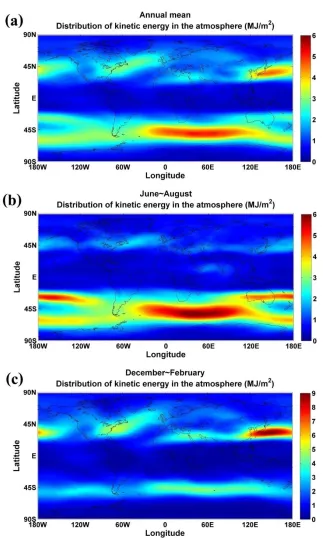
The spatial distributions of the annual mean, June - August, and December - February kinetic energy
111
budgets are shown in Fig. 3. Clearly evident is the influence of the dominant storm tracks at
mid-112
latitude, and the steady components of the subtropical and polar jet streams. There are two
113
distinct peaks in the Northern Hemispheric kinetic energy stock east of Japan and east of the
114
North American continent, with a more continuous belt of high kinetic energy located between
115
30 oS and 60 oS in the Southern Hemisphere. As discussed by Huang et al. [25], the boundary
116
layer wind, for example the wind at 100 m, is controlled by conditions in the free atmosphere,
117
perturbed by fast varying turbulence in the boundary layer. Strong winds in the free atmosphere
118
generally lead to strong winds near the surface, and consequently to high instantaneous values of
119
the capacity factors for wind turbines. The spatial distributions in Fig. 3 reflect the geographic
120
distribution and seasonality of wind resources as reported in the earlier studies [5, 26, 27].
121
4. Production of kinetic energy
122
For an air parcel of unit mass, production of kinetic energy may be written as:
123
(1)
124
where is the kinetic energy corresponding to unit mass, is the gravitational acceleration, is
125
the vertical velocity, is the velocity, is the air density, is the pressure and
is the frictional
126
force.
127
In calculating the kinetic energy production rate, it is convenient to consider the rate for
128
production of kinetic energy in a fixed unit of volume. Re-organizing equation (1), we have:
129
(2)
130
The left hand side of this equation denotes the rate per unit volume for production of kinetic
7
energy. The right hand side defines contributions to the production rate associated with the
132
convergence of the kinetic energy flux ( ), and the work carried out or consumed by
133
the pressure gradient force ( ), friction ( ) and gravity ( ).
134
The atmosphere is in quasi-hydrostatic balance: gravity is balanced approximately by the vertical
135
pressure gradient force. In this case, equation (2) may be recast in the simpler form:
136
(3)
137
where is the horizontal component of , and is the horizontal gradient of the pressure
138
force. Production of kinetic energy in the atmosphere, , can be estimated as
[17-139
22].
140
Fig. 4 illustrates the distribution of kinetic energy production, , averaged over the past 32 years
141
in units of . The tropical and subtropical region from 30 oS to 30 oN, dominated by
142
the thermally direct Hadley circulation, is responsible for a net source of kinetic energy as
143
indicated in Fig. 4a. The most prominent sources are located in the mid-latitude oceanic regions
144
below the pressure level, notably in the Southern Hemisphere, as depicted in Fig. 4c.
145
Production of kinetic energy in these regions is associated with the intense development of
146
eddies that stir the atmosphere over the ocean, carrying cold air equatorward and warm air
147
poleward, resulting consequently in cross-isobaric flow. The topographic forcing of the Tibetan
148
plateau has a noticeable impact on the production of kinetic energy in the upper region of the
149
atmosphere, from , as indicated in Fig. 4b.
150
The global and hemispheric rates for production of kinetic energy are obtained by integrating the
151
production term, , over the entire atmosphere or over each hemisphere separately. The global
152
kinetic energy production rate averaged over the past 3 decades is estimated at , with
8
a upward trend since the late 1990s (Fig. 5a). The average rate for production in the Northern
154
Hemisphere is , for the Southern Hemisphere. Hemispheric production
155
rates indicate strong seasonality (Fig. 5c), reaching maximum power output during local winter,
156
with minima in local summer.
157
5. Dissipation
158
Motions of the atmosphere against friction convert kinetic to internal energy. This process is
159
thermally irreversible, resulting in an increase in entropy. Approximately half of the frictional
160
dissipation takes place within the lowest kilometer of the atmosphere, a result of turbulent
161
motions generated mechanically by the flow over the underlying surface. The other half takes
162
place higher in the atmosphere where small-scale disturbances are generated as a result of
163
convection or shear instability of the vertical wind [28]. In the long run, the total kinetic energy
164
in the atmosphere, , is determined by a balance between production, , and dissipation by
165
friction, . The dissipation term may be quantified according to:
166
(4)
167
The long-term variation and seasonal cycle of are plotted in Fig. 6. Maximum dissipation
168
occurs in February, corresponding to the peak in Northern Hemisphere kinetic energy reflecting
169
the importance of surface roughness associated with Northern Hemisphere continental areas in
170
dissipating kinetic energy. The entropy generation associated with dissipation can be
171
approximated as
, where is the global average surface atmosphere (about ).
172
The fate of kinetic energy in the atmosphere from a mechanical perspective is summarized in Fig.
173
7. The residence time of kinetic energy, , calculated as , is 6.9 days.
174
6. The thermodynamics of atmospheric motions
9
According to the first law of thermodynamics:
176
(5)
177
where defines the rate per unit mass of dry air for diabatic heating, is the specific heat
178
of the air, is temperature, is the vertical component of wind velocity in an isobaric
179
system and [29].
180
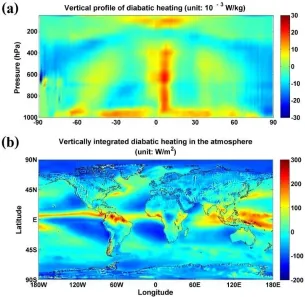
The annual mean spatial distribution of diabatic heating based on equation (5) is displayed in
181
Fig. 8. The results presented here are consistent with earlier studies [30, 31]. An important
182
fraction of the incoming sunlight reaches the surface which is heated accordingly. This heat finds
183
its way back into the atmosphere as a result of turbulent transport through the atmospheric
184
boundary layer. Most of the solar energy absorbed by the ocean is used to evaporate water. Water
185
vapor in the atmosphere acts as a reservoir for storage of heat that can be released later. As the air
186
ascends, it cools. When it becomes saturated, water vapor condenses with consequent release of
187
latent heat. Heating is dominated in the tropical atmosphere by release of latent heat. Separate
188
bands of relatively deep heating are observed at mid-latitudes where active weather systems
189
result in enhanced precipitation and release of latent heat.
190
The atmospheric system consists of dry air and water. Its total entropy and total static
191
energy , according to thermodynamics, can be expressed as: and
192
, where and represent the associated entropy and static energy of 193
the dry air component and and represent the associated entropy and static energy of
194
the water component. The focus in this study is on how atmospheric motion of the dry air is
195
maintained by diabatic heating. Condensation and evaporation of water are treated accordingly
196
as external to the dry air component [32], namely as an exchange of entropy and energy with the
10
dry air.
198
Regions of diabatic cooling, dominated by long wave radiation to space, occupy much of the
199
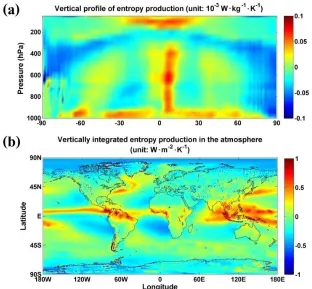
middle and upper troposphere. The rate of change of entropy, s, per unit mass is given by
200
. The spatial distribution of entropy generation is similar to the spatial pattern of , as 201
illustrated in Fig. 9.
202
Diabatic heating includes contributions from radiative heating and cooling, release of latent
203
heat associated with phase transitions, heating by conduction of sensible heat, and heating
204
by frictional dissipation:
205
(6)
206
where is the density of air, is the latent heat of condensation, and are the rates of
207
condensation and evaporation per unit mass, is the net radiative flux, is the sensible 208
heat flux due to conduction, is the wind tress tensor, and is the wind velocity.
209
The diabatic heating term can be written as , where accounts for
210
radiative heating (solar and infrared), latent heating and heating due to conduction:
211
(7)
212
The second component, , is associated with frictional dissipation:
213
(8)
214
By separating from , we may consider as the external heating responsible, from a
215
thermodynamic perspective, for the motion of the dry air. In the long run, the globally
216
integrated values for must be balanced by global production of kinetic energy, equal
217
therefore to . Consequently, we may rewrite the generation of entropy as:
11
(9)
219
where , and is the temperature of the environment in the region
220
where heat is either absorbed or released [33, 34].
221
In the long run, the entropy of the entire atmosphere must remain constant. Thus, with
222
the long term mean indicated by " ":
223
(10)
224
or
225
(11)
226
Since and are always positive, the second term representing the entropy
227
generation associated with dissipation is greater than zero, which implies that
228
. It follows that the and fields must be positively correlated. In 229
other words, the general circulation can be maintained against the disordering impact of
230
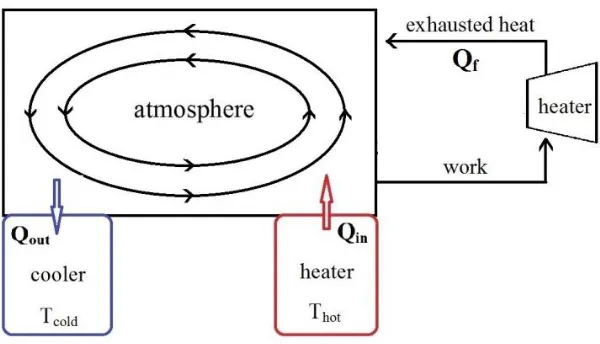
friction only if the heating occurs in warmer regions of the atmosphere with cooling in
231
colder regions. Fig. 10 summarizes the creation and dissipation of kinetic energy in the
232
atmosphere from a thermodynamic perspective.
233
The global heat source in Fig. 10 represents the heat that the atmosphere absorbs at the 234
higher temperature, , environment in order to do mechanical work. It is defined as
235
. The global heat sink in Fig. 10 represents the heat that the atmosphere 236
releases into the lower temperature, , environment and is defined by
237
12
The mechanical work produced by the atmosphere is dissipated by friction and converted to heat
239
that is released back into the atmosphere. This process is thermally equivalent to using the
240
mechanical work to turn on a heater and return the exhausted heat back to the atmosphere, as
241
depicted in Fig. 10. However, it is difficult to distinguish between and , and the absolute
242
value of the global integral of is negligible compared to the global integral for and .
243
Thus, the global heat source can be approximated as: with
244
approximated as: .
245
The value for the global heat source averaged over the past three decades is estimated
246
at . The average kinetic energy production rate over the same period is calculated as
247
. It follows that the average efficiency for kinetic energy production is equal to
248
approximately .
249
The effective temperature at which heat is absorbed can be calculated as: 250
(12) 251
or approximated as:
252
(13) 253
where
, with and representing the starting and ending times for the 254
integration.In the long run, the entropy of the entire atmosphere is required to remain 255
constant. Equation (10) can be recast as:
256
(14)
257
where
represents the entropy generation due to dissipation [34]. The effective
13
temperature at which heat is released can be estimated accordingly.
259
The schematic illustration of the dry air component of the atmosphere as a thermal engine is
260
summarized in Fig. 11, with values included here representing averages for the past 32 years.
261
The dry air component of the atmosphere acts as a thermal engine, absorbing heat at a
262
temperature of approximately , releasing heat at a temperature of approximately .
263
The process produces kinetic energy at a rate of sustaining thus the circulation of the
264
atmosphere against friction.
265
7. Discussion and summary
266
The study started with a quantification of the total kinetic energy stock of the atmosphere and
267
subsequently investigated how kinetic energy is generated and dissipated from mechanical and
268
thermodynamic perspectives.
269
The total kinetic energy stock of the atmosphere displays significant inter-annual variability, as
270
indicated in Fig. 1 and Fig. 2, with the changing phases of the ENSO cycle playing an important
271
role. This inter-annual variation reflects the fact that the wind energy potential for a particular
272
location can fluctuate on a long-term basis, under the influences of long-term atmospheric
273
oscillations which can alter the circulation of the atmosphere including the distribution of kinetic
274
energy.
275
To illustrate the inter-annual variation of wind energy potentials, we select two locations, one in
276
Texas (34.5 oN, 101.3 oW) and the other in North Dakota (47 oN, 101.3 oW), as indicated in Fig
277
12a. In calculating the potential electricity generated from wind, we chose to use power curves
278
and technical parameters for the GE 2.5 MW turbines (rated wind speed 12.0 m/s, cut-in wind
279
speed 3.5 m/s, and cut-out speed 25.0 m/s). The power curve of the wind turbine defines the
14
variation of power output as a function of wind speed. The hourly wind speeds at 100 m are
281
extrapolated from winds at 50 m according to the relation:
, where V100
282
and V50 indicate hourly values for the wind speed at 100 m and 50 m respectively, Z100 and Z50 283
define the elevation of the turbine hub (100 m) and the reference 50 m altitude, and Z0 defines 284
the surface roughness length.
285
The capacity factor (CF) values in Fig. 12b, at a particular time , are calculated as:
286
(15) 287
where denotes the power actually realized, and refers to the power that could have
288
been realized had conditions permitted the turbine to operate at its name plate capacity. The
289
seasonality of wind energy potentials, represent by CF values, have been removed due to the
290
averaging period defined in equation (15): averaging from to .
291
CF values of the wind farms in Texas and North Dakota display significant interanual variation.
292
The ups and downs of CF values in Fig 12b are the embodiments of the long-term atmospheric
293
oscillations. Modern wind turbines are designed to work with an anticipated lifespan of 20 years.
294
Wind energy potentials, as exemplified by the Texas and North Dakota cases, can vary on a
year-295
to-year basis with a large amplitude over a 20 years period. Predictions of wind power for the
296
next 20 years, or at least limits on its possible variation, will pose an important challenge for
297
prospective investors in wind power.
298
The kinetic energy of wind in the atmosphere is constantly dissipated by friction. The residence
299
time of kinetic energy, , is estimated at 6.9 days. The dry air component of the atmosphere
300
generates kinetic energy as a thermal engine to sustain the general circulation of the atmosphere
15
against frictional dissipation. Key thermodynamic properties were quantified, including the
302
kinetic energy production rate, , the heat absorption rate, , the effective temperature at
303
which heat is absorbed, , and the effective temperature at which heat is released, .
304
The calculations of these key properties are based on the assimilated meteorological data from
305
the MERRA compilation. Data assimilation is the process of incorporating historical
306
observations of the atmosphere into a numerical physical model, and produces the most reliable
307
estimate of the past meteorological conditions. However, some uncertainties with the final
308
outputs, such as wind speed data, cannot be completely eliminated.
309
The kinetic energy production rate, , is calculated from a mechanical perspective using wind
310
speed data and pressure gradient data. Wind speed data and pressure data are accurately obtained
311
in the assimilation process [24]. Thus, the kinetic energy production quantified here is reliable,
312
and the results obtained are consistent with other studies [18-22]. The quantification of other
313
variables, notably diabatic heating and effective temperatures, involves parameters such as the
314
vertical velocity of the air with relatively large uncertainties [24]. Absolute values of these
315
thermodynamic properties are subject to relatively large uncertainty, depending as they do on the
316
accuracy of the input data, the MERRA analysis in the case. It is not possible to place error bars
317
on the values derived here for these parameters.
318
The globally averaged combined land and ocean surface temperature data indicate a warming of
319
0.85 K, over the period 1880 to 2012 [35]. A number of studies argued that the warming climate
320
over the past decades has influenced the wind resource potential [36-44]. The upward trend in
321
kinetic energy production rate obtained hereconfirms the fact that thethermodynamic conditions
322
of the atmosphere have undergone a significant change over the past 32 years. A key question is
16
whether the conclusions reached in the study may be conditioned by the use of a specific data
324
base. Other datasets including NCEP-1, NCEP-2, ERA-40 and JRA-25 should be employed in
325
future to compare with results from the present study. Regarding the future warming climate,
326
according to the IPCC 2014 report [35], the change in global surface temperature by the end of
327
the 21st century is likely to exceed 1.5°C relative to the average from year 1850 to 1900 under
328
most future greenhouse emission scenarios. It is essential to investigate how the atmosphere, as a
329
thermal engine, will adjust under the different scenarios, altering thus the distributions and values
330
of wind energy resources.
331
A number of studies have suggested that large scale deployment of wind farms could potentially
332
influence the circulation of the atmosphere [9, 11-16, 45-49]. With a simple parameterization of
333
turbine operations, Miller et al. [46] performed numerical experiments and found that a
334
maximum of of electricity could be generated. Marvel et al. [47] extended Miller's work
335
by parameterizing the turbines as sinks for momentum and concluded that wind turbines placed
336
at the Earth’s surface could extract kinetic energy at a rate of at least , whereas
high-337
altitude wind turbines could extract more than . With a different global model and
338
parameterization approach, Jacobson and Archer [48] argued that as the number of wind turbines
339
increases over large geographic regions, power extraction would first increase linearly, then
340
converge to a saturation limit, with a saturation potential in excess of at 100 m globally,
341
at 10 km. There is a notable discrepancy between these various estimates. Adams and
342
Keith [16] addressed the question using a mesoscale model. They concluded that wind power
343
production would be limited to about 1 W/m2 at wind farm scales larger than about 100 km2 and
344
that the mesoscale model results are quantitatively consistent with results from global models
345
that simulated the climate response to much larger wind power capacities. However, as noted
17
earlier, the energetics of the entire atmosphere is different from the energetics of the mesoscale
347
region.
348
The quantity of wind energy that can be extracted from the atmosphere to generate electricity
349
depends ultimately on the rate at which kinetic energy is produced, not on the quantity of kinetic
350
energy stored in the atmosphere [50]. Answering the question of the ultimate limit of the
351
atmosphere as a source of wind-generated electric power requires a detailed study of the
352
underlying thermodynamics of the global atmosphere. While not trying to quantify the ultimate
353
wind potential, this study provides an analytical framework that can be adapted for future studies
354
addressing the ultimate wind energy potential and the potential perturbations to the atmospheric
355
circulation that could arise as a result of significant exploitation of this potential. It will be
356
critical to understand how the key thermodynamic variables, such as the effective temperature
357
( and ) and diabatic heating ( and ), evolve as increasing numbers of large scale
358
wind farms are deployed.
359
360
Acknowledgements
361
The work described here was supported by the National Science Foundation, NSF-AGS-1019134.
362
Junling Huang was also supported by the Harvard Graduate Consortium on Energy and
363
Environment. We acknowledge helpful and constructive comments from Michael J. Aziz, and Xi
364
Lu.
18
Reference:
369
[1] The World Wind Energy Association 2013 report. April 2014, Bonn, Germany.
370
[2]Landberg L, Myllerup L, Rathmann O, Petersen EL, Jørgensen BH, Badger J, and Mortensen
371
NG. Wind resource estimation—an overview. Wind Energy 2003; 6:3-261.
372
[3] Hoogwijk M, de Vries B, and Turkenburg W. Assessment of the global and regional
373
geographical, technical and economic potential of onshore wind energy. Energy Economics 2004;
374
26:5-889.
375
[4] Archer CL, and Jacobson MZ. Evaluation of global wind power. Journal of Geophysical
376
Research: Atmospheres (1984–2012) 2005; 110:D12.
377
[5] Lu X, McElroy MB, and Kiviluoma J. Global potential for wind-generated electricity.
378
Proceedings of the National Academy of Sciences 2009; 106:27-10933.
379
[6] Tapiador FJ. Assessment of renewable energy potential through satellite data and numerical
380
models. Energy & Environmental Science 2009; 2:11-1142.
381
[7] de Castro C, Mediavilla M, Miguel LJ, and Frechoso F. Global wind power potential:
382
Physical and technological limits. Energy Policy 2011; 39:10-6677.
383
[8] Zhou Y, Luckow P, Smith SJ, and Clarke L. Evaluation of global onshore wind energy
384
potential and generation costs. Environmental science & technology 2012; 46:14-7857.
385
[9] Keith DW, DeCarolis JF, Denkenberger DC, Lenschow DH, Malyshev SL, Pacala S, and
386
Rasch PJ. The influence of large-scale wind power on global climate. Proceedings of the national
387
academy of sciences of the United States of America 2004; 101:46-16115.
19
[10] Wang C, Prinn RG. Potential climatic impacts and reliability of very large-scale wind farms.
389
Atmospheric Chemistry and Physics 2010; 10:4-2053.
390
[11] Wang C, Prinn RG. Potential climatic impacts and reliability of large-scale offshore wind
391
farms. Environmental Research Letters 2011; 6:2-025101.
392
[12] Walsh-Thomas JM, Cervone G, Agouris P, Manca G. Further evidence of impacts of
large-393
scale wind farms on land surface temperature. Renewable and Sustainable Energy Reviews, 2012;
394
16:8-6432.
395
[13] Fitch AC, Olson JB, Lundquist JK, Dudhia J, Gupta AK, Michalakes J, Barstad I. Local and
396
mesoscale impacts of wind farms as parameterized in a mesoscale NWP model. Monthly
397
Weather Review, 2012; 140:9-3017.
398
[14] Fitch AC, Lundquist JK, Olson JB. Mesoscale influences of wind farms throughout a
399
diurnal cycle. Monthly Weather Review 2013; 141:7-2173.
400
[15] Fitch AC, Olson JB, Lundquist JK. Parameterization of wind farms in climate models.
401
Journal of Climate 2013; 26:17-6439.
402
[16] Adams AS, Keith DW. Are global wind power resource estimates overstated?
403
Environmental Research Letters 2013; 8:1-015021.
404
[17] Lorenz EN. Available potential energy and the maintenance of the general circulation.
405
Tellus 1955; 7:2-157.
406
[18] Oort AH. On estimates of the atmospheric energy cycle. Monthly Weather Review 1964;
407
92:11-483.
20
[19] Oort AH, Yienger JJ. Observed interannual variability in the Hadley circulation and its
409
connection to ENSO. Journal of Climate 1996; 9:11-2751.
410
[20] Li L, Ingersoll AP, Jiang X, Feldman D, Yung YL. Lorenz energy cycle of the global
411
atmosphere based on reanalysis datasets. Geophysical Research Letters 2007; 34:16.
412
[21] Marques CAF, Rocha A, Corte-Real J. Comparative energetics of ERA-40, JRA-25 and
413
NCEP-R2 reanalysis, in the wave number domain. Dynamics of Atmospheres and Oceans 2010;
414
50:3-375.
415
[22] Kim YH, Kim MK. Examination of the global lorenz energy cycle using MERRA and
416
NCEP-reanalysis 2. Climate Dynamics 2013; 40:5-6.
417
[23] Lorenz EN. The nature and theory of the general circulation of the atmosphere (Vol. 218).
418
Geneva: World Meteorological Organization; 1967.
419
[24] Rienecker M, et al. The GEOS-5 data assimilation system—Documentation of versions
420
5.0.1 and 5.1.0. NASA GSFC, Tech. Rep. Series on Global Modeling and Data Assimilation
421
2007; NASA/TM-2007-104606, Vol. 27.
422
[25] Huang J, Lu X, McElroy MB. Meteorologically defined limits to reduction in the variability
423
of outputs from a coupled wind farm system in the Central US. Renewable Energy 2014; 62:
424
331-340.
425
[26] Heide D, Von Bremen L, Greiner M., Hoffmann C, Speckmann M, Bofinger S. Seasonal
426
optimal mix of wind and solar power in a future, highly renewable Europe. Renewable Energy
427
2010; 35:11-2483.
21
[27] Archer CL, and Jacobson MZ. Geographical and seasonal variability of the global “practical”
429
wind resources. Applied Geography 2013; 45: 119.
430
[28] Kung EC. Large-scale balance of kinetic energy in the atmosphere. Mon. Wea. Rev 1966;
431
94:11-627.
432
[29] Holton JR, and Hakim GJ. An introduction to dynamic meteorology. Academic press; 2013.
433
[30] Hagos S, et al. Estimates of tropical diabatic heating profiles: Commonalities and
434
uncertainties. Journal of Climate 2010; 23:3-542.
435
[31] Ling J, Zhang C. Diabatic heating profiles in recent global reanalyses. Journal of Climate
436
2013; 26:10-3307.
437
[32] Johnson DR. “General Coldness of Climate Models” and the Second Law: Implications for
438
Modeling the Earth System. Journal of climate 1997; 10:11-2826.
439
[33] Peixoto JP, Oort AH, De Almeida M, Tomé A. Entropy budget of the atmosphere. Journal
440
of Geophysical Research: Atmospheres (1984–2012) 1991; 96:D6-10981.
441
[34] Peixoto JP, Oort AH. Physics of climate. American institute of physics; 1992.
442
[35] Stocker TF, et al. Climate Change 2013. The Physical Science Basis. Working Group I
443
Contribution to the Fifth Assessment Report of the Intergovernmental Panel on Climate
Change-444
Abstract for decision-makers. Groupe d'experts intergouvernemental sur l'evolution du
445
climat/Intergovernmental Panel on Climate Change-IPCC, C/O World Meteorological
446
Organization, 7bis Avenue de la Paix, CP 2300 CH-1211 Geneva 2 (Switzerland), 2013.
447
[36] Breslow PB, Sailor DJ. Vulnerability of wind power resources to climate change in the
22
continental United States. Renewable Energy 2002; 27:4-585.
449
[37] Pryor SC, Schoof JT, Barthelmie RJ. Climate change impacts on wind speeds and wind
450
energy density in northern Europe: empirical downscaling of multiple AOGCMs. Climate Res.
451
2005; 29:183.
452
[38] Sailor DJ, Smith M, Hart M. Climate change implications for wind power resources in the
453
Northwest United States. Renewable Energy 2008; 33:11-2393.
454
[39] Bloom A, Kotroni V, Lagouvardos K. Climate change impact of wind energy availability in
455
the Eastern Mediterranean using the regional climate model PRECIS. Natural Hazards and Earth
456
System Science 2008; 8:6-1249.
457
[40] Pryor SC, Barthelmie RJ. Climate change impacts on wind energy: A review. Renewable
458
and sustainable energy reviews 2010; 14:1-430.
459
[41] Mideksa TK, Kallbekken S. The impact of climate change on the electricity market: A
460
review. Energy Policy 2010; 38:7-3579.
461
[42] Pereira de Lucena, AF, Szklo AS, Schaeffer R., Dutra RM. The vulnerability of wind power
462
to climate change in Brazil. Renewable Energy 2010; 35:5-904.
463
[43] Wan H, Wang XL, and Swail VR. Homogenization and trend analysis of Canadian
near-464
surface wind speeds. Journal of Climate 2010; 23:5-1209.
465
[44] Jiang Y, Luo Y, Zhao Z, Tao S. Changes in wind speed over China during 1956–2004.
466
Theoretical and Applied Climatology 2010; 99:3-4.
23
[45] Lu H, Porté-Agel F. Large-eddy simulation of a very large wind farm in a stable
468
atmospheric boundary layer. Physics of Fluids (1994-present) 2011; 23:6-065101.
469
[46] Miller LM, Gans F, Kleidon A. Estimating maximum global land surface wind power
470
extractability and associated climatic consequences. Earth Syst. Dynam 2011; 2:1-1.
471
[47] Marvel K, Kravitz B, Caldeira K. Geophysical limits to global wind power. Nature Climate
472
Change 2013; 3:2-118.
473
[48] Jacobson MZ, Archer CL. Saturation wind power potential and its implications for wind
474
energy. Proceedings of the National Academy of Sciences 2012; 109:39-15679.
475
[49] Roy SB, Traiteur JJ. Impacts of wind farms on surface air temperatures. Proceedings of the
476
National Academy of Sciences 2010; 107:42-17899.
477
[50] Gustavson MR. Limits to wind power utilization. Science 1979; 204:4388-13.
478
479
480
481
482
483
484
24
Figures
486
487
Fig. 1. (a) Variation of the global kinetic energy from January 1979 to December 2010. (b)
488
Variation of the Northern Hemisphere kinetic energy from January 1979 to December 2010. (c)
489
Variation of the Southern Hemisphere kinetic energy from January 1979 to December 2010. (d)
490
The composite seasonal cycle of the kinetic energy of the atmosphere averaged over the past 32
491
years.
25 494
495
[image:26.612.182.413.111.368.2]496
Fig. 2. (a) The departure of global kinetic energy from its 32 years' mean value . The
497
seasonality of the departure is removed via 365-day running average. (b) The time series of the
498
multivariate ENSO index from January 1979 to December 2010. Positive values correspond to
499
the warm events of the ENSO phenomena, while the negative ones correspond to the cold events.
26 505
Fig. 3. (a) Spatial distribution of the annual mean kinetic energy of the atmosphere in ,
506
calculated based the past 32 years' data. (b) June ~ August, calculated based the past 32 years'
507
data. (c) December ~ February, based on the past 32 years' data.
[image:27.612.146.469.61.599.2]27 510
Fig. 4. (a) The vertical profile of kinetic energy production rate, . (b) Kinetic energy production
511
rate, , in the layer between . (c) Kinetic energy production rate, , in the
512
layer between .
28 516
Fig. 5. (a) Variation of the global kinetic energy production rate, , from January 1979 to
517
December 2010. (b) Variation of the Northern Hemisphere kinetic energy production trend, ,
518
from January 1979 to December 2010. (c) Variation of the Southern Hemisphere kinetic energy
519
production trend, , from January 1979 to December 2010. (d) The composite seasonal cycle of
520
the kinetic energy production rate, , based on the past 32 years' data.
[image:29.612.192.403.65.545.2]29 524
Fig. 6. (a) Variation of kinetic energy dissipation rate, , from January 1979 to December 2010;
525
(b) The composite seasonal cycle based on the past 32 years.
30 539
Fig. 7. Mechanical perspective on the budget of atmospheric kinetic energy.
31 551
Fig. 8. (a) Vertical profile of diabatic heating. (b) Vertically integrated results.
32 561
Fig. 9. (a) Vertical profile of entropy production. (b) Vertically integrated results.
33 571
Fig. 10. Schematic depiction of the atmosphere as a thermal engine.
34 588
Fig. 11. Illustration of the atmosphere as a Carnot engine. Work, , is dissipated ultimately by
589
friction.
590
591
592
593
594
595
596
597
598
[image:35.612.159.462.74.311.2]35 600
Fig. 12. (a) Color coded values for CF as a function of position averaged over the 32 year period
601
Jan 1st 1979 to Dec 30th 2013. Positions of two wind farms considered in this paper are
602
indicated by the stars. (b) CF values for two wind farms in Texas and North Dakota with
603
seasonal cycle removed.