This is a repository copy of Self-Help Groups for Alcohol Dependency: A Scoping Review. White Rose Research Online URL for this paper:
http://eprints.whiterose.ac.uk/86229/ Version: Accepted Version
Article:
Parkman, T, Lloyd, C and Spilsbury, K (2015) Self-Help Groups for Alcohol Dependency: A Scoping Review. Journal of Groups in Addiction & Recovery, 10 (2). pp. 102-124. ISSN 1556-035X
https://doi.org/10.1080/1556035X.2015.1034824
[email protected] Reuse
Unless indicated otherwise, fulltext items are protected by copyright with all rights reserved. The copyright exception in section 29 of the Copyright, Designs and Patents Act 1988 allows the making of a single copy solely for the purpose of non-commercial research or private study within the limits of fair dealing. The publisher or other rights-holder may allow further reproduction and re-use of this version - refer to the White Rose Research Online record for this item. Where records identify the publisher as the copyright holder, users can verify any specific terms of use on the publisher’s website.
Takedown
If you consider content in White Rose Research Online to be in breach of UK law, please notify us by
Manuscript title: Self-Help Groups for Alcohol Dependency: A Scoping Review Accepted by: Journal of Groups in Addiction & Recovery
Date: 11 May 2015 Manuscript ID: 1034824
Thomas James Parkman (Corresponding Author)
Institute of Psychiatry, Psychology and Neuroscience, Addictions Department, 4 Windsor Walk,
Denmark Hill, London, SE8 5BB United Kingdom. Email: [email protected]
Charlie Lloyd
University of York, Health Sciences, Room 208a, Health Sciences, York, YO10 5DD United
Kingdom. Email: [email protected]
Karen Splisbury
University of York, Health Sciences, Area 5, Health Sciences, York, YO10 5DD United
Abstract
The aim of this literature review was to scope and present evidence on self-help groups that aim
to facilitate recovery from alcohol addiction. A threefold search strategy was deployed. Within
the 25 identified quantitative studies, three themes were identified: attendance, involvement and
location, each of which impacted on recovery. Nine qualitative studies were also identified, five
of these focusing on Alcoholics Anonymous. This international review of self-help groups in
recovery from alcohol dependency demonstrates them to be an important and effective
component of recovery. However, this review demonstrates that more research is needed into ‘non-AA, non-12-step’ affiliated self-help groups.
Keywords
Introduction
In recent years, there has been a re-emergence of interest of recovery in the addictions world
(Berridge, 2012; Laudet & Humphreys, 2013; Roberts & Bell, 2013). This has been
accompanied by a shift in how treatment and care is delivered (Substance Abuse and Mental
Health Services Administration, 2008) (SAMHSA), with recovery support services emerging as
a key intervention to help people maintain recovery (Laudet & Humphreys, 2013). However,
treatment for those with addiction is not a “one-shot” intervention (SAMHSA, 2008, p. 2), and international research evidence indicates that ongoing care is critically important for long-term
recovery from alcohol addiction (Jason, Davis, & Ferrari, 2007). This care can be provided in a
variety of ways but one way is through self-help groups (SHGs). There is a body of evidence
that suggests peer-recovery support and mutual aid is effective for those in recovery
(Humphreys, 2004; Humphreys et al., 2004), as well as involving those non-addicted family
members as a form of support in recovery (Gruber & Fleetwood, 2004). SHGs therefore, are
considered an effective and cost efficient way of supporting long term recovery (Zarkin, Bray,
Mitra, Cisler, & Kivlahan, 2005).
In both the US and the UK, aftercare and long-term recovery is gaining in popularity, and is
being given a central focus in UK government policy (Roberts & Bell, 2013). ‘Aftercare’, a
concept which to date, has no widely recognised definition, is broadly defined by the National
Treatment Agency for Substance Misuse as continued support after a service user has left
structured treatment, with its primary goal to sustain treatment gains made during structured
treatment and to further develop community reintegration (National Treatment Agency for
to significantly contribute to effective treatment (Ito & Donovan, 1986), as well as having a
significant influence on long-term recovery outcomes (Moos, Finney, & Cronkite, 1990).
Despite policy and a number of international commentators implicating the importance of SHGs
for alcohol addiction recovery, little appears to be known of the association between SHG and
recovery. Presently, there are a number of literature reviews regarding SHGs that cover a range
of research areas. For example, there are literature reviews that have investigated key research
findings specifically related to Alcohol Anonymous (AA) (Straussner & Byrne, 2009) and the
effectiveness of AA and other 12-step programmes in reducing alcohol intake (Ferri, Amato, &
Davoli, 2006). There is a meta-analysis of the quality of studies that investigate AA outcomes
and their statistical power (Tonigan, Toscova, & Miller, 1999) and the effectiveness of 12-step
programs for maintaining abstinence (Fiorentine, 1999). Furthermore, there are literature reviews
on the spread of SHGs globally (Humphreys, 2004), the benefit of the social networks formed
within SHGs for alcohol addiction recovery (Groh, Jason, & Keys, 2008) and the need for SHGs
for adolescents with alcohol addiction problems (Sussman, 2010).
To date, there is no review that amalgamates and scrutinises the different mechanisms as to why
and how SHGs might be beneficial for alcohol addiction recovery. This represents a significant
gap in this research area. This paper aims to address this by reviewing the existing international
research literature on self-groups for alcohol dependency. In particular, the paper seeks to bring
together all the existing studies that explore why and how SHGs influence alcohol addiction
recovery and to scrutinise how and why SHGs might be beneficial for alcohol addiction
Methods
This scoping review has used a rigorous and comprehensive approach to identifying relevant
studies for the review (Centre for Reviews and Dissemination, 2001). A scoping review is
considered the best approach to map the literature, summarise findings and to explore the extent
to which a given area has been researched (Armstrong, Hall, Doyle, & Waters, 2011). This
approach has been followed to promote transparency and thoroughness (Mays, Roberts, &
Popay, 2001). To identify relevant studies, a threefold approach was taken in conjunction with
predefined inclusion and exclusion criteria. Table 1 illustrates the inclusion and exclusion
criteria.
[Insert table 1]
Identifying relevant studies
The first search strategy involved searching relevant electronic databases. The search strategy
was constructed with a systematic review specialist from a Centre for Reviews and
Dissemination (CRD) to ensure comprehensiveness of the search string. The search string
included 45 lines that covered any alcohol based SHG (gained from (Humphreys, 2004)), as well
as alcohol, dependency, abstinence, moderated use and SHG related terms. The electronic
databases were selected to ensure comprehensive coverage of relevant databases.
Medline (1946 – February Week 3 2013);
EMBASE (1974 – February 22nd 2013);
CINAHL Plus (1937 – February 2013);
The Cochrane Database of Systematic Reviews;
Database of Abstracts and Reviews of Effect (DARE);
Web of Knowledge;
Google Scholar
The total number of papers located via electronic database searches was 1,900. The second
search strategy was hand searching of key journals. Hand-searching of the following journals
were undertaken: Addiction; Alcohol and Alcoholism; Journal of Substance Abuse Treatment;
Drug and Alcohol Dependence; and Alcoholism Treatment Quarterly. These journals were
selected, as they were the top five journals where the vast majority of the papers from electronic
database search could be found. Each journal was searched back to 1980. This was because the
oldest paper located during the electronic database search was 1983 (Hoffman, Harrison, &
Belille, 1983). This process generated one new study.
The final search strategy was to hand-search the references and bibliographies of located studies.
Relevant studies were identified based on predefined inclusion and exclusion criteria (see table
1) that were applied to the 61 studies located via the electronic databases and hand searching of
journals. Seven new references were identified. Having employed this threefold approach to
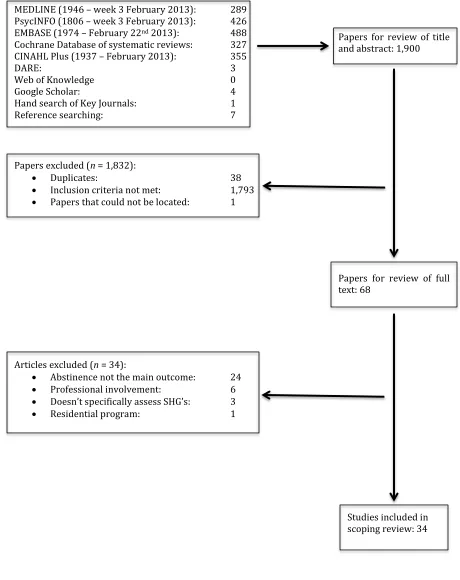
searching for relevant studies, 68 papers were requested in full. Figure 1 represents an overview
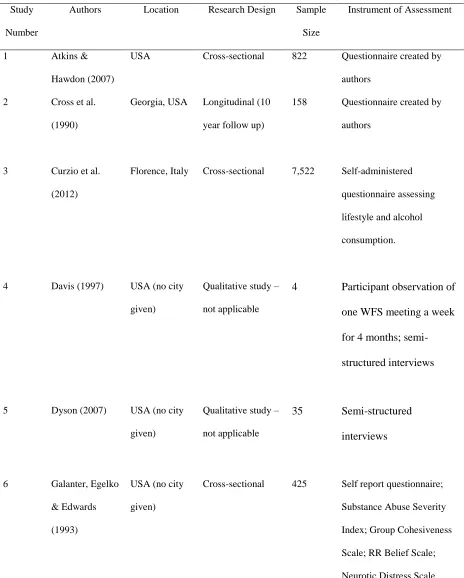
leaving 34 studies included in this review. Table 2 represents demographic and design details of
the included studies.
[Insert figure 1] [Insert table 2]
Results
A thematic analysis approach (Miles & Huberman, 1994) was used to analyse the data from each
of the studies. A thematic framework approach was taken as it provided the most robust and
efficient method of analysis to ensure all the data from the included studies was used during the
analysis. This was particularly helpful given the large number of studies identified during this
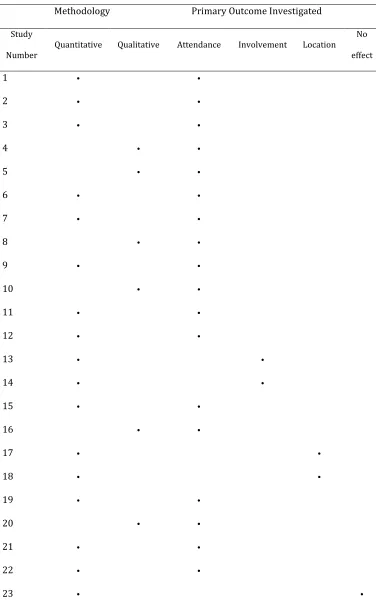
review. Table 3 represents the methodology used by each study, as well as the primary outcome
of investigation. This is to promote clarity for the reader in relation to studies included in the
scoping review.
[Insert table 3]
The results will be split into three sections: the quantitative studies that explore AA and/or 12-step programs, the quantitative studies that explore ‘non-AA, non-12-step-affiliated’ SHGs and
finally, the qualitative studies identified during this review. It is important to state that ’12-step
programme’ refers to any study that investigated a SHG that utilised the ‘12-steps and 12-traditions’ conceptual approach akin to that of AA, but is not a specific investigation of an AA
AA and/or 12-step programmes
The identified studies suggest that an association exists between AA and improved recovery for
three reasons: attendance; involvement and location.
Attendance
Of the 25 studies evaluating the impact of AA and/or 12-step programmes on abstinence, 16 primarily investigate the impact of ‘attendance’ on abstinence. ‘Attendance’ provides an
assessment of the studies that investigated the effect of attending (or not) a SHG for alcohol
addiction.
Early studies located during this review (Hoffman et al., 1983; McBride, 1991; Thurstin, Alfano,
& Nerviano, 1987) typically only demonstrate a straightforward association between those who
attend. For example, Hoffman et al. (1983) found a significant association (n = 900, p < 0.0001)
between those who attend AA and abstinence, as did Thurstin et al. (1987) (n = 145, p < 0.05)
and McBride (1991) (n 50, p < 0.001). These studies however, should be interpreted with
caution, as all three used self-designed questionnaires. Later studies on attendance used more
sophisticated methodologies that disaggregated attendance into more refined timeframes.
Regular AA attendance was found to be a moderately significant predictor of the number of
years of abstinence over a ten-year period of follow ups (n = 158; p < 0.05) (Cross, Morgan,
Mooney, Martin, & Rafter, 1990). Snow, Prochaska, and Rossi (1994) also found an association
p < 0.01). A further study found that those who attended AA on a weekly or more frequent basis
reported drinking less frequently than those who attended less frequently or not at all (n = 150;
weekly or more often: mean = 8.8 days; less than weekly: 17.3 days; not at all: 19.2 days; p <
0.05) and reported drinking less (p < 0.05) during the 30 day period prior to follow up at six
months (Gossop et al., 2003).
Several studies found a temporal relationship between 12-step attendance and substance use. In a
sample of 189 AA attenders, 81.5% (n = 154) attended a 12-step meeting between 0-3 months;
70.4% (n = 133) attended between 3-6 months; 61.9% (n = 116) attended between 6-9 months
and 56.6% (n = 106) over 12 months. Reported alcohol use fell from 100% (n = 189) at baseline
to 56.1% at 12 months (n = 106). Attendance also significantly predicted reductions in
percentage days of alcohol use (p < 0.001) and drinks per day (p < 0.018) over 12 months.
Frequency of attendance also predicted alcohol abstinence (p < 0.001) (Tonigan & Beatty, 2011).
Project MATCH data also confirmed that increased attendance at AA meetings was associated
with reduced alcohol use (n = 226; p < 0.01) (Pagano, White, Kelly, Stout, & Tonigan, 2013).
Kissin, McLeod, and McKay (2003) divided SHG attendees into 5 categories: 'continuous
attendees' (16%, n = 121); 'starters' (26%, n = 199) (those who did not meet attendance criteria at
baseline, but did at endpoint); 'stoppers' (13%, n = 103); 'non-attendees' (19%, n = 146) and
'intermittent attendees' (26%, n = 203). ‘Continuous attendees’ and ‘starters’ were the only
groups to significantly decrease alcohol use at 6-months (total n = 722 p < 0.005). This suggests
Kaskutas et al. (2005) divided SHG attenders into four categories: 'low' (n = 174), 'medium' (n =
63), 'high' (n = 71) and 'declining' (n = 41) based on people in recovery at 1-year following
treatment. At 5-year follow up, the 'low' group had significantly lower abstinence rates than the
'medium' group (p < 0.002), the 'declining' group (p < 0.003) and the 'high' group (p < 0.001). In
a comparative longitudinal follow up study over seven years, Kaskutas, Bond, and Ammon
Avalos (2009) found that abstinence was lowest amongst the 'low AA group' (n = 371) and
highest amongst the 'high AA group' (n = 58). These two studies suggest that those who attend
AA more frequently, and for longer periods of time, are associated with better rates of
abstinence. McKellar, Stewart, and Humphreys (2003) also found a significant effect of one-year
AA involvement on 2-year alcohol problems (n = 2,319; p < 0.001) suggesting that more
alcohol-related problems could be the consequence of decreased AA attendance.
An international comparison of a Swedish and US sample attending AA, found that in both
populations, SHG attendance was positively correlated with abstinence (total n = 2,451; Sweden:
p < 0.0001; USA: p < 0.0001) (Witbrodt & Romelsjo, 2010). These findings were corroborated
in a comparative study, but also found that men were less likely to be abstinent over 7 years
(men verses women coefficient = -0.057; n = 926) (Witbrodt & Delucchi, 2011). Finally,
Witbrodt et al. (2012) divided their participants into six attendance trajectories: 'high' (n = 457);
'descending' (n = 220); 'rising' (n = 93); 'early-drop' (n = 291); 'low' (n = 154; and 'no' (n = 608)
attendance. Approximately 75% of those in the 'high' attendance group reported abstinence in the
30 days prior to each follow up and had significantly better abstinence outcomes than all other
Meuller, Petitjean, Boening, and Wiesbeck (2007) found no effect of SHG attendance on rates of
abstinence in a sample of 50 participants. However, the small sample size suggests that the
results are less likely to be statistically significant.
Overall, the studies examining attendance indicate that attendance at AA is associated with
improved recovery outcomes. This may be because active attendance provides access to
resources that are perhaps lacking elsewhere. For example, attendance provides access to
increased structural support (Groh et al., 2008), in a social environment comprised of others who
provide first experience of addiction and recovery, as well as a support network that promotes
pro-abstinent values (Best & Lubman, 2012; Hibbert & Best, 2011). This may not be the case for
all however, as AA groups often vary considerably in terms of their social network and approach
to delivering the 12-step programme. This, in turn, will likely mean there are many AA groups
that are not appropriate for many, thus meaning attendance may not always be beneficial for
recovery efforts.
Involvement
Three studies explored the impact of active involvement when at AA and/or a 12-step SHG. ‘Involvement’ relates specifically to actively getting involved in activities at meetings and
participating in group discussion when attending a SHG.
Sheeran (1988) divided the participants into two groups: those who reported less than 2 years
abstinence (group 2; n = 37). Group 2 scored better in all measures of involvement, in particular
- having a sponsor (p < 0.001) and reaching out for help (p < 0.05).
Similarly, Kingree and Thompson (2011) found that for a sample of 268 participants, those who
had a sponsor at three months were 2.69 times more likely to be abstinent than those without a
sponsor. These findings have been confirmed elsewhere in specific investigations looking at the
effect of having a sponsor in AA (Tonigan & Rice, 2010). Finally, Kelly, Stout, and Slaymaker
(2013) found that in a sample of 303 ‘emerging adults’ (aged between 18-24) the greatest
predictor of alcohol abstinence was active involvement at AA in the form of active verbal
participation during meetings (F = 7.85; p < 0.002) and considering oneself a member of the
group (f = 9.17; p < 0.005). Furthermore, Kelly et al. (2013) found that meeting with others
outside the group (F = 6.58 p < 0.01) and working the twelve steps (F = 5.40; p < 0.02) were the
greatest predictors of reduced heavy days drinking.
In summary, these studies indicate that greater AA involvement is associated with improved
recovery outcomes. In particular, having a sponsor, reaching out for help, being verbally active
and reading the literature correlate with significantly better outcomes. We suggest that in
addition to active functional support (Groh et al., 2008), active involvement gives attenders the
Location
Two studies investigated the impact of AA or 12-step programmes locality in relation to abstinence rates. ‘Location’ refers specifically to the geographical location of AA and/or 12-step
and their effects on recovery and abstinence. In a study of men attending AA in India, Kuruvilla,
Vijaykumar, and Jacob (2004) found that distance from AA (n = 174; p < 0.030) and the
presence of a keyworker in the area (p < 0.011) were significant predictors of abstinence.
Relative risk calculations also found that males who lived closer to the location where AA was
conducted were 1.27 times more likely to be abstinent and 1.35 times more likely to be abstinent
if a keyworker lived in their area.
Laudet, Stanick, and Sands (2007) found similar results when comparing those who attended a
12-step group ‘on-site’ at a US hospital where individuals received outpatient treatment
compared to those who attended a 12-step program off-site. Laudet et al. (2007) found that those ‘on site’ had significantly higher rates of attendance and higher rates of involvement at each of
the follow up timepoints (n = 122; 3 months: 66% versus 45.1%, p < 0.01; 6 months: 50% versus
33.3%, p < 0.05; 12 months: 36.1% versus 24.6%, not significant) than those who attended 12-step groups ‘off site’. (n = 97). Furthermore, the ‘on site’ group had significantly higher rates of
abstinence since their previous interview at all follow ups than ‘off site’ participants (p < 0.001). ‘On site’ participants were also 5.79 times more likely than the ‘off site’ group to have
The studies on location suggest that more conveniently located SHGs are associated with greater
attendance and involvement, and greater levels of abstinence. However, given that there are only
two studies exploring location, the findings should be interpreted with caution.
Whilst the quantitative findings on AA groups do suggest a good correlation with improved
outcomes, it is important to state that a direct causal link is difficult to infer. People attending
AA less regularly are likely to differ in a number of ways from people who do not attend and it
may be these dissimilarities that are associated with the different levels of abstinence rather than
the level of their attendance. In the future, more multivariate analyses are needed that can take
account of other potentially influential factors that may lie behind the relationship between the
level of AA attendance and the level of alcohol-related problems,
Furthermore, whilst AA suggest that attendance, involvement and location may help people in
recovery, there is also a significant group of people who do not wish to attend AA or adhere to
the 12-steps and 12 traditions. For this group of people, attending AA may not only be unhelpful
to recovery, but could be potentially harmful. The following section reviews studies that have
focussed on ‘non-AA, non-12-step-affilated’ SHGs.
‘Non-AA, non-12-step-affiliated’ SHGs
Of the 34 quantitative studies, 4 explored a SHG that is neither AA nor 12-step affiliated.
attendance (n = 7,522; p < 0.0001). Curzio et al. (2012) attributed this finding to the involvement
of non-addicted family members.
Galanter, Egelko, and Edwards (1993) found that since joining Rational Recovery, 73% of
'engaged members' (those with an average of 8 months membership) were abstinent from all
substances compared to 38% of 'recruits' (those who had only attended for the first time in the
past month). Furthermore, those more engaged with Rational Recovery also had lower AA
attendance scores in the past month (p < 0.01).
While only these two studies focussed on the association between attendance and abstinence,
they point in the same direction as the 12-step evaluations: longer attendance is associated with
better outcomes. However, again, there is the quite plausible explanation that those who remain
in such projects differ in fundamental ways from those who do not.
The final two studies compared SMART (self management and recovery training) recovery with
AA on a number of factors, including locus of control and religiosity.
In a pilot study exploring the locus of control (the degree to which an individual attributes their
success or failures to individual behaviour) at AA and SMART recovery, Li, Feifer, and Strohm
(2000) found significant differences between AA (n = 48) and SMART recovery participants (n
= 33). Li et al. (2000) found that AA attenders exhibited significantly greater external locus of
control (p < 0.00003) and spiritual beliefs (p < 0.05) than SMART attenders. Li et al. (2000)
internal locus of control (outcomes are the result of behaviour), and less on the spiritual side of surrendering to a ‘Higher Power’ (an example of external locus of control).
Atkins and Hawdon (2007) found similar findings in a sample of 822 participants attending AA based mutual aid groups or ‘non-AA’ groups such as SMART recovery, SOS (Secular
Organisations for Sobriety) and WFS (Women for Sobriety). For AA, religiosity ( = 0.384; p < 0.001) and having friends in recovery ( = 0.368; p < 0.001) were all positively related to
programme participation, whereas for non-AA based groups, these factors predicted less
programme participation (WFS: = -0.211; p < 0.05; SOS: = -0.191; p < 0.05; SMART: =
-0.193; p < 0.05). Furthermore, the interaction between SMART recovery and religiosity ( =
-0.158, p < 0.01) and SOS and religiosity ( = -0.163; p < 0.05) were statistically significant
suggesting that religiosity was less effective at stimulating participation. Atkins and Hawdon
(2007) also found that for every 1 unit increase in religiosity at SMART, attendance only
increased by 0.91 at SMART (compared to 2.94 at AA) and for SOS members, every 1 unit
increase in religiosity actually resulted in a 0.71 decrease in participation.
These findings suggest that non-AA groups could be just as valuable as AA group attendance, if
not more for some, as the religious and spiritual orientation of AA could be unpalatable for those
who do not possess congruent values.
The quantitative studies demonstrate a strong body of evidence to suggest that attendance and
involvement at conveniently located AA (and possibly ‘non-AA’) SHGs are associated with
demonstrates a direct causal link with recovery and several studies (Curzio et al., 2012; Galanter
et al., 1993; Li et al., 2000; McBride, 1991; Sheeran, 1988; Snow et al., 1994) were
cross-sectional and therefore unable to detect any change over time.
Qualitative studies located during this review
There were nine qualitative studies located during this review, five of which, explored AA and
four that explored ‘non-AA’ affiliated SHGs.
Alcoholics Anonymous
Using a feminist ethnographic methodology, Hall (1994) was interested in understanding the
experiences of 35 lesbians in AA, as it was thought being a homosexual female in AA had
implications for healthcare interaction and attendance at AA. Hall (1994) identified three areas of
tension embedded in AA attendance: assimilation verses differentiation, authority verses
autonomy and false consciousness verses politicisation. Hall (1994) concluded that such tensions
impact on AA involvement as the tensions reveal fault lines among ideologies and experiences in
lesbian communities.
Through the use of semi-structured interviews with ten women, Davis (1997) found that a lack of support from friends and family, feelings of ‘invisibility’ and isolation were significant factors
that seemed to prevent women from attending and participating in AA groups. Davis (1997)
concluded that the experiences of men and women in recovery at AA are almost totally unique
In contrast, a UK based study conducted by Dyson (2007) found that eight women in a more
conventional, mixed AA group could still benefit from AA. First, the stories that people heard at
AA acted as a deterrent from further drinking and second, the supportive nature of AA was
significant for recovery, regardless of gender.
In another UK-based study, Whelan, Marshall, Ball, and Humphreys (2009) further investigated
the importance of sponsors (people considered to be primary sources of peer support in AA
recovery circles) and peer support. Whelan et al. (2009) identified two main roles of the sponsor: ‘working the programme’ and the provision of emotional and practical ‘support’. Whelan et al.
(2009) in turn, found that by carrying out these roles, the sponsor also benefitted, as it provides them with a source of ‘giving back’.
Finally, Kubicek, Morgan, and Morrison (2002) explored the experiences of seven AA members
with six spontaneous remitters. Five key themes were identified across both groups: the support
from others; acceptance of a Higher Power; a genuine desire to recover; a reconstruction of the ‘self’ and remembering the negative consequences of their addiction. Kubicek et al. (2002) made
two important conclusions. First, given that the themes were applicable to both AA members and
spontaneous remitters, it highlights an overlap between two qualitatively different recovery
trajectories. Second, Kubicek et al. (2002) acknowledge the importance of interviewing those in
recovery, as they can provide useful information on how to sustain long-term sobriety and
abstinence.
In a sample of four women, Kaskutas (1989) found that ‘Women for Sobriety’ (WFS) was
beneficial for some in recovery, as it does not require the re-telling of tragic stories, does not ‘compete’ individuals against one another in terms of sobriety, does not require individuals to
‘work the steps’, downplays the role of a Higher Power and facilitates social cohesion of WFS
members. Kaskutas (1989) concluded that WFS offers a potentially attractive alternative for
those women who consider AA unpalatable.
In an exploration of an adapted AA program, Rayburn and Wright (2010) found that ‘First Steps’ (the SHG) had three key components: ‘excessive twelfth-stepping’, ‘aggregated religious and
recovery principles’ and ‘unrealistic expectations’. However, those who engaged in ‘excessive
twelfth-stepping’ (giving ‘something’ back) often experienced detrimental effects in their
recovery, as it resulted in service users being worse off because of their desire to continually help
others at the detriment to their own wellbeing. Rayburn and Wright (2010) also found that being able to choose ‘how to recover’ was particularly beneficial, as it allowed flexibility to tackle their
addiction. Finally, First Steps helped to encourage service users to aim for realistic goals and that “going broke on perfection” (Rayburn & Wright, 2010, p. 335) could result in a failure to realise
a dream, a precursor to re-commencing their drinking.
In a qualitative exploration of SMART recovery, MacGregor and Herring (2010) found that
SMART recovery was particularly appealing to service users because it focused on “moving on and not repeating ‘war stories’” (p. 29), was perceived as non-hierarchical (everyone treated as
their recovery. This study provides qualitative support for the quantitative findings on SMART
recovery.
The final qualitative study found was the most recent (Parkman, 2014). It was a phenomenology
of a mutual aid group in Leeds, which concluded two important points. First it provided
supporting evidence that mutual aid attendance can reduce boredom, stress and anxiety, as well
as making significant contributions to recovery capital and access to supportive social networks.
However, it also found that there are some service users, typically those with a lack of recovery
capital and fairly isolated lives that can potentially develop a dependency on mutual aid. The
practical repercussions of this dependence are that it could leave service users without any
support structure at all if the mutual aid group ceased to exist – a potentially dangerous situation
that could precipitate relapse.
These exploratory qualitative studies provide further understanding of SHGs. They provide
alternative, and at times, alternative points of view to the quantitative findings.
Discussion
This review set out to explore why and how SHGs impact on recovery from alcohol dependency.
The studies identified in this review demonstrate that SHGs impact positively in a number of
ways. Active attendance and involvement at AA and 12-step groups, as well as ‘non-AA,
non-12-step’ affiliated groups were beneficial for recovery, as they allowed for recovery to be
maintained beyond structured support, and provided access to a social environment within
proximity had positive outcomes for recovery, as it encouraged attendance and involvement. In
contrast, the qualitative studies demonstrate that in some cases, there are potential barriers such
as gender or philosophical orientation of the SHG that could impact on attendance. One
qualitative study (Parkman, 2014) also found that there is the potential for some service users
with access to very little recovery capital and social support to become dependent on mutual aid.
Whilst they broadly support the positive impact of SHGs, these studies also demonstrate that
there are issues that could detrimentally impact SHG attendance and involvement.
This review contributes to the existing knowledge base, as it is the first scoping review of
international studies exploring the impact of SHGs on alcohol dependency. Furthermore, it is the
first known review that incorporates qualitative studies. As such, the review addresses an
important gap in knowledge. Based on the findings of this review, there are several important
conclusions to be made.
First, there is a great need to explore those SHGs that are not AA and/or 12-step related, as they
have been proven to produce favourable outcomes with regards to abstinence and recovery.
Second, the vast majority of quantitative and qualitative studies in this review were conducted in
the US (see table 2), which is most likely the result of the US being the birthplace of AA, thus
making it the most widely sought source of non-professional help for alcohol problems in the US
(Miller & McCrady, 1993). Research outside the US therefore, is needed to understand how
SHGs facilitate recovery in different recovery contexts. This is supported by the ACMD report
(2012) that concluded there is a need for more UK based evidence that considers key issues in
Third, not only is there a paucity of evidence-based knowledge with regards to addiction
research in general in the UK, but there is a significant dearth of evidence with regards to SHGs
and other recovery communities in the UK (Advisory Council on the Misuse of Drugs, 2012). It
has been found that communities of recovery are beneficial, as they are replete with individuals
who have firsthand experience of addiction and addiction recovery, and can therefore provide
more in-depth support and advice based on personal experience (Zemore, Kaskutas, & Ammon
Avalos, 2004). In-depth exploration and analysis is needed therefore, to understand how such
communities of recovery impact on addiction recovery.
Finally, the scoping review highlights that in comparison to quantitative studies, there are very
few qualitative studies that investigate the impact of SHGs on alcohol addiction recovery. Whilst
quantitative studies are important to statistically and objectively highlight the importance of
SHGs, qualitative studies are also important as they access the feelings, emotions and
testimonies of people who have experienced firsthand of what it is like to not only access SHGs,
but also what it is like being in recovery more generally. Furthermore, qualitative research can
unpack processes that are perhaps not easily addressed by quantitative analysis or that can help
explain quantitative findings.
Limitations
The most significant limitation is that this review focuses solely on SHGs for alcohol
dependency: other substance addiction literature has not been considered. Second, whist this
is not a systematic review. There is therefore a possibility that some studies may have been
overlooked. This is potentially an important consideration for any future reviews with a more
focused question on the effectiveness of SHGs. However, the reader will be able to judge the
comprehensiveness of the review and appreciate how it contributes to understanding of the
breadth of SHGs that currently exist for alcohol dependency and how SHGs impact on recovery.
Conclusions
This scoping review makes an important contribution to the debates and existing knowledge base
by offering a comprehensive review of how and why SHGs might impact on alcohol
dependency. This in turn, has shed light on potential performance issues surrounding SHGs,
identified potential strengths and weaknesses and provided a foundation on which future research
Table 1: Inclusion and exclusion criteria for the literature review
Inclusion criteria Exclusion criteria
Study Type: empirical work (quantitative or qualitative) that explored the impact of SHGs for people suffering with alcohol addiction. Any study design was included.
Study Type: any study that was not assessing alcohol as its primary outcome.
Intervention type: 12-step, SHG or any aftercare program that is led by recovering alcohol users and has no professional involvement. If the SHG is embedded in another intervention (for example, AA at an Oxford House), they will be excluded. This is because it is difficult to decipher if improved outcomes are due to the SHG or other intervention.
Outcome: any study that did not assess abstinence as its primary outcome. Any study investigating mutual aid groups that addressed mental health and alcohol dependence comorbidity were excluded.
Outcome: only studies that investigated abstinence from alcohol addiction as their primary outcome. Other outcomes such as quality of life were excluded.
Nature of the reference: policy papers, reviews (both systematic and scoping), theoretical papers, commentaries, dissertations or theses.
Recipient group: any individual above the age of 18 of any race of ethnicity, in any geographical location that was attending a SHG
for alcohol addiction.
Table 2: Selected demographic and design details of the included studies
Study
Number
Authors Location Research Design Sample
Size
Instrument of Assessment
1 Atkins &
Hawdon (2007)
USA Cross-sectional 822 Questionnaire created by
authors
2 Cross et al.
(1990)
Georgia, USA Longitudinal (10
year follow up)
158 Questionnaire created by
authors
3 Curzio et al.
(2012)
Florence, Italy Cross-sectional 7,522 Self-administered
questionnaire assessing
lifestyle and alcohol
consumption.
4 Davis (1997) USA (no city
given)
Qualitative study –
not applicable
4 Participant observation of
one WFS meeting a week
for 4 months;
semi-structured interviews
5 Dyson (2007) USA (no city
given)
Qualitative study –
not applicable
35 Semi-structured
interviews
6 Galanter, Egelko
& Edwards
(1993)
USA (no city
given)
Cross-sectional 425 Self report questionnaire;
Substance Abuse Severity
Index; Group Cohesiveness
Scale; RR Belief Scale;
7 Gossop et al.
(2003)
London, UK Longitudinal
(follow up at 6
months)
150 The Alcoholics Problem
Questionnaire; The Severity
of Alcohol Dependence; The
Symptoms Checklist; Life
Situation Survey
8 Hall (1994) San Fransisco,
USA
Qualitative study –
not applicable
10 Semi-structured
interviews
9 Hoffman,
Harrison &
Belille (1983)
Minneapolis,
USA
Longitudinal
(follow up at 6
months)
900 Questionnaire created by
authors
10 Kaskutas (1989) Maryville,
USA
Qualitative study –
not applicable
13 Semi-structured
Study
Number
Authors Location Research Design Sample
Size
Instrument of Assessment
11 Kaskutas et al.
(2005)
California,
USA
Longitudinal
(follow up at 1, 3
and 5 years)
349 Questionnaire created by
authors
12 Kaskutas, Bond
& Amman
Avalos, (2009)
California,
USA
Longitudinal
(follow up at 1, 3,
5 and 7 years)
926 Addiction Severity Index;
questions from the
Diagnostic Interview
Schedule for Psychoactive
Substance Dependence;
questions from AA
Affiliation Scale/Religious
Beliefs and Behaviours
Scale
13 Kelly, Stout &
Slaymaker
(2013)
Midwest, USA Longitudinal
(follow up at 0, 3,
6 and 12 months)
303 Global Severity Index;
Multidimensional
Mutual-help Meeting Activity Scale;
Form 90; Commitment to
Sobriety Scale; Leeds
Dependence Questionnaire;
Alcohol/Drug Efficacy Scale
14 Kingree &
Thompson
(2011)
South
Carolina, USA
Longitudinal
(follow up at 3 and
6 months)
268 Drug Use Frequency
Questionnaire; Alcoholics
Anonymous Affiliation
15 Kissin, McLeod
& McKay
(2003)
Ohio, USA Longitudinal
(follow up at 6, 30
months)
722 Computer Assisted Central
Intake Assessment
Instrument-Cleveland
(CIAI-C)
16 Kubicek,
Morgan &
Morrison (2002)
USA (no city
given)
Qualitative study –
not applicable
8 Semi-structured
interviews
17 Kuruvilla,
Vijayakumar &
Jacob (2004)
India Longitudinal
(follow up at 1
year)
174 Questionnaire created by
authors
18 Laudet, Stanick
& Sands (2007)
New York,
USA
Longitudinal
(follow up at 3, 6
and 12 months)
219 Lifetime Non-alcohol
Psychoactive Substance Use
Disorders subscale of the
Mini International
Neuropsychiatric Interview
Addiction Severity Index
19 Li, Feifer &
Strohm (2000)
California,
USA
Cross-sectional 81 Spiritual Beliefs
Questionnaire; Drinking
Study
Number
Authors Location Research Design Sample
Size
Instrument of Assessment
20 MacGregor &
Herring (2010)
UK Qualitative study –
not applicable
Not
stated
Semi-structured interviews
21 McBride (1991) Florida and
Georgia, USA
Cross-sectional 50 Questionnaire created by
author
22 McKellar,
Stewart &
Humphreys
(2003)
USA (no city
given)
Longitudinal
(follow up at 1 and
2 years)
2,319 Health and Daily Living
Form; Problems From
Substance Use Scale; Stages
of Change Readiness and
Treatment Eagerness Scale
23 Mueller et al.
(2007)
Germany (no
city given)
Longitudinal
(follow up at 3, 6
and 12 months)
78 Munich Alcoholism Test;
Hamilton Depression Scale;
Social Functioning
Questionnaire;
24 Pagano et al.
(2013) USA (Albuquerque, Buffalo, Farmington, Milwaukee and West Haven) Longitudinal
(follow up at 3, 15.
39 and 120
months)
226 Alcoholics Anonymous
Involvement questionnaire;
Form 90
25 Parkman (2014) Leeds, UK Qualitative study –
not applicable
26 Rayburn &
Wright (2010)
Florida, USA Qualitative study –
not applicable
28 Semi-structured
interviews
27 Sheeran (1988) Chicago, USA Cross-sectional 59 Likert Scale assessing AA
involvement and abstinence
28 Snow,
Prochaska &
Rossi (1994)
Rhode Island,
USA
Cross-sectional 191 Process and Change
Questionnaire; The
Self-Efficacy Questionnaire
29 Thurstin, Alfano
& Nerviano
(1987)
Alabama, USA Longitudinal
(follow up at 6, 12
and 18 months)
145 Not reported
30 Tonigan &
Beatty (2011)
USA (no city
given)
Longitudinal
(follow up at 1, 3,
5 and 7 years)
189 Form 90; iCassette Drug
Screen-4 Panel Test; Stages
of Change Readiness and
Treatment Eagerness Scale
31 Whelan et al.
(2009)
London, UK Qualitative study –
not applicable Not reported Semi-structured interviews Study Number
Authors Location Research Design Sample
Size
32 Witbrodt &
Delucchi (2011)
California,
USA
Longitudinal
(follow up at 1, 5,
7 and 9 years)
926 Social Network Assessment;
Addiction Severity Indices;
Graduated Frequency Scale
33 Witbrodt et al.
(2012)
California,
USA
Longitudinal
(follow up at 1
year)
1,825 Addiction Severity Indices;
self-assessed questionnaires
34 Witbrodt &
Romelsjo (2010)
Stockholm and
California
Longitudinal
(follow up at 6
months)
2,451 Addiction Severity Indices;
Table 3: The methodology and outcomes of studies in this scoping review Methodology Primary Outcome Investigated
Study
Number
Quantitative Qualitative Attendance Involvement Location No
effect
1
2
3
4
5
6
7
8
9
10
11
12
13
14
15
16
17
18
19
20
21
22
24
25
26
27
28
29
30
31
32
33
Figure 1: A consort flow diagram of the search strategy
MEDLINE (1946 week 3 February 2013): 289 PsycINFO (1806 week 3 February 2013): 426 EMBASE (1974 February 22nd 2013): 488
Cochrane Database of systematic reviews: 327 CINAHL Plus (1937 February 2013): 355
DARE: 3
Web of Knowledge 0
Google Scholar: 4
Hand search of Key Journals: 1
Reference searching: 7
Papers for review of title and abstract: 1,900
Papers for review of full text: 68
Papers excluded (n = 1,832):
Duplicates: 38
Inclusion criteria not met: 1,793
Papers that could not be located: 1
Studies included in scoping review: 34 Articles excluded (n = 34):
Abstinence not the main outcome: 24
Professional involvement: 6
Doesn t specifically assess S(G s 3
References
Advisory Council on the Misuse of Drugs. (2012). Recovery from drug and alcohol
dependence: an overview of the evidence. . London: Advisory Council on the Misuse of Drugs.
Armstrong, R, Hall, B. J, Doyle, J, & Waters, E. (2011). 'Scoping the scope' of a cochrane
review. Journal of Public Health, 33(1), 147-150.
Atkins, R. G Jnr., & Hawdon, J. E. . (2007). Religiosity and participation in mutual aid support groups for addiction. . Journal of Substance Abuse Treatment, 33(3), 321-331.
Berridge, V. (2012). The rise, fall, and revival of recovery in drug policy. The Lancet,
379(9810), 22-23.
Best, D. W., & Lubman, D. I. . (2012). The recovery paradigm: A model of hope and change for alcohol and drug addiction. . Australian Family Physician, 41(8), 593-597. Centre for Reviews and Dissemination. (2001). Undertaking systematic reviews of research
on effectiveness CRD s guidance for those carrying out or commissioning reviews.
York: NHS Centre for Reviews and Dissemination.
Cross, G. M., Morgan, C. W., Mooney, A. J., Martin, C. A., & Rafter, J. A. . (1990). Alcoholism treatment: a ten-year follow-up study. Alcoholism: Clinical and Experimental Research, 14(2), 169-173.
Curzio, O, Tilli, A., Mezzasalma, L., Scalese, M., Fortunato, L., Potente, R., . . . Molinaro, S. .
Characteristics of Alcoholics Attending Clubs of Alcoholics in Treatment in
Italy: A National Survey. Alcohol & Alcoholism, 47(3), 317-321.
Dyson, J. (2007). Experiences of alcohol dependence: a qualitative study. Journal of Family Health Care, 17(6), 211-214.
Ferri, M., Amato, L., & Davoli, M. (2006). Alcoholics Anonymous and other 12-step programmes for alcohol dependence. London: John WIley & Sons.
Fiorentine, R. (1999). After Drug Treatment: Are 12-Step Programs Effective in Maintaining
Abstinence? . The American Journal of Drug and Alcohol Abuse, 25(1), 93-116. Galanter, M., Egelko, S., & Edwards, H. . (1993). Rational Recovery: Alternative to AA for
Addiction? . American Journal of Drug and Alcohol Abuse, 19(4), 499-510.
Gossop, M., Harris, J., Best, D. W., Man, L. H., Manning, V., Marshall, J., & Strang, J. . (2003). Is attendance at Alcoholics Anonymous meetings after inpatient treatment related to
improved outcomes? A 6-month follow-up study. Alcohol & Alcoholism, , 38(5), 421-426.
Groh, D. R., Jason, L. A., & Keys, C. B. . (2008). Social network variables in alcoholics anonymous: A literature review. . Clinical Psychology Review, 28, 430-450.
Gruber, K.J., & Fleetwood, T.W. (2004). In-home continuing care services for substance use affected families. . Substance Use & Misuse, 39, 1370-1403.
Hall, J M. (1994). The Experiences of Lesbians in Alcoholics Anonymous. . Western Journal of Nursing Research, 16(5), 556-576.
Hibbert, L. J., & Best, D. W. (2011). Assessing recovery and functioning in former problem
Hoffman, N. G., Harrison, P. A., & Belille, C. A. . (1983). Alcoholics Anonymous after
Treatment: Attendance and Abstinence. . The International Journal of the Addictions, 18(3), 311-318.
Humphreys, K. (2004). Circles of Recovery: Self-Help Organizations for Addictions. Cambridge: Cambridge University Press.
Humphreys, K., Wing, S., McCarty, D., Chappel, J., Gallant, L., & Haberle, B. (2004). Self-help organizations for alcohol and drug problems: toward evidence-based practice and policy. . Journal of Substance Abuse Treatment, 26, 151-158.
Ito, J R, & Donovan, D. M. (1986). Aftercare in alcoholism treatment: A review. In W. R. Miller & N. Heather (Eds.), Treating Addictive Behaviours: Processes of Change. New
York: Plenum Press.
Jason, L.A., Davis, M.I., & Ferrari, J.R. (2007). The need for substance abuse after-care: Longitudinal analysis of Oxford House. Addiction Behaviors, 32, 803-818. Kaskutas, L, A. (1989). Women for Sobriety: a qualitative analysis. Contemporary Drug
Problems, 16, 177-200.
Kaskutas, L, A, Ammon, L., Delucchi, K., Room, R., Bond, J., & Weisner, C. (2005). Alcoholics anonymous careers: Patterns of AA involvement five years after treatment entry.
Alcoholism-Clinical and Experimental Research, 29(11), 1983-1990. doi: 10.1097/01.alc.0000187156.88588.de
Kelly, John F., Stout, Robert L., & Slaymaker, Valerie. (2013). Emerging adults' treatment outcomes in relation to 12-step mutual-help attendance and active involvement.
Drug and Alcohol Dependence, 129(1-2), 151-157. doi: 10.1016/j.drugalcdep.2012.10.005
Kingree, J. B., & Thompson, M. . (2011). Participation in alcoholics anonymous and
post-treatment abstinence from alcohol and other drugs. . Addictive Behaviours, 36, 882-885.
Kissin, W., McLeod, C., & McKay, J. . (2003). The longitudinal relationship between self-help group attendance and course of recovery. . Evaluation and Program Planning, 26, 311-323.
Kubicek, K. R., Morgan, O. J., & Morrison, N. C. . (2002). Pathways to Long-Term Recovery from Alcohol Dependence. . Alcoholism Treatment Quarterly, 20(2), 71-81.
Kuruvilla, P. K., Vijaykumar, N., & Jacob, K. S. . (2004). A Cohort Study of Male Subjects Attending an Alcoholics Anonymous Program in India: One-Year Follow-Up for
Sobriety. Journal of Studies on Alcohol and Drugs, 65(4), 546-549.
Laudet, A. B, & Humphreys, Keith. (2013). Promoting recovery in an evolving policy context: What do we know and what do we need to know about recovery support services? Journal of Substance Abuse Treatment, 45(1), 126-133. doi:
10.1016/j.jsat.2013.01.009
Li, C., Feifer, C., & Strohm, M. . (2000). A pilot study: locus of control and spiritual beliefs in Alcoholics Anonymous and SMART recovery members. . Addictive Behaviours, 25(4), 633-640.
MacGregor, S., & Herring, R. . (2010). The alcohol concern SMART Recovery pilot project: Final Evaluation Report. . Middlesex: Middlesex University Drug and Alcohol
Research Group. .
Mays, N., Roberts, E., & Popay, J. . (2001). Synthesising research evidence. In N. Fulop, P. Allen, A. Clarke & N. Black (Eds.), Studying the Organisation and Delivery of Health Services: Research Methods. London: Routledge.
McBride, JL. (1991). Abstinence Among Members of Alcoholics Anonymous. . Alcoholism
Treatment Quarterly, 8(1), 113-121.
McKellar, J., Stewart, E., & Humphreys, K. (2003). Alcoholics Anonymous Involvement and Positive Alcohol-related Outcomes: Cause, Consequence, Or Just a Correlate? A Prospective 2-Year Study of 2,319 Alcohol-Dependent Men. . Journal of Consulting
and Clinical Psychology, 71(2), 302-308.
Meuller, S. E., Petitjean, S., Boening, J., & Wiesbeck, G. A. . (2007). The impact of self-help group attendance on relapse rates after alcohol detoxification in a controlled study.
Alcohol & Alcoholism, 41(4), 108-112.
Miles, M. B., & Huberman, A. M. . (1994). Qualitative Data Analysis: An Expanded Sourcebook
(2nd ed). London: Sage
Anonymous: Opportunities and Alternatives. . New Brunswick: Rutgers Center of Alcohol Studies. .
Moos, R. H., Finney, J. W., & Cronkite, R. C. (1990). Alcoholism Treatment: Context, Process and Outcome. New York: Oxford University Press.
National Treatment Agency for Substance Misuse. (2006). Models of care for treatment of
adult drug misusers: Update 2006. London: NTA.
Pagano, M. E., White, W. L., Kelly, J. F., Stout, R. L., & Tonigan, J. S. . (2013). The 10-Year Course of Alcoholics Anonymous Participation and Long-Term Outcomes: A Follow-Up Study of Outpatient Subjects in Project MATCH. . Substance Abuse, 34, 51-59.
Parkman T J My actual mind and body is in a better place ) just feel better since
coming here Recovery and mental wellbeing - A phenomenology of service users
attending a mutual aid programme. Advances in Dual Diagnosis, 7(4), 1-11. Rayburn, R. L., & Wright, J. D. . (2010). Sobering Up on the Streets: Homeless Men in
Alcoholics Anonymous. Social Social Science and Public Policy, , 47, 333-336.
Roberts, M., & Bell, A. . (2013). Recovery in mental health and substance misuses services: a community on recent policy development in the United Kingdom. . Advances in Dual Diagnosis, 6(2), 76-83.
Sheeran, M. . (1988). The relationship between relapse and involvement in Alcoholics Anonymous. Journal of Studies on Alcohol, 49, 104-106.
Straussner, S. L. A, & Byrne, H. . (2009). Alcoholics Anonymous: Key Research Findings from 2002-2007. Alcoholism Treatment Quarterly, 27(4), 349-367.
Substance Abuse and Mental Health Services Administration. (2008). The Role of Recovery Support Services in Recovery-Orientated Systems of Care [white paper]. Rockville: Substance Abuse and Mental Health Services Administration.
Sussman, S. . (2010). A Review of Alcoholics Anonymous/Narcotics Anonymous Programs for Teens. . Evaluation & The Health Professions, 33(1), 26-55.
Thurstin, A. H., Alfano, A. M., & Nerviano, V. J. . (1987). The Efficacy of AA Attendance for Aftercare of Inpatient Alcoholics: Some Follow-up Data. . The International Journal of the Addictions, 22(11), 1083-1090.
Tonigan, J. S., & Beatty, G. K. . (2011). Twelve-Step Program Attendance and Polysubstance use: Interplay of Alcohol and Illicit Drug Use. Journal of Studies on Alcohol and Drugs, 72, 864-871.
Tonigan, J. S., & Rice, S. L. . (2010). Is It Beneficial to Have an Alcoholics Anonymous
Sponsor? . Psychology of Addictive Behaviours, 24(3), 397-403.
Tonigan, J. S., Toscova, R., & Miller, W. R. . (1999). Meta-Analysis of the Literature on Alcoholics Anonymous: Sample and Study Characteristics Moderate Findings. .
Journal of Studies on Alcohol, 57(1), 65-72.
Whelan, P. J. P., Marshall, E. J., Ball, D. M., & Humphreys, K. (2009). The Role of AA Sponsors:
A Pilot Study. Alcohol & Alcoholism, 44(4), 416-422.
Seekers.Alcoholism: Clinical and Experimental Research. Alcoholism: Clinical and Experimental Research, 35(12), 2231-2241.
Witbrodt, J., Mertens, J., Kaskutas, L, A, Bond, J., Chi, F., & Weisner, C. (2012). Do 12-step meeting attendance trajectories over 9 years predict abstinence? . Journal of Substance Abuse Treatment, 43, 40-43.
Witbrodt, J., & Romelsjo, A. . (2010). Gender Differences in Mutual-Help Attendance One Year After Treatment: Swedish and U.S. Samples. . Journal of Studies on Alcohol and Drugs, , 71(1), 125-135.
Zarkin, G.A., Bray, J.W., Mitra, D., Cisler, R.A., & Kivlahan, D.F. . (2005). Cost methodology of COMBINE. Journal of Studies on Alcohol Supplement, 15, 50-55.