AIS Electronic Library (AISeL)
AIS Electronic Library (AISeL)
SAIS 2014 Proceedings
Southern (SAIS)
4-14-2014
Transformational Leadership for IT Implementations and Internal
Transformational Leadership for IT Implementations and Internal
Control
Control
Randy G. Colvin
Kennesaw State University, Doctorate of Business Administration, [email protected]
Follow this and additional works at: https://aisel.aisnet.org/sais2014
Recommended Citation
Recommended Citation
Colvin, Randy G., "Transformational Leadership for IT Implementations and Internal Control" (2014). SAIS 2014 Proceedings. 4.
https://aisel.aisnet.org/sais2014/4
This material is brought to you by the Southern (SAIS) at AIS Electronic Library (AISeL). It has been accepted for inclusion in SAIS 2014 Proceedings by an authorized administrator of AIS Electronic Library (AISeL). For more information, please contact [email protected].
Transformational Leadership for IT Implementations and
Internal Control
Randy Colvin
Kennesaw State University
[email protected]
ABSTRACT
Many have heard “set a good example” and “lead by example”. These common phrases in a simple way provide valuable incremental insight for understanding success of enterprise system implementations, and the impact on end-users performing internal control activities. Internal control activities represent the policies and procedures of management in performing business requirements. Within enterprise systems, accounting type transactions are critical since they receive a host of interfaces from upstream modules and pass transactions to a wide range of downstream tables and modules. Activities in this type of setting carry the utmost importance and as discussed should be properly exemplified. However, following too many implementations, internal controls suffer. This study presents a conceptual approach for assessing the unique and positive influence of transformational leadership on the success of IT implementations and resulting internal control activities.
Keywords
Transformational leadership, IT implementations, leadership, internal control
INTRODUCTION
The framework for implementing enterprise systems and related internal control activities is Sarbanes-Oxley Act of 2002, which was passed for publicly traded companies. Section 404 of Sarbanes-Oxley placed significant internal control and reporting requirements around accounting related transactions that impacted non-management employees, management, board members, and external auditors.
From experience, many of the internal control activities to support compliance with Sarbanes-Oxley can be divided between manual compliance activities, and physical or programming activities. Compliance type activities include reconciliations, analytical review, supervision monitoring, and retained supporting documentation. Physical and programming activities include segregation of duties, authorization of transactions, control over information processing, IT security, and physical safeguards. Segregation of duties and authorization issues can become manual compliance activities when roles and workflows have not been properly configured/programmed, or when roles and authorizations are improperly shared. A mitigating point is that substantial programming controls are available for configuration in these applications. Some include validations, edits, segregation of roles, calculations, and authorizations. However, with client/server type applications or IT systems, not all controls are programed or automated.
Following Sarbanes-Oxley, Klamm and Watson (2009) performed a study including 129 public companies that reported material system weaknesses in 2004 or 2005. Of importance is that, these firms with material IT weaknesses also reported numerous non-IT weaknesses. They included, ethics and compliance training (76%); overall weak control environment (32%); accounting documentation, policy, and procedures (94%); period end cutoff (65%); inadequate account reconciliations (59%); segregation of duties (57%); and overall weak monitoring (44%). Sarbanes-Oxley correctly brought attention to weaknesses in processes, systems, and reporting.
Against the backdrop of Sarbanes-Oxley, many public corporations implement integrated enterprise wide software applications or they experience major upgrades. These type systems are costly with larger reported cases ranging from $112 million to $400 million (Seddon, Calvert, & Yang, 2010). They also tend to be long-life investments. The commitment of corporations to selected systems can span across decades, with new version releases and expansion of functionality following implementation (Jian Cao, Nicolaou, & Bhattacharya, 2013). Consequently, the applications encompass a host of challenges – costs, utilization, and risk.
These integrated systems are often recognized as enterprise wide systems or enterprise systems. The family of enterprise systems consists of supply chain management, data warehousing, customer relationship management, and the largest – enterprise resource planning (ERP) systems (Seddon et al., 2010). ERP systems being the largest, also command the most
resources to implement (Grabski, Leech, & Schmidt, 2011). ERP systems by definition span the organization or enterprise, and likewise can interface with sub-applications across the organization. With this breadth, it can be reasoned that, an organization’s IT view of its ERP system is representative of its philosophy concerning other enterprise system implementations and upgrades. Consequently, for this study enterprise systems and ERP are used interchangeably.
The risk and complicated nature of implementing extensively integrated enterprise systems, joined with the compliance demands of Sarbanes-Oxley, set the stage for this research. Over the years, studies have identified multiple factors that are key for both implementation and post-implementation success. For this study, post-implementation refers to the date from 100% go-live until three years post the go-live date. This research posits, does a transformative leadership style as an incremental construct, influence successful implementations in order to establish and exemplify principles for end-users in exercising effective internal controls? The DeLone and McLean Model of Information Systems Success provides the theoretical basis for capturing leadership, system implementation success, and related performance of internal control activities (DeLone & McLean, 2003).
LITERATURE REVIEW Interactive Environment
There are many individual studies on training, performance feedback, process improvement, communication, and end-users. However, based on experience, when looking at performance of tasks by end-users following an implementation, there appears to be multiple variables in play, operating in a dynamic environment. In 1976, Endler and Magnusson (as cited in Terborg, 1981) put forth Interactional Psychology as a means for analyzing behavior, which recognizes the aspects of the person and situation, as interaction takes place continuously and multidirectionally. Terborg (1981) expanded on this approach by explaining: (a) behavior is derived from the continuous process and “interaction or feedback between the individual and the situation encountered”, (b) the individual is changed by situations and works to intentionally change situations, (c) “cognitive, affective, and motivational factors and individual abilities are essential determiners of behavior”, and (d) “the psychological meaning of situations for the individual and the behavior potential of situations for the individual are essential determiners of behavior”.
In a study by Lee, S., Kim, & Lee, J. (1995) they developed a research model based on the Interactional Psychology Perspective. They advanced that prior research on end-user training was too narrow, focusing on individual and specific aspects. Their causal model consisted of five variables, End-User Ability, IS Acceptance, System Utilization, IS Satisfaction, and Job Satisfaction as the ending or dependent variable. Ten causal relationships were successfully tested using the interactive model.
Leadership
Implementation of enterprise systems, by definition involves some transforming, whether due to a new system or major upgrade. With leadership and motivation being two key factors for implementation success, transformational leadership and transactional leadership are two core concepts on leadership styles (Dvir, Eden, Avolio, & Shamir, 2002). Transactional leadership is focused on the successful execution of daily and short-term activities. The primary way of rewarding employees is by matching performance with short-term execution of tasks. Long-term strategic problem solving is not promoted. These short-term, non-strategic transactional leader characteristics do not position the organization best, for implementation success and consistent adherence to internal control activities.
However, during the time span from implementation to full adoption and steady state, transformational leadership attributes within the organization could be instrumental to success. A leader who models a transformational style is one who focuses on inspiring, energizing, and intellectually stimulating others (Bass, 1990). The transformational leader would present a clear vision for the new enterprise system, and inspire others to think about ways of using the new application to address problems (Piccolo & Colquitt, 2006). The leader seeks to reach followers in a form that seems individualized. For example, in an implementation environment, guidance about adhering to new processes and procedures are better received by direct instruction cascaded down to immediate supervisors, versus general distribution (Bass, 1990). Moreover, the transformational leader challenges the follower intellectually, by linking key organizational processes and procedures for the implementation to the follower’s individual performance goals (Hui Wang, Law, Hackett, Duanxu Wang, & Zhen Xiong Chen, 2005). Supervisors and managers should also be viewed and thought of as conforming to the same guidance, to establish validity and credibility.
Research on transformational leadership has generally followed two models, one where effects are mediated through the follower’s attitude to leader (Kark, Shamir, & Chen, 2003). The other model is based on self-efficacy of the follower (Bono & Judge, 2004). In a recent study, a model added three constructs as mediators between transformational leadership and its dependent variables, task performance and organizational citizenship behavior (Piccolo & Colquitt, 2006). Organizational citizenship behavior refers to those tasks that are extra, and voluntarily done to benefit the organization and fellow employees. The conceptual flow was transformational leadership through the mediator, core job characteristics, to intrinsic motivation and goal commitment, then with both to the two dependent variables. The researchers found a positive relationship between transformational leadership and core job characteristics; employees viewed their job as more significant and thought-provoking. Support for the dependent variables were also supported (Piccolo & Colquitt, 2006).
End-user Usage Behavior – Integrated Internal Control Framework
Sarbanes-Oxley defined five areas for companies to comply with in order to provide an interrelated control framework (Klamm & Watson, 2009). They are (1) control environment, (2) risk assessment, (3) control activities, (4) information and communication, and (5) monitoring. Some users of information make a general assumption that if an organization has significant investments in enterprise systems, then they should have good processes since they conceptually have fewer manual internal controls (Bedard & Graham, 2011). However, that assumption can be misguided since in an earlier study for example, Klamm and Watson (2009) reported that 57% of firms with IT weaknesses also reported non-IT weaknesses in segregation of duties. Segregation of duties can be due to weak controls around manual maintenance, update, and safeguarding, but the weakness could result in a material breach into the system. In the context of this study, the five components are being analyzed in relation to the implementation of an enterprise system and the organizational leadership surrounding it.
The usage behavior of management and employees would be reflected in the organization’s audit results, in accordance with Sarbanes-Oxley. The control environment (Klamm & Watson, 2009) begins foremost with senior management and cascades down through the organization, to all levels. It encompasses written mission statements, philosophies, value statements, policies, and procedures. Risk assessment involves management oversight, review, analysis, and decisions to effectively operate the organization in light of potential risk. Control activities include transaction level tasks such as reconciliations, authorizations, reviews, and segregation of duties to address risks. Information and communication involve the timely update of all parties or stakeholders involved with company business. Finally, monitoring is the timely review of the components to ensure their maintenance, update, and validity (Klamm & Watson, 2009). The execution and performance of control responsibilities occur at all levels of the organization, and recent enterprise system implementations create higher risk for auditors in segregation of duties, supply-chain, and payroll areas (Weidenmier & Ramamoorti, 2006).
Implementation Research
The growth in ERP systems fostered the development of ERP research. Three major areas emerged - critical success factors, organizational impact, and economic impact (Grabski et al., 2011). Out of these core areas, sub-categories emerged. The two major categories related to this study are critical success factors and organizational impact. In addition to these major categories, related detailed aspects include compliance, audits, and management control systems. Enterprise system research is positioned to make strong contributions in these major and sub-areas.
The major area, ERP critical success factors, centers on those elements key to a successful system implementation. In addition, factors should be instrumental in maintaining compliance with newly implemented procedures, and continuing compliance after the system reaches a steady state of operation. Grabski et al., (2011) summarized several research areas frequently cited by others as critical for a successful ERP implementation, (1) top management support, (2) business process reengineering or fit between the ERP systems and the organization, (3) the implementation team, (4) change management, (5) user education, and (6) acceptance of the new enterprise system organization-wide. However, more research is needed on how critical success factors interact (Grabski et al., 2011).
Enterprise system functionality that is under the umbrella of accounting information systems is also a focus (Grabski et al., 2011). This is due to the inherent nature of enterprise systems where there are numerous seamless interfaces, and accounting transactions can be recorded and updated in real-time. To ensure compliance, accountants and auditors within the organization are being called on to evaluate processes, make recommendations, and in some cases serve as in-house consultants (Grabski et al., 2011).
In the established research stream, studies have focused primarily on implementations, with relatively little attention on post-implementation (Jian Cao et al., 2013). This study recognizes that post-post-implementation is where strategic consistency is needed to address implementation gaps, and bring them in line with strategy. The latest research does indicate that corporations are now tending to review the status of systems, post-implementation (Seddon et al., 2010).
For a study based on a project model with organizational benefits as the dependent variable, researchers hypothesized “overcoming organizational inertia” as one of two key independent variables, with functional fit being the other (Seddon et al., 2010). Overcoming organizational inertia was defined as the motivation of company employees to learn, use, and accept the system. Research showed that effectiveness in overcoming organizational inertia was positively related to the firm receiving benefits from the enterprise system implementation. Benefits from implementations include process efficiencies, seamless integration, improved accuracy, and enhanced reporting (Seddon et al., 2010).
In a study of the influence of institutional forces on top management, results showed that top management played a positive mediating role in the assimilating of technology implementation in the firm (Huigang Liang, Saraf, Qing Hu, & Yajiong Xue, 2007). This influence continued post-implementation. Commitment and expectations of top management also work to establish the norm. Research on the implementation and post-implementation process of enterprise systems, shows that leadership and motivation are recurring themes to success. Functionally, leadership can be instrumental since managers can set strategy, policy guidance, allocate resources, set a far-reaching example, and in the end establish organizational norms.
DeLone McLean Model of Implementation Systems Success
The growth in the number of corporations engaged in system implementations has led to widespread research. DeLone and McLean (1992) performed a comprehensive review of the prevailing research and synthesized a parsimonious conceptual model that subsequently received substantial empirical support (DeLone & McLean, 2003). The model stresses the interdependent relationships of the constructs and the flow of information between them.
In 2003, the model was updated to reflect more wide-spread enterprise systems with increased end-user query functionality and e-commerce activity (DeLone & McLean, 2003). Service quality was added as a construct and the concept for the dependent variable was broadened to allow for more applicable application based on the subject of focus. Use was also expanded to provide the researcher the option to measure use or intention to use. Use represents behavior and intention identifies attitude. “Net benefits” provides the flexible to select the dependent based on context (DeLone & McLean, 2003).
Theory and Conceptual Design
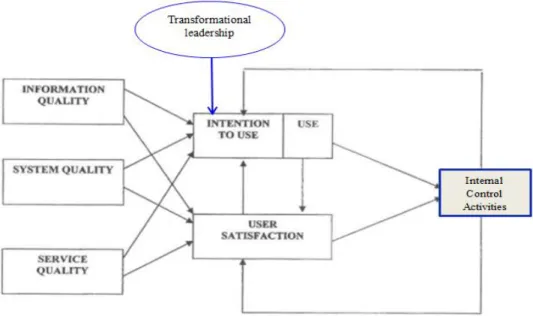
Research supports that a lack of success in implementations is due largely to aspects involving social and organizational issues, instead of tangible technological issues (Au, Ngai, & Cheng, 2008). The conceptual model (Figure 3) includes the construct, transformational leadership to capture and measure the social influence (subjective norm) on use or intention to use the system properly to generate internal control activities. Research supports leadership and motivation as key variables to a successful enterprise system implementation.
Figure 3 Conceptual Model
Adapted from D&M IS Success Model (DeLone & McLean, 2003)
Subjective norm encompasses a behavior related to the enterprise system, where an individual believes they should utilize the system in compliance with proper procedures and internal controls. This is especially due to their belief that someone of importance expects that they would perform the behavior (Venkatesh & Davis, 2000). The construct, transformational leadership, represents that level of supervision and management who in an encouraging way, has clearly communicated expectations, and the importance of the individual to the process. Moreover, supervision and management, set the example by abiding with the same guidelines they express.
In the model, usage behavior is a construct that represents employees’ usage of the new enterprise system after being influenced and encouraged by transformational leaders. The study also seeks to assess the degree of completeness and compliancy, in following and executing transaction and control procedures. Conceptually, transformational leadership at the top of the organization should influence managers at levels throughout the organization. Transformational leaders should also be committed to maintaining an image of propriety for the organization, and therefore the reporting of a strong enterprise internal control framework based on compliance with its five control components. Theoretically, the model is comprehensive, yet maintains enough parsimony while capturing the influence of the transformational leader on the acceptable use of a newly implemented enterprise system. This is in light of compliance with the internal control framework.
CONCLUSION
New enterprise system implementations and major upgrades are significant undertakings for organizations in terms of resources, accepted use, and risks. Costs usually involve millions of dollars, in addition, configuration and compliance with Sarbanes-Oxley requirements can require substantial effort for new applications. With this focus, an effective approach is needed to promote or ensure acceptable usage of the system, in compliance with guidelines and procedures. The conceptual model in this study addresses this need. It is based on the D&M IS Success Model, and incorporates the influence of transformational leadership on intention to use/use. Transformational leaders set an example for what is expected in proper and effective use of the enterprise system. Most importantly, the transformational leader shares a clear vision and strategy for the new enterprise system with their employees. They also identify the value of their individual contribution to the process, and challenge them to excel and look for opportunities for improvement by use of the new system. Transformational leaders recognize the challenge in new enterprise system implementations and major upgrades, and stay engaged to lead through to complete adoption and steady-state use.
REFERENCES
1. Au, N., Ngai, E. W. T., and Cheng, T. C. E. (2008) Extending the Understanding of End User Information Systems Satisfaction Formation: An Equitable Needs Fulfillment Model Approach, MIS Quarterly, 32(1), 43–66.
2. Avolio, B. J., and Bass, B. M. (1999) Re-examining the components of transformational and transactional leadership using the Multifactor Leadership Questionnaire, Journal of Occupational & Organizational Psychology, 72(4), 441–462. 3. Bass, B. M. (1990) From Transactional to Transformational Leadership: Learning to Share the Vision, Organizational
Dynamics, 18(3), 19–31.
4. Bedard, J. C., and Graham, L. (2011) Detection and Severity Classifications of Sarbanes-Oxley Section 404 Internal Control Deficiencies, Accounting Review, 86(3), 825–855. doi:10.2308/accr.00000036
5. Bono, J. E., and Judge, T. A. (2004) Personality and Transformational and Transactional Leadership: A Meta-Analysis,
Journal of Applied Psychology, 89(5), 901–910. doi:10.1037/0021-9010.89.5.901
6. DeLone, W. H., and McLean, E. R. (2003) The DeLone and McLean Model of Information Systems Success: A Ten-Year Update, Journal of Management Information Systems, 19(4), 9–30.
7. Dvir, T., Eden, D., Avolio, B. J., and Shamir, B. (2002) Impact of Transformational Leadership on Follower Development and Performance: A Field Experiment, Academy of Management Journal, 45(4), 735–744. doi:10.2307/3069307
8. Grabski, S. V., Leech, S. A., and Schmidt, P. J. (2011) A Review of ERP Research: A Future Agenda for Accounting Information Systems, Journal of Information Systems, 25(1), 37–78. doi:10.2308/jis.2011.25.1.37
9. Hui Wang, Law, K. S., Hackett, R. D., Duanxu Wang, and Zhen Xiong Chen. (2005) Leader-Member Exchange as a Mediator of the Relationship Between Transformational Leadership and Followers’ Performance and Organizational Citizenship Behavior, Academy of Management Journal, 48(3), 420–432. doi:10.5465/AMJ.2005.17407908 10. Huigang Liang, Saraf, N., Qing Hu, and Yajiong Xue. (2007) Assimilation of Enterprise Systems: The Effect of
Institutional Pressures and the Mediating Role of Top Management, MIS Quarterly, 31(1), 59–87.
11. Jian Cao, Nicolaou, A. I., and Bhattacharya, S. (2013) A Longitudinal Examination of Enterprise Resource Planning System Post-Implementation Enhancements, Journal of Information Systems, 27(1), 13–39. doi:10.2308/isys-50398 12. Kark, R., Shamir, B., and Chen, G. (2003) The Two Faces of Transformational Leadership: Empowerment and
Dependency, Journal of Applied Psychology, 88(2), 246–255. doi:10.1037/0021-9010.88.2.246
13. Klamm, B. K., and Watson, M. W. (2009) SOX 404 Reported Internal Control Weaknesses: A Test of COSO Framework Components and Information Technology, Journal of Information Systems, 23(2), 1–23.
14. Lee, S. M., Kim, Y. R., and Lee, J. (1995) An Empirical Study of the Relationships among End-User Information Systems Acceptance, Training, and Effectiveness, Journal of Management Information Systems, 12(2), 189–202. 15. Piccolo, R. F., and Colquitt, J. A. (2006) Transformational Leadership and Job Behaviors: The Mediating Role of Core
Job Characteristics, Academy of Management Journal, 49(2), 327–340. doi:10.5465/AMJ.2006.20786079
16. Seddon, P. B., Calvert, C., and Yang, S. (2010) A Multi-Project Model of Key Factors Affecting Organizational Benefits from Enterprise Systems, MIS Quarterly, 34(2), 305–A11.
17. Terborg, J. R. (1981) Interactional Psychology and Research on Human Behavior in Organizations, Academy of
Management Review, 6(4), 569–576. doi:10.5465/AMR.1981.4285691
18. Venkatesh, V., and Davis, F. D. (2000) A Theoretical Extension of the Technology Acceptance Model: Four Longitudinal Field Studies, Management Science, 46(2), 186.
19. Weidenmier, M. L., and Ramamoorti, S. (2006) Research Opportunities in Information Technology and Internal Auditing, Journal of Information Systems, 20(1), 205–219.