White Rose Research Online URL for this paper:
http://eprints.whiterose.ac.uk/85364/
Version: Accepted Version
Proceedings Paper:
Escolano, Francisco, Bonev, Boyan and Hancock, Edwin R.
orcid.org/0000-0003-4496-2028 (2014) Quantum vs classical ranking in segment grouping.
In: Structural, Syntactic, and Statistical Pattern Recognition:Joint IAPR International
Workshop, S+SSPR 2014, Joensuu, Finland, August 20-22, 2014. Proceedings. Joint
IAPR International Workshop on Structural, Syntactic, and Statistical Pattern Recognition,
S+SSPR 2014, 20-22 Aug 2014 Lecture Notes in Computer Science (including subseries
Lecture Notes in Artificial Intelligence and Lecture Notes in Bioinformatics) .
Springer-Verlag , pp. 203-212.
https://doi.org/10.1007/978-3-662-44415-3_21
[email protected] https://eprints.whiterose.ac.uk/ Reuse
Items deposited in White Rose Research Online are protected by copyright, with all rights reserved unless indicated otherwise. They may be downloaded and/or printed for private study, or other acts as permitted by national copyright laws. The publisher or other rights holders may allow further reproduction and re-use of the full text version. This is indicated by the licence information on the White Rose Research Online record for the item.
Takedown
If you consider content in White Rose Research Online to be in breach of UK law, please notify us by
Quantum vs Classical Ranking in Segment
Grouping
Francisco Escolano, Boyan Bonev, and Edwin R. Hancock
Department of Computer Science and AI, University of Alicante, Spain Department of Statistics, UCLA, USA
Department of Computer Science, University of York, UK
Abstract. In this paper we explore the use of ranking as a mean of guiding unsupervised image segmentation. Starting by the well known Pagerank algorithm we introduce an extension based on quantum walks. Pagerank (rank) can be used to prioritize the merging of segments em-bedded in uniform regions (parts of the image with roughly similar ap-pearance statistics). Quantum Pagerank, on the other hand, gives high priority to boundary segments. This latter effect is due to the higher order interactions captured by quantum fluctuations. However we found that qrank does not always outperform its classical version. We ana-lyze the Pascal VOC database and give Intersection over Union (IoU) performances.
Keywords: random walks, quantum walks, ranking, segment grouping
1
Introduction
When applied to image segmentation, random walks have been used to propagate labels in a semi-supervised way. For instance, in [1] pixels are labeled in terms of the probability that a random walk will reach them from a given seed.
there have been no attempts in the literature to investigate the propagation of information through the digraphs induced by asymmetric dissimilarity measures in an unsupervised context.
In this paper, we explore the impact of both classical and quantum ranking in the selection of the segments to merge in unsupervised segmentation. Our hypothesis is that ranking may improve significantly the quality of the segmen-tation, since the result of the process contains the information of random or quantum walks probing the network given by the adjacency graph. Therefore, ranking provides local-to-global information that may be critical in a greedy merging process.
[image:3.595.152.469.327.447.2]The remainder of the paper is organized as follows. In Section 2 we describe the simple hierarchical grouping algorithm used for the study of ranking effects. In Section 3 we review Pagerank from a perspective of digraphs. Section 4 is devoted to the description of the quantum extension of the Pagerank method. Experiments and analysis are presented in Section 5. Finally, in Section 6, we present our conclusions and future work.
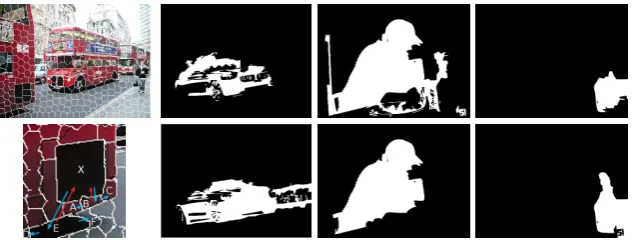
Fig. 1. Symmetric vs asymmetric dissimilarity. Top-left: Output of SLIC algorithm. Bottom-left: Asymmetric dissimilarities (in red and blue) between superpixel X and some of its 1st
and 2nd
−order neighbors (see text). Top-row: Best unsupervised
segmen-tation results imposing symmetry for some VOC Pascal objects. Bottom-row: results by imposing asymmetry. See the scenes analyzed in Top-left of Fig. 2 and Fig. 3.
2
Hierarchical Grouping Algorithm
The algorithm starts with a basic set of segments which are output by the SLIC algorithm [4]. We then build a segmentation hierarchy by merging/composing segments as follows.
Each segment is described by an appearance vector V = (µ, σ, cx, cy, w, h),
where µ, σ are the mean and the standard deviation of (l, a, b,∇x,∇y,∇2x,∇
2
), and (cx, cy, w, h) are the centroid of the segment and the dimensions of its
Quantum vs Classical Ranking 3
Each segment has a neighborhood structure. This consists of 1st−order
neigh-bors, which are directly adjacent to the segment, and 2nd−order neighbors (i.e.
those adjacent to the 1st−order neighbors). Then, we define an asymmetric
sim-ilarity function∆A
i|j between segments which are 1stor 2nd-order neighbors. An
appearance measure is defined to be:
∆Ai|j =||Vi−ViSj||2.
This is the change in the appearance vector of region i caused by merging it with regionj. This quantity is asymmetric – i.e.∆A
i|j 6=∆Aj|i. This quantity will
encourage merging neighboring regions which have similar appearance vectors. The appearance similarity measure is modified by an edge-term (Ei,jranging
from 0 to 1) that computes the strength of the edge on the boundary between two adjacent regions. This edge term is computed very simply using the Sobel edge detector. The underlying intuition is that we reduce the similarity between adjacent regions if there is an edge between them. We do not introduce an edge-term between segments in the 2nd-order neighborhood (because we want this
type of merging to jump between regions) and instead we pay a fixed penalty of size 1 (which is the maximum value the edge term can take).
This gives an asymmetric similarity function∆i|j:
∆i|j =
(
Ei,j+∆Ai|j if i, j are 1st−order neighbors
1 +∆A
i|j ifi, j are 2nd−order neighbors
Alternative segmentation algorithms such as the one in [5] can be used. Herein we use the simple method described above in combination with PageRank algorithm or with its quantum extension to rank the pairing between segments (i, j) on the basis of the similarity function. We allow the 30 % highest ranked segments to merge, see Fig. (1). This ranking encourages merging between segments which are most similar. However we reject merges in situations where the similarity function between two regions is too asymmetric (i.e. we do not allow merges where i ”likes” j, but j does not ”like” i). After these merges, we re-compute the PageRank algorithm and repeat the process.
3
Ranking Based on Random Walks
Since the similarity measure used for merging is asymmetric, we use a directed graph for encoding each segmentation level in the hierarchy.
A directed graph (digraph) G = (V, E) with N = |V| vertices and edges
E ⊆V ×V is encoded by an adjacency matrix A whereAij >0 ifi→j ∈E
and Aij = 0 otherwise (this definition includes weighted adjacency matrices).
The outdegree matrix Dout is a diagonal matrix wheredout i =
P
j∈VAij. The
transition matrixP is defined byPij =dAoutij
i if (i, j)∈E andPij = 0 otherwise. The transition matrix is key to defining random walks on the digraph and
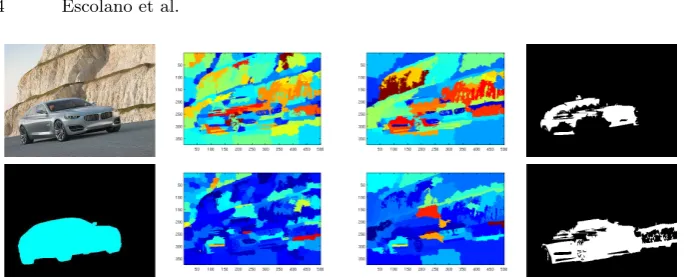
Fig. 2.Quantum vs classical ranking for car segmentation. Top-left: image. Bottom-left: ground truth. Top-center: classical ranking of segments at iterations 8 and 13. Bottom-center: quantum ranking of segments at the same iterations. Top-right: group-ing result with the hierarchical algorithm based on the classical rankgroup-ing (IoU = 0.43). Bottom-right: result using quantum ranking (IoU=0.61).
we have that P
j∈VPij 6= 1 in general. In addition, P is irreducible iff G is
strongly connected (there is path from each vertex to every other vertex). If
P is irreducible, the Perron-Frobenius theorem ensures that there exists a left eigenvector φsatisfyingφTP =λφT and φ
i >0∀i. IfP is aperiodic (spectral
radiusρ= 1) we haveφTP =ρφT and all the other eigenvalues have an absolute
value smaller thatρ= 1. By ensuring strong connection and aperiodicity we also ensure that any random walk in a directed graph satisfying these two properties converges to a unique stationary distribution.
By correctingP so that Pij =
1
N if Aij = 0 andd out
i = 0, we obtain a row
stochastic matrix:P
j∈VPij = 1∀i. This strategy is adopted in Pagerank [6] and
provides and allows forteleporting acting on the random walk to any other node in the graph. Teleporting is modeled by definingG=ηPT+(1−η)eeT
N , wheree T
is the all ones row vector and 0< η <1. The new matrixGis column stochastic and ensures both irreducibility and aperiodicity. Under these conditions Gji is
the probability of reachingjfromi. Teleporting means that for every node with
Aij >0,Gji=dAoutij
i is applied with probabilityη, whereas for nodes withAij = 0 we haveGji= N1 with probability 1−η. In [7] a trade-off between large values
η (preserving more the structure ofP′) and small ones (potentially increasing the spectral gap) is recommended. For instance, in [3], where the task is to learn classifiers on directed graphs, the setting is η = 0.99, but usually η = 0.85 is recommended. In any case, when using the newP we always have thatGii 6= 0
due to the Pagerank masking.
Finding the stationary distributionφcan be then formulated as an eigenvec-tor problem Gφ = φ subject to a normalization constraint eTφ = 1 (see [8]).
Usually the power method is used. Accordingly iterateφ(k+1) =Gφ(k) starting byφ(0) =e1
N until convergence (which will occur if the second eigenvalueλ2 is
Quantum vs Classical Ranking 5
4
Quantization of Random Walks
4.1 Unitary vs Stochastic Evolution
The above process for finding the stationary distribution simulates the diffusion of a discrete-time classical random walk on the directed graph G = (V, E). Then the states are the nodes and top-ranked nodes are those whose stationary probability is high.
On the other hand a discrete-time quantum walk [9] diffuses in a very different way since it is subject to quantum superpositions. In this approach states|ψi ∈ CN are assumed to belong to a Hilbert spaceH=span{|ji |j= 1, . . . , N}=CN
wherehj|= (0. . .1. . .0) with a 1 at thej−thposition. We use the Dirac bra-ket notation where: |ai = a, ha| = a∗, ha|bi = a∗b is the inner product and therefore hj|ki = j∗k = δjk. Then, the state of the quantum walk at a given
time is |ψi = PN
j=1cj|ji with cj ∈ C so that |c1|2 +|c2|2+. . .+|cN|2 = 1
and |ci|2 = cici. The probability that the quantum walk is at nodei is given
by|hi|ψi|2
=|ci|2. The|ci|2 are known as the amplitudes of the wave traveling
through the graph.
Given a initial state|ψ(0)i=PN
j=1c 0
j|ji, a quantum walk evolves through a
unitary operator instead of a stochastic one which is the case of random walks do. A N ×N complex matrix U is unitary ifU∗U =U U∗ = IN, where U∗
is the conjugate transpose, that is (A∗)
ij =Aji. Therefore, both the rows and
columns of U form a orthonormal basis in CN. In additionU is by definition
a normal matrix for it commutes with its conjugate transpose. In this case it is unitarily similar to a diagonal matrix, i.e., it is diagonalizable by U =VΛV∗
whereΛ=diag(λ1λ2. . . λN) contains the eigenvalues ofU andV is unitary and
its columns contains the eigenvectors ofU. Combining the latter diagonalization with the property|det(U)|= 1 we have that all the eigenvalues ofU must lie on the unit circle. In other words, they must have either the form eiθ or the form
e−iθ, where θis an angle on the complex plane.
Therefore we have|ψ(t)i=Ut|ψ(0)iwith the amplitudes of|ψ(t)isumming
to unity sinceU is unitary.
4.2 Szegedy’s Quantization
The problem of associating a unitary operator with a Markov chain (stochas-tic matrix) has been posed in different ways. One of them is inspired in the Grover’s search algorithm [10]. Grover’s search relies on projection operators
Π = PN
j=1|ΨjihΨj| where, for instance, |Ψji = PN
k=1 1
√
N|ki. The projectors
satisfy the condition Π2
= Π and the operator 2(Π −1) defines reflections (coin flips) around the subspace spanned by vectors|Ψji. In [11] Szegedy uses a
product of reflections for quantizing a Markov chain.
To commence, the state space, originally placed at the N nodes, is moved to the N ×N directed edges of the graph. The Hilbert space is now H =
the tensor (Kronecker) product, and the subindexes 1 and 2 make explicit the orientation of each edge. Following the approach in [12][13] orientation is critical when computing projections onto the vector encoding the second node of the edge. Then, the superposition of the edges outgoing from nodej are given by
|Ψji= N
X
k=1 p
Gkj|ji1|ki2. (1)
Given the projectorΠ =PN
j=1|ΨjihΨj| (coin flip) and the swap operatorS =
PN
j=1 PN
k=1|ji|kihk|hj| which alternates the direction of the edge (swaps both
edge spaces), a step of the quantum walk is given by the unitary operatorU =
S(2Π−1), where1is the identity matrix. However, Grover’s search requires a two-step unitary operator per iteration. When translating this idea to Markov chains, Szegedy suggested the use of the operator (2Π −1)(2Π′−1) in order to contemplate the case of two Markov chains (each one with its own reflection operator). When the two chains are coincident (e.g. for creating bipartite walks) then we have (2Π−1)2
. If we include the swap operator, which is also unitary, then the two-step evolution operator is given by U2
= (2SΠS−1)(2Π −1). This operator swaps the directions of the edges an even number of times
The initial state|ψ(0)i= 1
√
N
PN
j=1 PN
k=1|ji|ki assumes uniform
probabili-ties for all theN×N edges in the digraph. Given|ψ(0)i, we have that the state of the quantum walk at a given time tis given by|ψ(t)i=U2t
|ψ(0)i. In addi-tion, the probability of being at such state ishψ∗(t)|ψ(t)i. However, for ranking a given nodeiit is desirable to compute the probability of being atiat timet. This can be done by computing the probability that any edge ends at such node after ttime steps. Let the state|Iq(t)ibe the superposition of all paths ending
at|ii2(the second space of each edge ending ati).
The superposition state is defined as|Ii(t)i= 2hi|ψ(t)i= 2hi|U2t|ψ(0)iand
it is given by the projection of|ψ(t)ionto the space|ii2. Such projection can be
described more clearly if we exploit the spectral theorem, since we have U2t=
P
µµ
2t|µihµ|, where theµ are the N2
eigenvalues of U2
and the |µiare their correspondingN2
−dimensional eigenvectors. Then, 2hi|U2t=Pµµ2t2hi|µihµ|.
If we consider that the structure of2hi|µiis 2hi|ji1|ki2, for|µiis defined in the
tensor spaceH=CN⊗CN, then we have that the proper projection is given by the contraction 2hi|ki2|ji1.
Consequently, we have that the probability that the quantum walk at vertex
iafter ttime steps (that is, itsquantum rankingat this time) is
Ii(t) =hψ(0)|U∗
2t
|ii2hi|U 2t
|ψ(0)i=
X µ
µ2t2hi|µihµ|ψ(0)i 2 (2)
In practice, the time-averaged quantum ranking is used (although the long time average can be used since it only depends on the eigenvectors|µi). The average is useful because quantum oscillation typically decrease in amplitude withIi(t). In
any case, the main problem when this approach is applied to ranking segments is to compute or to approximateU2
Quantum vs Classical Ranking 7
4.3 The Eigensystem of the Unitary Operator
One of the nice properties of the Szegedy’s formulation is that it provides a direct link between the eigenvalues and eigenvectors ofU and those of aN×N matrix
D, whereDij =
p
GijGji, called thediscriminant matrix. Such matrix is linked
with the projector operatorΠand thehalf-projectionA=PN
j=1|ψjihj|through
the following properties: (i)A∗A=1, (ii)AA∗=Π and (iii)A∗SA=D. Let λand |λi be respectively the N eigenvalues andN−dimesional eigen-vectors of the symmetric matrix D. Then, if we define |λ˜i = A|λi and apply the above properties, we have the following ansatz for the eigenvectors |µiand eigenvalues µ of U: |µi = |λ˜i −µS|λ˜i. This means that we can easily obtain 2N of the N2
eigenvalues and eigenvectors of U from the N ones of D, since
µ =e±i×arccosλ. These latter values come from the SVD decomposition of D, whose singular values lie in (0,1).
In addition, when we considerU2
we have that this operator splitsHinto the subspaces Hdyn=span{|ψji,S|ψji} and its orthogonal complementHnodyn =
H⊥
dyn. The dimension ofHdyn is at most 2N. Thus, the spectrum of U2
cor-responding to Hdyn is given by, at most, the 2N values {e±
2i×arccosλ
}. The spectrum corresponding toHnodyn is given by at leastN2−2N 1’s.
When estimating the eigenvectors |µi and eigenvalues µ for segmentations we have to confront the problem that at the lowest segmentation levels the number of SLIC superpixels is too high for building anN2
×N2
unitary operator and then getting its eigensystem. The unitary operator is needed to extract the eigenvectors |µi corresponding to eigenvectors with value 1 (i.e. satisfying
U2
|µi = |µi). Obtaining the operator U2
(or even U) is infeasible for these levels, unless a more in-depth analysis of the structure of these operators reveals a shortcut. This latter question is beyond the scope of this paper and we have approximated the instantaneous rankingIi(t) with
˜
Ii(t) =
X
µ∈Hdyn
µ2t2hi|µihµ|ψ(0)i 2
. (3)
Therefore ˜Ii(t) is a low-pass approximation ofIi(t).
5
Analysis: Experiments and Conclusions
We evaluate to what extent the averaged ˜Ii(t) can improve grouping when
plane bicycle bird boat bottle bus car cat CPMC 78.6 64.4 74.8 71.2 74.9 78.9 72.1 85.5
Uniform 53.7 39.7 55.8 48.3 54.6 46.5 51.7 57.1 R. Walks 53.3 41.9 57.8 56.9 51.7 52.5 53.9 60.5 Quantum 55.6 41.8 56.3 54.7 51.7 49.0 53.0 58.0
chair cow d. table dog horse motorbike person pot. plant CPMC 51.7 79.9 62.2 82.6 77.5 74.2 67.6 63.9
Uniform 52.1 54.9 57.1 55.9 54.1 52.5 48.4 50.1 R. Walks 52.9 57.0 48.6 57.3 54.6 48.9 51.1 51.7 Quantum 49.7 57.1 51.0 57.5 51.8 49.2 50.3 51.6 sheep sofa train tv bag bed bench book CPMC 73.7 64.2 78.2 76.8 53.2 65.4 36.5 36.3 Uniform 54.6 58.2 48.0 57.9 54.3 54.3 43.1 46.8 R. Walks 56.8 58.8 50.9 57.2 55.7 59.4 49.0 52.9
Quantum 56.1 57.5 48.5 57.5 54.9 62.4 54.6 55.1 building cabinet ceiling clothes pc cup door fence CPMC 51.6 54.9 22.4 58.5 70.7 40.9 40.0 42.3 Uniform 51.8 55.5 54.6 57.3 48.8 47.3 50.8 44.5 R. Walks 53.5 54.6 60.1 57.8 48.6 46.8 56.2 45.7 Quantum 55.1 59.0 51.0 58.8 52.0 51.2 59.4 47.4
floor flower food grass ground keyboard light mountain CPMC 54.5 51.0 44.9 56.5 55.0 46.8 8.3 55.2 Uniform 58.8 49.8 43.3 60.4 58.5 46.3 43.7 59.5 R. Walks 62.1 48.5 56.9 61.3 60.4 52.2 38.4 62.3 Quantum 65.0 49.9 50.7 61.8 60.9 53.5 42.5 63.8
mouse sign plate road rock shelves sidewalk sky CPMC 12.6 24.6 44.5 56.3 61.1 52.6 53.0 65.1 Uniform 48.2 39.1 43.6 64.8 58.2 47.8 57.2 76.4 R. Walks 48.4 44.9 39.8 66.5 55.3 54.0 61.9 77.2 Quantum 48.3 47.4 39.0 67.5 58.2 49.9 59.2 81.0
snow table track tree truck wall water window CPMC 60.0 48.9 42.3 54.5 61.8 51.7 65.4 50.9 Uniform 55.8 47.0 41.8 54.2 47.1 59.0 62.4 54.2 R. Walks 55.1 49.2 44.0 56.3 53.7 59.7 62.9 57.9
Quantum 59.1 47.2 41.7 56.7 55.8 61.1 65.1 56.1 wood all IoU
CPMC 49.4 59.6 Uniform 59.2 57.2 R. Walks 60.5 58.7 Quantum 60.3 59.4
Quantum vs Classical Ranking 9
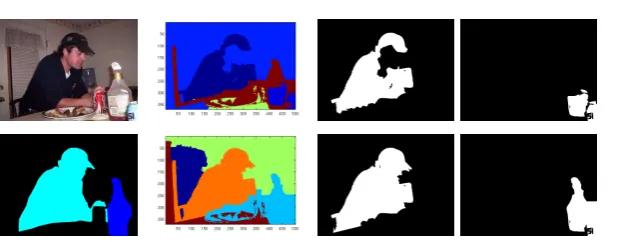
Fig. 3.Quantum vs classical ranking for person and bottle segmentation. First row, from left to right: image, classical rank at iteration 28, grouping result using classical rank for person (IoU=0.65), grouping using classical rank for bottle (IoU=0.36) . Sec-ond row, from left to right: ground truth, quantum rank at iteration 28, result using quantum rank for person (IoU=0.80), result with quantum rank for bottle (IoU=0.67).
dataset. In all cases the number of initial SLIC super pixels is 500 and there are 35 levels in the hierarchy until we reach a single segment.
Firstly, we analyze the behavior of Pagerank vs qrank (its low-pass approx-imation), before going through IoU analysis. In Fig. 2 we try to detect a car embedded in a textured environment. Pagerank seems to invert the priorities of qrank. It prioritizes the selection of segments inside quasi-homogeneous regions, whereas boundary segments have a low rank (blue). However, once the homo-geneous region is built, its ranking decreases (see the grouping of the sky, in first row, which starts at interation 8 and it is stopped at iteration 13). Most top-ranked segments in qrank correspond to low-ranked ones in Pagerank (see the shadowed region at the top of the car). However, this ”inversion” is mislead-ing since some top/medium-ranked segments in qrank are also prioritized by qrank. On the one hand, the tendency of Pagerank to propose merging inside a quasi-homogeneous region may merge a part of the object with the background when the appearance of the background and the part of the object are similar. In the case of the car, this results in obtaining a smaller area than the ground truth. On the other hand, the behavior of qrank may lead us to merge the object with a part of the background producing a bigger area than the ground truth. These behaviors are replicated in Fig. 3 where qrank outperforms Pagerank when segmenting a person and a bottle.
However, our grouping method uses only low-level cues and is not trained for object-like segments. Thus, it is natural to outperform CPMC on background region classes, for which it is not trained. Also, our method tends to group similar appearance regions, while CPMC may group different appearance regions. This explains that CPMC outperforms our method on many foreground object classes and on the overall performance.
To conclude, qrank slightly outperforms its classical counterpart, and in some cases both outperform a state-of-the-art learning-based method. These experi-ments provide an initial insight of the power of quantum walks but we must complete the low-pass ranking with higher-order experiments which become fea-sible in segmentation settings.
Acknowledgements Funding. F. Escolano: Project TIN2012-32839 (Spanish Gov.). E. R. Hancock: Royal Society Wolfson Research Merit Award.
References
1. Grady, L.: Random walks for image segmentation. TPAMI28(11) (2006) 1768– 1783
2. Burges, C.J.C., Platt, J.C.: Semi-supervised learning with conditional harmonic mixing. In Chapelle, O., Sch¨olkopf, B., Zien, A., eds.: Semi-Supervised Learning, Cambridge, MA, MIT Press (2006)
3. Zhou, D., Huang, J., Schlkopf, B.: Learning from labeled and unlabeled data on a directed graph. In: ICML. (2005) 1041–1048
4. Achanta, R., Shaji, A., Smith, K., Lucchi, A., Fua, P., S¨usstrunk, S.: Slic super-pixels compared to state-of-the-art superpixel methods. TPAMI 34(11) (2012) 2274–2282
5. Nock, R., Nielsen, F.: Statistical region merging. TPAMI26(11) (2004) 1452–1458 6. Page, L., Brin, S., Motwani, R., Winograd, T.: The pagerank citation ranking:
Bringing order to the web (1999)
7. Johns, J., Mahadevan, S.: Constructing basis functions from directed graphs for value function approximation. In: ICML. (2007) 385–392
8. Langville, A.N., Meyer, C.D.: Deeper inside pagerank. Internet Mathematics 1
(2004) 335–400
9. Aharonov, Y., Davidovich, L., Zagury, N.: Quantum random walks. Phys. Rev. A
48(August 1993) 1687–1690
10. Grover, L.K.: A fast quantum mechanical algorithm for database search. In: ACM Symposium on Theory of Computing. (1996) 212–219
11. Szegedy, M.: Quantum speed-up of markov chain based algorithms. In: FOCS, IEEE Computer Society (2004) 32–41
12. Paparo, G.D., Martin-Delgado, M.A.: Google in a quantum network. CoRR
abs/1112.2079(2011)
13. Paparo, G.D., M´’uller, M., Comellas, F., Martin-Delgado, M.A.: Quantum google in a complex network. Scientific Reports3:2773(2013)
14. Carreira, J., Sminchisescu, C.: Cpmc: Automatic object segmentation using con-strained parametric min-cuts. TPAMI34(7) (2012) 1312–1328