White Rose Research Online URL for this paper: http://eprints.whiterose.ac.uk/85326/
Version: Accepted Version
Article:
Divjak, D.S., Szymor, N.S. and Socha, A.K. (2015) Less is more: possibility and necessity as centres of gravity in a usage-based classification of core modals in Polish. Russian Linguistics, 39 (3). ISSN 1572-8714
https://doi.org/10.1007/s11185-015-9153-6
[email protected] https://eprints.whiterose.ac.uk/
Reuse
Unless indicated otherwise, fulltext items are protected by copyright with all rights reserved. The copyright exception in section 29 of the Copyright, Designs and Patents Act 1988 allows the making of a single copy solely for the purpose of non-commercial research or private study within the limits of fair dealing. The publisher or other rights-holder may allow further reproduction and re-use of this version - refer to the White Rose Research Online record for this item. Where records identify the publisher as the copyright holder, users can verify any specific terms of use on the publisher’s website.
Takedown
If you consider content in White Rose Research Online to be in breach of UK law, please notify us by
Less is more:
possibility and necessity as centres of gravity in a usage-based classification of core modals in Polish1
Dagmar Divjak1, Nina Szymor1 & Anna Socha-Michalik2
The University of Sheffield (UK)1, The Jagiellonian University (Kraków, Poland)2
Russian Linguistics
International Journal for the Study of Russian and other Slavic Languages 39(3)
Abstract
In this paper we present the results of an empirical study into the cognitive reality of existing classifications of modality using Polish data.
We analyzed random samples of 250 independent observations for the 7 most frequent modal
words (m ), extracted from the Polish
national corpus. Observations were annotated for modal type according to a number of classifications, including van der Auwera and Plungian (1998), as well as for morphological, syntactic and semantic properties using the Behavioral Profiling approach (Divjak and Gries 2006). Multiple correspondence analysis and (polytomous) regression models were used to determine how well modal type and usage align. These corpus-based findings were validated experimentally. In a forced choice task, naive native speakers were exposed to definitions and prototypical examples of modal types or functions, then labeled a number of authentic corpus sentences accordingly. In the sorting task, naive native speakers sorted authentic corpus sentences into semantically coherent groups.
We discuss the results of our empirical study as well as the issues involved in building usage-based accounts on traditional linguistic classifications.
NKJP móc, mo na,
musie nale y, powinien, trzeba, wolno
behavioral profiles Divjak, Gries 20
(van der Auwera, Plungian multiple
correspondence analysis
e
1. Accounts of modality
Modality has proven to be a fruitful research domain in both western (e.g. Perkins 1983, Huddleston 1988, Sweetser 1990, Bybee et al. 1994, van der Auwera and Plungian 1998, Palmer 2001, Hengeveld 2004, Nuyts 2006) and eastern European linguistic traditions (e.g.
G щ 1971, Korytkowska & Roszko 1997, Mirowicz 1956, Wróbel
1991, Puzynina 1974, Rytel 1982).
The core difference between western and eastern approaches lies in which sentences are considered modal. Western European linguists tend to limit modality to sentences that have an explicit modal marker. Polish linguists consider modality an inherent feature of the sentence; therefore, each sentence is a modal one, regardless of whether a modal marker is used.
A further difference pertains to what guides classifications. In Western accounts, the major classifications take as point of departure the source of the modality, that is, the conditions
under whichsomething is possible or necessary; few focus on the role of the speaker or agent.
Polish accounts have a different focus. Some Polish scholars (cf. Mirowicz 1956, Rytel 1982) define modality as the relation between the content of the utterance and reality, leaving out
O (щ G P
Korytkowska & ‘
statement. This has resulted in differently focused classifications of modality.
In the following sections, we will briefly comment on general tendencies in the existing literature on general categorizations of modality, leaving aside treatments of specific modal words. We will focus on disagreements in the literature, in particular disagreement on the domains to include (1.1.), the number of types to distinguish (1.2.) or the labels and definitions (1.3.) to use for each type.
1.1. Modal domains
T “
domains of modality are volition and evidentiality; we will define them briefly but they remain outside the scope of this study.
Evidentiality refers to utterances in which the truth-value of the described state of affairs is explained with reference to certain sources of knowledge. These sources include general knowledge, visual experience, auditory evidence, and hearsay (Palmer 2001, 8). Van der
A P
Evidentiality is closely related to epistemic modality - they are logically connected due to their mutual reliance on evidence, hence the discussion about its membership in the modal category. 1.2. Modal types
Linguists disagree as to which criterion should be used to classify modal meanings and how many types of modality to distinguish. Although van der Auwera & Zamorano Aguilar (forthc.)
G
classifications are not typically set up around these concepts. Instead, classifications center around the relation of the utterance to the real world, possibly seen from the point of view of the speaker or the agent, or centring on the source or origin of the modal conditioning.
Classifications can consist of as few as two (e.g. Coates 1995, Palmer 2001, Puzynina 1974) and
as many as six types (e.g von Fintel 2006). In addition to 1) alethic modality, sometimes called
logical or metaphysical modality, which concerns what is possible or necessary in the widest
sense, von Fintel distinguishes: 2) epistemic modality (from Greek: episteme, meaning
available evidence is; 3) deontic moda G
possible, necessary, permissible, or obligatory, given a body of law or a set of moral principles
or the like; 4) bouletic modality, sometimes boulomaic modality, concerns what is possible or
necessary, g dynamic modality,
concerns what is possible or necessary, given a particular set of circumstances; and 6)
teleological G r
necessary for achieving a particular goal. Different subsets of these types are encountered in both western and eastern European approaches, but are used to categorize a different subset of sentences.
To give some examples (we will return to some of these in more detail in Section 1.4),
1. Palmer (2001) proposes two types, i.e. event modality and propositional modality.
These types are further divided into deontic/dynamic and epistemic/evidential modality
respectively. Grzegorczykowa (1995) distinguishes
Coates (1995) also proposes a bifurcation but labels them root vs. epistemic modality. Puzynina (1974), finally, contrasts objective and subjective modality.
2. Perkins (1983) suggests three types - dynamic, deontic and epistemic modality. Rytel (1982) works with epistemic, deontic and alethic modality. Bybee et al. (1994) also propose three types but they distinguish agent-oriented, speaker-oriented, and epistemic modality.
3. van der Auwera and Plungian (1998) distinguish four types: participant-internal, and participant-external, deontic and epistemic modality.
1.3. Labels and definitions
There is also lack of unanimity as to the definitions and labels given to the different types of modality. For example, there are differing opinions in respect of the category of dynamic modality - although some linguists agree that it is a separate category (Perkins 1983), others label (some aspects of) it together with deontic modality, under such names as event modality (Palmer 2001), root modality (Hofmann 1976, Coates 1983, Sweetser 1990), or agent-oriented modality (Bybee et al. 1994).
1.4. Modal categories used in this study
In this study we will work with 4 classifications, representing different choices with regards to the nature of modality and the number of types it comprises. These are van der Auwera and Plungian (1998), Bybee et al. (1994), Palmer (2001) and Coates (1995).
Van der Auwera and Plungian (1998, 80-
involve possibility and necessity as paradigmatic variants, that is, as constituting a paradigm
W ich they define as
follows (examples theirs):
Participant-internal - (necessity)
(1) Boris can get by with sleeping five hours a night.
(2) To get to the station, you can take bus 66.
Deontic - permissions (possibility) and obligations (necessity) imposed on the participant by social/moral/legal norms
(3) John may leave now.
Epistemic - a proposition is judged to be uncertain (possibility) or probable (necessity) relative to some judgement(s)
(4) John may have arrived.
We retained this classification as our principal classification because its "single explanation" relates to the conditioning or source of the modal situation in a way that coincides with moral development in children (cf. Piaget 1932, Kohlberg 1984): is the source for a necessity or possibility inside the agent, in the immediate circumstances, in larger society or merely inferred?
Bybee et al. (1994) distinguish three categories of modality, i.e. epistemic, agent-oriented and speaker-oriented. Agent-oriented modality captures the conditions imposed on an agent in relation to the action mentioned in the sentence; this includes obligation, desire, ability, permission and root possibility. Speaker-oriented modality covers all directives, including imperative, optative, permissive, prohibitive, etc. The two categories, therefore, cut across the traditional concept of deontic modality.
Palmer (2001) works with two overarching modal types -- event modality and propositional modality -- that are further divided into deontic/dynamic and epistemic/evidential. The latter
-value of the proposition. The former
refer to events that could have not yet taken place. The subdivision into deontic and dynamic modality is given by the source of the conditioning factors. In deontic modality, the source is external, and the notion refers to permission and obligation; the definition is therefore relatively standard and in line with the other two accounts presented here. The source of factors in dynamic modality, on the other hand, is internal, i.e. dynamic modality refers to internal possibilities (i.e. abilities) and internal needs.
Coates (1995) proposes two subcategories epistemic modality and root modality. The meanings expressed by both types of modality revolve around the notions of possibility and necessity, and modal expressions have both root and epistemic meanings. Epistemic meanings
confident or uncertain whether the state of affairs uttered is true. Root meanings, on the other hand, refer to situations such as permission and obligation.
The question that we want to investigate in this paper is: are these and other classifications cognitively real? Do they play a role for speakers of a language or are they the interpretation and application of philosophical reasoning to language data? There are more examples of the latter approach in Slavic linguistics, e.g. the Vendlerian categories that were pressed into service to describe aspectual use in Slavic languages.
1.5. Modal words
According to Hansen (2004, 246-251), the semantic category of modals in Slavic consists of a small core with specific semantic and syntactic properties, and a periphery, which overlaps with other categories. Based on the characteristics of the core and the periphery of the category, we can distinguish between fully-fledged modal auxiliaries on the one hand, and modal content words and modal constructions on the other. The internal core of the category consists of modals which show both the central and the peripheral features. The external core of the category, on the other hand, consists of modals that have only the central characteristics and not necessarily the peripheral ones. Lastly, those modals that do not exhibit the central features to a full extent constitute the periphery of the category.
The central (core) features of modals include:
1. Semantic characteristics: a modal must express two or more types of modality. For
example, the verb móc
likelihood. As a contrast, the verb (be able to) only expresses capability.
2. Morphological characteristics: a modal must express the modal meaning independently,
rather than relying on the construction as a whole.
3. Syntactic characteristics: a modal must be a part of the predicate and does not normally
The peripheral features of modal auxiliaries include:
1. Semantic characteristics: a modal must not express any other meanings than the modal
ones.
2. Morphological characteristics: a modal no longer exhibits some of the characteristics of
the category to which it originally belonged, for example, it cannot form an imperative, or an infinitive. In other words, modal verbs are defective.
According to these criteria, then, such expressions as perhaps or probably are not considered to
be fully-fledged exponents of modality because they do not have all of the core characteristics of modals, i.e. they do not, for example, express two or more types of modality they are only
able to express epistemicity. Expressions such as it is necessary can express more than one
modal meaning; however, they are not followed by an infinitive in Slavic, which means that they too do not meet all of the necessary criteria. In other words, only modal auxiliaries meet the criteria for core modals as proposed by Hansen (2004), and for that reason the focus of this
Based on these criteria, Hansen claims that the internal core of the category of Polish modals
consists of , móc powinien
defective). The external core consists of trzeba
defective), and nsists of wolno
, wypada and
M and powinien exhibit all the central and peripheral characteristics, clearly
belonging to the internal core, and will be investigated here. M , however, does not meet the
criteria: apart from a modal meaning it also has a non-modal meaning of have (something).
N and trzeba, placed by Hansen in the external core of the category of modality are also included in this analysis.
Modals placed by Hansen in the periphery include wolno, as well as wypada, and nie
, which are placed on the border between modal auxiliaries and modal content
words. Wolno, although lacking semantic modal polyfunctionality, is frequently used to express
permission and prohibition, and will thus be included in this analysis. Wypada is more generally
used to express ethical or moral norms while expresses a lack of need for
something/to do something. The latter tw щ
(1971) only; wypada is rather colloquial while is perceived as an archaic and
In sum, all modal words that Hansen (2004) classed as fully-fledged modal auxiliaries will be
considered, with the exception of Excluded are also the two modals on the border
between modal auxiliaries and modal content words, wypada and .
2. Toward a usage-based classification
C э 40) and
provide an account of language data consistent with knowledge of human cognition. In this paper we present the results of a series of empirical studies that focus on the cognitive reality of existing classifications of modality using Polish data.
We aim to capture the way in which the different modality types as, for example, defined by van der Auwera and Plungian (1998), correlate with usage data by tracking the behaviour of modal words in their sentential contexts. We use this data to determine how different types of modality correlate with aspects of usage, to examine which types of modality cluster together and could be grouped and to quantify the intuitive clarity and related cognitive plausibility of the proposed classifications.
2.1. Data and annotation scheme
We start from an analysis of corpus data that applies Behavioral Profiling (Divjak & Gries 2006) to sentences extracted from the National Corpus of Polish. The National Corpus of Polish (http://nkjp.pl/) is a balanced, representative, morpho-syntactically annotated corpus of 239 million words. It consists of journalistic texts, belletristic literature, non-fiction, specialist periodicals and journals, other written texts, internet texts, and transcripts of conversations.
For each of the 7 most frequently used modals in the balanced sub-corpus of Polish, 250 independent observations were extracted and annotated to create a Behavioral Profile. BPs capture the formal and semantic characteristics of all elements within the sentence. In all, 12 different variables were annotated for, yielding 42 variable levels. The variables fall into two classes, form and meaning, and are described below:
Form-related variables encode the following 5 properties:
1. polarity of the sentence, which can be positive or negative and captures negation added
to the modal verb;
2. aspect of the infinitive: a verb typically exists in imperfective and perfective, with some
sentences containing an infinitive that could exist in both imperfective and perfective were retained, bringing the size of the database to 1359;
3. ellipsis or non-expression of the infinitive captures whether the infinitive that follows the modal was expressed or not;
4. voice encodes whether the verb is active or passive;
5. case of the subject was marked as either nominative or oblique (usually dative).
Meaning-related properties capture seven different aspects of the modal construction:
1. Seven modal words were analyzed, i.e. móc ,
ctive), powinien ,
trzeba , wolno The examples given
below are taken from the NKJP:
(5) D - i
z tej wiedzy.
I - and
(6) Moja
M
(7) U ,
profesjonalnych i kompetentnych osób.
I
(8) -A
- A I
(9) Powinienem
strony.
I
(10) Gdy
A
(11) Natomiast w Wietnamie trze
M S
W
In Vietnam, however, one must apply for special permission, issued by the Ministry of Internal Affairs, in order to search the inter
2. The four different categorizations of modality according to type introduced in Section
1.4. were applied. The distribution of type-categories in our dataset of 1359 examples is: deontic 188, participant external 1039, participant internal 68, epistemic 64.
(12) Deontic:
P F
licencje.
T C
(13) Participant external:
M
Y
(14) Participant internal:
M RM
A I ‘M I
(15) Epistemic:
T
T
To illustrate how difficult it is to annotate sentences for modality type, we present our own interrater agreement (or rather disagreement), in Table (1): we disagreed for at
Verb % agreement Annotaters
móc 69% (NS-AS)
powinien 66% (NS-DD)
wolno 63 % (NS-DD)
59% (NS-AS)
49% (NS-AS)
Table (1): Interrater agreement for categorization along the lines of (Auwera & Plungian 1998)
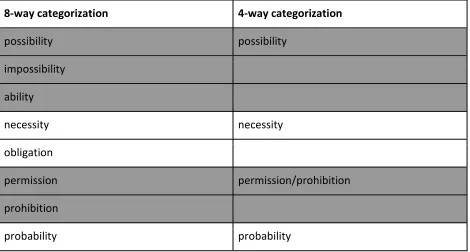
Because of the lack of interrater agreement in the annotation of modal types, we decided to introduce an alternative categorization, based on functions, that has proven useful in studying the acquisition of modal meanings by children (Coates 1988).
3. Two different categorizations of modal function were trialled, i.e. one with eight rather
specific categories and one with four broader categories, cf. Table (2)
8-way categorization 4-way categorization
possibility possibility
impossibility ability
necessity necessity
obligation
permission permission/prohibition
prohibition
probability probability
Table (2): four versus eight function-based categorizations of modality
[image:13.612.66.536.73.240.2] [image:13.612.68.538.388.640.2](16) Necessity:
Studia fotograficzne musi
Kodak.
P ы
(17) Permission:
N J C wolno
podatek Cezarowi, czy nie?
T щ sus this tricky question: are we allowed to pay tax to Caesar or
(18) Possibility:
N
D
(19) Probability:
G P J M
W P щ “
4. The modal source was tagged as either internal or external to the subject.
(20) External:
M Ż
powiedzenia.
T A
(21) Internal:
W
Yes, I like the sea, but it d I
5. Subject semantics: adapting the scheme proposed in Divjak & Gries (2006), we used four
different labels to summarize the different types of subjects encountered in our sample, i.e. animate:human, animate:organism, inanimate:abstract, inanimate:concrete.
6. Infinitive semantics: we used the bottom-up semantic classification proposed in Divjak &
Gries (2006) to annotate the infinitive verb. The nine categories used are physical,
physical involving an other , motion, motion involving an other , speech,
7. SoA applicability: following Divjak (2009) we encoded whether a situation was generic and always applies to everyone and everywhere or was specific in any sense.
2.2. Data analysis techniques
There are various types of statistics that can be used, and the choice depends both on the purpose of the study and the type of data collected. Using a Behavioral Profile approach, we aim to capture the behavior of modals within the inherently multivariate sentential context. Our interest was to explore the relationships between the variables introduced in Section (2.1) and to assess which classification is best predicted from a variable or combination of variables. For this, we use two complementary statistical techniques.
2.2.1 Multiple Correspondence Analysis
Multiple correspondence analysis (MCA) is designed to explore categorical data and establish whether variables of interest form property clouds (for an introduction to MCA for linguists, see Glynn 2014). There are various packages that can be used in R to carry out MCA; for this study,
‘ N G MCA ever.
It will help discover structure but will not state whether the relations found are significant or whether they occurred by chance.
2.2.2 Polytomous Regression
3. Results
In this section we describe the results of the statistical analyses of our data. The interim conclusions will be subjected to experimental validation in Section 4.
3.1 Multiple Correspondence Analysis
We ran MCAs for all logically possible variable combinations for type and function separately. If morphological, syntactic and semantic properties of the type described in Section 2.1. have any bearing on modality, we would expect clouds to form that contain a modal type or function, surrounded by points representing the properties that define it. MCA provides visualised results in the form of biplots: these biplots capture the dimensions that are created in the exploratory process but need to be interpreted. It also provides numerical output which gives details of, among others, the Eigenvalues, i.e. the percentage of data variation explained by a particular variable combination.
The multi-dimensional nature of the plots makes it difficult to interpret them. Even though data points are close to each other on the plot, this does not necessarily mean that they are related: it may be the case that if we looked at the data from a different dimension, these same points would be far apart. For this reason we based our interpretation on the plots that had the
P
correlations suggested by MCA are significant; the associated standardized residuals were used to identify the direction of these relationships.
3.1.1 MCA for type-based classifications
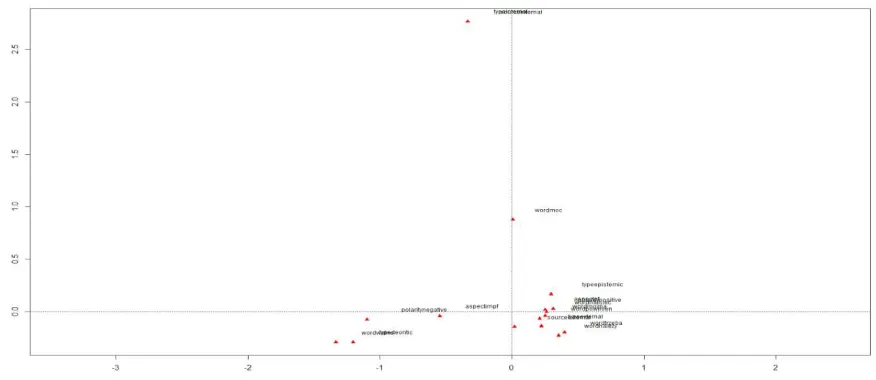
For type classifications, most of the variance in the data was captured by plotting van der
A P olarity
Figure (1a): MCA plot of Type by modal word, aspect of the infinitive, polarity and source of the modal conditioning
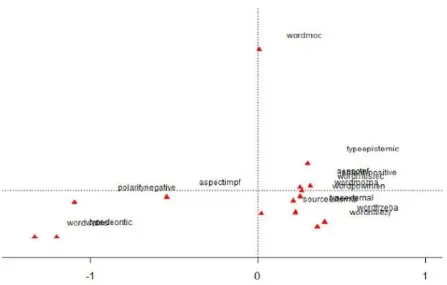
[image:17.612.78.516.118.308.2]Figure (1b): MCA plot of Type by modal word, aspect of the infinitive, polarity and source of the modal conditioning - zoomed in on origin
Participant-external modality has a significant association with only three of the points it is
close to, i.e. the words and trzeba, and the perfective aspect. Epistemic modality is
significantly associated with the words móc and powinien only. Deontic modality, pictured on
the left hand side of the plot, significantly groups together with imperfective aspect, negative
polarity, and the word wolno. Participant internal modality lies far from the centre of the plot,
towards the top, where it is significantly joined by an internal source of conditioning and with
the word móc.
In other words, this visualization shows that there is very little within the sentential context of the sentence that would support a type-based categorization of modality, and hence would provide the usage-based scaffolding that speakers need to build up the corresponding mental representations.
We performed the same analysis for the three other classifications of modality described in Section 1.4. The plot for Palmer (2001) is very similar to the one for van der Auwera and
P C classification resulted in a visualization that put root modality in
the centre of the plot, without significant associations with any of the variables. The plot for
B C -oriented
[image:18.612.70.517.114.399.2](1995) speaker-oriented modality showed significant associations with powinien and negative
polarity, while their epistemic modality associates significantly with móc and powinien, as in the
other classifications, including Coates (1995).
3.1.2. MCA for function-based classifications
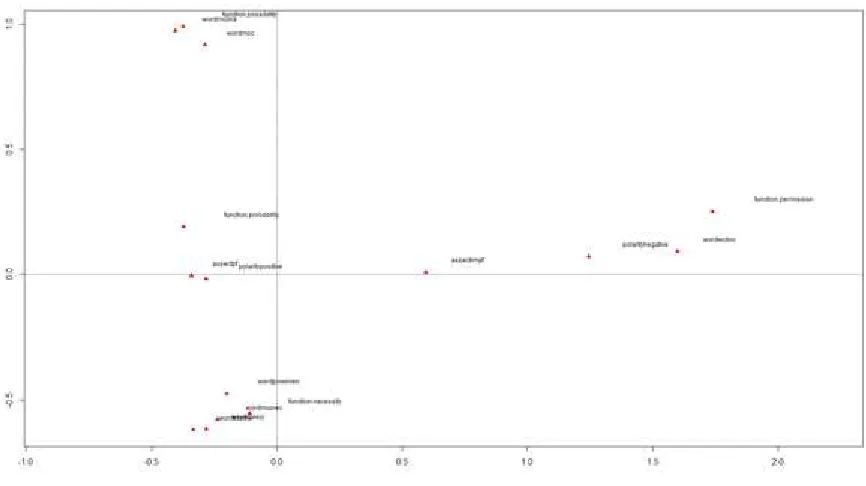
For function classifications, most of the variance in the data was captured by plotting a 4-way function classification (consisting of possibility, necessity, probability, and permission) against modal word, aspect of the infinitive and polarity. An 8-way classification which included ability, impossibility, obligation, prohibition in addition to possibility, necessity, probability, and permission showed that some meanings clustered together (i.e. ability and impossibility grouped with possibility; obligation with necessity; prohibition with permission) so they were collapsed. Figure (2) shows the first two dimensions that explain 60% of the variance in the data; this is 1% more than for the Type plot, with one variable less. Including the source of conditioning on the function plot reduces the inertia but removing it from the type plot makes the inertia fall to 52.4%.
Figure (2): MCA plot of 4-way function by modal word, aspect of the infinitive and polarity
[image:19.612.81.514.387.630.2]predominantly positive functions such as necessity and possibility and typically negated functions such as permission; that is, the lack of permission.
On the left hand side at the top we have a data point for possibility, significantly clustered with
the near-synonymous words móc and . At the bottom, we have a data cloud for
necessity, significantly clustered with the near-synonymous words , powinien, ,
and trzeba. In the middle of the plot, by the origin, we have probability; its central location indicates that probability has an undifferentiated sentential profile distribution. There are indeed no specific modals associated exclusively with probability; instead, probability shares
modals with other functions - móc with possibility, and powinien with necessity. Given that
these relationships are significant, probability could be seen as an extension of possibility and necessity, defined by properties that lie outside the sentence boundaries. Finally, on the right hand side of the plot, around the middle, we have the function of permission, which is
significantly associated with wolno, negative polarity, and imperfective aspect. Semantically
permission is related to both possibility and necessity, i.e. when the word wolno is used in
positive contexts, it states that something is being made possible by being permitted. When it is used in negative contexts, it expresses a prohibition, i.e. a necessity not to do something. Perhaps permission/prohibition, just like probability, is a link between possibility and necessity. Its location on the plot, i.e. in the middle between possibility and necessity, would support that.
This visualization shows that there is sufficient information available in the usage properties we annotated for to support a function-based categorization of modality and hence assist speakers in building up the corresponding mental representations. Multiple correspondence analysis is only an exploratory technique, however, and was therefore followed up with a polytomous regression analysis.
3.2 Polytomous regression analysis
3.2.1 Regression for type
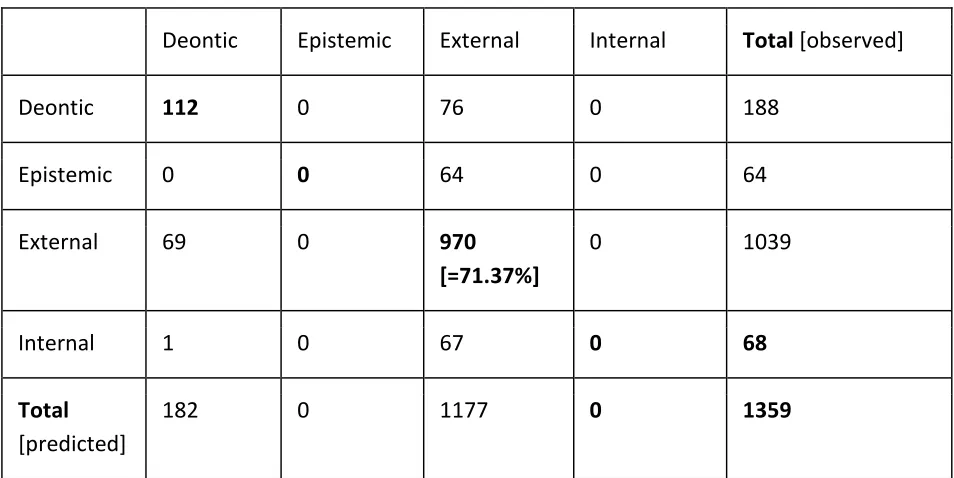
Our regression model was built step-wise, bottom-up. For type, the best model consists of 3 predictor variables: polarity, aspect of the infinitive and modal word. The predictions are displayed in Table (3). The overall prediction accuracy is very high for a 4-way choice at 79.61%, but given the skewed distribution of the observations this is not surprising: a baseline model that always chooses the most frequent type, i.e. participant-external, would make correct predictions 71.37% of the time. The R squared value is relatively low at 28.27%, indicating that the variables included in fact predict little of the variability in the data.
Deontic Epistemic External Internal Total [observed]
Deontic 112 0 76 0 188
Epistemic 0 0 64 0 64
[image:21.612.63.540.234.473.2]External 69 0 970
[=71.37%]
0 1039
Internal 1 0 67 0 68
Total [predicted]
182 0 1177 0 1359
Table (3): Predictions for type by polarity, aspect of the infinitive and modal word
Instances classified as external are correctly predicted as external in 93.35% of all cases; deontic ones are predicted correctly in 59.5% of all cases. Situations tagged as internal are never correctly predicted, and are instead considered to be instances of external modality. Epistemic situations are not predicted at all. This confirms that there is not much within the sentential context that helps predict what modality type we are dealing with.
3.2.2 Regression for function
again of 3 predictor variables: polarity, aspect of the infinitive and modal word. The predictions are displayed in Table (4). The overall prediction accuracy for function is at 87.27% higher than that for type, while the most frequent option occurs far less frequently, 47.76% of the time. The R2 likelihood is up and stands at 70%, indicating that the variables capture a large part of the variation in the data. Interestingly, modal word is the single best predictor: predicting modal function from word alone gives us an accuracy of 87%, so aspect and polarity add relatively little, but their contribution is statistically significant.
necessity permission possibility probability Total [observed]
necessity 691 72 7 0 770
permission 0 128 16 0 144
possibility 0 14 367 0 381
probability 33 0 31 0 64
Total [predicted]
724 214 421 0 1359
Table (4): Predictions for function by polarity, aspect of the infinitive and modal word
The table shows that the majority of the necessity sentences are predicted as necessity, with a few predicted as as permission; the majority of permission sentences are predicted as permission, with some predicted as possibility; the majority of possibility sentences are predicted as possibility, with a few predicted as permission; but none of the probability sentence are predicted as probability. Approximately half of them were predicted as necessity and half as possibility. This would confirm our earlier MCA results which placed probability on a scale between necessity and possibility, right in the center of the plot; there are no usage-features that reliably delineate probability.
3.3. Interim conclusion
is surprising, especially in the light of the observation that the literature on modality typically works with isolated sentences to illustrate a specific modal type. Modal functions, on the other hand, map directly onto primary aspects of language in use, primarily the choice of modal word. Given that Polish does not have special lexical items to signal probability, usage cannot predict probability (i.e. epistemic modality). Instead, it is predicted as either necessity or possibility in this study.
4. Experimental validation
We followed up on our corpus-based findings with two experimental studies. These studies focused on finding out how intuitive the type and function classifications are for naive native
P
the type- or function-based categorizations of modality most. Below we discuss the set-up and
results of these studies.2
4.1. Forced choice task
The forced choice tasks were designed to establish whether naive speakers of Polish grasp linguistic classifications of modality intuitively, and whether they show a preference for type or function.
Respondents were presented with authentic Polish modal sentences taken from the random samples used for the corpus study. There were 4 examples per variable level, thus the forced choice task for type contained 16 sentences, whereas the task for function contained 32 sentences. Subjects were asked to classify the 16 sentences according to the 4 types (epistemic, deontic, external, internal) and the 32 sentences according to 4 functions or 8 functions (possibility, necessity, probability, permission, ability, obligation, impossibility, prohibition). For each of these labels, definitions and an example were provided in Polish. For the type classifications, the definitions from Section 1.4 were translated into Polish. For the function
classification, the definition of each function was looked up in S J P PWN
2Sample surveys can be viewed online:
Forced choice (labelling) task (modality types) -
https://docs.google.com/forms/d/1jiTj6ovAVxzHnnZlykk9khxflHg7EooHjLd8ayUeQjA/viewform ; Forced choice (labelling) task (modal functions) -
https://docs.google.com/forms/d/1oAqeSQDvXR7ZwfuneYw0xSCcZpB3L1tqCyr85chIryM/viewform. Sorting task (modality types) - https://jfe.qualtrics.com/form/SV_9miRcLCj5jvFqUR ;
available on sjp.pwn.pl and then rephrased to suit the modal context. This information was repeated below each sentence that had to be labelled. The tasks thus compared the (learnability of the) type model with the (learnability of the) function models.
The study was set up using Google Forms, and 125 adult native speakers took the test. There were 57 responses to the type forced-choice task; 44 responses to the function forced-choice task (with 8 functions); and 24 responses to the function forced-choice task with 4 functions.
Histograms and a Shapiro-Wilk normality test show that the type data is reasonably normally distributed (p = 0.2811) while the function data borders on not being normally distributed (p = 0.07274). A t-test run to compare the variances shows that they are borderline significantly different (p = 0.05176).
Among the 101 respondents that responded to our first call for participation in the type and 8-way function tasks, there were about 19, or just under 20%, who currently live abroad. A t-test showed that there were no significant differences in mean score (p-value ~ .9) between respondents currently living in Poland and those living abroad so the groups were collapsed.
For the 4-way function labelling task to which we recruited in a second call, half of the participants were based abroad and the difference in score between those remaining in Poland and those residing abroad was nearing significance (p = 0.07858 with the U-test and p= 0.06549
W -test). This difference may be due to difference in level of education obtained (with
Poles residing abroad having obtained a higher/lower level of education than those remaining in Poland) rather than a difference in place of residence; this remains outside the scope of the current investigation.
We ran Welch 2-sample t-tests on the data that compare means of groups if variances are not equal and found the differences in means not to be significant. We also ran Wilcox U-tests that compare means of groups if the distribution is not normal; again, the differences in means were not significant. The results of the pair-wise comparisons of the mean scores are as follows, standardized to be correct out of a total of 10:
1. Type (4) vs function (8): means 4.55 vs 4.60; ns (Welch p = 0.42; Wilcox p = 0.38) 2. Type (4) vs function (4): means 4.55 vs 4.42; ns (Welch p = 0.67; Wilcox p = 0.6)
3. Function (8) vs function (4): means 4.60 vs 4.42; ns (Welch p = 0.77; Wilcox p = 0.31 with warning about ties in the data)
distinctions between modal types or functions and performed equally poorly when applying either of the classifications to real-life sentences. Interestingly, the respondents performed best on sentences involving probability, assigning this label correctly in over 60% of all cases. Given that the regression models did not predict probability at all from the available contextual annotation, the clue must lie elsewhere. One possibility that deserves further exploration is the fact that both sentences expressing probability contained an unexpressed (neuter/inanimate) third person singular subject.
4.2. Sorting task
Following Divjak & Gries (2008) a series of progressive open sorting tasks was run in order to ries they would distinguish and whether their intuitive sortings would show most resemblance to the type- or function-based categorizations of modality. A sorting task has previously been used in research on modality: Coates (1988) ran a sorting task with 8 and 12 year olds to reveal the system of modal meanings in children. In contrast to our experiment, Coates (1988) embedded all modals in the same sentential context and asked participants to perform a free sorting only.
A different group of subjects from those who participated in the labelling task were presented with the same authentic Polish modal sentences taken from the random samples used for the corpus study as were used in the forced choice tasks. There were again 4 examples per variable level, thus the forced choice task for type contained 16 sentences, whereas the task for function contained 32 sentences. For each modality type there were 2 sentences that both annotators had labelled identically and 2 that they had labelled differently. Subjects were asked
meaning of the
For the type test, the first task was a free sorting task, allowing subjects to sort the sentences into as many groups as they wanted. This was done in order to see how many, and what type of, groups they would create if no limits were imposed. In the second task of the type sorting test, the number of possible groups was limited to four. Here, the aim was to see whether respondents would sort the sentences into the four groups in accordance with the number of modality types proposed by van der Auwera and Plungian (1998). Lastly, since the regression has shown that epistemic modality is always predicted as one of the other modality types, the final task in the type sorting test asked subjects to create three groups.
task was a free sorting task, with no limit imposed on the number of groups to be created. The second task allowed for 8 groups (to see whether respondents distinguish between, for example, ability, possibility, and impossibility, or whether they group them together), and the third one was limited to four groups (to see whether respondents would create the same groupings that were suggested by corpus data).
The tasks were administered using the Qualtrics software of the Qualtrics Research Suite (Qualtrics, Provo, UT). Unfortunately, the task had to be halved to avoid subjects dropping out half-way through and in the revised version only 2 sentences per category were retained, that is 8 in total for type and 16 for function. For type, each pair contained 1 sentence on which the raters agreed, and 1 sentence on which they disagreed. In total, 47 subjects completed the experiment; 24 for function, and 23 for type.
Using an R function (Salmoni 2012) we worked out the similarity of any two items by taking the number of times both were put into the same group and dividing by the same number plus the total number of times the items were put elsewhere. This measure ranges from 0.0 to 1.0 with higher scores meaning greater similarity. We then clustered the data, using hierarchical agglomerative clustering.
We can now turn to the dendrogram in Figure (3):
In general we obtained the most homogenous clustering on the function task, i.e. when we asked respondents to sort the 16 sentences into 4 groups, and these groups are homogenous if the sentences are labelled according to the modal function they express. For the 8-cluster function sorting task, sortings went predominantly by modal word (except that there were 2
clusters with móc that were, however, not coherent in terms of function either); out of the 8
functions, only necessity was retrieved. Modal types were never replicated.
Read from right to left, the first split in the dendrogram coincides with the division between possibility on the left and necessity on the right; this mirrors the picture we obtained with
correspondence analysis. Root is a strong indicator of cluster-membership, with móc and
clustering together to form possibility, but it is not the sole criterion: while wolno and
form clusters of their own, móc and are combined, as are powinien and .
While signals strong necessity, powinien and are softer and more
A O
examples of permission, with two different modal verbs. In naive sortings, these permission sentences are divided over two clusters, depending on the word used to express permission - if
it is wolno, the permission is grouped with necessity, but if it is , then it is grouped with
possibility. This is in line with our findings from MCA, that suggested that permission should be divided up over possibility and necessity.
Remarkably, naive clusterings never contained a separate epistemic or probability category, neither in the function sorting task, nor in the type sorting task; this contradicts the results of the forced choice task where naive speakers performed best on this category, but is in line with the outcomes of the regression model that could not predict epistemic modality or probability
either. The function dataset only contained examples of epistemic modality expressed by
necessity modals (powinien and ); in order to see how an instance of epistemic modality expressed by a possibility modal (eg. móc) would be clustered, we annotated the 8 sentences used in the type sorting task for functions and ran a cluster analysis on those results. The dendrogram is shown in Figure (4).
The dendrogram nicely shows that, even if two examples are presented, probability does not get a separate cluster but instead is divided between the necessity and possibility clusters,
depending on which word expresses the epistemic meaning. If it is móc, then it clusters with
possibility; if it is powinien then it clusters with necessity. This is exactly what we saw in the MCA and indicates that the meaning of the modal word itself overrides the modal function expressed by the sentence.
4.3 Interim conclusion
The forced choice task revealed that naive speakers, different from corpus-based models, performed poorly when applying both type and function classifications to real-life sentences: naive speakers seem unable to grasp the distinctions between modal types or modal functions on the basis of a definition and a prototypical example. Interestingly, the highest scores were obtained for sentences involving probability, the one category that statistical techniques could not predict from usage, and the one category that was never never approximated in the type or function sorting tasks.
5. Conclusion
to pick up on probability and they do intuitively distinguish differences in modal meanings expressed along the lines of necessity and possibility. One likely cause for the latter result is the close relation between necessity and possibility and lexical items.
References
A A P R
U‘э http://CRAN.R-project.org/package=polytomous
Auwera van der, J.: 1998, O C B P
XVIième congrès international des linguistes, Oxford, Paper No. 0071.
A щ P V M э T
-124.
Auwera van щ A A ) н T in
Nuyts, J. and Auwera van der, J. (eds), The Oxford Handbook of Mood and Modality, Oxford.
B щ э н “ M G D
Amsterdam/Philadelphia.
B щ э P D ‘ P W T й G T A
M э W Chicago.
C щ T “ M A э
C щ T acquisition of the meanings of modality in children aged eight and
щ C э - 434.
C щ T й ‘ й P й B щ
Fleischman S. (eds.), Modality in grammar and discourse, Amsterdam/Philadelphia, pp. 55-66.
D D M T - ‘
Russian Linguistics 33 (3), 249-269.
D D G “ T W T ‘ C B P
Journal of Corpus Linguistics and Linguistic Theory 2(1), 23-60.
D D G “ T C C
Divjak, D., Szymor, N., Lyashevskaya, O., Ovsjannikova, M., Clancy, S., Stanojevic, M.M.: 2014,
T - “ International conference on
evidentiality and modality in European languages 2014 (EMEL'14). Theme session: Evidentiality, Modality and Corpus Linguistics. Facultad de Filología, Universidad Complutense de Madrid, 6-8 October 2014.
н ы M in Borchet D.M. (ed.) Encyclopedia of Philosophy,
Detroit.
G D C A й G
D. and Robinson, J.A. (eds.), Corpus Methods for Semantics: Quantitative studies in polysemy and synonymy VIII. 545, 443 485.
Grzegorcz ‘ W W
р B M ‘ P
and Serbo-C B W N р P W B W
makes grammaticalization: A look from its Fringes and its Components, Berlin, pp. 245-271.
р ы I B G э C M щ
Skopeteas, S. (eds), M A I р I tion and Word-Formation,
Vol. 2, Berlin, pp.1190-1202.
р T ‘ P M C щ
Syntax and semantics, vol. 7: Notes from the Linguistic Underground, New York, 85-100.
Huddleston, R.: 19 й G A O C
щ “ I щ “ “
W - 146.
ы э й M D II T P Moral Development.
San Francisco.
э G T I р -Cognitive Linguistics 1(1): 39 - 74.
Lyons, J.: 1997, э “ A I N э й Volume 3
Issue 1, 89 - 95.
M A P B P
T щ XV -92.
National Corpus of Polish (http://nkjp.pl/)
N O G M C A ‘ T - and
G T P Journal of Statistical Software(20) 3.
N щ M Overview and lin н W (ed.), The Expression
of Modality,Berlin, New York: pp. 1-26.
P н ‘ M M C
P н ‘ M M nd
edition. Cambridge.
P M ‘ M й й э
P щ T M щ C э [Le jugement moral chez l'enfant].
P щ O M M ‘ Tekst i
P W - Warszawa- Kraków- G -233.
Qualtrics software, Version 59627 of the Qualtrics Research Suite. Copyright © 2014 Qualtrics.
‘ D э W
“ A O C “ A http://www.uxbooth.com/articles/open-card-sort-analysis-101/
“ й н й P C