Rochester Institute of Technology
RIT Scholar Works
Theses Thesis/Dissertation Collections
12-2009
Psyche + Physique
Janet Winkie
Follow this and additional works at:http://scholarworks.rit.edu/theses
This Thesis is brought to you for free and open access by the Thesis/Dissertation Collections at RIT Scholar Works. It has been accepted for inclusion in Theses by an authorized administrator of RIT Scholar Works. For more information, please [email protected].
Recommended Citation
Rochester Institute of Technology
A Thesis Submitted to the Faculty of
The College of Imaging Arts and Sciences
In Candidacy for the Degree of
MASTER OF FINE ARTS
Advisors: Thomas Lightfoot, Don Arday, Amos Scully and Alex Miokovic
Psyche + Physique
by
Janet Winkie
April 3 – 19, 2006
Janet Winkie
Psyche + Physique
MFA Thesis Exhibition April 3 – 19, 2006
Rochester Institute of Technology Bevier Gallery
Rochester, NY 14623
Thesis Approval
Thesis Committee’s Approval:
Chief Advisor: ____________________________ (print name)
____________________________ Date: ____________ (signature)
Associate Advisors: ____________________________ (print name)
____________________________ Date: ____________ (signature)
____________________________ (print name)
____________________________ Date: ____________
` (signature)
Department Chairperson: ____________________________ (print name)
Janet Winkie
Psyche + Physique
MFA Thesis Exhibition April 3 – 19, 2006
Rochester Institute of Technology Bevier Gallery
Rochester, NY 14623
Thesis Approval
Thesis Committee’s Approval:
Chief Advisor: Dr. Thomas Lightfoot Date: 12/03/2009
Associate Advisors: Alex Miokovic Date: 12/03/2009
Amos Scully Date: 12/15/2009
Department Chairperson: Don Arday Date: 12/16/2009
Abstract
Through this thesis I explore how human perceptions are made regarding masculinity and the impact that apparel and environment have on the male psyche and physique. I perceive the function of men’s apparel as providing a hinge, or entry point into the male identity, ultimately examining themes such as gender roles, sexuality, social class and age. In this thesis exploration, I intend to examine the male physique and embody it using male and female byproducts, found objects and accessories.
Incorporating themes such as space and place, this practice of assemblage and installation offers the “staging” of male-themed spaces, providing dialogue pertaining to the performance of male sexuality, allowing new ways of seeing how men are socially identified. The fabricated environments I have constructed in this body of work allow the viewer to contemplate their familiarity with surroundings and question their fabricated identities. This body of work does not intend to recreate environments, rather staging a moment of male existence.
symbolic medium through which the viewer can achieve a deeper understanding of the metaphysical impact of both mind and body.
Thesis Reproduction Permission Statement:
I understand that I must submit a print copy of my thesis or dissertation to the RIT Archives, per current RIT guidelines for the completion of my degree. I hereby grant to the Rochester Institute of Technology and its agents the non-exclusive license to archive and make accessible my thesis or dissertation in whole or in part in all forms of media in perpetuity. I retain all other ownership rights to the copyright of the thesis or disserta-tion. I also retain the right to use in future works (such as articles or books) all or part of this thesis or dissertation.
Print Reproduction Permission Granted:
I, _______________________________, hereby grant permission to the
Rochester Institute of Technology to reproduce my print thesis or dissertation in whole or in part. Any reproduction will not be for commercial use or profit.
Signature of Author: ____________________________ Date: ___________________
Inclusion in the RIT Digital Media Library Electronic Thesis & Dissertation (ETD) Archive
of each third party copyrighted matter to be included in my thesis or dissertation. I certify that the version I submitted is the same as that approved by my committee. Signature of Author: ___________________________ Date: ___________________
Table of Contents
Abstract page 3
Acknowledgements page 6
Thesis Proposal page 7
Introduction page 8
Social Commentary page 12
Cultural Impact page 15
Spatial Environment page 18
Robert Gober – Dia Center for the Arts, 1992 page 19 The Body: Absence and Presence page 23 Ann Hamilton – indigo blue, 1991 page 25
Process and Assemblage page 28
Conclusion page 34
Bibliography page 37
Acknowledgements
I would like to take this opportunity to acknowledge the individuals who offered thought provoking discussions, as well as moments of clarity during the process of making this thesis body of work. I appreciate the generous time and effort submitted by Tom Lightfoot, Amos Scully and Alex Miokovic. There are moments when an artist cannot make sense of what is in front of them; all it takes is someone distanced from the material, process and intent to walk in and figure out that it’s all about male castration! Thank You.
Thesis Proposal
Bodily experience informs my physical and mental state as an artist. A part of the body has often been apparent in my artwork through the use of symbolism, color and/or found objects. As a result, my sculptures become emotionally charged, which establishes a dialogue between the artwork and the viewer. By exploring the function of apparel and its related environment, in my artwork, I hope to reveal and distort both internal and external boundaries within the body.
In this thesis exploration, I intend to examine the male physique and embody it using male and female byproducts and accessories. Found objects such as vintage gloves may by sewn together in order to conceptualize a jockstrap found within a locker room setting. The absence of the body is crucial to the work, making each piece an
independent object, as opposed to them being objects of fashion. By manipulating the context of found objects within an installation format, I hope to evoke strong reactions from the viewer in relation to the construction and conditioning of gender identity.
Robert Gober and Jana Sterbak are two mixed media artists who seem to
approach issues relating to installation, apparel, and gender. I intend to research Gober’s approach to installation, as well as Sterbak’s methods of apparel and accessories as sculpture. I will explore themes of gender identity, in relation to apparel, through
explore and question how the assimilation of gender identity is interrelated with the apparel we wear and the environment from which this apparel stems from.
Introduction
Apparel is a signifier of identity. It reinforces whom we are or how we want to be perceived. The function of apparel allows for the construction and conditioning of
identity. It is a symbol of human culture. What we wear is an extension of the self. For example, a business executive not dressing the social role he or she is entitled to may be identified as someone lacking status, intelligence or discipline. In other words,
individuals may not be identified in their social roles until they have “dressed the part”. As mundane as the daily act of dressing is for the majority of society, there is an undercurrent of hidden meaning behind what apparel we place on our bodies. Human culture embeds apparel with meaning. This intimate relationship with apparel can be greatly influenced by the environments or surroundings in which apparel is worn. Social environments condition the selection process of apparel and its acceptance. A gym coach will acquire a social role while wearing apparel such as shorts, sneakers and a sweatshirt. Playing the role of a gym coach implies looking like one and conforming to the relative surroundings.
jockstraps, dress shirts, socks and pants, confirming the origin of apparel. The transformation process of found objects and apparel provide ambiguous forms.
Consumers identify apparel as a result of visual cues found within the garment. Inspired by apparel, Jana Sterbak is an artist who presents found apparel and accessories as sculpture. I had intended to research Sterbak’s use of materials, however found them to be heavily recognized as body instruments and presented in a very literal fashion. I define apparel suggesting a category of social awareness related to the use or function of a garment. Ways of seeing apparel involve unassuming materials combined in a manner that insists they be viewed from a predetermined perspective.
Place, or environment, conditions the consumer to wear apparel accordingly. It may not be socially acceptable to wear athletic apparel to a funeral or wedding. Consumers conform to the function of apparel. In other words, each inter-related
environment acts as reinforcement to the identity of apparel and the individual wearing it. In Space and Place, author Yi-Fu Tuan explains, ‘most people function with the five senses, and these constantly reinforce each other to provide the intricately ordered and emotion-charged world in which we live’.1 This sense of place plays a key role in the conditioning of identity. The fabricated environments I have constructed in this body of work allow the viewer to contemplate their familiarity with surroundings and question their fabricated identities.
men’s apparel that is loosely based on ideological themes of masculinity and the concept of manhood. Through this thesis I explore how cultural assumptions are made, as well as perceived, in relation to masculinity.
I perceive the function of men’s apparel as providing a hinge, or entry point into the male identity, ultimately examining themes such as gender roles, sexuality, social class and age. Sexuality plays a crucial role in this thesis body of work by isolating the male physique and embedding meaning into the apparel that comes in contact with the chest, feet, genitals and torso. In addition to sexuality, age impacts the various genres of men’s apparel and targets what is socially accepted as opposed to what is publicly scrutinized. My work comments on the artificial fixation of age, sex, gender and class and attempts to look beyond the function of apparel and ultimately reinvent it.
What I am most concerned with are the underlying, or unsightly, garments, the garments that most people do not wish to consider, that create the most intimate of relations between a man’s physique as well as psyche. Men identify with the function of a garment as providing a backbone, or certainty of maleness, transcending the self seamlessly through the function of apparel. In other words, the impact of men’s apparel invades the social condition of the male psyche.
Notes
1. Yi-Fu Tuan, Space and Place: The Perspective of Experience (Minneapolis, Minnesota: University of Minnesota Press, 1977), p. 11.
Social Commentary
Men and women are social beings. I am influenced by the social interactions between myself and, specifically, men. I observe men during moments of mundane existence when there possibly seems to be a lack of awareness or concern for the physical condition and how it cohabits with the male psyche. This is the moment when I consider the male psyche to be the most fluid, the most pliable. Observing men during the
unspoken ritual of dressing and undressing offers an entry point into the social condition of the male. This is where I see men’s apparel playing a role in the constructing of the male identity. As an artist I attempt to focus attention on this by transforming, otherwise, abstract or mundane apparel, which is the remnant of the body, into emotionally charged artifacts.
As much emphasis as I am placing on the male, my role as the female offers the male psyche a reaffirmation of the self. In other words, when confronted with the opposite sex, the male gender gains a strong awareness of his masculinity. This is exactly what I observe when I get my tires rotated. Influenced by a very raw, dirty and noisy environment, as exhibited in “Service Station”, I am very conscious of the sexually charged, masculine surroundings; black rubber cables, grimy tire treads, the smell of oil, grease and stale coffee. The mechanics creeper, fabricated out of shop towels, wood and casters, hints at the transporting of a body from one space to another simply by rolling across a garage floor. This demonstrates how this environment is defined by the
uniformed men. Apparel that is worn in a setting such as a garage assists in the assemblage or construction of the utilitarian male identity.
[image:15.612.94.503.155.346.2]
Fig. 1 and 2. Janet Winkie, Installation view of Service Station and detail, 2006. Mixed media.
Uniforms are perceived as a wearable document of identity. Society has become familiar with the role of uniforms as a result of social conditioning, which confirms value, identity and function. Upon seeing a gas station attendant’s uniform the viewer is hit with the physical performance of changing tires, oil changes, replacing spark plugs, etc. In addition to job performance, a grease stained uniform comments on the social rank of the individual wearing it. A gas station attendant’s uniform, as opposed to an executive’s three-piece suit, infers status, social class and acceptance. Apparel that is worn in such a setting as a garage assists in the assemblage or construction of the utilitarian male identity.
Cultural Impact
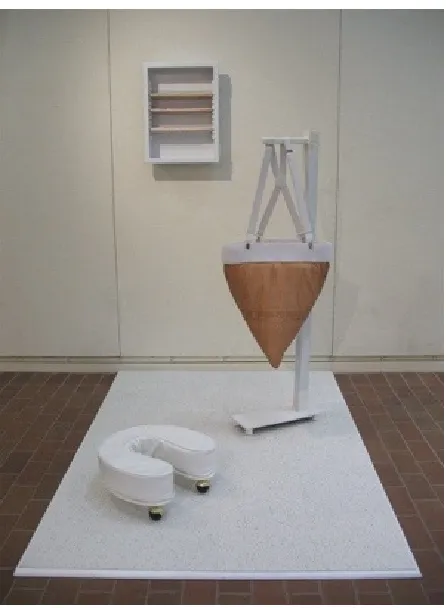
Maurice Merleau-Ponty suggests the notion of the lived body and explains that perceptions produce cultural identity. ‘The body is therefore a hinge; an articulation of the world’.i How we perceive our culture ultimately explains how we perceive ourselves. However, this presents a possible contrast to what others may perceive. There is a visual language involved with the identity of the self. In the piece entitled, “Dr. Johnson”, I articulate a visual dialogue using familiar objects such as a padded toilet seat, linoleum tiles and bandages. These materials can potentially be perceived as archaic,
[image:17.612.90.313.371.675.2]old-fashioned or expired. By juxtaposing a medical army bandage into the assemblage of a jockstrap, I intend to emphasize the patriarchal doctor and his cultural impact on the aging of male culture.
I observe the male gender as the sum of all thematic materials found within our culture. In other words, culture has provided gender-laden meaning on everything from a man’s sock to a blue shirt. I mean, when it comes down to it, it really is just a sock and a shirt…no matter what gender you are. During my process of making I rely on signifiers of cultural awareness, drawing me to materials that scream “male”. As an artist, I am inspired to draw attention to cultural meaning and how society defines what is male simply through an article of clothing.
Performance artist, filmmaker and sculptor, Matthew Barney, insists, ‘it is so very hard to become a man…Everything threatens to beat us down, to strip us of our
biological birthright’.ii Matthew Barney’s definitions of male sexuality and gender traits are inspiring, as is his perspective on male dominance and social acceptance. There is a mental and physical transformation of the self in what contemporary society defines as maturity. The cultural instinct of the male triggers a bodily awareness related to how the male physique is perceived and ultimately accepted. I observe the male figure allowing an outside force to pull the strings of his existence, unaware of the cultural forces swaying his decisions of what to wear or how to act.
The focus of this thesis is to dissect four male figures identified within
Notes
1. Catherine Vasseleu, Textures of Light: Vision and Touch in Irigaray, Levinas and Merleau-Ponty (London: Routledge, 1998), p. 27.
Spatial Environment
Emphasizing male identity and each correlating environment applies to the cultural layers of society’s perception of masculinity. As much as society identifies with the clichéd image of men they also relate to each corresponding space and place, offering a stage or platform for the social interaction we inevitably find ourselves in. My
“staging” of male-themed spaces offers dialogue pertaining to the performance of male sexuality and allows new ways of seeing how men are socially identified. I am not looking to recreate environments, rather to stage a moment of male existence.
Constructing absurd and humorous interiors invites the possibility to consider how space renders fabrication as opposed to reality. In other words, how much does a fabricated environment impact the assimilation of a fabricated identity?
The inside of a men’s locker room carries with it an unspeakable air of dominance and truth. Male dominance is personified by way of physical stamina, virility and
evidence of body hair, characterizing the locker room environment as a potential
battleground that emotionally impacts various occurrences. Coming from my perspective as a female “spectator”, I perceive a men’s locker room as a sexually charged
environment, yielding brutally honest physical traits such as phallus size, sexual performance and personal hygiene. These surroundings comment on the cultural awareness and acceptance of the self and the diverse spectrum of gender adequacy.
Fig. 6 and 7, Janet Winkie, Dr. Johnson (detail) and sketch, 2006.
each constructed male identity. By incorporating found objects I have presented unassuming materials from an absurd and unexpected perspective. In the piece entitled “Dr. Johnson”, I fabricated the shelves inside a medicine cabinet out of Ace bandages, which creates a physical intimacy of the male doctor “wrapped” around the interior details of an examination room. I am applying the familiarity or intimacy of objects related to the body and reversing its internal function into external design.
Sculptor and installation artist, Robert Gober, provides formal, yet thought provoking, insight related to constructed environments and the familiarity of space. Gober’s success as an artist came as a result of many years as a carpenter. What I like about his work is his application of space in transit, or transitory space. In other words, his installations portray a spatial reference beyond what he presents. Gober incorporates illusions related to the human condition and gender identity. Nothing is ever what it seems to be.
In Gober’s 1992 installation at Dia Center for the Arts, in New York City, it is evident that emotional content materializes in Gober’s object making and installations.
is a formal simplicity to a white, porcelain sink and a pile of newspapers, which are perceived as having a function, yet at the same time formulate a hidden message relating to hygiene, dialogue and utilitarianism. The function of a newspaper is to communicate information to a wide audience. Object making employs the application of function.
Gober’s objects require bodily use in order to fully complete its function, which in turn, transports the viewer to another space. In order to fabricate new and imaginative realities, I deconstruct spatial elements. Spatial reference is defined by the inclusion of objects. The use of found and fabricated objects provides definition to the surrounding space. In “Service Station” the mechanics creeper, fabricated out of shop towels, wood and casters, hints at the transporting of a body from one space to another simply by rolling across a garage floor. Because a mechanics uniform embodies the creeper, the viewer is faced with the physical impact a mechanics body has on the interior of a garage.
This demonstrates how this environment is defined by the existence of the male physique. Intimacy of space translates into the spatial conditions of sculpture. My goal as
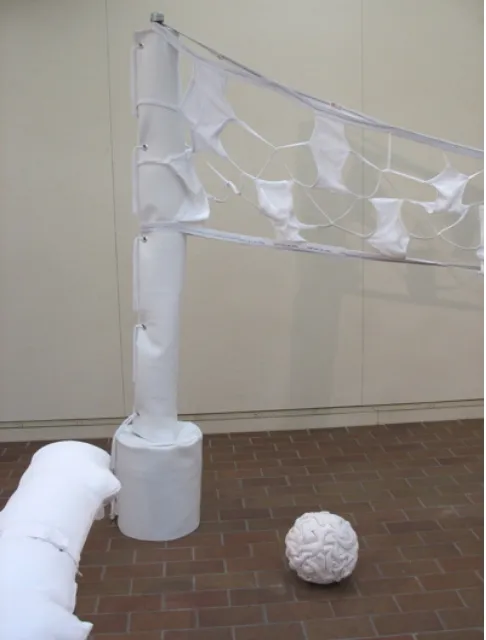
Figs. 12, 13 and 14. Janet Winkie, Phys. Ed., 2006. Mixed media installation.
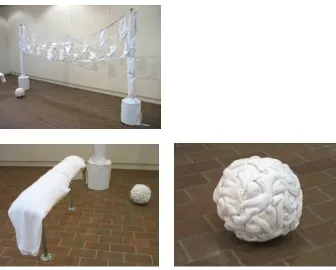
Men’s white briefs are cut with scissors, removing all cotton fabric that normally graces the skin of both buttock and hips. The remaining materials, made up of elastic, seams and cotton, visually transform a man’s brief into the fragmented appearance of a jockstrap. By using jockstraps as a sculptural medium, I am presenting concepts of the male body in an intimately fragmented manner which, when linked together, construct a conceptual as well as functional volleyball net. Through the process of cutting and isolating the critical “goods” related to male genitalia, I am suggesting a violent alteration of apparel intended to subtly comment on themes related to male castration. These subtle themes provide an underlying framework to the overall absurdity or humor related to the concept of volleyball nets and the visual appeal of men’s briefs.
Ed.” my intent was to construct a visually sterile environment yet simultaneously
incorporate materials identified as garments associated with sweat, semen and body hair. I have fabricated an artificial environment involving elements inspired by a men’s locker room that correlate athletic performance with sexual performance of the male. My application of found objects and assemblage offer a humorous look at the psychological threat to the male ego as well as cultural perceptions of masculinity.
Notes
The Body: Absence and Presence
‘Our body is not in space like things; it inhabits or haunts space. It applies itself to space like a hand to an instrument, and when we wish to move about we do not move the body as we move an object. We transport it without instruments as if by magic, since it is ours and because through it we have direct access to space.’1
-Maurice Merleau-Ponty
My body defines my vision, which is an outline of knowledge. When we see objects or spaces we see our preexisting relationship to it. I do not want the viewer to be confronted with a literal representation of the human form. This would cause emphasis to be placed on the external, surface-oriented body rather than the internal or lived body. In order to avoid the literal body, I choose to define the body as a vehicle or prop. I view props as inhabiting space, orienting them as compositional elements, causing relative impact within a composed or fabricated environment.
My work suggests a human presence, or essence, in what might normally be perceived as mundane apparel, as well as mundane activities. Human essence speaks from many voices, not just one singularity, and evokes a bodily link in relation to formalism. The form of men’s apparel often portrays a place of activity or function. Apparel such as ties, jockstraps and work shirts comment on the action implied by the garment. The function of men’s apparel offers the male an opportunity to personify the action of the garment. This action is implied by utilitarian details such as elastic, silk, heavy-duty cotton and polyester.
acquired an intimacy with the body. Intimate objects such as socks, jocks, shirts or pants hold a physical relationship with the body and its exterior skin. Objects that display the absence of the body evoke an essence of the body. Through this thesis I encourage the viewer to conceptually “inhabit” the vacated objects such as bandages, jocks, shirts and shoes. These found or fabricated objects serve as visual stimuli that evoke the essence of physical and sexual traits that act as a common thread within the human psyche.
Fig. 15. Janet Winkie, Phys. Ed. (detail)
apparel is fully engaged and identified as male when specifically worn by the male gender.
Ann Hamilton’s installations, sculptures and films explore perceptions of the body and its role in symbolic meaning. Working with remnants of the body, the impact of symbolic meaning communicates a heightened awareness of the body’s existence. I am interested in Hamilton utilizing apparel as a symbolic medium through which the viewer can achieve a deeper understanding of the metaphysical impact of both mind and body. Hamilton approaches ‘the human figure as a site through which to explore
perceptual awareness and “aspects” of our being.’2 I appreciate the lack of the absolute or the concrete. Her use of the human presence does not simply play the role of
storyteller; rather it is viewed more as a vessel through which one can fully recount the visual and cerebral experience.
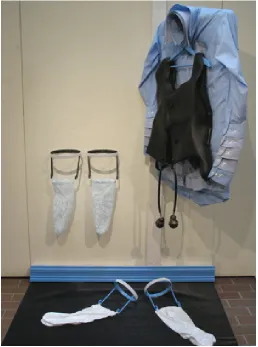
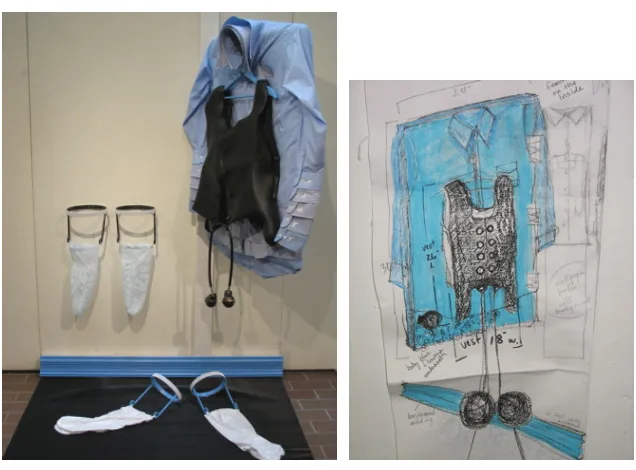
My use of blue dress shirts, layered in an orderly fashion, offers a parallel to the tactile qualities as Hamilton’s, however “Domain” focuses on the elitist approach to physical labor or lack thereof.
Fig. 18. Janet Winkie, Domain, 2006.
In contrast to subtlety and ambiguity, I am triggered by themes relating to the abjection of the male body. Abject themes, such as jock itch and personal hygiene, strike a nerve that comments on the physical imperfection of the male physique. Smell or sound compile a physical vocabulary of the self and comment on where our existence fits into the surrounding culture. As a result of digging through drawers of men’s used socks and underwear, an abject experience began to materialize during my process of collecting material for “Phys. Ed.”. It was not clear whether I was more grossed out with myself, or the used men’s briefs I was handling!
Author, Julia Kristeva states abjection as a moment when ‘one is neither subject or object. When one is in a state of abjection, the borders between the object and the subject cannot be maintained.’v The viewers own regressions come to the surface when faced with the ugly, distasteful or strange. It is not the object, such as a jockstrap, that is abject; merely, the cultural connotations that adhere to an object functioning in close proximity to the male genitalia.
Notes
1. Maurice Merleau-Ponty, “An Unpublished Text: Prospectus of his Work”, The Primacy of Perception, ed. James M. Edie (Urbana: Northwestern University Press, 1964), p. 5. Quoted by Cindy Nemser in Amelia Jones and Tracey Warr, The Artist’s Body (London: Phaidon Press Limited, 2000), p. 233.
2. Wexner Center for the Visual Arts (ed.), The Body and the Object: Ann Hamilton 1984-1996 (Columbus, Ohio: The Ohio State University, 1996), p. 15.
3. www.sfgate.com
4. Judith Nesbitt (ed.), mneme: Ann Hamilton (London: Tate Gallery Publications, 1994), p. 16.
Process and Assemblage
The bulk of this thesis work was made as a result of three major resources; thrift stores, fabric stores and hardware stores. As a mixed media artist I rely heavily on the use of found objects. That is, objects that visually speak to me while perusing the aisles of retail stores. I introduce spontaneity and the application of surprise into my process of making as a result of allowing myself to respond to visual and tactile stimuli. During my process of making, found objects are deconstructed, altered or manipulated, causing a loss of function, yet ultimately leading to a rebirth of materials and meaning.
The process of discovering objects allows a full comprehension of the object’s significance or potential value as a sculptural medium. I often respond to objects based on their three-dimensional qualities such as color, scale and construction. During my process of collecting materials I respond to ambiguous objects that trigger a further knowing or understanding of its relationship to the body. An object such as a padded vinyl toilet seat can be read as ambiguous as a result of not fully knowing its function or intent. In “Dr. Johnson”, this toilet seat could be read as a life preserver as well as a healing aid for a patient suffering from hemorrhoids. With the introduction of rolling casters, I distance myself from the visual meaning of a toilet seat and deconstruct its function and value, ultimately redefining its spatial significance to a medical
The clichéd male image I am constructing is significant when it comes to the details of first impressions and social appearances. “Domain” emphasizes the importance of the tailored dress shirt, suitable for the corporate office. Details such as sock garters and wallpaper communicate the superficial anxieties of appearance and how the suburban male image is socially accepted. The construction of this identity was strongly
influenced by my decisions related to the selection of sculptural materials, which provide deeper content and meaning. The five dress shirts are arranged in a manner that
references a door, complete with doorknob, hinges and hook. This door is intended to represent two ideas: a psychological doorway into the male identity and the physical door of an executive’s office. The internal anxieties of the executive male and his place of work are reversed into the external shell of appearances of blue dress shirts worn five days a week.
[image:31.612.89.407.397.632.2]
“Domain” portrays the business executive whose social inadequacies are
supplemented with material goods and the artificiality of domestic life. By juxtaposing sock garters and frilly wallpaper, I am interpreting this man to be creatively exhausted, socially awkward, unsure of his sexuality and concerned with appearances. The
importance of five tailored shirts and fully elasticized socks stress how the male personae is or is not perceived as successful and ultimately homogenized. Questioning possible inadequacies or the possession of both gender traits influences my perceptions of male identity. I was inspired by the emasculated male culture of the 1950’s and how it attentively catered to the glossy image of men’s apparel and accessories.
There is a method to dressing the body and shoes tend to be the final detail, completing the ensemble of one’s appearance. Rubber galoshes are worn directly over shoes and act as a vehicle of protection from nature’s elements. I recall observing my grandfather pulling his rubber galoshes over his shiny, black wingtip shoes, signifying a form of self-preservation. My grandfather’s shiny black shoes provided him with a great sense of identity and personal meaning. In regards to “Domain”,I have responded to galoshes as found objects and reassigned material value through process and
manipulation of medium. As a result of slicing, filleting and reassembling rubber galoshes, I constructed a man’s rubber vest allowing me to redefine the function of galoshes as potentially protecting or preserving the white-collar image as well as the internal makeup of this male specimen.
pertaining to how male culture is perceived by the viewing public. In order to explore personal interests related to gender, I intuitively collect found materials such as baseball pants, briefs, and socks, allowing for abject assumptions to be made related to the male body and its byproduct of sweat. I found myself in a state of abjection during one memorable visit to a thrift store in Newark, New York. Accepting the fact that the briefs I was handling were at one time in contact with a man’s testicles was almost too much to comprehend. After the sense of embarrassment subsided, the critical handling or
manipulating of materials, related to male genitals, revealed a relationship or familiarity of the male body. This visceral element offers content and material meaning to what would normally be a generic or pedestrian volleyball net.
Intuition plays a role in my process of making. I follow my intuition when it comes to choosing my materials and objects, as well as during my process of medium manipulation. In order to fully explore sculptural mediums, the artist must manipulate the chosen medium, exhausting all applications, orientations and arrangements. Each manipulation triggers one response after the other, offering a deeper appreciation for the process of making and the exploration of materials. Sculptor and installation artist, Kiki Smith once stated ‘the more you manipulate it…the more life you put into it.’1 Investing new life into objects and materials presents evidence of personal interest. I believe fully knowing your materials allows for the artist to extract the mediums full potential and invest personal meaning and content.
wearing them around the studio and laughing at myself. This represents a last glimpse at the function of a galosh before it is altered with scissors and thread, and redefined in form and object. Physically altering found objects lends an arresting effect to their function. The moment a rubber galosh is cut there is no turning back to its original condition or intent. Imagination, chance and play allow the concept of a rubber galosh to be transported into form and object causing a reversal of internal traits to be expressed as external.
The metamorphosis of material creates a visual dialogue commenting on the function or origin of any sculptural material. In other words, the more an artist pulls a material from its original found state; an awareness of the transformative steps involved resulting in the final presentation become even more evident. However there is a limit as far as how much manipulation causes a sock to lose its origin or identity. Failure of this evidence surfacing in my work would create a lack of clarity related to concepts of male apparel and physical performance. As a result of manipulation, I was inspired to create a tension between objects presented and the mediums utilized. My goal was to transform each material to the point where the viewer is distanced from the materials original function.
the materials were constructed or fabricated, ultimately preventing the viewer from discovering levels of playfulness, utilitarianism and ambiguity related to assemblage. By compiling ambiguous materials, I treat the assemblage process with equal amounts of intent, function and perception. My goal is to create objects that are perceived as
utilitarian, store bought or readily available for use. I methodically arrange and execute a process of assemblage that is efficient, cost effective and visually stimulating.
Notes
Conclusion
Exploring the male physique allows a deeper appreciation of gender roles and sexuality to surface in relation to apparel. The male identity is enhanced through the use of apparel and its function of constructing the ideal image of masculinity. Apparel signifies a universal symbol of human culture. As an extension of the self, apparel affects the psyche and its close proximity with identity. Meaning, how men identify themselves largely has to do with what they wear and where they wear it.
The male figure inhabits space and assimilates its constructed identity in front of the viewing public. My goal for this body of work involves isolating private spaces and translating them to public domain. In “Dr. Johnson”, providing the viewer with minimal yet identifiable surroundings, such as a medical exam room, opens the doorway to building a relationship with the constructed identity of a doctor. By using a minimal palette of white and beige, I am presenting a very sterile, uncomplicated and utilitarian environment. The viewer’s spatial experience of the examination room is defined by their physical awareness, approachability and mental condition. In other words, the more a person is aware of their physical and mental state the more perspective they are able to gain on what role they play when approaching a fabricated, yet recognizable
environment.
jockstraps heightened the importance of their intent, function and performance with the male body. This thesis explores concepts of apparel as providing an extension of the self. In addition to jockstraps, isolating the extended function of a sock provides the viewer with a heightened experience and a deeper understanding of socks and how they are socially perceived. Socks carry a stigma of smell, stains and disposability. As a result of exploring socks as a medium, I have directly and collectively linked its relationship with the human foot and all abject traits such as fungus, sweat and odor.
Throughout my process of making, the act of handling or manipulating objects allows for a deeper appreciation of a medium. The more I altered men’s briefs, the stronger my relationship became with their function and the male body they were intended for. In “Phys. Ed.”, the process of cutting and altering is evident, initiating an approach to the male body as unclean, smelly or hairy. Through process and the handling of male strangeness, I have created an open dialogue based on a better understanding of gender differences and familiarities. By familiarizing myself with male artifacts, I am able to put more feeling and emotion into the process, and inevitably, the sculptural medium.
Whether in a pocket or hand, a mechanic comes in close contact with blue shop towels, forming a relationship based on job performance or identity. While collecting a timeline of grease, the auto mechanic identifies his job performance within every fiber of a blue shop towel.
The installation process proved to be a playground for assemblage, allowing composition and self-editing to play key roles in the physical arrangement of each piece, defining the space and the viewer’s perspective. As a result of working with sculptural components and parts, many of my pieces awaited to be fully compiled until the time of installation. Within the gallery space I was able to visualize the dialogue spoken between each assemblage, relating to one another as if they each had something in common. “Domain” involved the installing of a hinged door, creating a moment of staging or constructing an entryway into the male identity, reinforcing the impact of space and place. As a result of assembling the installation on-site, “Domain” lacked a fleshing out of components and the surrounding space, creating a very frontal or static presentation. Unexpectedly, this does not discourage my clichéd image of a suburban, business executive lacking social interests or cultural achievements, possibly perceived as being somewhat boring or stale.
It was a liberating experience to invest new life into found objects. I felt it was a success when the viewer would identify and question the function of ambiguous materials and their place of origin. The social experiences presented throughout this thesis
Bibliography
Jones, A. and T. Warr. The Artist’s Body. London: Phaidon Press Limited, 2000. McDaniel, C. and J. Robertson. Themes of Contemporary Art: Visual Art After 1980.
New York: Oxford University Press, 2005.
Merleau-Ponty, Maurice. “An Unpublished Text: Prospectus of his Work”, The Primacy Of Perception, James Edie (ed.). Urbana: Northwestern University Press, 1964. Morgan, S. and F. Morris. Rites of Passage: Art for the End of the Century. London:
Tate Gallery Publications, 1995.
Nesbitt, Judith (ed.). mneme: Ann Hamilton. London: Tate Gallery Publications, 1994. Sollins, Susan. Art:21: Art for the Twenty-First Century. PBS Home Video, 2003. Tuan, Yi-Fu. Space and Place: The Perspective of Experience. Minneapolis,
Minnesota: University of Minnesota, 1977.
Vasseleu, Catherine. Textures of Light: Vision and Touch in Irigaray, Levinas and Merleau-Ponty. London: Routledge, 1998.
Wexner Center for the Visual Arts, (ed.). The Body and the Object: Ann Hamilton 1984-1996. Columbus, Ohio: The Ohio State University, 1996.
www.sfgate.com