R E S E A R C H
Open Access
Population-based analyses of
Giardia duodenalis
is
consistent with the clonal assemblage structure
Katsuhisa Takumi
1, Arno Swart
1, Theo Mank
2, Erica Lasek-Nesselquist
3,
Marianne Lebbad
4, Simone M Cacciò
5and Hein Sprong
1*Abstract
Background:Giardia duodenalisis a common protozoan parasite of humans and animals. Genetic characterization of single loci indicates the existence of eight groups called assemblages, which differ in their host distribution. Molecular analyses challenged the idea thatG. duodenalisis a strictly clonal diplomonad by providing evidence of recombination within and between assemblages. Particularly, inter-assemblage recombination events would complicate the interpretation of multi-locus genotyping data from field isolates: where is a host infected with multipleGiardiagenotypes or with a single, recombinedGiardiagenotype.
Methods:Population genetic analyses on the single and multiple-locus level on an extensive dataset ofG. duodenalisisolates from humans and animals were performed.
Results:Our analyses indicate that recombination between isolates from different assemblages are apparently very rare or absent in the natural population ofGiardia duodenalis.At the multi-locus level, our statistical analyses are more congruent with clonal reproduction and can equally well be explained with the presence of multipleG. duodenalisgenotypes within one field isolate.
Conclusions:We conclude that recombination betweenG. duodenalisassemblages is either very rare or absent. Recombination between genotypes from the same assemblage and genetic exchange between the nuclei of a single cyst needs further investigation.
Keywords:Giardia lamblia, Giardia intestinalis, Giardia duodenalis, Genetic recombination, Population genetics
Background
Giardia duodenalis (syn. G. lamblia, G. intestinalis) is the etiological agent of giardiasis, a gastrointestinal in-fection of humans, companion animals, livestock and
wildlife. Symptoms of a G. duodenalis infection range
from asymptomatic to severe diarrhea as well as chronic
disease [1]. G. duodenalis has a simple life cycle
com-prising rapidly multiplying, non-invasive trophozoites on the mucosal surface of the intestine, and the produc-tion of environmentally resistant cysts that are shed with the host faces. Infectious cysts are transmitted by the faecal-oral route either by direct contact or by
in-gestion of contaminated food or water [2]. G.
duodena-lis is considered as a species complex, whose members
show little variation in their morphology, yet can be assigned to eight distinct assemblages (A to H) based on enzyme electrophoretic and genetic studies [3,4]. Assemblages A and B can infect and multiply in humans and are also found in a wide range of mam-mals. The remaining assemblages show more restricted host ranges: C and D are predominantly found in canids, E in livestock, F in cats, G in rodents and H in marine vertebrates (seal and gull) [5,6]. In endemic areas where humans and animals live closely together,
transmission from human to animals or vice versa may
occur [7-9]. Direct evidence for transmission from
ani-mals to human is lacking, because Giardia cysts are
shed into the environment, making it very difficult to determine the primary source of the infection. Genetic characterization has been extensively used to assess the role of animals in the epidemiology of human infection and to develop tools for tracing sources of infection. * Correspondence:[email protected]
1National Institute of Public Health and Environment (RIVM), Laboratory for Zoonosis and Environmental Microbiology (CIb-LZO), P.O. Box 1, 3720, BA, Bilthoven, The Netherlands
Full list of author information is available at the end of the article
However, the zoonotic potential of G. duodenalis
remains a major and unresolved issue [1,10,11].
Many molecular epidemiological studies have been based on the analysis of a single marker, often from a limited number of isolates. Using single locus
approaches, the zoonotic potential of G. duodenalis
as-semblage A and B appears to be high: Irrespective of the genetic marker used, sequences from human and animal field isolates frequently appeared similar, if not identical [12]. In order to increase the accuracy of genotyping of
G. duodenalisisolates, multi-locus sequence typing strat-egies were introduced [13-18]. When genotypes from field isolates were defined using a multi-locus sequence typing scheme, only 2 from the 84 multi-locus genotypes (MLG) of assemblage A and none MLGs (n = 99) of as-semblage B appear to have a zoonotic potential [12]. Surprisingly, the genotypes of Giardia field isolates re-peatedly constituted a combination of loci derived from different assemblages [12]. The latter finding can be explained by two biological phenomena.
One explanation is that aGiardiafield isolate is not a singular clone, but consists of a mixture of different
Giardia genotypes. A Giardia field isolate is often not more than a DNA extract, obtained either directly from a stool sample or indirectly after (immune-) isolation of faecal cysts. For this situation, the uptake of genetically
differentGiardia cysts from the environment by a host,
or subsequent infection of an already infected host, likely
without overt symptoms, with a different Giardia
geno-type, must occur. As startingin vitro cultures from field samples prove to be very difficult due to variations in ex-citation and adaptation, and the ever-present bacterial and fungal contamination, it is hard to affirm the clonal-ity of Giardia field isolates [19,20]. Alternatively, the
Giardia isolates are clonal, but the mixing of loci from different assemblages have arisen by (para) sexual
re-combination, i.e. genetic exchange, betweenG.
duodena-lis assemblages. Although G. duodenalis shows no
cytological evidence of meiotic and sexual recombin-ation, several studies challenged the idea thatG. duode-nalis is a strictly clonal organism [21,22]. These studies have demonstrated: (i) the presence in theG. duodenalis
genome of true homologs of genes involved in meiosis in other eukaryotes [23,24]; (ii) the exchange of genetic material in different chromosomal regions among human isolates of the parasite [25,26]; (iii) the fusion be-tween cyst nuclei (karyogamy) and the transfer of gen-etic material (episomal plasmids) between them [27]. These results are pivotal for the existence of sexual re-combination. Recombination may take place at three levels withinG. duodenalis: (i) between the two nuclei at an individual level, (ii) between individuals of the same assemblage and (iii) between individuals of different assemblages.
Here, we only address the latter situation, i.e. recom-bination between assemblages, as this mostly compli-cates the interpretation of the molecular epidemiological data. Genetic exchange between different assemblages may occur in laboratory cultures or in nature, but it remains to be determined to what extent this occurs in natural populations [28]. Genetic exchange between iso-lates of different assemblages was addressed using two approaches: The detection of mosaic sequences in three loci and the performance of several tests for clonal reproduction at the population level.
Methods
Data collection
A European network of public and veterinary health Institutions that focused on zoonotic protozoan parasites (the ZOOnotic Protozoa Network, ZOOPNET) was established [12]. Within this consortium, a molecular epidemiological database was built, and currently
con-tains information on 3351 Giardia isolates, which
en-compass 4954 sequences from 5 different loci. Although GenBank sequences constitute approximately 45% of the database, limited epidemiological data (mainly country and source of isolation) are available for those isolates. All molecular epidemiological data were stored and ana-lyzed in Bionumerics (Version 6.10; Applied Math, Bel-gium). A selection of these sequences was made using the same strategy as previously described [4] . For ex-ample, sequences that were too short to cover regions of variation within any given assemblage were used only for analysis at the level of that assemblage, but not at the level of sub-assemblage. In addition, when multiple, identical sequences from any given isolate were depos-ited in GenBank, only the longest available sequence was retrieved.
DNA-sequence analysis
The loci beta-giardin (BG), glutamate dehydrogenase (GDH), and triose phosphate isomerase (TPI) were sorted into their different genes, assemblages, and sub-assemblages (AI, AII and AIII) as well as alignments along the gene using previously defined references [12]. Tests for intra-assemblage recombination events were performed essentially as described [26]. The four-gamete test, MaxChi, and the four additional tests offered in RDP V3.41, RDP, GENCONV, Chimera, and SiScan [29] were performed. All tests rely on the premise that re-combination will produce mosaic sequences. Because the region and length of GDH sequenced varied widely among the isolates, two GDH genealogies were pro-duced; a GDH1, which used sequences that spanned
nucleotides 186–1,159 and a GDH2, which used
sequences that spanned nucleotides 258–647 where
of GDH from the WB:C6 genome [30]. Potential recom-binants identified by these algorithms, were discarded if both parental sequences were from the same assemblage (potential intra-assemblage recombination).
Sequences were aligned by using MAFFT [31],
distance-based analyses were conducted by using
Kimura 2-parameter distance estimates, and trees were constructed by using the Neighbor-Joining algorithm, implemented in the Bionumerics program. Bootstrap proportions were calculated by the analysis of 500 repli-cates for neighbor-joining trees.
Probability of observing no offspring of recombinant types in the sample
Occurrence of a recombinant of B assemblage and E as-semblage at TPI locus of a human isolate is an evidence of genetic exchange between the two assemblages. Under the hypothesis of selective neutrality, we calcu-lated the probability of our observation; each recombin-ant type was found in only one sample at the particular locus, to statistically test the hypothesis, we made an as-sumption that a recombinant and a non-recombinant se-quence type are selectively neutral, and calculated the probability that each recombinant type was observed exactly once in the samples of DNA sequences under the assumption of selective neutrality. The probability was calculated using the formula [32],
n!
k!js nð ;kÞjn1n2. . .nk
where the symbol nis the number of samples at a given
locus, the symbolkis the number of distinct recombinant types and a non-recombinant type, the function s(n,k)is the stirling numbers of the first kind, and the bracket |.| indicates an absolute value.
Criteria for clonality: Identical genotypes (test d)
The extent to which the predominant genotype was overrepresented can be quantitatively evaluated by
cal-culating the probabilityP of observing as many or more
individuals of the particular genotype as actually observed in the sample,
P¼X
n
i¼m
n!xið1xÞni
i!ðniÞ! ;
where x= probability of the multi-locus genotype under
the null hypothesis of full recombination, estimated by multiplying the observed frequency of the single-locus
genotypes; n= number of individuals sampled; and m=
number of individuals in the sample with the particular genotype [28].
Criteria for clonality: Absence of recombinant genotypes (test e)
This criterion is the probability of observing as few differ-ent multi-locus types as actually observed, given the size of the samples and expected multi-locus type frequencies under the hypothesis of full recombination [28]. The probability was calculated by a Monte Carlo approach by drawing ten-thousand random samples from the multi-nomial distribution with the vector of expected frequen-cies in Table 1. The probability was defined to be the fraction of random samples for which the number of dis-tinct multi-locus types are less than or equal to the num-ber of multi-locus types actually observed.
Criteria for clonality: Linkage disequilibrium (test f)
This is a standard test for non random association between loci, under the assumptions of random mating, and non-overlapping generations [33]. In our database ofG. duode-nalis, two genotypes were recorded at each locus. Hence we refer to one genotype by a letter 0 and to the other genotype by a letter 1. Linkage disequilibriumD12between locus 1 and locus 2 was calculated using the equation [33],
[image:3.595.305.539.402.683.2]D12¼p00p0p0;
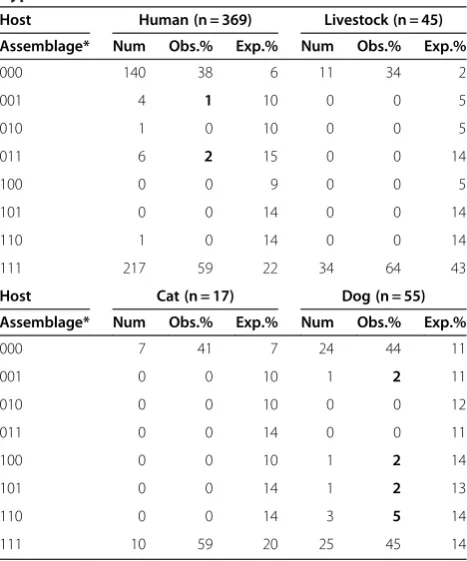
Table 1 Frequencies of three-locus types under the hypothesis of free recombination
Host Human (n = 369) Livestock (n = 45)
Assemblage* Num Obs.% Exp.% Num Obs.% Exp.%
000 140 38 6 11 34 2
001 4 1 10 0 0 5
010 1 0 10 0 0 5
011 6 2 15 0 0 14
100 0 0 9 0 0 5
101 0 0 14 0 0 14
110 1 0 14 0 0 14
111 217 59 22 34 64 43
Host Cat (n = 17) Dog (n = 55)
Assemblage* Num Obs.% Exp.% Num Obs.% Exp.%
000 7 41 7 24 44 11
001 0 0 10 1 2 11
010 0 0 10 0 0 12
011 0 0 14 0 0 11
100 0 0 10 1 2 14
101 0 0 14 1 2 13
110 0 0 14 3 5 14
111 10 59 20 25 45 14
where p00is the frequency of congruent assemblages 00,
p0*is the frequency of assemblage whose locus 1 is the type 0 and locus 2 is either 0 or 1, andp*0is the frequency of as-semblage whose locus 2 is the type 0 and locus 1 is either 0 or 1.
In the case of three-locus typing, linkage disequilib-rium was calculated using the equation 1 in [34],
D¼p000p0p0p0p0D23p0D13
p0D12;
whereD23,D13and D12 are pair-wise linkage disequilib-rium between the three loci 1, 2, and 3, p000 is the fre-quency of multi-locus types 000. The symbol * is a wildcard for either genotype 0 or 1. Thus,p00*is the fre-quency of the assemblages having genotype 0 at the first and at the second loci and genotype at the third locus is either 0 or 1. P-values for linkage disequilibrium were obtained by a Monte Carlo approach as described in the testebut usingDas the test statistic.
Index of association
Index of association for G. duodenalis was calculated
using the observed frequencies of two genotypes at each of the three loci (Table 1) using the equation 3 in [35]. Variance of the index of association was calculated using the equation 4 in [35].
Results
Frequency of inter-assemblage recombination events within three loci
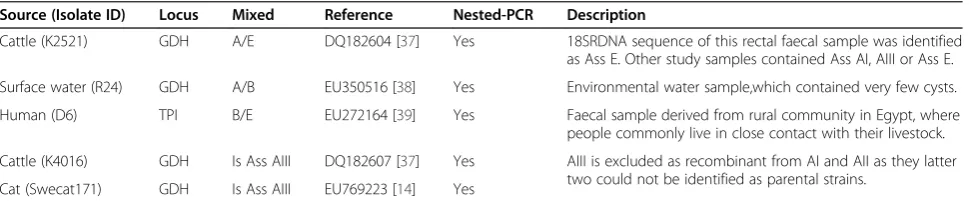
In a recent study, recombination between homologous loci from different assemblages was identified in at least three G. duodenalisisolates [26]. In this study, a limited number of sequences from two loci (a selection from GenBank entries until 2008) were analyzed. We per-formed the same approaches [26] to analyze the 4582 sequences from three loci stored in our database. Here, only potential recombinant events where parental sequences could be identified were taken into account. In the 1633 sequences from the BG locus, no inter-assemblage recombination events were detected. From
the 1325 TPI sequences, only one isolate (D6) displayed a recombination event between assemblages B and E. In the GDH sequences (n = 1624) of two isolates, K2521 and R24, potential inter-assemblage recombination events occurred (Table 2, Additional file 1: Table S1). Both recombination events were identified previously. One 551-bp GDH sequence (GQ337967) in GenBank displayed a recombination event, where the last ~95 bp
did not align with any other G.duodenalis, but were
similar to H. sapiensRIO kinase 2 (AK225348) [36]. No
inter-assemblage recombination was identified in the GDH sequences of the K4016 and SweCat17 isolates. These two were identified previously as potential recom-binants [26], but turned out to be identical to other members of sub-assemblage AIII [13].
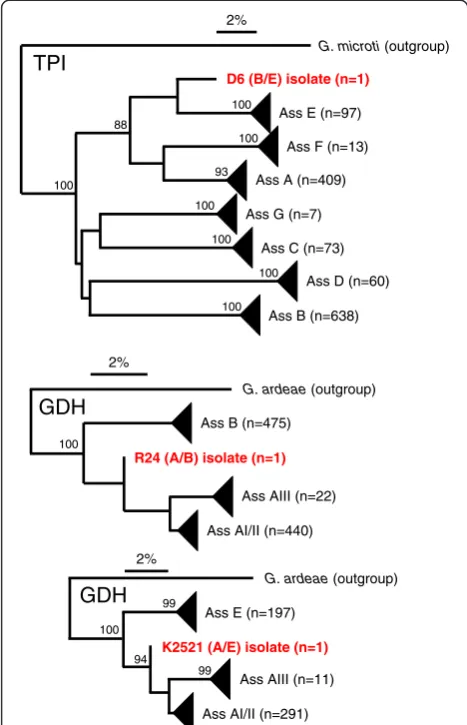
[image:4.595.57.542.614.715.2]Lack of inter-assemblage recombination will eventually result in the independent and divergent evolution of alleles from different assemblages [42]. Phylogenetic ana-lyses of the available sequences of GDH and TPI gener-ally display divergent and independent evolution (not shown, but see [4,12]). The sequences of the three iso-lates which underwent potential recombination events (Table 2) turned out to be exceptional, as they do not cluster significantly with any of the other sequences from the same locus (Figure 1). We conjectured that a successful recombinant is (at least) equally fit as its par-ents, resulting in offspring. To statistically test this hy-pothesis, we made an assumption that a recombinant and a non-recombinant type are selectively neutral in producing offspring, and calculated the probability that each recombinant type in the sample was observed exactly once in the sample. For GDH locus, we counted two recombinant types each occurring exactly once in the sample and counted the rest of 1622 non-recombinant types. The probability of this observation under the assumption of selective neutrality was esti-mated to be 0.5%. For TPI locus, we counted one re-combinant type occurring exactly once in the sample and counted the rest of 1324 non-recombinant types. The probability of this observation under the assump-tion of selective neutrality was 6% (see Methods for cal-culation of the probability).
Table 2 Isolates with potential inter-assemblage recombination within loci
Source (Isolate ID) Locus Mixed Reference Nested-PCR Description
Cattle (K2521) GDH A/E DQ182604 [37] Yes 18SRDNA sequence of this rectal faecal sample was identified as Ass E. Other study samples contained Ass AI, AIII or Ass E.
Surface water (R24) GDH A/B EU350516 [38] Yes Environmental water sample,which contained very few cysts.
Human (D6) TPI B/E EU272164 [39] Yes Faecal sample derived from rural community in Egypt, where people commonly live in close contact with their livestock.
Cattle (K4016) GDH Is Ass AIII DQ182607 [37] Yes AIII is excluded as recombinant from AI and AII as they latter two could not be identified as parental strains.
Cat (Swecat171) GDH Is Ass AIII EU769223 [14] Yes
Frequency of inter-assemblage recombination events between loci of two assemblages
Absence of recombination within the three loci is insuf-ficient to rule out inter-assemblage recombination, as these loci are relatively conserved regions and have an average size of only ~ 500 base pairs. The probability of detecting inter-assemblage recombination becomes sig-nificantly higher when multiple, independent loci on dif-ferent chromosomes are used. Potential recombination events were assessed between pairs of assemblages, which occur most frequently together, i.e. which share similar host categories. Recombination between
assem-blages A and B was studied in G. duodenalis isolates
from humans, between assemblages C and D in dog iso-lates, between A and F in cat isolates and between A and E in isolates from livestock. The presence of a par-ticular multi-locus type in great excess is often the most
robust and significant evidence of clonal reproduction, i.e. lack of recombination [28]. Here, a multi-locus type of aG. duodenalisisolate was based on the concatenated assemblage-typing of the three different loci BG, GDH and TPI. Only two multi-locus types are found in great excess in humans, namely AAA (38%) and BBB (59%). Of the six possible combinations of A and B in three-locus genotypes, only 3% are found (Table 1). The same was observed in the three other host categories. Two multi-locus types are found in great excess: AAA and EEE in livestock, AAA and FFF in cats, and CCC and DDD in dogs (Table 1). The contrast to theobservedfrequencies of three-locus genotypes is clear when the expected frequencies of three-locus types under the hypothesis of free recombin-ation is calculated (Table 1), supporting the assertion that sexual reproduction between assemblages inG. duodenalis
did not leave its trace on the population structure. Three formal tests for clonality were performed and all three yielded highly significant results in the four
G. duodenalis populations isolated from human, live-stock, cat, and dog (Table 3). These results support that clonal reproduction had indeed shaped the observed population structures, independent of the origins from
which the genetic materials of G. duodenalis were
iso-lated. A fourth statistical test, Index of association (IA), was originally developed to index the extent of clonality within bacterial populations [35]. Small estimates for the variance indicate that the index values were significantly different from zero, and hence that recombination has been rare or absent.
Discussion
Occurrence of one recombination event between assem-blage B and assemassem-blage E at the TPI locus of a human isolate is an indication that genetic exchange between the two assemblages has occurred. However, detection of a single recombinant is important but not sufficient information to assert the nature of recombination be-tweenGiardia duodenalisassemblages. In fact, in a con-siderable number of isolates present in the database, this recombinant was found only once. The test under the G. microti (outgroup)
Ass E (n=97)
Ass F (n=13)
Ass A (n=409)
Ass G (n=7)
Ass C (n=73)
Ass D (n=60)
Ass B (n=638)
100 100 100 100
93 100 100
100 88
2%
TPI
D6 (B/E) isolate (n=1)
R24 (A/B) isolate (n=1)
2%
G. ardeae (outgroup)
GDH
Ass B (n=475)
Ass AI/II (n=440) Ass AIII (n=22)
100
K2521 (A/E) isolate (n=1)
2%
G. ardeae (outgroup)
GDH
Ass E (n=197)
Ass AI/II (n=291) Ass AIII (n=11)
94 99
100
[image:5.595.56.290.90.453.2]99
Figure 1Phylogenetic analysis based on single gene sequences of TPI and GDH, as obtained using neighbour joining.Bootstrap values > 85 are indicated. Terminal branches were collapsed for clarity. The three recombinant sequences (D6, R24 and K2521) form singular branches between the existing assemblage structures.
Table 3 Tests for clonality applied to the three-locus typing datasets
Criterion Human Livestock Cat Dog
Identical genotypes widespread (d)
<10-9 10-6 10-4 10-9
Absence of recombinant genotypes (e)
<10-4 <10-4 <10-4 <10-4
Linkage disequilibrium (f) 0.38* 0.24* 0.38* 0.42*
Index of association (IA) 1.8 ± 0.00 2.0 ± 0.02 2.0 ± 0.04 1.5 ± 0.02
* P value < 10-4
. Italic letters in parentheses corresponds to the same tests in [43]. IA-values which are significantly different from zero indicates that
[image:5.595.306.539.621.707.2]assumption of selective neutrality between a
recombin-ant and a non-recombinrecombin-ant type supported that a
Giar-dia recombinant might contribute genetically little to
the population structure ofGiardia duodenalis. It could be argued that a zoonotic transmission event between a human individual and domestic livestock is unlikely to produce a novel viableG. duodenalisassemblage by a re-combination of existing assemblages at TPI locus.
Mo-lecular typing of the Giardia isolates at GDH locus in
addition indicated that a recombinant at the GDH locus contributes genetically very little to the population struc-ture ofGiardia duodenalis. The observation of a recombin-ation event between a GDH DNA-sequence (GQ337967) and a DNA sequence probably derived from its host (sheep) is highly anomalous. A PCR-artifact or sequencing error seems more likely.
The lack of observation of selectively neutral or fitter recombinant types was not due to a limited capacity of detecting a recombination event that could be associated with a single locus typing method. The analysis of the three-locus sequence typing data by applying a battery of population genetic tests supported that the contribu-tion of recombinacontribu-tion events between the three loci to the population structure ofG. duodenalisis also limited. These population genetic tests have been applied to a number of microorganisms, to support a clonal
popula-tion structure of Leishmania as well as Trypanosoma,
and to reject a clonal population structure of Candida
albicans[28]. Judging by the weight of the evidence pro-vided by the population genetic analyses of the molecu-lar typing datasets of G. duodenalis, both a single and multi-locus based typing method, we opt for the
hypoth-esis that the population structure of G. duodenalis
assemblages is clonal. This conclusion is by no means in conflict with the existence of recombination within the two nuclei of a cyst at the genomic and the cellular level [21,22], nor does our analysis exclude the possibility of intra-assemblage recombination.
Our molecular epidemiological database consists of 1312 human and animal isolates with two or more loci. Fifteen percent (n = 197) of these isolates constitute a combination of loci derived from different assemblages. Based on the analyses of this study, we conclude that
these isolates are a mixture of different Giardia
geno-types from different assemblages. This is probably an underestimation, as mixed infections are not always detected. Unequal loads or stability of the microorgan-isms of interest in the original sample, preferential immuno-purification or preferential binding of primer pairs to one of microorganisms will result in the detec-tion of only one of them. PCR assays based on the use of assemblage-specific primers have been developed to show the frequency of mixed infections [8,44]. It also is possible that another fraction of the field-isolates in this
database consists of a mixture of differentGiardia geno-types from thesameassemblage. Besides allelic sequence heterogeneity, the latter may be an additional explan-ation for the presence of ambiguous nucleotides (“double peaks”) present in the sequences of many iso-lates. Unfortunately, it is still not possible to distinguish between a clonal isolate and an isolate consisting of a mixture of the same assemblage. A PCR-based approach using a generic set of primers appears to be unreliable for the detection of mixed infections.
Conclusion
Molecular epidemiology is probably the best method
available to study transmission dynamics ofG.
duodena-lis in and between human and animal populations. The
relatively poor genetic resolution of the available single loci used for these studies could not be solved by com-bining several of these loci to a multi-locus genotyping scheme. Multilocus-sequence typing directly on field iso-lates is hampered by the occurrence of mixed infections in both animals and humans. Our data imply that gen-etic recombination between genotypes of different assemblages is either very rare or absent in theG. duo-denalis population. Thus, multilocus sequence types from field isolates, which consist of more than one as-semblage, should be interpreted as a mixed infection.
Improved in vitroculturing methods and novel
molecu-lar typing methods, such as single cyst PCR, are required to investigate the directionality and frequency of animal to human transmission and to determine the frequency of intra-assemblage recombination events [45].
Additional file
Additional file 1:Table S1.Inter-assemblage recombination events within three loci.
Competing interest
The authors declare that they have no competing interests.
Authors’contributions
TM, ML, SC, and HS performed data collection and sequence analysis. KT and AS performed population genetic and mathematical analysis. HS performed phylogenetic analysis. KT, SC, EL and HS were involved in the study design and interpretation of the results. KT and HS drafted the manuscript and wrote the final version. All authors read and approved the final manuscript.
Author details
1National Institute of Public Health and Environment (RIVM), Laboratory for Zoonosis and Environmental Microbiology (CIb-LZO), P.O. Box 1, 3720, BA, Bilthoven, The Netherlands.2Department of Parasitology, Laboratory of Public Health, Haarlem, The Netherlands.3Josephine Bay Paul Center for Comparative Evolution and Molecular Biology, Woods Hole, MA, USA. 4
Received: 28 May 2012 Accepted: 1 August 2012 Published: 10 August 2012
References
1. Feng Y, Xiao L:Zoonotic potential and molecular epidemiology ofGiardia species and giardiasis.Clin Microbiol Rev2011,24:110–140.
2. Adam RD:Biology ofGiardia lamblia.Clin Microbiol Rev2001,14:447–475. 3. Monis PT, Andrews RH, Mayrhofer G, Ey PL:Genetic diversity within the
morphological speciesGiardia intestinalisand its relationship to host origin.Infect Genet Evol2003,3:29–38.
4. Wielinga CM, Thompson RC:Comparative evaluation ofGiardia duodenalis sequence data.Parasitology2007,134:1795–1821.
5. Caccio SM, Ryan U:Molecular epidemiology of giardiasis.Mol Biochem Parasitol2008,160:75–80.
6. Lasek-Nesselquist E, Welch DM, Sogin ML:The identification of a new Giardia duodenalisassemblage in marine vertebrates and a preliminary analysis ofG. duodenalispopulation biology in marine systems.Int J Parasitol2010,40:1063–1074.
7. Hopkins RM, Meloni BP, Groth DM, Wetherall JD, Reynoldson JA, Thompson RC: Ribosomal RNA sequencing reveals differences between the genotypes of Giardiaisolates recovered from humans and dogs living in the same locality.J Parasitol1997,83:44–51.
8. Geurden T, Levecke B, Caccio SM, Visser A, De Groote G, Casaert S, Vercruysse J, Claerebout E:Multilocus genotyping ofCryptosporidiumand Giardiain non-outbreak related cases of diarrhoea in human patients in Belgium.Parasitology2009,136:1161–1168.
9. Traub RJ, Monis PT, Robertson I, Irwin P, Mencke N, Thompson RC: Epidemiological and molecular evidence supports the zoonotic transmission ofGiardiaamong humans and dogs living in the same community.Parasitology2004,128:253–262.
10. Isaac-Renton JL, Lewis LF, Ong CS, Nulsen MF:A second community outbreak of waterborne giardiasis in Canada and serological investigation of patients.Trans R Soc Trop Med Hyg1994,88:395–399. 11. Isaac-Renton JL, Cordeiro C, Sarafis K, Shahriari H:Characterization of
Giardia duodenalisisolates from a waterborne outbreak.J Infect Dis1993, 167:431–440.
12. Sprong H, Caccio SM, van der Giessen JW:Identification of zoonotic genotypes ofGiardia duodenalis.PLoS Negl Trop Dis2009,3:e558. 13. Caccio SM, Beck R, Lalle M, Marinculic A, Pozio E:Multilocus genotyping of
Giardia duodenalisreveals striking differences between assemblages A and B.Int J Parasitol2008,38:1523–1531.
14. Lebbad M, Mattsson JG, Christensson B, Ljungstrom B, Backhans A, Andersson JO, Svard SG:From mouse to moose: multilocus genotyping ofGiardiaisolates from various animal species. Vet Parasitol2010,168:231–239.
15. Martinez-Diaz RA, Sansano-Maestre J, Martinez-Herrero Mdel C, Ponce-Gordo F, Gomez-Munoz MT:Occurrence and genetic characterization ofGiardia duodenalisfrom captive nonhuman primates by multi-locus sequence analysis.Parasitol Res2011,109:539–544.
16. Lebbad M, Petersson I, Karlsson L, Botero-Kleiven S, Andersson JO, Svenungsson B, Svard SG:Multilocus genotyping of humanGiardia isolates suggests limited zoonotic transmission and association between assemblage B and flatulence in children.PLoS Negl Trop Dis2011,5:e1262. 17. Beck R, Sprong H, Pozio E, Caccio SM:Genotyping Giardia duodenalis
Isolates from Dogs: Lessons from a Multilocus Sequence Typing Study. Vector Borne Zoonotic Dis2012,12:206–213.
18. Solarczyk P, Majewska AC:Prevalence and multilocus genotyping of Giardiafrom animals at the zoo of Poznan, Poland.Wiad Parazytol2011, 57:169–173.
19. Isaac-Renton JL, Shahriari H, Bowie WR:Comparison of anin vitromethod and anin vivomethod ofGiardiaexcystation.Appl Environ Microbiol1992, 58:1530–1533.
20. Benere E, Geurden T, Robertson L, Van Assche T, Cos P, Maes L:Infectivity ofGiardia duodenalisAssemblages A and E for the gerbil and axenisation of duodenal trophozoites.Parasitol Int2010,59:634–637. 21. Birky CW Jr:Giardia sex? Yes, but how and how much?Trends Parasitol
2010,26:70–74.
22. Caccio SM, Sprong H:Giardia duodenalis: genetic recombination and its implications for taxonomy and molecular epidemiology.Exp Parasitol 2010,124:107–112.
23. Ramesh MA, Malik SB, Logsdon JM Jr:A phylogenomic inventory of meiotic genes; evidence for sex inGiardiaand an early eukaryotic origin of meiosis.Curr Biol2005,15:185–191.
24. Melo SP, Gomez V, Castellanos IC, Alvarado ME, Hernandez PC, Gallego A, Wasserman M:Transcription of meiotic-like-pathway genes inGiardia intestinalis.Mem Inst Oswaldo Cruz2008,103:347–350.
25. Cooper MA, Adam RD, Worobey M, Sterling CR:Population genetics provides evidence for recombination inGiardia.Curr Biol2007,17:1984–1988. 26. Lasek-Nesselquist E, Welch DM, Thompson RC, Steuart RF, Sogin ML:
Genetic exchange within and between assemblages ofGiardia duodenalis.J Eukaryot Microbiol2009,56:504–518.
27. Poxleitner MK, Carpenter ML, Mancuso JJ, Wang CJ, Dawson SC, Cande WZ: Evidence for karyogamy and exchange of genetic material in the binucleate intestinal parasiteGiardia intestinalis.Science2008,319:1530–1533. 28. Tibayrenc M, Kjellberg F, Arnaud J, Oury B, Breniere SF, Darde ML, Ayala FJ:
Are eukaryotic microorganisms clonal or sexual? A population genetics vantage.Proc Natl Acad Sci U S A1991,88:5129–5133.
29. Martin D, Rybicki E:RDP: detection of recombination amongst aligned sequences.Bioinformatics2000,16:562–563.
30. Morrison HG, McArthur AG, Gillin FD, Aley SB, Adam RD, Olsen GJ, Best AA, Cande WZ, Chen F, Cipriano MJ,et al:Genomic minimalism in the early diverging intestinal parasiteGiardia lamblia.Science2007,317:1921–1926. 31. Katoh K, Misawa K, Kuma K, Miyata T:MAFFT: a novel method for rapid
multiple sequence alignment based on fast Fourier transform.Nucleic Acids Res2002,30:3059–3066.
32. Ewens WJ:The sampling theory of selectively neutral alleles.Theor Popul Biol1972,3:87–112.
33. Ewens W:Mathematical population genetics. Second edn: Springer; 2004. 34. Long JC, Williams RC, Urbanek M:An E-M algorithm and testing strategy
for multiple-locus haplotypes.Am J Hum Genet1995,56:799–810. 35. Smith JM, Smith NH, O'Rourke M, Spratt BG:How clonal are bacteria?
Proc Natl Acad Sci U S A1993,90:4384–4388.
36. Robertson LJ, Gjerde BK, Furuseth Hansen E:The zoonotic potential of GiardiaandCryptosporidiumin Norwegian sheep: a longitudinal investigation of 6 flocks of lambs.Vet Parasitol2010,171:140–145. 37. Langkjaer RB, Vigre H, Enemark HL, Maddox-Hyttel C:Molecular and
phylogenetic characterization ofCryptosporidiumandGiardiafrom pigs and cattle in Denmark.Parasitology2007,134:339–350.
38. Plutzer J, Karanis P, Domokos K, Torokne A, Marialigeti K:Detection and characterisation ofGiardiaandCryptosporidiumin Hungarian raw, surface and sewage water samples by IFT, PCR and sequence analysis of the SSUrRNA and GDH genes.Int J Hyg Environ Health2008,211:524–533. 39. Foronda P, Bargues MD, Abreu-Acosta N, Periago MV, Valero MA, Valladares B, Mas-Coma S:Identification of genotypes ofGiardia intestinalisof human isolates in Egypt.Parasitol Res2008,103:1177–1181.
40. Read CM, Monis PT, Thompson RC:Discrimination of all genotypes ofGiardia duodenalisat the glutamate dehydrogenase locus using PCR-RFLP. Infect Genet Evol2004,4:125–130.
41. Sulaiman IM, Fayer R, Bern C, Gilman RH, Trout JM, Schantz PM, Das P, Lal AA, Xiao L:Triosephosphate isomerase gene characterization and potential zoonotic transmission ofGiardia duodenalis.Emerg Infect Dis2003, 9:1444–1452.
42. Butlin R:Evolution of sex: The costs and benefits of sex: new insights from old asexual lineages.Nat Rev Genet2002,3:311–317.
43. Tibayrenc M, Kjellberg F, Ayala FJ:A clonal theory of parasitic protozoa: the population structures ofEntamoeba, Giardia, Leishmania, Naegleria, Plasmodium, Trichomonas, andTrypanosomaand their medical and taxonomical consequences.Proc Natl Acad Sci U S A1990,87:2414–2418. 44. Geurden T, Geldhof P, Levecke B, Martens C, Berkvens D, Casaert S,
Vercruysse J, Claerebout E:MixedGiardia duodenalisassemblage A and E infections in calves.Int J Parasitol2008,38:259–264.
45. Ankarklev J, Svard SG, Lebbad M:Allelic sequence heterozygosity in single Giardiaparasites.BMC Microbiol2012,12:65.
doi:10.1186/1756-3305-5-168