White Rose Research Online URL for this paper:
http://eprints.whiterose.ac.uk/129050/
Version: Published Version
Article:
Goodley, D. orcid.org/0000-0002-0660-5671 (2018) The dis/ability complex. DiGeSt.
Journal of Diversity and Gender Studies, 5 (1). pp. 5-22. ISSN 2593-0273
10.11116/digest.5.1.1
© 2018 Dan Goodley and Leuven University Press. Dan Goodley (2018) The Dis/ability
Complex, DiGeSt. Journal of Diversity and Gender Studies, 5(1), 5-22. Reproduced in
accordance with the publisher's self-archiving policy.
[email protected]
https://eprints.whiterose.ac.uk/
Reuse
Items deposited in White Rose Research Online are protected by copyright, with all rights reserved unless
indicated otherwise. They may be downloaded and/or printed for private study, or other acts as permitted by
national copyright laws. The publisher or other rights holders may allow further reproduction and re-use of
the full text version. This is indicated by the licence information on the White Rose Research Online record
for the item.
Takedown
If you consider content in White Rose Research Online to be in breach of UK law, please notify us by
1
h
e Dis/ability Complex
Dan Goodley
Abstract
Diversity studies have much to gain from the interdisciplinary fi eld of crit-ical disability studies. h e dis/ability complex acknowledges the mutually inclusive socio-political practices associated with the conceptual co-con-stitution of disability and ability. Simultaneously, the dis/ability complex recognizes that in order for disablism to be reproduced it requires its hidden referent to be present; namely, ableism. Disability all to often appears in our cultural psyche as a problem of body or mind, as an object of rehabilitative or curative intervention. Ability, meanwhile, is posited as an idealized marker of successful citizenship. In this paper I foreground the dis/ability complex as a guiding subject through which to think a number of important indi-vidual and collective processes including labour, emotion, learning, tech-nology, and the anthroposcene. I conclude that all of these intersectional sites of engagement signifi cantly benefi t from an engagement with the dis/ ability complex.
Keywords
Disability, ability, ableism, disablism, theory, politics
***
Introducing dis/ability studies
disability studies scholars for failing to represent the desires of disabled women. From the early 1990s a whole body of feminist disability studies literature has blos-somed (e.g. Morris, 1992, 1996; h omas, 1999; Garland-h omson, 1997, 2002, 2005; Titchkosky, 2003), some of it connecting with the politics of race (e.g. Vernon, 1999; Erevelles, 2012; Dunhamn, et al., 2015; Mollow, 2017). h is work has been important not only in decentring the implicit masculine and white values of disability studies but also in bringing to the fore the perspectives of disabled women of colour. h ese intersectional interventions have moved the fi eld from plain old disability studies to critical disability studies (Meekosha & Shuttleworth, 2009). A critical disability studies scholar asks diffi cult questions about the possibilities of representation and accountability of scholarship and activism to all disabled people. And this new-found criticality seeks to challenge some of the starting assumptions of disability scholarship, founded at a time when some groups of disabled people were not pres-ent in deliberations as to its potpres-ential meaning. h is paper is a small contribution to the growing criticality within disability studies, a criticality that has a lot to off er to studies of diversity (see Goodley, 2016 for an overview).
In my 2014 book Dis/ability Studies: h eorising Disablism and Ableism I sought to blend studies of disability and ability. It had occurred to me, in the early days of writing that book, that critical disability studies had given rise to a number of theoretical communities that were, at times, forking off in diff erent investigative directions and failing to commune with one another. In 2016 I wrote the second edition of Disability Studies: An Interdisciplinary Introduction for Sage, in which I spent some time unpacking theoretical studies of ableism/ability and disablism/ disability. I argued that traditionally disability theory had connected with the lives of disabled people, contested disablism, and challenged the socio-political geneal-ogies of disability and impairment. Disability was, unsurprisingly, the main object of study for scholars of disability. We have since learnt much about the conditions of oppression that disabled people are subjected to and, just as signifi cantly, disabled people are now often the subjects, authors, and researchers of disability. h is work has paralleled and fed into the wider disabled people’s movement, resulting in a stage of theoretical sophistication framed in terms of critical disability studies.
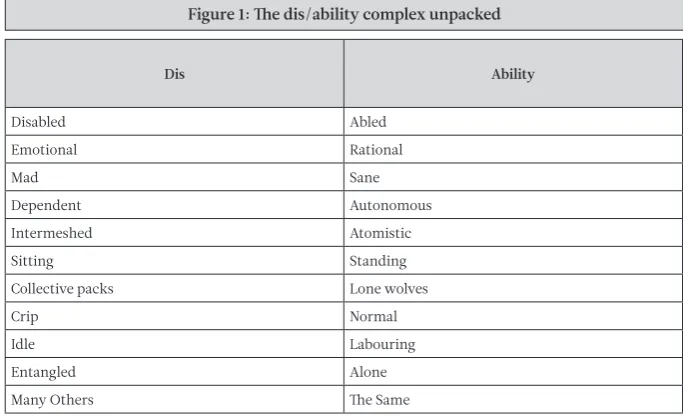
all individuals of contemporary society are imperilled by the practices of ableism. Ableism and disablism feed off each other; they are coterminous. h is is because disability cannot exist without ability. We would not be able to comprehend dis-ability without its mirror image. Moreover, the ableist premise that we can (and should) ontologically and economically self-fi nance our everyday lives helps breed the disabling circumstances on which disabled people are seen as not embodying the autonomous assets necessary for everyday life. I fi nd it helpful to think of us all living with the “dis/ability complex.” h is is a bifurcated reality where just as disability is diagnosed so ability is further expanded. And just as society holds more sway in the promises of self-suffi cient, autonomous, and able citizens so those that fail to meet up to the ableist zeitgeist are rendered disabled. And there are winners and losers here as diff erent values, social groupings, and individual human qualities are placed on either side of the dis/ability complex. In fi gure 1, I seek to briefl y tease out some of the key elements of the dis/ability complex:
Figure 1: h e dis/ability complex unpacked
Dis Ability
Disabled Abled
Emotional Rational
Mad Sane
Dependent Autonomous
Intermeshed Atomistic
Sitting Standing
Collective packs Lone wolves
Crip Normal
Idle Labouring
Entangled Alone
Many Others h e Same
activ-ism of critical disability studies. Second, one might view either side of the dis/ability complex as extreme binaries of opposition. And while some might argue that we live in a time of post-binaries, the dis/ability complex attends to the very defi nite ways in which humanity works through and against preferred and othered, claimed and abandoned, majoritarian and minoritarian positions. Disabled people are conceptu-alized in those terms described on the left of fi gure 1, and reacted to by a non-disabled society as monstrous others (Shildrick, 2002). Able-bodied and -minded people tend to succeed in a world governed by and constructed for citizens with whom they share many similarities (the right column in fi gure 1). h e dis/ability complex captures the global politics of diagnosis (in which more and more of us are likely to encounter a disability category) that is happening at exactly the same time when human survival and success is being ramped up in terms of individual autonomy and self-suffi ciency, as the interventions of the state recede, austerity rolls across and through nations, and American and UK isolationism begins. And the dis/ability binarism also invites the grouping of people in terms of – to paraphrase Braidotti (2006) – “the same” and (on the other side) “many others.” So, while I am prepared to concede that the dis/ ability complex is a representational fi gure of extremes, one could assert (with some justifi cation) that we are living in extreme socio-political times, a point I develop later when I consider our Trump-Brexit condition.
Labour
h e dis/ability complex has the potential to allow us to think critically about the way we labour in life. Labour remains a key topic of analysis for a whole host of disciplines ranging from economic policy to social policy and sociology. Labour in the form of paid labour is a defi ning feature of identity in many global north coun-tries across the globe. Employment status is an absolute marker of human success in these neoliberal-able times. Work is so embedded into the psyche of all of us that the prospect of unemployment conjures up not simply matters of fi nancial survival but also questions of ontological stability. But what would it mean to contest this naturalized phenomenon of the valued labouring citizen? How might we off er an intersectional critique of labour? One productive elision is that of critical disability and queer studies.
Queer scholars have led a resistance against the neoliberalisation of the soul where human value equates with labour value. h e work of Halberstam has been foundational to the queer celebration of “a way of refusing to acquiesce to dominant logics of power and discipline” and “a form of critique” (2011, p. 88). Carr beautifully described Halberstam’s h e Queer Art of Failure as
an energetic and loving tribute to those of us who fail, lose, get lost, forget, get angry, become unruly, disrupt the normative order of things, and exist and behave in the world in ways that are considered antinormative, anticapitalist, and antidisciplinary. In this manifesto on failure, the author claims the possibility of failing well. She also looks at what it means to not win, to not buy into consumer culture, to not aspire to accumulate goods, or to challenge disciplinary boundaries (Carr, 2012, n.p.).
contribution. Immaterial and unpaid relationships of support and care provide nec-essary building blocks of everyday community life. And these relational moments are a necessary antidote to the ableist emphasis on human value being tied to labour value. As Akemi Nishida (2017) demonstrates, it is through our emotional connec-tions and assemblages that we can promote mutual relaconnec-tionships and, by virtue of this, our shared humanness.
At the same time, however, disabled activists and researchers desire employ-ment. We know of the myriad ways in which disabled people are excluded from the world of work (e.g. Barnes & Roulstone, 2005). Failure in the labour market reveals the oppressive nature of employment regimes: conditions that many people (disa-bled and non-disa(disa-bled) struggle to celebrate. h is does not automatically denigrate queer/crip politics though it does raise questions about the place of normative desires for such things as the chance to work. Dis/ability studies provides a means of holding in tension crip and normative desires in relation to labour. I have built on this ten-sion by developing a DisHuman perspective with my colleagues Rebecca Lawthom, Katherine Runswick Cole, and Kirsty Liddiard.1 A DisHuman theory
“simultane-ously acknowledges the possibilities off ered by disability to trouble, reshape and re-fashion the human (crip ambitions) while at the same time asserting disabled people’s humanity (normative desires)” (Goodley & Runswick-Cole, 2016, p. 1). As we argue, DisHuman analysis allows us to “claim (normative) citizenship (associ-ated with choice, a sense of autonomy, being part of a loving family, the chance to labour, love and consume) while simultaneously drawing on disability to trouble, reshape and re-fashion liberal citizenship” to invoke what we call DisCitizenship (to rethink how we choose, act, love, work, and shop). DisCitizenship keeps in sharp relief the deeply complex, contradictory, and tension-fi lled ways in which disabled people crip the relationships around them while simultaneously engaging in very normative modes of life. h e dis/ability complex recognizes the push and pull of labour. Labour is an intersectional phenomenon that we might both be drawn to and also repulsed by.
Emotion
h e renowned feminist social psychologist Margie Wetherell has recently argued that the humanities, psychological and social sciences are witnessing the emergence of various theories of aff ect and emotion that attend to the ways in “which bodies are pushed and pulled in contemporary social formations, in the ‘engineering’ of aff ec-tive responses, and in how workers and citizens become emotionally engaged and aff ectively interpellated” (2015, p. 139). h e study of emotion is a key area of studies of diversity. And my sense is that there is much potential in probing the intersections of critical disability studies, critical race, feminist, and queer theories.
In terms of critical disability studies, there has been a plethora of work associ-ated with psycho-emotional disablism. h is phenomenon permits insights into the micro-aggressions felt by disabled people when they undergo direct and indirect forms of discrimination. Much can be learnt from the feminist disability scholars who have developed this work to consider the ontological damage that risks being done as a consequence of disablism. I am thinking here of the work of British writers Carol h omas (1999) and Donna Reeve (2005). When non-disabled people stare at disabled people, ask inappropriate questions about impairment, or respond with hostility, then there is a risk that disabled people are emotionally marginalised by these very political, micro-sociological encounters. And the psycho-emotional register not only refl ects processes of disablism but is also informed by ableism. As Ben Whitburn and Lucinda McKnight (2017) acknowledge, it is paramount that we attend to the psychological impact of living in an ableist culture where the very language we use speaks of a wider symbolic order that is phallocentric and ableist. To speak of disability is to use the language of defi ciency:
Retarded development. Blind to the facts.
h e truth falling on deaf ears. We stand up for ourselves. Blind panic.
h ese are just some common examples that reveal an inherently ableist and disablist lexicon. h is focus on psycho-emotional ableism is being developed in the work of Julia Daniels (2016). Her current groundbreaking doctoral research seeks to inves-tigate the experiences of disabled people as they refl ect back on their educational experiences. Schools are designed with a non-disabled learner in mind. And nar-rowing forms of assessment assume a particular kind of learner. Her unique angle on these experiences relates to the ways in which she asks informants to refl ect on the presence of ableist thought in their educational memories. Early fi ndings indicate the profound ontological impact of competitive individualized modes of achievement upon disabled people. Daniels’ work assembles a new way of thinking about the ableism inherent within society that risks denigrating the psycho-emotional worlds of individuals who fail to match up to ableist imperatives. Failure might, as we have considered above, be a resource for intersectional politics. But, equally, failure hurts. Emotion is worked at the dis/ability complex.
kinds of personhood associated with dominant groups (able-bodied and -minded, straight, white, male). h is play of denigration and predilection risks constituting a split cultural psyche. It is therefore crucial to work the split self in order to tease out the hegemonic forces at play. Such an activity fi ts well with a psycho-politi-cal analysis in which we consider the ways in which the psyche risks being injured through discrimination and oppression (Fanon, 1993; Hook, 2004). Without lapsing back into the usual individualized therapeutic discourses that colonise the aff ective register, a psycho-political intervention would uncover the social, cultural, and political circumstances that risk spoiling human subjectivity. A dis/ability complex provides a complementary framework for psycho-political work that builds on the critical race and black studies of Fanon. Indeed, in a recent book (Goodley, 2016) I argue that a pressing concern is to address the psychical injuries caused by racism and disablism that fl ourish in our cultural imaginaries biased towards ableism and whiteness. Disabled people often complain at “becoming the repositories of other’s ontological anxieties” (Marks, 1999, p. 188). Just as black people are expected to be, in the words of Frantz Fanon “good niggers” [sic], disabled people are supposed to be “good cripples;” “eternal victims of an essence, of an appearance, for which they are not responsible” (1993, p. 34). Black studies and disability studies each respond to these subtle relational moments of racism and disablism and feed, most importantly, into the work of activist organisations that respond to the psychological impact of living in a disabling and racist society through politicisation and the arts as powerful forms of catharsis. Similarly, the self-advocacy movement of people with the label of intellectual disabilities has established supportive community spaces for the sharing of aspirations (Roets, et al., 2008), mad pride has subverted normative understand-ings of sanity (Chamberlin, 1990), and queer crips have celebrated their transgression (McRuer, 2006). And these transformative spaces necessarily challenge the subjec-tive outcomes of disablism, racism, sanism, and heterosexism, performing a cultural act of what Frantz Fanon called socio-diagnosis: “waging war against discrimination on both levels of the socio-economic and the subjective” (Fanon, 1993, pp. 12-13).
categories we pull emotion out of its cultural moorings and, instead, comprehend un/happiness as an individual attribute. h e dis/ability complex can weigh in on these discussions about the cultural reproduction of emotion.
Learning
Drawing in the dis/ability complex encourages us to question the ideological appa-ratus of our places of learning. Clearly education is an intersectional concern. Ability and normativity tend to hunt together. Schools are striated in ways that lead groups of students down diff erent ability pathways. Norming ability and fi nding disability are key dividing practices of our educational systems. Educational success, signifi ed through individual achievement, threatens to break alliances between young people and sets them up as individualized entities competing with one another. Such indi-vidualization is apparent, too, in the university sector. In Britain the rather clumsily titled Early Career Researcher (ECR) is expected to adhere to a number of trajectories related to publication power, research bidding success, and administrative leader-ship. Little space is aff orded for collegiality and collectivity when one is chasing the next grant or publication. h is culture is not conducive to those researchers who are mutually interdependent on or with others. Disabled researchers and academics, those with caring responsibilities – many of whom are women – are already disad-vantaged even before the success indicators are brought out for public consumption and institutional audit.2 Educational spaces, across the board, work upon the dis/
ability complex. Education needs ability as an outcome and also as an object of edu-cational practice. And, just as importantly, let us not forget education’s reliance on disability: the naming, diagnosis, and treatment of those whose abilities fail or fall at educational hurdles that are designed to sift and sort learners.
Slee (2017) argues that exclusionary educational practices are an ontological given: where we fi nd learning we will fi nd some learners who are included and others who hover on the peripheries of the classroom. Slee (2017) is inspired by the American musician, composer, activist, and fi lmmaker Frank Zappa when he argues that inclusive education is not dead, it just smells funny (a point Zappa had made about the state of Jazz music in the 1960s). His point is that the educational systems we bear witness to are the products of complex debates, politics, and pol-icies in relation to education and inclusion. We have inherited a failed project of inclusive education in which we are (i) obsessed with individual achievement and attainment and (ii) infatuated with disability diagnoses. Whether or not inclusion ever occurred (though I fi nd that unlikely) the point of signifi cance is that we are currently witnessing a mismatch of competing discourses that are right at the heart of the dis/ability complex. h is leaves spaces of learning in a questionable state. And we know schools struggle to respond to diversity in terms of race, gender, sexuality, and disability, with those at the normative centre responding the best.
Applying the dis/ability complex to education reminds us that children of colour and disabled learners continue to exist on the peripheral borders of our educational cultures. And as the ableism of education becomes ever more pronounced, we can only expect to fi nd these learners shifting further and further away from the nor-mative centre.
Politics
In a concurrent piece I am writing with Tanya Titchkosky, we argue that these Trump-Brexit times pose signifi cant challenges for marginalised sections of society (Titchkosky & Goodley, in press). Both the Trump and Brexit campaigns referenced migrants, refugees, Mexicans, disabled people, and people of colour as threats to the normative homelands of the USA and the UK. h ese colonizing practices merely reiterate white colonial and supremacist views that deem the US or the UK as the centre of the world. h is is a particular kind of centrism where the white British or American voter is re-sited as the citizen worthy of interest. Centralising white Brits/Americans feeds into an ableist ideology that positions the WENA (Western European and North American) individuals as the business of our wider politics. Disabled activists have been quick to point out the irony of this politicking that claims to address the ignored generation. h e Trump and Brexit campaigns postured around a politics of inclusion, developing policies that addressed the hidden (white) urban and rural working classes, historically ignored by the political elites (Harnish, 2017). Trump’s campaign emphasized the plight of the able-bodied, self-suffi cient working class that needed only work rather than the state to release their potential. In making this argument we are left, yet again, with an ableist common sense: an unconscious, ideological position that emphasizes this well-work trope. According to this view, individual citizens are ready and able to work if only we would let them. Such a tacit model of the cit-izen ignores those that require the support of others (such as many people with impairments or illnesses) and, importantly, dismisses those communities that have at their heart a more collectivist and interdependent approach to everyday life (such as many of the diasporic and fi rst nation communities found across the states of America).
Technology
h e blending of the wet ware of bodies with the hard ware of technology demands a cross-examination of the promises and ethics of technology. What is it about the limits of humanity that some of us fi nd so unappealingly incomplete? When is tech-nology brought in to refashion the human whose imaginations are being framed? h e ethics of human enhancement and bio-psycho improvement encompass a huge range of ideas and possible interventions including genome editing, the use of prosthetics, the merging of organic and inorganic matter, artifi cial intelligence, and revised uses of drugs previously assigned for childhood labels such as ADHD. Enhancement also encompasses fraught bioethical debates such as the quality of life, the right to die and live, and the value of technological implants.
One way in which dis/ability studies can intercede is to provide an indispensable moment to pause and think. Let us take, as an example, the treatment of ADHD with Ritalin. Disability’s detection invites a pharmacological response to make the user as able as possible and contain or eliminate diff erence. Disability is diagnosed at the same time as a trajectory of ability is produced. Many scholars and activists of disability studies are understandably suspicious about technological or medical intervention, especially when these treatments imply normative ambitions. h e prescription of ADHD responds to a dis/ability diagnosis with the hope of embold-ening the dis/ability element of newly diagnosed children (to get them back in line with other non-disabled people in the classroom). Dis/ability studies would want to unpack the normative desires at the heart of such psycho-pharmacological inter-vention.
At the same time, however, dis/ability studies must be attentive to the more non-normative approaches to biomedical and technological intervention (see, for example, Sparrow, 2013). One example relates to trans and gender nonconforming individuals who draw on technologies of the psyche and body. For those people who are engaged with gender transition we might understand the appropriations of technology as potentially more non-normative by design. Biomedical interven-tion, in this case, feeds into gender fl uidity. h e debates do not end there, of course, because others might view gender reassignment as the medical paradigm off ering only strictly embodied, gendered binarised options.3 I would suggest, however, that
there is queer potential in technologies of trans. h is draws in trans activists (and I would also add disabled people) as key contributors to bioethical deliberations (Powell & Foglia, 2014). Too often people from LGBTQ communities – like disabled people – are considered to be merely the objects rather than the subjects of medical intervention and bioethical debate. Trans perspectives on technologies of the body share much with the politics of disabled people who are working the dis/ability complex for more crip ways of living life. We want to explore how biomedical tech-nologies – often the subject of crip critique – might be utilized in order to enhance
a body’s trans potential. As Argüello (2016) makes clear, too often we hold norma-tive ideas about the biomedical that already view medicalization as (often unnec-essarily) intervening in life to eradicate ill health and pathology. h is might explain why some disability studies scholars have recently contributed to twitter debates arguing against gender reassignment surgery undertaken by young trans people. Such surgery is viewed as a form of medicalization being unnecessarily adopted by unwitting, not-yet-adult and, therefore, naïve individuals. Yet, such a viewpoint fails to engage with more queer understandings of biomedical intervention. Here, again, the dis/ability complex invites a deep interrogation of technology, including trans/crip connections.
Anthropocene
Our discussion of technology inevitably takes us into a discussion of the anthropo-cene, i.e. our current times when the world has been deeply marked by the practices of human beings. Environmental politics and disability politics might be conceived of together as a critical response in these times of posthuman activism. h e reason for this is that a wider exclusionary politics is at the heart of the dehumanization of disabled people, a politics that justifi es the privileging of certain sections of the human population over other humans and non-humans. Indeed in their introduc-tion to the 2018 Posthuman Glossary, Rosi Braidotti and Maria Hlavajova are clear that these posthuman times need to bring together animal, human, cosmological, technological, and ecological politics in order to address the damage being done to the globe and those who live on it.
Mindy Blaise’s work with other colleagues draws attention to the importance of attending to the relationships between humans and non-humans.4 In order to
develop a truly inclusive human politics, Blaise (2017) argues that we need to attend to our relationships with non-humans and the wider environment. She puts for-ward a non-hierarchical model of diff erence in which we consider the complexities of human-animal relationships and resist the temptation of anthropocentrism. Instead, thinking through how we live with animals may develop a more complex, non-hierarchical, and contingent politics of everyday life. h is approach picks up on the infl uential work of Rosi Braidotti and her analysis of the posthuman (2006, 2013). She calls for a posthuman politics that extends life beyond the species. As we argue in Goodley, Lawthom and Runswick-Cole (2014, p. 345),
Braidotti takes to task the human species centering of our own perceived superiority: an anthropocentrism that puts humanist man (anthropos) before other species and the environment. Humanism situates anthro-pos as elite species, occupying a sovereign anthro-position. A anthro-posthuman turn contests such elitism, reminding itself that the superior human ideal is of
course only that; a utopian ideal. Moreover, this is an organic entity that has been “technological mediated to unprecedented order” (Braidotti, 2013, p. 57) subjected to “the four horsemen of the posthuman apocalypse: nanotechnology, biotechnology, information technology and cognitive science” (59). h e human species has been expanded upon through these experiments; thus challenging the centrality of anthropos and ensuring that “the boundaries between ‘Man’ and his others go tumbling down, in a cascade eff ect that opens up unexpected perspective … Relinquishing the demonic forces of the naturalised others” (66-67). h ese others include animals, insects, plants, environment and the cosmos as a whole.
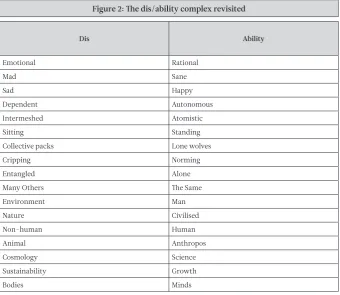
[image:14.484.84.425.277.572.2]For Braidotti, the posthuman urge to move beyond the species opens up solidarities with non-humans including animals and the wider natural environment. Post-an-thropocentricism results from this posthuman response, a reaction that fi ts well with dis/ability studies. With this in mind, we can revisit the dis/ability complex:
Figure 2: h e dis/ability complex revisited
Dis Ability
Emotional Rational
Mad Sane
Sad Happy
Dependent Autonomous
Intermeshed Atomistic
Sitting Standing
Collective packs Lone wolves
Cripping Norming
Entangled Alone
Many Others h e Same
Environment Man
Nature Civilised
Non-human Human
Animal Anthropos
Cosmology Science
Sustainability Growth
Bodies Minds
oppressive value system that declares some bodies normal, some bodies broken, and some bodies food” (2011, p. 191). She declares, “as a freak, as a patient, I do not deny that I’m like an animal. Instead, I want to be aware of the mistreatment that those labelled ‘animal’ (human and nonhuman) experience. I am an animal” (Taylor, 2011, p. 194). In contemplating the ways in which animals are portrayed as burdensome, dependent, and natural, we connect with some key tropes associated with the his-torical maltreatment of disabled people. Taylor envisages a cross-pollination of ideas across animal and disability studies precisely because both animals and disabled people occupy similar devalued positions. h is dialogue between animal studies and disability studies invites the engendering of a posthuman politics that contemplates human/non-human connections (see Taylor, 2017).5
Such connections seem to me to be at the foreground of contemporary engage-ments with intersectionality especially when we think more broadly about environ-mental politics. Deborah Fenney-Salkeld off ers the following observation about the relationship between disability and environmental politics:
Disability studies’ concern with the environment has often only extended as far as its potential for accessibility is concerned – implying an anthro-pocentric viewpoint. Although it may be appropriate for disability studies to remain broadly anthropocentric, an explicit acknowledgement of the value of the environment beyond accessibility would enable engagement with sustainability debates. h is might mean explicit recognition of the natural environment as sustaining life, and an understanding of the inter-dependence of humans and nature (2016, p. 460).
h is argument fi ts well with a posthuman political project that seeks to respond to the anthropocene through a trans-amalgamation of animal, disability, and envi-ronmental studies.
Conclusions
To say that a category such as race or gender is socially constructed is not to say that the category has no signifi cance in our world. On the contrary, a large and continuing project for subordinated people – and indeed, one of the projects for which postmodern theories have been very helpful – is thinking about the way power has clustered around certain categories and is exercised against others. h is project attempts to unveil the processes of subordination and the various ways these processes are experienced
by people who are subordinated and people who are privileged by them. (Crenshaw, 1991, pp. 1296-1297)
I end this paper with this extended quotation from Crenshaw to remind us of the tension at the heart of intersectional theory: the simultaneous exposure of privi-lege and subordination. h is fi ts in with the project of dis/ability studies to keep in play the oppositional work that takes place everyday between “dis” and “ability.” h e dis/ability complex functions as an intersectional cultural archetype: an event, process, model, moment, and instance. For intersectional theory, dis/ability off ers what Garland-h omson (2005) terms the chance to “rethink”: to refl ect on what we already have learnt from intersectional theory and to draw in new insights from dis/ability. Rather than replacing theoretical ideas, concepts or preferences, the dis/ ability complex is an additional heuristic device that we might draw into our work.
Acknowledgements
I would like to thank and acknowledge the Economic and Social Research Coun-cil for the funding of the research project ES/P001041/1, “Life,} Death, Disability and the Human: Living Life to the Fullest”. h is project, while in its early stages, has challenged me further to understand the complex co-dependent workings of ableism and disablism.
References
Ahmed, S. (2004). h e cultural politics of emotion. New York: Routledge. — (2007/2008). h e happiness turn. New Formations, 63(8), 7-14.
— (2010). Killing joy: Feminism and the history of happiness.Signs,35(3), 571-594.
Argü ello, T. M. (2016). Fetishizing the health sciences: Queer theory as an intervention. Journal of Gay & Lesbian Social Services, 28(3), 231-244, http://dx.doi.org/10.1080/10538720.2 016.1191407
Barnes, C. & Roulstone, A. (Eds.). (2005). Working futures. London: Policy Press.
Blaise, M. (2017). Moving-with: Activating feminist politics and practices in the early years. Keynote lecture presented at the Past the Posts? Post-inquiry in the Post-truth Era con-ference,18-19 July 2017, Deakin University.
Braidotti, R. (2006). Posthuman, all too human: Towards a new process ontology. h eory Cul-ture Society, 23(7-8), 197-208.
— (2013). h e posthuman. London: Polity.
Braidotti, R. & Hlavajova, M. (Eds.). (2018). Posthuman glossary. New York: Bloomsbury Pub-lishing.
Carr, A. D. (2012). Unbeing and unbecoming [Review of the queer art of failure by Judith Halber-stam]. Enculturation. Retrieved from: http://enculturation.net/unbeing-and-unbecoming Campbell, F. K. (2008a). Refusing able(ness): A preliminary conversation about ableism. M/C
– Media and Culture, 11(3). Retrieved from: http://journal.media-culture.org.au/index. php/mcjournal/article/view/46
— (2008b). Exploring internalized Ableism using critical race theory. Disability & Society,
— (2009). Contours of Ableism: Territories, objects, disability and desire. London: Palgrave Macmillan.
Chamberlin, J. (1990). h e ex-patients movement: where we’ve been and where we are going.
Journal of Mind and Behaviour, 11(3),323-336.
Crenshaw, K. (1991). Mapping the margins: Intersectionality, identity politics, and violence against women of color. Stanford Law Review, 43(6), 1241-1299.
Daniels, J. (2016). An exploration of psychoemotional ableism. University of Sheffi eld: Unpub-lished confi rmation report.
Dunhamn, J., Harris, J., Jarrett, S., Moore, L., Nishida, A., Price, M., Robinson, B., & Schalk, S. (2015). Developing and refl ecting on a Black Disability Studies pedagogy: Work from the National Black Disability Coalition. Disability Studies Quarterly, 35(2). Retrieved from: http://dsq-sds.org/article/view/4637/3933.
Erevelles, N. (2012). Disability and diff erence in global contexts: Towards a transformative body politic. London: Palgrave.
Powell, T. & Foglia, M. B. (2014). h e time is now: Bioethics and LGBT issues. Hastings Center Report, 44, S2–S3.
Fanon, F. (1993). Black skins, white masks. h ird edition. London: Pluto Press.
Fenney Salkeld, D. (2016). Sustainable lifestyles for all? Disability equality, sustainability and the limitations of current UK policy. Disability & Society, 31(4), 447-464.
Garland h omson, R. (1997). Extraordinary bodies: Figuring physical disability in American literature and culture. New York: Columbia University Press.
— (2002). Integrating disability, transforming feminist theory. NWSA Journal, 14(3), 1-32. — (2005). Feminist disability studies. Signs: Journal of Women in Culture and Society, 30(2),
1557-1587.
Goodley, D. (2014). Dis/ability studies. London: Routledge.
—. (2016). Disability studies: An interdisciplinary introduction. Second edition. London: Sage. Goodley, D., Lawthom, R. & Runswick-Cole, K. (2014). Posthuman disability studies.
Sub-jectivity, 7, 342-361.
Goodley, D. & Runswick-Cole, K. (2016). Becoming dishuman: h inking about the human through dis/ability. Discourse: Studies in the Cultural Politics of Education, 37(1), 1-15. http://dx.doi.org/10.1080/01596306.2014.930021
Halberstam, J. (2011). h e queer art of failure. Durham: Duke University Press.
Hannam-Swain, S. (2017). h e additional labour of a disabled PhD student. Disability & Soci-ety. http://dx.doi.org/10.1080/09687599.2017.1375698
Harnish, A. (2017). Ableism and the Trump phenomenon. Disability & Society, 32(3). http:// dx.doi.org/10.1080/09687599.2017.1288684
Hook, D. (2004). Frantz Fanon, Steve Biko, ‘psychopolitics’ and critical psychology. In D. Hook (Ed.), Critical Psychology (pp. 114-137). Lansdowne, South Africa: Juta Academic Publish-ing. Retrieved on 10 September 2011 from http://eprints.lse.ac.uk/961.
Marks, D. (1999). Disability: Controversial debates and psychosocial perspectives. London: Routledge.
Meekosha, H., & Shuttleworth. R. (2009). What’s so ‘critical’ about Critical Disability Studies?
Australian Journal of Human Rights, 15(1), 47–75.
McRuer, R. (2006). Crip theory: Cultural signs of queerness and disability. New York: New York University Press.
— (2012). Disability and the globalisation of austerity politics. Keynote paper presented at the
Contact Zone: Disability, Culture, h eory conference, 25-27 October, University of Cologne. McRuer, R. & Wilkerson, A. (2003). Cripping the (queer) nation. GLQ: A Journal of Lesbian
and Gay Studies, 9(1-2), 1-23.
Mollow, A. (2017). Unvictimizable: Toward a Fat Black Disability Studies. African American Review, 50(2), 105-121.
Morris, J. (1991). Pride against prejudice: Transforming attitudes to disability. London: h e Women’s Press.
— (1992). Personal and political: a feminist perspective on researching physical disability. Dis-ability, Handicap and Society, 7(2), 157-166.
— (Ed.). (1996). Encounters with strangers: Feminism and Disability. London: h e Women’s Press.
Nishida, A. (2017). Relating through diff erences: Aff ective relationality of disabled care recip-ients and their paid care providers within the U.S. public healthcare assemblage. Subjec-tivity, 10(1), 89-103.
Reeve, D. (2005). Towards a psychology of disability: h e emotional eff ects of living in a dis-abling society. In D. Goodley & R. Lawthom (Eds.), Disability and psychology: Critical introductions and refl ections (pp. 94-108). London: Palgrave.
Roets, G., Reinaart, R., Adams, M., & Van Hove, G. (2008). Looking at lived experiences of self-advocacy through gendered eyes: Becoming femme fatale with/out “intellectual dis-abilities”. Gender & Education, 20(1), 15-29.
Shildrick, M. (2002). Embodying the monster: Encounters with the vulnerable self. London: Sage. Slee, R. (2017). Inclusive education isn’t dead, it just smells funny. Paper presented at Past the
Posts? Post-inquiry in the Post-truth Era conference, 18-19 July 2017, Deakin University. Sparrow, R. (2013). Queerin’ the PGD clinic: Human enhancement and the future of bodily
diversity. Journal of Medical Humanities, 34(2), 177-96.
Sue, D. W., Bucceri, J., Lin, A. I., Nadal, K. L., & Torino, G. C. (2007). Racial microaggressions and the Asian American experience. Cultural Diversity and Ethnic Minority Psychology,
13(1), 72-81.
Sue, D. W. (2010). Microaggressions in everyday life: Race, gender, and sexual orientation.
London: Wiley.
Taylor, S. (2011). Beasts of burden: Disability studies and animal rights. Qui Parle: Critical Humanities and Social Sciences, 19(2),191-22.
— (2017). Beasts of burden: Animal and disability liberation. New York: h e New Press. h omas, C. (1999). Female forms: Experiencing and understanding disability. Buckingham:
h e Open University Press.
Titchkosky, T. (2003). Disability, self and society. Toronto: University of Toronto Press. Titchkosky T. & Goodley, D. (in press). h e disability imaginary in TrumpBrexit times. In
[Jour-nal tbc at time of writing]
Vernon, A. (1999). h e dialectics of multiple identities and the disabled people’s movement.
Disability & Society, 14(3),385-398.
Wetherell, M. S. (2015). Trends in the turn to aff ect: A social psychological critique. Body and Society, 21(2), 139-166.
Whitburn, B. & McKnight, L. (2017). Attending to the wince: Resisting persistent sexist and ableist metaphor in education research. Paper presented at Past the Posts? Post-inquiry in the Post-truth Era conference,18-19 July 2017, Deakin University.