Q
•
-
>
-·
)("'
LUDIRECTORATE GENERAL XV Internal Market and Financial Services
General matters and coordination, free movement of persons and direct taxation
External dimension of the internal market and financial services
JAPAN
Brussels, 8 June 1995
Ref: Nigg-jv\tcr\japanXV-A-2
. O
Rue de la Loi 200, B-1049 Brussels, Belgium - Office: C 107 8/4327.GDP in Japan reached 466 tm yen (3581 bn ECU1) in 1993. With a population of 125 mn this represented 3.7 million yen (28,640 ECU) per capita GDP. This compares to an average of 15,800 ECU in the EU. The Japanese economy experienced modest growth in real terms in 1993 of 0.2%.
Introduction
There have been improvements in conditions of access and operation since the 1992 report with further significant changes planned. These derive mainly from the Financial System Reform Act, the ongoing deregulation process and insurance law reform.
Japan pursues a general policy of national treatment towards foreign financial institutions with regard both to their establishment and to their operations. · Notwithstanding the implementation of financial deregulation measures such as ~e financial system reform, the 5-year deregulation plan, and the insurance system reform, foreign firms nonetheless experience serious market access problems in Japan. While this may in part be due to the fact that the above measures are too new to have produced market opening effects, it is . also reported that problems subsist in the form of heavy and conservative administrative regulation, market segmentation and the existence of close corporate relationships, established networks and patterns of doing business preventing effective market access and penetration by foreign firms, particularly in the insurance sector. It is expected that the latter will experience considerable reform in the course of 1996.
Japan has confirmed its commitment to a policy of deregulation of its financial sector over the past two years. In iq.surance a major revision of the Insurance Law is being undertaken. Introduction of a brokerage system is envisaged; procedures for product and rate approval it is intended to expedite and simplify procedures for product and rate approval. Some foreign exchange business previously reserved for banks, is now allowed for securities firms, through subsidiaries. Foreign
banks
can now have wholly-owned subsidiaries or branches operating in the securities business. Optionally, they may retain the 50 per cent ceiling, thus avoiding the need for strict segmentation of activities (firewalls), a facility not available to domestic operators. This has been termed "better than national treatment". The rules on traditional market segregation have been relaxed. Several EC requests have therefore been met by Japan.However, corporate underwriting (lead-management of corporate issues unknown for foreign firms), investment management services ( distribution problem) and pension fund management (partial access to Employees' Pension Funds and "Nempuku" funds by IACs) remain to be addressed. The Japanese government states that foreign firms have already obtained the lead management of domestic corporate issues for the past year.
Additional deregulatory, market-opening, measures seem therefore to be needed in asset and investment management, corporate securities and to complement and complete the deregulatory progress in Japan to date. The US/Japan measures on Insurance and Financial Services could, depending on how they are implemented, give further impetus to the market opening and deregulation process in a number of financial services. It
l.
t'
remains to be seen how far non-US companies will in practice benefit from these provisions. In the Joint Statement on the US/Japan Framework agreement, the Japanese government stated "Benefits under this Framework will be on a. Most Favored Nation basis."
CREDIT INSTITUTIONS
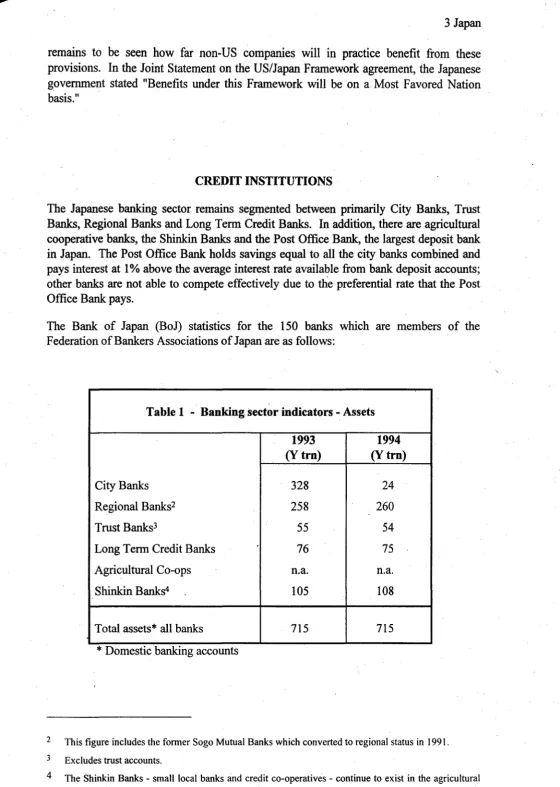
The Japanese banking sector remains segmented between primarily City Banks, Trust Banks, Regional Banks and Long Term Credit Banks. In addition, there are agricultural cooperative banks, the Shinkin Banks and the Post Office Bank, the largest deposit bank in Japan. The Post Office Bank holds savings equal to all the city banks combined and pays interest at I% above the average interest rate available from bank deposit accounts; other banks are not able to compete effectively due to the preferential rate that the Post Office Bank pays.
The Bank of Japan (BoJ) statistics for the
150
banks which are members of the Federation of Bankers Associations of Japan are as follows:2
3
Table 1 - Banking sector indicators - Assets
1993 1994
(Y trn) (Y trn)
City Banks
328
24
Regional Banks2
258
260
Trust Banks3
55
54
Long Term Credit Banks
76
75
Agricultural Co-ops n.a. n.a.
Shinkin Banks4
105
108
Total assets* all banks
715
715
* Domestic banking accounts
This figure includes the former Sogo Mutual Banks which converted to regional status in 1991.
Excludes trust accounts.
[image:3.596.24.584.27.814.2], Table 2 - Banking sector indicators - Deposits ,
1993
1994(Ytm) (Ytm)
City Banks 209 208
Regional Banks 220 226
Trust BanksS 9 9
Long Term Credit Banks 58 57
Agricultural Co-ops 66 676
Shinkin Banks 91 95
Deposits 7 all banks (Y trn) 494 500
Source : The Bank of Japan.
Foreign banks
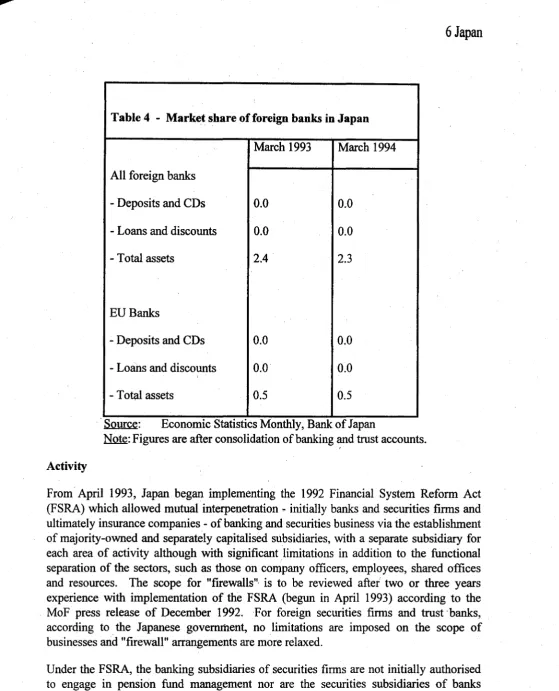
At the end of June 1994 there was a total of 88 foreign banks established in Japan. EU banks represented about 1.9% of assets and 0.6% of chartered bank deposits, and non-EU foreign banks about 1.2% and 0.4%, respectively.
Most foreign banks operate in niche markets; only one foreign bank has tried to enter the retail sector without success. · The comparatively small asset bases and high cost of operating in the Japanese market means that it is unlikely that there will be any further expansion by foreign banks except by acquisition or merger. One EU bank ceased operations on 31 March 1995.
MARKET ACCESS AFFORDED TO EU CREDIT INSTITUTIONS
Establishment
Notwithstanding the fact that foreign banks continue to enjoy de jure national treatment in Japan for the rules on establishment and operation, their market penetration remains severely limited. The difficulties encountered by EU banks arising from the well known institutional and behavioural features of the Japanese market still dominate the overall picture of market access in Japan. The Japan/US agreements, or "measures" on financial services provided the benefits are extended to other foreign financial intermediaries, may produce real changes in the market place and an increase in the level of market penetration by foreign firms.
5
6
7
As of November 1994.
As of November 1994.
[image:4.596.11.581.28.681.2]( a) Commercial Banks
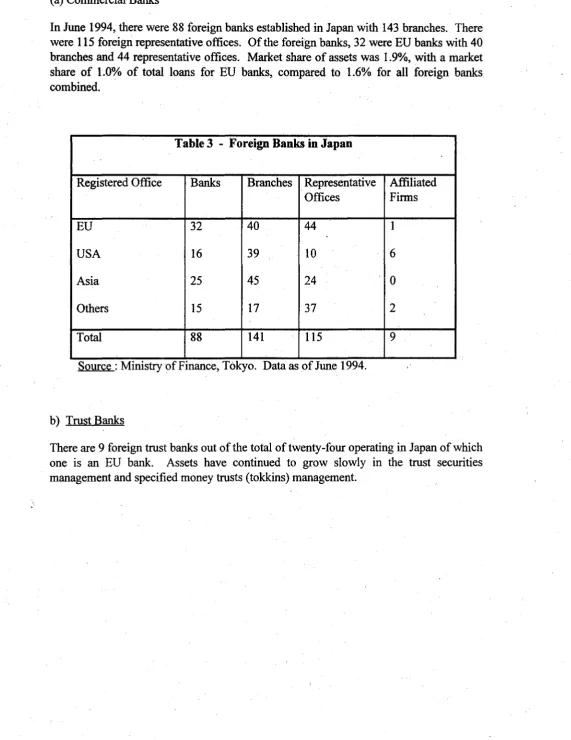
In June 1994, there were 88 foreign banks established in Japan with 143 branches. There were 115 foreign representative offices. Of the foreign banks, 32 were EU banks with 40 branches and 44 representative offices. Market share of assets was 1.9%, with a market share of 1.0% of total loans for EU banks, compared to 1.6% for all foreign banks. combined.
Table 3 - Foreign Banks in Japan
Registered Office Banks Branches Representative Affiliated Offices Firms
EU 32 40 44 1
USA 16 39 10 6
Asia 25 45 24 0
Others 15 17 37 2
Total 88 141 115 9
Source: Ministry of Finance, Tokyo. Data as of June 1994.
b) Trust Banks
[image:5.596.21.592.105.845.2]6 Japan
Table 4 - Market share of foreign banks in Japan
March 1993 March 1994
All foreign banks
- Deposits and CDs
0.0
0.0
- Loans and discounts
0.0
0.0
- Total assets 2.4 2.3
EU Banks
- Deposits and CDs
0.0
0.0
- Loans and discounts
0.0
0.0
- Total assets
0.5
0.5
Source:
Economic Statistics Monthly, Bank of Japan~ : Figures are after consolidation of banking and trust accounts.
'
Activity
From April 1993, Japan began implementing the 1992 Financial System Reform Act (FSRA) which allowed mutual interpenetration - initially banks and securities firms and ultimately insurance companies - of banking and securities business via the establishment of majority-owned and separately capitalised subsidiaries, with a separate subsidiary for each area of activity although with significant limitations in addition to the functional separation of the sectors, such as those on company officers, employees, shared offices and resources. The scope for "firewalls", is to be reviewed after two or three years experience with implementation of the FSRA (begun in April 1993) according to the MoF press release of December 1992. For foreign securities firms and trust -banks, according to .. the Japanese govermhent, no limitations are imposed on the scope of businesses and "firewall" arrangements are more relaxed.
[image:6.596.23.582.24.715.2], Nonetheless, the FRSA effected a significant change in that ordinary banks were allowed into trust banking and securities business, but not brokerage activities, trust banks into · securities business, securities firms into ordinary and trust banking and long term credit banks and specialised banks into ordinary banking, trust banking and securities business. The securities subsidiaries of banks are, according to the Japanese government, only initially denied access to equity-related activities and from trading in convertible bonds
and bonds with warrants. Trust banking subsidiaries likewise are reported to be only
initially denied access to certain securities trusts8 and special loan trusts in which public funds are invested to protect under-performing trust banks. These initial limitations on scope of businesses are, according to MoF, expected to be reviewed in the near future. ·
INSURANCE
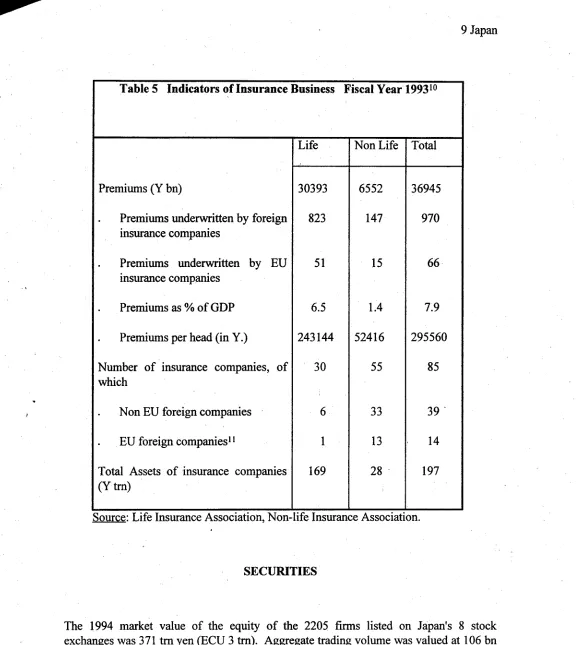
Insurance continues to hold an important position in the financial sector in Japan and remains the second largest insurance sector in the world. At the end of March 1994 there were 30 life and 55 non-life companies operating in Japan. Life premiums amounted to 30,393 bn yen (6.5% of GDP) and non-life premiums to 6,552 bn yen (1.4% of GDP) in 1993. Total assets of life insurance companies amounted to 169,122 bn yen at the end of March 1994 and 27,952 bn yen in non-life.
The Administrative Procedure La}V was implemented in October 1994 which was expected to make handling of insurance-related applications more transparent. Pursuant to general reform in the insurance field, a draft insurance law has been presented to the Diet in April 1995 with implementing regulations expected in the next year. Full implementation of deregulatory insurance reform is therefore expected around April 1996. The US/Japan Measures may in principle create new opportunities for foreign msurers.
MARKET ACCESS AFFORDED TO EC INSURANCE UNDERTAKINGS
Activity
Deregulation measures announced to date represent a step in the right direction, including greater transparency, statistical monitoring, and confirmation of the introduction of a brokerage system. Many aspects of deregulation depend upon implementation of the insurance law reform.
The Japan/US Insurance measures on insurance foresee reform in two major areas: administrative measures and market access measures. The administrative measures will provide greater transparency, rights of participation in industry advisory groups and rights of appeal. The reform measures in the area of market access concern product and rate approval, access to public. companies' insurance requirements and examination of anti-competitive practices in the insurance market. No abolition across the board of prior
.,
I
.,
approval of products and rates is envisaged. These measures will be accompanied
by
institutional action to review implementation consisting of annual joint meetings which assess the, impact of the measures in place on the basis of the number of new approvals of
new products, "Ilew rates and licences. 9
As in other sectors, it is the non-discriminatory impediments which prevent foreign companies from reaching their full potential in the Japanese market, and, until now, the relatively modest pace of implementation of reform.
TREATMENT OF EU COMPANIES
Japan's rules generally grant EU insurers national treatment as regards establishment and
operation in Japan. Foreign insurers have been allowed to operate in both the life and·
non-life business through separate subsidiaries, which is not permitted to domestic firms. Problems for foreign firms emerge primarily due to the lack of transparency of the regulatory environment and the exclusionary business practices of companies which are often related (keiretsu). Enabling legislation in respect of a long-awaited domestic liberalisation plan in the insurance sector was adopted by the Diet in May 1995. Enactment will be followed by the preparation of detailed ordinances, with implementation of the new system planned for 1996.
Lacking the size and business relationships of Japanese insurers, EU companies cannot effectively compete as the regulatory structure and keiretsu do not give rise to competition on the basis of innovative products at competitive prices.
9 The US/Japan Measures state : " ... on the basis of the overall consideration of the qualitative and
f
Table 5 Indicators of Insurance Business Fiscal Year 199310
Life Non Life Total
Premiums (Y bn)
30393
6552
36945
.
Premiums underwritten by foreign823
147
970
.
.
insurance companies
Premiums underwritten by EU
51
15
66
insurance companies
Premiums as % of GDP
6.5
1.4
7.9
Premiums per head (in Y.)
243144
52416
295560
Number of insurance companies, of
30
55
85
which
Non EU foreign companies
6
33
39.
EU foreign companies• 1
1
1314
Total Assets of insurance companies
169
28 ·
197
(Y trn)Source: Life Insurance Association, Non-life Insurance Association.
SECURITIES
The
1994
market value of the equity of the2205
firms listed on Japan's8
stockexchanges was
371
trn yen (ECU3
trn). Aggregate trading volume was valued at106
bn shares. New equity funding was936
bn yen. Of the93
foreign firms listed on the T9kyo Stock Exchange at the end of1994, 29
were EU firms. The OTC market saw2.4
bn shares traded in1994.
The Tokyo Stock Exchange fell to its lowest levels since1992
in the first half of1995.
A low volume of trading has made it virtually impossible for any10 April 1993 - March 1994.
[image:9.595.6.582.20.665.2]but the largest securities firms to make a profit over the past few years. Thus, the number of foreign companies listed in Tokyo has fallen by about one third.
Table 6 - Securities Market Indicators. Japan's 8 Stock Exchanges
1993 1994
Turnover in equity shares (Y trn) 106.1 114.6
Turnover as % of GDP 22.8 24.4
Capitalisation equity shares (Y trn) 335.5 371.0
Number of companies with shares listed 2155 2205
Source:
Tokyo Stock Exchange.Establishment
Japan formally grants foreign securities companies national treatment for establishment and operations. European industry has nonetheless reported that market access problems exist. There is an insufficient foreign share in underwriting corporate issues due to keiretsu relationships, although the MoF notes that this is a matter of commercial judgement on the part of the issuer. In addition, non-discriminatory but burdensome regulation of the market and the severe restrictions on competing for major categories of asset management, in particular public and private pension fund management, are both said to be problems in this sector.
Activity
Securities Trading
The deregulatory measures put into place in July 1994 included a move from case by case approval of financial futures to adoption of three categories of product thus streamlining the approval procedure. Other measures introduced related to liberalising the rules dealing with negotiated transaction financial derivatives; swaps, options and futures; and allowing of more c?mpanies to issue securities .and commercial paper. Taken together, the measures were a step in the right direction without amounting to a major programme
of deregulation. ·
[image:10.594.44.579.31.810.2]subject to "relevant criteria". Relevant standards and procedures have been "improved" with a view to clarifying whether an instrument constitutes a "security" under the SEL. Also appearing in the March deregulation plan is the intention to introduce asset-backed securities backed by leasing claims or credit claims, but only once investor protection has been assured and compatibility with other laws has been verified. Implementation is nonetheless expected to occur in FY1995. According to the MoF, there are no approval
procedures under the SEL regarding the introduction of new products. When
implemented, the measures announced by Japan will meet some of the EU requests concerning cross-border trade in securities.
Asset Management - Pension funds
In February 1995, Japan and the US agreed on Measures in financial services. These measures, could, depending on how implemented, represent significant steps forward in liberalising Japan's financial markets and, if successful, lead to further deregulation. The measures allow independent fund managers to enter large parts of the Japanese pension market; as well as offer increased opportunities to foreign firms in the Japanese corporate securities market.
The MoF contends that substantial improvements in access to pension fund management will be achieved with regard to the main public pension funds, namely the "rtempuku" funds12. Investment advisory companies will have.effective access to the management of nempuku funds after specific investment vehicles have been established and that will only take place after decisions have been made on their .structure. This could take some time although the MoF reports that those who will be participating in the scheme are already making new contracts for this purpose ..
In addition, asset allocation rules imposed by the Ministries of Finance and of Health and Welfare were relaxed. Under regulations established by these Ministries, individual fund managers were required to maintain a minimum of 50% of safe. assets (yen fixed interest investments). The figure for foreign financial institutions was 30%. The 50% minumum rule was abolished by MoF in April 1995. Public and private pension funds must observe the method of asset allocation comprising a maximum of 30% domestic equities, 30% foreign securities and 20% real estate. The rule handicaps foreign companies whose main activity is management of equities. These obligations on individual managers· were abolished in April 1995, though the asset allocation method of 5:3:3:2 remains for overall allocation of fund assets.
As regards private Employees' Pension Funds, the agreement represents further improvements in the liberalisation of non-discriminatory barriers to access to management of these funds by Investment Advisory Companies. In this context, the Japanese government announced its intention to reduce the compulsory eight year period, before independent managers are allowed to advise and manage employees' pension
funds, to three years, and, while no details have been given on the expected timing, to enlarge the current one third ceiling on asset managementl3. It is expected that the one third ceiling on fund management will be increased to one half in the autumn of 1996.
With regard to Mutual Aid Associations (38.4 trn yen in 1994), Japan confirmed that investment advisors are already permitted to manage funds of a certain number of such organisations. Access to tax-qualified pension plans (16.1 trn yen in 1994), which represent a growing share of the market, remains confined to fund management by trust banks and life insurance companies.
Asset management - other issues
Japan
has
announced that it would relax the present strict licensing separation between investment advisory and investment trust business, thus reducing entry and operating costs. In addition, the Japanese government has allowed since 1 January 1995 investment trusts, subject to minimum prudential requirements, to invest in a wider range of financial instruments with increased disclosure of performance data and fewer restrictions of sales of foreign funds into Japan.Prospects for EU companies
Japan has taken and announced a number of steps which amount to a drastic relaxation of previous regulations in pursuit of liberalisation and modernisation. However, in statistical terms, market penetration for foreign companies
has
not changed significantly since 1992. The financial system reform, the deregulation plan the insurance measures may rightly be viewed as part of an on-going process of liberalisation and internationalisation, first begun in the 80's by the Japanese government. For European industry, these changes are thought to be overdue and are seen to be motivated, at least in part, by a need to redress the weakness of th~ domestic Japanese markets in financial services as much as to respond to requests for market opening measures from Japan's trading partners.The Japanese government has indicated that the benefits of the Japan/US Measures are available on an MFN basis, in which case European firms are well placed to benefit from the increased . business opportunities. Broader economic and financial market considerations will of course also play a role.