This is a repository copy of
Java in the Safety-Critical Domain
.
White Rose Research Online URL for this paper:
http://eprints.whiterose.ac.uk/115605/
Version: Accepted Version
Proceedings Paper:
Cavalcanti, A. orcid.org/0000-0002-0831-1976, Miyazawa, A.
orcid.org/0000-0003-2233-9091, Wellings, A. orcid.org/0000-0002-3338-0623 et al. (2
more authors) (2017) Java in the Safety-Critical Domain. In: Bowen, J., Liu, Z. and Zhang,
Z., (eds.) Engineering Trustworthy Software Systems:Second International School, SETSS
2016, Chongqing, China, March 28 - April 2, 2016, Tutorial Lectures. Lecture Notes in
Computer Science . Springer , pp. 110-150.
https://doi.org/10.1007/978-3-319-56841-6_4
[email protected] https://eprints.whiterose.ac.uk/ Reuse
Items deposited in White Rose Research Online are protected by copyright, with all rights reserved unless indicated otherwise. They may be downloaded and/or printed for private study, or other acts as permitted by national copyright laws. The publisher or other rights holders may allow further reproduction and re-use of the full text version. This is indicated by the licence information on the White Rose Research Online record for the item.
Takedown
If you consider content in White Rose Research Online to be in breach of UK law, please notify us by
Java in the Safety-Critical Domain
Ana Cavalcanti, Alvaro Miyazawa, Andy Wellings, Jim Woodcock, Shuai Zhao
Department of Computer Science, University of York, UK
Abstract. Safety-Critical Java (SCJ) is an Open Group standard that defines a novel version of Java suitable for programming systems with various levels of criticality. SCJ enables real-time programming and cer-tification of safety-critical applications. This tutorial presents SCJ and an associated verification technique to prove correctness of programs based on refinement. For modelling, we use theCircusfamily of notations, which combine Z, CSP, Timed CSP, and object orientation. The tech-nique caters for the specification of functional and timing requirements, and establishes the correctness of designs based on architectures that use the structure of missions and event handlers of SCJ. It also considers the integrated refinement of value-based specifications into class-based designs using SCJ scoped memory areas. As an example, we use an SCJ implementation of a widely used leadership-election protocol.
1
Introduction
Java needs no introductions: it has a wide base of programmers, an impressive collection of libraries, and continues to evolve with the backing of a very large number of companies. However, it lacks effective support for real-time application development, in particular it has poor facilities for real-time scheduling and unpredictable memory management. This has led to the creation of the Real-Time Specification for Java (RTSJ) [47], which augments the Java platform to provide a real-time virtual machine and support preemptive priority-based scheduling and a complementary region-based memory management mechanism. Java augmented by the RTSJ provides a comprehensive set of facilities suit-able for a wide range of real-time applications. Safety-critical applications, how-ever, require the use of a controlled engineering approach, to ensure reliability, robustness, maintainability, and traceability. Many of them also require certifi-cation based on standards before they can be deployed. For these reasons, it is common to reduce complexity (and with it flexibility) via the adoption of lan-guage subsets. Examples are SPARK Ada [3] and MISRA C [37]. In this context, RTSJ is far too rich: it includes the whole of Java, and more.
As opposed to the RTSJ, SCJ enforces a constrained execution model based on missions, event handlers, and memory areas [46]. SCJ restricts the RTSJ. It prohibits use of the heap and defines a policy for the use of memory areas, which are cleared at specific points of the program flow to avoid the unpredictable garbage collection of the heap. The SCJ design is organised in Levels (0, 1, and 2), with a decreasing amount of restrictions to the execution model.
In this tutorial, we give a detailed description of SCJ and its programming and memory models. For illustration, we use a Level 1 implementation of a leadership-election protocol, which is widely used for coordination of distributed systems. SCJ Level 1 corresponds roughly to the Ravenscar profile for Ada [6].
We also present here a technique for verification by refinement of SCJ Level 1 programs [12]. It uses the Circus family of notations [10], which combine con-structs from Z [49] for data modelling, CSP [40] for behavioural specification, and standard imperative commands from Morgan’s refinement calculus [34]. We coverCircus Time [45], with facilities for time modelling from Timed CSP [39], andOhCircus [11], based on the Java model of object-orientation. This tutorial gives an overview ofCircusand its constructs relevant for modelling SCJ designs. Our technique is based on the stepwise development of SCJ programs based on specification models that do not consider the details of either the SCJ mission or memory models. Development proceeds by model transformation justified by the application of algebraic laws that guarantee that the transformed model is a refinement of the original model. Before, presenting the SCJ refinement technique, we give an overview of algebraic refinement.
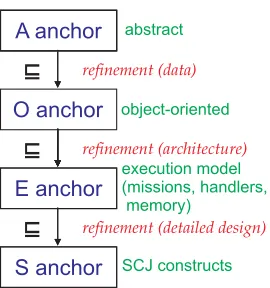
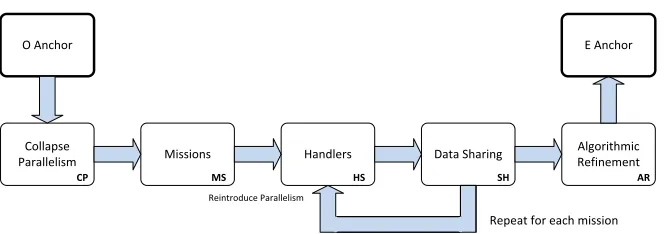
The verification technique is a refinement strategy: a procedure for appli-cation of algebraic refinement laws. Four Circus specifications characterise the major development steps: we call them anchors, as they identify the (interme-diate) targets for model transformation and the design aspects treated in each step of development. Each anchor is written using a different combination of the Circus family of notations. The first anchor is the abstract specification written inCircus Time. The last is written inSCJ-Circus; it is so close to an SCJ program as to enable automatic code generation. This tutorial describes this technique using the verification of the leadership-election protocol as an example.
Next, we present the notations used in our work, namely, SCJ, in Section 2, andCircus, in Section 3. Algebraic refinement is the subject of Section 4. Finally, Section 5 presents our refinement strategy. We draw some conclusions, where we identify open problems on refinement for SCJ, in Section 6.
2
Safety-Critical Java
identi-cal SCJ program runs on each robot. We present the overall architecture of the application and then focus on the details of the election algorithm.
Fig. 1.Dancing Robots
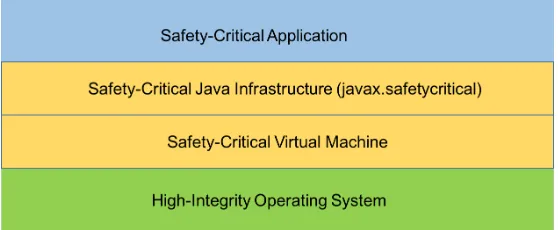
An SCJ program is executed under the auspices of an SCJ virtual machine, which provides core Java services and an infrastructure to manage the life-cycle of safety-critical applications. The core services are those typically provided by a standard Java virtual machine and include support for bytecode execution and memory management. The infrastructure is provided in a Java extension library namedjavax.safetycritical. It supports the main programming abstractions defined by SCJ and requires specialised support from the core services, not found in standard Java virtual machines. Typically, an SCJ virtual machine is hosted on a high-integrity operating system (such as Green Hills Integrity real-time operating system), as illustrated in Figure 2.
Fig. 2.Safety-Critical Java: VM and Infrastructure
In order to understand the SCJ programming model, there are three main topic areas that must be mastered:
[image:4.612.169.448.456.571.2]2. concurrency and scheduling; and 3. memory management.
These topics are covered in the next three sections. Throughout, we use the robot leadership-election application as an illustrative example.
2.1 Applications, missions and mission sequencers
An SCJ program is started by invoking the SCJ virtual machine with a parameter that identifies the application’s main program. This is called asafelet in SCJ, as it is analogous to an applet in which Java code executes in a constrained web-browser environment. The SCJ infrastructure defines the interface to a safelet, and the application must provide a class that implements this interface.
The application itself consists of the execution of a sequence of missions, where a mission represents an application’s activity that must be completed. For example, a program that controls the flight of an aircraft might have three main missions: one that manages the take-off activity, one that maintains the flight at its cruising altitude, and one that oversees the landing procedures.
In our robot application, there are two missions. During the first mission a leader is elected. Once the election is completed, the robots perform their dance mission. If a failure occurs, the robots return to the election mission.
[image:5.612.138.481.393.520.2]As illustrated in Figure 3, each mission has three phases of operation:
Fig. 3.Safety-Critical Application Phases[29]
1. Initialization – during which the resources needed to complete the mission are acquired and initialised. In our robot application, the initialisation of the election mission acquires access to a wireless network and establishes links with the other robots.
3. Cleanup – starts after completion of the execution phase, and is responsible for returning any resources and performing any other needed finalization code. In our robot application, all resources are returned automatically to the operating system when the program terminates. Hence, there is no explicit application cleanup code.
The order of execution of missions is controlled by an application-definedmission sequencer as also illustrated in Figure 3.
Hence, theSafeletinterface contains the following two methods:
1 packagejavax.safetycritical;
2
3 public interfaceSafelet<MextendsMission<M>> {
4 public voidinitializeApplication();
5 publicMissionSequencer<M> getSequencer();
6 ...
7 }
The initializeApplication method is called by the SCJ infrastructure af-ter the SCJ virtual machine has been initialised. Following this, it calls the getSequencer method to obtain the application mission sequencer that will oversee the sequence of execution of the missions.
As mentioned in the previous section, SCJ has three compliance levels. The SCJ uses Java generics to ensure that a mission sequencer and its missions have been designed for the same compliance level and are type safe.
The structure of the code for the robots example is shown below:
1 importjavax.safetycritical.∗;
2
3 classRobotAppimplementsSafelet<RobotMission> {
4
5 @Override
6 publicMissionSequencer<RobotMission> getSequencer() {
7 return newRobotSequencer(...);
8 }
9
10 @Override
11 public voidinitializeApplication() {
12 ...
13 }
14 }
All missions that are scheduled by an application must have a common super-class. In the robots example, this is called RobotMission and appears as the generic parameter at line 2. ThegetSequencermethod at line 5 now can only return a mission sequencer that schedules missions of typeRobotMission.
by the infrastructure to select the initial mission to execute, and subsequently, each time a mission terminates, in order to determine the next mission to execute.
1 packagejavax.safetycritical;
2
3 public abstract classMissionSequencer<MextendsMission<M>>
4 extendsManagedEventHandler {
5
6 /∗∗Construct a MissionSequencer object to oversee 7 ∗a sequence of mission executions
8 ∗/
9 publicMissionSequencer(...) {
10 ...
11 }
12
13 protected abstractM getNextMission() {
14 ...
15 }
16 ...
17 }
A mission sequencer is an asynchronous event handler (ASEH): it executes in its own thread of control. This is considered in depth in Section 2.2.
The structure of the robot mission sequencer can now be given:
1 importjavax.safetycritical.∗;
2
3 classRobotSequencerextendsMissionSequencer<RobotMission> {
4
5 privateMission mission;
6 private booleanelecting = true;
7
8 publicRobotSequencer(...) {
9 super(...); . . .
10 }
11
12 @Override
13 publicMission getNextMission() {
14 if(electing) {
15 return newElectionMission();
16 }else{
17 return newDanceMission();
18 }
19 }
20 21 }
TheMissionclass encapsulates the direct infrastructure support for an SCJ mission; its main methods are shown below. The application extends this class and overrides itsinitializeandcleanUpmethods.
1 packagejavax.safetycritical;
2 public abstract classMission<MextendsMission<M>> {
3 publicMission() {}
4
5 protected abstract voidinitialize();
6 protected booleancleanUp() {...}
7
8 /∗Request that this mission be terminated∗/ 9 public final booleanrequestTermination() {...}
10
11 /∗Is there an outstanding termination request for this mission∗/ 12 public final booleanterminationPending() {...}
13
14 /∗Obtain the controlling sequencer∗/
15 publicMissionSequencer<M> getSequencer() {...}
16
17 /∗Obtain the current mission.∗/
18 public static<MextendsMission<M>> M getMission() {...}
19 }
A typical implementation ofinitializeinstantiates and registers all the ASEHs that constitute theMission. Besides,initializemay also instantiate and ini-tialise mission-level data structures. The infrastructure ensures that ASEHs can only be instantiated and registered during theinitialize method. The infras-tructure also arranges to begin executing the registered ASEHs associated with a particular Missionupon return from itsinitialize method.
ThecleanUp method is called by the infrastructure after all asynchronous event handlers registered with the mission have terminated.
registers two ASEHs. On line 4 below, theReceiverclass is a PEH. Its goal is to receive communication from the robots.
1 public abstract classRobotMissionextendsMission<RobotMission> {
2 ...
3 protected voidinitialize() {
4 Receiver receiver =newReceiver(...);
5 receiver.register();
6
7 Sender sender =newSender(...);
8 sender.register();
9 }
10 }
Similarly on line 7, the Sender class is also a PEH. Its goal is to broadcast communication to the other robots. Both of the robot’s missions extend this class; for instance, the election mission is given below.
1 classElectionMissionextendsRobotMission {
2 @Override
3 protected voidinitialize() {
4 super();
5 Elector elector =newElector(...);
6 elector.register();
7 }
8 ...
9 }
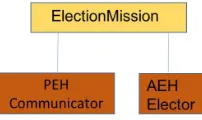
ElectionMissioncreates and registers an additional PEH. Its goal is to use the state of each robot to determine whether it should be a leader or a follower.
2.2 Concurrency and scheduling
In general, there are two models for creating concurrent programs. The first is a thread-based model in which each concurrent entity is represented by a thread of control. The second is an event-based model, where an event handler executes in direct response to the firing of its associated event. The RTSJ, upon which SCJ is based, supports a rich concurrency model allowing real-time threads and asynchronous events. The SCJ Level 1 concurrency model simplifies this and relies exclusively on asynchronous event handling.
An ASEH executes in response to invocation requests (known as release events); the resulting execution of the associated logic is a release. Release re-quests are categorised as follows: periodic, sporadic, or aperiodic. If Ri denote the time at which an ASEH has had theith
release event occur, then:
1. an ASEH is periodic when there exists a value T >0 such that, for all i, Ri+1−Ri =T, where T is called the period;
3. an aperiodic ASEH is said to be sporadic when there is a known valueT >0 such that for alli,Ri+1−Ri≥T.T is then called the minimum interarrival
time (MIT).
PEHs are timed triggered in SCJ, which means that they are indirectly released via the passage of time (using a real-time clock). APEHs and sporadic (SEH) handlers can be both timed triggered or released directly from application code. SCJ specifies a set of constraints on the RTSJ concurrency model. This con-strained model is enforced by defining a new set of classes, all of which are implementable using the concurrency constructs defined by the RTSJ. As an example, the following shows the class for a PEH. This class permits the au-tomatic periodic execution of code. ThehandleAsyncEventmethod behaves as if the handler were attached to a periodic timer. This method is executed once for every release. The class is abstract; non-abstract sub-classes must override handleAsyncEventand may override the defaultcleanUpmethod.
1 packagejavax.safetycritical;
2
3 public abstract classPeriodicEventHandlerextendsManagedEventHandler
4 {
5 /∗Constructs a periodic event handler.
6 ∗priority: specifies the priority parameters for this periodic event handler. 7 ∗release: specifies the periodic release parameters, in particular the 8 ∗start time, period and deadline miss handler.
9 ∗/
10 publicPeriodicEventHandler(PriorityParameters priority,
11 PeriodicParameters release, ...) {...}
12
13 /∗Applications override this method to provide 14 the code to be executed on each release∗/ 15 public voidhandleAsyncEvent() {...}
16
17 /∗Register this handler with its mission∗/ 18 public voidregister() {...}
19
20 /∗Called by the infrastructure during the mission cleanup phase∗ 21 public void cleanUp() {...}
22
23 /∗Called by the infrastructure to indicate that the enclosing mission 24 ∗has been instructed to terminate. ß∗/
25 public voidsignalTermination() {...}
26 }
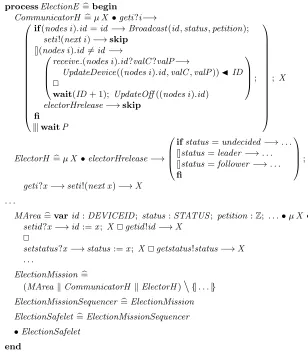
Fig. 4.The Architecture of the Robots Safety-Critical Application
Fig. 5.Optimised Architecture of the Election Mission
Scheduling in SCJ is performed in the context of a scheduling allocation domain. The scheduling allocation domain of an ASEH consists of the set of processors on which that schedulable object may be executed. Each ASEH can be scheduled for execution in only one scheduling allocation domain. At Level 1, multiple allocation domains may be supported, but each domain must consist of a single processor. Hence, from a scheduling perspective, a Level 1 system is a fully partitioned system. Within a scheduling allocation domain, multiple ASEHs are scheduled for execution in priority order using a priority-based scheduler. If ASEHs have the same priority, then they are scheduled in a FIFO order, that is, the order in which they become schedulable.
In the robot example, there are several PEHs in each mission. Two handlers are responsible for robot-to-robot communication in each mission. The other ones focus on the main activity of the mission (electing a leader, detecting a change in leadership, and performing the dance). The full software architecture of the program is illustrated in Figure 4.
For small embedded systems, it is often required that we optimise the solution in order to reduce the scheduling overheads. One possibility is to combine the PEHs responsible for communication into one handler. TheElectorcan then be transformed into an APEH which is released on successful receipt of one round of communication. This is illustrated in Figure 5.
2.3 Memory Management
[image:11.612.257.358.236.296.2]that it is too unpredictable. For this reason, the RTSJ introduces the notion of a memory area; this is a chunk of memory from where the memory for object allocation is taken. The Java heap is an example of a memory area.
The RTSJ supports two additional types of memory areas: immortal and scoped memory. Every object allocation is performed with an allocation context. It can change dynamically by a thread of control entering into and exiting from a memory area. The current allocation context at the time an object allocation is requested determines which memory area its space comes from.
Objects created in immortal memory are never collected: once created they exist for the lifetime of the application. Objects in scoped memory areas are automatically freed when no thread of control has an active allocation context for that memory area, that is, it has entered but not exited that memory area.
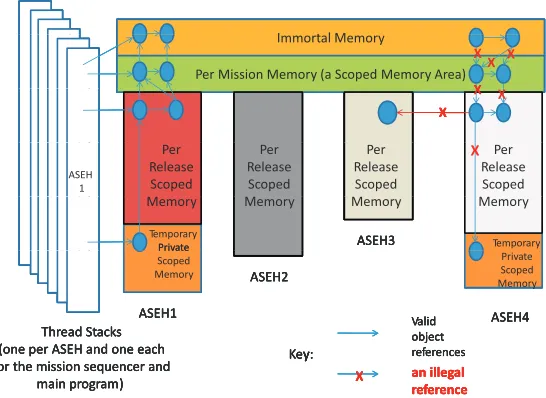
SCJ constrains the memory model of RTSJ by not allowing the heap memory area. It also distinguishes between scoped memory areas that can be entered by multiple ASEHs (calledmission memory) and those that are private to an ASEH (calledprivate memory). Each mission has a single mission memory. Each ASEH has a single private memory area (called per-release memory area), which is entered into automatically when the ASEH is released and exited automatically (and hence has all its objects collected) when the release completes. Each ASEH may also have nested private memories for ephemeral objects. All objects stored in mission memory are collected at the end of each mission.
In addition, all ASEHs have a thread stack where they can store references to objects created in the various memory areas. Figure 6 illustrates the memory hierarchy of an SCJ program. In order to maintain the referential integrity of all objects in SCJ programs, a reference to an object A cannot be assigned in a field of an object B if object A’s lifetime is less than object B’s lifetime. If allowed, object A could disappear and leave object B with a dangling pointer.
In our robot example, the system state is stored in immortal memory, data that must be communicated between handlers is stored in mission memory, and all other data is stored in private memory areas or on the handlers stack. This is a typical data design for valid and efficient SCJ programs.
2.4 The election details
For the election, each robot has the following associated information:
– Id: this uniquely identifies the robot and its IP address;
– Petition: a unique ranking among the robots that indicates how badly the robot wants to be the leader. The robot with the highest petition that is online is elected the leader;
– Status: an indication of whether the robot is the leader, a follower or unde-cided.
I t l M Immortal Memory
Per Mission Memory (a Scoped Memory Area)
X X X X X X X Per Release Scoped Per Release Scoped Per Release Scoped X Per Release Scoped ASEH 1 Memory Memory ASEH3 Memory Temporary Private Memory Temporary ASEH2 Private Scoped Memory Private Scoped Memory ASEH4 Valid object references Key: Thread Stacks (one per ASEH and one each
ASEH1
an illegal reference X
y for the mission sequencer and
main program)
I t l M
Immortal Memory
Per Mission Memory (a Scoped Memory Area)
X X X X X X X Per Release Scoped Per Release Scoped Per Release Scoped X Per Release Scoped ASEH 1 Memory Memory ASEH3 Memory Temporary Private Memory Temporary ASEH2 Private Scoped Memory Private Scoped Memory ASEH4 Valid object references Key: Thread Stacks (one per ASEH and one each
ASEH1
an illegal reference X
y for the mission sequencer and
main program)
I t l M
Immortal Memory
Per Mission Memory (a Scoped Memory Area)
X X X X X X X Per Release Scoped Per Release Scoped Per Release Scoped X Per Release Scoped ASEH 1 Memory Memory ASEH3 Memory Temporary Private Memory Temporary ASEH2 Private Scoped Memory Private Scoped Memory ASEH4 Valid object references Key: Thread Stacks (one per ASEH and one each
ASEH1
an illegal reference X
y for the mission sequencer and
main program)
I t l M
Immortal Memory
Per Mission Memory (a Scoped Memory Area)
X X X X X X X Per Release Scoped Per Release Scoped Per Release Scoped X Per Release Scoped ASEH 1 Memory Memory ASEH3 Memory Temporary Private Memory Temporary ASEH2 Private Scoped Memory Private Scoped Memory ASEH4 Valid object references Key: Thread Stacks (one per ASEH and one each
ASEH1
an illegal reference X
y for the mission sequencer and
[image:13.612.173.446.116.315.2]main program)
Fig. 6.Memory Hierarchy of an SCJ Program
The Sender PEH broadcasts its robot’s state every 500 milliseconds. The ReceiverPEH receives as many messages as are available every 500 milliseconds. TheElectorreviews the global state each 3000 milliseconds and decides whether its robot should elect itself as leader or become a follower. When the global state shows that all robots have decided and that there is only one leader, the mission terminates, and the Dancingmission is executed. During this mission, theDetectorcontinues to monitor the global state every 3000 milliseconds. If the status quo is changed, then the Dancemission terminates and a new Election mission is executed. The Dancer PEH sends and receives dancing commands every 3000 milliseconds depending on whether it is the leader or the follower.
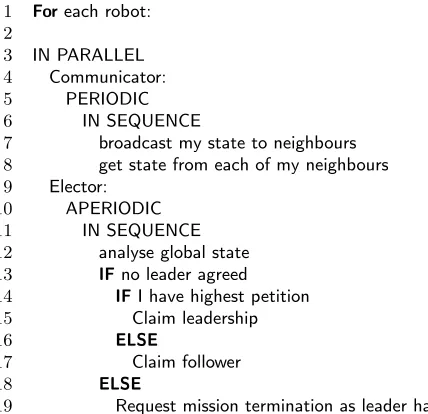
The full code for the leadership-election example that is presented here is at www.cs.york.ac.uk/circus/hijac/code/LeaderElectionPaper.zip. The pseudo code shown Figure 7 summarises the overall optimized approach.
Essentially there are two parallel activities (theCommunicator – lines 4 - 9 and the Elector – line 9-19). The Communicator is responsible for periodically sending out a robot’s state to its neighbouring robots, and then acquiring their current states. TheElectoris aperiodic and is released after theCommunicatorhas acquired all its neighbours states. It analyses the global state and if a leader has been globally agreed, it requests termination of the current mission. Otherwise, if its petition is the highest among all the robots, then it makes a claim to be the leader, or then it settles for being a follower.
1 Foreach robot:
2
3 IN PARALLEL
4 Communicator:
5 PERIODIC
6 IN SEQUENCE
7 broadcast my state to neighbours
8 get state from each of my neighbours
9 Elector:
10 APERIODIC
11 IN SEQUENCE
12 analyse global state
13 IFno leader agreed
14 IFI have highest petition
15 Claim leadership
16 ELSE
17 Claim follower
18 ELSE
[image:14.612.137.351.127.334.2]19 Request mission termination as leader has been established
Fig. 7.Pseudo-code for the optimised leadership-election algorithm
3
Circus
The search for increasing levels of abstraction is a key feature in software engi-neering, and, particularly, in language design. For example, the concept of class embeds a notion of an abstract data type and allows a structured modelling of real-world entities, capturing both their static and dynamic properties. The notion of process abstracts from low-level control structures, allowing a system architecture to be decomposed into cooperative and active components.
Despite the complementary nature of constructs for describing data and con-trol behaviour, most programming languages focus only on one or the other aspect. Java is no exception: it offers (abstract) classes, interfaces, and packages; in contrast, only the low-level notion of threads is available. There are excep-tions like Ada [23], whose design has clearly addressed abstract data and control behaviour (with packages and tasks), but even so there are several limitations; for example, a package is not a first-class value.
The design of specification languages has followed a similar trend, with state-based and property-oriented formalisms concentrating on high-level data con-structs [5], and process algebras exploring control mechanisms. A current and active research topic is the integration of notations to achieve the benefits of both abstract data and control behaviour [20, 44]. Circus is one of these inte-grated notations, whose focus is refinement (to code).
aspects of concurrent systems, and a development technique. Such a combination has obvious advantages: Z is good at describing rich information structures using a predicative style (based on invariants, and pre and postconditions), and CSP is good at describing behavioural patterns of communication and synchronisation. In Circus, Z constructs can be combined with executable commands, like assignments, conditionals, and loops. Reactive behaviour, including communica-tion, parallelism, and choice, is defined with the use of CSP constructs.
In this section, we give an overview of Circus: we describe the structure of the Circus models, and explain how Z and CSP are combined. Beforehand, we say a bit more about Z (Section 3.1) and CSP themselves (Section 3.2). As an example, we provide a model of the leadership-election protocol (Section 3.3).
3.1 Z
A system specification in Z consists basically of a definition for a state and a collection of operations. The state is composed by variables representing infor-mation used and recorded in the system. The operations take inputs and produce outputs, and possibly update the state. Both the state and the operations are defined by schemas, which group variable declarations and a predicate.
Example 1. As a very simple example, we consider a system presented in [35] that calculates the mean of a sequence of numbers. The state of this system has only one component: the sequenceseq of integers input so far.
Calculator seq : seqZ
The state definition gives it a name,Calculator, and declares its component. This system has three operations. The first,Init, initialises the state.
Init
Calculator′
seq′=hi
The reference toCalculator indicates that this is an operation over that state. In an operation definition, we can refer toseq and toseq′. The former refers to the
value of the state component before the operation, and the latter, to the value after the operation. The dash decoration onCalculator, however, indicates that Init, as an initialisation, can refer to seq′ only. The predicate of Init specifies
that, after the initialisation, the value of seq is the empty sequence. The second operation,Enter, records an input value in the sequence.
Enter ∆Calculator n? :Z
seq′=seqahn?i
n?represents an input ofEnter: the number to be inserted. The predicate defines that the new sequence of numbers can be obtained by inserting the input at the end of the existing sequence;ais the concatenation operator.
The last operation,Mean, calculates the mean of the numbers input so far.
Mean ΞCalculator m! :Z
seq 6=hi
m! = (Σseq)div (#seq)
The Ξ indicates that Mean does not change the state. The output is repre-sented by the variable m!. The specification requires that the sequence seq is non-empty. This is a precondition for this operation: even thoughMean can be executed when this condition is not satisfied, its result is not predictable in such a situation. If, however, the precondition is satisfied, the specification requires the output to be the sum of the elements in the sequence divided by its size. TheΣoperator is not directly available in Z, but can be easily specified.
3.2 CSP
In CSP, a system and its components are modelled by processes that interact with their environment not via inputs and outputs, like in Z, but via synchro-nisations that characterise events. These events, however, can model exchange of data, as well as simple interactions of interest. In the description of a CSP process, a first element of interest is the set of events in which it can participate; the definition of an event simply gives it a name.
Example 2. A process that controls a revolving door can be characterised in terms of the events step-in, revolve, step-out, and stop; the first denotes the arrival of someone in the area around the door, the second represents the start of the revolving movement, step-out is the event that captures the exit of a person from the door area, and, finally,stop occurs when the door stops moving. In the specification of the door, inputs and outputs are not a concern; the relevant issue is the form in which the door interacts with the environment: the people that use the door. Below, we present the definition of processesDoor(i), wherei is the number of people already using the door.
If there are no people using the door, the only possible event is for someone to arrive; afterwards, the door starts revolving, and proceeds to behave as a door that is being used by one person. In the specification of Door(0), we use the prefix operatora →P, which gives the unique eventa in which the process is prepared to engage, and a processP that characterises its behaviour afterwards.
Door(0) =step-in→revolve →Door(1)
If there is one person using the door, then either someone else arrives or that person leaves. We use the choice operator P@Q to specify this behaviour: this process is prepared to behave asP orQ; the choice is made by the environment.
Door(1) =step-in→Door(2)@step-out→stop →Door(0)
If the event step-in takes place, then the door behaves as a door used by two people. Ifstep-outtakes place, the only possible event isstop, and then we have the behaviour of Door(0) again. The definitions of Door(0) and Door(1) are mutually recursive; the use of recursion is very common in CSP.
Doors with two or more people are similar; forn >1,Door(n)is below.
Door(n) =step-in→Door(n+ 1)@step-out→Door(n−1)
If someone steps in an door withn people, forngreater than 1, then we have the behaviour of a door withn+ 1people. If someone steps out, then the behaviour is that of a door with n−1 people.
In a big building, we usually have a number of these doors. They work in parallel, but independently. We define a process entrance withmdoors as follows.
Entrance=
9
i: 1. .m •Door(0)[step-in.i,revolve.i,step-out.i,stop.i/step-in,revolve,step-out,stop]
In this process we havemcopies ofDoor(0)recording eventsstep-in.i,revolve.i, step-out.i,stop.i, foribetween 1 andm. The set of events ofEntrancecomprise all of them×4events: 4 for each of them doors. The parallel operator9is for an interleaving composition, where the parallel processes do not interact with each other. Above we use the iterated form (
9
) of this operator.A polite door contains an additional component: a process that detects that someone has arrived and welcomes this person with a greeting message. This Polite process can be specified as follows.
Polite=step-in→welcome→Polite
The extra event welcome signals the play of the greeting. The polite door can be characterised by the parallel execution of the standardDoor(0)andPolite.
PDoor =Door(0)J{step-in}K Polite
In this parallel process (J...K), there is interaction between the two components; they are not independent as in the previous example. Since step-in is an event of both Door and Polite, they synchronise on this event. Every time someone steps in,Door(0)and Polite act jointly; from the point of view ofPDoor, just one event occurs.
3.3 Leadership election in Circus
A Circus model is formed by a sequence of paragraphs that specify types, con-stants, functions, and, crucially, processes. Like in CSP, processes define systems and their components. Their definitions use the types, constants and functions defined globally, as well Z and CSP constructs.
In our example, we first define two types:DEVICEID andSTATUS.
DEVICEID==N
STATUS ::=leader |follower |undecided|off
These types are sets that contain the valid identifiers for devices, and constants leader, follower, undecided, and off that represent the status of a device. For simplicity, we define the identifiers of the devices to be natural numbers. We need to use an ordered set, because the election conditions use the order of the devices to resolve ties. We could make this more abstract by requiring only a set of identifiers with a total order, but it is simpler to use the natural numbers.
We also have some global constants. UP LMT is the maximum value for the petition of a device.P is the period of the protocol.TIMEOUT is how long a device waits for information from a neighbour before giving up, and marking it as offline. ID and OD are the input and output deadlines. The set devices contains all the identifiers of the devices in the network: a subset ofDEVICEID.
UP LMT :N
P,TIMEOUT,ID,OD :N devices :PDEVICEID
TIMEOUT ≤P ∧ID ≤P∧OD ≤P∧#devices >0
A constraint ensures that the timeout, input and output deadlines are all less than or equal to the periodP. Moreover, there must be at least one device.
The process that defines the functional requirements of the protocol is called ABReqsLE. It is introduced below.
processABReqsLE =b begin
In its body, the first few paragraphs define the state space.
The state of a device includes its identifierid,status, and petition.
DeviceState id :DEVICEID status:STATUS petition:N
id ∈devices
petition≤UP LMT
To execute the election protocol, a device needs additional information, cap-tured in records of the type ElectionState. In addition to the state components in DeviceState described above, ElectionState records the highest petition of a device claiming to be a leader as well as its identifier: highest andhighestid in the schema, that is, record type,Highest below.
Highest== [highest:N; highestid :DEVICEID]
The schemaElectionStateincludes all the components ofDeviceStateandHighest. It also records the numbernLeadersof leaders in the network, the indexi of the device currently communicating (lines 7-8 in Figure 7) in a sequencenodesthat records information about individual devices, and a functionnext that gives the index (innodes) of the device considered in the next cycle.
ElectionState DeviceState Highest nLeaders:N
i:N; nodes : seqDeviceState; next :N→N+
i∈domnodes
∀n :N+•next n = ((n−1) mod (#nodes)) + 1
devices ={d: rannodes•d.id}
#nodes= #devices θDeviceState ∈rannodes
The invariant states that the indexiis an index fornodes. Moreover, the function next identifies indices of nodes in a way that iterates through this sequence, circling back to the beginning at the end.
The setdevices includes the identifiers in the range of nodes. By requiring that the size of this set and the size ofnodes are equal, we ensure that the range ofnodes does not include two records for the same device identifier. Finally, the invariant establishes that the current device, identified by a recordθDeviceState, containing the fields ofDeviceStateinElectionState, is also in the range ofnodes. Unlike CSP processes, aCircus process has a state defined by a schema. It ElectionState that defines the state of the processABREqsLE being specified.
statest ==ElectionState
The next few paragraphs define data operations. Initially, there is no leader, the highest petition is 0 and the indexi is that for the device itself.
InitElectionState ElectionState′
nLeaders′= 0∧highest′= 0∧(nodes′i′).id =id
When a status valC? and petition valP? is received from a device whose identifier is idDev?, we can update the fields ofHighest if the device claims to be aleader and the petitionvalP?is higher than previously recorded, or if it is the same and the identifieridDev?is greater than the previous identifier.
UpdateHighest ∆Highest
idDev? :ID; valC? :STATUS; valP? :N
valC? =leader
valP?>highest∨(valP? =highest∧idDev?>highestid) valP?>highest⇒highest′=valP?∧highestid′ =idDev?
valP? =highest⇒highest′=valP?∧highestid′ =idDev?
This operation is partial; it should only be used when an update to highest or highestid is needed as indicated. This is ensured by its use in UpdateDevice, shown below, which also modifies the remaining components ofElectionState.
UpdateDevice ∆ElectionState
idDev? :ID; valC? :STATUS; valP? :N
letd== (µx : rannodes|x.id =idDev?•x)•
d.status=leader ∧valC?=6 leader ∧nLeaders′=nLeaders−1 ∨
d.status6=leader ∧valC? =leader ∧nLeaders′=nLeaders+ 1 ∨
d.status=leader ∧valC? =leader ∧nLeaders′=nLeaders ∨
d.status6=leader ∧valC?6=leader ∧nLeaders′=nLeaders
nodes′ =nodes⊕ {(nodes∼ d))7→
h|id ==idDev?,status==valC?,petition ==valP?|i}
θDeviceState =θDeviceState′∧next′=next ∧i′=i
UpdateHighest ∨[ΞHighest | ¬(preUpdateHighest)]
UpdateDevice takes the information d on idDev? in nodes using the definite description operatorµand updates the number of leadersnLeadersdepending on the previousd.status and current valuevalC?of its status. It also overrides (⊕) nodeswith the newly received information; withnodes∼d, we get the index ofd.
UpdateDevice also leaves the components ofDeviceState, the functionnext and indexiunchanged, and updates the components ofHighestusingUpdateHighest, if necessary, as captured by the preconditionpreUpdateHighestof this operation. In aCircusprocess, the Z data operations can be combined to define actions. In the definition of actions, we can also use CSP constructs.
it broadcasts its state using the actionBroacast.
BReq1=b
if(nodes i).id =id −→Broadcast(id,status,petition) 8(nodes i ).id 6=id −→
receive.(nodes i).id?valC?valP−→
UpdateDevice((nodes i).id,valC,valP) @
timeout−→UpdateOff((nodes i).id)
;
ifstatus =undecided −→
ifnLeader>0−→status:=follower 8nLeader ≤0−→
ifid =next i−→
if
(highest =petition∧highestid<id)∨
highest <petition
−→
status:=leader
8¬
(highest=petition∧highestid<id)∨
highest <petition
−→
status:=follower fi
8id6=next i −→status:=undecided fi fi
8status =leader −→
ifnLeader>0−→status:=undecided 8nLeader ≤0−→
ifid =next i−→
petition:=min(UP LMT,petition+ 1); status:=leader 8id6=next i −→status:=leader
fi fi
8status =follower −→
ifnLeader= 0−→status:=undecided 8nLeader 6= 0−→status:=follower fi
fi fi
If the device is undecided, its new status depends on the number of leaders. If there are leaders, it becomes a follower (assignmentstatus:=follower), other-wise, the protocols considers the devicenext i. If it isid itself, then it compares its petition to the highest petition and becomes a leader or follower depending on whether or not its petition (or identifier) is greater than the highest petition (or identifier) recorded. If the next device is not id, the status remains undecided.
Ifid’s status isleader, and there are other leaders (besides itself asnLeaders only refer to leaders among the neighbours), then it becomes undecided. Other-wise, it remains a leader and increments its own petition (up to the maximum UP LMT) if it is the next device to be considered. Finally, if id is a follower and there are no leaders, it becomes undecided. Otherwise, it stays a follower.
The actions used inBReq1 above are defined next.
Broadcast=b valid :DEVICEID; status:STATUS; petition :N•
9
i:devices\ {id} •send.id.i.status.petition−→skipBroadcast sends in interleaving (
9
) thestatusandpetitionof the device to each of the neighbouring devices using the channelsend. These are the devicesd in nodes whose identifier is notid itself. The parameters ofsend are the identifiers of the source and target devices, the status and petition values. The protocol assumes an asynchronous bus, so this communication does not deadlock even if the target device is unavailable. Since communications inCircusare synchronous, the model requires the definition of the bus (omitted here).UpdateOff =b validDev :DEVICEID •varvalC :STATUS; valP :N• valC,valP :=off,0; UpdateDevice
UpdateOff uses the schema operationUpdateDevice to update the state of the process. It sets the status andpetition tooff and0, before updating the state.
As already said, the process ABReqsLE describes the behavioural require-ments for the protocol on a single device. Its behaviour is defined below by the main action. It initialises the state using the schema operationInitElectionState and starts a recursive action (µX •...X), which at each step executes the action BReq1 and updates the indexi using the functionnext.
•InitElectionState; (µX •BReq1; i:=next i; X) end
The timing requirements are specified in a separate process ATReqsLE shown below. Its main behaviour is also defined by a recursion, but at each iteration it offers a choice between receiving information onreceive, indicating a timeout using the channel timeout, or sending information to all neighbours in inter-leaving through the channelsend. The particular values communicated through these channels are irrelevant here; they are defined inABReqsLEspecified above. Here, on the other hand, the time in which these events occur is important.
previously defined. All communications lead to an action that potentially lets time pass until the end of a periodP. TheCircusstatementwait0. .(P−t)is a nondeterministic choice of a delay of 0 up toP−t time units. In the example,t is the time between the communication being offered and actually taking place. In each case, that is recorded via the@operator, like in timeout@t.
processATReqsLE =b begin
TReq1= (TReqCycleb ◮P9waitP); TReq1 TReqCycle=b
(
9
i: 1. .#devices−1•(send?x?y?z?w@t−→wait0. .(P−t))◭OD) @(receive?x?y?z?w@t−→wait0. .(P−t))◭ID @
(timeout@t−→wait0. .(P−t))◭P
•TReq1 end
Finally, the overall specification is given by the processLeaderElection.
processLeaderElection=b
(ABReqsLE J{|send,receive,timeout|}KATReqsLE)
\
{|timeout|}It is the parallel composition (J...K) of the behavioural and timing processes, synchronising on the external channelssendandreceive, and ontimeout, which is hidden (
\
) and, therefore, internal toLeaderElection. We note that parallelism is used not to define a parallel architecture for a design, but to define a conjunction of requirements: the behavioural requirements of ABReqsLE and the timing requirements of ATReqsLE. Synchronisation ensures that the communications transmit values as defined inABReqsLE within the times defined byATReqsLE. In Section 5, we explain how we can refine this abstract specification of the leadership-election protocol to obtain a model of an SCJ program. Beforehand, in the next section, we say more about refinement and theCircusapproach.4
Algebraic refinement
Circusdistinguishes itself in that it is aimed at the (calculational) refinement of specifications. Besides Z and CSP, Circus also includes specification constructs usually found in refinement calculi [34, 2, 36] and Dijkstra’s language of guarded commands [16], a simple imperative language with nondeterminism. The extra constructs that we use here are familiar: assignments, conditionals, and so on.
The notion of refinement captures the essence of the daily tasks of software engineers, who design systems based on their specifications, and programmers, who implement these designs. In both cases, the main objective is the construc-tion of systems and programs in accordance with their specificaconstruc-tions. The final product, above all, should be, or has to be, correct.
Refinement is the relationship that holds between a specification and its cor-rect designs and implementations. Formal methods of program development are based on this notion, as are all other methods in some way. A formal technique, however, goes further since refinement of an initial specification to obtain an acceptable implementation is the primary aim. Acceptability may be judged, for instance, in terms of performance, but the guarantee provided is that the specification and the implementation are related by refinement.
In this section, at first we present the classical notions of refinement. Initially, refinement was extensively studied in the context of sequential programs [26, 27, 4], where the concern is the relation between inputs and outputs. It was identified that there are basically two ways of refining a specification. The first is the introduction and transformation of programming and control structures, like assignments, conditions, and loops. This is called algorithmic refinement.
The second form of refinement is related to the data structures used in the program. Systems may be specified in terms of data types that are appropri-ate to describe properties of the application domain, without, for example, any considerations related to efficiency. During design, however, ingenious decisions usually involve the introduction of data structures that are available in the pro-gramming language and make the computation tasks easier or faster. The change of data representation involved in this task is called data refinement [21, 24, 25]. For an object-oriented language like Java, there are new concerns related to the presence of classes and their use as data types [28]. Refining a class is very much like refining a data structure in a traditional imperative setting. Nevertheless, due to the presence of, for instance, type tests, type casts, and dynamic binding, new techniques are needed. Type tests and casts may be used to distinguish objects of different classes. Even if we have two classes with the same fields and methods, but different names, type tests (and casts) can be used to distinguish objects of these classes. Dynamic binding means that a method call may lead to the execution of several different pieces of code. To ensure correctness, we need to consider all possibilities. Pointers are also a challenge.
Refinement of imperative programs, including data and algorithmic refine-ment is the subject of Section 4.1; there we use Z as a concrete notation. Refine-ment of concurrent reactive systems is addressed in Section 4.2.
4.1 Basic Concepts
A formal specification is the starting point of any formal development method. Correctness is a relative notion: a program is correct or wrong depending on whether it implements its specification or not; the specification is the basis for the evaluation. To guarantee correctness, we need a formal specification.
Specifying a system is the first step to get its implementation right. A formal development method takes such a specification as a basis to produce a correct implementation: one that refines the specification.
Refinement is based on the idea that a specification is a contract between the client and the developer. The client cannot complain if, when executed in situations that satisfy their preconditions, the operations of the implementation produce outputs that satisfy the properties stated in the specification. In this case we have a correct implementation.
Data refinement Our first opportunity for refinement typically comes in the change of representation of state components. As said before, a Z specification describes the relation between inputs and outputs when the system is initialised and a sequence of operations is executed. The values of the state components, however, are not visible. Similarly, in Circus, the state of a process, which is defined in Z, is not visible. We can only observe the behaviour of a process via its interactions with its environment, which use the channels that are in scope.
In Example 1, for instance, we use a sequence to record the numbers input; this is a natural way of describing the system. It is less space-consuming, however, to record just the sum and the number of integers input. If the operations are updated accordingly, it is perfectly valid to change the representation of the state in this way. This sort of change is known as data refinement; the original specification is regarded as abstract and the new specification, as concrete.
The other opportunity for refinement is the development of implementations for the operations; this is the subject of the next section, where we discuss al-gorithmic refinement. Since these implementations are affected by changes in the state, we consider data refinement first. At this stage, we change the oper-ations only to adapt them to the new data types. In Z, we write the concrete specification in the same style as that used for the abstract specification.
Example 3. The concrete state suggested above can be defined as follows.
CalculatorC size,sum:Z
The new definition for the operations is as follows. The initialisation,InitC, records that no numbers have been input.
InitC
CalculatorC′
size′= 0∧sum′ = 0
The operation EnterC, which inputs a number, increments size and updates sum by adding the input to it.
EnterC
∆CalculatorC′
n? :Z
size′=size+ 1∧sum′ =sum+n?
The operation that calculates the mean has a much simpler specification.
MeanC
ΞCalculatorC′
m! :Z
size6= 0
m! =sum div size
The needed values are readily available insum andsize.
After providing the concrete specification, we have to prove that it satisfies the refinement property mentioned above: clients that agreed on the abstract specification cannot complain if they get an implementation of the concrete specification [17, 49, 38]. The most widely used technique to carry out such a proof is known as simulation. It involves the definition of a relation between the abstract and concrete states that specifies how the information in the abstract state is represented in the concrete state. In the context of Z, this relation is known as a retrieve relation and is specified using a schema.
There are, actually, two simulation techniques that can be applied: for-wards (or downfor-wards) simulation and backfor-wards (or upfor-wards) simulation. Here, we concentrate on the forwards simulation technique, as it is often enough in practice. Upwards simulation is a similar technique. (The difference lies in the way it handles nondeterminism in data operations.)
For our example, the appropriate retrieve relation can be specified as follows.
Retrieve Calculator CalculatorC
size= #seq∧sum =Σseq
andCalculatorC reflects the fact that we are specifying a relation between them. Basically, a concrete state is related to an abstract state when the value ofsize is indeed the size of seq andsum is the sum of the numbers in this sequence.
Given the retrieve relation, we need to check first that the initialisation is adequate: given an initial concrete state, there is a corresponding abstract initial state. In general, if A and C are the schemas that specify the abstract and concrete states,AI andCI are the corresponding initialisation operations, and R is the retrieve relation, then we have to prove the following.
∀C′ •CI ⇒ ∃A′•AI ∧R′ (initialisation)
The use of schemas in predicates is common in Z. We are required to prove that, for all values that the components of the concrete state may assume, if these values are those of an initial state, then there are initial values that can be as-signed to the abstract state components that are related to those of the concrete initial state. The use ofC′,A′, andR′is necessary because the predicates ofCI
andAI are written in terms of the dashed version of the state components. For our data refinement, we are required to prove the following property.
∀size′,sum′ :Z•size′= 0∧sum′= 0⇒
∃seq′ : seqZ•seq′=hi ∧size′= #seq′ ∧sum′=Σseq′
With two applications of a one-point rule we get0 = #hi ∧0 = Σhi, which is true as the size of and the sum of the elements of the empty sequence are 0. This reflects the fact that the initialisation ofCalculatorC chooses values tosize andsum that are in accordance with the initial value ofseq. This is, of course, relative to the way in which we representseq usingsize andsum.
We also need to prove that each of the operationsCO of the concrete spec-ification is in accordance with the specspec-ification of the corresponding operation AO of the abstract specification. We have to prove the following, wherepreAO andpreCO refer to the precondition of the operations.
∀A; C •preAO∧R⇒preCO (applicability)
∀A; C •preAO ∧R⇒(∀C′•CO ⇒ ∃A′•AO∧R′) (correctness)
When refining an operation, there are usually two separate concerns: its pre-condition and its effect, also known as postpre-condition. The prepre-condition of an operation characterises the situations in which it behaves properly. The first proof obligation above, applicability, requires that, whenever the precondition of the abstract operation holds, the related concrete states satisfy the precondition of the concrete operation. So, this proof obligation requires that whenever the abstract operation behaves properly, so does the concrete operation.
In our example, the preconditions ofEnterandEnterC are both true, there-fore applicability is not interesting. ForMean, the precondition isseq 6=hi. For MeanC, the precondition issize6= 0. Applicability is as follows.
∀seq : seqZ; size,sum :Z•
seq 6=hi ∧size= #seq∧sum=Σseq ⇒size6= 0
thensize is certainly different from 0.
The second proof-obligation, correctness, is related to the effect of the opera-tions. First of all, we are only interested in the situations in which the precondi-tion of the abstract operaprecondi-tion holds; if it does not, then there are no requirements on the concrete operation. If it does, for all states resulting from the execution of the concrete operation in a related state, exists a related abstract state that could be obtained with the execution of the abstract operation.
ForMean andMeanC, correctness is as follows.
∀Calculator; CalculatorC •seq 6=hi ∧Retrieve ⇒
(∀CalculatorC′•MeanC ⇒ ∃Calculator′ •Mean∧Retrieve′)
Three applications of the one-point rule (and basic predicate calculus properties) reduces this predicate to true.
A special case of simulation that involves simpler proof obligations is that in which the retrieve relation is a total function from the concrete to the abstract state. Most proof-obligations generated in a refinement, however, are long, but simple, and a lot of help is provided by tools [31]. Data refinement can also be applied to variable blocks and to modules. As long as we have a structure for information hiding, this kind of change of representation is always possible.
Algorithmic refinement Once we have decided on the data types to be used in the program, we can proceed to work on the implementation of the operations. There are basically two approaches to refinement in general: verification and calculation. For data refinement, we have proposed a new specification and then proved that it is satisfactory: we verified the proposed refinement to be correct. For algorithmic refinement, we can use a calculational approach [34, 2, 36]. In such techniques, the initial specification is the starting point for a sequence of transformations, each captured by a refinement law, to gradually transform the specification into a program. Because refinement is a transitive relation, this establishes that the initial specification is refined by the final program.
Each law captures a model transformation, which is the essence of the very popular model-based approach to design and programming. Distinctively, how-ever, laws of refinement, guarantee that the transformations that they specify preserve the behaviour of the original program. For Z, such a refinement calculus has been presented in [7, 13, 9], and it is called ZRC. Its laws can also be used to transform Z operations defined in aCircus process.
The language of ZRC, as of all refinement calculi, can be used to write spec-ifications, designs, which involve programming and specification constructs, and programs. Besides Z, this language includes assignments, conditionals, iterations, and procedures, among other constructs, like inCircus. In a design, we may have, for instance, a loop whose body is a schema. Specifications, designs, and pro-grams are all regarded as propro-grams; refinement is a relation between propro-grams in this more general sense. The refinement relation is usually denoted by⊑.
transform a schema into a so called specification statement. This is a construct that takes the form w : [pre,post], where w is a list of variables, and pre and postare predicates: the precondition and the postcondition. The list of variables is the frame, which determines the variables that can be changed.
For instance,EnterC can be specified by the specification statementsize,sum : [true,size′ = size + 1 ∧ sum′ = sum +n?], where the state components are
explicitly listed as part of the frame. Similarly, MeanC can be specified as m! : [size 6= 0,m! = sum div size]. A refinement law in [13] explains how the conversion can take place. That work also includes laws that refine elaborate schema expressions to more refined programs; we have, for instance, a law to translate schema disjunctions into conditionals.
Refinement laws can be applied to transform a specification statement into a design or program; they embody common intuition about programming. We presentassigI, a law that transforms a specification statement to an assignment.
LawassigI Assignment introduction
w,v: [pre,post]⊑v:=e provided pre⇒post[e/v′][ /′]
Since the assignment v :=e potentially modifies the variable v, it must be in the frame of the specification statement. The proviso ensures that, when the precondition of the specification statement holds, its postcondition is satisfied if v′ assumes the valuee established by v :=e. To put it more simply, it certifies
that this assignment really implements the specification statement. The predi-catepost[e/v′][ /′]is that obtained by substituting the expressione forv′ and
removing the dashes from the free variables ofpost.
With an application of assigI, we can transform the second specification statement presented above to m! := sum div size. The proviso generates the proof-obligation size 6= 0 ⇒ sum div size = sum div size, which follows by reflexivity of equality. The precondition is ignored; if it does not hold, the result of the assignment is not predictable. This is in accordance with the specification. More interesting developments give rise to a sequence of law applications. Substantial examples can be found later on in Section 5. To give a flavour of the approach, we consider the law below, which splits a specification statement into another specification statement and an assignment.
LawfassigI Following assignment introduction w,v: [pre,post]⊑w,v : [pre,post[e′/v′] ]; v :=e
This law introduces an assignment, which does not implement the specification statement by itself. We are still left with a specification before the assignment, which has the same precondition as the original one, but a modified postcon-dition. A substitution of e, with its free variables dashed, for v′ records the
To refinesize,sum: [true,size′=size+ 1∧sum′=sum+n?], we can apply
fassigI to introduce the assignment tosum. We are left with the program below.
size,sum : [true,size′=size+ 1∧sum′+n? =sum+n?];
sum:=sum+n?
Since, the assignment already updates the sum, the new postcondition actually requires only that its value is not changed:sum′+n? =sum+n?is equivalent
tosum′=sum. This is an easier task. With an application of lawassigI we can
refine the remaining specification statement tosize:=size+ 1.
Due to space restrictions, we cannot discuss ZRC or refinement calculi in more detail. Many interesting issues are involved in the development of code from specification using these techniques. An important point is that the sequence of laws applied defines the structure of the obtained program. In the simple examples above, we have just an assignment, or a sequence whose last component is an assignment. Conversely, if we have a program of a particular structure in mind, to a large extent, that defines the sequence of laws that need to be applied. So, we can use the calculational approach also to verify an existing program, by reconstructing the sequence of laws that can be used to generate it.
The refinement strategy presented in the next section can be applied in this spirit, to verify an existing SCJ program. As we discuss there, the constrained architecture of an SCJ program determines to some extent a particular sequence ofCircusrefinement laws that are useful to establish refinement. It is, therefore, possible to define a procedure (or strategy) to apply such laws.
We note, however, that the applications of the laws require additional infor-mation. For instance, if our target program has a sequence of statements ending in an assignment, we may decide to use the LawfassigI above to derive it. We, however, still need to define the particular variable that is to be assigned last, and the expression that is to be assigned to it. Specifically, in the application of fassigI, we need to definev ande; these are parameters of this law. If the target program is known in advance, it determines the right arguments forv ande. In this case, the application of the refinement law is fully determined.
Before presenting the refinement strategy for SCJ, we discuss refinement of processes, considering both CSP and Circusprocesses as examples.
4.2 Process refinement
Refinement is based on the possible interactions of the processes. Basically, the interactions of the implementation process have to be interactions that could be performed by the specification process. For our example, we observe that it is not realistic to assume that an arbitrary number of people can use a door at the same time. A possible implementation ofDoor(0)can be obtained if we consider that there is a limit max to this number of people and define Door(max) as follows, where we assumemax >2.
Door(max) =step-out→Door(max−1)
When the maximum number of people is reached, the door is not prepared to accept the arrival of any further people. The only event enabled is step-out.
We observe that the number of people using a door is part of the state of Door and is not visible to the environment. In Circus and CSP, each process encapsulates its state information; interaction between the processes is achieved through events. Refinement, as said above, is concerned with these events.
On the other hand, since the state is hidden, we can consider data refinement. In the case ofCircus, since the state and its data operations are defined using Z, the simulation technique adopted in Z can be used to data refineCircusprocesses. In CSP, the state is defined by parameters and the data model uses a functional language, so we have a simpler set up. For instance, we could use the negative integers to represent the number of people using a door, as shown below.
DoorN(0) =step-in→revolve →DoorN(−1)
DoorN(−1) =step-in →DoorN(−2)@step-out→stop→DoorN(0) DoorN(−n) = step-in→DoorN(−n−1)
@
step-out→stop→DoorN(−n+ 1) if −n <−1
The processes Door(0) and DoorN(0) are equivalent. This sort of refinement, however, has not been the interest of the CSP community as the data language of CSP is very simple. The main concern is really interaction.
A further concern involved in the refinement of concurrent processes is related to the events in which a process may refuse to engage, and to the sequence of events that may lead to a divergent process. For instance, the specification of the door is a process that does not refuse the arrival of people in any circumstance; the implementation, on the other hand, may refuse this event if the door is full. From this point of view, it is not really a proper implementation.
Due to space restrictions, we do not discuss this any further. We note, how-ever, that refinement in CSP andCircusensures that safety and liveness proper-ties are preserved. Safety requires that the sequences of interactions (traces) of the program are possible for the specification. Liveness requires that deadlock or divergence in the program can occur only if allowed in the specification.
![Fig. 3. Safety-Critical Application Phases[29]](https://thumb-us.123doks.com/thumbv2/123dok_us/7737391.164234/5.612.138.481.393.520/fig-safety-critical-application-phases.webp)