Global Multimedia Collaboration System
Geoffrey Fox1, Wenjun Wu1, Ahmet Uyar2, Hasan Bulut1, Shrideep Pallickara1 [email protected],[email protected],[email protected],
[email protected], [email protected] 1Community Grid Labs, Indiana University
2
Department of Electrical Engineering & Computer Science, Syracuse University
Abstract
In order to build an integrated collaboration system over heterogeneous collaboration technologies,
we propose a Global Multimedia Collaboration System (Global-MMCS) based on XGSP A/V
Web-Services framework. This system can integrate multiple A/V services, and support various
collaboration clients and communities. Now the prototype is being developed and deployed across many
universities in USA and China.
Keywords: Collaboration, Web-Services, XGSP, Admire, NaradaBrokering 1. Introduction
Collaboration systems enable people in remote places to communicate and cooperate. And most
collaboration systems are not designed in the approach of an open system and cannot communicate with
each other. It will bring substantial benefits to Internet users if we can build an integrated collaboration
environment, which combines conferencing, streaming, instant messaging as well as other collaboration
applications into a single easy-to-use, intuitive environment. However, traditional collaboration systems
can only provide limited collaboration capabilities to a small group of people in a local or private
community. They have features that sometimes can be compared but often the systems make implicit
architecture and implementation assumptions that hamper interoperability and functionality. Therefore it
is very important to create a more general framework to cover the wide range of collaboration solutions
and allow different users from different communities to collaborate.
The ITU standard package, H.323 [7] is a very complicated framework for videoconferencing over
ISDN and IP networks because its design philosophy follows the idea of OSI and comes from
telecommunication industry. The disadvantages of H.323 as a candidate for general collaboration
framework are quite obvious. Since XML and Web Services provide a very powerful capability for
meta-dating and constructing heterogeneous distributed systems, it is a very promising solution to build
a general collaboration framework based on XML and Web Services technology.
In this paper, we propose to develop Global Multimedia Collaboration System (Global-MMCS)
based on the XGSP web-services framework [3]. Global MMCS will integrate various services
including video-conferencing, instant messaging and streaming, support multiple videoconferencing
technologies and heterogeneous collaboration environments. The paper is organized as follows: In
Section 2, the architecture of Global MMCS is introduced. Section 3 presents the design and
implementation of the prototype system. And we give the conclusion in section 4.
2. Global-MMCS Architecture
To build an integrated large-scale multimedia collaboration system over heterogeneous network
environments, we have to design a scalable computing architecture and a flexible software framework.
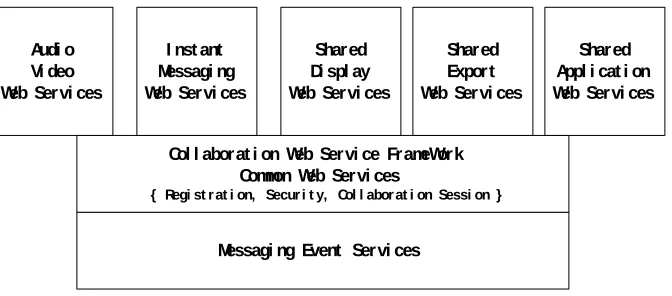
Figure 1 shows such a solution to our Global-MMCS. The Messaging event services provide
publish-subscribe paradigm for all kinds of group communications in collaboration applications. And it
is implemented in a distributed messaging broker middleware, which helps to ensure QoS requirements
services framework defines a general architecture, which can integrate all possible collaboration
services, for example videoconferencing, streaming, IM as well as shared application. On top of these
services, all the services can be described, implemented and deployed.
Messagi ng Event Servi ces Col l aborat i on Web Servi ce FrameWork
Common Web Servi ces
{ Regi st r at i on, Secur i t y, Col l abor at i on Sessi on } I nst ant
Messagi ng Web Servi ces
Shared Di spl ay Web Servi ces
Shared Export Web Servi ces
Shared Appl i cat i on Web Servi ces Audi o
[image:2.595.120.456.134.282.2]Vi deo Web Servi ces
Figure 1. Global-MMCS Architecture
2.1 Global-MMCS Services
Videoconferencing services may include different collaboration systems, such as H.323, SIP [8] and
AccessGrid [1] system. Real-Server will be added as a streaming Web-Service. Global-MMCS has SIP
proxies and Jabber servers to provide Instant Messaging service. We allow users to use multiple types of
clients to access GlobalMMCS system, including H.323 terminals, SIP endpoints, MBONE tools, Real
and Windows Media Players.
Collaboration pattern usually can be divided into two categories: ad-hoc mode, scheduled mode. Ad-hocneeds Instant Messenger to provide chat and remote presence services. And it can implement
very dynamic membership, which is quite suitable for small group and informal collaborations.
Scheduled mode needs meeting calendar to prepare the formal collaboration. People have to log into
some web site or use emails to make reservation of some virtual meeting room, send invitations to other
attendee in advance. Scheduled mode is better for formal and large scale collaborations. Global-MMCS
will support the hybrid collaboration pattern, which allows users to schedule formal meetings or to
create small group ad-hoc meetings.
2.2 Web Services Architecture
The Session Web Service tries to provide a general session collaboration framework, which can
support various kinds of collaboration tools. This framework includes two parts: one is XGSP (XML
based General Session Protocol), which defines a general session protocol in XML. The other is
WSDL-CI (WSDL Collaboration Interface), which gives an interface definition of any collaboration
server.
XGSP solves the issue of interconnecting the different collaboration tools for the same session. For
example, we have AccessGrid, H.323 as well as SIP for videoconferencing. In order to make the servers
and clients from different communities be able to communicate with each other, it is necessary to define
only one session protocol which can be translated into AccessGrid, H.323, SIP messages and vice versa.
WSDL-CI is used to describe the functionalities of the particular collaboration server. When we try
to integrate the server into Global-MMCS, WSDL-CI provides the WSDL information to generate the
interface component through which Global MMCS session server can control this collaboration server
and add it into current active session. For example, the global session server can schedule a third-party
methods of session establishment, session membership and session collaboration control.
There are different directories in Global-MMCS. The first is the directory of user account and media
terminal. Unique user identifications help to authenticate valid users and bind the user to his media
terminal. A user account may also include the information of user’s media capability, for example, the
audio terminal that the user wants to use. Also it is important to keep the directory of the active terminal,
which the participant will use to access the media services. The second is the directory of different
communities and collaboration servers. A community should be regarded as autonomous area that has its
own collaboration control servers and media servers. The community directories will be used to
integrate different services from different communities.
2.3 General Messaging Middleware (NaradaBrokering)
Collaboration applications for example videoconferencing usually need group communication. But
current Internet cannot support group communication very well even with IP multicast solution which
seems to have a long time to become ubiquitously available. Therefore messaging middleware is
definitely necessary for group communication over heterogeneous networks. Since topic-based
publish-subscribe model defines a general API for group communication, it seems to be a very good
interface between collaboration applications and messaging middleware.
NaradaBrokering [4] from the Community Grid Labs is adapted as a general event brokering
middleware. NaradaBrokering supports publish-subscribe messaging models with a dynamic collection
of brokers. And it is able to provide services for TCP, UDP, Multicast, SSL and raw RTP clients. For
accessing the remote resources behind of a firewall, NaradaBrokering provides the capability of the
communication through firewalls and proxies. It can operate either in a client-server mode like JMS or
in a completely distributed JXTA-like peer-to-peer mode. By combining these two disparate models,
NaradaBrokering can allow optimized performance-functionality trade-offs for different scenarios. As
the development and administration tools, NaradaBrokering provides Performance Monitoring, and
Performance Aggregation Service.
3. Global MMCS Prototype & Implementation
We plan to build a Global-MMCS prototype system across the sites in US and China. In China, we
have a partner group called Admire [2], also working on videoconferencing systems. Admire group
comes from National Software Development Environment Lab of Beihang University. Now they are
beginning to deploy a videoconferencing system across the universities in China. Admire developers
will build web-services of Admire system based on our framework. Indiana A/V research group will use
these web-services interface to integrate Admire with H.323, SIP as well as Real Networks streaming
systems.
3.1 Admire Project in China
Admire project has been started in 1999 and finished a prototype system – Admire. The initial aim of
the early project was to develop a large scale real-time multimedia interaction environment on top of
NSCFnet, which allows users distributed in different sites of NSCFnet to make distant seminars and
scientific collaboration through multiple collaboration tools. Now, the prototype system can support
audio, video, chat, whiteboard, PowerPoint, web page sharing, desktop sharing, and provide a complete
conference management tool kit as well as conference archiving tools. Furthermore, it can be deployed
on heterogeneous network environments, supporting both unicast and multicast communication.
By the end of 2002, Admire system has been deployed in over 20 sites in NSFCNET, CERNET
Grid, the de facto Internet2 multimedia collaborative environment.
3.2 Global MMCS Prototype System
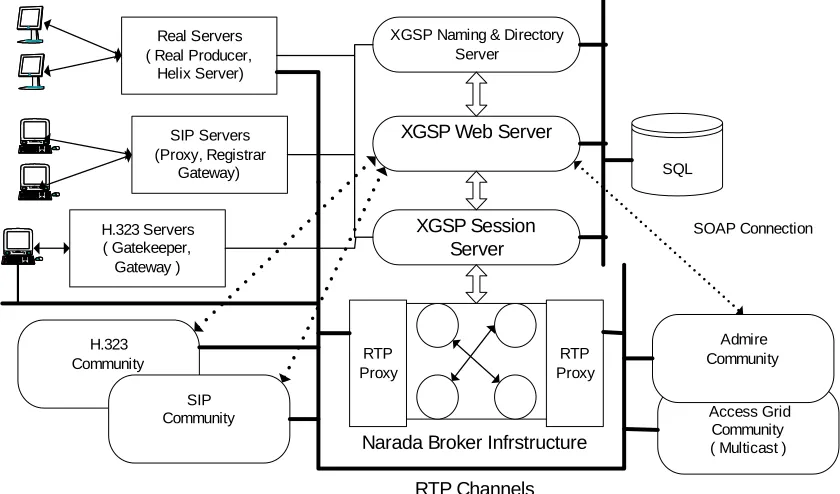
Figure 2 shows the architecture of Global-MMCS prototype system that we are developing. The
XGSP Web Server, XGSP naming & directory server and XGSP session server implement the
web-services framework of Global-MMCS. Through SOAP connection, the XGSP Web Server can
invoke web-services provided by other communities, such as Admire and SIP. The XGSP Session Server
translates the high-level command from the XGSP Web Server into signaling messages of XGSP, and
sends these signaling messages to the NaradaBrokering servers to create a publish/subscribe session on
the NaradaBrokering server. The distributed set of NaradaBrokering nodes take the tasks of routing and
forwarding video/audio events to various communities and collaboration clients.
XGSP Session Server
Access Grid Community ( Multicast )
Narada Broker Infrstructure
H.323 Servers ( Gatekeeper,
Gateway )
XGSP Web Server
XGSP Naming & Directory Server
SQL
SOAP Connection SIP Servers
(Proxy, Registrar Gateway)
Admire Community H.323
Community
SIP Community Real Servers ( Real Producer,
Helix Server)
RTP Channels iM ac
iM ac
iM ac
RTP Proxy
[image:4.595.95.515.233.480.2]RTP Proxy
Figure 2 Global MMCS Prototype System
For different A/V clients, Global-MMCS has correspondent servers to accept their signaling requests
and provide various services. The H.323 Servers including a H.323 Gatekeeper and H.323 gateway
create a new H.323 administration domain for individual H.323 endpoints, translate H.225 and H.245
signaling from these endpoints into XGSP signaling messages, and redirect their RTP channels to the
NaradaBrokering servers. The SIP Servers including a SIP Proxy, SIP Registrar and SIP Gateway create
a similar SIP domain for SIP terminals and perform SIP translation. In addition, the SIP Proxy and SIP
Gateway provide the services of Instant Messaging and Chat room for IM capable clients such as
Windows Messenger.
The Real Servers including a Real Producer and a Helix Server provide a streaming service to
real-player and windows media player. Enhanced with customer input plug in, our Real Producer can
receive RTP audio and video packets from network, encode them into Real format and submit them to
the Helix Server. Real-players as well as windows media players can use RTSP to connect the Helix
Server and choose the multimedia streams that they are interested in.
The NaradaBrokering servers provides a scalable distributed messaging platform for RTP
communications in these A/V collaboration applications. Whenever a new session is activated across
server. Any RTP client or server who wants to join in this session, it can “subscribe” to this topic and
“publish” its RTP messages through RTP Proxies in the NaradaBrokering system. After we made some
optimizations on the message transmission of NaradaBrokering system, it shows excellent performance
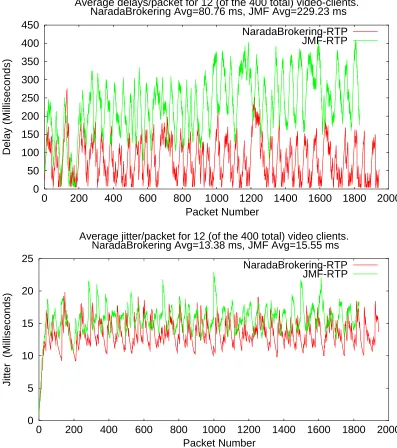
for A/V communication. We have tested the performance of NaradaBrokering in the case of high
bandwidth video transmission: A video client sends a video stream to the NaradaBrokering server and
400 receivers receive it. 12 of these clients run in the same machine as the sender client and the rest of
the clients run in another machine. We gather the results from only those 12 clients, because if we run
more clients in that machine, receivers introduce delays. This video stream has an average bandwidth of
600Kbps. So totally it takes up 240Mbps of network bandwidth. We compare the results of
NaradaBrokering with the performance of a JMF reflector program written in Java. Figure 3 shows the
[image:5.595.98.495.255.703.2]measurement results:
Figure 3 Comparison between the performance of NaradaBrokering and JMF
The tests we have conducted show that our messaging systems outpaces JMF reflector in the
performance of delay and jitter. It is good enough to be used for large scale videoconferencing 0
5 10 15 20 25
0 200 400 600 800 1000 1200 1400 1600 1800 2000
Jit
te
r (
M
illiseconds)
Packet Number
Average jitter/packet for 12 (of the 400 total) video clients. NaradaBrokering Avg=13.38 ms, JMF Avg=15.55 ms
NaradaBrokering-RTP JMF-RTP
0
50
100
150
200
250
300
350
400
450
0
200
400
600
800
1000
1200
1400
1600
1800
2000
D
e
lay (M
illiseconds)
Packet Number
Average delays/packet for 12 (of the 400 total) video-clients.
NaradaBrokering Avg=80.76 ms, JMF Avg=229.23 ms
applications. And one broker can support more than a thousand audio clients or more than 400 hundred
video clients at one time providing a very good quality.
Based on these XGSP servers and NaradaBrokering servers, Global-MMCS can support not only
individual collaboration clients but also collaboration communities including AccessGrid, Admire,
H.323 and SIP. For each community, we can define its collaboration web-services using WSDL, and
implement these services based its own framework and protocol. There are two approaches to build RTP
channels between these communities. For Admire community, XGSP Web Server invokes the
web-services of Admire to notify the address of the rendezvous point. And Admire responds with its
rendezvous point in SOAP reply. After that, both sides will create RTP agents on this rendezvous. For
H.323 and SIP community, in additional to web-services commands, they have to rely upon H.323 and
SIP Gatekeeper for signaling procedure, which means their RTP agents will be created through H.323 or
SIP signaling procedure.
We have built web-services of HearMe [6], a SIP based Voice-over-IP system. Similar interface can
also be implemented based on other SIP or H.323 collaboration systems. Now we are co-operating with
Admire research group to build Admire Web-services.
4. Conclusion
In this paper, we presented the design and implementation of a Global Multimedia Collaboration
System. Based on the XGSP framework, this system can provide the services of videoconferencing,
instant messaging and streaming to various clients, and integrate different collaboration communities
into a global collaboration platform.
5. Reference
[1] Access Grid, http://www.accessgrid.org
[2] Admire, http://www.nlsde.buaa.edu.cn/projects/Admire
[3]Geoffrey Fox, Wenjun Wu, Ahmet Uyar, and Hasan Bulut A Web Services Framework for
Collaboration and Audio/Videoconferencing, The 2002 International Multiconference in Computer
Science and Computer Engineering, Internet Computing(IC’02), June 2002, Las Vegas
[4] Geoffrey C. Fox and Shrideep Pallickara, “The Narada Event Brokering System: Overview and
Extensions”, proceedings of the 2002 International Conference on Parallel and Distributed Processing
Techniques and Applications (PDPTA'02)
[5] Hasan Bulut, Geoffrey Fox, Shrideep Pallickara,Ahmet Uyar and Wenjun Wu, Integration of
NaradaBrokering and Audio/Video Conferencing as a Web Service, IASTED International Conference
on Communications, Internet, and Information Technology, November 2002, US Virgin Islands.
[6] HearMe Audio conference system, http://www.hearme.com,
[7] International Telecommunication Union, “Packet based multimedia communication systems”,
Recommendation H.323, Geneva, Switzerland, Feb. 1998.
[8] J. Rosenberg et al., “SIP: Session Initiation Protocol”, RFC 3261, Internet Engineering Task Force,
June 2002, http://www.ietf.org/rfc/rfc3261.txt,
[9] Steve Graham, Simeon Simeonov, etc, Building Web Services with Java, ISBN0-672-32181-5, Sams