1-1-1997
Root-zone water stress effects on plant
development and leaf water relations of red and
Freeman maples
James Allen Zwack
Iowa State UniversityFollow this and additional works at:https://lib.dr.iastate.edu/rtd
This Thesis is brought to you for free and open access by the Iowa State University Capstones, Theses and Dissertations at Iowa State University Digital Repository. It has been accepted for inclusion in Retrospective Theses and Dissertations by an authorized administrator of Iowa State University Digital Repository. For more information, please [email protected].
Recommended Citation
Zwack, James Allen, "Root-zone water stress effects on plant development and leaf water relations of red and Freeman maples" (1997). Retrospective Theses and Dissertations. 17775.
development and leaf water relations of red and Freeman maples
by
e,
I James Allen ZwackA thesis submitted to the graduate faculty
in partial fulfillment of the requirements for the degree of MASTER OF SCIENCE
Major: Plant Physiology Major Professor: William R. Graves
Iowa State University Ames, Iowa
Graduate College Iowa State University
This is to certify that the Master's thesis of James Allen Zwack
has met the thesis requirements of Iowa State University
TABLE OF CONTENTS
CHAPTER 1. GENERAL INTRODUCTION 1
Introduction 1
Thesis organization 4
Literature Review - Drought Stress 4
Literature Review - Flood Stress 17
Literature Cited 31
CHAPTER 2. LEAF WATER RELATIONS AND PLANT DEVELOPMENT 36 OF THREE FREEMAN MAPLE CULTIV ARS SUBJECTED
TO DROUGHT
Abstract 36
Introduction 37
Materials and Methods 39
Results 43
Discussion 44
Literature Cited 49
CHAPTER 3. VARIATION AMONG RED AND FREEMAN MAPLE 57
RESPONSES TO DROUGHT AND FLOOD STRESS
Abstract 57
Introduction 58
Materials and Methods 60
Results 65
Discussion 67
Literature Cited 72
CHAPTER 4. GENERAL CONCLUSIONS 85
APPENDIX. SIL VER MAPLE DATA 88
CHAPTER!. GENERALINTRODUCTION
Introduction
Urban trees are valuable to people at physical, economic, emotional, and psychological levels, yet they are installed in unnatural, often harsh, environments where they are expected to flourish. This conflict provides rationale for conducting research on the stress physiology of ornamentally valuable tree species. My research characterizes the physiological responses of red maples (Acer rubrum L.) and Freeman
maples (Acer xfreemanii E. Murray) to root-zone moisture stress, a very common
problem in urban areas. Freeman maples are considered hybrids between red maples and silver maples (Acer saccharinum L. ), but genetic verification of genotypes of
Freeman maples has not been reliably performed. Thus, for all genotypes listed as Freeman maples throughout this thesis we rely on the validity of industry designations.
The presence of trees in urban landscapes is often assumed, if not overlooked, and to some people trees are noticed only when they flower, display fall color, represent a nuisance, or when they are removed. The beauty of urban trees, however, is that they provide benefits even when they are not noticed.
Harris, 1992). There is little doubt that tree-lined streets are much more pleasing than
tree-less urban areas, and living is more enjoyable in neighborhoods with many trees
(Kielbaso, 1990). Architects and designers utilize trees to soften harsh edges of city
landscapes and accentuate structural details (Harris, 1992; Moffat, 1987). Parks and
play areas are enhanced by trees through definition of space and creation of an inviting
atmosphere (Harris, 1992). Others say there are deep psychological and emotional ties
between people and urban and forest trees that go far beyond aesthetics (Dwyer et al.,
1991).
Considering the importance of trees in urban landscapes, one might believe our
urban forests are well-maintained and we are keenly aware of the problems and
challenges that such trees face. This is not the case. At the heart of the matter lies the
notion that urban environments are distinctly different than natural settings. There is a
consensus that urban habitats place many constraints on the growth of urban trees, and
that these constraints reduce tree life spans (Whitlow and Bassuk, 1988). Unusual
combinations of various environmental factors coupled with the physical isolation of
trees from one another can account for physiological stress and reduced life spans
(Clark and Kjelgren, 1990). Fowles (1989) claims trees are social creatures just as
humans are, and that isolated trees are no more natural than hermits or marooned
sailors. Furthermore, urban species composition does not reflect the expression of a
genotype's capacity to colonize, compete, and achieve an equilibrium with the
environmental limitations (Whitlow and Bassuk, 1988). What are some of the physical
Remarkably, there are few data characterizing the urban environment as it pertains to growing trees (Graves, 1994; Moffat, 1987; Whitlow and Bassuk, 1988). Furthermore, urban areas are very heterogeneous, and different stresses or levels of
stress may be present, even at adjacent sites (Berrang et al., 1985). Drought, however, is generally considered the most serious threat to urban trees (Clark and Kjelgren, 1990; Houston, 1985; Krizek and Dubik, 1987; Moffat, 1987, Whitlow and Bassuk, 1987), and excessive soil moisture is also cited as a potential problem (Berrang et al., 1985; Whitlow and Bassuk, 1987). Precipitation falls on a variety of surfaces in urban areas. Many surfaces carry water away via sewers and gutters, while others, like grass, compete with trees (Tattar, 1980). Water that percolates into soil may be held tightly due to compaction and structural problems common to urban streetscapes, and space for root development may be limited because of below-ground obstructions, grade changes, and so on. Excessive soil salts, which could be caused by inadequate drainage, may also negatively influence the water relations of a tree, leading to the development of stress symptoms (Berrang et al., 1985). Graves and Dana (1987) found that mean soil temperatures at planting sites along urban streets were higher than at urban sites away from streets and in suburban and native woodland areas, which could account for increased soil water evaporation. Poor drainage resulting from compaction and
Thesis Organization
The next section of this thesis is a literature review that pertains to previous
research conducted on drought and flood stress of ornamentally valuable tree species.
Following the review of literature, I include a chapter, in manuscript form, which
details a major part of my research completed in the fall of 1996. This manuscript has
been accepted by the Journal of the American Society for Horticultural Science. The
next chapter is also in manuscript form, and addresses the other large portion of my
research which was completed in 1997. This manuscript has not been submitted for
publication yet. Following these, is the last chapter in which I discuss general
conclusions as they apply to the larger problem detailed in the Introduction.
Literature Review - Drought Stress
Water is limiting to trees in urban areas for a number of reasons. Precipitation
falls on a variety of surfaces, many of which carry it away via sewers and gutters, while
others, like grass, compete with trees (Tattar, 1980). Water that percolates into soil
may be held tightly due to compaction and textural problems common to urban
streetscapes, and space for root development may be limited because of below-ground
obstructions or grade changes. Excessive soil salts, which could be caused by
inadequate drainage, may also negatively influence the water relations of a tree, leading
to the development of stress symptoms (Berrang et al., 1985). Urban areas can be as
much as 9°C warmer than outlying areas during different times of the day (McPherson
cooling. High shoot: root ratios in recently transplanted trees often exist because of root
pruning that occurs when trees are dug and balled in a nursery. High shoot:root ratios
result in a transpirational demand that may exceed water supply. Fluctuating wind
patterns in urban areas can desiccate leaves, and relative humidity around isolated
trees can be lower than around non-isolated trees, also increasing the evaporative loss
(Clark and Kjelgren, 1990).
It is intuitive that withholding water for plants will decrease growth, alter dry
matter partitioning, and kill plants if the stress is severe enough. Researchers have,
nonetheless, characterized the responses to drought of a number of ornamentally
valuable deciduous trees, because it is equally intuitive that species will differ in
response to the same stress. My review of the relevant literature related to drought
stress among deciduous trees will begin with those studies that have included members
of the genus Acer. Numerous articles describe comparative evaluation of multiple
species in natural settings, however, I largely confine this literature review to only those
papers that describe experiments in a growth chamber or greenhouse.
Townsend and Roberts (1973) found water stress resistance varied between red
maple seedlings originating from different seed sources. They subjected seedlings
grown from seed collected from two wet sites and two dry sites to three levels of drought
stress by witholding irrigation. Transpiration per unit leaf weight tended to be greatest
in seedlings originating from the wettest site at all stress levels. Growth of seedlings
from the wet sites continued after reaching the temporary wilting point, whereas
point was reached. Seedlings from the drier sites took longer to develop temporary or
permanent wilt, and their water potentials upon wilting were more negative than those
of seedlings from the wet sites. The authors also found that seedlings originating from
sites between the extremes showed intermediate responses to water stress, suggesting
that genetic variation was correlated with habitat.
Photosynthesis and water relations during drought of red maple seedlings from
four contrasting sites were evaluated by Abrams and Kubiske (1990). The sites
represented a moisture gradient from hydric (bog) to mesic (valley) to xeric (ridge top
and barrens) conditions. During middle and late stages of drought, bog plants had
lower net photosynthesis and leaf conductance than plants from the three upland
sources. Bog plants had less negative shoot water potential at the incipient wilting
point. The bog plants had less negative osmotic potentials before drought, and only
plants from this source adjusted osmotically before maximal drought stress was
attained. At peak drought there were no differences in osmotic potentials, relative
water content at zero turgor, and tissue elasticity between any sources. The authors
found most of the differences occurred between bog plants and the upland sources,
versus within the upland sources. There were no differences in leaf thickness among all
sources, but specific leaf mass was highest in the bog plants. Considerable genotypic
variation in responses to drought between plants from the bog and the three upland
sources, combined with morphological and physiological plasticity, can allow different
Nash and Graves (1993) evaluated 'Franksred' red maple, sweetbay magnolia
(Magnolia virginiana L.), black tupelo (Nyssa sylvatica Marsh.), bald cypress [Taxodium
distichum (L.) Rich.], and pawpaw [Asimina triloba (L.) Donal.] for responses to
drought stress induced by witholding irrigation. Severe drought reduced net
assimilation rate, root dry mass, shoot dry mass, and leaf surf ace area of red maple,
pawpaw, black tupelo, and bald cypress, but not sweetbay magnolia. Root:shoot ratio
of black tupelo was significantly lower under severe drought than for control plants
maintained at container capacity, which is contrary to what is considered an effective
drought resistance mechanism. Only pawpaw showed an increase in root:shoot ratio in
this study. Drought caused an osmotic adjustment of 0.26 MPa in leaves of sweetbay
magnolia, but there were no differences between leaves of control and drought-stressed
red maple. The authors reported sweetbay magnolia may merit increased use in
landscapes where water is deficient, while red maple and black tupelo genotypes with
superior capabilities to resist water stress are needed.
Davies and Kozlowski (1977) subjected sugar maple (Acer saccharum Marsh.),
red maple, white ash (Fraxinus americana L.), American elm (Ulmus americana L.),
black walnut (Juglans nigra L.), and silky dogwood (Cornus amomum Mill.) to a
soil-drying cycle and a rewatering period. As the soil-drying cycle progressed, leaf water
potentials decreased, stomata closed, and the rates of transpiration and photosynthesis
decreased. Stomata of the two maple species were initially more sensitive to water
stress than the others, with abrupt closure at relatively high leaf water potentials, while
potentials. Among drought-stressed plants, the ratio of photosynthesis to leaf
conductance was highest in ash. Following rewatering, all species except walnut
regained leaf turgor, and within 24 hours had leaf water potentials similar to
non-stressed plants. No plant regained full stomatal opening or photosynthesis during the
experiment. Stomatal opening of the two maple species and dogwood occurred within 1
day, and in elm and ash within 4 days. Walnut did not recover from drought in this
study. The authors noted stomatal closure at high leaf water potential, with the
consequent decrease in photosynthesis, can put plants at a disadvantage on dry sites,
and the results of this study indicated the two maple species might be limited to moist
areas. They also reported low photosynthesis: leaf conductance ratios for these species,
further suggesting they might compete unsuccessfully on dry sites. Ash and elm,
however, limited stomatal opening after rewatering, which conserves water and might
allow these species to compete more successfully on drier locations.
Pallardy and Rhoads (1993) evaluated morphological adaptations to drought in
seedlings of two drought-tolerant species, post oak (Quercus stellata Wangenh.) and
white oak (Quercus alba L.), and two drought-sensitive species, sugar maple and black
walnut. When subjected to severe drought, the two oak species showed no leaf
abscission, while both sugar maple and black walnut showed abscission. Production of
new leaf area after watering in the latter species did not compensate for the initial loss
caused by water stress. Stem dry weight of walnut was greater than the stem dry
weight of the other species when exposed to drought cycles, as was taproot weight. The
drought-prone sites may be especially detrimental to the drought-sensitive species in this study
because of the greater capacity for carbon loss in the form of recurring leaf abscission.
They concluded post oak had a root system that was better able to supply water to
leaves than the other species, which contributed to the drought tolerance of this species.
Martin et al. (1987) evaluated dehydration tolerance of leaf tissues of black
walnut, sugar maple, white oak, red oak, black oak (Quercus velutina Lam.), and flowering dogwood (Cornusflorida L.). This study was conducted with leaf tissue collected from trees growing in a natural setting, however I include it in this review of
literature because of the interesting method for assessing drought tolerance that was
described. A major factor in dehydration tolerance capacity is membrane maintenance
during dehydration. Stress-induced loss of cell membrane integrity is associated with
an efflux of solutes and electrolytes, with the amount of leakage being proportional to
the level of injury. Dehydration resulted in increased electrolyte leakage for all species,
however, the authors showed a hardening to drought of several species during the
growing season. All of the oaks and dogwood tended to have less leakage at given water
potentials in August than at the same water potentials in June and July. Sugar maple
and black walnut, however, were regarded as drought sensitive and showed no such
trend. This is consistent with some of the work previously described (Davies and
Kozlowski, 1977; Pallardy and Rhoads, 1993), which deemed black walnut and sugar
maple less tolerant to drought than oak species.
Graves (1994) evaluated development of sugar and black maple (Acer nigrum
curtailed growth for both species when compared to plants irrigated at a 10-day
interval, however, growth of sugar maple was more adversely affected. The impact of
drought on dry mass, stem length, and leaf area was more pronounced for sugar maple
than black maple, and black maple grew more slowly when irrigated at a higher
frequency. Graves reported this information is consistent with previous speculation
that black maple has a greater capacity to withstand drought than sugar maple, which
is considered by others to be drought sensitive.
Researchers have characterized the drought resistance of sugar maple and red
maple, while there is little information regarding the resistance to drought of silver and
Freeman maple. Without speculating as to the reason for this, I will focus the
remainder of the literature review to studies that do not consider Acer species.
Seidel (1972) evaluated the drought resistance and internal water balance of
white oak, post oak, red oak (Quercus rubra L. ), and black oak, and concluded that post
oak is the most drought tolerant, followed by black oak and white oak, which differed
little from each other, and finally red oak. This is consistent with the findings of
Pallardy and Rhoads (1993), who also deemed post oak very drought resistant. Seidel
reported cells of post oak leaves and roots survived at more negative water potentials
than the other oak species, which could account for the drought resistance of this
species. Increasing soil moisture stress affected leaf transpiration similarly for all
species, and as soil became drier, transpiration continued to decline but at a slower rate.
Soil water potential of -0.1 to -0.2 MPa yielded transpiration rates of about 95% of
of controls. When soil water potential was about -2.5 MPa, transpiration rate was
about 5% to 10% of controls. The author noted that leaf and root cell survival may not
be well correlated with seedling survival under drought conditions because of the
capacity of oaks to die back and resprout later.
Leaf and root osmotic adjustment in drought-stressed white, bur, and post oak
were examined by Parker and Pallardy (1988). Drought resulted in active osmotic
adjustment in leaves of all three species, with decreases in osmotic potential at full
turgor and at the turgor loss point of 0.25 to 0.60 MPa. Leaf osmotic potential at full
turgor and the turgor loss point were lower in post oak than white or bur oak. Post oak
also showed osmotic adjustment in root tissue, while all three species possessed
decreased turgor loss points of root tissue after drought. Decreases in the root turgor
loss point of white and bur oak were attributed to increased tissue elasticity. Leaf
osmotic adjustment may result in the enhanced capacity for gas exchange and water
uptake in an environment where water is limiting, however, overall survivability of a
species also depends on protoplasmic dehydration tolerance and on a root system that
can sustain the capacity to transport water during drought. This study sheds light on
why post oak is such a tolerant species, as previously noted in this review.
Osonubi and Davies (1978) studied osmotic adjustment in English oak (Quercus
robur L.) and silver birch (Betula verrucosa Ehrl. ), by using repeated episodes of
drought separated by irrigation to container capacity. Solute accumulation in roots
and leaves of oak seedlings allowed maintenance of turgor and higher leaf conductances
adjustment and maintained turgor by stomatal closure at high soil water potentials.
Consecutive cycles of drought had no effect on height, dry weight, or leaf area of oak
seedlings after 14 weeks, however these variables were substantially reduced in
water-stressed birch seedlings compared to controls. The authors noted oak seedlings
subjected to water stress had long, thin roots compared to the short, thick roots that
developed in well-watered controls. Droughted oak seedlings had a significantly higher
root:shoot ratio than similarly treated birch. This work is consistent with the findings
of Pallardy and Parker (1988) who have shown that water-stressed oak seedlings have a
capacity for turgor maintenance via osmotic adjustment.
The variation in response to progressive water stress of black alder (Alnus glutinosa (L.) Gaerth.), hazel alder (A. se"ulata (Ait). Willd.), and seaside alder (A.
maritima Muhl. ex Nutt.) was evaluated by Hennessey et al. (1985). At moderate drought stress, stomatal resistance of black alder was three times that of seaside alder
and hazel alder. Seaside alder maintained low stomatal resistance after 30 days of
severe stress. Apical dominance of black alder was lost during drought, resulting in
branched and bent stems, and leaves of seedlings in severe water deficit became
chlorotic. No obvious morphological changes occurred for seaside alder in response to
the water stress. Leaf area of black alder exposed to moderate drought was 54 % of
controls after 30 days, while leaf area of similarly treated seaside alder was 77% of
control plants. Height growth of black alder was significantly reduced at moderate
drought stress, whereas height growth of the other species in the study was similar for
differ in response to drought stress and black alder showed poor adaptation to even
moderate water deficit, while seaside alder performed comparably better.
Morphological and physiological changes in black alder induced by water stress
were studied by Seiler (1985). Seedlings were exposed to sublethal drought stress for 12
weeks, during which time they were irrigated only when visibly wilted. Stressed
seedlings displayed an osmotic adjustment of over 0.4 MPa compared to controls, and
drought also reduced leaf size, and increased epicuticular wax content and root: shoot
ratio. Stomatal conductance of drought-stressed seedlings was significantly affected by
a previous episode of drought. After irrigation, stressed seedlings had much lower
stomatal conductance than controls and were able to maintain conductance for a longer
time and to much more negative leaf water potentials. Such control of water loss
through changes in leaf conductance affects drought tolerance of tree species (Davies
and Kozlowski, 1977; Unterscheutz et al., 1974).
Joly et al. (1989) evaluated the phenological and morphological responses of
Douglas-fir (Pseudotsuga menziesii [Mirb.] Franco var. menziesii) from mesic and dry
sites to water deficit. Although this species is not a deciduous tree common to urban
areas, I am including this paper in the literature review because the traits that were
examined were evaluated in my experiments. In general, water deficit led to reduced
growth and resulted in earlier budset. Stressed seedlings had higher root:shoot ratios
and higher leaf area: sapwood area ratios. Mesic-site versus dry-site populations
differed in response to water deficit for date of budbreak, date of budset, number of
mass, total mass, length of shoot extension, root: shoot ratio, number of branches, leaf
area: root dry weight ratio, and leaf area:sapwood area ratio. The authors reported
dry-site populations were less capable of responding to a favorable environment, but
were more capable of withstanding the detrimental effects of drought.
Douglas-fir was also evaluated by Unterscheutz et al. (1974). I include this
study in my literature review because it deals with the topic of pre-conditioning.
Seedlings exposed to prior soil moisture stress decreased transpiration more in response
to low plant water potential than did seedlings not previously exposed to stress. This
conservative water use was viewed as an adaptive response to episodes of water deficit
as they might occur in nature.
Potts and Herrington (1982) evaluated drought resistance adaptations of
honeylocust (Gleditsia triacanthos L. var. inermis Willd.). Experimental trees were
grown in lysimeters in an outdoor location, with supplemental irrigation during the
growing season. I include this study here because honeylocust is reputed to be
well-adapted to stressful urban environments. The authors reported that small leaves and
the combination of small stomatal dimensions and low stomatal density gave
honeylocust low transpiration capacity. Premature leaf senescence reduced leaf surface
area, which may be a drought-resistance mechanism of this species. Potts and
Herrington also noted, however, that honeylocust has poor stomatal control over water
use. Stomata opened very quickly but closed very slowly, which might be a liability for
loss to excess, and the insensitivity of stomata of honeylocust can cause periods of low
plant water potential, where loss of vigor or death could result.
Honeylocust was also studied by Graves and Wilkins (1991). The primary
objective of the study was to consider high root-zone temperature and osmotic stress
interactions among seedlings grown in solution and similarly stressed seedlings in an
aggregate mix. Osmotic stress in solution was administered by additions of
polyethylene glycol (PEG). The authors reported growth of seedlings was greatly
diminished by small reductions in the osmotic potential of the medium with PEG.
Drought stress for seedlings grown in solution caused a reduction in root:shoot ratio,
however the root: shoot ratios of stressed plants grown in solid media were more than
double those grown hydroponically. Withholding irrigation in the mix and reducing
solution osmotic potential to -0.20 MPa caused similar reductions in shoot growth,
however PEG-induced stress reduced seedling dry weight compared to controls, while
there was no reported difference in total seedling dry weight of irrigated and
unirrigated seedlings in solid media. Finally, the authors expressed concern over the
use of PEG to induce water stress hydroponically because as little as 10 g PEG/liter in
solution restricted shoot expansion, yet use of PEG at this rate caused an undetectable
difference in osmotic potential. This suggests the PEG itself may have had some
inhibitory effect.
Eastern redbud (Cercis canadensis L.) is widely distributed across the eastern
United States. It occurs on both mesic and xeric sites, and is found as far west as
relations during drought for redbud seedlings originating from a xeric Kansas site, an
intermediate Kansas site, and a mesic Indiana site. Leaf conductance decreased for all
genotypes during the drought, however, seedlings from the xeric Kansas site maintained
higher conductance levels than seedlings from the other locations. Xeric-site seedlings
had more negative osmotic potential at full turgor and osmotic potential at zero turgor
than mesic-site seedlings, with the seedlings from an intermediate site displaying
intermediate values of these parameters. Differences in leaf morphology among
seedlings from the different sites were also evident. Xeric-site seedlings had less total
area, greater thickness, and greater specific mass than seedlings from mesic sites.
Physiological and morphological adaptation through genetic or plastic changes
facilitates the survival of redbud in greatly contrasting habitats. The large native
ranges of red maple and silver maple suggest these species could have a similar capacity
and that stress-resistant selections can be made.
Parker and Pallardy (1985) evaluated genotypic variation in tissue water
relations of leaves and roots of black walnut seedlings. Sources from different
geographic areas differed in the capacity for and degree of leaf and root osmotic
adjustment. Seedlings of four different sources showed a decrease in osmotic potential
at zero turgor of 0.4 MPa. This was attributed to an increase in tissue elasticity.
Seedlings from an Ontario source exhibited a 0.7-0.8 MPa decline in osmotic potential
at zero turgor, which was attributed to both increased solute content and increased
tissue elasticity. Seedlings from a New York source showed no osmotic adjustment.
similar response in roots, although because of greater elasticity, roots showed a more
gradual decline in turgor and total water potential than leaves as water deficit
increased. The authors showed that leaf osmotic potential at full turgor was lower than
that of root systems, and they noted that root systems released a larger volume of water
as total water potential declined than did leaves or shoots. This suggests roots systems
act as reservoirs to prevent injurious levels of water stress in leaves on a diurnal basis,
and recovery occurs at night when stomata close and water demand is lower.
Literature Review - Flood Stress
Excess soil moisture is a common problem in many urban sites that can result in
severe stress for trees. Waterlogged soils can arise for a variety of reasons. The
overflowing of rivers and streams, construction of dams, and over-irrigation are among
the more common causes (Kozlowski, 1985), with poor underground and surf ace
drainage also playing a role (Kawase, 1981). The primary reason waterlogged soils are
detrimental to tree health is because of poor aeration (Bradford and Yang, 1981;
Kawase, 1981). Low soil oxygen concentrations force roots to undergo anaerobic
respiration, which results in a decrease in energy, accumulation of toxic end products,
and a depletion of organic compounds (Kawase, 1981). Specific responses of trees to
waterlogged soils include leaf chlorosis, leaf epinasty, leaf abscission, decreased stem
elongation, wilting of leaves and shoots, stomata) closure, decreased root growth, root
The adverse effects of flooding have been studied for many woody plants in
numerous genera. Some experiments assess relative flood tolerance of a variety of
species, while others focus on characterizing the response to flooding of a single species,
often with greater detail. I will begin a review of relevant literature with those
experiments that use members of the genus Acer. Because red maple (Acer rubrum L.)
and silver maple (Acer saccharinum L.) are considered bottomland or riparian species,
there are a number of studies that include these species, but the relatively new Freeman
maples (Acer xfreemanii E. Murray) are not found in any current literature.
Will et al. (1995) flooded red maple seedlings grown from fruits collected from
wet and dry sites to determine if there are ecotypic differences in growth and
physiology. They report no interactions between flooding and maternal hydrologic
conditions, which suggests no genetic differences in flood response between wet- and
dry-site seedlings. They did, however, find flooding causes a reduction in height
growth, leaf mass, stem mass, and root mass. They also showed that flooded seedlings
have higher water potentials than nonflooded seedlings, and flooding decreased
photosynthesis and leaf gas exchange. Stomatal conductance of flooded seedlings was
reduced to 70% of controls after 1 day and 49% after 3 days of flooding, and after 9
days they reported a recovery to 70% of the conductance of controls. In this study,
flooding caused lenticel hypertrophy and adventitious root formation, but stem
diameter growth of flooded seedlings did not differ from that of unflooded controls.
The effect of flood frequency on production and allocation of biomass in red
Seedlings were subjected to continuous flooding, intermittent flooding, or no flooding. Although total biomass increased throughout the experiment for all treatments, continuous flooding resulted in less biomass production than other treatments. Adventitious root production partially compensated for a lack of below-ground root production induced by the most extreme treatment. After 6 months of treatments, non -flooded plants had greater root:shoot ratios than those in the continuous flooding treatment. Responses of intermittently flooded seedlings were generally intermediate to those continuously flooded or those not flooded. Leaf senescence increased with
severity of flooding, as did the number of hypertrophied lenticels, and numerous red leaves suggested anthocyanins either increased or became more visible due to
chlorophyll degradation.
Peterson and Bazzaz (1984) evaluated growth and physiological responses of silver maple (Acer saccharinum L.) seedlings to flooding. They reported flooded seedlings grew less, as reflected by height, leaf number, leaf weight, stem weight, root weight, and total weight; decreases in root weight accounted for widely disparate shoot:root ratios compared to controls. Net photosynthesis and transpiration decreased after 28 and 21 days of flooding for 3-month-old, spring-flooded seedlings, while these responses decreased after 21 days for summer-flooded seedlings of the same age. Photosynthesis in 1-year-old, spring-flooded seedlings was not reduced, and
photosynthetic recovery after complete submersion than 2-month-old seedlings.
Duration of flooding had an inverse correlation with rate of photosynthesis and biomass
production, and previously flooded seedlings had a greater capacity for recovery of
pre-flood photosynthetic and transpiration rates than seedlings inundated for the first time.
Red maple, sugar maple (Acer saccharum Marsh.), river birch (Betula nigra L. ),
and European white birch (Betula pendula Roth) were studied by Tripepi and Mitchell
(1984) to determine whether internal aeration of roots by lower stems, changes in lower
stem morphology, or both contribute to the flood tolerance of red maple and river
birch, or whether the absence of such changes accounts for the intolerance of sugar
maple and European birch. Seedlings of red maple and river birch survived at least 30
days of flooding, while sugar maple and European birch were intolerant. New growth
on all species in the study became chlorotic, however, desiccation and senescence
occurred only on the intolerant species. Red maple seedlings developed lenticel
intumescences and adventitious roots, while river birch developed only adventitious
roots. Stem morphology of sugar maple and European birch did not change in response
to flood stress. During this study, flooding did not affect height growth of red maple,
whereas stem growth of river birch was reduced.
Nash and Graves (1993) evaluated 'Franksred' red maple, sweetbay magnolia
(Magnolia virginiana L.), black tupelo (Nyssa sylvatica Marsh.), bald cypress [Taxodium distichum (L.) Rich.], and pawpaw [Asimina triloba (L.) Dunal.] responses to flooding,
with emphasis on traits that may represent mechanisms of stress resistance. Flooding
maple, pawpaw, and black tupelo had negative NAR and RGR values during flooding,
which indicated senescence, and 22% of red maple and 33% of black tupelo died during
the 118 days of exposure to flood. Root mass of all species except sweetbay magnolia
was reduced by flooding, and the root: shoot ratio of black tupelo was lower for flooded
plants than for plants at container capacity. Leaf area of all species except sweetbay
magnolia was reduced by flooding, and red maple and black tupelo leaf abscission
occurred. The authors also evaluated leaf water relations of red maple and sweetbay
magnolia, and they reported red maple had the least negative midday water potential
and highly reduced transpiration rates. Both sweetbay magnolia and bald cypress were
suggested for use in stressful situations, while red maple and black tupelo were deemed
sensitive to flooding. The authors suggest identification of water stress-resistant
genotypes of these latter species is warranted.
Red maple was one of six bottomland species used by McDermott (1954) to
measure the degree of recovery following different lengths of flood conditions. The
other species used were hazel alder [Alnus rugosa (Du Roi) Spreng.], sycamore
(Platanus occidentalis L.), river birch, American elm (Ulmus americana L.), and winged
elm (Ulmus alata Michx.). Seedlings were flooded for as little as 1 day and for as long as
32 days, and the primary means of assessing flood tolerance and recovery was height
growth relative to unflooded controls. McDermott showed that prolonged exposure to
flooded conditions was detrimental to all species in the study except alder. In fact, the
growth of alder was accelerated by short intervals of soil saturation, and its growth was
to flooded conditions and assessment of rate of recovery in well-drained conditions, McDermott noted river birch and red maple recovered very rapidly, sycamore
recovered rapidly, and the elm species recovered at a moderate rate. This appears to agree with the findings of Tripepi and Mitchell (1984), and to be contrary to Nash and Graves (1993) who labeled red maple sensitive to flooding. The potential for ecotypic adaptation of red maple, however, suggests there may be genotypes of this species that may possess superior flood tolerance, and the cultivar 'Franksred', which Nash and Graves evaluated, may not be in this category.
Red maple, silver maple, and boxelder (Acer negundo L.) were part of a large study by Hosner (1960) to evaluate the relative tolerance to complete seedling
submersion of 14 bottomland species. Seedlings were completely submerged for 5, 10, 20, and 30 days, and the potential for survival and recovery were assessed. Hosner noted that flooding severely retarded the growth of all seedlings, and there was considerable variation in flood tolerance between the species used. He indicated the relative tolerance to flooding among all 14 species from most to least tolerant as follows: silver maple, buttonbush (Cephalanthus occidentalis L.), boxelder, black willow (Salix nigra Marsh.), cottonwood (Populus deltoides Bartr. ex Marsh.), green ash (Fraxinus
pennsylvanica Marsh.), American elm, pin oak (Quercus palustris Muenchh. ), sycamore,
red maple, shumard oak (Quercus shumardii Buckl.), redgum (Liquidambar styraciflua L.), hackberry (Celtis occidentalis L.), and cherrybark oak (Quercusfalcata var.
pagodifolia Ell.). This suggests the flood tolerance of red maple is moderate, which is
McDermott (1954) and Tripepi and Mitchell (1984). Hosner's study, however, involved
complete seedling submersion, which was not done by either McDermott or Tripepi and
Mitchell. Hosner also states that the seed source for red maple used in his study was
from an upland source, and that selection of seeds from trees in wet sites may have
resulted in a different classification for this species.
Red maple, silver maple, and boxelder were also used in a similar study by
Hosner and Boyce (1962), in which 17 bottomland species were subjected to saturated
soil for 15, 30, and 60 days. They classified the seedlings according to tolerance to
saturated soil as follows: tolerant -- green ash, pumpkin ash (Fraxinus profunda Bush),
water tupelo, and willow; intermediate -- eastern cottonwood, boxelder, red maple,
silver maple, pin oak, and sycamore; intolerant -- Shumard oak, cherrybark oak,
American elm, willow oak (Quercus phellos L.), sweetgum, hackberry, and sugarberry
(Ce/tis laevigata Willd.). Classification of red maple as intermediate is consistent with
previous work by Hosner (1960), however, the similar classification of silver maple is
contrary to his previous work where silver maple was the most tolerant of 14
bottomland species. The mean height growth after 60 days of saturated soil for water
tupelo, green ash, pumpkin ash, and pin oak was greater than control plants
maintained in a well-drained condition, and conversely, American elm, sweetgum, and
willow oak grew less than their respective controls. Root growth during saturated
conditions accounted for the increase in height during flooding. The authors state that
mortality of cherrybark oak seedlings was associated with leaf moisture deficits, and
physiological characteristics that make them resistant to desiccation. They also noted
the capacity to survive and grow under completely saturated soil conditions depends on
whether the root system can maintain growth, whether seedlings can develop an
adventitious root system, and whether the leaves and stem can resist drought
conditions.
A species of similar importance to maples in urban areas is green ash, and I have
already discussed literature that has included this species in studies of root hypoxia.
The flood tolerance of green ash is generally held to be quite good, and as such it has
received attention over the years.
Sena Gomes and Kozlowski (1980) evaluated growth responses and adaptations
of green ash seedlings to flooding. They reported stomatal closure was among the first
responses of the seedlings to a flooded condition, with closure beginning 1 or 2 days
after inundation. They noted stomata continued to close over the next 7 days, and the
degree of stomatal closure remained roughly the same for the following week. Fifteen
days after flooding, the stomata began to open, and after 30 days of flooding, leaf
diffusive resistance was only slightly higher in flooded plants than in non-flooded
controls. By the fifth day of flooding, hypertrophied lenticels appeared on the
submerged portion of the stem above the soil line, and after 30 days of flooding, an
extensive adventitious root system was present. Flooding reduced dry weight of plants,
with root dry weight being affected the most. The authors noted the formation of
adventitious roots was an important adaptation because these roots efficiently absorb
The effect of flooding green ash seedlings for 1 O, 20, 30, or 40 days on leaf
diffusive resistance was studied by Kozlowski and Pallardy (1979). Seedlings were
evaluated during the period of flooding and for 17 days after to learn about recovery.
All flooding treatments induced stomatal closure, as evidenced by increased diffusive
resistance, but some adaptation to flooding was noted as stomata began to reopen after
a critical period of root hypoxia. During post-flooding evaluation, stomata opened to
near preflood levels within 6 to 10 days, and the degree of opening was only slightly
higher in plants flooded for 10 days versus 40 days. The stomatal adaptations to
flooding of green ash are consistent with reports of the high tolerance to flooded
conditions of this species.
Pereira and Kozlowski (1977) studied green ash, eastern cottonwood, black
willow, American elm, red oak (Quercus rubra L.), Eucalyptus camaldulensis Dehn., and
Eucalyptus globulus Labill. Particular attention was paid to effects of flooding on
stomatal responses and plant water balance. The authors noted flooding induced
physiological changes, with stomatal opening among the earliest of responses. Other
responses included inhibition of root growth, alterations in root and stem morphology,
formation of adventitious roots, and leaf senescence. These observations were similar to
the findings of other authors noted previously. The most important aspect of this
research was that stomata( closure was not correlated with leaf water stress, and both
short-term and long-term flooding did not increase plant water stress. In cottonwood
and black willow, day-time water potential of flooded plants did not differ from
potential was higher (less negative) in flooded plants. Leaf water potential of red oak
and green ash was only affected slightly by flooding, and after 2 days of flooding, daily
changes in water potential were more stable than after a single day. The authors
suggested hormonal control of stomatal response is a likely possibility.
Green ash was studied by Hook and Brown (1973), as they assessed root
adaptations and relative flood tolerance of five hardwood species. The other genotypes
involved in this study were yellow poplar (Liriodendron tulipifera L. ), sycamore, sweet
gum, and water tupelo (Nyssa aquatica L.). Based on previous work, the authors
assumed yellow poplar was an intolerant species and water tupelo was tolerant, and
they believed the other species involved would be intermediate to these. The order of
decreasing flood tolerance reported by these authors was water tupelo, green ash,
sycamore, sweetgum, and yellow poplar. These results are consistent with other reports
previously noted here. The authors noted that green ash and water tupelo were the
only species involved in this study that had the capacity to oxidize their root zones,
which means reduced toxins, such as Fe and Mn, may be oxidized. This could give
these species a competitive advantage over others in waterlogged situations.
Pezeshki and Chambers (1986) evaluated the responses of green ash, bald
cypress, and cow oak (Quercus michauxii Nutt.) to 21 days of flooding. After 1 day of
flooding, stomatal conductance was reduced to 49%, 56%, and 53% of the preflood
values for bald cypress, cow oak, and green ash, respectively. Leaf water potential
measurements revealed water deficits did not arise as a result of flooding, and stomatal
cypress was not reduced, despite the stomata! closure, however, photosynthesis was
reduced in cow oak. Hypertrophied lenticels occurred on all species after 1 week of saturation, and after 2 weeks of flooding, adventitious roots developed on green ash and bald cypress. Cow oak did not develop adventitious roots. Recovery of stomata!
conductance was minimal at the end of 3 weeks of flooding for green ash and bald
cypress, and it continued to decrease in cow oak for the duration of the inundation. After 9 days of post-flood recovery, stomata! conductance of bald cypress was 112% of
preflood levels, whereas green ash and cow oak conductances were only 75% and 77% of preflood levels. The information in this study is consistent with the work of others in that bald cypress and green ash were deemed tolerant of flooding; it was noted for the
first time that cow oak is intolerant.
The research that pertains to flooding of members of the genus Acer has also
included a variety of other species, such as green ash, which are important components
of urban vegetation. A number of studies focus on characterizing the flood responses of a single species or two, some of which have already been discussed in less detail in previous literature. The focus of the remainder of this portion of the literature review is on those papers that consider the response to flooding of some other tree species
commonly found in temperate urban areas, or with potential for use in these sites.
Kludze and coworkers (1994) studied root oxygenation and growth of bald
cypress in response to short-term soil hypoxia. They reported soil redox potential
decrease in stomatal conductance and net photosynthesis in response to the flood
treatment. Stem growth of flooded trees was sharply curtailed compared to unflooded
controls, and root dry weight of flooded plants was about 1.5 times less than the
controls, despite no differences in mean root length between the two. Rapid formation
of aerenchyma at early stages of life in bald cypress may explain its flood tolerance.
Sycamore is often rated as a somewhat flood-tolerant species, as evidenced by
the consistent findings of McDermott (1954), Hosner (1960), Hosner and Boyce (1962),
and Hook and Brown (1973). Tang and Kozlowski (1982) studied the physiological,
morphological, and growth responses of sycamore seedlings to flooding. Flooding of
sycamore seedlings for up to 40 days induced early stomatal closure, accelerated
ethylene production by stems, formation of hypertrophied lenticels and adventitious
roots, and reduced growth of leaves, stems, and roots. Stomatal closure was not
followed by a period of reopening, which prompted the authors to label sycamore as
poorly adapted to the stress. They also cited a drastic reduction in root growth as a
poor adaptation to flooding partly because the root:shoot ratio was greatly lowered and
thus was unfavorable for water balance of the plants after flooding. The increase in
ethylene production can lead to development of aerenchyma and stem hypertrophy,
which can provide oxygen to roots.
The metabolic responses of river birch, a flood-tolerant species, and European
birch, a flood-intolerant species, to root hypoxia were evaluated by Tripepi and
Mitchell (1984). These authors reported total adenosine phosphate and ATP contents
were 13% and 8%, respectively. The authors also noted that alcohol dehydrogenase activity of river birch increased 25-fold during six days of hypoxia, and the authors suggested flood resistance may be attributed to ATP production via increased glycolysis and fermentation. They noted European birch roots may have insufficient fermentative
activity, and consequently inadequate ATP production.
Eastern cottonwood is a fast-growing species common to flood plains. Regehr et al. (1975) evaluated photosynthesis, transpiration, and leaf conductance of this species in relation to flooding and drought. Complete inundation of the root system for 28 days reduced photosynthesis and transpiration by 50%, but recovery to 85% of preflood levels occurred within 1 week of the end of flooding. The flood tolerance of this species is apparent; shoot development of flooded plants was similar to unflooded controls at a rate of over 2 leaves per week. Leaf maturation, however, was slower in flooded plants than in controls. Flooded plants remained turgid throughout the experiment, which the authors conclude was due to increased root resistance that was offset by the
simultaneous decrease in leaf conductance. Although flooding caused reductions in photosynthesis, flooded eastern cottonwood maintained rates of photosynthesis that were similar to the rates many other species achieve under optimal conditions.
Bur oak (Quercus macrocarpa Michx.) is widely distributed and drought resistant. As mentioned in this review, it may be advantageous for flood-tolerant species to be drought tolerant as well. Tang and Kozlowski (1982) flooded bur oak seedlings for 30 days and studied the physiological and morphological responses. As
5 days, hypertrophied lenticels formed on submerged portions of the stem, and near the
end of the study, adventitious roots also formed. Flooding inhibited growth of bur oak,
and most dramatically reduced root mass, which also contributed to a severe reduction
in root: shoot ratio. Leaf water potential of flooded plants was less negative than for
unflooded controls, indicating the plants were not under water stress. The authors did
not report a significant recovery of stomatal conductance at any time during the
experiment. Tang and Kozlowski declared bur oak to be poorly adapted to flooding
with stagnant water. They cite lack of stomatal recovery and an induced root: shoot
imbalance as major reasons. As noted in other reports, mature trees may have greater
flood tolerance than seedlings, and this must be kept in mind when making broad
statements about relative tolerance to flooding among tree species.
Although not a tree that is currently used in urban areas, a study of the cellular
processes limiting leaf growth of Populus trichocarpa x deltoides is relevant to this
literature review because numerous reports have shown that flooding reduces leaf
growth, with few reasons why. Smit and coworkers (1989) reported root hypoxia, as
induced by flooding and nitrogen gassing of a liquid nutrient solution, reduced leaf
growth rates within 8 hours of treatment initiation, and final leaf size was also
decreased. They also reported root hypoxia severely reduced root growth, root biomass,
and the root:shoot ratio. No water deficits in hypoxia-treated plants were reported, and
after 48 hours, turgor potential was higher in hypoxia-treated plants relative to aerated
controls. As with other reports, stomatal conductance was reduced, and these authors
values after 24 and 48 hours of hypoxic conditions. Leaf cell expansion was limited by
this decrease in cell wall extensibility, rather than by a reduction in turgor.
Literature Cited
Abrams, M.D. 1988. Genetic variation in leaf morphology and plant and tissue water relations during drought in Cercis canadensis L. For. Sci. 34: 200-207.
Abrams, M.D. and M.E. Kubiske. 1990. Photosynthesis and water relations during drought in Acer rubrum L. genotypes from contrasting sites in central Pennsylvania. Funct. Ecol. 4: 727-733.
Berrang, P., D.F. Karnosky, and B.J. Stanton. 1985. Environmental factors affecting tree health in New York City. J. Arboricult. 11: 185-189.
Bradford, K.J. and S.F. Yang. 1981. Physiological responses of plants to waterlogging. HortScience 16: 25-30.
Clark, J. R. and R. Kjelgren. 1990. Water as a limiting factor in the development of urban trees. J. Arboricult. 16: 203-208.
Clark, J. and R. Kjelgren. 1989. Conceptual and management considerations for the development of urban tree plantings. J. Arboricult. 15: 229-236.
Davies, W.J. and T.T. Kozlowski. 1977. Variations among woody plants in stomatal conductance and photosynthesis during and after drought. Plant and Soil 46: 435-444.
Day, F.P. 1987. Effects of flooding and nutrient enrichment on biomass allocation in Acer rubrum seedlings. Amer. J. Bot. 74: 1541-1554.
Dwyer, J.F., H.W. Schroeder, and P.H. Gobster. 1991. The significance of urban trees and forests: Toward a deeper understanding of values. J. Arboricult. 17: 276-284.
Fowles, J. 1989. The Tree. In: Dwyer, J.F., H.W. Schroeder, and P.H. Gobster. 1991. The significance of urban trees and forests: Toward a deeper understanding of values. J. Arboricult. 17: 276-284.
Graves, W.R. 1994. Seedling development of sugar maple and black maple irrigated at various frequencies. HortScience 29: 1292-1294.
Graves, W.R., and M.N. Dana. 1987. Root-zone temperature monitored at urban sites. HortScience 22: 613-614.
Graves, W.R. and L.C. Wilkins. 1991. Growth of honey locust seedlings during high root-zone temperature and osmotic stress. HortScience 26: 1312-1315.
Harris, R.W. 1992. Arboriculture: Integrated management of landscape trees, shrubs, and vines 2nd ed. Prentice Hall, Englewood Cliffs, New Jersey.
Hennessey, T.C., L.K. Blair, and R.W. McNew. 1985. Variation in response among three Alnus spp. clones to progressive water stress. Plant and Soil 87: 135-141.
Hook, D.D. and C.L. Brown. 1973. Root adaptations and relative flood tolerance of five hardwood species. For. Sci. 19: 225-229.
Hosner, J.F. 1960. Relative tolerance to complete inundation of fourteen bottomland
tree species. For. Sci. 6: 246-251.
Hosner, J.F. and S.G. Boyce. 1962. Tolerance to water saturated soil of various
bottomland hardwoods. For. Sci. 8: 180-186.
Houston, D.R. 1985. Dieback and decline of urban trees. J. Arboricult. 11: 65-72.
Joly, R.J., W.T. Adams, and S.G. Stafford. 1989. Phenological and morphological responses of mesic and dry site sources of coastal Douglas-fir to water deficit. For. Sci. 35: 987-1005.
Kawase, M. 1981. Anatomical and morphological adaptation of plants to waterlogging. HortScience 16:30-34.
Kielbaso, J.J. 1990. Trends and issues in city forests. J. Arboricult. 16: 69-76.
Kludze, H.K., S.R. Pezeshki, and R.D. DeLaune. 1994. Evaluation of root oxygenation and growth in baldcypress in response to short-term soil hypoxia. Can. J. For. Res. 24: 804-809.
Kozlowski, T.T. 1985. Soil aeration, flooding, and tree growth. J. Arboricult. 11: 85-96.
Kozlowski, T.T. and S.G. Pallardy. 1979. Stomatal responses of Fraxinus
Krizek, D.T. and S.P. Dubik. 1987. Influence of water stress and restricted root volume
on growth and development of urban trees. J. Arboricult. 13: 47-55.
Martin, U., S.G. Pallardy, and Z.A. Bahari. 1987. Dehydration tolerance of leaf tissues
of six woody angiosperm species. Physiol. Plant. 69: 182-186.
McDermott, R.E. 1954. Effects of saturated soil on seedling growth of some
bottomland hardwood species. Ecology 35: 36-41.
McPherson, E.G., D.J. Nowak, P.L. Sacamano, and S.E. Prichard. 1992. Chicago's
evolving urban forest. United States Department of Agriculture Forest Service, NE
Expt. Station.
Moffat, A.S. 1987. Killing Streets. Horticulture 65(7): 56-61.
Nash, L.J. and W.R. Graves. 1993. Drought and flood stress effects on plant
development and leaf water relations of five taxa of trees native to bottomland habitats. J. Amer. Soc. Hort. Sci. 118: 845-850.
Osonubi, 0. and W.J. Davies. 1978. Solute accumulation in leaves and roots of woody plants subjected to water stress. Oecologia 32: 323-332.
Pallardy, S.G. and J.L. Rhoads. 1993. Morphological adaptations to drought in
seedlings of deciduous angiosperms. Can. J. For. Res. 23: 1766-1774.
Parker, W.C. and S.G. Pallardy. 1988. Leaf and root osmotic adjustment in
drought-stressed Quercus alba, Q. macrocarpa, and Q. stellata seedlings. Can. J. For. Res.
18: 1-5.
Parker, W.C. and S.G. Pallardy. 1985. Genotypic variation in tissue water relations of
leaves and roots of black walnut (Juglans nigra) seedlings. Physiol. Plant. 64:
105-110.
Pereira, J.S. and T.T. Kozlowski. 1977. Variations among woody angiosperms in
response to flooding. Physiol. Plant. 41: 184-192.
Peterson, D.L. and F.A. Bazzaz. 1984. Photosynthetic and growth responses of silver
maple (Acer saccharinum L.) seedlings to flooding. Am. Midi. Nat. 112: 261-272.
Potts, D.F. and L.P. Herrington. 1982. Drought resistance adaptations in urban honeylocust. J. Arboricult. 8: 80.
Regehr, D.L., F.A. Bazzaz, and W.R. Boggess. Photosynthesis, transpiration, and leaf conductance of Populus deltoides in relation to flooding and drought.
Photosynthetica 9: 52-61.
Seidel, K.W. 1972. Drought resistance and internal water balance of oak seedlings. For. Sci. 18: 34-40.
Seiler, J.R. 1985. Morphological and physiological changes in black alder induced by water stress. Plant, Cell Environ. 8: 219-222.
Sena Gomes, A.R. and T.T. Kozlowski. 1980. Growth responses and adaptations of
Fraxinus pennsylvanica seedlings to flooding. Plant Physiol. 66: 267-271.
Smit, B., M. Stachowiak, and E. Van Volkenburgh. 1989. Cellular processes limiting leaf growth in plants under hypoxic root stress. J. Exp. Bot. 40: 89-94.
Tang, Z.C. and T.T. Kozlowski. 1982. Physiological, morphological, and growth responses of Platanus occidentalis seedlings to flooding. Plant and Soil 66: 243-255.
Tang, Z.C. and T.T. Kozlowski. 1982. Some physiological and morphological responses of Quercus macrocarpa seedlings to flooding. Can. J. For. Res. 12: 196-202.
Tattar, T.A. 1980. Non-infectious diseases of trees. J. Arboricult. 6: 1-4.
Townsend, A.M. and B.R. Roberts. 1973. Effect of moisture stress on red maple seedlings from different seed sources. Can. J. Bot. 51: 1989-1995.
Tripepi, R.R. and C.A. Mitchell. 1984. Metabolic response of river birch and European birch roots to hypoxia. Plant. Physiol. 76: 31-35.
Tripepi, R.R. and C.A. Mitchell. 1984. Stem hypoxia and root respiration of flooded maple and birch seedlings. Physiol. Plant. 60: 567-571.
Unterscheutz, P., W.F. Reutz, R.R. Geppert, and W.K. Ferrell. 1974. The effect of age, pre-conditioning, and water stress on the transpiration rates of Douglas-Fir
(Pseudotsuga menziesi1) seedlings of several ecotypes. Physiol. Plant. 32: 214-221.
Whitlow, T. and N. Bassuk. 1988. Ecophysiology of urban trees and their management -- The North American experience. HortScience 23: 542-546.
Will, R.E., J.R. Seiler, P.P Feret, and W .M. Aust. 1995. Effects of rhizosphere
inundation on the growth and physiology of wet and dry-site Acer rubrum (red
CHAPTER 2. LEAF WATER RELATIONS AND PLANT
DEVELOPMENT OF THREE FREEMAN MAPLE CUL TIV ARS
SUBJECTED TO DROUGHT
A paper accepted by the Journal of the American Society for Horticultural Science
James A. Zwack, William R. Graves, Alden M. Townsend
Additional index words. Acer xfreemanii, water stress, osmotic adjustment, woody
landscape plants
Abstract. Little is known about drought stress resistance of Freeman maples (Acer
xfreemanii E. Murray), which are presumed to be hybrids of red maples (A. rubrum L.)
and silver maples (A. saccharinum L.). The objective of our study was to measure plant
growth and leaf water relations of 'D.T.R. 102' (Autumn Fantasy®), 'Celzam'
(Celebration®), and 'Marmo' Freeman maples subjected to drought. Plants grown
from rooted cuttings were subjected to four consecutive cycles of water deficit followed
by irrigation to container capacity. Average stomatal conductance at container
capacity for all cultivars was 255 mmol·s-1·m-2 in the first drought cycle and 43 mmoJ.s
-1·m-2 during the fourth drought cycle. Predawn and midmorning leaf water potentials
of droughted plants at the end of the fourth drought cycle were 1.16 and 0.82 MPa
more negative than respective values for control plants. Osmotic potential of leaves at
full turgor was -1.05 MPa for controls and -1.29 MPa for droughted plants, indicating
an osmotic adjustment of 0.24 MPa. Root and shoot dry mass and leaf area were
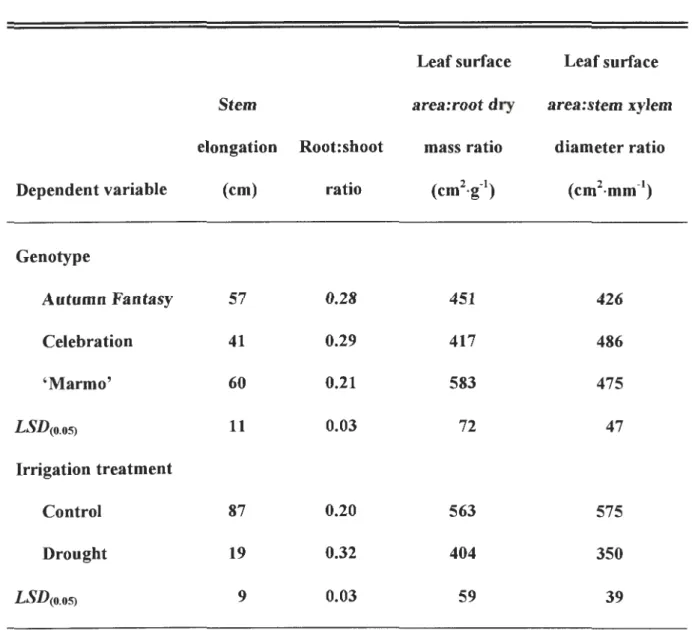
reduced similarly by drought for all cultivars, while Celebration exhibited the least stem
elongation. 'Marmo' treated with drought had the lowest root:shoot ratio and the
of leaf area:stem xylem diameter. Specific leaf mass of drought-stressed Autumn Fantasy was 1.89 mg·cm-2 greater than that of corresponding controls, whereas specific masses of Celebration and 'Marmo' leaves were not affected by drought. Leaf
thickness was similar among cultivars, but leaves of droughted plants were 9.6 µm thicker than leaves of controls. This initial characterization of responses to drought illustrates variation among Freeman maples and suggests that breeding and selection programs might produce superior genotypes for water-deficient sites in the landscape.
Urban trees are exposed to both excess and deficit soil moisture, but drought generally is considered the more serious threat (Clark and Kjelgren, 1990; Whitlow and Bassuk, 1987). Urban surfaces and compacted soils diminish infiltration of
precipitation into tree root zones, and turf and other vegetation compete with trees for available water. Graves and Dana (1987) showed that urban soil temperatures were higher than soils of natural areas, and this higher temperature may promote faster evaporation of soil water. Because water deficits are prevalent in many landscapes, more information is needed about the resistance to water deficits of tree taxa with potential for use in urban areas.
Freeman maples (Acer xfreemanii E. Murray) are hybrids of red maples (Acer rubrum L.) and silver maples (Acer saccharinum L. ), two species commonly found in
urban areas. Freeman (1941) made the first controlled crosses of red and silver maples in 1933. More recently, numerous cultivars presumed to be the result of natural hybridizations of red and silver maple have been marketed as Freeman maples.
Drought resistance among red maples has been the topic of previous research in
both greenhouse (Abrams and Kubiske, 1990; Nash and Graves, 1993; Townsend and
Roberts, 1973) and field studies (Abrams, 1988; Briggs et al., 1986). We are not aware
of studies that describe drought resistance in silver maples or Freeman maples, yet these
species are considered adapted to stressful sites where other species may perish (Dirr,
1990). Santamour (1993) has questioned whether silver maple is more stress resistant
than red maple and cautions we should not assume Freeman maples possess a greater
degree of stress resistance because of their lineage. There are few reports of
experiments that involve Freeman maples subjected to stress. Wilkins et al. (1995)
concluded 'Autumn Flame' and 'Schlesinger' red maple and 'Jeffersred' Freeman
maple were more resistant to high root-zone temperature than 'Franksred' red maple
and 'Indian Summer' Freeman maple. Zhang et al. (1997) found stem cuttings of
'Autumn Flame' red maple were more heat resistant than cuttings of 'Indian Summer'
Freeman maple.
For many taxa, drought stress can change stomatal resistance (Havis, 1980;
Hennessey et al., 1985), alter osmotic and leaf water potential (Abrams and Kubiske,
1990; Ranney et al., 1991), decrease leaf surface area (Borghetti et al., 1989;
Hennessey et al., 1985), alter dry matter partitioning (Graves and Wilkins, 1991; Joly
et al., 1989), and increase specific leaf mass (Joly et al., 1989). These responses
represent ways that tissues can resist low water potentials, and they have been used to
assess drought resistance. The objective of our research was to measure the growth and
Materials and Methods
HANDLING OF STOCK PLANTS. Stock plants of 'D. T.R. 102' (Autumn Fantasy®),
'Celzam' (Celebration®), and 'Marmo' Freeman maples were potted between 19 Mar.
and 10 Apr. 1996 and grown in a greenhouse with natural photoperiod at Ames, Iowa
(42 °N latitude). Tap water with Nat 10.8 mol·m-3 from Peters Excel all-purpose
21N-2.2P-16.6K fertilizer (Scotts, Marietta, Ga.) was applied weekly to container capacity
and had a pH of 6.0 to 6.6. All subsequent references to fertilization are at this rate and
from this source.
PRODUCTION AND MAINTENANCE OF PROPAGULES. Plants were propagated by
taking 5-cm-long, single-node stem cuttings from actively growing stock plants on 20
May, 24 July, and 8 Aug. 1996. Epidermis on the basal 1 cm of the stem of each cutting
was removed with a razor blade, and the cutting was dipped in Hormodin #3 rooting
powder (MSD AGVET, Merck & Co., Rahway, N.J.). Cuttings were rooted in coarse
perlite by using subirrigation (Zhang and Graves, 1995), grown under natural
photoperiod, irrigated twice weekly with tap water, and fertilized to container capacity
weekly. Greenhouse environmental conditions were monitored 5 d per week between
1000 and 1300 HR CST with a steady-state porometer (Ll-1600; LI-COR, Lincoln,
Neb.). Average midday air temperature during rooting ranged from 19.0 to 25.9 °C,
average relative humidity (RH) was 32% to 79%, and average photosynthetic photon
flux (PPF) was 26 to 668 µmol·s-1·m-2• After 4 weeks, cuttings were potted in round,
plastic pots (15.2-cm bottom diameter, 20.0-cm top diameter, 15.7-cm height) in 2,250
cm3 of 3 coarse perlite: 1 medium vermiculite (by volume). Potted cuttings were placed
in a greenhouse under high intensity discharge lamps with a 16-h photoperiod and