https://doi.org/10.5194/bg-15-6649-2018 © Author(s) 2018. This work is distributed under the Creative Commons Attribution 4.0 License.
Effect of elevated
p
CO
2
on trace gas production during
an ocean acidification mesocosm experiment
Sheng-Hui Zhang1,3, Juan Yu1,2, Qiong-Yao Ding1, Gui-Peng Yang1,2, Kun-Shan Gao4, Hong-Hai Zhang1,2, and Da-Wei Pan3
1Key Laboratory of Marine Chemistry Theory and Technology, Ministry of Education, Ocean University of China, Qingdao 266100, China
2Laboratory for Marine Ecology and Environmental Science, Qingdao National Laboratory for Marine Science and Technology, Qingdao 266237, China
3Key Laboratory of Coastal Environmental Processes and Ecological Remediation, Yantai Institute of Coastal Zone Research (YIC), Chinese Academy of Sciences (CAS); Shandong Provincial Key Laboratory of Coastal Environmental Processes, YICCAS, Yantai Shandong 264003, China
4State Key Laboratory of Marine Environmental Science, Xiamen University, Xiamen, 361102, China
Correspondence:Gui-Peng Yang ([email protected]) Received: 27 March 2018 – Discussion started: 16 May 2018
Revised: 4 October 2018 – Accepted: 20 October 2018 – Published: 9 November 2018
Abstract. A mesocosm experiment was conducted in
Wuyuan Bay (Xiamen), China, to investigate the effects of elevated pCO2 on the phytoplankton species Phaeo-dactylum tricornutum(P. tricornutum),Thalassiosira weiss-flogii(T. weissflogii) andEmiliania huxleyi(E. huxleyi) and their production ability of dimethylsulfide (DMS), dimethyl-sulfoniopropionate (DMSP), as well as four halocarbon compounds, bromodichloromethane (CHBrCl2), methyl bro-mide (CH3Br), dibromomethane (CH2Br2) and iodomethane (CH3I). Over a period of 5 weeks,P. tricornuntum outcom-peted T. weissflogii and E. huxleyi, comprising more than 99 % of the final biomass. During the logarithmic growth phase (phase I), mean DMS concentration in high pCO2 mesocosms (1000 µatm) was 28 % lower than that in low
pCO2 mesocosms (400 µatm). ElevatedpCO2 led to a de-lay in DMSP-consuming bacteria concentrations attached to T. weissflogii andP. tricornutumand finally resulted in the delay of DMS concentration in the high pCO2 treatment. Unlike DMS, the elevated pCO2did not affect DMSP pro-duction ability ofT. weissflogiiorP. tricornuntum through-out the 5-week culture. A positive relationship was detected between CH3I and T. weissflogii and P. tricornuntum dur-ing the experiment, and there was a 40 % reduction in mean CH3I concentration in the highpCO2mesocosms. CHBrCl2, CH3Br, and CH2Br2concentrations did not increase with
el-evated chlorophylla (Chla)concentrations compared with DMS(P) and CH3I, and there were no major peaks both in the highpCO2or lowpCO2mesocosms. In addition, no effect of elevatedpCO2was identified for any of the three bromo-carbons.
1 Introduction
simultane-ously have an impact on some volatile organic compounds produced by marine phytoplankton (Liss et al., 2014; Liu et al., 2017), including the climatically important trace gas dimethylsulfide (DMS) and a number of volatile halocarbon compounds.
DMS is the most important volatile sulfur compound pro-duced from dimethylsulfoniopropionate (DMSP), which is ubiquitous in marine environments, mainly synthesized by marine microalgae (Stefels et al., 2007), a few angiosperms, some corals (Raina et al., 2016), and several heterotrophic bacteria (Curson et al., 2017) through complex biological in-teractions in marine ecosystems. Although it remains con-troversial, DMS and its by-products, such as methanesul-fonic acid and non-sea-salt sulfate, are suspected of having a prominent part in climate feedback (Charlson et al., 1987; Quinn and Bates, 2011). The conversion of DMSP to DMS is facilitated by several enzymes, including DMSP lyase and acyl CoA transferase (Kirkwood et al., 2010; Todd et al., 2007); these enzymes are mainly found in phytoplankton, macroalgae, symbiodinium, bacteria and fungi (de Souza and Yoch, 1995; Stefels and Dijkhuizen, 1996; Steinke and Kirst, 1996; Chla and Yoch, 1998; Yost and Mitchelmore, 2009). Several studies have shown a negative impact of decreasing pH on DMS-production capability (Hopkins et al., 2010; Av-goustidi et al., 2012; Archer et al., 2013; Webb et al., 2016), while others have found either no effect or a positive ef-fect (Vogt et al., 2008; Hopkins and Archer, 2014). Several assumptions have been presented to explain these contrast-ing results and attributed the pH-induced variation in DMS-production capability to altered physiology of the algae cells or of bacterial DMSP degradation (Vogt et al., 2008; Hop-kins et al., 2010, Avgoustidi et al., 2012; Archer et al., 2013; Hopkins and Archer, 2014; Webb et al., 2015).
Halocarbons also play a significant role in the global cli-mate because they are linked to tropospheric and strato-spheric ozone depletion and a synergistic effect of chlorine and bromine species has been reported, accounting for ap-proximately 20 % of the polar stratospheric ozone deple-tion (Roy et al., 2011). In addideple-tion, iodocarbons can re-lease atomic iodine quickly through photolysis in the at-mospheric boundary layer and iodine atoms are very effi-cient in the catalytic removal of O3, which governs the life-time of many climate-relevant gases, including methane and DMS (Jenkins et al., 1991). Compared with DMS, limited attention was received about the effect of ocean acidifica-tion on halocarbon concentraacidifica-tions. Hopkins et al. (2010) and Webb et al. (2015) measured lower concentrations of sev-eral iodocarbons, while bromocarbons were unaffected by elevatedpCO2in two acidification experiments. In addition, another mesocosm study did not elicit significant differences from any halocarbon compounds at up to 1400 µatmpCO2 (Hopkins et al., 2013).
Taken together, the data indicate that the response of DMS and halocarbon release to elevated pCO2 is complex and controversial. DMS and halocarbons play a significant role in
the global climate and will perhaps act to a greater extent in the future. An intermediate step between laboratory and nat-ural community field experiments was designed in this study to understand the response of the release of DMS and halo-carbon to ocean acidification in Chinese coastal seas using isolates of non-axenic phytoplankton added to filtered nat-ural water. We hypothesized that the response of DMS and halocarbon release to elevatedpCO2in natural seawater can be better presented after minimizing the shifting composition of the natural phytoplankton and microbial communities.
2 Experimental method
2.1 Experimental setup
2.2 Algal strains
Before being introduced into the mesocosms, the three phy-toplankton speciesPhaeodactylum tricornutum(P. tricornu-tum),Thalassiosira weissflogii(T. weissflogii) andEmiliania huxleyi(E. huxleyi) were cultured in autoclaved, pre-filtered seawater from Wuyuan Bay at 16◦C (similar to the in situ
temperature of Wuyuan Bay) without any addition of nutri-ents. Cultures were continuously aerated with filtered am-bient air containing 400 µatm of CO2 within plant cham-bers (HP1000G-D, Wuhan Ruihua Instrument & Equipment, China) at a constant bubbling rate of 300 mL min−1. The cul-ture medium was renewed every 24 h to maintain the cells of each phytoplankton species in exponential growth. When the experiment began, these three phytoplankton species were inoculated into the mesocosm bags, with an initial di-atom/coccolithophorid cell ratio of 1:1. The initial concen-trations ofP. tricornuntum,T. weissflogii, andE. huxleyi in-oculated into the mesocosm were 10, 10, and 20 cells mL−1, respectively.P. tricornuntumandT. weissflogiiwere obtained from the Center for Collections of Marine Bacteria and Phy-toplankton of the State Key Laboratory of Marine Environ-mental Science (Xiamen University). P. tricornuntum was originally isolated from the South China Sea in 2004 andT. weissflogiiwas isolated from Daya Bay in the coastal South China Sea. E. huxleyiwas originally isolated in 1992 from the field station of the University of Bergen (Raunefjorden; 60◦180N, 05◦150E).
2.3 Sampling for DMS(P) and halocarbons
DMS(P) and halocarbon samples were taken from the above-mentioned mesocosm bags at 09:00; then all collected sam-ples were transported into a dark cool box back to the lab-oratory onshore for analysis within 1 h. For the DMS anal-ysis, a 2 mL sample was gently filtered through a 25 mm GF/F (glass fiber) filter and transferred to a purge and trap system linked to a Shimadzu GC-2014 gas chromatograph (Tokyo, Japan) equipped with a glass column packed with 10 % DEGS on Chromosorb W-AW-DMCS (3 m×3 mm) and a flame photometric detector (Zhang et al., 2014). For total DMSP analysis, a 10 mL water sample was fixed using 50 µL of 50 % H2SO4and sealed (Kiene and Slezak, 2006). After>1-day preservation, DMSP samples were hydrolyzed for 24 h with a pellet of KOH (final pH>13) to fully convert DMSP to DMS. Then, 2 mL of the hydrolyzed sample was carefully transferred to the purge and trap system mentioned above for extraction of DMS. For halocarbons, a 100 mL sample was purged at 40◦C with pure nitrogen at a flow rate of 100 mL min−1 for 12 min using another purge and trap system coupled to an Agilent 6890 gas chromatograph (Ag-ilent Technologies, Palo Alto, CA, USA) equipped with an electron capture detector (ECD) as well as a 60 m DB-624 capillary column (0.53 mm ID; film thickness, 3 µm) (Yang
et al., 2010). The analytical precision for duplicate measure-ments of DMS(P) and halocarbons was>10 %.
2.4 Measurements of chlorophylla
Chlorophylla(Chla) was measured in water samples (200– 1000 mL) collected every 2 days at 09:00 by filtering onto Whatman GF/F filters (25 mm). The filters were placed in 5 mL 100 % methanol overnight at 4◦C and centrifuged at 5000 g for 10 min. The absorbance of the supernatant (2.5 mL) was measured from 250 to 800 nm using a scanning spectrophotometer (DU 800, Beckman Coulter Inc., Brea, CA, USA). Chlaconcentration was calculated according to the equation reported by Porra (2002).
2.5 Enumeration of DMSP-consuming bacteria
The number of DMSP-consuming bacteria in the mesocosms was estimated using the most probable number methodol-ogy. The medium consisted of a mixture (1:1v/v) of ster-ile artificial seawater and a mineral medium (Visscher et al., 1991), 3 mL of which was dispensed into 6 mL test tubes, which were closed by an over-sized cap, allowing gas ex-change. Triplicate dilution series were set up. All test tubes contained 1 mmol L−1 DMSP as the sole organic carbon source and were kept at 30◦C in the dark. After 2 weeks, the presence/absence of bacteria in the tubes was verified by DAPI staining (Porter and Feig, 1980). Three tubes contain-ing 3 mL ASW without substrate were used as controls.
2.6 Statistical analysis
One-way analysis of variance (ANOVA), Tukey’s test, and the two-sample t test were carried out to demonstrate the differences between treatments. Ap value<0.05 was con-sidered significant. Relationships between DMS(P), halocar-bons and a range of other parameters were detected using Pearson’s correlation analysis via SPSS 22.0 for Windows (SPSS Inc., Chicago, IL, USA).
3 Results and discussion
3.1 Temporal changes in pH, Chla,P. tricornuntum,T. weissflogii, andE. huxleyiduring the experiment
During the experiment, the seawater in each mesocosm was well mixed, and the temperature and salinity remained sta-ble, with means of 16◦C and 29, respectively, in all
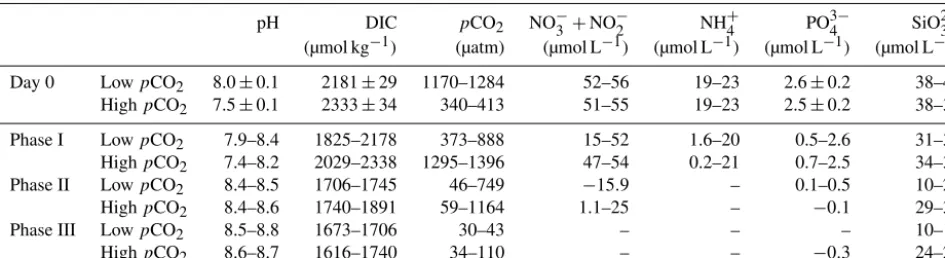
Table 1.Dissolved inorganic carbon (DIC), pH,pCO2and nutrient concentrations in the mesocosm experiments. “–” means that the values were below the detection limit.
pH DIC pCO2 NO−3 +NO
−
2 NH
+
4 PO
3−
4 SiO
2−
3 (µmol kg−1) (µatm) (µmol L−1) (µmol L−1) (µmol L−1) (µmol L−1) Day 0 LowpCO2 8.0±0.1 2181±29 1170–1284 52–56 19–23 2.6±0.2 38–40 HighpCO2 7.5±0.1 2333±34 340–413 51–55 19–23 2.5±0.2 38–39
Phase I LowpCO2 7.9–8.4 1825–2178 373–888 15–52 1.6–20 0.5–2.6 31–38 HighpCO2 7.4–8.2 2029–2338 1295–1396 47–54 0.2–21 0.7–2.5 34–39 Phase II LowpCO2 8.4–8.5 1706–1745 46–749 −15.9 – 0.1–0.5 10–24 HighpCO2 8.4–8.6 1740–1891 59–1164 1.1–25 – −0.1 29–30
Phase III LowpCO2 8.5–8.8 1673–1706 30–43 – – – 10–16
HighpCO2 8.6–8.7 1616–1740 34–110 – – −0.3 24–25
0 5 10 15 20 25 30 35
7.2 7.6 8.0 8.4 8.8 9.2
pH
Incubation days
[image:4.612.63.536.96.225.2]LC HC
Figure 1. Temporal development of pH in the high pCO2 (1000 µatm, solid squares) and lowpCO2(400 µatm, white squares) mesocosms. Data are mean±SD, n=3 (triplicate independent mesocosm bags) (Origin 8.0).
plateau phase (phase II, days 13–23, bloom period), and (iii) a secondary plateau phase (phase III, days 23–33) at-tained after a decline in biomass from a maximum in phase II. The initial chemical parameters of the mesocosm exper-iment are shown in Table 1. The initial mean dissolved ni-trate (including NO−3 and NO−2), NH+4, PO34− and silicate (SiO23−) concentrations were 54, 20, 2.6 and 41 µmol L−1, respectively, for the low pCO2 treatment and 52, 21, 2.4 and 38 µmol L−1, respectively, for the highpCO2treatment. The nutrient concentrations (NO−3, NO−2, NH+4 and phos-phate) during phase I were consumed rapidly and their con-centrations were below or close to the detection limit during phase II (Table 1). SiO23− was detectable during the entire experimental period, and was unlikely to be a limiting fac-tor for phytoplankton growth during the experiment. In ad-dition, although dissolved inorganic nitrogen (NH+4, NO−3, and NO−2) and phosphate were depleted, Chl a concentra-tion in both treatments (biomass dominated byP. tricornun-tum) remained constant over days 12–22, and then declined over subsequent days. T. weissflogii was found throughout the entire period in each bag, but the maximum concentration
was 8120 cells mL−1, which was far less than the concen-tration ofP. tricornutumwith a maximum density of about 1.5 million cells mL−1(Liu et al., 2017). It is possible thatP. tricornutumoutcompetedT. weissflogiibecause of its higher surface-to-volume ratio and/or species-specific physiology, which would enhance the efficiency of nutrient uptake and related metabolism (Alessandrade et al., 2007).E. huxleyi was only found in phase I and its maximal concentration reached 310 cells mL−1 according to the results of Liu et al. (2017). Previous studies have reported that the maximum specific growth rate ofT. weissflogiiandP. tricornutum is about 1.2 d−1(Li et al., 2014; Sugie and Yoshimura, 2016), while that ofE. huxleyiis about 0.8 d−1(Xing et al., 2015). This might be the main reason why diatoms overwhelmingly outcompeted the coccolithophores during this experiment.
3.2 Impact of elevatedpCO2on DMS and DMSP production
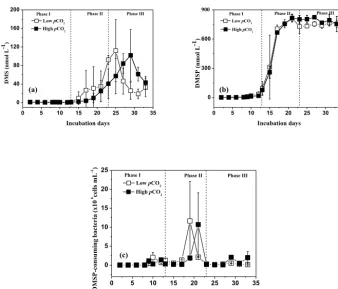
DMSP concentrations in the highpCO2and lowpCO2 treat-ments increased significantly along with the increase in Chla
concentrations and algal cells, and remained relatively con-stant over the following days. A significant positive relation-ship was observed between DMSP and phytoplankton in the experiment (r=0.961, p <0.01 for P. tricornuntum, r=
0.617,p <0.01 forT. weissflogiiin the lowpCO2treatment, Table 2;r=0.954,p <0.01 forP. tricornuntum,r=0.743,
[image:4.612.60.263.105.375.2]be-Table 2.Correlation between dimethylsulfide (DMS), dimethylsulfoniopropionate (DMSP), chlorophylla(Chla), bromodichloromethane (CHBrCl2), methyl bromide (CH3Br), dibromomethane (CH2Br2), iodomethane (CH3I), DMSP-consuming bacteria,Thalassiosira
weiss-flogii(T. weissflogii) andPhaeodactylum tricornutum(P. tricornutum) concentrations in the lowpCO2treatments.
DMS DMSP Chla CHBrCl2 CH3Br CH2Br2 CH3I DMSP-consuming T. weissflogii P. tricornutum
bacteria
DMS 1
DMSP 0.701∗∗ 1
Chla 0.597∗∗ 0.792∗∗ 1
CHBrCl2 0.526 0.280 0.559 1
CH3Br −0.413 −0.230 0.196 0.313 1
CH2Br2 0.310 0.180 0.001 −0.136 −0.308 1
CH3I 0.694∗∗ 0.654∗∗ 0.717∗∗ 0.596∗ −0.151 0.129 1
DMSP-consuming bacteria 0.643∗∗ 0.520∗ 0.522∗ 0.394 −0.268 −0.038 0.762∗∗ 1
T. weissflogii 0.410 0.617∗∗ 0.899∗∗ 0.301 0.322 0.028 0.680∗∗ 0.399 1
P. tricornutum 0.560∗ 0.961∗∗ 0.821∗∗ 0.528 −0.032 0.162 0.588∗∗ 0.334 0.685∗∗ 1
[image:5.612.55.540.107.229.2]∗Correlation is significant at the 0.05 level (two-tailed).∗∗Correlation is significant at the 0.01 level (two-tailed).
Table 3.Correlation between dimethylsulfide (DMS), dimethylsulfoniopropionate (DMSP), chlorophyll a (Chla), bromodichloromethane (CHBrCl2), methyl bromide (CH3Br), dibromomethane (CH2Br2), iodomethane (CH3I), DMSP-consuming bacteria,Thalassiosira
weiss-flogii(T. weissflogii) andPhaeodactylum tricornutum(P. tricornutum) concentrations in the highpCO2treatments.
DMS DMSP Chla CHBrCl2 CH3Br CH2Br2 CH3I DMSP-consuming T. weissflogii P. tricornutum
bacteria
DMS 1
DMSP 0.752∗∗ 1
Chla 0.318∗ 0.738∗∗ 1
CHBrCl2 0.324 0.094 0.326 1
CH3Br −0.410 −0.349 0.065 0.076 1
CH2Br2 0.540∗ 0.352 0.142 0.233 −0.377 1
CH3I 0.694∗∗ 0.816∗∗ 0.741∗∗ 0.690∗ −0.407 0.316 1
DMSP-consuming bacteria 0.544∗ 0.522 0.549∗ 0.532 −0.311 0.368 0.851∗ 1
T. weissflogii 0.355 0.743∗∗ 0.930∗∗ 0.304 0.076 0.233 0.690∗∗ 0.567 1
P. tricornutum 0.635∗∗ 0.954∗∗ 0.803∗∗ 0.143 −0.257 0.267 0.834∗∗ 0.559 0.820∗∗ 1
∗Correlation is significant at the 0.05 level (two-tailed).∗∗Correlation is significant at the 0.01 level (two-tailed).
tween DMS andT. weissflogii(Tables 2 and 3) during the ex-periment. Similar to DMS, DMSP-consuming bacteria also maintained a low level during phase I (mean of 0.57×10⁶ and 0.40×10⁶cells mL−1in the lowpCO2and highpCO2 treatments, respectively). DMSP-consuming bacterial con-centrations peaked on days 19 (11.65×10⁶cells mL−1)and 21 (10.70×10⁶cells mL−1) in the low pCO
2 and high pCO2treatments, respectively.
In this study, no difference in mean DMSP concentra-tions was observed between the two treatments, indicating that elevated pCO2 had no significant influence on DMSP production in P. tricornuntum andT. weissflogii. However, significant reductions in mean DMS concentration (28 %) and DMSP-consuming bacteria (29 %) were detected dur-ing phase I in the high pCO2 treatment compared with those in the low pCO2 treatment, indicating that elevated pCO2 inhibited DMSP-consuming bacteria and DMS pro-duction during the logarithmic growth phase. In addition, the peak DMS concentration in the high pCO2 treatment was delayed 4 days relative to that in the low pCO2 treat-ment during phase II (Fig. 2a). This result has been observed in previous mesocosm experiments and it was attributed to
small-scale shifts in community composition and succession (Vogt et al., 2008; Webb et al., 2016). However, this phe-nomenon during the present study can be explained in an-other straightforward way. Previous studies have shown that marine bacteria play a key role in DMS production, and that the efficiency of bacteria converting DMSP to DMS may vary from 2 to 100 % depending on the nutrient sta-tus of the bacteria and the quantity of dissolved organic matter (Simó et al., 2002, 2009; Kiene et al., 1999, 2000). In addition, a significant positive relationship was observed between DMS and DMSP-consuming bacteria (r=0.643,
[image:5.612.52.542.300.416.2]Figure 2.Temporal development in dimethylsulfide (DMS), dimethylsulfoniopropionate (DMSP) and DMSP-consuming bacteria concen-trations in the highpCO2(1000 µatm, black squares) and lowpCO2(400 µatm, white squares) mesocosms. Data are mean±SD,n=3 (triplicate independent mesocosm bags).
highpCO2 mesocosm compared to those in the lowpCO2 mesocosm (Fig. 2c). Taken together, we inferred that the el-evatedpCO2first delayed growth of DMSP-consuming bac-teria; then the delayed DMSP-consuming bacteria postponed the DMSP degradation process, and eventually delayed the DMS concentration in the highpCO2treatment. In addition, considering that algae and bacteria in natural seawater were removed through a filtering process before the experiment (Huang et al., 2018), we further concluded that the elevated
pCO2 controlled DMS concentrations mainly by affecting DMSP-consuming bacteria attached to T. weissflogiiandP. tricornuntum.
3.3 Impact of elevatedpCO2on halocarbon compounds
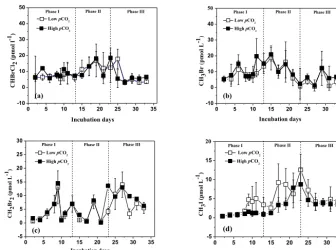
The temporal development in CHBrCl2, CH3Br, and CH2Br2 concentrations is shown in Fig. 3a, b, and c, respectively. The temporal changes in their concentrations were substantially different from those in DMS, DMSP,P. tricornuntumandT. weissflogii. The mean concentrations of CHBrCl2, CH3Br, and CH2Br2for the entire experiment were 8.58, 7.85, and 5.13 pmol L−1 in the low pCO2 treatment and 8.81, 9.73, and 6.27 pmol L−1in the highpCO2treatment. The concen-trations of CHBrCl2, CH3Br, and CH2Br2 did not increase
with the Chla concentration compared with those of DMS and DMSP, and no major peaks were detected in the meso-cosms. In addition, no effect of elevatedpCO2 was iden-tified for any of the three bromocarbons, which compared well with previous mesocosm findings (Hopkins et al., 2010, 2013; Webb et al., 2016). No clear correlation was observed between the three bromocarbons and any of the measured al-gal groups (Tables 2 and 3), indicating thatP. tricornuntum andT. weissflogiidid not primarily release these three bro-mocarbons during the mesocosm experiment. Previous stud-ies reported that large-sized cyanobacteria, such as Aphani-zomenon flos-aquae, could produce bromocarbons (Karlsson et al., 2008). Significant correlations between the abundance of cyanobacteria and several bromocarbons have been re-ported in the Arabian Sea (Roy et al., 2011). However, the filtration procedure led to the loss of cyanobacteria in the mesocosms and finally resulted in low bromocarbon concen-trations during the experiment, althoughP. tricornuntumand T. weissflogiiabundances were high.
Figure 3. Temporal development in bromodichloromethane (CHBrCl2), methyl bromide (CH3Br), dibromomethane (CH2Br2), and iodomethane (CH3I) concentrations in the highpCO2(1000 µatm, black squares) and lowpCO2(400 µatm, white squares) mesocosms. Data are mean±SD,n=3 (triplicate independent mesocosm bags).
The maximum CH3I concentrations in the high pCO2and low pCO2 treatments were both observed on day 23. The range of CH3I concentrations during this experiment was similar to that measured in the mesocosm experiment (<
1–10 pmol L−1) in Kongsfjorden conducted by Hopkins et al. (2013). In addition, the mean CH3I concentration in the lowpCO2treatment was similar to that measured in the East China Sea, with an average of 5.34 pmol L−1in winter and 5.74 pmol L−1in summer (Yuan et al., 2016). Meanwhile, a positive relationship was detected between CH3I and Chla, P. tricornuntumandT. weissflogii(r=0.588,p <0.01 in the lowpCO2treatment;r=0.834,p <0.01 in the lowpCO2 treatment for P. tricornuntum; r=0.680, p <0.01 in the lowpCO2treatment;r=0.690,p <0.01 in the highpCO2 treatment forThalassiosira weissflogii;r=0.717,p <0.01 in the lowpCO2treatment;r=0.741,p <0.01 in the high pCO2 treatment for Chl a). This result agrees with previ-ous mesocosm (Hopkins et al., 2013) and laboratory experi-ments (Hughes et al., 2013; Manley and De La Cuesta, 1997) identifying diatoms as significant producers of CH3I. More-over, similar to DMS, the maximum CH3I concentration also occurred after the maxima ofP. tricornuntumandT. weiss-flogii, at about 4 days (Fig. 3d). This result was similar to the conclusions reported by Hopkins et al. (2010) and Win-genter et al. (2007) during two mesocosm experiments con-ducted in Norway. Their results confirmed that iodocarbon gases generally occur after the Chlamaxima. Furthermore, the mean CH3I concentration measured in the high pCO2
treatment was significantly lower (40 %) than that measured in the lowpCO2treatment during the mesocosm experiment. This result is in accordance with Hopkins et al. (2010) and Webb et al. (2015), who also reported that elevatedpCO2 leads to a reduction in iodocarbon concentrations, but is in contrast to the findings of Hopkins et al. (2013) and Webb et al. (2016), who showed that elevatedpCO2does not sig-nificantly affect the iodocarbon concentrations in the meso-cosms. Considering that the phytoplankton species did not show significant differences in the highpCO2and lowpCO2 treatments during the experiment, this reduction in the high
4 Conclusions
In this study, the effects of increased levels of pCO2 on marine DMS(P) and halocarbon release were studied in a controlled mesocosm facility. During the logarithmic growth phase, the elevatedpCO2led to a reduction in mean DMSP-consuming bacteria (29 %) and DMS concentration (28 %) compared with those in the low pCO2 treatment. In ad-dition, a 4-day delay in DMS concentration was observed in the high pCO2 treatment due to the effect of elevated pCO2, and we attribute this delay in DMS concentration to the DMSP-consuming bacteria attached to P. tricornuntum and T. weissflogii. Due to the loss of main bromocarbon-producing species affected by the filtration procedure, three bromocarbon compounds measured in this study were not correlated withP. tricornuntumandT. weissflogii, and Chla. In addition, elevated pCO2 had no effect on any of the three bromocarbons. The temporal dynamics of CH3I, com-bined with strong correlations with P. tricornuntum andT. weissflogii, and Chla, indicate that P. tricornuntumandT. weissflogiiplay a critical role in controlling CH3I concentra-tions. In addition, the production of CH3I was sensitive to pCO2, with a significant increase in CH3I concentration at higher pCO2. However, without additional empirical mea-surements, it is unclear whether this decrease was caused by bacterial methyl transferase enzyme activity or by pho-tochemical degradation at higherpCO2.
Data availability. The data in this research can be accessed by
sending an e-mail to [email protected].
Author contributions. GPY and KSG designed the experiments.
SHZ, JY and QYD carried out the experiments and prepared the manuscript. HHZ and DWP revised the paper. SHZ and JY con-tributed equally to this work.
Competing interests. The authors declare that they have no conflict
of interest.
Acknowledgements. This study was financially supported by
the National Natural Science Foundation of China (grant nos. 41320104008, 41576073 and 41830534), the National Key Research and Development Program of China (grant no. 2016YFA0601300), and the AoShan Talents Program of Qingdao National Laboratory for Marine Science and Technology (no. 2015 ASTP). We are thankful to Minhan Dai for the nutrient data and to Bangqin Huang for the bacterial data.
Edited by: Tina Treude
Reviewed by: Bo Qu and one anonymous referee
References
Alessandrade, M., Agnès, M., Shi, J., Pan, K., and Chris, B.: Ge-netic and phenotypic characterization ofPhaeodactylum
tricor-nutum(Bacillariophyceae) accessions. J. Phycol., 43, 992–1009,
2007.
Amachi, S., Kamagata, Y., Kanagawa, T., and Muramatsu, Y.: Bac-teria mediate methylation of iodine in marine and terrestrial en-vironments, Appl. Environ. Microb., 67, 2718–2722, 2001. Archer, S. D., Kimmance, S. A., Stephens, J. A., Hopkins, F.
E., Bellerby, R. G. J., Schulz, K. G., Piontek, J., and En-gel, A.: Contrasting responses of DMS and DMSP to ocean acidification in Arctic waters, Biogeosciences, 10, 1893–1908, https://doi.org/10.5194/bg-10-1893-2013, 2013.
Avgoustidi, V., Nightingale, P. D., Joint, I., Steinke, M., Turner, S. M., Hopkins, F. E., and Liss, P. S.: Decreased marine dimethyl sulfide production under elevated CO2levels in mesocosm and in vitro studies, Environ. Chem., 9, 399–404, 2012.
Bacic, M. K. and Yoch, D. C.: In vivo characterization of dimethyl-sulfoniopropionatelyase in the fungusFusariumlateritium, Appl. Environ. Microbiol., 64, 106–111, 1998.
Boyd, P. W. and Doney, S. C.: Modelling regional responses by ma-rine pelagic ecosystems to global climate change, Geophys. Res. Lett., 29, 1–4, 2002.
Charlson, R. J., Lovelock, J. E., Andreae, M. O., and Wakeham, S. G.: Oceanic phytoplankton, atmospheric sulfur, cloud albedo and climate, Nature, 326, 655–661, 1987.
Curson, A. R., Liu, J., Martínez, A. B., Green, R., Chan, Y., Carrion, O. Williams, B. T., Zhang, S. H., Yang, G. P., Page, P. C. B., Zhang, X. H., and Todd, J. D.: Dimethylsulfonio-propionate biosynthesis in marine bacteria and identification of the key gene in this process, Nat. Microbiol., 2, 17009, https://doi.org/10.1038/nmicrobiol.2017.9, 2017.
Czerny, J., Schulz, K. G., Ludwig, A., and Riebesell, U.: Techni-cal Note: A simple method for air-sea gas exchange measure-ments in mesocosms and its application in carbon budgeting, Biogeosciences, 10, 1379–1390, https://doi.org/10.5194/bg-10-1379-2013, 2013.
de Souza, M. P. and Yoch, D. C.: Purification and characteriza-tion of dimethylsulfoniopropionatelyase from an Alcaligenes -like dimethyl sulfide-producing marine isolate, Appl. Environ. Microbiol., 61, 21–26, 1995.
Doney, S. C., Fabry, V. J., Feely, R. A., and Kleypas, J. A.: Ocean acidification: the other CO2problem, Annu. Rev. Mar. Sci., 1, 169–192, 2009.
Fenical, W.: Natural products chemistry in the marine environment, Science, 215, 923–928, 1982.
Gattuso, J. P., Gao, K., Lee, K., Rost, B., and Schulz, K. G.: Ap-proaches and tools to manipulate the carbonate chemistry, edited by: Riebesell, U., Fabry, V. J., Hansson, L., and Gattuso, J. P., in: Guide to Best Practices in Ocean Acidification Research and Data Reporting, Office for Official Publications of the European Communities, Luxembourg, 41–52, 2010.
an-thropogenic CO2 emissions scenarios, Science, 349, aac4722, doi:10.1126/science.aac4722, 2015.
Hopkins, F. E. and Archer, S. D.: Consistent increase in dimethyl sulfide (DMS) in response to high CO2in five shipboard bioas-says from contrasting NW European waters, Biogeosciences, 11, 4925–4940, https://doi.org/10.5194/bg-11-4925-2014, 2014. Hopkins, F. E., Kimmance, S. A., Stephens, J. A., Bellerby, R. G.
J., Brussaard, C. P. D., Czerny, J., Schulz, K. G., and Archer, S. D.: Response of halocarbons to ocean acidification in the Arctic, Biogeosciences, 10, 2331–2345, https://doi.org/10.5194/bg-10-2331-2013, 2013.
Hopkins, F. E., Turner, S. M., Nightingale, P. D., Steinke, M., and Liss, P. S.: Ocean acidification and marine biogenic trace gas pro-duction, P. Natl. Acad. Sci. USA, 107, 760–765, 2010.
Huang, Y. B., Liu, X., Edward, A. L., Chen, B. Z., Li Y., Xie, Y. Y., Wu, Y. P., Gao K. S., and Huang, B. Q.: Effects of increas-ing atmospheric CO2on the marine phytoplankton and bacterial metabolism during a bloom: A coastal mesocosm study, Sci. To-tal. Environ., 633, 618–629, 2018.
Hughes, C., Johnson, M., Utting, R., Turner, S., Malin, G., Clarke, A., and Liss, P. S.: Microbial control of bromocarbon concentra-tions in coastal waters of the western Antarctic Peninsula, Mar. Chem., 151, 35–46, 2013.
Jenkins, M. E., Cox, R. A., and Hayman, G. D.: Kinetics of the reaction of IO radicals with HO2at 298 K, Chem. Phys. Lett., 177, 272–278, 1991.
Karlsson, A., Auer, N., Schulz-Bull, D., and Abrahamsson, K.: Cyanobacterial blooms in the Baltic–A source of halocarbons, Mar. Chem., 110, 129–139, 2008.
Kiene, R. P., Linn, L. J., Gonzalez, J., Moran, M. A., and Bruton, J. A.: Dimethylsulfoniopropionate and methanethiol are important precursors of methionine and protein-sulfur in marine bacterio-plankton, Appl. Environ. Microbiol., 65, 4549–4558, 1999. Kiene, R. P. and Linn, L. J.: The fate of dissolved
dimethylsulfonio-propionate (DMSP) in seawater: tracer studies using35S-DMSP. Geochim, Cosmochim. Acta., 64, 2797–2810, 2000.
Kiene, R. P. and Slezak, D.: Low dissolved DMSP concentrations in seawater revealed by smallvolume gravity filtration and dialysis sampling, Limnol. Oceanogr. Methods, 4, 80–95, 2006. Kirkwood, M., Le Brun, N. E., Todd, J. D., and Johnston, A. W.
B.: The dddP gene of Roseovarius nubinhibens encodes a novel lyase that cleaves dimethylsulfoniopropionate into acrylate plus dimethyl sulfide, Microbiology, 156, 1900–1906, 2010. Li, Y. H., Xu, J. T., and Gao, K.: Light-modulated responses of
growth and photosynthetic performance to ocean acidification in the model diatom Phaeodactylum tricornutum, PLoS One, 9, e96173, https://doi.org/10.1371/journal.pone.0096173, 2014. Liss, P., Marandino, C. A., Dahl, E., Helmig, D., Hintsa, E. J.,
Hughes, C., Johnson, M., Moore, R. M., Plane, J. M. C., Quack, B., Singh, H. B., Stefels, J., von Glasow, R., and Williams, J.: Short-lived trace gases in the surface ocean and the atmo-sphere, in: Ocean-Atmosphere Interactions of Gases and Par-ticles, edited by: Liss, P. and Johnson, M., Springer, 55–112, https://doi.org/10.1007/978-3-642-25643-1, 2014.
Liu, N., Tong, S., Yi, X., Li, Y., Li, Z., Miao, H., Wang, T., Li, F., Yan, D., Huang, R., Wu, Y., Hutchins, D. A., Beardall, J., Dai, M., and Gao, K.: Carbon assimilation and losses during an ocean acidification mesocosm experiment, with special reference to algal blooms, Mar. Environ. Res., 129, 229–235, 2017.
Manley, S. L. and De La Cuesta, J. L.: Methyl iodide produc-tion from marine phytoplankton cultures, Limnol. Oceanogr., 42, 142–147, 1997.
Orr, J. C., Fabry, V. J., Aumont, O., Bopp, L., Doney, S. C., Feely, R. A., Gnanadesikan, A., Gruber, N., Ishida, A., Joos, F., Key, R. M., Lindsay, K., Maier-Reimer, E., Matear. R., Monfray, P., Mouchet, A., Najjar, R. G., Plattner, G. K., Rodgers, K. B., Sabine, C. L., Sarmiento, J. L., Schlitzer, R., Slater, R. D., Totterdell, I. J., Weirig, M. F., Yamanaka, Y., and Yool, A.: Anthropogenic ocean acidification over the twenty first century and its impact on cal-cifying organisms, Nature, 437, 681–686, 2005.
Porra, R. J.: The chequered history of the development and use of simultaneous equations for the accurate determination of chloro-phyllsaandb, Photosynth. Res., 73, 149–156, 2002.
Porter, K. G. and Feig, Y. S.: DAPI for identifying and counting aquatic microflora, Limnol. Oceanogr., 25, 946–948, 1980. Quinn, P. K. and Bates, T. S.: The case against climate regulation
via oceanic phytoplankton sulphur emissions, Nature, 480, 51– 56, 2011.
Raina, J. B., Tapiolas, D., Motti, C. A., Foret, S., Seemann, T., and Tebben, J.: Isolation of an antimicrobial compound produced by bacteria associated with reef-building corals, PeerJ, 4, e2275, https://doi.org/10.7717/peerj.2275, 2016.
Richter, U. and Wallace, D. W. R.: Production of methyl iodide in the tropical Atlantic Ocean, Geophys. Res. Lett., 31, L23S03, doi:10.1029/2004GL020779, 2004.
Riebesell, U., Czerny, J., von Bröckel, K., Boxhammer, T., Büden-bender, J., Deckelnick, M., Fischer, M., Hoffmann, D., Krug, S. A., Lentz, U., Ludwig, A., Muche, R., and Schulz, K. G.: Tech-nical Note: A mobile sea-going mesocosm system – new oppor-tunities for ocean change research, Biogeosciences, 10, 1835– 1847, https://doi.org/10.5194/bg-10-1835-2013, 2013.
Roy, R., Pratihary, A., Narvenkar, G., Mochemadkar, S., Gauns, M., and Naqvi, S. W. A.: The relationship between volatile halo-carbons and phytoplankton pigments during aTrichodesmium
bloom in the coastal eastern Arabian Sea, Estuar. Coast. Shelf Sci., 95, 110–118, 2011.
Simó, R., Archer, S. D., Pedros-Alio, C., Gilpin, L., and Stelfox-Widdicombe, C. E.: Coupled dynamics of dimethylsulfoniopro-pionate and dimethylsulfide cycling and the microbial food web in surface waters of the North Atlantic, Limnol. Oceanogr., 47, 53–61, 2002.
Simó, R., Vila-Costa, M., Alonso-Sáez, L., Cardelús, C., Guadayol, Ó., Vázquez-Dominguez, E., and Gasol, J. M.: Annual DMSP contribution to S and C fluxes through phytoplankton and bacte-rioplankton in a NW Mediterranean coastal site, Aquat. Microb. Ecol., 57, 43–55, 2009.
Stefels, J. and Dijkhuizen, L.: Characteristics of DMSP-lyase in
Phaeocystissp. (Prymnesiophyceae), Mar. Ecol. Prog. Ser., 131,
307–313, 1996.
Stefels, J., Steink, M., Turner, S., Malin, G., and Belviso, S.: En-vironmental constraints on the production of the climatically ac-tive gas dimethylsulphide (DMS) and implications for ecosystem modelling, Biogeochemistry, 83, 245–275, 2007.
Sugie, K., and Yoshimura, T.: Effects of high CO2levels on the eco-physiology of the diatomThalassiosira weissflogiidiffer depend-ing on the iron nutritional status, ICES J. Mar. Sci., 73, 680–692, 2016.
Todd, J. D., Rogers, R., Li, Y. G., Wexler, M., Bond, P. L., Sun, L., Cruson, A. R. J., Malin, G., Steinke, M., and Johnston, A. W. B.: Structural and regulatory genes required to make the gas dimethyl sulfide in bacteria, Science, 315, 666–669, 2007. Visscher, P. T., Quist, P., and van Gemerden, H.: Methylated
sul-fur compounds in microbial mats: in situ concentrations and metabolism by a colorless sulfur bacterium, Appl. Environ. Mi-crobiol., 57, 1758–1763, 1991.
Vogt, M., Steinke, M., Turner, S. M., Paulino, A., Meyerhöfer, M., Riebesell, U., LeQuéré, C., and Liss, P. S.: Dynamics of dimethylsulphoniopropionate and dimethylsulphide under differ-ent CO2concentrations during a mesocosm experiment, Biogeo-sciences, 5, 407–419, 2008.
Vogt, M., Steinke, M., Turner, S., Paulino, A., Meyerhöfer, M., Riebesell, U., Le Quéré, C., and Liss, P.: Dynamics of dimethyl-sulphoniopropionate and dimethylsulphide under different CO2 concentrations during a mesocosm experiment, Biogeosciences, 5, 407–419, https://doi.org/10.5194/bg-5-407-2008, 2008. Webb, A. L., Leedham-Elvidge, E., Hughes, C., Hopkins, F. E.,
Ma-lin, G., Bach, L. T., Schulz, K., Crawfurd, K., Brussaard, C. P. D., Stuhr, A., Riebesell, U., and Liss, P. S.: Effect of ocean acidifica-tion and elevatedfCO2on trace gas production by a Baltic Sea summer phytoplankton community, Biogeosciences, 13, 4595– 4613, https://doi.org/10.5194/bg-13-4595-2016, 2016.
Webb, A. L., Malin, G., Hopkins, F. E., Ho, K. L., Riebesell, U., Schulz, K., Larsen, A., and Liss, P.: Ocean acidification has different effects on the production of dimethylsulphide and dimethylsulphoniopropionate measured in cultures of Emiliania huxleyi RCC1229 and mesocosm study: a comparison of labora-tory monocultures and community interactions, Environ. Chem., 13, EN14268, https://doi.org/10.1071/EN14268, 2015.
Wingenter, O. W., Haase, K. B., Zeigler, M., Blake, D. R., Rowland, F. S., Sive, B. C., Paulino, A., Thyrhaug, R., Larsen, A., Schulz, K., Meyerhofer, M., and Riebesell, U.: Unexpected conse-quences of increasing CO2and ocean acidity on marine produc-tion of DMS and CH2ClI: Potential climate impacts, Geophys. Res. Lett., 34, L05710, https://doi.org/10.1029/2006GL028139, 2007.
Xing, T., Gao, K., and Beardall, J.: Response of growth and photo-synthesis ofEmiliania huxleyito visible and UV irradiances un-der different light regimes, Photochem. Photobiol., 91, 343–349, 2015.
Yang, G. P., Lu, X. L., Song, G. S., and Wang, X. M.: Purge-and-trap gas chromatography method for analysis of methyl chloride and methyl bromide in seawater, Chin. J. Anal. Chem., 38, 719– 722, 2010.
Yost, D. M. and Mitchelmore, C. L.: Dimethylsulfoniopropionate (DMSP) lyase activity in different strains of the symbiotic alga Symbiodinium microadriaticum, Mar. Ecol. Prog. Ser., 386, 61– 70, 2009.
Yuan, D., Yang, G. P., and He, Z.: Spatio-temporal distributions of chlorofluorocarbons and methyl iodide in the Changjiang (Yangtze River) estuary and its adjacent marine area, Mar. Pollut. Bull., 103, 247–259, 2016.