Ames Laboratory Publications
Ames Laboratory
10-2001
Theoretical study of spin-orbit coupling constants
for O+2 (A 2Π3/2,1/2u, v+=0–17 and a 4Π5/
2,3/2,1/2,−1/2u, v+=0–25)
Dmitri G. Fedorov
Iowa State University
Mark S. Gordon
Iowa State University, [email protected]
Y. Song
Iowa State University
C. Y. Ng
Iowa State University
Follow this and additional works at:
http://lib.dr.iastate.edu/ameslab_pubs
Part of the
Chemistry Commons
The complete bibliographic information for this item can be found at
http://lib.dr.iastate.edu/
ameslab_pubs/323
. For information on how to cite this item, please visit
http://lib.dr.iastate.edu/
howtocite.html
.
Theoretical study of spin-orbit coupling constants for O+2 (A 2Π3/2,1/
2u, v+=0–17 and a 4Π5/2,3/2,1/2,−1/2u, v+=0–25)
Abstract
The spin-orbit coupling constants (Av+) for O+2(A 2Πu,v+=0–17) and O+2(a 4Πu,v+=0–25) were
computed based on the Pauli–Breit Hamiltonian with one and two electron terms for comparison with
experimental measurements. In the present theoretical study, the vibrational wave functions are obtained
using the potential energy curve calculated at the multireference configuration interaction (MRCI) level of
theory, with single and double excitations from the complete active space self-consistent field (CASSCF)
reference wave function. The electronic wave functions and spin-orbit coupling constants are obtained at the
CASSCF and restricted MRCI levels. The effect on Av+ for O+2(A 2Πu,v+) and O+2(a 4Πu,v+) due to
interactions of the O+2(A 2Πu,v+), O+2(a 4Πu,v+), and O+2(2Σ+u)states is examined. The theoretical Av+
predictions for O+2(A 2Πu,v+) are found to be consistent with the experimental finding that O+2(A 2Πu) is
an inverted spin-orbit state at low v+ levels and becomes a regular spin-orbit state at higher v+ levels. Good
accord between theoretical predictions and experimental results for O+2(A 2Πu,v+=0–12) is observed with
discrepancies in the range of 2–10 cm
−1. In the case of O+2(a 4Πu,v+), excellent agreement between
theoretical
ab initio
and experimental results is found with a discrepancy of 2–5 cm
−1. Our effort to
theoretically reproduce experimental fine structure in the Av+ curve for O+2(a 4Πu,v+) based on interstate
vibrational interactions has met with limited success.
Keywords
Spin orbit interactions, Wave functions, Ab initio calculations, Configuration interaction, Excited states
Disciplines
Chemistry
Comments
The following article appeared in
Journal of Chemical Physics
115 (2001): 7393, and may be found at
doi:
10.1063/1.1402170
.
Rights
Copyright 2001 American Institute of Physics. This article may be downloaded for personal use only. Any
other use requires prior permission of the author and the American Institute of Physics.
Theoretical study of spin-orbit coupling constants for O 2 + (A 2 Π 3/2,1/2u , v + =0–17
and a 4 Π 5/2,3/2,1/2,−1/2u , v + =0–25)
D. G. Fedorov, M. S. Gordon, Y. Song, and C. Y. Ng
Citation: The Journal of Chemical Physics 115, 7393 (2001); doi: 10.1063/1.1402170
View online: http://dx.doi.org/10.1063/1.1402170
View Table of Contents: http://scitation.aip.org/content/aip/journal/jcp/115/16?ver=pdfcov
Published by the AIP Publishing
Articles you may be interested in
Accurate theoretical study on 18 Λ-S and 50 Ω states of CS in the gas phase: Potential energy curves, spectroscopic parameters, and spin-orbit coupling
J. Chem. Phys. 139, 044306 (2013); 10.1063/1.4813794
Spin-orbit quenching of the C+(2 P) ion by collisions with para- and ortho-H2 J. Chem. Phys. 138, 204314 (2013); 10.1063/1.4807311
Electronically excited-state properties and predissociation mechanisms of phosphorus monofluoride: A theoretical study including spin–orbit coupling
J. Chem. Phys. 137, 014313 (2012); 10.1063/1.4731635
Spin–orbit branching in the photodissociation of HF and DF. I. A time-dependent wave packet study for excitation from v=0
J. Chem. Phys. 113, 1870 (2000); 10.1063/1.482075
Spin-orbit induced radiationless transitions in organometallics: Quantum simulation of the intersystem crossing processes in the photodissociation of HCo(CO)4
J. Chem. Phys. 106, 1421 (1997); 10.1063/1.473291
Theoretical study of spin-orbit coupling constants for O
2¿„
A
2⌸
3Õ2,1Õ2u,
v
¿Ä
0 – 17 and
a
4⌸
5Õ2,3Õ2,1Õ2,À1Õ2u,
v
¿Ä
0 – 25
…
D. G. Fedorov, M. S. Gordon, Y. Song, and C. Y. Ng
Ames Laboratory, United States Department of Energy and Department of Chemistry, Iowa State University, Ames, Iowa 50011
共Received 19 December 2000; accepted 20 July 2001兲
The spin-orbit coupling constants (Av⫹) for O2⫹(A2⌸u,v⫹⫽0 – 17) and O2⫹(a 4⌸
u,v⫹⫽0 – 25)
were computed based on the Pauli–Breit Hamiltonian with one and two electron terms for comparison with experimental measurements. In the present theoretical study, the vibrational wave functions are obtained using the potential energy curve calculated at the multireference configuration interaction 共MRCI兲 level of theory, with single and double excitations from the complete active space self-consistent field共CASSCF兲reference wave function. The electronic wave functions and spin-orbit coupling constants are obtained at the CASSCF and restricted MRCI levels. The effect on Av⫹ for O2⫹(A2⌸u,v⫹) and O2⫹(a
4⌸
u,v⫹) due to interactions of the
O2⫹(A2⌸u,v⫹), O2⫹(a 4⌸
u,v⫹), and O2⫹( 2⌺
u
⫹) states is examined. The theoretical A
v⫹
predictions for O2⫹(A2⌸
u,v⫹) are found to be consistent with the experimental finding that
O2⫹(A2⌸u) is an inverted spin-orbit state at lowv⫹levels and becomes a regular spin-orbit state at
higher v⫹ levels. Good accord between theoretical predictions and experimental results for O2⫹(A2⌸u,v⫹⫽0 – 12) is observed with discrepancies in the range of 2–10 cm⫺
1
. In the case of O2⫹(a4⌸u,v⫹), excellent agreement between theoretical ab initio and experimental results is found
with a discrepancy of 2–5 cm⫺1. Our effort to theoretically reproduce experimental fine structure in the Av⫹curve for O2⫹(a4⌸u,v⫹) based on interstate vibrational interactions has met with limited
success. © 2001 American Institute of Physics. 关DOI: 10.1063/1.1402170兴
I. INTRODUCTION
Considerable uncertainty has existed concerning the in-terpretation of the spin-orbit coupling in the O2⫹(A2⌸u)
state.1– 6 On the basis of a previous O2⫹(A2⌸u)
→O2⫹(X2⌸g) emission study, Stevens concluded that low
v⫹ vibrational levels for O2⫹(A2⌸u) were regular and have positive spin-orbit coupling constants Av⫹.1,2 However, the subsequent analysis of new emission bands showed that Av⫹
is negative, i.e., inverted, forv⫹⫽0, 5, and 6 and positive for
v⫹⫽8, providing the first evidence that the O2⫹(A2⌸u) state changes from an inverted state to a regular state aroundv⫹
⫽7.3This conclusion was supported by the critical analysis of early emission data by Albritton et al.4 The high-resolution emission experiment of Coxon and Haley5 has provided the most precise spectroscopic constants for O2⫹
共A2⌸u; v⫹⫽0 – 8 and 11–15兲. The Av⫹ values derived are consistent with the trend suggested by Albritton et al. The latter experiment also revealed anomalous behavior for most of the spectroscopic constants for high v⫹ levels of the O2⫹(A2⌸u) state. Discontinuities observed for the
v⫹-dependencies of the ⌳-doubling, centrifugal distortion, and spin-rotation constants strongly suggest the presence of a perturbation state nearv⫹⫽9. Referring to previous ab initio calculations,7,8Coxon and Haley suggested that the shallow-bound2⌺u⫹state correlating with the O⫹(4S)⫹O(3P) disso-ciation limit is the likely perturbing state.
Reliable calculations on spin-orbit interactions have not been readily accessible due to the requirement of accurate electronic and vibrational wave functions. To our knowledge, the only previous theoretical investigation on the vibrational
dependence of the spin-orbit coupling constant for O2⫹ was made by Raftery and Richards.6 While the agreement be-tween theoretical predictions and experimental observations for O2⫹ 共X2⌸gand a4⌸u; v⫹兲was reasonable, the
theoret-ical Av⫹ predictions for O2⫹(A2⌸u;v⫹) compare poorly
with experimental results, possibly owing to the neglect of two-center integrals and the inadequacy of the wave func-tions employed. By employing an empirical correction, they arrived at a set of positive Av⫹ values for O2⫹(A2⌸
u;v⫹),
showing the regular downward trend in the Av⫹ values with increasing v⫹. In view of the small Av⫹ values for O2⫹(A2⌸u;v⫹), reliable predictions would require a higher
level ab initio study.
Using a synchrotron-based pulsed-field ionization-photoelectron 共PFI-PE兲 method, we have recently obtained reliable Av⫹ values for several diatomic ions in the ground and excited electronic states with v⫹ close to their disso-ciation limits, such as O2⫹(X2⌸g,v⫹⫽0 – 38),9
O2⫹(a4⌸u,v⫹⫽0 – 18),10 and CO⫹(A2⌸;v⫹⫽0 – 41).11 Since the Av⫹ values for O2⫹(A2⌸u,v⫹⫽0 – 12)
12
are close to the PFI-PE energy resolution, accurate Av⫹ values cannot be obtained by simulation of the PFI-PE bands. However, the simulation supports the conclusion of the previous emission study5 that the O2⫹ 共A2⌸u, v⫹⫽9 and 10兲 states are
strongly perturbed by a nearby electronic state. The PFI-PE data also provide evidence that 兩Av⫹兩⭐6 cm⫺1 for O2⫹(A2⌸3/2,1/2u,v⫹⫽0 – 12) and that the simulation prefers
negative Av⫹ values at lowv⫹.12The PFI-PE studies helped to stimulate the development of a new ab initio computa-tional code11 for calculating Av⫹ values associated with a
JOURNAL OF CHEMICAL PHYSICS VOLUME 115, NUMBER 16 22 OCTOBER 2001
7393
0021-9606/2001/115(16)/7393/8/$18.00 © 2001 American Institute of Physics
wide range of vibrational energy levels. The code included in the publicly available quantum chemistry packageGAMESS13
has the capability of performing efficient spin-orbit coupling calculations for arbitrary spin multiplicities with any con-figuration interaction共CI兲wave-function types supported by
GAMESS, for both one and two electron spin-orbit coupling operators.11Using this new capability, we have pre-viously calculated Av⫹ values for CO⫹(A2⌸3/2,1/2,
v⫹⫽0 – 41) and O2⫹(X2⌸1/2,3/2g,v⫹⫽0 – 38), which are
found to be in good accord with experimental PFI-PE measurements.11In this article, we present results of a simi-lar theoretical study on the spin-orbit coupling interactions for O2⫹(A2⌸u,v⫹⫽0 – 17) and O2⫹(a
4⌸
u,v⫹⫽0 – 25).
The nature of the perturbation by the2⌺u⫹state,5which cor-relates with the O⫹(4S)⫹O(3P) dissociation limit, is also examined.
II. THEORETICAL METHODS
A. Energy levels and spin-orbit coupling
The method used to calculate ab initio Av⫹ values is described in greater detail in Ref. 11. All calculations were performed with a fairly large basis set 共the AVTZ basis in
MOLPRO兲.14 –18The potential energy curve for O2⫹as a func-tion of the O–O distance 共R兲 was determined 共using
MOLPRO兲 at the multireference configuration interaction
共MRCI兲level of theory, with single and double共SD兲 excita-tions from the complete active space self-consistent field
共CASSCF兲19 reference wave function. The full valence ac-tive space includes 11 electrons in 8 orbitals共2s and 2 p兲.13 The core 1s orbitals were correlated at the CI step with single and double excitations into the virtual space. This method is denoted as MR共SD兲CI.
The spin-orbit coupling matrix elements as a function of R were calculated separately for each pair of electronic states with GAMESS,13 using the full Breit–Pauli Hamiltonian20 with both CASSCF and truncated second-order configuration interaction共SOCI兲levels of theory. The SOCI wave function differs from the MR共SD兲CI wave function that was used to obtain the energy. The MR共SD兲CI wave function takes into consideration all contracted single and double excitations from the CASSCF space into the full virtual space共82 orbit-als兲, whereas the SOCI virtual space is limited to 26 orbitals. In addition, the SOCI wave function includes no core exci-tations. The size of the SOCI virtual space was chosen to maintain a manageable number of configuration state func-tions共between 200 000 and 300 000兲. The cutoff to limit the virtual space was determined by choosing all low-lying vir-tual orbitals that are separated from the rest of the virvir-tual space by an energy gap of 0.4133 and 1.0504 hartree at equi-librium and dissociation limit, correspondingly. In addition, molecular orbitals were separately optimized for each state at the MR共SD兲CI level, and a single set of orbitals was opti-mized for the A2⌸ustate and subsequently used for all states
at the SOCI level. The first-order CI共FOCI兲method was also explored, in which all uncontracted single excitations from the CASSCF space into the full virtual space of 82 orbitals are included. However, the spin-orbit coupling constants pre-dicted by this level of theory are unacceptably
poor as compared to the experimental results, so this method was not extensively pursued. All calculations were per-formed in the Abelian subgroup of D⬁h(D2h).
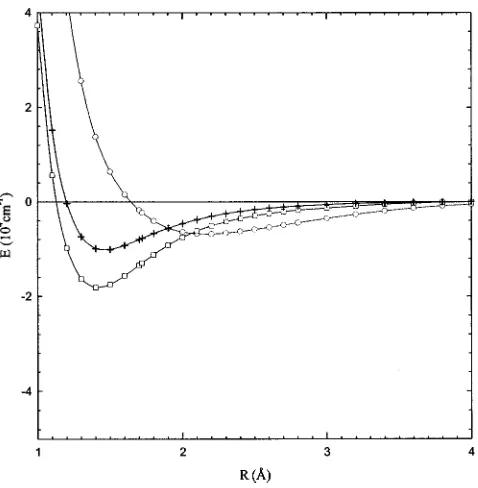
The potential energy curves for O2⫹ 共X2⌸g, A2⌸u,
a4⌸u, and 2⌺u⫹兲 calculated at the MR共SD兲CI level are
shown in Fig. 1, while the potential energy curves for O2⫹(A2⌸u, a4⌸u, and 2⌺u⫹兲 obtained using the SOCI
method are presented in Fig. 2. The behavior of the two sets of curves is clearly similar.
[image:5.612.319.559.47.289.2]As in previous calculations, the eigenfunctions of the Morse potential21
FIG. 1. Potential energy curves for O2⫹(X 2⌸
g) 共䉭兲, O2⫹(A 2⌸
u) 共䊊兲,
O2⫹(a 4⌸
u)共⫹兲, and O2⫹( 2⌺
u
⫹)共䊐兲calculated at the MR共SD兲CI level.
FIG. 2. Potential energy curves for O2⫹(A2⌸u)共䊐兲, O2⫹(a4⌸u)共⫹兲, and
O2⫹( 2⌺
u
⫹)共䊊兲calculated at the SOCI level.
7394 J. Chem. Phys., Vol. 115, No. 16, 22 October 2001 Fedorovet al.
[image:5.612.320.559.489.733.2]关U共R兲⫽De兵1⫺exp关⫺a共R⫺Re兲兴其2兴 共1兲
obtained by fitting the theoretical potential energy curves were used to calculate the nuclear wave functions.11 The Morse parameters共Re, a, and De兲for the ab initio potentials obtained at the MR共SD兲CI and SOCI levels of theory are compared in Table I with literature values22based on experi-mental measurements. As expected, the Morse potential fit-ted to the MR共SD兲CI potential is in better agreement with the experimental values.
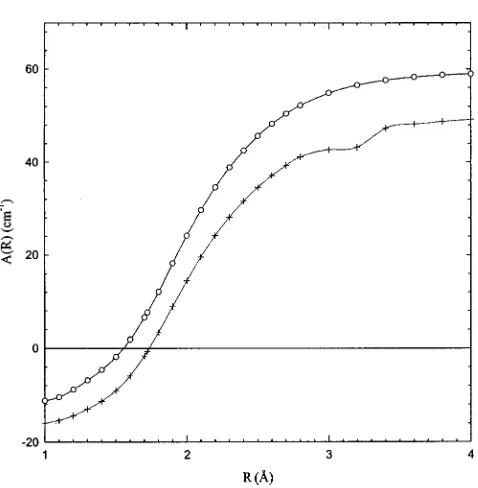
The ab initio spin-orbit coupling constant as a function of R, A(R), was first calculated at discrete R values and then fitted to an appropriate analytic functional form for the con-venience of performing numerical integration. The best fitted curve to A(R) values was found to have the functional form
[image:6.612.127.488.75.182.2]A共R兲⫽h共1⫹tanh共R⫺Ro兲s兲⫺A0. 共2兲
Table II summarizes the least square-fitted parameters h, Ro, s, and A0 for the O2⫹共A2⌸u and a4⌸u兲states calculated at
the CASSCF and SOCI levels of theory. Here, h and A0 are
in cm⫺1, Ro in Å, and s in Å⫺
1
. The ab initio A(R) values calculated using the CASSCF 共solid dots兲 and SOCI共solid triangles兲 methods, together with their best-fitted curves
共solid lines兲, are plotted in Fig. 3.
In order to gain a better understanding of the nature of the inversion of the spin-orbit coupling constant for O2⫹(A2⌸
u), the one-electron and two-electron contributions
to A(R) were separately studied at the SOCI level. The one-electron contributions共open circles兲and two-electron contri-butions 共open squares兲, along with their sums共⫹兲, thus ob-tained for the R range of 1.0– 4.0 Å are depicted in Fig. 4.
The detailed structure of the energies computed at the SOCI level near the crossing between the O2⫹(A2⌸u) and
O2⫹(2⌺u⫹) states is shown in Fig. 5. In this figure, we show the weight of the adiabatic state O2⫹(A2⌸u) in the diabatic states 共⍀⫽1/2 and ⍀⫽3/2, where ⍀ denotes the absolute value of the JZ operator兲, coupled by spin-orbit interaction,
near the region where the surface crossing occurs. It also shows the splitting of the diabatic surfaces near the crossing. The ⍀⫽3/2 state is a pure A2⌸u state, so that its weight is
not shown and the two⍀⫽1/2 states come from coupling of the A2⌸1/2uand2⌺1/2u⫹ states. The diabatic surfaces are
ob-tained from diagonalization of the spin-orbit coupling Hamil-tonian in the basis of the three states A2⌸u, a4⌸u, and
2⌺
u
⫹. The a4⌸
u state is well-separated from the other two
[image:6.612.320.559.479.723.2]and exerts only a weak influence on them.
FIG. 3. The ab initio A共R兲 values for O2⫹(A 2⌸
u) calculated using the
CASSCF共䊊兲and SOCI共⫹兲methods, together with the best-fitted curves 共solid lines兲.
TABLE I. Parametersafor the Morse potential关U(R)⫽D
e兵1⫺exp关⫺␣(R⫺Re)兴其2,兴for O2⫹(A 2⌸
u) obtained by
fitting the ab initio potential energies.
Morse Potential Re共Å兲 a共Å⫺
1兲
De共cm⫺1兲 e⫹共cm⫺1兲 e⫹e⫹共cm⫺1兲
Expt. O2⫹(A 2⌸
u)b,c 1.4090 2.5376 14 864.7 898.25共898.10兲 13.57共13.22兲
Theor. O2⫹(A 2⌸
u)d 1.410 2.5607 15 096.1 913.44 13.82
Theor. O2⫹(A 2⌸
u)
e 1.45 2.675 10 533. 797.1 15.1
Expt. O2⫹(a4⌸u)b,c 1.3813 2.2205 25 809.9 1035.69共1035.9兲 10.39共10.20兲
Theor. O2⫹(a 4⌸
u)d 1.372 2.4582 22 904.4 1080.09 12.73
Theor. O2⫹(a 4⌸
u)e 1.42 2.399 18 203.8 939.7 12.1
Theor. O2⫹( 2⌺
u
⫹)d 1.97 0 1.5554 7605.6 393.83 5.10
Theor. O2⫹(2⌺u⫹)
e
2.18 1.296 7029.0 315.4 3.5
a
Reis the equilibrium bond distance for O2⫹(A2⌸,v⫹⫽0) and De⫽well depth,e⫹⫽vibrational frequency, and
e⫹e⫹⫽anharmonicity for the Morse potential.
bMorse potential based on vibrational constants cited in Ref. 22. cValues for
e
⫹and
e
⫹
e
⫹reported in Ref. 12 are given in parentheses. d
This work. Morse potential based on ab initio共MR共SD兲CI兲potential energies. eThis work. Morse potential based on ab initio共SOCI兲potential energies.
TABLE II. Parameters for the function A(R)⫽h(1⫹tanh关(R⫺Ro)s兴)⫺A0, which yield the best fit to the ab initio spin-orbit coupling constant calcu-lated as a function of R.
Level of theory/states h共cm⫺1兲
Ro共Å兲 s共Å⫺
1兲
A0共cm⫺1兲
CASSCF/O2⫹(A2⌸u) 37.0077 1.966 59 1.516 36 16.6459
CASSCF/O2⫹(a 4⌸
u) ⫺14.7546 2.195 17 2.982 45 ⫺21.2267
SOCI/O2⫹(A 2⌸
u) 30.2944 1.970 05 1.817 22 17.9773
SOCI/O2⫹(a 4⌸
u) ⫺14.1221 2.050 97 2.855 33 ⫺22.9843
7395 J. Chem. Phys., Vol. 115, No. 16, 22 October 2001 Spin-orbit of O2¿
[image:6.612.51.297.689.757.2]In order to better understand the discrepancy between theory and experiment, we also calculated Av⫹values based on computed vibrational wave functions obtained using the potential fitted to the experimental data, along with ab initio values of A(R) based on the SOCI electronic wave function. This method is labeled the semiempirical-SOCI method here.
B. Theoretical model for coupling of the vibrational states
In order to couple the vibrational states for particular electronic states, the following matrix is constructed and di-agonalized共similarly to the scheme described in Ref. 23兲:
具
⌿Nv⌿
e i兩
Hˆ兩⌿Nv⬘⌿ei⬘
典
, 共3兲where⌿Nv and⌿ei are nuclear and electronic wave functions, respectively, for given combinations of vibrational 共v兲 and electronic共i兲states, and the scalar product is taken over both nuclear and electronic coordinates. The Hamiltonian operator can include any interactions of interest. For the purpose of this paper, it includes the usual nonrelativistic Hamiltonian and spin-orbit coupling operators. The number of states to be included depends on the desired accuracy of the results. The influence of a state (v
⬘
,i⬘
) upon the state of primary interest (v,i) can be estimated by means of perturbation theory:兩
具
⌿Nv⌿
e i兩
Vˆ兩⌿Nv⬘⌿ei⬘
典
兩2E⫺E
⬘
, 共4兲where V is the coupling potential 共e.g., spin-orbit coupling兲 and E and E
⬘
are the energies of the (v,i) and (v⬘
,i⬘
) states, respectively.For spin-orbit coupling in diatomic molecules, the ma-trix is block-diagonal for each eigenvalue (MJ) of the Jz
operator. The eigenvalues of this matrix provide diabatic vi-brational levels that include coupling between adiabatic states. For relatively weak coupling, the diabatic states retain discernable adiabatic character, and the effect of the coupling may be manifested experimentally as small bumps on the plots depicting the dependence of Av⫹’s upon the vibrational quantum number v⫹.
For the system of interest, a single electronic state pic-ture would produce a 4⫻4 (8⫻8) matrix for O2⫹(A2⌸u)
关O2⫹(a4⌸u)兴 states. This matrix is block-diagonalized with
4 共8兲 blocks consisting of EMJ values corresponding to MJ
⫽⫾1/2,⫾3/2,共⫾5/2,⫾3/2,⫾1/2,⫿1/2兲, with the property that the eigen-energy EMJ⫽E⫺MJ. The spin-orbit coupling
constant can be easily calculated as, for example, E1/2⫺E3/2.
The three lowest excited O2⫹ states共A2⌸u, a4⌸u, and
2⌺
u
⫹兲interacting by means of spin-orbit coupling in O 2 ⫹were
coupled using this model. In the case of O2⫹(a4⌸
u),
ac-counting for the vibrational energies shifts the various MJ levels by different amounts. Consequently, the uniform split-ting between all four distinct spin-orbit levels becomes non-uniform. In order to compare the theoretical predictions with the experiments, from which a single averaged spin-orbit splitting constant is reported for each multiplet, the shift in each兩MJ兩 level due to vibrational energies was added to the
uniform constant with equal weight共1/4兲. It should be noted that at very large distances, additional states interact with
2⌸
u, so that a quantitatively correct description of the
[image:7.612.56.296.49.284.2]sporbit coupling behavior at the dissociation limit requires in-clusion of these共atom-like兲states. However, the value of the spin-orbit coupling at these large distances has only a
FIG. 4. The one-electron 共䊊兲 and two-electron contributions共䊐兲 to the spin-orbit splitting constant共⫹兲for O2⫹(A
2⌸
u), along with their sums共⫹兲
in the R range of 1.0– 4.0 Å.
FIG. 5. The SOCI energies near the crossing between the O2⫹(A2⌸u)共䊊兲
and O2⫹( 2⌺
u
⫺)共䊉兲states共solid curves兲, showing the weight of the adiabatic O2⫹(A
2⌸
u) state in the diabatic representations关⍀⫽1/2共䉭andⵜ兲and⍀
⫽3/2共䊐兲兴 共dashed curves兲, coupled by spin-orbit interaction.
7396 J. Chem. Phys., Vol. 115, No. 16, 22 October 2001 Fedorovet al.
[image:7.612.55.295.480.710.2]very weak influence upon the spin-orbit coupling of the lower vibrational levels, due to a negligible density of the vibrational states in that region.
For O2⫹, the value of兩
具
⌿Nv⌿ei兩Vˆ兩⌿Nv⬘⌿ei⬘典
兩 is typically found to be on the order of 1–10 cm⫺1. The typical value of E – E⬘
is ⬎500–1000 cm⫺1, except for nearest neighbors.Thus, only one vibrational level was included in the matrix for each electronic state. This produced a 4⫻4 MJ⫽1/2
ma-trix共built upon A2⌸1/2u, 2⌺1/2u⫹ , a4⌸1/2u, and a4⌸⫺1/2u兲,
a 2⫻2 MJ⫽3/2 matrix 共A2⌸3/2u, a4⌸3/2u) and a
1⫻1 MJ⫽5/2 matrix (a4⌸5/2u) with the following
struc-ture, H( MJ):
H共1/2兲
⫽
冋
⫺De1⫹Ev1⫺A1/2
具
2⌸ux共v1,⫺ 12兲兩Hˆso兩2⌺u⫹共v2, 1 2兲
典
i具
2⌸
ux共v1,⫺ 1
2兲兩Hˆso兩4⌸uy共v3,⫺ 1
2兲
典
0c.c. ⫺De2⫹Ev2
具
2⌺u⫹共v2,⫹ 12兲兩Hˆso兩4⌸ux共v3,⫺ 1
2兲
典
⫺)H23共 1/2兲c.c. c.c. ⫺De3⫹Ev3⫺A3/2 0
c.c. c.c. c.c. ⫺De3⫹Ev3⫺3A3/2
册
,
共5a兲
H共3/2兲⫽
冋
⫺De1⫹Ev1⫹A1/2 H13共 1/2兲
c.c. ⫺De3⫹Ev3⫹A3/2
册
,
共5b兲 H共5/2兲⫽关⫺De3⫹Ev3⫹3A3/2兴, 共5c兲
where De is the dissociation energy, Ev is the vibrational level energy共given for a Morse potential by Ev⫽e(v⫹
1 2)
⫺exe(v⫹ 1 2)
2), A
1 and A3 are single electronic state
spin-orbit coupling constants for O2⫹(A2⌸u) and O2⫹(a 4⌸
u),
re-spectively, and c.c. in Hi jrefers to the complex conjugate of
Hjisince the Hamiltonian matrices are Hermitian. The
num-bers given in parentheses beside the electronic states, such as
2⌸
u(v, MS) are the values of the vibrational quantum
num-bers v and MS. Thus, three additional matrix elements are
needed for this model: H12 (1/2)
, H13 (1/2)
, and H23 (1/2)
. They were computed with SOCI wave functions in the same manner as the spin-orbit splitting constant calculations described in the previous section.
In order to reproduce the experimental results, the zero-order levels 共the diagonal elements兲 must be as accurate as the perturbation, on the order of a few cm⫺1for this system. It is difficult for current ab initio electronic structure theory to provide such accuracy, whereas it is possible experimen-tally. However, it should be possible to use experimental levels for the diagonal matrix elements and ab initio cou-pling terms 共off-diagonal elements兲 in order to understand the nature of the fine features.11
III. RESULTS AND DISCUSSION
As shown in Fig. 4, the one-electron contributions to A(R) calculated at the SOCI level of theory are negative at R⬍1.78 Å and become positive at larger R. On the contrary, the two-electron contributions are positive at small R (⬍1.87 Å) and become negative at larger R. Thus, the one-electron and two-one-electron contributions are both positive only in a narrow range of R in the vicinity of R⫽1.80 Å. The A(R) value, which is the sum of the two contributions, is
negative at R⬍1.72 Å and becomes positive at R⬎1.72 Å. This crossover distance of 1.72 Å roughly determines thev⫹
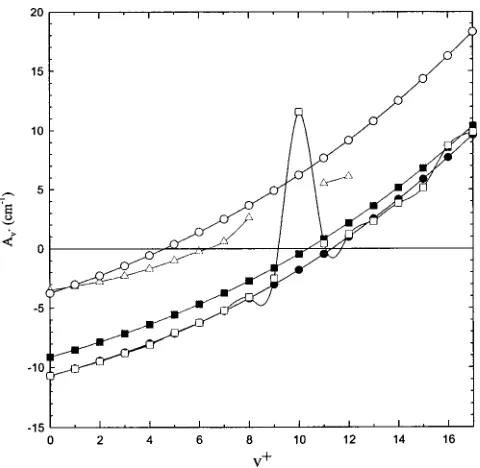
level for O2⫹(A2⌸u) at which Av⫹would change sign. The theoretical Av⫹(v⫹⫽0 – 25) values for O2⫹(A2⌸u)
obtained using the CASSCF, SOCI, semiempirical SOCI, and the vibrational level coupling schemes共described in Sec. II B兲, together with the experimental Av⫹ 共v⫹⫽0 – 8 and 11–15兲, are plotted as a function of v⫹ in Fig. 6. These theoretical and experimental Av⫹are also tabulated in Table III. The theoretical Av⫹ curves obtained at the CASSCF, SOCI, and semiempirical SOCI are nearly parallel to the experimental Av⫹ curve as shown in Fig. 6, although this correspondence becomes worse at larger v⫹states.
Further-FIG. 6. Comparison between theoretical spin-orbit coupling constants (Av⫹,) for O2⫹(A2⌸u,v⫹⫽0 – 17) computed using the CASSCF 共䊊兲,
SOCI 共䊉兲, semiempirical SOCI 共䊏兲, and vibrational level coupling 共䊐兲 procedures and experimental Av⫹ (v⫹⫽0 – 12) values 共䉭兲 reported in Ref. 5.
7397 J. Chem. Phys., Vol. 115, No. 16, 22 October 2001 Spin-orbit of O2¿
[image:8.612.319.559.469.703.2]more, all theoretical calculations predict that Av⫹is negative at low v⫹ states and becomes positive at higher v⫹ states. The crossover v⫹ state varies from v⫹⫽5 at the CASSCF level to v⫹⫽12 at the SOCI level. Thus, we may conclude that the theoretical calculations predict that the O2⫹(A2⌸u) state changes from a spin-orbit inverted state at lowv⫹ to a regular state around v⫹⫽5 – 12. This prediction is in quali-tative agreement with experimental findings. The inver-sion of Av⫹ for O2⫹(A2⌸u) is found to be caused by the mutual interaction of several states arising from the
(g)2(u)3(g*)
2 configuration, as the contributing
spin-orbit integrals between active spin-orbitals come with opposite sign and weights determined by the CI coefficients, that change along the dissociation path. We note that the inver-sion occurs when the A2⌸u state is computed alone, so that
the inversion phenomenon comes from this state itself. Cer-tainly when the constant becomes very small, even weak influences by other states may cause a noticeable difference and slightly change the value of v⫹ at which the inversion occurs.
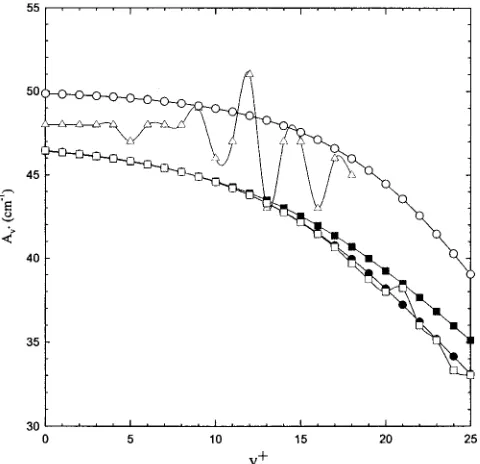
The theoretical Av⫹(v⫹⫽0 – 25) values for O2⫹(a4⌸u)
obtained at the CASSCF, SOCI, and multistate coupling level of theory, together with the experimental values10,24,25 for Av⫹ (v⫹⫽0 – 18), are depicted in Fig. 7. These theoret-ical and experimental10,24,25 values are also listed in Table IV. The Av⫹ values calculated for O2⫹(a4⌸u) at the
CASSCF level are higher than those at corresponding v⫹
states obtained at the SOCI level by 3.5– 6.0 cm⫺1. Similar to the case of O2⫹(A2⌸u), the Av⫹ values calculated for O2⫹(a4⌸u) at the SOCI and semiempirical SOCI schemes
are in good agreement, indicating that the use of the Morse potential fitted to experimental results in very little improve-ment over the ab initio potential. As shown in Fig. 7, the vibrational dependencies of the theoretical Av⫹ values for O2⫹(a4⌸u) are similar to the other levels of theory, showing
a gradual decrease as v⫹ is increased. The CASSCF Av⫹ values for O2⫹(a4⌸u) are generally higher than the
[image:9.612.52.296.71.302.2]corre-sponding experimental Av⫹ values,10while the SOCI values
FIG. 7. The comparison between theoretical spin-orbit coupling constant (Av⫹) for O2⫹(a
4⌸
u;v⫹⫽0 – 25) computed using the CASSCF共䊊兲, SOCI
[image:9.612.317.561.73.377.2]共䊉兲, semiempirical SOCI 共䊏兲, and vibrational level coupling 共䊐兲 proce-dures and experimental Av⫹(v⫹⫽0 – 18) values共䉭兲reported in Ref. 10. TABLE III. Comparison of the experimental and theoretical spin-orbit con-stants Av⫹for O2⫹(A
2⌸
3/2,1/2u,v⫹⫽0 – 17).
v⫹
Theoretical共cm⫺1兲a
Experimental 共cm⫺1兲b
CASSCF SOCI Vibrational Semiempirical
0 ⫺3.76 ⫺10.69 ⫺10.7 ⫺9.13 ⫺3.50
1 ⫺3.04 ⫺10.10 ⫺10.1 ⫺8.52 ⫺3.16
2 ⫺2.28 ⫺9.46 ⫺9.5 ⫺7.86 ⫺2.78
3 ⫺1.45 ⫺8.75 ⫺8.8 ⫺7.15 ⫺2.28
4 ⫺0.57 ⫺7.99 ⫺8.1 ⫺6.39 ⫺1.69
5 0.37 ⫺7.15 ⫺7.1 ⫺5.57 ⫺0.99
6 1.39 ⫺6.25 ⫺6.24 ⫺4.69 ⫺0.22
7 2.47 ⫺5.26 ⫺5.24 ⫺3.74 0.6
8 3.64 ⫺4.2 ⫺4.1 ⫺2.73 2.6
9 4.88 ⫺3.04 ⫺2.51 ⫺1.63
10 6.21 ⫺1.8 11.57 ⫺0.46
11 7.64 ⫺0.46 0.43 0.80 5.5
12 9.16 0.98 1.2 2.15 6.1
13 10.77 2.52 2.3 3.60 6.84
14 12.49 4.15 3.83 5.14 7.78
15 14.32 5.88 5.14 6.79 8.9
16 16.24 7.71 8.71 8.54
17 18.28 9.62 9.88 10.40
aThis work. b
Reference 5.
TABLE IV. Comparison of the experimental and theoretical spin-orbit con-stants Av⫹for O2⫹(a
4⌸
5/2,3/2,1/2,⫺1/2u,v⫹⫽0 – 25).
v⫹
Theoretical共cm⫺1兲a
Experimental 共cm⫺1兲b
CASSCF SOCI Vibrational Semiempirical
0 49.85 46.44 46.44 46.41 48共47.79兲
1 49.81 46.35 46.35 46.32 48共47.80兲
2 49.77 46.25 46.25 46.21 48共47.77兲
3 49.71 46.12 46.12 46.09 48共47.74兲
4 49.65 45.98 45.98 45.95 48共47.71兲
5 45.58 45.82 45.82 45.79 47共47.64兲
6 49.49 45.64 45.64 45.61 48共47.55兲
7 49.39 45.42 45.42 45.40 48共47.44兲
8 49.28 45.18 45.18 45.17 48共47.06兲
9 49.14 44.89 44.89 44.91 49共47.13兲
10 48.97 44.57 44.57 44.61 46
11 48.78 44.20 44.20 44.28 47
12 48.54 43.78 43.78 43.91 51
13 48.27 43.30 43.30 43.49 43
14 47.95 42.77 42.75 43.03 47
15 47.56 42.17 42.13 42.52 47
16 47.11 41.50 41.44 41.96 43
17 46.58 40.76 40.66 41.35 46
18 45.97 39.96 39.69 40.69 45
19 45.26 39.10 38.74 39.99
20 44.46 38.18 37.99 39.25
21 43.55 37.22 38.21 38.46
22 42.54 36.21 35.99 37.65
23 41.45 35.18 35.11 36.82
24 40.27 34.14 33.31 35.97
25 39.03 33.09 33.02 35.11
aThis work.
bReference 10. Values in parentheses are from Refs. 24 and 25.
7398 J. Chem. Phys., Vol. 115, No. 16, 22 October 2001 Fedorovet al.
[image:9.612.56.296.479.711.2]for Av⫹ are generally lower than the corresponding experi-mental Av⫹ values. The average differences of 1–2 cm⫺1 between the ab initio and experimental Av⫹values 共 exclud-ing the fine features兲are likely caused by neglected interac-tions, of which the most obvious candidate is the spin-spin coupling. Another important factor is the dynamic electron correlation, not fully accounted for since the virtual CI space was truncated in the SOCI calculations. A further possible factor is the deviation of the actual potential energy curve from that represented by the Morse potential, but this is probably a less important issue.
We observe that the much more expensive SOCI ap-proach gives better values of spin-orbit coupling constants for larger v⫹ 共corresponding to larger internuclear separa-tion兲 in case of O2⫹(A2⌸u), however CAS values are in
better agreement with experiment for small v⫹ in both O2⫹(A2⌸u) and O2⫹(a
4⌸
u). The lack of experimental data
and very strong perturbations at largev⫹values leave some uncertainty with regard to whether CAS or SOCI values are better in that region in the case of O2⫹(a4⌸u). The
trunca-tion of the SOCI virtual space that we employed may have caused some numerical deterioration of the SOCI compared to the CAS approach.
Although the spin-orbit coupling of the electronic states O2⫹(A2⌸u) and O2⫹(a
4⌸
u) is very strong共⬇50–100 cm⫺1兲,
the spin-orbit couplings between vibrational levels of O2⫹(A2⌸u) and O2⫹(a
4⌸
u), are predicted to be small,
typi-cally less than 10⫺3cm⫺1. These small spin-orbit interac-tions are attributed to the fact that the vibrational states of the two electronic states are centered at almost the same equilib-rium distance R. As a result, the vibrational levels that are close in energy, i.e., roughly O2⫹(A2⌸u,v⫹⫽0) and O2⫹ 共a4⌸u, v⫹⫽10 and above兲, feature highly oscillating wave
functions of the quartet state that have very small overlap with those of the doublet state. On the contrary, vibrational levels of the O2⫹(2⌺u⫹) state are centered at a much larger equilibrium distance R and the overlaps of these levels with those of both O2⫹(A2⌸u) and O2⫹(a
4⌸
u) are relatively
large, leading to larger shifts of about 1–10 cm⫺1 in Av⫹. Two nearly degenerate vibrational levels of O2⫹(A2⌸u) and
O2⫹(2⌺u⫹) combined with large vibrational interactions, are responsible for producing a large jump in Av⫹ at O2⫹
共A2⌸u,v⫹⫽10兲, as can be seen on Fig 6. The Av⫹value of
11.6 cm⫺1for O2⫹共A2⌸
u,v⫹⫽10兲, calculated incorporating
the coupling between vibrational levels, is significantly higher than those for the adjacent O2⫹ 共A2⌸u, v⫹⫽9 and
11兲states. This result predicts that the strongest vibrational contribution for O2⫹(2⌺u⫹) occurs at O2⫹ 共A2⌸u, v⫹⫽10兲.
Since no measurements for Av⫹ exist for O2⫹ 共A2⌸u, v⫹
⫽9 and 10兲, this theoretical prediction cannot be confirmed experimentally. Nevertheless, the previous experimental studies5,10 suggest that the strongest vibrational interaction with O2⫹(2⌺u⫹) occurs at O2⫹ 共A2⌸u, v⫹⫽9 and 10兲. This
can be considered to be in reasonable agreement with the theoretical prediction at O2⫹ 共A2⌸u, v⫹⫽10兲 obtained in
the present study.
As shown in Fig. 7, oscillations are observed in thev⫹
⫽8 – 18 range in the experimental Av⫹ curve10 for O2⫹(a4⌸u). These oscillations may be due to vibrational
in-teractions with other electronic states. The vibrational model predicts oscillations at v⫹⬎18 with significantly lower am-plitudes. Theoretically, the strongest coupling with other curves, mainly the O2⫹(2⌺u⫹) state, is seen at v⫹⫽21 as compared to the experimental observation atv⫹⫽12.
In the above model, the O2⫹(a4⌸u) state by itself has no
influence upon the Av⫹ values of O2⫹(A2⌸u), owing to the
fact that the perturbation causes both O2⫹(A2⌸
1/2u) and
O2⫹(A2⌸3/2u) components to be shifted by the same amount.
The Av⫹values of O2⫹(a4⌸u) can, however, be affected by
interaction with the O2⫹(A2⌸u) state, i.e., the shifts of the
levels belonging to a given spin-orbit multiplet for O2⫹(a4⌸u) are unequal. Nevertheless, the differences of
these shifts are small and were not resolved in experi-mental10 measurements. For this reason, only the average Av⫹ values obtained in the present theoretical studies are compared to experimental Av⫹ values. On the basis of the above analysis, we conclude that the observed fine features in the experimental Av⫹ curves shown in Figs. 6 and 7 can-not be attributed to spin-orbit coupling between O2⫹(A2⌸u)
and O2⫹(a4⌸u) states. As noted in the previous paragraph,
evidence exists that these fine structures, at least in part, arise from vibrational interactions with the O2⫹(2⌺u⫹) state. Other neglected interactions may play a role, of which derivative coupling between O2⫹(X2⌸g) and O2⫹(A
2⌸
u) is particularly
worth mentioning.
IV. CONCLUSIONS
We have investigated the spin-orbit interactions of the O2⫹(A2⌸u), O2⫹(a
4⌸
u), and O2⫹( 2⌺
u
⫹) states. The
theoret-ical Av⫹values for O2⫹(A2⌸
u) and O2⫹(a4⌸u) calculated at
the CASSCF and SOCI level of theory are in good quantita-tive agreement with experimental measurements. The trun-cated SOCI method does not perform decisively better than CASSCF, and in some ranges of v⫹ SOCI actually gives worse agreement with experiment than CASSCF. The present theoretical study correctly predicts the inverted and regular nature of the spin-orbit splitting for O2⫹(A2⌸u) at lowv⫹and highv⫹levels, respectively, observed in experi-mental studies. On the basis of the multistate vibrational in-teraction model, the strongest perturbation of O2⫹(a4⌸
u) by
O2⫹(2⌺u⫹) is predicted to occur atv⫹⫽10, This is also
con-sistent with the experimental finding atv⫹⫽9 and 10. How-ever, the multistate vibrational interaction calculations were unable to reproduce fine structures observed in the Av⫹ curves for O2⫹(a4⌸u), although there is evidence to explain
them as a result of perturbation by the O2⫹(2⌺u⫹) state.
ACKNOWLEDGMENTS
This work was supported by the Director, Office of En-ergy Research, Office of Basic EnEn-ergy Sciences, Chemical Science Division of the U. S. Department of Energy under contract No. W-7405-Eng-82 for the Ames Laboratory, and Contract No. DE-AC03-76SF00098 for the Lawrence Berke-ley National Laboratory. Two of the authors 共C.Y.N. and M.S.G.兲acknowledge partial support from AFOSR. The au-thors also thank Professor C. Marian for very useful discus-sions. One of the authors 共D.G.F.兲 acknowledges financial support from JSPS.
7399 J. Chem. Phys., Vol. 115, No. 16, 22 October 2001 Spin-orbit of O2¿
1D. S. Stevens, Phys. Rev. 38, 1292共1931兲.
2R. S. Mulliken and D. S. Stevens, Phys. Rev. 44, 720共1933兲. 3L. Bozoky, Z. Phys. 104, 275共1937兲.
4
D. L. Albritton, W. J. Harrop, A. L. Schmeltekopf, and R. N. Zare, J. Mol. Spectrosc. 46, 89共1973兲.
5J. A. Coxon and M. P. Haley, J. Mol. Spectrosc. 108, 119共1984兲. 6J. Raftery and W. G. Richards, J. Chem. Phys. 62, 3184共1975兲. 7N. H. F. Beebe, E. W. Thulstrup, and A. Andersen, J. Chem. Phys. 64,
2080共1976兲.
8C. M. Marian, R. Marian, S. D. Peyerimhoff, B. A. Hess, R. J. Buenker,
and G. Seger, Mol. Phys. 46, 779共1982兲.
9Y. Song, M. Evans, C. Y. Ng, C.-W. Hsu, and G. K. Jarvis, J. Chem. Phys.
111, 1905共1999兲.
10
Y. Song, M. Evans, C. Y. Ng, C.-W. Hsu, and G. K. Jarvis, J. Chem. Phys.
112, 1306共2000兲.
11D. Fedorov, M. Evans, Y. Song, M. Gordon, and C. Y. Ng, J. Chem. Phys.
111, 6413共1999兲.
12
Y. Song, M. Evans, C. Y. Ng, C.-W. Hsu, and G. K. Jarvis, J. Chem. Phys.
112, 1271共2000兲.
13M. W. Schmidt, K. K. Baldridge, J. A. Boatz et al., J. Comput. Chem. 14,
1347共1993兲.
14
MOLPROis a package of ab initio programs written by H.-J. Werner and P.
J. Knowles, with contributions from J. Almlo¨f, R. D. Amos, M. J. O. Deegan, S. T. Elbert, C. Hampel, W. Meyer, K. Meyer, K. Peterson, R. Pitzer, A. J. Stone, P. R. Taylor, and R. Lindh.
15H.-J. Werner and P. J. Knowles, J. Chem. Phys. 82, 5053共1985兲. 16
P. J. Knowles and H.-J. Werner, Chem. Phys. Lett. 115, 259共1985兲.
17
H.-J. Werner and P. J. Knowles, J. Chem. Phys. 89, 5803共1988兲.
18
P. J. Knowles and H.-J. Werner, Chem. Phys. Lett. 145, 514共1988兲.
19
M. W. Schmidt and M. S. Gordon, Annu. Rev. Phys. Chem. 49, 233
共1998兲.
20
H. A. Bethe and E. E. Salpeter, Quantum Mechanics of the One and Two Electron Atoms共Plenum, New York, 1977兲.
21
D. G. Fedorov, Ph.D. thesis, ISU, 1999.
22K. P. Huber and G. Herzberg, Molecular Spectra and Molecular Structure,
Constants of Diatomic Molecules, vol. IV 共Van Nostrand, New York, 1979兲.
23Modern Electronic Structure Theory, Part I, edited by David R. Yarkony
共World Scientific, NJ, 1995兲, specifically, p. 238.
24P. C. Cosby, J.-B. Ozenne, J. T. Moseley, and D. L. Albritton, J. Mol.
Spectrosc. 79, 203共1980兲.
25
J. C. Hansen, J. T. Moseley, and P. C. Cosby, J. Mol. Spectrosc. 173, 48
共1983兲.
7400 J. Chem. Phys., Vol. 115, No. 16, 22 October 2001 Fedorovet al.