ACTS OF DISPLAY:
IDENTITY AND ROME IN HERODIAN PALESTINE
Brian A. Coussens
A thesis submitted to the faculty at the University of North Carolina at Chapel Hill in partial fulfillment of the requirements for the degree of Master of Arts in the
Depart of Religious Studies in the College of Arts & Sciences.
Chapel Hill 2014
ABSTRACT
Brian A. Coussens: ACTS OF DISPLAY: IDENTITY AND ROME IN HERODIAN PALESTINE
(Under the direction of Jodi Magness)
Dedicated to the memory of Colleen Gunter Cavin, my beloved and much missed grandmother. You did not see the end, but you always believed in me.
ACKNOWLEDGEMENTS
I would like to thank all of the people who made this thesis possible. First, I would like to thank my advisor, Jodi Magness, without whom this thesis would not be. Because of her close readings and her helpful comments, it is more readable than it would have been and is
characterized by more rigorous scholarship, even though we do not always agree. I would also like to thank my committee for their time, patience, and comments. For a number of reasons, the process of completing this thesis took longer than I anticipated, and they were all too kind in accommodating my personal needs.
Second, I would like to thank my family, especially Mom and Dad. Without your support, I am not sure how I would have gotten through the past several years. Thank you, Mom, for the countless number of phone calls and for listening to me talk (and complain) endlessly about the same things over and over again. Thank you, Dad, both for getting me through some rough spots and for reading large sections of this thesis, even if it was outside of your field. Thank you both for investing in my education and believing in my capabilities, even when I fail to believe in them myself.
Third, I would like to thank all of those colleagues and friends who helped me both with the content of this thesis and with overcoming hurdles along the way. I would like to give a special thanks to Shaily S. Patel, who, having the unfortunate luck of being my neighbor, had to listen to me rattle off about this thesis way too often. She is a rock in the storm and, to
texts and emails. Thanks to my other stalwart companion, Stephanie Gaskill, who, knowing how I hate to share my work, through her patient persistence and, perhaps, a bit of stubbornness, managed to get me to present part of this thesis at the Religious Studies’ Writing Group. I would also like to give a special shout out to Shannon Schorey, Daniel Schindler, Lenny Lowe, and anyone else who got to play counselor to my particular brand of crazy when I let the process overwhelm me. Thanks to the members of the UNC Religious Studies Writing Group for reading and commenting on Chapter 2 and the members of the Judaism and the Levant in Antiquity Reading Group for slogging their way through the original version of Chapter 4. Thanks to all of you who have helped me think through some of these issues over the past couple of years, including Travis Proctor, Matt Grey, Brad Erickson, Jocelyn K. Burney, and David Culclasure.
Finally, thanks to Lady Eowyn Kiyo, because my dog puts up with way too much from me. She patiently waits for me to get home from extremely long days, generally lets me sleep in after pushing myself too hard for several days, and gives the best doggy snuggles. And, let’s face it: when you are writing on a topic such as Romanization, you get through the hairier parts with a lot of puppy breaks.
TABLE OF CONTENTS
LIST OF TABLES ... X
CHAPTER 1: INTRODUCTION ... 1
CHAPTER 2: HOW TO READ “ROMAN”: THE SHIFTING PARADIGM OF ROMANIZATION ... 7
2.1. From Romanization to…? A Century of Reading “Roman” ... 8
2.1.1. Roman-izing: Haverfield and the Acculturation Model (1890s-early 1900s) ... 8
2.1.2. Resisting “Roman”: The Post-Colonial Resistance Model (1970s-1980s) ... 14
2.1.3. Resurrecting Roman: Neo-Romanization Model (1990) ... 15
2.1.4. Breaking Roman: The “Post”-Romanization Era (1990-Present) ... 19
2.2. Can the East Be Won? Romanizing the “Roman” East ... 26
2.3. Romanizing Palestine: Changing Perspectives on the East ... 30
2.3.1. Roma Philohellene: Rome as Hellenizer ... 31
2.3.2. Herodes Philorhomaios, a Roman Exception?... 35
2.3.3. Emerging Romanization Paradigms ... 38
2.3.3.1. Defining Boundaries in the Galilee (Berlin) ... 39
2.3.3.2. Roman in Politics, Not in Culture (Lee) ... 40
2.3.3.3. A Roman Cultural Revolution (Altshul) ... 42
2.4. Conclusions ... 42
CHAPTER 3: RE-READING ROMANIZATION: IDENTITY NEGOTIATION, DISPLAY, AND THE HOUSEHOLD ... 44
3.2. Power Plays: Negotiating Identities and Acts of Display ... 49
3.3. Archaeological Dyslexia and Interpreting Changing Display Acts ... 53
3.4. Locating Identity: The Household as a Locus of Romanization ... 55
3.5. Conclusions ... 57
CHAPTER 4: IDENTIY DISCOURSE AND DISPLAY: ROMANIZATION AND THE HOUSES OF JERUSALEM’S UPPER CITY ... 58
4.1. A Multi-vocal Romanization? Limits and Survival Bias ... 59
4.2. The Vernacular of Elite Display: A Summary ... 60
4.2.1. Frescoes... 61
4.2.2. Stucco ... 65
4.2.3. Mosaics ... 68
4.2.4. Opus Sectile ... 71
4.2.5. Pottery: Imported Finewares ... 72
4.2.7. Glasswares ... 74
4.2.8. Chalk Vessels ... 76
4.2.9. Miqva’ot ... 79
4.3. Negotiated Identities: Material Displays and the Identity(ies) of the Jerusalem Elite ... 80
4.3.1. A Shifting Vernacular: Changes in Display Practices ... 80
4.3.2. Multiple Identities: the Multivalency of Displays ... 81
4.3.3. Imperial Identities: Rome and the Jerusalem Elite ... 84
4.4. Conclusions ... 88
CHAPTER 5: ANTI…: IDENTITY AND DISPLAY AT QUMRAN ... 89
5.1. A Villa or Sectarian Community? Methodology ... 90
5.2. The Display Vernacular of Qumran ... 92
5.2.2. Decorative Techniques ... 97
5.2.3. Glass ... 99
5.2.4. Pottery ... 100
5.2.5. Chalk Vessels ... 101
5.2.6. Miqva’ot ... 103
5.3. A Difference of Identities?... 104
5.4. Anti…: An Oppositional Identity at Qumran?... 107
5.5. Conclusions ... 109
CHAPTER 6: CONCLUSIONS ... 111
LIST OF TABLES
CHAPTER 1:
INTRODUCTION
For scholars who study ancient Palestine, few periods loom larger than the time of Herod the Great and his successors.1 From the beginning of Herod’s reign in 40 BCE to the destruction of the Second Jewish Temple in 70 CE, the land was transformed physically, politically,
culturally, and religiously. One of the changes associated with this period was the
transformation of Judea from a small independent kingdom to a subject territory of the Roman Empire.2 This change has prompted much debate over Rome’s cultural and material impact on the Jews of Palestine. Over the years, the theories have ranged widely. For some scholars, Rome’s influence was only political, eliciting no complementary cultural changes.3
For others, its influence was so profound that it should properly be categorized as a “cultural revolution.”4
1 While the geographical terminology for this region is somewhat problematic because of modern political
discourse, this thesis will primarily use the terms ancient Palestine, Roman Palestine, and Palestine to refer to the region over which Herod the Great ruled and the states which surrounded that territory. This geographical
description includes lands in the modern state of Israel, the Palestinian territories, and the Kingdom of Jordan. This terminology is anachronistic as it was not applied to the region until the 130s C.E., but it avoids the problems of the term Judea, which changes meanings during the period of interest. I have generally eschewed the use of Judea in this thesis, using it primarily to refer to the administrative region around Jerusalem.
2 As noted below, Rome gained control of Palestine in 63 BCE. The nature of the relationship and control changes
in 40 BCE when Herod the Great was appointed as client king of Judea, as, unlike his predecessor, he had no hereditary claim to throne. As noted by Roller, Herod’s architectural habits, including its euergetistic tendencies and some of its style and techniques, can partially be linked to an imitation of his predecessors. For example, Josephus cites Gabinius’ role in rebuilding parts of the region. Some of the material practices noted in the course of this thesis may also have had their beginnings in this early period of Roman rule. Duane W. Roller, The Building Program of Herod the Great (Berkeley: University of California Press, 1998), 81–83, 85; Joseph. BJ 1.8.4 § 165-166.
3 Francis Haverfield, The Romanization of Roman Britain, 3d ed. (Oxford: Clarendon Press, 1915), 12–13; Reuben
Lee, Romanization in Palestine: A Study of Urban Development from Herod the Great to Ad 70 (Oxford, England: Archaeopress, 2003), 82.
4 Asher Y. Altshul, “Was There a Herodian ‘Revolution’? Changes in the Social and Material Culture of the Late
For most, the change probably falls somewhere between these extremes. Other scholars debate the nature of Rome’s influence, deliberating over whether its impact was primarily Romanizing or Hellenizing.5 Still others have begun to ask what, if any, connection exists between new local “Jewish” practices and Rome.6
The discussion is diverse, and no consensus has been reached on how living under Empire affected the Jews of Herodian Palestine and what the material changes of the period mean. This thesis attempts to address the problem of Jewish-Roman relations by examining the material culture and re-assessing it in light of identity theory. It contends that the new situational reality of the Herodian period – living under Empire – required the Jews of Palestine to engage in a process of Romanization, a discourse of identity negotiation which had material expressions.
From the beginning of Hasmonean rule, Jewish leaders in Palestine had maintained a relationship with Rome. This began as a political alliance, renewed on occasion by the various Hasmonean rulers.7 In 63 BCE, the nature of the Jewish-Roman relationship changed
fundamentally. The Roman general Pompey interceded in the civil war between Hyrcanus II and
5 This debate is evident in the discussions over the origins and influence behind particular types of architecture, and
especially, in discussions of Herod’s construction projects. See, for example, R. Förtsch, “Residences of King Herod and Their Relations to Roman Villa Architecture,” in Judaea and the Greco-Roman World in the Time of Herod in Light of the Archaeological Evidence, ed. Klaus Fittschen and Gideon Foerester (Göttingen: Vandenhoeck & Ruprecht, 1996), 74–119; Karl Galinsky, “The Augustan Programme of Cultural Renewal and Herod,” in Herod and Augustus: Papers Presented at the IJS Conference, 21st-23rd June 2005, ed. David M. Jacobson and Nikos Kokkinos (Leiden: Koninklijke Brill NV, 2009), 29–42; Gideon Foerster, “Hellenistic and Roman Trends in the Herodian Architecture of Masada,” in Judaea and the Greco-Roman World in the Time of Herod in Light of the Archaeological Evidence, ed. Klaus Fittschen and Gideon Foerester (Göttingen: Vandenhoeck & Ruprecht, 1996), 55–72; Achim Lichtenberger, “Herod and Rome: Was Romanisation a Goal of the Building Policy of Herod,” in
Herod and Augustus: Papers Presented at the IJS Conference, 21st-23rd June 2005, ed. David M. Jacobson and Nikos Kokkinos (Leiden: Koninklijke Brill NV, 2009), 43–64.
6 Andrea Berlin, “Romanization and Anti-Romanization in Pre-Revolt Galilee,” in The First Jewish Revolt:
Archaeology, History, and Ideology, ed. Andrea Berlin and J. Andrew Overman (London: Routledge, 2002), 57–73; Andrea Berlin, “Jewish Life before the Revolt: The Archaeological Evidence,” Journal for the Study of Judaism 36, no. 4 (2005): 417–470.
7 1 Macc 8:1-32; 12:1-4; 14:16-24; Joseph. AJ 12.10.6 §415-419; 13.5.8 §163-166; 13.9.2 §259-263; 14.8.5
Aristobulus II and conquered Jerusalem.8 Rome seized control. With this coup, Rome was transformed from a notable (if stronger) ally to the region’s ruler. This move altered the manner in which the two parties interacted and required a redefinition of their co-dependent identities. One became ruler, and the other subject. Whereas their previous bonds had been based upon verbal terms of friendship and did not require sustained contact, they now entered into a
relationship of governance.9 It guaranteed and necessitated some form of direct contact between Rome and its subject peoples, though the nature and manner of that contact varied throughout the Herodian period.
This political change precipitated a material change. Although Rome never instituted an imperial policy of acculturation, in the case of ancient Palestine, the political redefinition of Jewish-Roman relations correlates with visibly different patterns of material consumption in the archaeological record. On the state scale, this change was visible in the monumentalization of the region by Herod the Great and his successors. On a smaller scale, in the households of Palestine’s Jewish residents, it appears in a range of patterns from the rejection of previously forms of acceptable consumption habits to the adoption of new Greco-Roman practices. Materially, the context of Empire provided the setting for a “cultural revolution,” but it was not solely “Roman.”10 It was characterized by a diversity of changes, both local and Greco-Roman. The lingering question is “What can explain this diversity of material change?” This thesis
8 Joseph. AJ 14.1.1 §1 – 14.4.5 §79; BJ 1.6.1 §120 - 1.7.7 §158.
9 The extent to which the two groups were in contact prior to 63 BCE is debatable. They may have maintained
minimal economic contact, but according to historical sources, official contact was restricted to the renewal of the Rome-Jerusalem friendship. E. Mary Smallwood, The Jews under Roman Rule: From Pompey to Diocleatian. A Study in Political Relations, 2nd ed. (Leiden: Brill, 1981), 5–11; Sara R. Mandell, “Did the Maccabees Believe That They Had a Valid Treaty with Rome?,” Catholic Biblical Quarterly 53, no. 2 (1991): 202–220.
suggests that the answer may lie in a Romanization based upon a linguistic interpretation of identity negotiation.
To address the issue of change in Herodian Palestine, this thesis begins in Chapter Two with a historiographical discussion of the term Romanization. It traces the theoretical
development of the term in the regions of the Western Empire, from its popularization under Francis Haverfield in the early 1900s until its rejection by the “post”-Romanization movement from the 1990s to the present. This chapter also addresses the peculiar issue of “Romanizing” in the Eastern Empire and ancient Palestine. There, despite parallel evidence of changes in material practice, the process of Romanization in the East has been seen as categorically different from that in the Western Empire. This chapter places the current work within this discourse of Romanization, and many of the solutions presented in the course of this thesis should be seen as developing in response to this theoretical conversation.
In light of the discussion of Romanization from Chapter Two, Chapter Three proposes a somewhat different model for approaching Romanization. Instead of equating objects with identity, it argues for an understanding of Romanization that integrates identity practice by looking at how people construct identity through material objects. Using Andrew Wallace-Hadrill’s discussion of such material praxis, it suggests that Romanization is best described as a discourse of identity negotiation involving the manipulation of a range of material objects in acts of display.11 As exhibited by the discussions in the succeeding chapters, this definition of
Romanization best explains the range of material change characteristic of Herodian Palestine. This chapter contends that, if the material from Palestinian sites is viewed as the range of
material symbols used in a discourse of identity, one can then use this range to analyze how the discourse of identity changes over time and how it differs from site to site within a period.
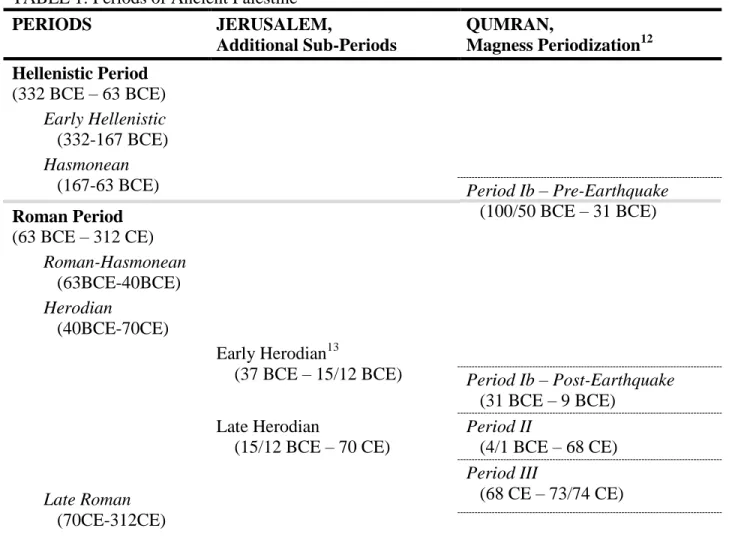
TABLE 1: Periods of Ancient Palestine
PERIODS JERUSALEM,
Additional Sub-Periods
QUMRAN,
Magness Periodization12
Hellenistic Period
(332 BCE – 63 BCE) Early Hellenistic (332-167 BCE) Hasmonean
(167-63 BCE) Period Ib – Pre-Earthquake
(100/50 BCE – 31 BCE)
Roman Period (63 BCE – 312 CE) Roman-Hasmonean (63BCE-40BCE) Herodian
(40BCE-70CE)
Early Herodian13
(37 BCE – 15/12 BCE) Period Ib – Post-Earthquake (31 BCE – 9 BCE)
Late Herodian
(15/12 BCE – 70 CE)
Period II
(4/1 BCE – 68 CE) Period III
(68 CE – 73/74 CE) Late Roman
(70CE-312CE)
12 Jodi Magness, The Archaeology of Qumran and the Dead Sea Scrolls (Grand Rapids: Eerdmans, 2002), 68.
13 The beginning of this period is based upon Herod’s retaking of the city in 37 BCE. The end is based upon the
CHAPTER 2:
HOW TO READ “ROMAN”:
THE SHIFTING PARADIGM OF ROMANIZATION
This thesis engages with a century-long discussion of the consequences of Roman imperial expansion across the Mediterranean. Scholars have struggled to define the relationship between Rome and its subjects. They have examined classical literature for imperial discourse and consulted the archaeological record for evidence of material change.1 In the past, scholars interpreted the existing data as attesting to an empire-initiated cultural modification, a
transformation they termed Romanization. With Roman power came the adoption of literary and material praxis that did not accord with the previous cultural systems of the local peoples. Thus, according to earlier generations of Classicists, the Romans adopted a policy of assimilation.2 With the collapse of the modernist paradigm and the adoption of post-modernist ideas, this model of Romanization has come under increasing scrutiny, as scholars have attempted either to revise the term or to abandon it altogether. To many, it does not correspond with emerging theoretical models that engage with ideas of power dynamics, identity, culture, and practice.
1 By imperial discourse, I mean the ancient image of empire constructed by Rome and its subjects. This discourse
need not be restricted only to literature. As Zanker and others show, imperial discourse can be applied through imagery and architecture. Paul Zanker, The Power of Images in the Age of Augustus (Ann Arbor: University of Michigan Press, 1990), 101.
2 Here, an issue of terminology exists as the authors do not typically refer to their models as an assimilation or
acculturation model and the critique of such models fluctuates between the usage of these terms. While assimilation
Although the post-modern critique and deconstruction of the concept of Romanization has proven to be beneficial and necessary, the word, while debated, remains useful in understanding the identity negotiations that occurred when Rome annexed a people.
The following chapter discusses the complex history of Romanization from its first rendition to the modern critique. It provides a critical examination of past studies and adds to the discussion by considering some of the issues that have emerged from the current formulations (or anti-formulations) of Romanization. It also addresses the approach to Romanization in the East, where Roman interests have traditionally been minimalized before a Hellenizing paradigm. This chapter contends that, despite developments in theoretical models, studies of the Eastern Empire have continued to suffer under biases originating in nineteenth-century traditions. Whereas the West has served as the testing grounds for theory in Romanization, the East has generally rehashed older traditions, only recently adopting new modes of Roman-native interaction and incorporating new models of Romanization.3
2.1. From Romanization to…? A Century of Reading “Roman”
2.1.1. Roman-izing: Haverfield and the Acculturation Model (1890s-early 1900s)
Romanization, as a technical term in classical studies, dates to at least the time of Theodor Mommsen, but a discussion of the term in Western scholarship (particularly in Britain and America) necessarily begins with Francis Haverfield.4 Haverfield was the first to popularize Building on the Past: Papers Celebrating 150 Years of the Royal Archaeological Institute, ed. Blaise Vyner
(London: Royal Archaeological Institute, 1994), 150.
3 On the contention that the West tends to serve as the testing ground for Romanization theory, see, for example, the
Gaul-focused study of Woolf, the Italy-focused study of Wallace-Hadrill, and the Britain-focused studies of Millett and others. Greg Woolf, Becoming Roman: The Origins of Provincial Civilization in Gaul (Cambridge: Cambridge University Press, 1998); Wallace-Hadrill, Cultural Revolution; Martin Millett, The Romanization of Britain: An Essay in Archaeological Interpretation (Cambridge: Cambridge University Press, 1990).
4 Freeman traces it to the Renaissance, and Mattingly notes its earliest occurrence in 1607. However, the
it among English-speaking scholars during the early 1900s.5 His articulation became
determinative for the understanding of the word, and the critiques which followed address the short-comings of his interpretation.6 Haverfield defined Romanization as an act of civilizing mankind, wherein the Romans “extinguished the difference between Roman and provincial through all parts of the Empire but the east, alike in speech, in material culture, in political feeling and religion.”7 He envisioned, “native elements succumb[ing] almost wholesale to the conquering influences” of the Romans.8
Thus, the earliest understanding of Romanization was an assimilation model, in which one group exchanged (forcibly or not) its own traditions and culture for that of another. The result of this exchange was a complete identity re-alignment. For Haverfield, the natives became Romans.
Haverfield’s formulation of the Roman-native interaction dominated the field for the first half of the twentieth century, despite the occasional critique.9 However, with the rise of native
Britain,” in Dialogues in Roman Imperialism: Power, Discourse, and Discrepant Experience in the Roman Empire, ed. David J. Mattingly (Portsmouth, RI: Journal of Roman Archaeology, 1997), 45; David J. Mattingly, Imperialism, Power, and Identity: Experiencing the Roman Empire (Princeton, N.J.: Princeton University Press, 2011), 38.
5
One should caution here against over exaggerating the influence of Haverfield’s ideas. Mattingly notes similar traditions in France and Italy; however, the ideas entered into the English-speaking world through Haverfield. Also see Hingley’s comment on the wider influence of Mommsen over Haverfield. Mattingly, Imperialism, Power, and Identity, xix; Richard Hingley, Globalizing Roman Culture: Unity, Diversity and Empire (London: Routledge, 2005), 35.
6 One need only read Webster, Mattingly, and others to ascertain the extent of Haverfield’s influence. See, for
example, Richard Hingley, “The ‘Legacy’ of Rome: The Rise, Decline, and Fall of the Theory of Romanization,” in
Roman Imperialism: Post-Colonial Perspectives: Proceedings of a Symposium Held at Leicester University in November 1994, ed. Jane Webster and Nicholas J Cooper (Leicester: School of Archaeological Studies, University of Leicester, 1996), 35–39; Jane Webster, “Creolizing the Roman Provinces,” American Journal of Archaeology
105, no. 2 (2001): 211; Richard Hingley, Roman Officers and English Gentlemen: The Imperial Origins of Roman Archaeology (London: Routledge, 2000), 111–155; Freeman, “Mommsen to Haverfield.”
7 Haverfield, Romanization (3rd Ed.), 22.
8 Francis Haverfield, The Romanization of Roman Britain, 2nd ed. (Oxford: Clarendon Press, 1912), 30.
9 For example, Webster sees Collingwood’s major study as a challenge to Haverfieldian Romanization, though the
archaeologies and post-colonial theory, Haverfield’s thesis became the main target of anti-assimilation, anti-Romanization critiques.10 As he originally framed the concept, Haverfield’s modernist model no longer seemed pertinent in a post-colonial, post-modern world. Although scholars have deemed his work insufficient for a number of reasons, the major critiques fall into one of three categories: assimilation, Romano-centrism, and anachronism.
The central component of Haverfield’s Romanization model was a theory of assimilation, a diffusionist model that explains change in the archaeological record through the adoption of one culture’s traits by another culture.11
In its traditional formulation, the model is progressive, with the cultural exchange occurring from the more “advanced” culture to the less-“advanced.”12
Thus, Haverfield’s formulation of Romanization posits that, whether by Roman encouragement or by elective adoption by the natives, subject peoples took on Roman traits and eventually identified as Roman.13 As demonstrated by Haverfield’s own research, archaeological evidence does not support such a thesis. He pointed to several “survivals of Celtic traditions” that
remained in Britain after the Roman conquest, including the habit of depicting animals according to Celtic tradition on Castor pottery.14 Such theories fail to depict the complexity of cultural
1953), 12; Hingley, Roman Officers, 131–134.
10
At times, Haverfield’s critics seem to forget that he lived in a different time and place.
11
For a discussion of “diffusion” models and their historical development, see Bruce G. Trigger, A History of Archaeological Thought, 2nd ed. (Cambridge: Cambridge University Press, 2006), 217–223.
12 Trigger argues that diffusionism replaced evolutionary progressive models and that progressivism fell out of
fashion by the end of the nineteenth century as scholars become disillusioned with the Industrial Revolution. In a sense, he is right, as scholars exchanged certain theories for others, but in the case of diffusionism, they only have replaced one model of progressivism with another. See Trigger, A History of Archaeological Thought, 217-218.
13 Note that, despite critiques indicating otherwise, Haverfield does indicate in places native participation in
Romanization. Where this agency appears, though, it is prompted by the desirability of Roman culture. In others, such agency seems to fade before a Roman-ization machine. A careful reading should not dismiss the agency present in Haverfield. Instead, it should recognize that the ongoing problem with agency seems to be the motivation behind or cause of that agency. Haverfield, Romanization (3rd Ed.), 14, 16.
exchange, as they assume such exchange is one-sided, done willingly, and adopted equally by all social classes in all places.15 As a result, Haverfield had to turn to the concept of Tylorian survivals to explain deviations from his Romanization model.16
The Haverfieldian version of Romanization is also Romano-centric. His model assumes that the natural progression in history is from native to Roman, without explaining this
connection beyond the “definite and coherent culture of Rome.”17
It presumes the superiority of the Roman culture and universalizes the standards of desirability.18 The model obscures the multiplicity of responses to the Roman presence, opting for an optimistic interpretation of Roman interaction with local cultures.19 And, it subsumes a process of complex, ideological identity negotiation under a unidirectional adoption of Roman culture, with all cultural exchange moving from the imperial center outward.20 The Eternal City and its people remained unaffected by this cultural interchange. This aspect of Haverfield’s theory, in particular, has led to a call among post-modernists for the exorcising of the “Roman” from Romanization.21
15 Examples addressing one-sidedness, willingness/resistance, and universalism include, among others, Woolf,
Becoming Roman, 6–7; Richard Hingley, “Resistance and Domination: Social Change in Roman Britain,” in
Dialogues in Roman Imperialism: Power, Discourse, and Discrepant Experience in the Roman Empire, ed. David J. Mattingly (Portsmouth, RI: Journal of Roman Archaeology, 1997), 85–86; Hingley, “Legacy of Rome,” 42–44; Mattingly, Imperialism, Power, and Identity, 29.
16 Edward B. Tylor, Primitive Culture: Researches into the Development of Mythology, Philosphy, Religion, Art,
and Custom, vol. I (London: John Murray, 1871), 16–17, 63–144. For Haverfield’s discussion of survivals, see the following: Haverfield, Romanization (2nd Ed.), 15, 39, 54; Haverfield, Romanization (3rd Ed.), 11, 18, 48, 52–53, 66.
17
The meaning of this phrase is not entirely clear, but it seems to establish an opposing dichotomy between the order of “civilization” and the chaos of “barbarism” (or, at least, local, non-“civilized” cultures). Haverfield,
Romanization (3rd Ed.), 14.
18
Hingley, “Legacy of Rome,” 45.
19
Mattingly, Imperialism, Power, and Identity, 13–14; Hingley, “Legacy of Rome,” 40.
20 Webster, “Creolizing,” 205.
21 In Gardner, this extraction of “Roman” from Romanization has already occurred. He views the term as stripped of
A handful of scholars have cited the inappropriateness of this model due to its anachronism. They contend that, instead of reflecting life in Roman Britain, Haverfield’s Romanization expresses a late nineteenth- and early twentieth-century utopian conception of the world.22 The “civilizing” process in which Haverfield imagined Rome engaging mirrored the British moral defense of their own empire, such that the two ideas of empire became mutually re-enforcing.23 In other words, the colonial project reproduced its own image in the past, creating a mythical basis for the continuation of imperial praxis in the present.
Haverfield’s scholarship reflects his own time, but two points of caution are needed here. One cannot assume, as some have, that Haverfield’s interpretation of the data developed for the sinister reasons of sustaining British imperial repression. It is true that the interpretation justified the British Empire and its goals and that many classically trained students became administrators of the empire, learning from the “Romans” how to manage their imperial present.24
However, the conclusion does not follow that Haverfield formulated his interpretation with the goal of maintaining British colonial power. He likely read his past in light of his present experience of Empire, without consciously molding it to support his own system.25 Such an act is reflective of
22 Especially Hingley: see Hingley, Globalizing Roman Culture, 30–40; Hingley, Roman Officers, 111–155.
23
Hingley, Roman Officers, 1.
24
Philip Freeman, “British Imperialism and the Roman Empire,” in Roman Imperialism: Post-Colonial
Perspectives: Proceedings of a Symposium Held at Leicester University in November 1994, ed. Jane Webster and Nicholas J Cooper (Leicester: School of Archaeological Studies, University of Leicester, 1996), 26–27; Hingley,
Roman Officers, 38–60.
25
Bourdieu’s self-sustaining habitus, which does not require that actions be of “genuine strategic intentions.”26
Along these lines, a theory should not be rejected simply because it reflects the author’s own time. While I find John Boardman’s sometimes vitriolic descriptions of modern theoretical trends off-putting, his point that all archaeological theories are situational is pertinent here.27 As the following discussion of the responses to Haverfield’s theories will show, all of the
succeeding theoretical discourses reflect the historical moment in which they developed. Haverfield’s social context may have given form to his model, but this connection does not, in itself, invalidate the theory and only serves to provide background for the origins of the theory. Since all theoretical models necessarily reflect the contexts of their authors, they can only be invalidated by the application of data, not by the service to which they are employed. The use of Haverfield’s model in bolstering British imperial practice only serves as an example and
admonition of how history can engender theories that may support current systems of power and modes of thinking.28 As demonstrated above, it happens that Haverfield’s rendition of
Romanization does not fully explain the available data and, on those grounds alone, must be revised – not simply because it is “anachronistic.”
26 Pierre Bourdieu, Outline of a Theory of Practice, trans. Richard Nice (Cambridge: Cambridge University Press,
1977), 73.
27 Boardman’s rhetoric against modern theoretical movements seems to increase across his work. I do not approach
modern theoretical ideas with the same hostility he seemingly does (in fact, I embrace many of their principles); however, the anachronistic argument seems to be blindsided by the fact that its own ideas are situational and, therefore, according to their argument, irrelevant to interpreting the past. For examples of Boardman’s response to modern theory, see the following, especially his 2002 critique: John Boardman, “Al Mina and History,” Oxford Journal of Archaeology 9 (1990): 170; John Boardman, “Aspects of Colonization,” Bulletin of the American Schools of Oriental Research 322 (2001): 33; John Boardman, “Greeks and Syria: Pots and People,” in Greek Settlements in the Eastern Mediterranean and the Black Sea, ed. Gocha R. Tsetskhladze and Anthony M. Snodgrass (Oxford: Archaeopress, 2002), 13.
28
To represent Haverfield fairly, one must acknowledge that many of his claims are also attenuated by asides and that, despite his shortcomings, no one has yet completely abandoned his model.29 While scholars call for the jettisoning of Romanization as a term, object to the
assimilation model, and generally set Haverfield up as a straw man, they do not completely dismiss his work, and even his harshest critics acknowledge his contributions. 30 Rather than rejecting Haverfield’s work, many scholars state that it is too simplistic in its universality and unidirectionality, and the responses which followed in Haverfield’s wake can be seen as complicating his theory by opening it up to multivocality and eliminating its moral progressive directionality.
2.1.2. Resisting “Roman”: The Post-Colonial Resistance Model (1970s-1980s)
In the aftermath of the breakdown of European imperial control of the Mediterranean littoral, Roman archaeologists, following similar trends in anthropology and other fields, re-assessed the traditional Romanization model. One of the earliest responses to Romanization was the Resistance Model of the 1970s and 1980s. This model developed in the wake of native archaeologies of the Mediterranean and the rise of British and Irish archaeologists’ interests in their own non-Roman (Gallic) roots.31 Examples of works emerging out of this milieu include Black Athena and L’histoire du Maghreb.32
Many of these studies constructed scenarios in which the occupied populations of the Mediterranean re-acted negatively towards their Roman
29 For example, Haverfield provided examples of British cultural continuity, though bracketed as “latent
persistence”; acknowledged that Romanization was not consistent or concurrent across the Empire; and noted that the reasons for Romanizing are sometimes complex (e.g., political and economic incentives for acculturating). In many ways, he foreshadowed the critiques that modern scholars use against him. Haverfield, Romanization (2nd Ed.), 13, 18.
30
Hingley, Roman Officers, 14.
31 Hingley, Globalizing Roman Culture, 40; Webster, “Creolizing,” 212.
32 Martin Bernal, Black Athena: The Afroasiatic Roots of Classical Civilization (London: Free Association Books,
colonizers. At the same time that the modern African and Near Eastern peoples were shrugging off years of their own colonial experiences, these emerging theoretical interpretations envisioned Roman subjects as resisting imperial power and the imposition of imperial culture.33 While this theoretical shift proved important for re-introducing some vocality to the subject person, Webster and others have critiqued the move because the resistance model remains firmly within the framework of the acculturation school.34 Faced with the imposition of Roman control, native subjects only had two possible responses: they could become Roman or they could resist. While they included new reactions to the political situation of imperial expansion, these models
retained their Romano-centrism and a conception of the subject’s passive receipt of Roman culture evident in Haverfield’s Romanization.35
2.1.3. Resurrecting Roman: Neo-Romanization Model (1990)
In 1990, Martin Millett introduced an updated model of Romanization, bringing Haverfield’s theory into the twentieth century.36
Some scholars now view The Romanization of Britain as the new “standard” formulation of Romanization.37 In it, Millett suggested that Romanization was a dialectical process in which native elites chose to adopt Roman praxis.38 It
33 Mattingly, Imperialism, Power, and Identity, 59–63.
34 Some scholars seem to imply that such models re-introduce the subject peoples as actors in this process. As
pointed out above, Haverfield’s model already clearly envisions subject peoples as agents. The change is not from recipient to agent, but from one cause of agency to another. Webster, “Creolizing,” 212.
35 Note that, for Haverfield, resistance does not seem to be an option. He terms the existence of earlier traditions
during the Roman period as Tylorian “survivals.” See above.
36
Millett, Romanization of Britain. According to Hingley, this work belongs to the “nativist” school of thought. In part, he is correct, but this work is transitional, framing the gap between the “nativist” traditions and
post-modernism. For this reason, I elected to separate the “nativist” school as Resistance from Millett’s Romanization model, which sees a different goal in native participation. Hingley, Globalizing Roman Culture, 40–42.
37
In particular, Hingley seems to view it as a new orthodoxy. The fact that the post-modern, deconstructionist critique arose directly after his work (and possibly from it) makes any claims about the dominance of Millett’s views suspect. Hingley, “Legacy of Rome,” 41–42.
was native-initiated and developed in the context of political discourse. As such, it no longer occurred either at the behest of the Romans or as the result of some moral teleology.39 The native elites emulated their Roman masters, not because Roman culture was better or forced upon them, but because of a dialog of power. They sought to retain control by adopting cultural practices that aligned them with those who could guarantee their positions of power.40 From such Romanized elites, Roman culture trickled down to the lower classes as they emulated their acculturated rulers and other agents of Roman control.41
Millett’s proposal addressed several of the issues that had emerged in the earlier models. Whereas previous models had largely envisioned Roman subjects as passive recipients of Roman culture, Millett sought other ways of reading the evidence of imperial change. As he wrote in his introduction, his work reflects a post-imperial generation “unwilling to accept the paternalistic view that ‘the Britons did what they were told by the Romans because it represented
progress.’”42
As such, his theory recognized not only that local peoples could resist Roman culture but also that they could be active participants and agents in the adoption of it.43
Likewise, whereas Haverfield’s version of Romanization has been criticized for its sui generis exposition of cultural change and its evolutionary progress, Millett’s explanation provides clear political motivations for elite acculturation under the rubric of political discourse.44 Cultural
39 Despite Hingley’s claims that Millett’s model is simply progressive. See below.
40
Millett, Romanization of Britain, 2, 7, 68-69.
41
Martin Millett, “Romanization: Historical Issues and Archaeological Interpretations,” in The Early Roman Empire in the West, ed. Thomas Blagg and Martin Millett (Oxford: Oxbow Books, 1990), 38.
42 Millett, Romanization of Britain, xv.
43 This point is the major distinction between Millett and those nativists of the Resistance Movement: not only can
locals be active in their resistance to Rome, but they can also play a major role in the adoption and spread of “Roman” culture.
change no longer flowed from greater to lesser cultures but moved according to political needs in a system of power discrepancies. Despite these necessary improvements to the Romanization theory, Millett’s definition prompted further critique of the Romanization paradigm and precipitated the field’s fascination with “post”-Romanization models.45
As with Haverfield, this critique of Millett originated out of discontent with its inherent Romano-centrism and its inability to account for cultural change across all classes. While Millett had altered the nature of elite agency, the local elites were still largely “Romanizing,” making themselves into Romans.46 This act engenders a new cultural identity (or synthesis), but that identity remained Roman, such that his fourth-century Britain was “utterly Roman.”47 This interpretation does not stray far from Haverfield, who imagined a similar hybridization, an “amalgamation” that he termed “Roman.”48
It preserves the unidirectionality of Haverfield’s model, with ideas flowing from the center of the Empire outward. Because the end result is “Romanness,” Hingley contends that Millett’s model is merely a dressed-up acculturation model with a progressive teleology.49 It imagines a unified “Roman” cultural package.50 While such an
45
This is a view Millett shares in his self-assessment of the work 15 years later. He adopted the term post-Romanization to describe the theoretical developments which followed his own work. I find the term applicable, though, I intentionally relocate the quotation marks around post, as I find the claim to be beyond Romanization suspect, especially since, as Millett demonstrates, many of the “post”-Romanization critics’ definitions fit comfortably within his own work. Also see Hill. Martin Millett, “The Romanization of Britain: Changing Perspectives,” Kodai: Journal of Ancient History 13/14 (2004): 169–173; J. D. Hill, “Romanisation, Gender, and Class: Recent Approaches to Identity in Britain and Their Possible Consequences,” in Britons and Romans:
Advancing an Archaeological Agenda, ed. Simon James and Martin Millett (York: Council for British Archaeology, 2001), 12.
46 For Millett, the origin of the change is much clearer. Later renditions of the Romanization model, like Woolf’s
“becoming Roman,” make the direction of change ambiguous (intentionally so).
47 Millett, Romanization of Britain, 212. In some respects, his synthesis is akin to Collingwood’s fusion, though
Collingwood carefully notes that such a fusion is not “consistent and homogenous” blend. Rather, he speaks of a scale of Romanization, which he correlates with class. Collingwood, Roman Britain, 92.
48 Haverfield, Romanization (3rd Ed.), 17, 20, 37, 71.
49
Hingley, Globalizing Roman Culture, 44.
analysis exaggerates the direction of Millett’s work, it does isolate its inherent weaknesses.51 Millett’s model falters in its universality, subsuming multivocality and multiple identities under a single response.
Following from Millett’s tendency towards universal explanations, Mattingly, Webster, and others find his discussion of the non-elite response to Romanization limiting.52 Millett’s model explains cultural change as an emulation of the local elite. In this exposition, many of the post-modern critics see shades of Haverfield. The native non-elites became recipients of the elite Roman culture, and Millett provides little explanation of this change beyond a concept of trickle-down culture.53 In some respects, the critique expressed by other scholars is gratuitous since Millett’s theory actually contains the answer. Power negotiation becomes the explanation for all changes in the system. It is “self-generating” because each class within society must interact with the one above it, and members of each class adopt or emulate the practices above them in a process of power negotiation.54 Such a system does not require, as Webster assumes, that the one adopting Roman culture have the potential for mobility to a “Roman” elite position; rather, such a model requires only that the classes be able to converse in a system of symbols.55 It does, however, fail to consider the non-elites’ role in the discourse of power and the compelling
suggestion by Webster that other forms of social capital may exist.56
51 While Hingley prefers to see Millett’s model as progressive, his study actually works to eliminate such
characteristics. In particular, the reason given for the change, even if acculturation, seems to weaken any claim that Millett’s work is progressive, as the process of change is not read as improvement/civilizing but as discourse.
52 Mattingly, Imperialism, Power, and Identity, 18, 26; Webster, “Creolizing,” 209–210, 214–215.
53 Webster, “Creolizing,” 214–215, 219.
54
Millett, “Romanization,” 38. Of course, other factors become involved such as resistance and the limitation of certain symbols to certain classes.
55 Webster, “Creolizing,” 216.
As with Haverfield’s theory, Millett’s has not been rejected by most scholars. While his model does not completely explain the effects of Roman imperial expansion, many scholars accept his interpretation of elite culture exchange as valid in some Roman-local interactions.57 Yet, the inability of the model to account for variations has prompted classical scholars to search for other means of explaining what happens with sustained colonizer-colonized relationships.
2.1.4. Breaking Roman: The “Post”-Romanization Era (1990-Present)
In the 1990s and 2000s, many scholars in the humanities attempted to divest their fields of the trappings of modernism. They took terms central to their fields under the modernist paradigm, investigated how they paralleled the new theoretical paradigms, and deconstructed them. For example, anthropologists problematized the concept of culture while religious studies scholars debated the existence of religion as a category and field.58 Classicists also incorporated such approaches into their own work, examining their field through the lenses of postmodern and postcolonial theories.59 In particular, they found that models of cultural change, such as
Romanization and Hellenization, lacked explanatory power. They failed to encompass the entirety of the empire-subject relationship and, according to some, they were burdened with the baggage of the British imperial climate in which they had developed. Because of this
dissatisfaction with such models, some scholars have sought a clean break from Romanization.
57 Given that most of this thesis focuses on elite households, Millett’s use of power as a motivation for social
exchange has been influential on this work.
58 Russell T. McCutcheon, Manufacturing Religion: The Discourse on Sui Generis Religion and the Politics of
Nostalgia (Oxford: Oxford University Press, 1997).
59 Of course, the break with the modernist paradigm was not sudden. The roots of this process can be traced back to
The attempt to replace Romanization has produced a profusion of alternative models which attempt to describe a relationship once encompassed by the term Romanization.60
Such models have been grouped here as “post”-Romanization theories because they reject the Romanization paradigm as unsatisfactory and often attempt to replace it with some other term or phrase, usually one borrowed from theoretical models originating in other fields or specializations.61 For example, scholars have substituted such terms as “discrepant identities,” “globalization,” “creolization,” “negotiated syncretism,” and “becoming Roman” for
Romanization.62 Although each of these new models differs in its specifics, they share some commonalities that reflect the tenor of this theoretical turn.63 The following list outlines the primary characteristics of the post-Romanization movement.64
1. A Rejection of Romano-Centrism.
60 In an overview of the field’s developments, Mattingly lists ten alternatives to Romanization. However, one
should be cognizant of the fact that not everyone involved in the field adopted these ideas, and traditionalists theories and revisionist theories of Romanization remain alongside the theories that are discussed here. See, for an example of the latter, de la Bedoyere. David J. Mattingly, “Vulgar and Weak ‘Romanization’ or Time for a
Paradigm Shift,” Journal of Roman Archaeology 15 (2002): 537–538; Guy De la Bédoyère, “Romanization,” British Archaeology 92 (2007): 22.
61 In other words, these scholars are anti-Romanization in the sense that they avoid the term. Of course, some, like
Hingley and Mattingly, are ANTI-Romanization. They depict the term as a dangerous idea and a tool of repression. Other scholars such as Woolf and Wallace-Hadrill demonstrate much less animosity towards the term.
62 Discrepant identities: Mattingly, Imperialism, Power, and Identity, 213–215; globalization: Hingley, Globalizing
Roman Culture; Martin Pitts, “Globalizing the Local in Roman Britain: An Anthropological Approach to Social
Change,” Journal of Anthropological Archaeology 27 (2008): 493–506; creolization: Webster, “Creolizing”; negotiated syncretism: Jane Webster, “A Negotiated Syncretism: Readings on the Development of Romano-Celtic Religion,” in Dialogues in Roman Imperialism: Power, Discourse, and Discrepant Experience in the Roman Empire, ed. David J. Mattingly (Portsmouth, RI: Journal of Roman Archaeology, 1997), 165–184; and becoming Roman: Woolf, Becoming Roman.
63 Because of the number of theories, they are best treated here as a group, as our interest here is not what each
individual theory states (I address some specifics elsewhere) but in defining their collective approach to Romanization.
64
The classical definition of Romanization was Rome-centered: objects and ideas moved from the center and the subjects of the Empire eventually became Roman. As seen above, this was one of the major critiques against Haverfield, the Nativists, and Millett.65 Such models either do not account for the contributions of the periphery to the center, or they render the actions of the periphery as reactionary and solely dependent upon those of the center.66 To correct this traditionalist point of view, the new models continue to examine peripheral regions but attempt to swap perspectives, expounding upon Millett’s local-initiated Romanization by examining ways locals interact with the ruling culture.67 Some, in an attempt to be particularly thorough in their rejection of previous models, maintain an anti-imperial, anti-Roman perspective for the sake of argument.68
2. Framing of identity/interaction as discourse.
As part of this attempt to provide the periphery with greater participation in “Romanization,” many of these theories have rejected traditional assimilation and acculturation models and opted to define the adoption and use of culture in terms of communication. Reframing the question in such a manner ensures that the periphery is neither written over nor reactionary: native populations are active participants in a
65 Webster argues that one should examine Romanization through a colonial view because imperialism is focused on
centralism. Colonialism, in turn, pushes the focus outwards towards the periphery. Jane Webster, “Roman Imperialism and the ‘Post Imperial Age,’” in Roman Imperialism: Post-Colonial Perspectives: Proceedings of a Symposium Held at Leicester University in November 1994, ed. Jane Webster and Nicholas J Cooper (Leicester: School of Archaeological Studies, University of Leicester, 1996), 4; Webster, “Creolizing,” 216; Pitts, “Globalizing the Local,” 494.
66 This is particularly evident in Haverfield. Though Mattingly does allow at times that the center can be more
dominant, the stress of new methodologies, as is exhibited by points #2 and #4 below, is giving voices to a wider group of people, such as the natives on the periphery. Mattingly, Imperialism, Power, and Identity, 40.
cultural conversation, wherein objects are symbols that can be displayed,
manipulated, and altered in the course of that cultural conversation.69 This continues the work of Millett, who framed the adoption of Roman culture as a discourse of power.70
3. Allowance for variations in practice/meaning of the same materialia.
The “post”-Romanization critics also recognize the multivalent meanings and uses of objects. The meaning of objects manipulated in such cultural discourses need not always be constant, and it may depend upon one’s conversation partner. For example, Hingley discusses terra sigillata found along the northern border of the Empire. 71 Traditionally, archaeologists have assumed that the presence of such pottery has a universal meaning, namely that local populations adopted a particularly Roman way of eating and, therefore, had become Romanized.72 However, evidence suggests that native peoples did not always use such pottery in a Roman manner, such that the same pottery may have different meanings, depending on its context.73 In particular, scholars of the post-Romanization school of thought are particularly concerned with the rejection of the concept of a “Roman cultural package.” The locals on the periphery had no Guide to Being Roman and could not purchase the
68 In particular, Mattingly adopts a negative approach to Rome that tends to denigrate previous works as lauding the
glory of an empire built on blood and violence. Mattingly, Imperialism, Power, and Identity, 4, 13, 22–26.
69 See Wallace-Hadrill’s understanding of code-switching: Wallace-Hadrill, Cultural Revolution, 63–64, 96–103,
452.
70
Millett uses the phrase “dialectical change.” Millett, Romanization of Britain, 1.
71 Hingley, Globalizing Roman Culture, 109–114.
72 Berlin, “Romanization and Anti-Romanization,” 62.
latest extension pack for downloading all the necessary accoutrements for being Roman. Rather, each community worked out what it was to be Roman on their own so that what was “Roman” varied from place to place, even within small geographic confines.74
4. Allowance for a multiplicity of identities/experiences.
Working from developments in identity theory, several of these models emphasize two points about identity and experience. First, they correct the univocality of earlier models by recognizing multiple responses to Empire, both individually and at the group level. For example, Webster finds Millett’s model pertinent for the elite of the periphery but seeks other ways to explain non-elite responses to Roman power.75 Second, identity studies free scholars from the burden of making the subject “simply Roman”: people have multiple identities and group associations that can be
manipulated and brought to the forefront depending upon their circumstance.76 Both of these characteristics introduce multivocality to “Romanization.”
5. Incorporation of the non-elite.
Accompanying this multiplicity of experiences, many of these models attempt to address the non-elite, non-male members of society, including women, children, and slaves. This portion of the discussion of Romanization has only just begun, as it is
74 Woolf, Becoming Roman, 241–246.
75 Webster, “Creolizing,” 209.
hampered by the availability of evidence and the archaeological invisibility of such populations.77
6. Rejection/Avoidance of the term Romanization.
Finally, a vociferous group of scholars has called for the elimination of the term Romanization altogether, suggesting a wide variety of various alternatives. Thus, Hingley writes, “it is time that we abandoned the term and the intellectual baggage that it carries…,” and Mattingly describes the use of the term, tongue-in-cheek, as grooming a dead horse or selling dead parrots.78 Since such appeals rarely prevail (e.g., the failure of the processual call for the end of biblical archaeology),
Romanization likely will continue to be used to describe cultural change in the Roman period.79 However, this movement has partially succeeded by firmly
imprisoning the term behind hyperbolic air quotes. Scholars must now expound upon what they mean by Romanization (see Chapter 3) and, when the term comes up in introductory courses, explain to their students that the subject is more complicated than can be covered in the scope of an introductory class.
77 As Millett points out, the elite focus of his own work and others resulted from an artifactual bias, not a personal
bias. Millett, “Changing Perspectives,” 170–171.
78 In another article, Hingley (or the article publisher) uses the asterisk in the manner through which reporters
indicate curse words in a publicly “acceptable” manner. While tongue-in-cheek, Mattingly’s imagery is particularly disturbing because it implies either that his colleagues do not realize that “Romanization is dead” or that they recognize the passing of the paradigm and are being intentionally deceptive. Hingley, Globalizing Roman Culture, 2; Mattingly, “Vulgar and Weak Romanization,” 537; Richard Hingley, “R****ization,” British Archaeology 95 (2007): 20.
79 For the debate over what to call to call biblical archaeology, see the discussion between Dever and Shanks in
Assessing the “Post”-Romanization movement is difficult, as it is currently in its heyday. Some of the major works that belong to this school of thought are less than a decade old, with the result that their authors continue to develop their theoretical models and their students have only begun to apply these works to case studies. Much of the viability of such models has yet to be tested. In addition, although I object to the strong anti-Romanization sentiment expressed by some of these scholars, I find my work aligned with many of the goals of the
“post”-Romanization movement, making any critique harder.
Like all of the theories examined thus far, the content of these models reflects the period in which they developed. In particular, the multivocality of the past seems to be a reflection of the multivocality of the present. As I pointed out with Haverfield, this interaction of past and present does not necessarily reflect poorly on the theoretical model. Rather, the model must be applied to see if such claims are sustainable. In the present case, while perhaps exaggerated at times, the multivocality of the past solves many of the shortcomings of previous models and reflects human reality. It runs little risk of being labeled anachronistic, except perhaps by its exaggeration.80 The problem with multivocality is that no suitable inclusive alternative has been proposed to replace Romanization: a plethora of methodologies exists but their applicability is limited. All of the proposed theories work in certain cases but not in others because they focus on specific features of society. This fact becomes particularly evident with Webster. In discussing two different topics (the non-elite and religion), she must turn to two different
80 One of the dangers that arises with multivocality is the danger of imagining that the ancients had unlimited
American historical archaeology models to explain cultural change.81 This new paradigm has led to fracturing explanations of cultural change and lacks a holistic model.82 The version of
Romanization presented below addresses some of this challenge, but this issue largely lies beyond the scope of this thesis. In addition, with the new freedom of multivocality and multivalency provided in the “post”-Romanization era, some of these models have sacrificed historical specificity for comparative power. For example, Pitts and Hingley apply an economic model that has its basis in twentieth century connectivity in an attempt to explain the system of the Roman Empire.83 Despite its weaknesses, the “post”-Romanization movement has expanded the discussion of cultural change and corrected a number of the issues that appeared under the previous models.
2.2. Can the East Be Won? Romanizing the “Roman” East
Traditionally, the debate over Romanization has centered upon the Western Empire, largely ignoring the issue of cultural discourse between the Romans and their Eastern subjects. Although recent studies have begun to shift to regions such as Greece and Palestine, the
discussion remains overwhelmingly Western.84 This orientation is apparent in many of the works discussed thus far, as the case studies on which they depend are overwhelmingly
81 Webster, “Creolizing”; Webster, “Negotiated Syncretism.”
82 Millett, “Changing Perspectives,” 172; Martin Pitts, “The Emperor’s New Clothes? The Utility of Identity in
Roman Archaeology,” American Journal of Archaeology 111 (2007): 696.
83 While perhaps I run the risk here of falling into my own critique against anachronism, of all the models applied to
the Roman-period Mediterranean, perhaps ironically, globalization is the most fitting for the label. Globalization is a twentieth-century term used to describe an economic and global system that did not come into existence until the twentieth century due to the greater global connectivity caused by technological advances. On the other hand, see Webster’s arguments for such comparisons, which illustrate differences between past and present. Hingley,
Globalizing Roman Culture; Pitts, “Globalizing the Local”; Webster, “Roman Imperialism and the ‘Post Imperial
Age,’” 8–9.
84
Western.85 As a result, most of the theoretical discussion of what it meant to be “Roman” depends exclusively upon the evidence from the Western Empire.
The reasons for the Western focus of Romanization can be traced back to its beginnings. Of course, interest in the West depends partly upon the location of scholars and their own
interests: for the most part, the scholars engaging in a discussion of the Romanization of the West are Westerners telling the story of their own perceived past (or present). However, beyond simple interest in the subject lie two questions that are determinative for the Western bias of the field. Can a people who already possess “civilization” be Romanized? And, how do we define cultural change — by origins or by power? The answers to these questions constitute the central assumptions in the discussion of Romanization, and the manner in which they have been
traditionally answered pushed the discussion of Romanization westward.
With respect to the first question, the answer has always been a resounding, “No.” This answer can be traced back to Haverfield’s original framing of the term Romanization. With respect to the East, Haverfield argued that “The Romanization of these lands was political. They ultimately learnt (sic) to call and to consider themselves Romans. But they did not adopt the Roman language or the civilization.”86
He equated Romanization with bringing “civilization” to the native peoples, or as Hingley and his colleagues would have it, his Romanization was framed by a moral prerogative of civilization that reflected the British Empire’s own belief in their civilizing mission.87 In civilizing the natives, Rome introduced them to the cultural
achievements that historians have long associated with Western culture. However, Greece and many of the states of the Eastern Empire not only possessed, but also had developed many of
85
See examples above.
86 Haverfield, Romanization (2nd Ed.), 11.
these central ideas of “civilization.”88
These peoples, therefore, could not be Romanized. The assimilation model provided no effective explanation for cultural exchange between one
“civilization” and another “civilization.” In theory, modern scholarship has escaped the limits of assimilation and Rome-centric acculturation models by reframing the relationship between ruler and subject. Despite these apparent changes in the “post”-Romanization period, though, the topic of Romanization has largely remained the prerogative of the West.89
While this tendency preserves a scholarly tradition, it may also be explained by the answer to the second question. For decades, the dominant opinion in classics has deemed origins as the most important (and, at times, the most interesting) factor in cultural change. For
example, it appears in debates over the inspiration behind Herodian architecture and appears in nativist works such as Bernal’s and Ball’s under the guise of we-did-it-first.90 For the present purposes, this assumption has traditionally led scholars of the Eastern Empire to approach cultural change in the Roman East differently from the West. The peoples of the East do not Romanize: they Hellenize. While Hellenization has also faced many of the same criticisms as Romanization, the term seems to be applied more readily to the East than Romanization.91 This trend stems from the idea that much of the cultural change taking place in the East during the Roman period originated from places like Greece and Alexandria, reflecting the intensification and spread of the hybrid culture developed in the aftermath of Alexander the Great’s conquest. This fascination with origins, though, is problematic. It relies upon the same paradigm which
88 Greg Woolf, “Becoming Roman, Staying Greek: Culture, Identity and the Civilizing Process in the Roman East,”
Proceedings of the Cambridge Philological Society 40 (1994): 119.
89 Millett suggests that modern imperial settings may explain this tendency. Martin Millett, “A View from the
West,” in The Early Roman Empire in the East, ed. Susan E. Alcock (Oxford, England: Oxbow Books, 1997), 201.
90 Bernal, Black Athena; Warwick Ball, Rome in the East: The Transformation of an Empire (London: Routledge,