International Journal of Innovative Technology and Exploring Engineering (IJITEE) ISSN: 2278-3075,Volume-8 Issue-11, September 2019
ABSTRACT— Optimization is the process that relates to finding the most excellent ways for all possible solutions. From last 2-3 decades, natural algorithms play an important role in improving solutions of various problems. By comparing various meta-heuristic algorithms, researchers can make a choice to the best selection of the meta-heuristic algorithms for the proposed problem. In this particular research, we have applied New Cepstrum based technique of image restoration to find out PSF parameters of motion blurred images as a primary technique. In addition, Genetic Algorithm (GA), Particle Swarm Optimization (PSO), BAT Algorithm and GA-BAT hybrid technique etc. are also applied to optimize the blur parameters for calculated by new cepstrum based technique for blur estimation. This aids in analyzing the performance of each algorithm on the same primary technique. The performance analysis of all four algorithms aid in making the decision on the best meta-heuristic algorithm of the cepstrum based technique and to identify the preciseness of the motion blur. All four methods are applied to the same set of images. The algorithm is tested and compared using grayscale images and the benchmarking freely available online datasets, respectively.
Keywords: Image Restoration, Genetic Algorithm, Parameter Estimation, Cepstrum.
I. INTRODUCTION
Newly developed optimization algorithms aid to improve the quality of restored images. These also aid researchers to make a proper choice of the selection of the best meta-heuristic algorithm for the better solution of problem. In order to guarantee reasonable comparison between GA, PSO, BAT and GA-BAT hybrid optimization techniques, these four algorithms have been implemented on the same images, same number of iterations, same cost function and the same platform (i.e. MATLAB 16, with 64 bit window operating system). In blind deconvolution problem, Point Spread Function (PSF) is unknown and hence PSF needs to be estimated. Here, the authors have worked on PSF estimation technique for motion blurred images. But simply estimating PSF parameter does not give optimum solution of the problem. The purpose of optimization is to find suitable parameters of PSF and to improve the image restoration quality. In case of motion blur [4], degradation is caused due to loss of high frequency information. PSF estimation technique varies as the approach gets changes. There are various approaches of computing PSF of motion blur like Cepstrum analysis, Radon transform and Hough transform etc. The Cepstrum is used to calculate PSF parameters
Revised Manuscript Received on September 05, 2019.
Mrs. Ramteke Mamta G, Computer science, and engineeringNITTTR, Sector 26, Chandigarh, India
Dr. (Mrs.) Prof. Maitreyee Dutta. Department of Computer science and engineeringNITTTR, Sector 26, Chandigarh, India.
.
through its spectrum of an image. Using cepstrum domain, it’s possible to apply mathematical technique to estimate the blur parameters correctly. Basically, it helps for the separation of blur component and the image component. The logarithm of the frequency spectrum and square of it, highlight the most powerful frequencies. In this paper, the authors have proposed a new method for calculating blur angle as given in section 3.1 and optimization of these parameters with GA, PSO, BAT and GA-BAT hybrid have been done.. The analysis of these optimizing techniques has been presented in this paper. In all four algorithms, we have taken sharpness as cost function.GA-based stochastic algorithm is the first technique to adopt natural selection which helps to find better a solution. Mutation is the first step which helps random modification. Its purpose is to maintain diversity within the population. The selection step helps to generate appropriate solution by checking fitness function. Another optimization technique, PSO algorithm [7], is population-based technique and it consists of a set of potential solutions which update to reach a desirable solution. It helps to find the global optimum solution. PSO is bio-inspired optimization technique which has many advantages such as (i) it is easy and straight forward to implement, (ii) it is computationally efficient, (iii) it has high convergence rate to get the better solution than GA. It is an intelligent technique that can be used to find estimated solutions for extremely tricky or impossible numeric maximization and minimization problems. PSO is based on the concept of many birds that look for the most excellent food source by sharing their knowledge. BAT inspired algorithm described in [ 3],[21] is metaheuristic optimization. BAT utilizes its changing pulse rates of loudness capacity and emission which is called echolocation. Echolocation is based on the approach that Bats use to find the way in their surroundings, even in complete darkness. Bats are able to locate their directions and accordingly perceive their surrounding objects and prey. They emit calls out to the environment and then listen to the bouncing back echoes. This helps in spotting the exact position of other objects and impulsively calculates their distance from it by observing the delay in the reverberating sound. The remaining of the paper has been structured as Section 2, which deals with the Literature Work on the topic. Section 3 gives a brief introduction to PSF estimation and proposed algorithms. Experimental results along with discussions are given in section 4. Section 5 presents the conclusion of research work.
New Cepstrum Based Image Restoration
Algorithm for Grayscale Images
II. LITERATURESURVEY
The problem of PSF(Point Spread Function) estimation is the most difficult problem of blind deconvolution [16] in image restoration. In this work, the authors have referred the papers mostly related to cepstrum and added work related to optimization techniques. Detail fundamental work of blur estimation of blind deconvolution was described in [1][11]. Cepstrum domain technique of image restoration described in [2][5] reviewed several important methods of PSF estimation. There are several motivating reasons for the use of cepstrum domain are summarized in [7] for various imaging applications of blind deconvolution. First of all, the cepstrum of an image can be represented as a two-dimensional signal which is used to determine the difference between two sub-areas. Basic method of cepstrum provides various ways to find the angle and length of blur as the technique gives one scenario of computing PSF parameters [12]. Various applications such as the aerospace, military system and medical imaging utilizes the motion blur image restoration techniques extensively to a large number of scientific and technical fields in the current decade. Cepstrum method is giving good result of image restoration done to motion blur images. In analysis of cepstrum, minimum peak has an important role for cepstral analysis but sometimes it is unable to maintain reliability because image gets corrupted due to noise. Hence, optimizing the blur identification using GA based cepstrum technique can increase the reliability of PSF computation. The isophote technique is used as binary mask and anisotropic diffusion to create isophotes [13]. Based on connected components, image is divided into isophotes, where each is having constant intensity. This method creates a best possible connectivity between all disconnected isophotes pairs. For connecting the disconnected isophotes, estimation of the value of the smoothness is needed. This is achieved by the finest chromosomes computed by GA[6]. The GA technique used in [14] computes the PSF directly and later on the deconvolution is done using Richardson Lucy algorithm. The extreme sensitivity of initial conditions falls into local minima, which can make the genetic algorithm easily fall into local optimum, which also causes the defects of slow convergence speed. Hence, this problem was solved by adding properties of chaotic motion as optimization mechanism [15]. The author also added chaotic adaptive genetic algorithm by incorporating mutation probability and crossover probability. For solving the BID problem, support vector regression is used by means of PSO [17] .The method utilizes particle swarm optimization (PSO) [7] with its parameters optimized. This method improved convergence rate. To optimize the weighed parameters, PSO was used to rectify motion blur and the restored images [18]. Anisotropic diffusion is used to smooth the texture. BAT algorithm described is based on Echolocation property which utilizes frequency of sound to find the presence of prey[8][19]. As sound pulse bounces back from the nearby objects, the variation in species changes the criteria of hunting process and pulse rate[9][10][20][21], but we have followed generalized method to define the algorithm. The structural similarity index (SSIM) family [23] is a set of metrics that has demonstrated good agreement with human observers with
good approximation of perceived image quality. GMSD metric [22] can predict perceptual image quality accurately and it is much faster than all state-of-the-art IQA metrics. Hence we have incorporated these two metrics to interpret the result of an algorithm. Some recent work used knife-edge function [25]and innovative techniques for the motion blur estimation by clustering kernel [26]. The blur technique [24] has been used as baseline model to develop the concept and to evolve new idea to design cepstrum based proposed system.
III. PSFPARAMETER ESTIMATION AND IMAGE RESTORATION
In this work, the authors have proposed a new cepstrum based method to calculate motion blur parameter. These parameters have been optimized using GA, PSO, BAT and GA- BAT optimization techniques. By using computed PSF and blurred image, restoration is done using Non-blind restoration technique of Richardson Lucy algorithm. To assess the performance of the proposed four algorithms for estimating PSF and their restoration, different standard metrics have been utilized. These are Peak Signal to Noise Ratio (PSNR), SSIM and GMSD, etc.
1 Proposed algorithm of cepstrum method technique to calculate theta of blur
S = 0,BLUR = 0; For theta = 0 to 90
X1i = m/2+m sin (theta)
Y1i = m/2+ m cos (theta)
X2i= m/2+m sin (theta + pi)
Y2i = m/2+m cos (theta + pi)
(X,Y) = points (X1i, Y 1i, X2i,Y2i)
for j = 1 to p
Ib ( Xj,Yj) =1 // for respective theta it considered
binary image End for loop
Ib = Ib & Iblur // AND operation is performed between two
images
If SUM (Ib)> S
S = SUM (Ib)
Thiblur = theta
End if End for
The angle represents the maximum theta, up to which image can be blurred, but in this work, it has been proposed that theta will be between 0 to 90 degrees. Dimensions of blurred image represented using m, n. X1i, Y1i are the points
at imaginary circle where centre is at m/2, n/2 with radius m at Thiblur. X2i, Y2i are the points which are at pi angle from
X1i, Y1i on the same imaginary circle. Points are the
function to compute position with respect to x, y at the line which joins (Xi1, Y1i) (X2i, Y2i). Thiblur is the blur variable
International Journal of Innovative Technology and Exploring Engineering (IJITEE) ISSN: 2278-3075,Volume-8 Issue-11, September 2019
2 GA based Blind Image Deconvolution in cepstrum domain.
1.Get blurred image as an input.
2. Apply FFT to a blurred image.
3. Compute log magnitude of spectrum.
4. Apply improved cepstrum based technique to calculate theta and length.
5. Feed these parameters as an input to GA, as an initial population.
6. Calculate objective function as current population as fitness.
7. Locate the best individuals.
8. The new population is proceeded using crossover and mutation.
9. New values of theta and length are used to calculate PSF.
10. Apply deconvolution using Nonblind
Richardson Lucy algorithm and restored the image.
The suggested technique attempts to reconstruct image using the theta and length by using cepstrum domain. The best possible value of length and theta is estimated using GA based optimization method. In GA, population of chromosomes indicates possible solution, each having their fitness value. The chromosomes give random solutions in each generation using selection, crossover and mutation. After some iterations they converge to the optimal solution by giving the best theta and length of blur. The computed PSF using this theta and length, and input blurred image, image will get restored using nonblind Richardson Lucy algorithm.
3 PSO based Blind Image Deconvolution in cepstrum domain.
1. Take a blur image as an input.
2. Apply Fast Fourier Transform on input image.
3. Calculate log magnitude spectrum.
4. Compute the spectrum of length and theta.
5. Add theta and length as input parameters to a PSO.
6. Apply random velocities and positions on the d-dimensional problem space to initialize populations of particles.
7. Evaluate the desired fitness value for each particle.
8. Compare particle’s fitness with its pBest. If the current fitness is better than pBest, then the pBest value is set equal to the current value and the pBest location is equal to the current location.
9. Compare the fitness evaluation with overall previous best value of population. If the current value is better than the global best (gBest), then set gBest to the current value of current particle and set the global best position to the position of current particle.
10. Update the parameters location using (1) and (2), respectively
(1)
Present x = present x + V (2)
11. Continue step 7 till encountered a maximum number of iterations.
12. Calculate the PSF.
13. Restore the image using Non-blind Richardson Lucy algorithm
In PSO based cepstrum based method , the same blurred image has been used. Cepstrum method is applied to calculate length and theta using modified cepstrum method as given in algorithm 3.1. Then theta and length are passed as input parameters to the PSO. Initialize the system with the population of random solutions and the update generations to search for the optima. After calculating pbest and gbest, velocity and position of particle are updated and finally retrieved optimized theta and length for calculating motion blur. Lastly, deconvolution is done using Richardson Lucy algorithm.
4 BAT based Blind Image Deconvolution in cepstrum domain.
1. Input motion blur blurred image.
2. Pertain Fast Fourier Transform on it.
3. Calculate log magnitude spectrum
4. Calculate the theta and length of the spectrum.
5. Insert computed theta and length using cepstrum method as input parameters to a BAT
6.a. Define the BAT population s and velocity. b. Initialize frequency.
c. Define initial pulse rate pr at s and the loudness.
7. While (t<tmax)
// by adjusting frequency create new solutions, and revise
velocities and location [using equation. 3 to 5]
(3)
(4)
(5)
if (random(0,1) < pri) // random function helps to generate
new solution
Within current population select best solutionby
following best solution, find local solution. end if
if (random(0,1) <li and f(xi) < f(x))
new solutions is accepted raise pri and lessen li
end if
reorder the bats and locate the current best end while
//it returns optimized value of theta and length
8. Compute the PSF using new value of the theta and length of the spectrum produced by BAT algorithm.
9. Perform the restoration using the Non-blind Lucy Richardson algorithm and computed PSF.
In experimentation of the BAT algorithm, the frequencies were considered as an initial population of bats. Frequencies
are randomly selected within the range of fmin and fmax
assigned to each bat along with random initial loudness and
pulse emission rate pr ∈ [0, 1]. The frequency, velocity and
location of each bat are updated by following step 7. After a random number is selected, which needs to be in the range of 0 to 1, current pulse rate is compared with selected random number. Location of bat is updated, if it is less than or equal to the current pulse rate of bat. After that, the objective function is evaluated at the new location for the bat. If the fitness is improved and a random number drawn is less than the current loudness for the bat, then the location is accepted. Finally the loudness and rate of pulse emission are updated.
5GA-BAT BASED BLIND IMAGE DECONVOLUTION IN
CEPSTRUM DOMAIN.
1 Get blurred image as an input.
2 Apply FFT to blurred image.
3 Compute log magnitude of spectrum.
4 Apply improved cepstrum based technique to calculate theta and length.
5 Feed these parameters as a Seed to GA, for an initial population.
6 Calculate objective function, taken as fitness function with boundaries limits.
7. Crossover and mutation process with step size taken into consideration.
8 Select best chromosomes using selection process. if (random(0,1) < best chromosomes // random function helps to generate new solution
Within current population select best solution by following best solution ,find local solution else
New solution is replaced by random solution // Adding random solution using bat-optimizing technique.
end if
9 New values of theta and length are used to calculate PSF. 10 Apply deconvolution using Nonblind Richardson Lucy algorithm and restored the image. In experimentation of the GA-BAT hybrid algorithm, utilizes both GA and BAT technique. Here the worst solution in GA is replaced by the random solution using BAT optimization technique, Though the quality of the image has been improved but evaluation time is more in case of GA-BAT algorithm.
IV. RESULTSOFEXPERIMENT
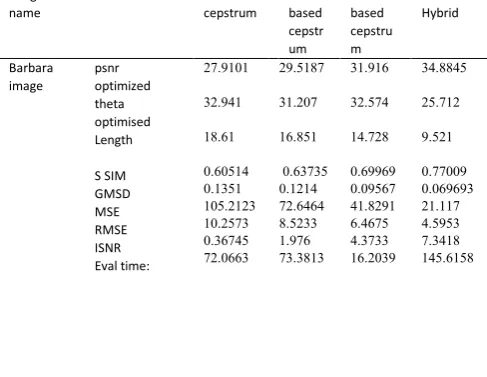
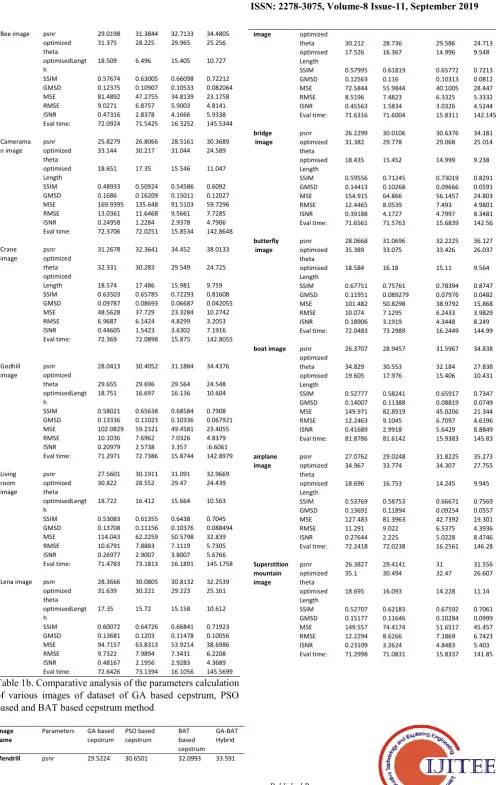
[image:4.595.305.549.543.731.2]The experiment was performed on Windows 8 with 4 GB RAM and was implemented using a Matlab 16. The online database of gray scale images of 49 images has been used to test the performance analysis of all four algorithms of cepstrum based image restoration using GA, PSO, BAT and GA-BAT hybrid. In all four algorithms cost function is sharpness function and generation size has been taken as 10. Table 1a and 1b shows parameters like PSNR, MSE, SSIM, GMSD, RMSE, CPU TIME etc evaluated.
Table 1a. Compative analysis of the parameters calculation of various images of dataset of GA based cepstrum, PSO based and BAT based cepstrum method
Image name
Parameters GA based cepstrum
PSO based cepstr um
BAT based cepstru m
GA-BAT Hybrid
Barbara image
psnr optimized theta optimised Length
S SIM GMSD MSE RMSE ISNR Eval time:
27.9101
32.941
18.61
0.60514 0.1351 105.2123 10.2573 0.36745 72.0663
29.5187
31.207
16.851
0.63735 0.1214 72.6464 8.5233 1.976 73.3813
31.916
32.574
14.728
0.69969 0.09567 41.8291 6.4675 4.3733 16.2039
34.8845
25.712
9.521
International Journal of Innovative Technology and Exploring Engineering (IJITEE) ISSN: 2278-3075,Volume-8 Issue-11, September 2019
Bee image psnr optimized theta optimisedLengt h SSIM GMSD MSE RMSE ISNR Eval time: 29.0198 31.375 18.509 0.57674 0.12375 81.4892 9.0271 0.47316 72.0924 31.3844 28.225 6.496 0.63005 0.10907 47.2755 6.8757 2.8378 71.5425 32.7133 29.965 15.405 0.66098 0.10533 34.8139 5.9003 4.1666 16.3252 34.4805 25.256 10.727 0.72212 0.082064 23.1758 4.8141 5.9338 145.5344 Camerama n image psnr optimized theta optimised Length SSIM GMSD MSE RMSE ISNR Eval time: 25.8279 33.144 18.651 0.48933 0.1686 169.9395 13.0361 0.24958 72.3706 26.8066 30.217 17.35 0.50924 0.16209 135.648 11.6468 1.2284 72.0251 28.5161 31.044 15.546 0.54586 0.15011 91.5103 9.5661 2.9378 15.8534 30.3689 24.589 11.047 0.6092 0.12027 59.7296 7.7285 4.7906 142.8648 Crane image psnr optimized theta optimized Length SSIM GMSD MSE RMSE ISNR Eval time: 31.2678 32.331 18.574 0.63503 0.09787 48.5628 6.9687 0.44605 72.369 32.3641 30.283 17.486 0.65785 0.08693 37.729 6.1424 1.5423 72.0898 34.452 29.549 15.981 0.72293 0.06687 23.3284 4.8299 3.6302 15.875 38.0133 24.725 9.759 0.81608 0.042055 10.2742 3.2053 7.1916 142.8055 Godhill image psnr optimized theta optimisedLengt h SSIM GMSD MSE RMSE ISNR Eval time: 28.0413 29.655 18.751 0.58021 0.13336 102.0829 10.1036 0.20979 71.2971 30.4052 29.696 16.697 0.65638 0.11023 59.2321 7.6962 2.5738 72.7386 31.1884 29.564 16.136 0.68584 0.10336 49.4581 7.0326 3.357 15.8744 34.4376 24.548 10.604 0.7908 0.067921 23.4055 4.8379 :6.6061 142.8979 Living room image psnr optimized theta optimisedLengt h SSIM GMSD MSE RMSE ISNR Eval time: 27.5601 30.822 18.722 0.53083 0.13708 114.043 10.6791 0.26977 71.4783 30.1911 28.552 16.412 0.61355 0.11156 62.2259 7.8883 2.9007 73.1813 31.091 29.47 15.664 0.6438 0.10376 50.5798 7.1119 3.8007 16.1891 32.9669 24.439 10.563 0.7045 0.088494 32.839 5.7305 5.6766 145.1758
[image:5.595.51.548.21.807.2]Lena image psnr optimized theta optimisedLengt h SSIM GMSD MSE RMSE ISNR Eval time: 28.3666 31.639 17.35 0.60072 0.13681 94.7157 9.7322 0.48167 72.6426 30.0805 30.221 15.72 0.64726 0.1203 63.8313 7.9894 2.1956 73.1394 30.8132 29.223 15.158 0.66841 0.11478 53.9214 7.3431 2.9283 16.1056 32.2539 25.161 10.612 0.71923 0.10056 38.6986 6.2208 4.3689 145.5699
Table 1b. Comparative analysis of the parameters calculation of various images of dataset of GA based cepstrum, PSO based and BAT based cepstrum method
Image name
Parameters GA based cepstrum PSO based cepstrum BAT based cepstrum GA-BAT Hybrid
Mendrill psnr 29.5224 30.6501 32.0993 33.591
image optimized
theta optimised Length SSIM GMSD MSE RMSE ISNR Eval time: 30.212 17.526 0.57995 0.12563 72.5844 8.5196 0.45563 71.6316 28.736 16.367 0.61819 0.116 55.9844 7.4823 1.5834 71.6004 29.586 14.996 0.65772 0.10313 40.1005 6.3325 3.0326 15.8311 24.713 9.548 0.7213 0.0812 28.447 5.3332 4.5244 142.145 bridge Image psnr optimized theta optimised Length SSIM GMSD MSE RMSE ISNR Eval time: 26.2299 31.382 18.435 0.59556 0.14413 154.915 12.4465 0.39188 71.6561 30.0106 29.778 15.452 0.71245 0.10268 64.866 8.0539 4.1727 71.5763 30.6376 29.068 14.999 0.73019 0.09666 56.1457 7.493 4.7997 15.6839 34.181 25.014 9.238 0.8291 0.0591 24.803 4.9801 8.3481 142.56 butterfly image psnr optimized theta optimised Length SSIM GMSD MSE RMSE ISNR Eval time: 28.0668 35.389 18.584 0.67751 0.11951 101.482 10.074 0.18906 72.0483 31.0696 33.075 16.18 0.75761 0.089279 50.8298 7.1295 3.1919 73.2989 32.2225 33.426 15.11 0.78394 0.07976 38.9792 6.2433 4.3448 16.2449 36.127 26.037 9.564 0.8747 0.0482 15.868 3.9829 8.249 144.99
boat image psnr
Accuiel image
psnr optimized theta optimised Length SSIM GMSD MSE RMSE ISNR Eval time:
26.5173
31.905 19.682
0.59991 0.1428 144.995 12.0414 0.2066 71.4785
29.433
28.487 16.708
0.67395 0.10848 74.0933 8.6077 3.1223 71.976
31.5923
30.238 14.798
0.72435 0.08889 45.0657 6.7131 5.2817 15.6969
33.219
24.057 10.228
0.7715 0.0738 31.014 5.5692 6.9042 141.65
Trillium lake image
psnr optimized theta optimised Length SSIM GMSD MSE RMSE ISNR Eval time:
28.2056 30.298
18.555
0.57803 0.11735 98.2915 9.9142 0.43039 73.1377
31.7703 28.275
15.709
0.67753 0.089943.2565 6.577 3.995 72.6394
32.4846 29.774
15.265
0.68705 0.08791 36.6964 6.0578 4.7093 16.0895
34.667 24.648
10.619
0.7523 0.0709 22.198 4.7115 6.8924 145.03
PSNR computed by cepstrum is found to be same by all three methods in every image. Figure 1a and 1b show graphical representation of comparative analysis of PSNR. It is found that PSNR is better in case of BAT than in case of GA and PSO.
Figure.1 Comparative analysis of PSNR cepstrum method using GA, PSO and BAT
[image:6.595.307.550.135.311.2]GMSD provides gradient magnitude similarity deviation used to measure the image quality. GMSD of restored image using GA, PSO and BAT is given in figure 2. The restored image output depends on the correctness of theta and length of cepstrum. GMSD have been calculated using the equation (5). It is observed from Figure 2, GMSD computed for all the three algorithms confirms that BAT based cepstrum is having lowest GMSD and GA based cepstrum having the highest GMSD. But PSO based cepstrum has the GMSD less than the GA based cepstrum. The value of GMSD reflects the range of distortion severities in an image. Higher the GMSD value, greater the distortion range. Hence BAT based cepstrum gives better perceptual quality.
Figure. 2 Comparative analysis of GMSD cepstrum method using GA, PSO and BAT
The similarity between two images can be computed using Structural Similarity (SSIM) index. It is a matrix to predict the quality. From Figure 3, it is clear that SSIM of BAT and PSO based cepstrum will have almost same the SSIM which is much better than GA based cepstrum.
Figure. 3 Comparative analysis of SSIM cepstrum method using GA, PSO ,BAT and GA-BAT hybrid
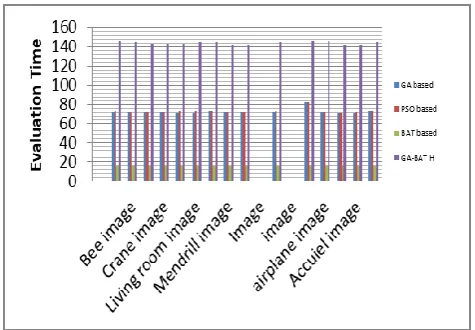
[image:6.595.308.546.420.585.2]Execution time of BAT based cepstrum method is the least among four algorithms. Figure 4 shows the running time of four algorithms on all images of dataset. All algorithms were run on Pentium processor with Intel® core(TM) i5-3210@ 2.50 GHZ 4 GB RAM, 64 BIT window operating system.
Figure.4 Comparative analysis of Evaluation time cepstrum method using GA, PSO , BAT and GA-BAT hybrid (1)
[image:6.595.51.289.637.765.2]International Journal of Innovative Technology and Exploring Engineering (IJITEE) ISSN: 2278-3075,Volume-8 Issue-11, September 2019
Figure. 5 Cost function cepstrum method using GA, PSO and BAT
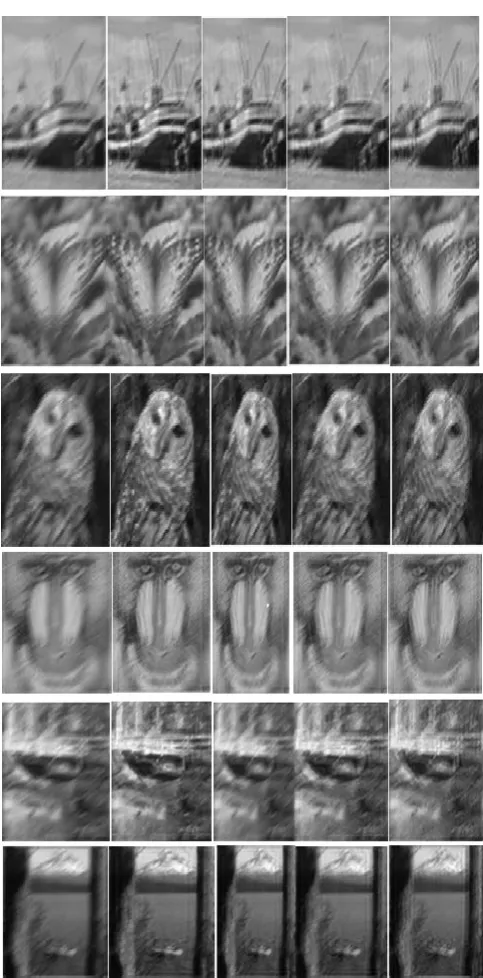
All four algorithms of cepstrum methods using GA, PSO, BAT and GA-BAT hybrid have applied on the dataset of motion blurred images. Visual appearance found to be better in case PSO and BAT as shown in Figure 6.
Figure 6(A) Motion blurred Camera image (B) Restored using method GA(C) Restored using PSO (D) Restoration using BAT on the dataset created using standard images. (E) Restoration using GA- BAT Hybrid on the dataset created using standard images.
Fig7. (a) Motion Blurred image (b)Restored image by Wang Met al [25] of PSNR 30. (c)Restored image by proposed system
[image:7.595.62.267.59.215.2]uthor-1 oto
V. CONCLUSION
In this paper, we have tried to improve the basic proposed technique of parameter estimation given in section 3.1 using various optimization techniques. The comparative analysis of cepstrum based PSF estimation method of motion blur has been done using GA, PSO, BAT and GA-BAT hybrid. Using all four methods, we have precisely estimated the blur parameters of motion blur. The quality of output restored image found using PSO and BAT is almost the same. The quality is improved using GA-BAT hybrid technique, but the evaluation time needed is much greater. It is clear that the evaluation time of BAT is minimum compared to the other three cepstrum based methods. This analysis can be helpful for researchers for further improvement of PSF parameter estimation.
Compliance with Ethical Standards:
Conflict of interest: All the authors declared that they have no conflict of interest.Ethical approval: This article does not contain any studies with human participants or animals performed by any of the authors.
ACKNOWLEDGEMENT
The author wish to convey her heartfelt thanks to the department of Electronics and department of Computer science engineering of the NITTTR, Chandigarh for their continued support and guidance for this research work. REFERENCE
1. Mark R. Banham : “Digital Image Restoration”, IEEE Signal Magazine’, 1997.
2. Torfinn Taxt ,”Comparison of cepstrum-based methods for radial blind deconvolution of ultrasound images”, IEEE transactions On ultrasonics ferroelectrics and frequency control, Vol.44 (3) ,1997, pp. 666–674.
3. O. Hasançebi, T. Teke, O. Pekcan ,”A bat-inspired algorithm for structural optimization”, Elsevier,2013
4. Qiong Li, Junhui Rao and Xiaofeng Yang,”Research Motion Blurred Image Restoration Algorithms”, International Journal of Signal Processing .Image Processing and Pattern Recognition, 8, (9), 2015, pp. 31-44.
5. Haruka Asai, Yuji Oyamada, Julien Pilet, Hideo Saito, “Cepstral analysis based blind deconvolution for motion blur”, International Conference on Image Processing, Hong Kong, 2010.
6. Mahmoud S. Hamid, Neal R. Harvey, and Stephen Marshall,“Genetic Algorithm Optimization of Multidimensional Grayscale Soft Morphological Filters With Applications in Film Archive Restoration”, IEEE Tansactions on circuits and systems for video technology,vol.13(5), ,2003, pp.406-416.
7. Yang-Chih Lai, Chih-Li Huo, Yu-Hsiang Yu,Tsung-Ying-Sun, “PSO-based Estimation for Gaussian Blur in Blind Image Deconvolution Problem.”,IEEE International Conference on Fuzzy Systems,2011.
8. X. Yang: ,”A new Metaheuristic Bat-inspired Algorithm”, Nature inspired cooperative strategies for optimization (NICSO 2010).
9. B. Ahmed, K. Zamli, and C. Lim, “Application of Particle Swarm Optimization to Uniform and Variable Strength Covering Array construction”, Applied Soft Computing, vol.12, 2012,pp. 1330-1347.
10.A. Gandomi, X. Yang, A. Alavi, and S. Talatahari,”Bat Algorithm for Constrained Optimization Tasks”, Neural Computing and Applications, 22, 2013, pp. 1239-1255.
11.D. Kundur and D. Hatzinakos, ”Blind image deconvolution.’, IEEE Signal Processing Magazine, vol.13(3) , 1996,pp. 43-64. 12.Shiqian Wu, Zhongkang Lu, Ee Ping Ong, Weisi Lin, “Blind Image Blur Identification in Cepstrum Domain”, IEEE Conference, 2007.
13.Jong Bae Kim, Hang Joon Kim,”GA Based Image Restoration by Isophote Constraint Optimization”, EURASIP Journal on Applied Signal Processing. Hindawi Publishing Corporation, 2003, pp. 238–243
14.Shah M, Dalal UD,”3D-image restoration technique using Genetic Algorithm to solve blurring problems of images”, The Imaging Science Journal,vol.62(7) ,2014, pp.365–74. 15.Zheng G, Yiran WA.,”Adaptive Genetic Algorithm Based on
Chaotic Intelligent Algorithm to Image Restoration”, Research. International Journal of Signal Processing, Image Processing and Pattern Recognition, vol.9(7), , 2016, pp305–314. 16.Tetsuya Imai, Ryoji Miyakoshi, and Heronry Yamauchi,”A
blind image restoration for out-of-focus blurred images using adaptive inverse filters”, Computational intelligence, man-machine systems and cybernetics miami, florida, USA,2005..
17.Ratnakar Dash, Pankaj Kumar Sa, and Banshidhar Majhi, “Particle Swarm Optimization Based Support Vector Regression for Blind Image Restoration”, Journal of Computer science and technology, vol. 27(5), 2012 pp. 989-995. 18.Chunhe Song, Hai Zhao, Wei Jing, Hongbo Zhu, “PSO Based
Motion Deblurring for Single Image”, ACM, 2011.
19.O. Hasançebi , T. Teke, O. Pekcan ,”A bat-inspired algorithm for structural optimization”, Elsevier, 2013.
20.Adis Alihodzic, Milan Tuba M,”Improved Hybridized Bat Algorithm for Global Numerical Optimization”, IEEE Conference, 2014.
21.X. S. Yang. ,”A new metaheuristic bat-inspired algorithm”,. Nature Inspired Cooperative Strategies for Optimisation (NICO), 2010, pp. 65-74.
22. Wufeng Xue , Lei Zhang , Xuanqin Mou , Alan C. Bovik, “Gradient Magnitude Similarity Deviation: A Highly Efficient Perceptual Image Quality Index”, IEEE Transactions on Image Processing, vol. 23,(2), ,2014,pp.684 – 695.
23. Alan C. Brooks, Xiaonan Zhao, , and Thrasyvoulos N. Pappas, “Structural Similarity Quality Metrics In a Coding Context: exploring the space of realistic distortions”, IEEE Transactions on image processing,vol.17(8),2008, pp.1261-1273.
24. Ashwini M. Deshpande, Suprava Patnaik,”On Improving
Accuracy of PSF Estimation in Spectral and Cepstrum Domain with Morphological Filtering”,IEEE conference 2012. 25.Wang M, Zhou S, Yan W (2018) Blurred image restoration
using knife-edge function and optimal window Wiener filtering. PLoS ONE , 2018,VOL.13(1):
26. Hui-YuHuang∗andWei-ChangTsai,” An efficient motion deblurring based on FPSF and clustering”, Mathematical Biosciences and Engineering Volume 16, Issue 5,2019, pp. 4036–4052.
AUTHORSPROFILE
Mrs Ramteke Mamta G. is a Research Scholar in the Department of Computer Science and Engineering at NITTTR Chandigarh. She received her Master’s degree at NITTTR Chandigarh. Her main research area is ‘Development Blind Deconvolution Technique for Restoration of Gray Scale Images.
International Journal of Innovative Technology and Exploring Engineering (IJITEE) ISSN: 2278-3075,Volume-8 Issue-11, September 2019