Available Online atwww.ijcsmc.com
International Journal of Computer Science and Mobile Computing
A Monthly Journal of Computer Science and Information Technology
ISSN 2320–088X
IMPACT FACTOR: 6.017
IJCSMC, Vol. 6, Issue. 9, September 2017, pg.8 – 14
ENHANCING THE LIFETIME OF
WIRELESS SENSOR NETWORK
USING P-LEACH PROTOCOL
R.Vanitha
1, Prof. B. Murali
2M.Phil Research Scholar, Department of Computer Science, PSG college of Arts and Science, Coimbatore, Tamilnadu, India1 Associate Professor, Department of ComputerScience, PSG college of Arts and Science, Coimbatore, Tamilnadu, India2
Abstract:
Wireless sensor network (WSN) consists of tiny sensor nodes with sensing, computation and wireless communication capabilities. Now a day, it is finding wide applicability and increasing deployment, as it enables reliable monitoring and analysis of environment. Recent advances in wireless sensor networks have led to many new protocols specifically designed for sensor networks where energy awareness is an essential consideration. The design of routing protocols for WSN is influenced by many challenging factors like fault tolerance, energy efficiency, scalability, latency, power consumption and network topology. The main requirement of a wireless sensor network is to prolong network energy efficiency and lifetime. This paper deals with these two factors. Researchers have developed protocols Low Energy Adaptive Clustering Hierarchy (LEACH) and Power-Efficient Gathering in Sensor Information Systems (PEGASIS) for reducing energy consumption in the network. LEACH features the dynamicity but has limitations due to its cluster-based architecture. PEGASIS overcomes the limitations of LEACH but lacks dynamicity. We introduce PEGASIS-LEACH (P-LEACH), a near optimal cluster-based chain protocol that is an improvement over PEGASIS and LEACH both. This P-LEACH performs better than LEACH and PEGAIS in terms of energy consumption, number of dead nodes and lifetime of the network. MATLAB is used for evaluating the performance of the protocol.
Keywords: LEACH protocol, PEGASIS protocol, P-LEACH protocol, Fuzzy logic, Cluster head (CH).
I. INTRODUCTION
of hundreds to thousands of sensor nodes that have the ability to communicate among themselves using radio [1]. The most important factor for WSN is the efficient energy usage and long lifetime. A higher lifetime can be accomplished through optimized applications, operating systems, and communication protocols [2].
The protocols have been proposed in recent times to make optimum use of the energy. Low Energy Adaptive Clustering Hierarchy (LEACH) [3] is the first ever clustering based protocol in which nodes are divided into clusters and for each cluster, a cluster head is selected randomly. LEACH provided the energy load balancing between the nodes by rotating the cluster heads. This approach increased the efficiency of the network. From then on, many researches focused on the various efficient ways of cluster formation and selection of the cluster heads so that operation of the network can be extended for a longer time. Other protocols like Stable Election Protocol (SEP) [4] divided the nodes on the basis of energy levels and nodes with higher residual energy are prioritized for the selection of cluster heads. This approach also improved the performance of the network in terms of increasing the lifetime. Various improvements of LEACH protocol has also been proposed that choose different criteria for the selection process of cluster head. PEGASIS [5] is chain based protocol in which nodes do not directly communicate with the base station, instead nodes connect with the nearest neighbor and thus start forming chain. In PEGASIS, randomly a node is chosen that becomes leader and that node will collect the data and send it to the sink. The performance of PEGASIS is much better than LEACH. The chain based protocol PEGASIS randomly selects a node to forward the data collected from the other nodes. The random selection will sometime lead to high delay due to formation of long links. So improvements are required in this area for the chain based protocols to perform better.
Hence, in this paper we propose the protocol P-LEACH, which overcome the shortcomings of LEACH and PEGASIS both. In P-LEACH, we use the cluster formation technique of LEACH in the chain based architecture of PEGASIS. As a result, the system will have higher lifetime, low energy consumption, and unlike PEGASIS, can also deal with a dynamic system and the delay in forming the chain is also taken into account and that is done using the fuzzy logic. This protocol uses an energy efficient routing algorithm to achieve the proposed results. The remainder of the paper is organized as follows: Section II briefs the progress in the field of WSNs; Section III presents the proposed work. Section IV shows the simulation result of P-LEACH routing protocol; Section V concludes the entire paper.
II. RELATED WORK
Many energy efficient techniques were employed. In [6], Handy et al. focus on reduction in power consumption of wireless sensor networks with the help of the LEACH protocol. LEACH’s stochastic cluster head selects an algorithm by a deterministic component to define the lifetime of a sensor network. It presents the three metrics – First Node Dies (FND), half of the Nodes Alive (HNA), and the Last Node Dies (LND) that determines the lifetime of a sensor network. However, it is assumed that all nodes in the network are homogenous and energy-constrained and are able to reach the base station, nodes have no location information, and cluster heads perform data compression.
In [7], multi-hop routing with the LEACH protocol to prolong lifetime of WSN is implemented based on Received Signal Strength Indicator (RSSI). It introduces the concept of equal clustering in which any node reaches the BS in an equal number of hops. This reduces energy consumption. But using direct communication protocol, it requires large amount of transmission power and thus drains the battery. This results in reduction in network lifetime.
In [8], sensor webs consisting of nodes with limited battery power and wireless communications are deployed to collect information from the field. Gathering information in an energy efficient manner is critical to operating the sensor network for a long period of time. Each sensor node has to send that packet to the distant base station. The LEACH protocol forms clusters to fuse the data before transmitting it to the base station. The PEGASIS protocol is put forth to reduce the amount of energy sent per round, to overcome the drawback of the LEACH protocol. PEGASIS eliminates the overhead dynamic cluster formation, minimizes the transmission distance for non-leader nodes, and limits the number of transmissions and receptions among all nodes.
tree technique have been selected by the base station, which then broadcasts this information to all nodes in the network. GSTEB requires less energy to change the topology in each round, has short transmission delay, and prolongs the network lifetime. The only short comings with this protocol are its transmission distance and power consumption. Al-Karaki et al. posted the advantages and disadvantages of routing, power management, and data dissemination protocols that are energy efficient in [10]. Based on network structure the routing techniques are classified as hierarchical, location based, or cluster based routings. These are evaluated for design, energy and communication overhead savings, and drawbacks. Based on this analysis the challenges and pinpoint future research guidelines are posed. Our paper gives highlights a few of the issues posed in [10]: energy and power efficiency, and dynamicity.
III. PROPOSED WORK
LEACH and PEGASIS are the most well-known energy efficient protocols for wireless sensor networks. LEACH considers dynamic cluster approach and energy efficiency during wireless transmission, while PEGASIS considers the power consumption, reduced traffic overload, increased network lifetime and cost efficiency, but doesn’t take into account dynamicity. The combination of the two protocols is to design an ideal routing protocol for wireless transmission and networking. The cluster head set is responsible for data forwarding in LEACH, while in PEGASIS, hierarchical chain formation is implemented. We propose the new protocol P-LEACH that combines the chain formation technique within the clusters for data forwarding.
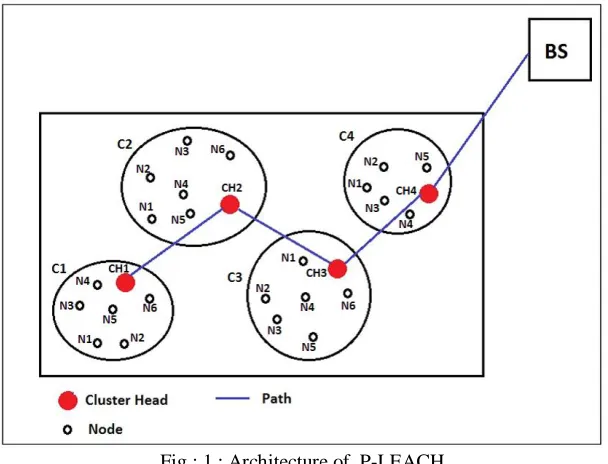
In Fig.1, the hollow circles represent the nodes, and the black spots represent the cluster heads. The line represents the optimized path from nodes (cluster-heads) to the Base Station. The nodes in a cluster select an active cluster head having the highest energy amongst them. Each cluster head communicates with other cluster heads in the network and thus form a chain to the base station. The cluster head having the nearest distance to the base station is selected as a leader of the chains, who is responsible for sending the data to the base station directly.
Fig : 1 : Architecture of P-LEACH
Cluster Head Selection: The leader selection method leads to improvement of the energy consumption of
Chain formation: The distance is calculated between the nodes and from nodes to the sink. Both these distances are calculated for each of the node and then the farthest node is determined based on the distance calculations. Thus bubble sort is applied to obtain the farthest node from the sink and it is labeled as first node. In this way nodes are sorted in descending fashion and then chain is constructed by connecting each node with nearest possible node till all the nodes get connected. After the formation of chain, as shown in Figure 2, the leader selection phase starts, leader is selected with the help of Fuzzy Inference System. For this Mamdani system is used that contains three parts: fuzzifier, inference engine and defuzzifier [12].
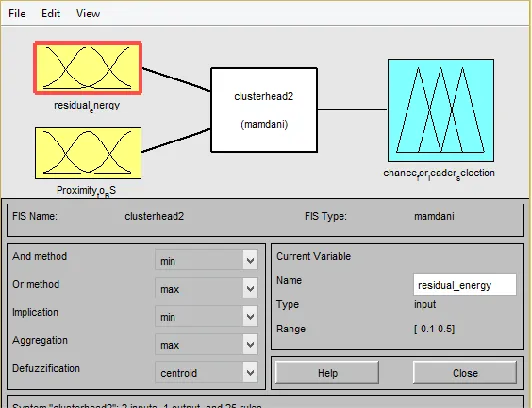
The MATLAB consists of Fuzzy toolbox in which two parameters have been used as input variables: residual energy and proximity to base station as shown in Figure 3.
These variables are divided into five levels: low, medium, high, very high, very low are used for residual energy whereas near, very near, medium, far, very far are used for the proximity to base station. Since two parameters are divided into five levels so 25 chance values are possible and thus 25 rules are possible for evaluation as shown in Figure 4.
Fig : 3 Fuzzy Inference System toolbox in MATLAB
In every round, the chance to become leader is calculated using IF-THEN rules and the one having the highest chance is selected as the leader which further leads to data transmission phase in which node collect the data from all the other nodes and transmit it to the base station.
The steps of the proposed method are as follows:
1. Initialize number of nodes, energy and location to the base station. 2. Dynamic cluster formation using LEACH
3. Select the cluster head using the fuzzy interference system.
4. Calculate the distances between the nodes and the sink.(i.e between the clusters) 5. Chain Construction starts by finding the farthest node form the BS
6. Join the farthest node to the minimum distance alive node and construct a chain 7. The node which is near to the sink is selected as the leader.
IV. SIMULATION AND RESULTS
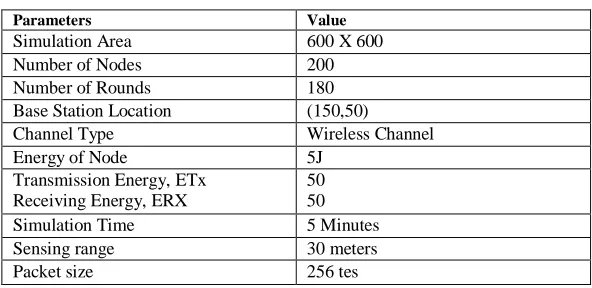
Our performance evaluations are based on the simulation of 100 wireless sensor nodes that form a wireless sensor network over a rectangular (600 m X 600 m) flat space. All network nodes start the simulation by an initial energy that is equal to 5Joules and an unlimited amount of data to be transmitted to the base station. In addition, the energy of the base station is considered unlimited. Each node uses its limited reserves of energy during the simulation, which causes the depletion. Any node which has exhausted its energy reserve is considered dead. We simulated P-LEACH protocol with MATLAB and parameters are given in Table II. The expected outcomes for the data transfer – energy, failure and lifetime are evaluated and compared with the existing protocols. The simulation parameters are provided in Table 1.
TABLE I: Simulation Parameters for MATLAB
Parameters Value
Simulation Area 600 X 600 Number of Nodes 200 Number of Rounds 180 Base Station Location (150,50) Channel Type Wireless Channel Energy of Node 5J
Transmission Energy, ETx Receiving Energy, ERX
50 50 Simulation Time 5 Minutes Sensing range 30 meters Packet size 256 tes
V. CONCLUSIONS
In this paper, we proposed the P-LEACH Routing Protocol for improving energy efficiency in wireless sensor networks. The performance of P-LEACH is compared with the LEACH and PEGASIS protocols. With simulation we observed that P-LEACH performs much better than LEACH, and PEGASIS in terms of network lifetime, number of dead nodes and energy consumption. MATLAB is used for evaluating the performance of the protocol.
REFERENCES
1. Baghyalakshmi, D., Jemimah Ebenezer, and S. A. V. Satyamurty. "Low latency and energy efficient routing protocols for wireless sensor networks." In Wireless Communication and Sensor Computing, 2010.ICWCSC 2010. International Conference on, pp. 1-6. IEEE, 2010.
2. Gowrishankar, S., T. G. Basavaraju, D. H. Manjaiah, and Subir Kumar Sarkar. "Issues in wireless sensor networks." In Proceedings of the World Congress on Engineering, vol. 1, pp. 978-988. 2008.
3. Z.Yang, J.Liu and X.Chen, “An Optimal Mechanism of LEACH protocol for Wireless Sensor Network”, International Colloquim on Computing Communication, Control and Management, Sanya, China, pp. 254-257, 2009.
4. G.Smaragdakis, I. Matta and A. Bestavros, “SEP: Stable Election Protocol for clustered heterogeneous Wireless Sensor Networks”, Deptt. Of Computer Science, Boston University, USA, Tech. Rep. BUCS-TR, 2004
5. S. Lindsey and C.S. Raghvendra, “ PEGASIS: Power Efficient Gathering in Sensor Information System”, IEEE Aerospace Conference Proceedings, pp 1125-1130, 2002
6. Al-Karaki, Jamal N., and Ahmed E. Kamal. "Routing techniques in wireless sensor networks: a survey." Wireless communications, IEEE 11,no. 6 (2004): 6-28.
7. Razaque A, Elleithy K. Modular energy-efficient and robust paradigms for a disaster-recovery process over wireless sensor networks. Sensors.2015 Jul 6;15(7):16162-95.
9. Lindsey, Stephanie, and Cauligi S. Raghavendra. "PEGASIS: Power efficient gathering in sensor information systems." In Aerospace conference proceedings, 2002. IEEE, vol. 3, pp. 3-1125. IEEE, 2002.
10. Shukla, Indu, and N. Meghanathan. "Power Efficient Gathering in Sensor Information System (PEGASIS Protocol)." Jackson State University,Jackson MS, USA (2010).
11. Gupta, D. Riordan, and S. Sampalli, “Cluster-head election using fuzzy logic for wireless sensor networks,” in
Proc. 3rd Annu. Commun. Netw.Services Res. Conf., May 2005, pp. 255–260.