Abstract: In recent years, there has been growing interest in alternative energy sources to fossil fuels. One of them is plastic pyrolysis oil (ppo) that converted from plastic waste by the pyrolysis process. The oil could be used as a fuel for combustion process in some industries. The performance of ppo combustion in steam-atomizing burner was investigated to determine the feasibility of diesel oil displacing in pyrolysis process heating. A prototype steam-atomizing burner was installed to burn plastic pyrolysis oil, with variable 3, 6, and 9 bar steam pressure, to pyrolyze 10 kg/batch low density polyethylene (LDPE) waste in a batch reactor. The pyrolysis process was maintained at 3500C along 2 hours at atmospheric condition. The flame temperature, the length of flame, fuel consumption, heating rate, and pyrolysis yield was observed along the process. The experiment shows that the increase of steam pressure will increase all parameters. The most optimum condition is plastic pyrolysis oil combustion using steam-atomizing burner at 9 bar steam pressure, which consumes 28 litre of fuel and yields 57% of pyrolysis oil.
Keywords : batch reactor, low density polyethylene, pyrolysis, steam-atomizing burner
I. INTRODUCTION
Plastic waste has become a major problem in Indonesia. The considerable growth of population and the change of lifestyle have caused a great amount of plastic wastes. This is not surprising because plastics have been used in many fields and become a part of modern life [1]. Actually, plastics are very useful and have good characteristics as materials, such as durability, processability, cheap, light weight, corrosion resistant, etc., so that they are exploited massively in human daily activities. Furthermore, the amount of plastic waste is increases which linier to its utilization, and they are finally ended in the ocean. Based on the fact, the number of plastic waste that threw away to the ocean in Indonesia is the second in the world, after China [2].
Plastics made from polyethylene (HDPE and LDPE) are the largest parts of inorganic wastes, followed by polypropylene (PP), polystyrene (PS), polyethylene terephthalate (PET) and Others [3]. They have a short lifetime and will end up in the landfills [4]. They have a slow degradation rates and the presence of toxic dyes will destroy the environment and cause some operational problems at
Revised Manuscript Received on September 03, 2019
* Correspondence Author
M.Sigit Cahyono*, Petroleum Engineering Department, Proklamasi 45 University, Yogyakarta, Indonesia. Email: [email protected]
Agus Prasetya, Chemical Engineering Department, Gadjah Mada University, Yogyakarta, Indonesia. Email: [email protected]
M.Syamsiro, Mechanical Engineering Department, Janabadra University, Yogyakarta, Indonesia. Email: [email protected]
landfills [5]. Though plastic wastes can be destructed by burning at low temperatures, they in turn cause pollution problems with harmful and carcinogen compounds, such as poly-chloro dibenzodioxins and poly-chloro dibenzofurans [6]. Plastic waste also causes a healthy problem because they can act as a habitat for disease-causing vectors and release waterborne pollutants [7].
Therefore, to reduce the damage and avoid the pollution caused by plastic waste, it was needed a recycling process and recovery efforts. One of the chemical recycling technology is pyrolysis, as an acceptable method for plastic waste treatment from environmental and economical aspect [8] [9]. Pyrolysis is defined as a thermochemical process of the material degradation with heating process in an inert atmosphere. It can produce synthetic fuel for gaseous and liquid products which can be used in petrochemical industry, and production of the coke as raw material for gasification [10].
Plastic is a crude oil derived polymer which has high heating value from 42.1 to 49.4 MJ/kg [11]. The oil product of plastic pyrolysis is dominated by hydrocarbon compounds with low oxygenated compounds, so that they have a high heating value and low degree of acidity.
The plastic pyrolysis research are carried out in different experimental conditions. They are mostly related to the specific types of materials or their mixtures [12-14]. All of the experiments makes the comparison of processes occurred. Jung and Fontana give a brief review of the materials variations to the pyrolysis process [15].
Some parameters are influence the optimization of the product yield and composition in pyrolysis process. Those key parameters are residence time, catalysts, temperature, pressure, type of reactors, type of fluidizing gas and its rate. The preferred product can be accomplished by controlling the setting of parameters [16]
Previous research have been carried out to convert plastic wastes into fuel by pyrolysis process. They have been studied the parameters which influence the products yield. The most affecting variables are pyrolysis temperature and time. Mandala et al [17] determined the effect of temperature on the yield and calorific value of plastic pyrolysis oil. Based on the experiment, increasing the temperature have upgraded the yield and calorific value of the oil. The highest yield and calorific value have generated for the pyrolysis process at temperature 4000C, that are 44% and 10,292 cal/g, respectively.
Syamsiro et.al [18] was examined the sequential pyrolysis and catalytic reforming process for the fuel oil production from municipal plastic wastes.
The outcomes show that the product yields and the quality
Combustion of Plastic Pyrolysis Oil in
Steam-Atomizing Burner and Its Application for
Pyrolysis Process
of liquid and solid products was influenced by feedstock types. The highest liquid fraction was produced from HDPE waste. The liquid fraction was decreases and the gaseous fraction was increases along with the presences of the catalyst. In addition, the pyrolysis of municipal plastic wastes was produced a solid products with higher heating value than those of low rank coal and biomass. Yuliansyah et.al [19] was studied the pyrolysis of plastic bag waste, considered as a low density polyethylene (LDPE), to produce fuel oil. The proceeds indicated that 3500C was the optimum temperature for plastic waste pyrolysis, which the oil yield gained was 52.6% (vol/w). Furthermore, the oil product’s properties were relatively closer to the characteristic of kerosene than other commercial fuels.
The type of reactors has a significant effect to the residence time, heat transfer and efficiency of the pyrolysis reaction. Most of the lab scale plastic pyrolysis experiments were performed in batch reactor, because the parameters can be easily controlled. Therefore, from the literature study, the batch or semi-batch reactors are obtain high liquid yield. Nevertheless, batch operation was not suitable for large production since it required high operating cost for feedstock recharging [20].
The utilization of plastic pyrolysis products has been studied by some researcher, especially in the diesel engine. Verma et.al. learned the impact of waste plastic pyrolysis oil utilization in a diesel engine at various compression ratios with different load and blending with pure diesel (pure diesel, 10%, 20%, 30%, 40%) at constant engine revolution. The results show that Plastic oil can be used to save the 40% diesel without loss of power, and its trend does not differ with variation in compression ratio [21].
Kalargaris et. al. explain the use of plastic pyrolysis oil as a primary fuel in diesel engine and give the long-term effects of them. In their study, 75% PPO and 25% diesel blending was used in the engine for the longevity test. The engine was failed and a piston was cracked after 36 hours operation. Indeed, the exhaust temperatures analysis during the failure moment encouraged that the injector failure was the reason for the cracked piston. Then, the lubricant oil was analysed and confirmed that due to the elevated contamination, the wear was increase. Finally, the deposits from the piston heads disclose that incomplete combustion was taking place [22].
Panda et al., [23] concluded that engine gives better performance up to 30%, while it may operate with maximum up to 50% blended to diesel. The study shows a stable performance with brake thermal efficiency similar to that of diesel and its value is higher up to 80% of the load. Also, the emissions are excessively higher than diesel, that observed throughout the experiment. Ceyla et al. [24] also found the similar trend of emission. Injection timing for any CI engine plays a major role in combustion and performance. Viswanath et al. [25] also concluded that brake thermal efficiency of blends are lower compared to diesel, but 25% blending shows similar performance to that of diesel. Syamsiro et.al [26] also found that brake thermal efficiencies of waste polyethylene oil (WPO) are quite higher as compared to that of diesel. However, the difference was not significant since the calorific value of WPO which is found to be similar than that
Some studies above have shown that the pyrolysis of plastic wastes become oil product was conducted a good result. However, its implementation has not been optimum because they need a lot of energy to heat the reactor, so that it
needs external fuel addition such as fuel oil, natural gas, or biomass. The best alternative to make the process more efficient is by using their by-product for reactor heating
(Autothermal system). This system will make it work properly
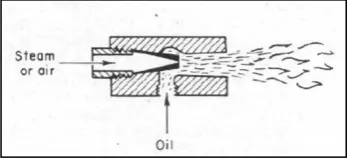
if use a good combustion equipments, like steam-atomizing burner, as shown in Figure 1 below.
Fig. 1
. Steam-atomizing burnerIn this burner, the atomization process of fuel uses a high pressure steam from injectors with 3-12 kg/cm2 pressure. The working principle of the burner is the fuel flow from the channel that perpendicular with steam or air flow, then it was broken into soft granules in front of the nozzle. This will cause a swirl of oil and air or steam mixture in front of the burner's mouth. The centrifugal force that emerges from the vortex of the mixture will help the fogging process, so that a large flame will be obtained [27].
There are several ways to atomize the fuel. Some (usually smaller) boilers just use pressure (like the 'mist' setting on a garden hose) to atomize. Some shoot the fuel into a cup that is spinning really fast so that the fuel is flung in all directions. But more common in my experience is either steam or air atomization. Air is again more common on smaller boilers or used for start up before steam pressure is developed. Steam atomization is at least partially chosen because it is simple. Pressurized steam is used to blow what would otherwise be a stream of fuel apart into those nice, small droplets that burn quickly. While compressed air requires a compressor which requires electricity, pressurized steam is readily available once the boiler is up and running. Using steam will shut down one more piece of machinery that could break down and it is probably cheaper to produce than the compressed air [28].
The effectiveness of the plastic pyrolysis oil utilization as a fuel can be observed from the characteristics of oil combustion, which consists of combustion temperature, length of flame, and the air to fuel consumption ratio (AFR). The combustion characteristics are very dependent on the pressure that used for the atomization process in the burner. Therefore, the purpose of this research was to determine the influence of steam pressure on the combustion characteristics of plastic pyrolysis oil using Steam-Atomizing Burner.
II. MATERIALS AND METHODS
A. Materials
The materials used as the feedstock for pyrolysis process is the waste of plastic carrier bag, considered as low density polyethylene (LDPE). It was obtained from waste collector in Piyungan Landfill Area, Bantul Regency, Indonesia. While the fuel used for the initial pyrolysis process is biomass in the form of branches and leaves in around Umbulharjo Integrated
Waste Processing Area,
[image:2.595.342.516.129.212.2]B. Equipments and Experimental Procedures
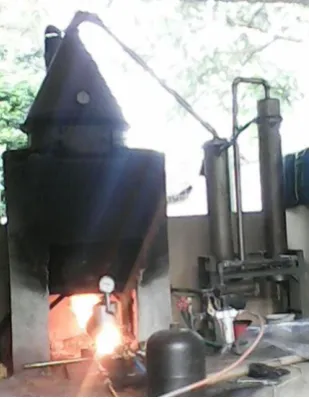
[image:3.595.90.245.112.312.2] [image:3.595.310.545.301.468.2]The equipment used is a set of steam-atomizing burner which integrates with fixed-bed pyrolysis reactor, as seen in Figure 2.
Fig. 2. Steam-atomizing burner integrated with pyrolysis reactor
The first phase of research is the production of plastic pyrolysis oil. The raw material is fed into the pyrolysis reactor (retort), then the cover is closed tightly. Otherwise, furnace (kiln) is filled with initial fuel (biomass) and the condenser is filled with water using a pump from a water reservoir. After all equipment is ready, fire is ignited with initial fuel, while the circulation of condensation water is turned on. The pyrolysis process is carried out at a stable temperature of 3500C. In the pyrolysis process, plastic will melt and evaporate into hydrocarbon vapor, flowing through the pipe to condenser and condense into oil and stored in a container. Some noncondensable gas will be recycled to the kiln to help the heating process. Pyrolysis is stopped when there is no gas coming out from condenser again. Then all equipments are turned off and allowed to stand near room temperature. After cool, reactor cover is opened and the charcoal is displaced from the reactor and weighed. The oil obtained from the pyrolysis process is measured using measuring glass to calculate the yield of the pyrolysis process.
Next stage is testing the combustion characteristics of plastic pyrolysis oil using a steam-atomizing burner. This experiment starts with filling a 10-liter storage tank with pyrolysis oil and filling the water tube with clean water to the specified level. Then, opening the air valve and fuel valve slowly until the oil sprayes through the burner nozzle. In front of nozzle, the flame igniter is turned on so that the oil will burn and heat up the steam in the steam tube.
The heating process is carried out until steam pressure reaches the desired variable, that are 3, 6, and 9 bars. After the pressure reached, the steam valve was opened to replace the air so that combustion with oil and steam mixtures can occur. The energy that produces from its combustion was used to heat the pyrolysis reactor until produce pyrolysis oil. During combustion, temperature and length of flame are recorded every 5 minutes until the process completed for 1 hour, and then all equipment is turned off completely. The fuel
(pyrolysis oil) remaining in the storage tank is measured to determine fuel consumption during the experiment, and the pyrolysis oil that produced also measure for efficiency analysis.
III. RESULT AND DISCUSSION
A. Effect Of Steam Pressure on Fire Temperature and Flame Length
The fire temperature measurement is carried out with a thermocouple connected to a digital thermometer, at the end of the fire tube of thein steam-atomizing burner. While the process of measuring the length of the flame is carried out with a ruler placed in front of the burner in the direction of fire coming out from the burner.
During the combustion process of plastic pyrolysis oil using a steam-atomizing burner, data were obtained from observation of fire temperature and length of flame during the heating process when the system was stable, shown in Figure 3.
Fig. 3. Influence of steam pressure to fire temperature and flame length of the burner
Figure 3 shows that increasing steam pressure, the fire temperature also increases, which the largest temperature is 1500°C at 9 bar steam pressure. This happens as the increase of steam pressure, the atomization process of fuel is better and fire temperature will be higher. Increased of pressure discharge will increase the amount of oxygen in the combustion process, so that it will increase a combustion temperature [29].
In addition, figure 3 also shows that increasing of steam pressure, the length of flame will also increase, with a maximum length of 100 cm occur at 9 bar steam pressure. This flame is more stable than the flame with pressure below it. At small pressure (3 bar) the nature of flame is unstable and the flame length is only 50 cm, because of the low steam pressure cannot atomize the fuel properly to break droplets into smaller sizes.
Koide et al [30] showed that the lack of oxygen with a constant amount of fuel and air pressure, would result in incomplete combustion, as indicated by the more smoke formed where CO gas more
indicated by the length of flame reaching 100 cm and stable. This happens because steam pressure is able to atomize the fuel so that the droplet size is smaller and easy to burn and produces a stable flame. The use of steam atomization in oil burners is to support the mixing of oil and air to drive a full combustion. With a steam injection, the oil is narrowed to a fine spray that jumbled with air and burns facilely. The result is a flame that is short and robust.
B. Effect of Steam Pressure on Fuel Consumption Fuel consumption rate measurement is done to determine the efficiency of plastic pyrolysis oil combustion using steam-atomizing burner, with steam pressure variable. The volume of fuel consumption is calculated from the difference of initial pyrolysis oil level with unburned oil which left in fuel tank.
[image:4.595.312.549.50.218.2]During the combustion process of plastic oil using a steam-atomizing burner, we obtained data about the effect of burner steam pressure on fuel consumption and yield of oil produced from the pyrolysis process, as shown in table 1.
Table-1: Fuel consumption and yield of oil produced Steam pressure
(bar)
Fuel consumption
(liter)
Yield of the oil
produced (%)
3 13 25
6 22 37
9 28 57
From Table 1 we can see that the consumption of fuel (pyrolysis oil) used during the experiment have increased with steam pressure used in the steam-atomizing burner. This shows that the presence of large steam pressure requires a lot of fuel so that combustion can be perfect.
On the other side, increasing the steam pressure have increased the yield of plastic oil produced, although not proportional to the consumption of fuel used. This is due to the higher steam pressure of burner will cause a good mixing of air and fuel, so that the combustion will be more perfect and generate a lot of heat [29]. This heat is transferred to the pyrolysis reactor quite well so that it can increase the yield of oil from pyrolysis.
In the combustion process, liquid fuel needs to be in contact with oxygen at a high temperature in order to combust and be destroyed. These liquids are typically injected into the hot gas stream through spray nozzles that are designed to transform the liquid stream into droplets that are more easily combusted. The spray nozzles commonly utilize steam to heat the liquid and mechanically cause the droplets in the spray pattern to form and easily travel in the hot gas to locate oxygen molecules for combustion. In general, better atomization results in better combustion and make the fuel consumption is lower [31].
C. Effect of Air Pressure on Pyrolysis Reactor Temperature
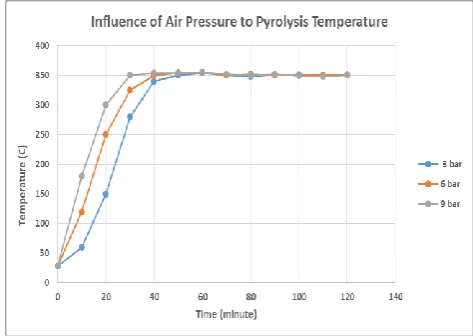
Based on the main experiment, the increase of reactor temperature during pyrolysis process with energy sources from plastic oil combustion using steam atomizing burner is shown in Figure 4.
Fig. 4. The increasing rate of temperature in the reactor during the pyrolysis process
Figure 4 shows the graph of temperature rising rate in the reactor during the plastic pyrolysis process. It can be seen that the increase of air pressure used in steam-atomizing burner for burning plastic oil, have increased the temperature rising rate of the pyrolysis process. The highest temperature rising rate is 11,670 C/min, that reach from pyrolysis with 9 bar air pressure in the burner. This is because of energy produced from burning plastic oil process is increase if the amount of steam used greater, so that the reactor temperature will be higher due to a high amount of energy. It must be noted that the results and quality of pyrolysis products were dependent on several parameters, such as temperature, type of reactor, residence time, pressure, and use of catalysts. However, thermo-gravimetric analysis (TGA) shows that the rate of temperature rise is important in decomposition of plastic molecules [19].
IV. CONCLUSION
The steam pressure in steam-atomizing burner have influence the temperature of fire and the length of flame, where is increasing the steam pressure have increased fire temperature and length of flame. Otherwise, the fuel consumption of the burning process and yield of the oil produced from the pyrolysis process also increase along increasing of steam pressure, which linier with temperature rising rate of the reactor.
ACKNOWLEDGMENT
The authors would like to thank the Ministry of Research and Technology and Higher Education (RISTEKDIKTI) of Republik Indonesia, for fully funding the work described in this publication through the Higher Education Collaboration Research (PEKERTI) Scheme.
REFERENCES
1. M.S.Cahyono, U.I.F. Styana, “Influence of heating rate and temperature on the yield and properties of pyrolysis oil obtained from waste plastic bag”. Conserve : Journal of Energy and Environmental Studies (CJEES), Vol.1, No.1, pp. 1-10, March. 2017.
2. J.R. Jambeck, R. Geyer, C. Wilcox, T.R. Siegler, M. Perryman, A. Andrady, R. Narayan, K.L. Law,
[image:4.595.51.291.298.377.2]Author-1 Photo
Author-2 Photo
Author-3 Photo 3. H. Saptoadi, N.N. Pratama, “Utilization of plastics waste oil as partial
substitute for kerosene in pressurized cookstoves”. International Journal of Environmental Science and Development, Vol. 6, No. 5, 2015.
4. M. Anjum, R. Miandad, M. Waqas, I. Ahmad, Z.O.A. Alafif, A.S. Aburiazaiza, M.A. Barakat, T. Akhtar, “Solid waste management in Saudi Arabia: a review”. Journal of Applied Agriculture and Biotechnology, Vol.1, pp 13-133, 2016.
5. A. Demirbas, B.O. Al-Sasi, A.S. Nizami, “Conversion of waste tires to liquid products via sodium carbonate catalytic pyrolysis”, Energy Source: Part A, 38, 2487-2493, 2015.
6. R. Ermawati, “Conversion of plastic waste as alternative energy source”, Jurnal Riset Industri, Vol.V, No.3, Hal.257-263, 2011.
7. M. Rehan, A.S. Nizami, K. Shahzad, O.K.M. Ouda, I.M.I. Ismail, T. Almeelbi, T. Iqbal, A. Demirbas, A.S. Nizami, “Effect of zeolite catalysts on pyrolysis liquid oil”, International Biodeterior. Biodegradable, 119, 162-175, 2017.
8. S.V. Papuga, “Temperature and time influence on the waste plastics pyrolysis in the fixed bed reactor”. Thermal Science, Vol. 20, No. 2, pp. 731-741, 2016.
9. R.F. Wati, I.N.G. Wardana, Winarto, Sukarni, P. Puspitasari, “Pengaruh penambahan nanokatalis MnFe2O4 terhadap proses pirolisis sampah plastik HDPE”, Jurnal Rekayasa Mesin, Vol.9, No.3, 221-225, 2018. 10. P.T. Williams, Waste Treatment and Disposal, John Wiley & Sons,
Chichester, UK, 2005.
11. B. Kunwar, H.N. Cheng, S.R. Chandrashekaran, B.K. Sharma, “Plastics to Fuel: A Review”. Renewable and Sustainable Energy Reviews. 54, 421, 2016.
12. A. Adrados, “Pyrolysis of plastic packaging waste: a comparison of plastic residuals from material recovery facilities with simulated plastic waste”, Waste Management, 32, 5, pp. 826-832, 2012.
13. F. Ding, “Kinetic study of low-temperature conversion of plastic mixtures to value added products”, Journal of Analytical and Applied Pyrolysis, 94, Mar., pp. 83-90, 2012.
14. P.T. Williams, E. Slaney, “Analysis of products from the pyrolysis and liquefaction of single plastics and waste plastic mixtures”, Resources, Conservation and Recycling, 51, 4, pp. 754-769, 2007.
15. C.G. Jung, A. Fontana, Production of Gaseous and Liquid Fuels by Pyrolysis and Gasification of Plastics: Technological Approach, in: Feedstock Recycling and Pyrolysis of Waste Plastics: Converting Waste Plastics into Diesel and Other Fuels, (Eds J. Scheirs, and W. Kaminsky), John Wiley & Sons, Chichester, UK, pp. 251-283. 2006 16. S. Sharuddin, F. Abnisa, W.M.A.W. Daud, M.K. Aroua, “A review on
pyrolysis of plastic wastes”, Energy Conversion and Management, Vol. 115, p. 308–326, 2016.
17. W.W. Mandala, M.S. Cahyono, S. Ma’arif, H.B. Sukarjo, Wardoyo. “Influence of temperature to the yield and caloric value of waste plastic pyrolysis oil”, Jurnal Mekanika dan Sistem Termal, Vol. 1(2), pp. 49-52, Agustus 2016.
18. M. Syamsiro, H. Saptoadi, T. Norsujianto, P. Noviasri, S. Cheng, Z. Alimuddin, K. Yoshikawa, “Fuel oil production from municipal plastic wastes in sequential pyrolysis and catalytic reforming reactors”. Energy Procedia, Volume 47, pp. 180–188, 2014.
19. A.T. Yuliansyah, ”Pyrolysis of plastic waste to produce pyrolytic oil as an alternative fuel”. International Journal of Technology, 7: 1076-1083, 2015.
20. I. Kayacan, O.M. Dogan, “Pyrolysis of low and high density polyethylene, part I: non-isothermal pyrolysis kinetics”, Energy Sources, Vol. 30, pp. 385-391, 2008.
21. A. Verma, A. Raghuvansi, M.A. Quraishi, J.V. Tirkey, C. Verma, “Engine fuel production from waste plastic pyrolysis (WPO) and performance evaluation in a CI engine with diesel blend”, J. Mater. Environ. Sci., Volume 9, Issue 6, Page 1712-1721, 2018.
22. I. Kalargaris, G. Tian, S. Gu, “Investigation on the long-term effects of plastic pyrolysis oil usage in a diesel engine”. In : 9th International Conference on Applied Energy, ICAE2017, Energy Procedia 142 (2017) 49–54, 21-24 August 2017, Cardiff, UK.
23. P. Achyut, S. Murugan, R.K.Singh, “Performance and emissions characteristics of diesel fuel produced from waste plastic oil obtained by catalytic pyrolysis of waste polypropylene”, Energy soures, Part A; Recovery utilization and environmental effects, 38, 568-576, 2016. 24. C. Güngör, H.Serin, M.Özcanli, S. Serin, K. Aydin, “Engine
performance and emission characteristics of plastic oil produced from waste polyethylene and its blends with diesel fuel”, International Journal of Green Energy, 12, 98–105, 2015.
25. V.K. Kaimal, P. Vijayabalan, “A study on synthesis of energy fuel from wasteplastic and assessment of its potential as an alternative fuel for diesel engines”, Waste Management, 51, 91–96, 2016.
26. M. Syamsiro, H. Saptoadi, M. Kismurtono, Z. Mufrodid, K. Yoshikawa, “Utilization of waste polyethylene pyrolysis oil as partial substitute for diesel fuel in a diesel engine”, International Journal of Smart Grid and Clean Energy, vol.8 no.1, Januari 2019.
27. A. Curtis, Assesment of The Effect of Cumbustion Waste Oil, and Health Effect Associated with The Waste Oil as a Dust Supresant. USA : WoodwardClyde. Ltd, 2001.
28. A. Slade, “Why is atomization with steam done in oil-fired boilers?” https://www.quora.com/Why-is-atomization-with-steam-done-in-oil-fir ed-boilers. Feb 10, 2018.
29. P.A.Prabawa, Influence of air pressure to characteristic of residual oil combustion using vaporizing burner for alumunium melting, Bachelor Thesis, Universitas Sebelas Maret Surakarta. 2010.
30. K. Koide, R&D on central heating system with cracked light oil fraction as the main fuel, Petroleum Energy Center All Right Reserved. C3.1.8, 1999.
31. D.W. Spitzer, “Air vs. Steam Atomization Part 3 – The Atomization Process”.
https://chemical-materials.elsevier.com/chemical-manufacturing-excell ence/air-vs-steam-atomization-part-3-atomization-process/ Posted on July 24th, 2017.
AUTHORS PROFILE
M.Sigit Cahyono is currently working as Lecturer and Researcher in the Department of Petroleum Engineering at Proklamasi 45 University. His main research area is waste to energy especially in thermal procession technology.
Agus Prasetya is currently working as Lecturer in the Department of Chemical Engineering at Gadjah Mada University. His main research area is waste processing technology.