a
Corresponding author: [email protected]
A process-based approach to management of the enterprise
Tatiana Ryzhakina¹,a, Natalia Koroleva¹, and Natalia Makasheva2
1
Tomsk Polytechnic University, 634050 Lenin Avenue, 30, Tomsk, Russia 2
Tomsk State University, 634050 Lenin Avenue, 36, Tomsk, Russia
Abstract. Establishing an efficient management system is an especially pressing issue for machinery industry as a basic sector of economy in a country. The present paper considers establishing a management system oriented towards increasing enterprise value and customer satisfaction through the integration of process-based management and a Balanced Scorecard. An integrated management system enables structuring of organization processes, redesigning them with regard to external changes as well as applying a balanced scorecard connecting functional units by means of defining strategic objectives and measurable indicators detailing and controlling these objectives and thus increasing the efficiency of processes orienting an organization towards a customer.
Introduction
The dynamics of the external surroundings dictates to the enterprises the necessity of the transfer from the accumulation of the volumes of the production to the diversification of the economic activities. On this basis, the maximum satisfaction of the clients, in its turn, requires the flexibility of the new ideas, technologies on new markets, work experience of the competitive advantages. In the situation of economy reorientation towards a customer, process-based management acquires special relevance [1].
A characteristic feature of the activity of the enterprises is a functional approach, which in a market economy makes it difficult to manage enterprises effectively. The development of management systems requires new approaches, aimed at optimizing business processes in order to increase their effectiveness. The main indicators of efficiency of business processes include the volume and value of production. These indicators should be connected to the purpose of the enterprise: increasing its value. Experience in the use of the process approach to management allows solving the problems in the interaction between the functional units of the company, focusing their activities on achieving the corporate goals and the end result - customer satisfaction. It also allows reducing overhead costs, making management decisions flexibly and quickly in a dynamic external environment.
Main areas of the organization process
management
Today it is possible to identify three main areas of the organization process management: 1) allocation of key processes, their consistent organization, documentation, and their gradual spread; 2) allocation of end-to-end processes; 3) system of the organization processes based on one of the models.
The first direction describes the integrated processes of structural divisions of the upper level. Then each of these processes is considered to be a lower-level process, etc. However, in this case a company is described in terms of functional activities, which is a major shortcoming of this method.
The second direction is based on the methodology for the selection of cross-cutting processes. Effective management of activities focuses on cross-cutting values chains, passing through the subdivisions of the Organization and business processes. Organization of enterprise management enables us to focus on getting the final result of the process, dramatically speeds up business processes and enhances the quality of the work.
The third direction assumes that the organization processes carried out by introducing models of allocation of business-processes organization. Their characteristic is a clear aggregation, which works on the result. This approach is more difficult to develop, much more difficult to introduce, but allows one to actually optimize the operations of the enterprise.
Process-based management
This approach is based on business process determination.
Currently the majority of machinery industry enterprises in Russia have obtained a functional organizational structure in which an enterprise business is a set of functions connected with functional units. It should be noted that the statement implying that a hierarchically built organization has no processes is wrong. There are processes in each organization. In addition, if an enterprise is financially healthy, it means its processes are sufficiently effective and productive. A question is only whether the existing management system provides a profitable operation in the long term.
Using a system approach, which considers the enterprise activity within a linear-functional organizational structure, one has to define an interconnected process system of an organization. Hereupon the enterprise is considered as a business process system being an aggregate of interconnected and interacting business processes, representing all the functions executed in its units and converting inputs into outputs [ 5]. The process owner, taking a clear position in the organizational structure, possesses all resources required to increase process efficiency. The interaction between all units is regulated. The enterprise activity is accurately documented. The organizational structure is not subjected to changes without well-founded reasons. When assigning processes to functional units, it is necessary:
1. To single out structure and describe existing business processes in the business process system of an organization.
2. To indicate the responsibility of managers for each business process.
3. To determine the efficiency indicators of business processes, as well as their measurement methodology.
4. To develop and approve existing orders, thus, formalizing a business process system.
5. To manage a business process in case of deviations in a process indicators or external environment changes.
Thus, the influence of the clear, regulated interaction of different units' processes on inputs/outputs occurs to ensure conditions for an enterprise to operate efficiently. The internal business processes are divided into core and auxiliary processes. The cores (marketing, product development - innovation, supply, production, sales, service, etc.) produce added value; auxiliary processes (financial management, staff management, etc.) form an enterprise structure. Considering the processes as the value added objects of an enterprise one reveals bottlenecks and defines a perfection vector. It seems obvious that, depending on an enterprise goal and, respectively, a developed strategy, different options of projects to perfect these or other processes are possible: 1. The identification of target products and services that provide a fixed level of profitability and that are promising in a long-term period, as well as withdrawal of «unprofitable» products from an assortment.
2. The identification and the development of key competences that might ensure enterprise’s achievement of a competitive advantage.
3. The establishment of a business culture to support changes at an enterprise.
Framing the system of indicators
The stage of scorecard development is critical to introduce a process-based approach in management. In order to develop a scorecard to manage processes it is necessary that:
- an organization should obtained a formalized strategy including strategic objectives and indicators to measure progress;
- strategic objectives should be tied up with process management indicators;
- a scorecard should be focused on the increase of process operational efficiency and the satisfaction of internal and external customers;
- indicators should cascade in the transition from the process of one level to another.
Moreover, if managers do not manage their processes on the basis of the scorecard, the process regulation tool will be used in most cases formally, existing regulation is to be constantly ignored.
If the perfection project of a management system covers all the company, the consideration of strategic issues and objectives becomes its integral part. This approach started its development in a balanced scorecard (BSC) developed by R. Kaplan and D. Norton [2] .
Balanced scorecard
A balanced scorecard for assessment of organization activity was developed by R. Kaplan and D. Norton. In the 90s, it was proposed as a means of overcoming limitations that arose during management with the use of financial measures only. The idea of this system is based on two key provisions [2]:
1. The use of only financial measures in management does not allow successfully achieving a long-term objective to maximize enterprise value.
2. The well-organized implementation of chosen strategies is much more important than the quality of the strategies themselves.
The balanced scorecard provided enterprises with a mechanism to develop a value creation strategy based on four components:
The Finance. A profitability growth and a risk management strategy in the shareholder value perspective.
The Customers. A value creation and a differentiation strategy in the customer satisfaction perspective.
The Internal Business Processes. Efficient organization of business processes and their operational efficiency. The Learning and Growth. An organization’s capability for changes, adoption of new ideas, flexibility, and orientation towards continuous improvements.
getting an important source to increase efficiency and competitiveness.
A balanced scorecard has allowed companies, which pioneered it, to redirect and to concentrate on executing the strategy guide, business units, personnel, information technology and financial resources. It proposes a model whereby one can formulate a strategy and bring it to the attention of all staff in a most accessible and consistent ways.
Materials and methods
Current trends in the theory and practice of financial analysis are related to the issue of modification in the financial measure system. Traditionally, an enterprise financial analysis is carried out with the use of a sufficiently large number of ratios. This system should be determined and transformed into a form convenient for taking objective and timely managerial decisions during the implementation of a strategy aimed at enterprise value creation. We have applied a statistical approach to the ratio method of financial analysis. The system of financial measures represented by V.P. Savchuk was used as a basis for selection of indicators for a balanced scorecard [3]. The main advantages of this system are capabilities: 1) to carry out enterprise financial analysis based on its financial statements: balance sheet, statement on profit and losses, cash flow statement; 2) to separate and to put in order measures for groups characterizing the main trajectories of enterprise activity. Defining perspectives of a BSC (balanced scorecard) model, we have chosen following perspectives: The Finance, The Customers, The Processes, The Potential. The Potential perspective enables including in the BSC of both existing and prospect potential of an enterprise.
Having defined perspectives of the BSC model, we have chosen measures by the criteria, the main ones of which are: the extent of a measure impact on value creation, an ability to be quantitatively measured, availability, clarity, balance, relevance, unambiguous interpretation, as well as presence of cause-effect relations between measures.
The data of the 2008-2013 outgoing financial statements of machine building enterprises (the calculations of the authors), as well as results of a correlational relationship between the financial indicators of balance sheets in the beginning of 1998 including over 500,000 Russian enterprises of the key sectors of economy were used as an information basis [4].
The correlation coefficients with values from 0.5 to 0.7 and, especially, less than 0.3 characterize a small correlation and, therefore, possess greater significance and informational content. Therefore, for BSC it is expedient to select measures with a low correlation between them. In addition, one must specify that we are talking about measures characterizing the same aspect of enterprise finance during the implementation of its strategy of goal achievement to increase its value. Meantime the great correlation between financial and
non-financial indicators selected for BSC (the value of the correlation coefficient exceeds 0.7) is a positive point because it allows seeing how a focused impact on a measure will affect the value of others [5].
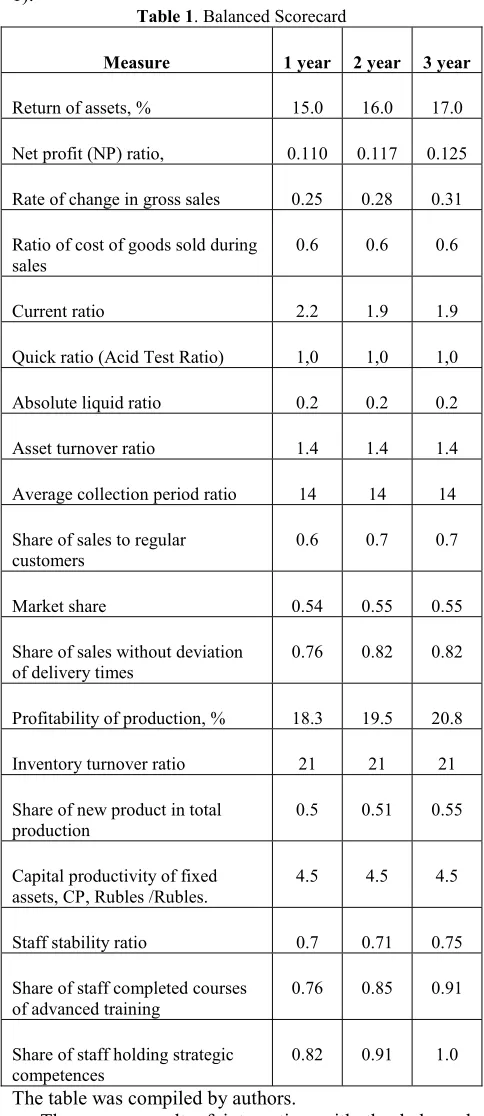
[image:3.595.303.545.160.718.2]Thus, a conducted correlational regression analysis and a developed factor model enable forecasting value scores during enterprise strategy implementation (Table 1).
Table 1. Balanced Scorecard
Measure 1 year 2 year 3 year
Return of assets, % 15.0 16.0 17.0
Net profit (NP) ratio, 0.110 0.117 0.125
Rate of change in gross sales 0.25 0.28 0.31
Ratio of cost of goods sold during sales
0.6 0.6 0.6
Current ratio 2.2 1.9 1.9
Quick ratio (Acid Test Ratio) 1,0 1,0 1,0
Absolute liquid ratio 0.2 0.2 0.2
Asset turnover ratio 1.4 1.4 1.4
Average collection period ratio 14 14 14
Share of sales to regular customers
0.6 0.7 0.7
Market share 0.54 0.55 0.55
Share of sales without deviation of delivery times
0.76 0.82 0.82
Profitability of production, % 18.3 19.5 20.8
Inventory turnover ratio 21 21 21
Share of new product in total production
0.5 0.51 0.55
Capital productivity of fixed assets, CP, Rubles /Rubles.
4.5 4.5 4.5
Staff stability ratio 0.7 0.71 0.75
Share of staff completed courses of advanced training
0.76 0.85 0.91
Share of staff holding strategic competences
0.82 0.91 1.0
The table was compiled by authors.
Thus, as a result of integration with the balanced scorecard, the value based concept acquires greater efficiency, due to:
2) the strategy extension to all enterprise levels due to BSC cascading to units;
3) a capability to manage strategy implementation at all its levels;
4) the use of non-financial measures in BSC that also participate in enterprise value creation
[image:4.595.49.294.192.773.2]Results and discussion
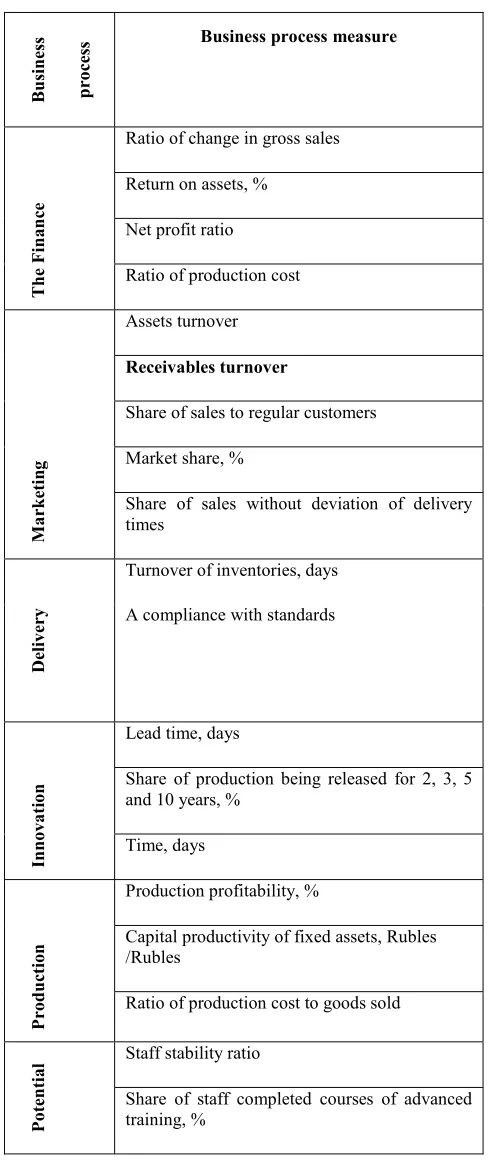
Table II. Balanced scorecard in enterprise business processes
Bu
sin
ess
p
ro
cess
Business process measure
Th
e F
in
a
n
ce
Ratio of change in gross sales
Return on assets, %
Net profit ratio
Ratio of production cost
M
a
rk
eti
n
g
Assets turnover
Receivables turnover
Share of sales to regular customers
Market share, %
Share of sales without deviation of delivery times
De
live
ry
Turnover of inventories, days
A compliance with standards
Innov
a
ti
on
Lead time, days
Share of production being released for 2, 3, 5 and 10 years, %
Time, days
Pr
oduc
tio
n
Production profitability, %
Capital productivity of fixed assets, Rubles /Rubles
Ratio of production cost to goods sold
Pote
ntia
l Staff stability ratio
Share of staff completed courses of advanced training, %
Share of staff holding strategic competences, %
The table was compiled by authors.
Moreover, the use of BSC in business process management makes the integration of a market-focused approach and a resource-focused approach natural in strategy creation. An integrated approach includes a strong focus on customer needs and efficient use of organization internal resources. A customer component and an internal one are supported by the component of learning and growth. All the organizations strive to develop their staff, technology, culture, but the majority does not bring their intangible assets into a strategic compliance.
Conclusion
Currently, the most appropriate is the use of a process-oriented approach, the need for which is provided by the focus on continuous improvement of quality of the final product and the satisfaction of customers. It allows one to distribute responsibility for the final result among all participants in business processes and organize an efficient system of work motivation. The process-oriented approach eliminates the fragmentation, organizational and informational gaps, unsustainable use of resources, reduce the number of levels of decision-making, combine the target management principle with group work organization, which will improve the efficiency of enterprise management and the level of its adaptation to factors of external environment in the long run. However, as it was noted above, the process-oriented approach to the management of the enterprise should be supplemented with BSC, which is indicators of value in the process of implementing a strategy aimed at increasing the value of the enterprise.
Thus, the introduction of a process-based management based on the balanced scorecard will:
- structure organization processes, redesign them quickly in respect of external changes to ensure the high extent of organization adaptation to dynamics of external environment;
- focus limited enterprise resources on the performance of the value creation strategy;
- apply a balanced scorecard connecting strategic and operational objectives, as well as functional units by means of defining strategic objectives and measurable indicators detailing and controlling these objectives and thus increasing efficiency of the processes orienting an organization towards a customer.
This all leads to establishing a management system focused on enterprise value creation and customer satisfaction.
Acknowledgment
References
1. I.S. Antonova, O.A. Negodina, D.D. Vavilov, Proceed. IBIMA, 2181-2187 (2015)
2. R. Kaplan, The Strategy-Focused Organization: How Balanced Scorecard Companies Thrive in the New Business Environment (2010)
3. V.P. Savchuk, Enterprise Diagnostics: Supporting Management Decisions (2010)
4. E.V. Lisitsyna, Financial management, 17-19 (2001) 5. V.V. Repin, V.G. Eliferov, The Process-focused
Approach to Management. Business Process Modeling (2013)