Abstract: In the present scenario of H2O scarcity, it needs a smart irrigation system that can save about 80% of the water in agriculture area. Automation plays an important role in this 21st century day today life. Industries use automation to control machine, but the same technique is not suitable for use in agriculture area due to its high in cost. In this study, a price efficient elegant irrigation scheme which middle class farmer use it in farm field is discussed. The developed prototype monitor the soil’s moisture content during its dry and wet conditions with the aid of a moisture sensor circuit, calculate the corresponding relative humidity and automatically irrigate it based on its nature using a node micro controller unit (MCU), IOT(Internet Of Things) and an automatic water inlet setup. The same can be done from remote location using smart phones. A record of soil moisture and humidity value is also maintained in a database for backup. This backup is used for weather forecasting and directs the farmers regarding the type of crop to be cultivated in future. IOT gives the whole information to the operator about the irrigation. The details of the prototype are explained elaborately.
Keywords: IOT, Node MCU, sensors, smart irrigation, smart phone.
I. INTRODUCTION
India is a rustic in which the essential career is the agriculture. Almost seventy three% of Indian populace relies upon immediately or in a roundabout way on agriculture. [1] Hence the requirements had to broaden agriculture field are improving day-by using-day. Out of them, first and fundamental want is the supply of gas for agriculture that is nothing but the water [2]. Farmers rely upon monsoon typically for water aid, that's insufficient. The water shortage is in general because of extra population boom, industrialization, Climate change, Reduction in traditional water recharging areas because of encroachments, letting wastewater drainage into conventional water our bodies, release of chemical compounds and effluents into rivers, streams and ponds, lack of on-time de-silting operations in massive water our bodies, lack of efficient water control and distribution of water among urban customers, the agriculture zone and industry, and so forth.
Revised Manuscript Received on May 22, 2019.
S.Parthasarathy, Department of Electrical and Electronics Engineering, New Prince Shri Bhavani College of Engineering and Technology, Vengaivasal main road, Gowrivakkam, Chennai – 600073.
T.Arun, Department of Electrical and Electronics Engineering, New Prince Shri Bhavani College of Engineering and Technology, Vengaivasal main road, Gowrivakkam, Chennai – 600073.
S.Hariharan, Department of Electrical and Electronics Engineering, New Prince Shri Bhavani College of Engineering and Technology, Vengaivasal main road, Gowrivakkam, Chennai – 600073.
D.Lakshmanan, Department of Electrical and Electronics Engineering, New Prince Shri Bhavani College of Engineering and Technology, Vengaivasal main road, Gowrivakkam, Chennai – 600073.
India is a number of the maximum growers of agricultural production inside the world and for this reason the intake of water for irrigation is among the biggest.
This water scarcity results in reduction in the output yield of agriculture which in flip displays on the general Gross home product (GDP) of the us of a. Traditional techniques of irrigation reason extra water loss because of evaporation, drainage, percolation, water conveyance, and excess use of groundwater [3]. As maximum of the areas come again beneath historical irrigation techniques, the strain for water obtainable for lots other functions will hold.
The answer lies in developing a method which involves watering the flowers depending upon their soil type, soil fertility, atmospheric temperature and moisture content material this is not anything however micro-irrigation techniques along with drip and sprinkler irrigation. Various literatures are available explaining the developments in irrigation structures.[4] has discussed approximately various kinds of irrigation structures in India, and the irrigation control policies and activities followed in India. [4] Has reviewed the irrigation gadget performance with admire to preliminary goals. [5] Flow charts the different kinds of irrigation techniques in India and he has said that the three common conventional strategies that exist in India are diversion channels (use of boulders and tree branches), small scale water bodies like irrigation tanks to save rainwater, and wells to acquire groundwater. One of the huge technological revolutions is via the usage of poly vinyl chloride (PVC) pipes for developing a community at the farm for wearing water from the supply to different places. The modern-day or micro irrigation (MI) has given a ray of wish to lessen overall dependence on maximum undistributed, Under MI (drip and sprinkler), in contrast to traditional irrigation techniques, water is provided at a required quantity of periods and quantity using pipe network, emitters, and nozzles. Therefore, the conveyance and distribution losses are reduced absolutely, which ends up in better water use performance. [6] Stated that in contrast to traditional irrigation methods, drip resources water at once to the basis zone of the crop, in preference to land, and consequently, the water losses going on via evaporation and distribution are absolutely absent. [7] Tells that during India, drip has been in exercise because the early seventies, whereas sprinkler has been used over the mid fifties. [8] Points out that the scientists at the Tamil Nadu Agricultural University (TNAU), Coimbatore, who're taken into consideration to be the pioneers in drip irrigation studies in India, have performed large-scale demonstration within the farmers’ subject for diverse plants, which received encouraging reaction from the farmers.
Smart Irrigation System
However, an appreciable development inside the adoption of MI has taken region best from the eighties, specifically because of various promotional programs added by way of the Central and State governments. Apart from the authorities efforts, some studies institutes and personal drip manufactures have additionally been gambling an crucial position in selling MI in India. [9] Insisted that cutting-edge agriculture requires computerized and superior irrigation methods to optimize the water usage in farming. Number of
studies has been performed on automatic based irrigation systems [10-21]. Also, review on various technology used in irrigation device is likewise available [2-29].
II. HARDWARE DESCRIPTION
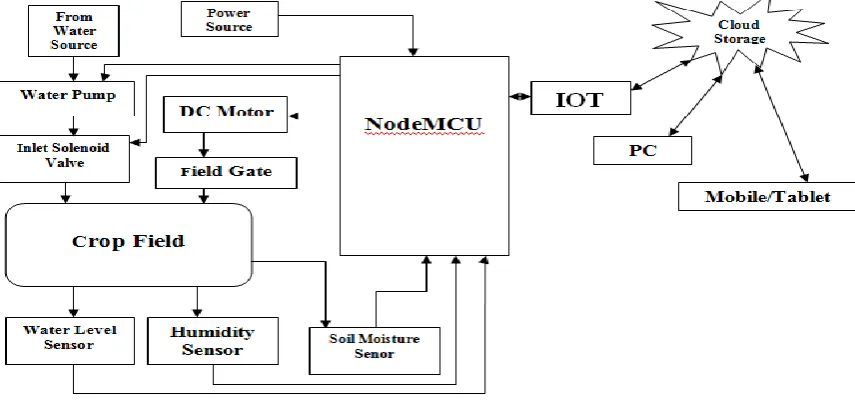
The block diagram of our technology is shown in Fig.1. The various additives of the block diagram are explained in addition.
Fig. 1 Block Diagram
A. Node Micro Controller Unit (MCU)
[image:2.595.82.510.186.391.2]The Node MCU (ESP8266) is the call of a micro controller designed with the aid of Espressif Systems. The ESP8266 itself is a self-contained LAN networking resolution performing as a bridge from existing micro-controller to LAN and is moreover capable of running self-contained packages. Its predominant advantage is that with a micro USB cable, you could connect Node MCU device package in your laptop and flash it without any problem, just like Arduino. It is also breadboard pleasant. It is favored greater than Arduino controller because of its compact size. This micro-controller is used in our generation for its gain. The architecture of Node MCU is shown in Fig. 2. [30]. The specifications of the used Node MCU are : Voltage: 3.3V, Wi-Fi Direct, Current intake: 10uA~170mA, Flash memory attachable: 16MB max, Integrated TCP/IP protocol stack, Processor: Tensilica L106 32-bit, Processor velocity: 80~160MHz, RAM: 32K + 80K, GPIOs: 17, Analog to Digital: 1 input with 1024 step decision, +19.5dBm output strength in 802.11b mode, 802.11 support: b/g/n and Maximum concurrent TCP connections.
Fig. 2 Node MCU A. Solenoid valve
Solenoid valve is an electromechanical device that converts AC or DC electric power into linear motion. It is used to manipulate the glide of water from the water pump to the field. Here a 24V.
Fig. 3 Solenoid valve
B. Soil Moisture Sensor
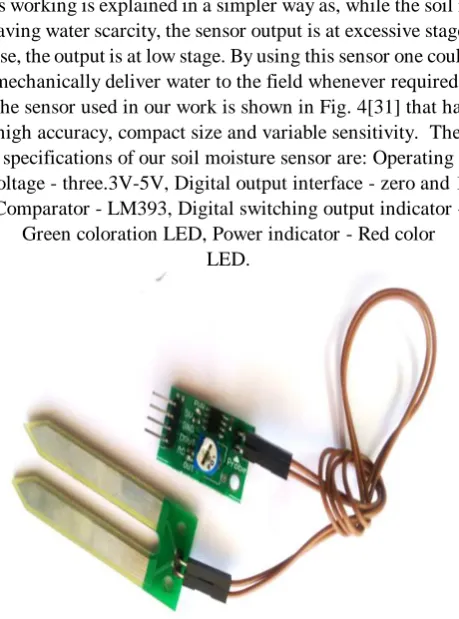
The soil moisture sensor is used to check the moisture of soil. Its working is explained in a simpler way as, while the soil is having water scarcity, the sensor output is at excessive stage, else, the output is at low stage. By using this sensor one could mechanically deliver water to the field whenever required. The sensor used in our work is shown in Fig. 4[31] that has
high accuracy, compact size and variable sensitivity. The specifications of our soil moisture sensor are: Operating voltage - three.3V-5V, Digital output interface - zero and 1,
Comparator - LM393, Digital switching output indicator - Green coloration LED, Power indicator - Red color
[image:3.595.367.476.55.160.2]LED.
Fig. 4Soil moisture sensor
C. Water level sensor
The water level sensor is used to perceive the water stage in water tank. This sensor senses the water degree through the assist of series of uncovered parallel wires. This sensor consumes much less power, and has high sensitivity. This sensor can be well suited with Arduino UNO, Arduino mega2560, Arduino ADK and various other controllers. The specifications of our water level sensor proven if Fig. 5, are , Working voltage - 5V, Working Current - < 20 mA, Interface – Analog, Width of detection - 40mm×16mm, Working Temperature - 10~30oC, Weight - 3g, Size - 65mm×20mm×8mm,Output voltage signal - 0~four.2V.
Fig. 5 Water level sensor D. Humidity Sensor
[image:3.595.323.529.244.363.2]Humidity sensor module is used to degree the humidity available in the atmosphere.
Fig. 6 Humidity sensor
The model used right here is PK/HUM/v 2.1 which has superb fine, speedy reaction, anti-interference capability and excessive cost overall performance advantages. The humidity sensor used is shown in Fig.6.
E. Water pump
Water pump is used for sucking the water from a well or a bore for supplying to the crop field. It consists of a brushless permanent magnetic rotor. This pump is immersive in water hence it remains under water. Its main advantages are that it needs less maintenance, high efficiency and long working hours, low noise, less power consumption. The specifications of the water pump used here are Condition of use : Continuously, Fluids : Water, oil, gas, acid and alkali answer, and so forth., Working Temperature : Less than 60 centigrade, Power Consumption : 5W, Rated Voltage: 110-230V AC, Noise : Less than 35dB, Water proof Class : IP68, Life Span : More than 30,000 hrs. The Water pump used is shown in Fig.7.
[image:3.595.54.284.260.570.2]F. Driver IC
[image:4.595.61.276.116.291.2]L293D is the Motor Driver IC (Integrated Chip) used here Which lets in DC motor to pressure on both path.
Fig. 8 Driver IC
L293D is a 16-pin IC which is capable of controlling A hard and fast of two DC automobiles concurrently in any path .It method you will be able to management 2 DC motor with one L293D IC. The pin diagram of a L293D motor controller is shown in Fig.8. Pin 1 and pin 9 are the two enable pins. To drive the motor, the pins 1 and 9 need to be high.
G. DC motor
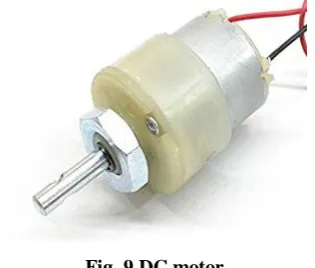
A DC motor is one of many rotary electrical machines that convert DC power into mechanical energy.
Fig. 9 DC motor
Its rotary operation is used to open the gate present in the crop field, which when opened, drains the excess water present in the field. The specifications of the DC motor used here are 200 RPM 12V DC automobiles with Gearbox, 3000 RPM base motor, 6mm shaft diameter with inner hollow, 125gm weight, 0.5kgcm torque, No-load present day = 55 mA (Max), Load cutting-edge = 305 mA (Max). Fig. Nine indicates the DC motor used in this paintings.
III. SOFTWARE DESCRIPTION
A.Arduino IDE
Arduino is a prototype based platform which supports easy-to-use hardware and software. Here Arduino IDE is used for programming the Micro-controller (NodeMCU). Since this IDE is an open-source platform, it is easy to program Arduino boards as well as other boards like
NodeMCU, Genuino etc. The key features of Arduino are: The Arduino IDE can be configured to application a variety of microcontrollers, not just those determined on the standard Arduino boards. The Arduino IDE uses a simplified version of C++, making it simpler to application. The Arduino IDE (Integrated Development Environment) carries a textual content editor for writing code, a message place, a text console, a toolbar with buttons for common features and a chain of menus. It connects to the Arduino and Node MCU hardware to upload programs and talk with them.
B.Internet of Things (IOT)
Internet of Things (IOT) explains an emerging trend where a huge range of embedded devices are connected to the Internet. These connected gadgets communicate with human beings and other matters and regularly provide the sensed facts to cloud storage and cloud computing resources where the facts is analyzed and processed to advantage important insights. Cheap cloud computing strength and superior tool connectivity has been enabling this fashion. IOT answers are constructed for several packages like tracking and manage of surroundings, fitness, industry, car fleet tracking, and domestic automation
C. Thing Speak
Thing Speak is an IOT analytics platform service that permits you to aggregate, visualize and analyze live information streams within the cloud. Some of the key capabilities of Thing Speak embody the power to simply set up devices to send information to Thing Speak exploitation widespread IOT protocols, Visualize your sensing element Data in actual-time, aggregate information on-call for from 1/3-celebration sources, run your IOT analytics robotically supported schedules or occasions, photo and construct IOT structures without becoming servers or developing net software package, automatically act on your information and communicate using third-party services like Twilio or Twitter.
IV. RESULTS AND DISCUSSION
From the block diagram shown in Fig.1 the components are placed accordingly which results in the Hardware installation as proven in Fig.10. The important sensors like soil moisture sensor, humidity sensor and water level sensor are placed in the crop field. Soil moisture sensor is placed inside the soil which measures the soil moisture present in the crop field for watering it accordingly. The water level sensor is placed slightly above the surface crop field to measure the water level present in the field. The humidity sensor is placed near the field in order to water the crops according to the climatic conditions. All the three sensors are connected to a microcontroller named NodeMCU. Simultaneously, a field door is kept along the border of the crop field which is opened to drain the excess water present in the field according to the
[image:4.595.91.249.429.563.2]connected to a Solenoid valve that is used to govern the glide of water to the sphere.
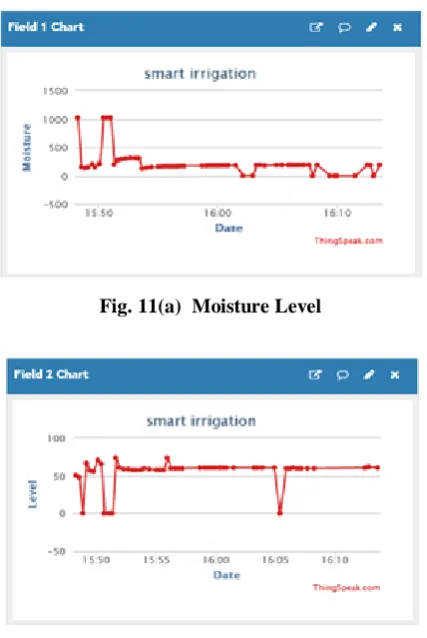
[image:5.595.325.527.76.210.2]The water is supplied to the crop field through the solenoid valve only based on the signal received by the soil moisture sensor. Various data like soil moisture, humidity and water level are sensed by various sensors and fed to the micro-controller which is equipped with IOT module which transfers the data to cloud storage. From the cloud, user can control, collect, view, and store the sensed data. The data are collected continuously from various sensors and are shown in graphical manner, as shown in Fig.11, in Thing Speak cloud storage website. All the operations are performed in automatically, in addition user also can manually control the water flow through the field door and solenoid valve.
Fig. 10 Hardware Setup
Fig. 11(a) Moisture Level
Fig. 11(b) Water Level In Field
Fig. 11(c) Humidity Present In Atmostphere
V. CONCLUSION
In this examine, a value powerful smart irrigation device which center magnificence farmer use it in farm discipline is mentioned. The evolved prototype reveal the soil’s moisture content during its dry and wet situations with the resource of a moisture sensor circuit, calculate the corresponding relative humidity and mechanically irrigate it primarily based on its nature, simultaneously removes excess water from the field under rainy condition, using a node micro controller unit (MCU), IOT and an automatic water inlet setup. The same can be done from remote location using smart phones. A record of soil moisture and humidity value is also maintained in a database for backup. This backup is used for weather forecasting and directs the farmers regarding the type of crop to be cultivated in future. IOT gives the whole information to the operator about the irrigation. With this technology of smart irrigation system, we could conclude that, our farmers will feel full relief in terms of cost, life and comfort.
REFERENCES
1. Dr. M. Mahalakshmi, Dr. S. P. Rajaram, S. Priyanka, “A Distant Monitoring and Controlling of Solar Driven Irrigation System through IoT”, National Power Engineering Conference (NPEC), Madurai, Tamilnadu , 2018.
2. S. Parthasarathy, P. Neelamegam, P. Thilakan, “Power performance characterization of multi-crystalline silicon solar cells and its module at outdoor exposure” International Journal of Green Energy, Vol. 14, Issue 1, 2017, pp. 9-14.
3. S. Parthasarathy, P. Neelamegam, P. Thilakan, “Outdoor Performance Characterization Of Multi-crystalline Silicon Solar Module”, Journal of Applied Sciences, Vol. 12(18), 2012, pp: 1953-1959.
4. S.Parthasarathy, P. Thilakan, P. Neelamegam, R. N. Srinath, ”Studies on the assembly induced performance losses in multi-crystalline silicon solar PV module” , European journal of scientific research , Vol .62, No:2 (2011), pp. 248-256.
5. Jeffrey D. Brewer and K. V. Raju,” Types Of Irrigation Management Transfer In India”, workshop in political theory and policy analysis, Indiana University, Indiana, May 1996.
6. Herve L. Plusquellec, Kathryn Mcphail & Christian Polti, “Review of irrigation system performance with respect to initial objectives”, Irrigation and Drainage Systems, 1990, Vol.4, pp. 313-327.
7. Sirisha Adamala, “Traditional to Smart Irrigation Methods in India: Review”, American Journal of
Agricultural Research, 2016, Vol. 1(1), pp. 0013-0023. 8. Dhawan, B. D. “Technological
[image:5.595.61.276.252.412.2] [image:5.595.63.277.447.766.2]agriculture: A study of water saving methods”, Commonwealth Publishers, New Delhi, 2002.
9. N. Chandrababu Naidu Chairman, “Ministry of Agriculture Report of Task Force on Micro-irrigation”, Government of India, January, 2004. 10.INCID, “Drip irrigation in India”, Indian National Committee on Irrigation
and Drainage, 11.New Delhi. 1994.
12. Ojha, T., Misra, S., Raghuwanshi, N. S., “Wireless sensor networks for agriculture: The state-of-the-art in practice and future challenges”, Comput. Electron. Agric., 2015, Vol. 118, pp. 66-84.
13. Shock C. C., David R. J., Shock C. A., Kimberling C. A., “Innovative, automatic, low-cost reading of watermark soil moisture sensors”, In Proc. Irrig. Assoc. Tech. Conf., 1999, Falls Church, VA, pp. 147-152. 14. Damas, M., Prados, A. M., Gomez, F., Olivares, G., “HidroBus system:
Field bus for integrated management of extensive areas of irrigated land”, Microprocessors Microsyst., 2001, Vol. 25, pp. 177-184.
15. Evans, R., Bergman, J., “Relationships between cropping sequences and irrigation frequency under self-propelled irrigation systems in the Northern great plains (Ngp)”, USDA Annual Report, June 11, 2003-December 31, 2007.
16. Miranda, F. R., Yoder, R. E., Wilkerson, J. B., Odhiamboc, L. O., “An autonomous controller for site-specific management of fixed irrigation systems”, Comput. Electron. Agric., 2005, Vol. 48, pp. 183-197. 17. Wall, R.W., King, B. A., “Incorporating plug and play technology into
measurement and control systems for irrigation management”, In Proc. ASAE/CSAE Annual International Meeting, Ottawa, Canada, August, 2004.
18. Kim Y., Evans .R., Iversen. .W, “Remote sensing and control of an irrigation system using a distributed wireless sensor network”, IEEE Trans. Instrum. Meas., 2008, Vol. 57, pp. 1379-1387.
19. Xiong, S. M., Wang, L. M., Qu, X. Q., Zhan, Y. Z., “Application research of WSN in precise agriculture irrigation”, In Proc. Int. Conf. Environ. Sci. Inf. Applic. Tech., Wuhan, China, 4-5 July, 2009, Vol. 2, pp. 297-300 20. de Lima, G. H. E. L., e Silva, L. C., Neto, P. F. R. “WSN as a tool for
supporting agriculture in the precision irrigation”, In Proc. Int. Conf. on Networking and Services, Cancun, Mexico, March, 2010, pp. 137-142. 21. Jaria, F, Madramootoo, C. A., “Irrigation scheduling of field tomatoes
based on stand-alone continuous, real-time soil moisture sensor data”, In Proc. Northeast Agricultural and Biological Conference, South Burlington, Vermont, July, 2011, pp. 24-27.
22. Sudha, M. N., Valarmathi, M., Babu, A. S. “Energy efficient data transmission in automatic irrigation system using wireless sensor networks”, Comput. Electron. Agric., 2011, Vol.78, pp. 215-221. 23. Dhivya, A., Infanta, J., Chakrapani, K., “Automated agricultural process
using PLC and ZigBee”, J. Artificial Intelligence, 2012, Vol. 5, pp. 170-177.
24. Pravina B. Chikankar, P. B., Mehetre, D., Das, S., “An automatic irrigation system using ZigBee in wireless sensor network”, In Proc. International Conference on Pervasive Computing (ICPC), 8-10 Jan, Report of the Task Force on Irrigation, 2009, Planning Commission Government of India, May, 2015.
25. S. R. Barkunan, V. Bhanumathi,J. Sethuram, “Smart sensor for automatic
drip irrigation system for paddy cultivation”, Computers & Electrical Engineering, January 2019, Volume 73, Pages 180-193.
26. Amarendra Goap, Deepak Sharma, A. K. Shukla, C. Rama Krishna “An IoT based smart irrigation management system using Machine learning and open source technologies”, Computers and Electronics in Agriculture, December 2018, Volume 155, Pages 41-49.
27. Francesco Fabiano Montesano, Marc W. van Iersel, Francesca Boari, Vito Cantore, Angelo Parente, “Sensor-based irrigation management of soilless basil using a new smart irrigation system: Effects of set-point on plant physiological responses and crop performance”, Agricultural Water Management, 30 April 2018, Volume 203, Pages 20-29.
28. Yasin Kabalci, Ersan Kabalci, Ridvan Canbaz, Ayberk Calpbinici “Design and implementation of a solar plant and irrigation system with remote monitoring and remote control infrastructures” Solar Energy, 1 December 2016, Volume 139, Pages 506-517.
29. Cohen, N. Lazarovitch, J. Gilron “Upgrading groundwater for irrigation using monovalent selective electrodialysis” Desalination, 1 April 2018, Volume 431, Pages 126-139.
30. S. R. Nandurkar, V. R. Thool, R. C. Thool, “Design and development of Precision Agriculture System Using Wireless Sensor Network.”, First International Conference on Automation, Control, Energy and Systems (ACES), 2014.
31. Jain, P., Kumar, P., & Palwalia, D. K. (2017), “Irrigation management system with micro-controller application”, 1st International Conference on Electronics, Materials Engineering and Nano-Technology (IEMENTech) 2017.
32. Ravi Kishore Kodali and Borade Samar Sarjerao, “A Low Cost Smart Irrigation System Using MQTT Protocol” IEEE Region 10 Symposium, 2017.
33. Rosegrant, W. M., Ximing, C., Cline, S. A., “World water and food to 2020: Dealing with
34. Scarcity” International Food Policy Research Institute, Washington, D.C., USA and International
35. Water Management Institute, Colombo, Sri Lanka, 2002.