Munich Personal RePEc Archive
Prudent rationalizability in generalized
extensive-form games
Heifetz, Aviad and Meier, Martin and Schipper, Burkhard C
The Open University of Israel, Institute for Advanced Studies,
Vienna, University of California, Davis
30 March 2011
Online at
https://mpra.ub.uni-muenchen.de/30220/
Prudent Rationalizability in Generalized
Extensive-Form Games
∗
Aviad Heifetz
†Martin Meier
‡Burkhard C. Schipper
§March 30, 2011
Abstract
We define an extensive-form analogue of iterated admissibility, called Prudent Rationalizability (PR). In each round of the procedure, for each information set of a player a surviving strategy of hers is required to be rational vis-a-vis a belief system with a full-support belief on the opponents’ previously surviving strategies that reach that information set. Somewhat surprisingly, prudent rationalizable strategies may not refine the set of Extensive-Form Rationalizable (EFR) strategies (Pearce 1984). However, we prove that the paths induced by PR strategy-profiles (weakly) refine the set of paths induced by EFR strategies.
PR applies also to generalized extensive-form games which model mutual un-awareness of actions (Heifetz, Meier and Schipper, 2011a). We demonstrate the applicability of PR in the analysis of verifiable communication, and show that it yields the same, full information unraveling prediction as does the unique sequen-tial equilibrium singled out by Milgrom and Roberts (1986); yet, we also show that under unawareness full unraveling might fail.
Keywords: Prudent rationalizability, caution, extensive-form rationalizability, extensive-form games, unawareness, verifiable communication.
JEL-Classifications: C70, C72, D80, D82.
∗The material of this paper was previously part of our paper “Dynamic Unawareness and
Rationaliz-able Behavior”. We are grateful to Pierpaolo Battigalli for numerous insightful comments and suggestions and to Elchanan Ben Porath for helpful discussions and exchange of ideas. We thank Paulo Barelli, Andy McLennan, Yoram Halevy as well as to seminar participants at Barcelona, Bocconi, Caltech, Maryland, Maastricht, Pittsburgh, USC, UC Davis, Tel Aviv, Stony Brook 2007, LOFT 2008, Games 2008 and NSF/NBER/CEME 2009. Aviad is grateful for financial support from the Open University of Israel’s Research Fund grant no. 46106. Martin was supported by the Spanish Ministerio de Educaci´on y Cien-cia via a Ramon y Cajal Fellowship (IAE-CSIC) and a Research Grant (SEJ 2006-02079). Burkhard is grateful for financial support from the NSF SES-0647811.
†The Economics and Management Department, The Open University of Israel. Email:
‡Institut f¨ur H¨ohere Studien, Wien, and Instituto de An´alisis Econ´omico - CSIC, Barcelona. Email:
1
Introduction
In normal-form games, iterated admissibility (IA) is a refinement of rationalizability. In the latter solution concept, at every round of elimination a player’s strategy survives only if it is a best-reply to some belief over the opponents’ strategies which survived the previous rounds, while in the former a strategy survives only if it is a best reply to such a full-support belief, which doesn’t completely exclude any strategy of the other players that has not been thus far eliminated. In this paper we investigate the connection between the counterparts of these two notions in dynamic games.
The prominent analogue for rationalizability in dynamic games is Extensive-Form Ra-tionalizability (EFR) (Pearce, 1984, Battigalli, 1997). EFR is particularly interesting be-cause it may be used to refine the notion of sequential equilibrium (Pearce, 1984). More-over, in generic perfect-information games EFR induces the unique backward-induction path (Reny, 1992, Battigalli, 1997, Robles, 2006, Perea, forthcoming), even though the
EFR strategies may be distinct from the backward-induction strategies (Reny, 1992).
EFR is a notion that captures forward induction: at every information set, the active player looks for a best rationalization for the way this information set has been reached (in terms of her opponents’ rationality, their belief intheir opponents’ rationality etc.), and replies optimally to a belief on these best-rationalizable strategies. In this paper we define
Prudent Rationalizability (PR) in a likewise fashion by additionally requiring this belief to havefull-support on the opponents’ (recursively defined) prudently-best-rationalizable
strategies. In Theorem 1 we prove that PR strategies exist in every dynamic game,
including generalized extensive-form games (Heifetz, Meier and Schipper 2011a) which allow for the modeling of mutual unawareness of actions.
In normal-form games every IA strategy is also rationalizable. Somewhat surprisingly, we show that a similar inclusion does not obtain in dynamic games: in Section 4 we
bring an example of a game in which a player’s PR strategies is not a subset of her
EFR strategies but is rather disjoint from it. Nevertheless, in Theorem 2 we prove that inclusion does obtain in terms of outcomes: The set of paths induced by PR strategy profiles is always contained in the set of paths induced by EFR strategy profiles.
In Section 5 we exemplify the attractiveness of PR in the Milgrom-Roberts (1986)
– the unique sequential equilibrium outcome is also the uniquePR outcome.
Full unraveling of information is somewhat unrealistic, though. In Section 6 we show
that when unawareness is introduced into the model, PR need not necessarily entail
full information unraveling. We also analyze a sender-receiver game with unawareness introduced by Ozbay (2007), and show that PR delivers the same prediction as does his equilibrium notion which incorporates forward-induction reasoning.
These two applications demonstrate the attractiveness ofPR in dynamic games with
unawareness. Indeed, in many games with unawareness PR rules out implausible EFR
strategies, with which a player makes an opponent aware of an action which the player would actually like the opponent to avoid, just because the player has a firm belief that the opponent wouldn’t take it (even if the opponent is indifferent between the revealed action and another one, of which she was aware also before);PRrules out such imprudent behavior.
PRis equivalent toiterated admissibility on the tree as defined by Brandenburger and Friedenberg (2007). Iterated admissibility on the tree is analogous to iterated dominance conditional on normal-form information sets `a la Shimoji and Watson (1994), in which strict dominance is replaced by weak dominance. Brandenburger and Friedenberg (2007) show that iterated admissibility on the tree is equivalent to IA of the strategic form of the game. IA does not require conditioning on normal-form information sets. In Heifetz, Meier and Schipper (2011b) we show, however, that such an analogous equivalence for dynamic games with unawareness still requires normal-form information sets since they encode also the awareness of players.
Some readers may be interested in PR independently of unawareness, and to this
2
Extensive-form Games
We consider finite extensive-form games with finite horizon, perfect recall and possibly simultaneous moves (for standard properties see Dubey and Kaneko, 1984, and Osborne and Rubinstein, 1994). To fix notation, denote by I the finite set of players, by N the finite set of decision nodes, byIn the active players at noden, byAin the finite action set of playeri ∈In (for n ∈N), by C the chance nodes, and by Z the terminal nodes with a payoff vector (pz
i)i∈I ∈R
I for the players for every z ∈Z. The nodes ¯N =N ∪C∪Z shall constitute a tree. We denote byNi the set of nodes in which playeri∈I is active. The information set of player i at node n is denoted by πi(n). Let Hi be the set of i’s information sets. For two information sets hi, h′i, we say thathi precedes h′i (or that h′i succeeds hi) if for every n′ ∈ h′
i there is a path n, ..., n′ such that n ∈ hi. We denote it by hi h′i. Standard properties on information sets imply that if n′, n′′ ∈ hi then
Ai
n′ =Ain′′. Thus, if n∈hi we write also Ahi for A
i n.
A (pure) strategy
si ∈Si ≡
Y
hi∈Hi
Ahi
for player ispecifies an action of playeriat each of her information setshi ∈Hi.Denote by
S=Y j∈I
Sj
the set of strategy profiles in the game.
Ifsi = (ahi)hi∈Hi ∈Si, we denote by
si(hi) =ahi
the player’s action at the information set hi. If player i is active at node n, we say that at noden the strategy prescribes to her the actionsi(πi(n)).
We say that a strategy profiles∈Sreaches the information sethi ∈Hiif the players’ actions and nature’s moves (if there are any) lead to hi with a positive probability. We say that the strategysi ∈ Si reaches the information sethi if there is a strategy profile
s−i ∈S−i of the other players such that the strategy profile (si, s−i) reacheshi. Otherwise,
we say that the information sethi is excluded by the strategy si. Similarly, we say that the strategy profile s−i ∈ S−i reaches the information set hi if there exists a strategy
reaches a node n if the players’ actions sj(πj(n′))j∈I and nature’s moves in the nodes n′ lead to n with a positive probability. Since we consider only finite trees, (sj)j∈I reaches an information sethi ∈Hi if and if there is a node n∈hi such that (sj)j∈I reaches n.
For an information sethi,letsi/s˜hii denote the strategy that is obtained by replacing actions prescribed bysi at the information sethi and its successors by actions prescribed by ˜si. The strategy si/s˜hii is called an hi-replacement of si.
The set ofbehavioral strategies is
Y
hi∈Hi
∆ (Ahi).
3
Prudent Rationalizability
A belief system of player i
bi = (bi(hi))hi∈Hi ∈
Y
hi∈Hi
∆ (S−i)
is a profile of beliefs - a beliefbi(hi)∈ ∆ (S−i) on the other players’ strategies, for each
information set hi ∈Hi , with the following properties
• bi(hi) reaches hi, i.e. bi(hi) assigns probability 1 to the set of strategy profiles of the other players that reach hi.
• Ifhiprecedesh′i (hi hi′) thenbi(h′i) is derived frombi(hi) by Bayes rule whenever possible.
Denote byBi the set of player i’s belief systems.
For a belief system bi ∈Bi, a strategy si ∈Si and an information set hi ∈Hi, define player i’s expected payoff at hi to be the expected payoff for player i given bi(hi), the actions prescribed bysi at hi and its successors, and conditional on the fact that hi has been reached.1
1
Even if this condition is counterfactual due to the fact that the strategysi does not reach hi. The conditioning is thus on the event that nature’s moves, if there are any, have led to the information set
We say that with the belief system bi and the strategy si player i is rational at the information set hi ∈ Hi if there exists no action a′hi ∈ Ahi such that only replacing the
action si(hi) by a′hi results in a new strategy s
′
i which yields player i a higher expected payoff at hi given the belief bi(hi) on the other players’ strategies S−i.
Definition 1 (Prudent rationalizability) Let
¯
S0
i =Si
For k ≥1 define inductively
¯ Bk i =
bi ∈Bi :
for every information set hi, if there exists some profile
s−i ∈S¯k−
1 −i =
Q
j6=iS¯ k−1
j of the other players’ strategies
such that s−i reaches hi, then the support
of bi(hi) is the set of strategy profiles s−i ∈S¯k−
1
−i that reach hi
¯ Sk i = (
si ∈S¯k−
1
i :
there exists bi ∈B¯ik such that for all hi ∈Hi player i
is rational at hi
)
The set of prudent rationalizable strategies of player i is
¯
Si∞=
∞ \ k=1 ¯ Sk i
At each level each player and each information set of the player, she forms full support beliefs over the opponents’ strategies remaining from the previous level and reaching this information set. The player retains any of her previous level strategies for which there exists such a belief such that the strategy is rational at all information sets.
4
Extensive-Form Rationalizability versus Prudent
Rationalizability
4.1
Extensive-Form Rationalizability
Pearce (1984) defined extensive-form (correlated) rationalizable strategies by a procedure of an iterative elimination of strategies. The inductive definition below is essentially the version in Battigalli (1997).2
Definition 2 (Extensive-form rationalizable strategies) Define, inductively, the fol-lowing sequence of belief systems and strategies of playeri.
B1
i =Bi
S1
i ={si ∈ Si: there exists a belief system bi ∈ Bi1with which for every information set
hi ∈Hi player i is rational at hi}
...
Bk
i ={bi ∈ Bk−
1
i : for every information set hi, if there exists some profile of the other
players’ strategies s−i ∈ Sk−
1 −i =
Q
j6=iS k−1
j such that s−i reaches hi, then bi(hi) assigns
probability 1 to Sk−1 −i }
Sk
i ={si ∈Si: there exists a belief system bi ∈Bik with which for every information set
hi ∈Hi player i is rational at hi}
The set of player i’s extensive-form rationalizable strategies is
Si∞ =
∞
\
k=1
Sik.
The set of extensive-form rationalizable strategies (Pearce 1984, Battigalli 1997) is nonempty.
2
Some normal-form games have Nash equilibria in weakly dominated strategies. Simi-larly, the game in Figure 1.3
is an example of a perfect-information extensive-form game with a subgame-perfect equilibrium involving a strategy which is EFR but not PR. To wit, this is the subgame-perfect equilibrium (af, dg). The strategy af is EFR for player 1 – it is supported by the belief system which starts at the root with the belief that player 2 will play dg, revised completely at 1’s second decision node by the belief that 2 is playing cg; the strategy dg is EFR for player 2 with the belief system with which player 2 is initially certain that 1 is playingaf, revised completely at 2’s second decision node to the belief that 1 playedac. However, af is rational for player 1 at the root for no full-support belief on 2’s entire strategy set{dg, dh, cg, ch}, and hence af is notPR.
Figure 1:
1 a b 2 a b c d 10 5 1
2 e f
10, 5
10 10 2
g h
10, 10
5,, ‐10
20, 20 0, 20
4.2
PR refines EFR outcomes, but not EFR strategies
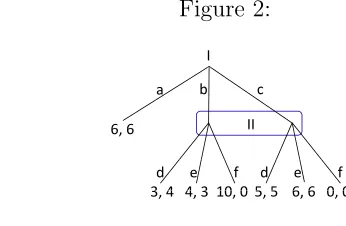
[image:9.612.191.364.549.662.2]In normal-form games, iterated admissibility is a refinement of rationalizability. Some-what surprisingly, in extensive-form games prudent rationalizability isnot a refinement of extensive-form rationalizability, as the following example (Figure 2) demonstrates.
Figure 2:
I
a b c
II
6 6 II
6, 6
d e f d e f 0 0 5 5 6 6 10 0
3 4 4 3 10, 05, 5 6, 6 0, 0 3, 4 4, 3
3
In this example, player 1 can guarantee herself the payoff 6 by choosingaand ending the game. If player 2 is called to play, should he believe that player 1 chose b or c? If player 1 is certain that player 2 is rational, she is certain that player 2 will not choose f. Hence, if player 2 is certain that player 1 is certain that he (player 2) is rational, then at his information set player 2 is certain that player 1 chose c. The reason is that among player 1’s actions leading to 2’s information set, c is the only action which, assuming 2 believes c was chosen and that 2 is rational and will hence choose e, yields player 1 the payoff 6, which is just as high as the payoff she could guarantee herself with the outside option a. Hence (a, e) and (c, e) are the profiles of extensive-form (correlated) rationalizable strategies (as well as extensive-form rationalizable strategies) in this game.
The notion of prudence, in contrast, embodies the idea that being prudently rational, player 1 shouldn’t rule out completely any of 2’s possible choices, and hence that c is strictly inferior for player 1 relative to her outside optiona. Hence, if 2’s information set is ever reached, the only way for 2 to rationalize this is to believe that 1 choseb, based on a belief ascribing a high probability to the event that 2 will foolishly choosef. Player 2’s best reply tob is d; and player 1’s best reply to d is a. Thus, the only profile of prudent rationalizable strategies in this game is (a, d).
This example demonstrates that in dynamic interactions the notions of rationalization and prudence might involve atension. Extensive-form rationalizability embodies a best-rationalization principle (Battigalli 1997, Battigalli and Siniscalchi 2002); it is driven by the assumption that in each of his information sets, a player assesses the other players’ future behavior by attributing to them the ‘highest’ level of rationality and mutual cer-tainty of rationality consistent with the fact that the information set has indeed been reached. But, with the additional criterion of ‘prudence’, what should a player believe about the behavior of his opponent if, as in the example, the opponent’s only action which is compatible with common certainty of rationality is imprudent on the part of the opponent?
rationalizability taking into account both rationalization and prudence.
Remark 1 The definition of prudent rationalizability employs extensive-form rational-ity. For standard extensive-form games, Brandenburger and Friedenberg (2007) studied the connection between extensive-form iteratively admissible strategies (defined on the basis of rationality rather than extensive-form rationality) and extensive-form rational-izability. They showed that under a “no relevant convexities” condition, extensive-form rationalizability and extensive-form iterated admissibility coincide. However, the exam-ple in Figure 2 does not satisfy this condition, and hence demonstrates that in general extensive-form iterated admissibility is not a refinement of extensive-form rationalizabil-ity.
Nevertheless, as far as paths of play are concerned, in the above example the set of paths induced by prudent rationalizability (the path a) is a subset of the paths induced by extensive-form rationalizability (the paths a and (c, e)). This is an instance of a general phenomenon as we show in Theorem 2 below.
4.3
Forward Induction: the tension between EFR and PR
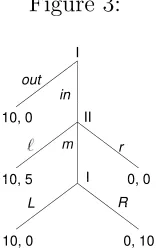
[image:11.612.266.345.496.620.2]In Figure 2 we demonstrated the tension between the considerations of rationalization and prudence when a player tries to divine his opponent’s past actions. A related but distinct tension arises when a player tries to deduce the opponent’s future behavior from past actions of that opponent. Consider the following example in Figure 3.
Figure 3:
I
out in
II
m
10, 0
I
r m
10 5 I 0 0
L R
10, 5 0, 0
10, 0 0, 10
strategy in ¯S1
1 reaches 2’s information set. Hence, the beliefs ¯B 2
2 of player 2 about player
1’s future actions are not restricted. In particular, it contains beliefs by which if player 2 choosesm, player 1 will foolishly chooseR (with a high probability). That’s why both
m and ℓ are prudent rationalizable for player 2.
However, it is not very sensible on the part of player 2 to believe that following m
player 1 may choose R. After all, when player 2 has to move, player 1 has already proved to be imprudent, but not irrational. Indeed, player 1’s rationalizable (though imprudent) strategy (in, L) yields her the payoff 10 in conjunction with 2’s only (extensive-form) ra-tionalizable strategy ℓ, as well as in conjunction with 2’s prudent rationalizable strategy
m; and this payoff is the same as the payoff player 1 gets from her only prudent ratio-nalizable strategy (out, L).
Thus, as long as player 1 has been rational (even if imprudent) thus far, it makes more sense for player 2 to believe that player 1 will continue to be rational (though possibly imprudent) in the future. Restricting player 2’s beliefs according to this logic would cross out the nonsensical choice m.
Already Pearce (1984) was well aware of this tension, which motivated his definition of
cautious extensive-form rationalizability. That definition involves refining the set of rationalizable strategies by another round of strategy elimination with full support beliefs about the other players’ surviving strategies; and then repeating this entire procedure – the standard iterative elimination process as in the definition of rationalizability, followed by one round assuming full-support beliefs –ad infinitum. In the above example, cautious extensive-form rationalizability does indeed rule out the strategy m for player 2.
However, as Pearce (1984) himself admits, the definition of cautious extensive-form rationalizability is not really satisfactory, as the following simple example of his shows.
Figure 4:
1 a b
2 5, 5 c d
0, 0 5, 5
In this example, the strategy d is irrational for player 2. Onced is crossed out, both
extensive-form rationalizable. Notice that in contrast, b does get crossed out byprudent rationalizability, and the only prudent rationalizable strategy for player 1 is a.
4.4
Discussion of the PR definition
Definition 2 of extensive-form rationalizable strategies involves, as in Battigalli (1997), an iterative reduction procedure of belief systems (that is, by definition Bk
i ⊆ B
k−1
i ), and this definition implies that strategies get iteratively eliminated (Sk
i ⊆S k−1
i ); and the
same is true also for extensive-form correlated rationalizable strategies – by definition ˆ
Bk
i ⊆Bˆk−
1
i and hence ˆS k
i ⊆Sˆk−
1
i .In contrast, the inductive definition of prudent ratio-nalizable strategies involves an iterative elimination of strategies (that is, by definition
¯
Sk i ⊆S¯
k−1
i , in analogy with the original formulation of Pearce (1984) for extensive-form rationalizability by an iterative elimination procedure), but in the case of prudence it is
notgenerally the case that ¯Bk i ⊆B¯
k−1
i . Indeed, when ¯S−ki (S¯ k−1 −i :
• If the set of strategy profiles in ¯Sk
−i reaching some information set hi ∈ Hi is a proper, non-empty subset of the strategy profiles in ¯Sk−1
−i that reach hi, then the support of each belief ¯bk−1
i (hi) in each belief system ¯b k−1
i ∈ B¯ k−1
i is strictly larger than the support of any belief ¯bk
i (hi) for ¯bki ∈B¯ik.
• For information sets hi not reached by ¯S−ki, there is no restriction (beyond Bayes rule) on ¯bk
i (hi) for ¯bki ∈B¯ik. No such restriction is needed, because if we define
mk
hi = max
m < k: there exists s−i ∈S¯−mi that reaches hi
then forsk
i ∈S¯ik the restrictions oni’s actions ski (hi) athi were already determined at stage mk
hi, since by definitions
k
i ∈S¯ik ⊆S¯ mk
hi
i .
Is it nevertheless feasible to define prudent rationalizability via a reduction process of
belief systems? Asheim and Perea (2005) proposed to look atsystems of conditional
lexicographic probabilities – belief systems in which each belief at an information
set is itself a lexicographic probability system (Blume, Brandenburger and Dekel
In each round of the procedure, the surviving belief systems would be those in which at each information set, ruled-out strategy profiles of the other players (i.e. strategy profiles outside ¯Sm
k hi
−i ) would be deemed infinitely less likely than the surviving strategy profiles, but infinitely more likely than strategy profiles which had already been eliminated in previous rounds. We leave the precise formulation of such an equivalent definition to future work.
In their paper, Asheim and Perea (2005) proposed the notion of quasi-perfect
ra-tionalizability, which also involves the idea of cautious beliefs. Quasi-perfect rational-izability is distinct from our notion of prudent rationalrational-izability. The difference is that with prudent rationalizability (as with extensive-form rationalizability), a player need not believe that another player’s future behavior must be rationalizable to a higher order than that exhibited by that other player in the past; in contrast, with the quasi-perfect rationalizable strategies of Asheim and Perea (2005), a player should ascribe to her op-ponent the highest possible level of rationality in the future even if this opop-ponent has already proved to be less rational in the past. That’s why quasi-perfect rationalizability implies backward induction in generic perfect information games, while our prudent ra-tionalizable strategies need not coincide with the backward induction strategies in such games (though they do generically lead to the backward induction path – the argument is the same as in Reny 1992 and Battigalli 1997, since in generic perfect information games prudent rationalizability coincides with extensive-form rationalizability in terms of realized paths).
5
An Application to Verifiable Information
In this section we provide an application of prudent rationalizability to the problem of relying on information of interested parties, which was introduced by Milgrom and Roberts (1986).
Consider a merchandise whose quality qi ∈ {q1, . . . , qn} is known to its seller, while
a buyer knows only the prior probability distribution (p1, . . . , pn) of the qualities, where
pi >0 for all i= 1, . . . , n. For each quality level qi the seller is better off the larger the quantity that she sells, while the utility of the buyer from the merchandise is strictly concave in the quantity purchases with a single peak at β(qi). Furthermore,
Before sale takes place, the seller has the option of providing the buyer with a certified signal about the quality of her merchandise, proving to the seller that the quality is within some range{qmin, . . . , qmax} containing the actual quality qi.
Milgrom and Roberts (1986) proved that if the buyer’s utility is strictly concave then there is a unique sequential equilibrium, in which when the quality isqi the seller certifies to the buyer a range (possibly a singleton) {qmin, . . . , qmax} in whichqmin =qi, while the
buyer is skeptical and always buys β(qmin). Thus, in this unique sequential equilibrium
the qualityqi is fully revealed to the seller, who buys the optimal quantity β(qi) for him.
We proceed with the caveat that the quantities which can be demanded by the buyer belong to a finite, fine grid (recall that, formally, in our formulation each player has finitely many available actions in each information set). For simplicity, we assume further that the quantities β(qi), i = 1, . . . , n belong to this grid. For 1 ≤ m < n we denote by [β(qm), β(qn)] the set of quantities in this grid at least as large asβ(qm) and no larger thanβ(qn).
Proposition 1 The strategy to buy β(qmin) when confronted with the certification that
the quality is in the range {qmin, . . . , qmax} is also the unique prudent rationalizable
strat-egy for the buyer, and certifying some range{qmin, . . . , qmax} in whichqmin =qi constitute
the prudent rationalizable strategies of the seller.
Thus, any profile of prudent rationalizable strategies in this game yields the full rev-elation outcome indicated by Milgrom and Roberts (1986).
Proof of Proposition 1. When the buyer is confronted with the certificate {qn}, his unique level-1 (prudent) rationalizable action is to buyβ(qn), while when he is confronted with some range {qm, . . . , qn} all the quantities in the interval [β(qm), β(qn)] are level-1 (prudent) rationalizable (because any posterior belief of the buyer about the qualities with support{qm, . . . , qn}can be derived from a belief of the buyer that the seller provides the certificate{qm, . . . , qn}with an appropriate probabilityri when the seller knows that the quality is qi ∈ {qm, . . . , qn}.) Consequently, the only level-2 prudent rationalizable strategies of the seller are those in which she provides the certificate{qn}when the quality isqn(because any other certificate that she can provide{qm, . . . , qn}will yield an expected sale strictly smaller than β(qn) with a full support belief about the level-1 prudent rationalizable strategies of the buyer, that have actions in the range [β(qm), β(qn)]).
rationalizable strategies of the buyer, for every i = 0, . . . , k − 1 he buys the quantity
β(qn−i) when confronted with a certificate of the form {qn−i, . . . , qℓ}, and that in all the level-2k prudent rationalizable strategies of the seller she indeed provides such a certificate when the quality isqn−i. Then in all the level-(2k+ 1) (prudent) rationalizable
strategies of the buyer he buys the quantity β(qn−k) when confronted with a certificate
of the form {qn−k, . . . , qℓ} (because he believes that such a certificate could only be presented to him with the quality qn−k, as by the induction hypothesis with each higher quality all the level-2k prudent rationalizable strategies of the seller present a certificate where that higher value is the minimal value). Furthermore, when confronted with some range {qm, . . . , qn−k, . . . , qℓ} all the quantities in the interval [β(qm), β(qn−k)] are
level-(2k+ 1) (prudent) rationalizable (because any posterior belief of the buyer about the qualities with support {qm, . . . , qn−k} can be derived from a belief of the buyer on the
level-2k prudent rationalizable strategies of the seller in which the seller provides the certificate {qm, . . . , qℓ}with an appropriate probability ri when the seller knows that the quality is qi ∈ {qm, . . . , qn−k}.)
Consequently, in all the level-(2k+ 2) prudent rationalizable strategies of the seller she provides the certificate {qn−k, ..., qℓ} when the quality is qn−k (because any other certificate that she can provide {qm, . . . , qn−k, . . . , qℓ} will yield an expected sale strictly smaller than β(qn−k) with a full support belief about the level-(2k+ 1) prudent
ratio-nalizable strategies of the buyer, that have actions in the range [β(qm), β(qn−k)]).
Hence, the inductive claim obtains in particular for k = n−1, concluding what we
wanted to prove.
In fact, it is not difficult to see that the above argument does not depend on the assumption that the available certificates consist of ranges of qualities (containing the true quality). For the argument to hold it is enough to assume that for each quality level
qi one of the available certificates is the fully revealing certificate {qi}.
6
The refining power of prudent rationalizability in
generalized extensive-form games with
unaware-ness
We now present two examples demonstrating the refining power of prudent rationalizabil-ity. The first example was originally analyzed (for the full awareness case) by Milgrom and Roberts (1986) using sequential equilibrium and in Section 5 using prudent rational-izability. A second example is due to Ozbay (2007). We will also show a general result on existence and the refinement power of prudent rationalizability.
Unawareness and mutual unawareness is modeled in a generalized extensive-form
game by a family T of trees (see Heifetz, Meier and Schipper 2011a for the formal
definition and properties). Each treeT ∈T represents a subjective view of a player (or a subjective view of a player about another player’s subjective view, etc.) of the feasible paths; one of the trees represents the modeler’s ‘objective’ view. The set of nodes that
a player i ∈ I considers as possible at a node n of a tree T ∈ T – her information
set hi = πi(n) there – may be a subset of nodes of a different tree T′ ∈ T, in case T′ represents the set of feasible paths of which player i is aware at the node n. (In such case we writeT T′, and we denote by ֒→ the transitive closure of ). As the game
proceeds, each player’s view of the game may evolve, and the trees T′ in which in the
information sets are contained may be different at distinct nodes along a path. The players have perfect recall, and remember their past views and information sets as well as their respective chosen actions.
Player i’s strategy si ∈ Si defines her choice of action si(hi) ∈ Ahi for all of her
information setshi ∈Hi in all trees T ∈T. In particular, si(πi(n)) defines i’s action at the noden∈T even whenπi(n) is a subset of a different treeT′ ∈T. Thus, a profile of strategiess = (si) defines a path in every tree T ∈T. Denote by Thi the tree containing
the information sethi.
For every treeT ∈T, theT-partial game is the partially ordered set of trees including
T and all trees T′ satisfying T ֒→ T′. A T-partial game is a generalized game by itself.
We denote by HT
i the set of i’s information sets in the T-partial game. We denote by
sT
i the strategy in the T-partial game induced by si. If Ri ⊆ Si is a set of strategies of playeri,denote by RT
i the set of strategies induced byRi in theT-partial game. The set ofi’s strategies in the T-partial game is thus denoted by ST
A belief system of player i
bi = (bi(hi))hi∈Hi ∈
Y
hi∈Hi
∆SThi
−i
is a profile of beliefs - a belief bi(hi) ∈ ∆
SThi
−i
about the other players’ strategies in the Thi-partial game, for each information set hi ∈Hi,with the following properties
• bi(hi) reaches hi, i.e. bi(hi) assigns probability 1 to the set of strategy profiles of the other players that reach hi.
• Ifhiprecedesh′i (hi hi′) thenbi(h′i) is derived frombi(hi) by Bayes rule whenever possible.
Denote byBi the set of player i’s belief systems.
For a belief system bi ∈Bi, a strategy si ∈Si and an information set hi ∈Hi, define playeri’s expected payoff athi to be the expected payoff for player iinThi givenbi(hi),
the actions prescribed by si at hi and its successors, and assuming that hi has been reached.
We say that with the belief system bi and the strategy si player i is rational at the information set hi ∈ Hi if there exists no action a′hi ∈ Ahi such that only replacing the
action si(hi) by a′hi results in a new strategy s
′
i which yields player i a higher expected payoff at hi given the belief bi(hi) on the other players’ strategiesS
Thi
−i .
The definition of prudent rationalizability in generalized extensive-form games is al-most identical to its definition in standard games. The only difference is the fact that a belief of a player at an information set hi is about the opponents strategies S
Thi
−i in the
Thi-partial game:
Definition 3 (Prudent rationalizability in generalized extensive-form games) Let
¯
S0
For k ≥1 define inductively ¯ Bk i =
bi ∈Bi :
for every information set hi, if there exists some profile
s−i ∈S¯−k−i1 =
Q
j6=iS¯ k−1
j of the other players’ strategies
such that s−i reaches hi in the tree Thi, then the support
of bi(hi) is the set of strategy profiles s−i ∈S¯ k−1,Thi
−i that reach hi
¯ Sk i = (
si ∈S¯k−
1
i :
there exists bi ∈B¯ik such that for all hi ∈Hi player i
is rational at hi
)
The set of prudent rationalizable strategies of player i is
¯
Si∞=
∞ \ k=1 ¯ Sk i
The proof of the next result is contained in the appendix.
Theorem 1 The set of player i’s prudent rationalizable strategies is non-empty.
In Section 4, we showed that prudent rationalizability isnot a refinement of extensive-form rationalizable strategies. However, we can show that it refines the set of extensive-form rationalizable paths.
Theorem 2 The set of paths induced by profiles of prudent rationalizable strategies is a subset of the paths induced by profiles of extensive-form rationalizable strategies (or, equiv-alently, the paths induced by profiles of extensive-form correlated rationalizable strategies).
The proof is contained in the appendix.
6.1
Milgrom-Roberts (1986) with unawareness
Assume now that there are several dimensions of quality along which such certifications could be provided. To fix ideas, consider two dimensions L, H and 0
,∗. The four
combi-nations are
L0
, H0
So, for instance, in the stateL0
the available certificates are {L, H} × {0
,∗},{L} × {0
,∗},
{L, H} × {0}
and {L} × {0}.
Assume further that
β(L∗)< β L0
< β H0
< β(H∗)
Since the singleton certificates
{L} × {∗},{L} ×0
,{H} ×0
,{H} × {∗}
are available, the above argument obtains and full revelation takes place in any profile of prudent rationalizable strategies of the players.
Assume, however, that the buyer is initially aware only of the{L, H}dimension and is unaware of the {0
,∗} dimension; he evaluates the merchandize as having the default
quality L0
when confronted with the certificate {L}, and similarly, with the certificate {H}he evaluates the merchandize as having the default qualityH0
. Assume further that the seller knows this, and that by presenting the certificates{∗}, {0
} or {0
,∗} the seller inter alia makes the buyer aware of the{0
,∗} dimension.
Intuitively, it is clear that the seller will want to make the buyer aware of this extra dimension when the quality is H∗, because this will lead the buyer to demand the high
quantity β(H∗). In contrast, when the actual quality is L∗, the seller will prefer not
to present any certificate at all along the dimension {0
,∗}: This way the buyer will
remain unaware of this extra dimension, and will demand the quantity β(L0
) (because unraveling and full revelation will occur only along the {L, H} dimension); if the seller were to make the buyer aware of this extra dimension, the buyer would have demanded onlyβ(L∗)< β(L0
).
This strategic interaction is represented in the following generalized game form (Fig-ure 5). Initially, nat(Fig-ure, c, selects a state out of {L0
, L∗, H0
, H∗}. The seller observes
the state of nature and chooses a certificate. Unless the seller presents a certificate in-volving the dimension{0
,∗}, the buyer remains unaware of it. This is indicated by the
intermitted arrows from nodes in the upper tree to nodes in the lower tree. E.g., if the seller selects the certificate{L}, then the buyer remains unaware of the {0
,∗}dimension
and views the game as represented by the lower tree. In particular, his information set is a singleton containing the node after nature selects L and the seller reports {L} in the lower tree. If the seller presents a certificate involving the{0
Figure
5:
Seller Seller Seller Seller
c
L0 L* H0 H*
Seller Seller Seller Seller
{L}×{0 *}
{L,H}×{0}
{L,H}×{0, *}
{L}×{0 *}
{L,H}×{*} {L,H}×{0, *}
{H}×{0 *}
{L,H}×{0}
{L,H}×{0, *}
{H}×{0 *}
{L,H}×{*} {L,H}×{0, *}
●
●
●
●
●
●
{L}×{0}
{L}×{ , }
{L}×{*} {L}×{0, }
{H}×{0}
{H}×{0, }
{H}×{*} {H}×{0, *}
{L, H} {L, H} {L, H} {L, H}
●
●
●
●
●
…
●
…
…
{L}
…
{L} {H}…
{H}…
…
…
…
…
…
…
…
H L
…
…
…
…
c
Seller Seller
{L,H} {L}
●
{L,H}●
{H}…
…
…
[image:21.612.92.703.117.499.2]buyer becomes aware of it and he conceives of the entire generalized game. For instance, if the seller selects the certificate{L, H}×{0
,∗}, then the buyer’s information set is given
by the upmost information set drawn as an intermitted line connecting four nodes.
We summarize the discussion in the following proposition.
Proposition 2 In the verifiable information model in which the buyer is unaware of some dimension of the the good’s quality, the seller may not fully reveal the quality in any prudent rationalizable outcome.
This is in sharp contrast to the case with full awareness discussed in Section 5.
6.2
An example by Ozbay (2007)
To demonstrate the extra power of prudent rationalizability, consider the following ex-ample of dynamic interaction with unawareness, which is a variant of exex-ample 3 in Ozbay (2007). There are 3 states of nature, ω1, ω2, ω3. A chance move chooses one out of four
potential distributions over the states of nature:
δ1 = (1,0,0)
δ2 = (0,1,0)
δ3 = (0,0,1)
δ4 =
1 3,
1 3,
1 3
An Announcer gets to know the distribution (but not the realization of the state of nature). A Decision Maker (DM) is initially aware only of the state ω1 (and hence the
DM is certain that ω1 will be realized with certainty). However, before the DM chooses
what to do, the Announcer can choose to make the DM aware of eitherω2, ω3, none of
them or both of them. Increased awareness makes the DM aware of the relevant marginals of the distributions. For instance, if the Announcer makes the DM aware ofω2, the DM
becomes aware of the set of distributions
δ1|{ω1,ω2} = (1,0)
δ2|{ω1,ω2} = (0,1)
δ4|{ω1,ω2} =
1 2,
1 2
and also becomes certain that the Announcer knows which of these is the true distribu-tion.4
Subsequently, the DM should choose one out of three possible actions – left, middle or right. The payoffs to the players as a function of the chosen action and the state of nature appear in the following table:
left middle right
ω1 3,3 0,0 2,2
ω2 0,0 5,5 2,2
ω3 2,2 0,0 2,2
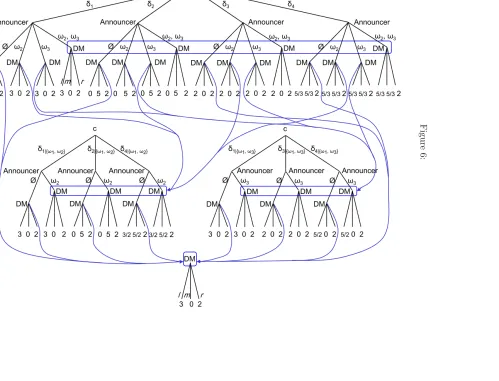
The game is thus described in Figure 6 in the following page.
It is obvious that if the Announcer announces nothing, and hence the DM is certain that ω1 prevails, the DM will choose ‘left’.
What happens if the Announcer makes the DM aware of ω2? The information set of
the DM becomes
n
δ1|{ω
1,ω2}, δ2|{ω1,ω2}, δ4|{ω1,ω2}
o
The DM may then assign a high probability to δ1|{ω1,ω2}, 5
and this will lead the DM to choose ‘left’. Hence, assuming such a belief by the DM, it is rationalizable for the
Announcer to make the DM aware of ω2 when the Announcer knows that the true
dis-tribution isδ1 (i.e. when the Announcer knows that ω1 will be realized with probability
1).
This is not very sensible, though. After all, the Announcer can ensure that the DM chooses ‘left’ by not announcing any new state. When the Announcer likes the
DM to choose ‘left’, it makes no sense on the Announcer’s part to announce ω2 and
4
In Ozbay’s example and in what follows the DM’s beliefs about these marginal distributions will not be necessarily related to the prior probabilities with which the distributions were chosen by the chance move. That’s why we do not even bother to specify the probabilities with which the chance move chooses the different distributions.
Put differently, instead of describing this game by a partially ordered set of trees, one for each level of awareness as in Figure 6, we could have replaced each tree with an arborescence in which the initial chance move is erased. Allowing for arborescences instead of trees in the framework for dynamic unawareness is straightforward, but for the sake of clarity of the exposition we avoid this explicit generalization in the body of the paper.
5
That is, the DM may assign a high probability to strategies of the Announcer by which the Announcer announcesω2 (and cause the DM’s information set to become
n
δ1|{ω1,ω2}, δ2|{ω1,ω2}, δ4|{ω1,ω2}
o
Figure
6:
Announcer Announcer Announcer Announcer c
δ1 δ2 δ3 δ4
Ø ω2 ω3 DM DM DM
Announcer
ω2, ω3
DM Ø ω2 ω3 DM DM DM
Announcer
ω2, ω3
DM Ø ω2 ω3 DM DM DM
Announcer ω2, ω3
DM Ø ω2 ω3 DM DM DM
Announcer ω2, ω3 DM
l m r
3 0 2 3 0 2 3 0 2 3 0 2 0 5 2 0 5 2 0 5 2 0 5 2 2 0 2 2 0 2 2 0 2 2 0 2 5/3 5/32 5/3 5/325/3 5/32 5/3 5/32
c c
δ1|{ω1, ω2} δ2|{ω1, ω2} δ4|{ω1, ω2} δ1|{ω1, ω3} δ3|{ω1, ω3} δ4|{ω1, ω3}
Announcer
DM Announcer
Ø ω2
DM
DM Announcer
Ø ω2
DM
DM Ø ω2
DM
Announcer
DM Announcer Ø ω3
DM
DM Announcer Ø ω3
DM
DM Ø ω3
DM
DM
3 0 2 3 0 2 0 5 2 0 5 2 3/2 5/223/2 5/22 3 0 2 3 0 2 2 0 2 2 0 2 5/20 2 5/20 2
l m r DM
3 0 2
[image:24.612.113.689.93.512.2]thus face the risk that the DM assigns a low probability to δ1|{ω1,ω2} and consequently
choose ‘middle’. This idea is captured by Ozbay’s reasoning refinement to his awareness equilibrium notion6
, as well as by prudent rationalizability:
Proposition 3 The DM has a unique prudent rationalizable strategy. With this strat-egy the DM chooses ‘left’ when no new state is announced, ‘middle’ when only ω2 is
announced, ‘left’ when onlyω3 is announced, and ‘right’ when bothω2, ω3 are announced.
Proof. B¯1
DM contains belief systems in which in the information set
n
δ1|{ω1,ω2}, δ2|{ω1,ω2}, δ4|{ω1,ω2}
o
(which follows the announcement of only ω2 by the Announcer) the DM’s belief assigns
high probabilities toδ2|{ω1,ω2}, δ4|{ω1,ω2}.The strategies in ¯S 1
DM corresponding to these
be-lief systems prescribe ‘middle’ to the DM in the information setnδ1|{ω1,ω2}, δ2|{ω1,ω2}, δ4|{ω1,ω2}
o
.
The crucial point is that ¯B2
Announcer contains only belief systems that assign strictly positive probabilities to these strategies of the DM. Thus, with any belief system in
¯
B2
Announcer, it is sub-optimal for the Announcer to announce ω2 in the announcer’s
in-formation set {δ1}, in which the Announcer is certain of ω1.7 Hence, ¯SAnnouncer2 does
not contain strategies in which the Announcer announces just ω2 when the announcer’s
information set is {δ1}. We conclude that ¯BDM3 contains only belief systems in which
the belief at the information setnδ1|{ω1,ω2}, δ2|{ω1,ω2}, δ4|{ω1,ω2}
o
assigns probability zero to
δ1|{ω1,ω2}. Hence, ¯S 3
DM contains only strategies with which the DM chooses ‘middle’ at
the information setnδ1|{ω1,ω2}, δ2|{ω1,ω2}, δ4|{ω1,ω2}
o
.
Furthermore, already ¯S1
DM contains only strategies with which the DM chooses ‘left’ at the information setnδ1|{ω1,ω3}, δ3|{ω1,ω3}, δ4|{ω1,ω3}
o
(i.e. when the Announcer announces just the new stateω3). This is because prudent rationalizability implies that all the belief
systems in ¯B1
DM assign a positive probability to strategies of the Announcer with which
the Announcer announces the new state ω3 even when the Announcer’s information set
(from the point of view of the DM!) isnδ1|{ω1,ω3}
o
ornδ4|{ω1,ω3}
o
.
Also, ¯B1
DM contains belief systems in which the DM’s belief in the information set {δ1, δ2, δ3, δ4}(when the Announcer announces both new statesω2, ω3) assigns high
proba-bility toδ2.The strategies in ¯SDM1 corresponding to these belief systems prescribe ‘middle’
to the DM in the information set {δ1, δ2, δ3, δ4}. Hence, ¯B 2
Announcer contains only belief systems that assign strictly positive probabilities to these strategies of the DM. Thus,
6
We believe that equilibrium notions are somewhat questionable in the context of unawareness, and hence our focus on rationalizability. See Heifetz, Meier and Schipper (2011a) for further discussions.
7
Because according to every belief system in ¯B2
Announcer, announcing justω2will lead the DM with
with any belief system in ¯B2
Announcer, it is sub-optimal for the Announcer to announce bothω2 and ω3 in the announcer’s information sets {δ1} and {δ3}. Similarly, ¯BDM1
con-tains belief systems in which the DM’s belief in the information set{δ1, δ2, δ3, δ4} assigns
high probability toδ1. The strategies in ¯S 1
DM corresponding to these belief systems pre-scribe ‘left’ to the DM in the information set {δ1, δ2, δ3, δ4}. Hence, ¯BAnnouncer2 contains
only belief systems that assign strictly positive probabilities to these strategies of the DM. Thus, with any belief system in ¯B2
Announcer, it is sub-optimal for the Announcer to announce both ω2 and ω3 in the Announcer’s information sets {δ1},{δ2} or {δ3}. We
conclude that ¯B3
DM contains only belief systems in which the belief at the information set {δ1, δ2, δ3, δ4} assigns probability zero to δ1, δ2, δ3. That is, ¯BDM3 contains only
be-lief systems that assign probability 1 to δ4 at the information set {δ1, δ2, δ3, δ4}. Hence,
¯
S3
DM contains only strategies with which the DM chooses ‘right’ at the information set {δ1, δ2, δ3, δ4}.
We thus conclude that ¯S3
DM contains a unique strategy s∗DM. This strategy pre-scribes the DM to choose ‘left’ in the information set nδ1|{ω1}
o
(i.e. when the An-nouncer does not announce any new state), to choose ‘middle’ in the information set
n
δ1|{ω1,ω2}, δ2|{ω1,ω2}, δ4|{ω1,ω2}
o
(i.e. when the Announcer announces just the new state
ω2), to choose ‘left’ in the information set
n
δ1|{ω
1,ω3}, δ3|{ω1,ω3}, δ4|{ω1,ω3}
o
(i.e. when the Announcer announces just the new state ω3) and to choose ‘right’ in the information set
{δ1, δ2, δ3, δ4}(i.e. when the Announcer announces both new states ω2, ω3).8
A
Proofs
A.1
Proof of Theorem 1
First, observe that ¯Bk
i 6= ∅ for every k ≥ 1, because if an information set hi ∈ Hi is reached by some s−i ∈S¯k−
1
−i , then s−i reaches also all of i’s information sets that precede
hi in the treeThi.
We proceed by induction. ¯S0
i = Si and hence non-empty. Notice also that for every
bi ∈ B¯i1, a standard backward induction procedure on the arborescence of information sets Hi yields a strategysi ∈S¯i1 with which player i would be rational ∀hi ∈Hi given bi.
Suppose, inductively, we have already shown that∀i∈I S¯k−1
i 6= 0 (and hence that
8
¯
Sk−1
−i 6= 0), and also that for every bi ∈B¯ik−1 there exists a strategysi ∈S¯ik−1 with which player i would be rational∀hi ∈Hi givenbi.
Letbi ∈B¯ik. Let ˙Hi ⊆Hi be the set ofi’s information sets not reached by any profile
s−i ∈S¯k−
1
−i but reached by some profile s−i ∈S¯k−
2
−i . If ˙Hi 6=∅, for every hi ∈H˙i with no predecessor in ˙Hi, modify (if necessary)bi(hi) so as to have full support on the profiles in
¯
Sk−2
−i that reachhi, and in succeeding information sets modify bi by Bayes rule whenever possible. Denote the modified belief system by ˙bi.Then by construction also ˙bi ∈B¯ik.
Consider a sequence of belief systemsbi,n∈B¯k−
1
i such that
˙
bi =
˙
bi(h′i)
h′i∈Hi
≡lim
n→∞bi,n(h ′
i)
h′i∈Hi
and given this sequence9
bi,n ∈ B¯k−
1
i let si,n ∈ S¯k−
1
i be a corresponding sequence of
strategies with the property that given bi,n, it is the case that with the strategy si,n player i would be rational at every hi ∈ Hi. Since player i has finitely many strategies, some strategy si appears infinitely often in the sequence si,n. Since expected utility is linear in beliefs and hence continuous, also given ˙bi it is the case that with the strategy
si player i would be rational at every hi ∈Hi.Hence si ∈S¯ik as well. Now, since playeri’s set of strategiesSi is finite and by definition ¯Sk
+1
i ⊆S¯ikfor every
k ≥ 1, for some ℓ we eventually get ¯Sℓ i = ¯Sℓ
+1
i ∀i ∈ I and hence ¯B ℓ+1
i = ¯B ℓ+2
i ∀i ∈ I. Inductively,
∅ 6= ¯Siℓ = ¯S ℓ+1
i = ¯S ℓ+2
i =... and therefore
¯
Si∞=
∞
\
k=1
¯
Sk i = ¯S
ℓ i 6=∅
as required.
9
To construct such a sequence bi,n ∈ B¯k−
1
i , for every information seth′i ∈ Hi not reached by any s−i ∈S¯k−
1
−i definebi,n(h′i) = ˙bi(h′i) for everyn ≥1; and for everyh′i ∈Hi with no predecessors but reached by some profile s−i ∈S¯k−
1
−i define bi,n(h′i)∈∆ ¯S k−1
−i
to be any converging sequence of beliefs such that for every n≥1 the support of bi,n(h′i) is the subset of profiles in ¯S
k−2
−i that reach h′i,while limn→∞bi,n(h′i) = ˙bi(h′i). In succeeding information sets reached by some si∈S¯k−
1
A.2
Proof of Theorem 2
Denote by (ai, hi) the copy of the action ai of player i ∈ I whenever it appears in the information set hi. For the purpose of this proof the word “action” will refer to a copy (ai, hi) of an actionat a given information set.
Define amenu of a player to be a (possibly empty) subset of (the union of) her actions in her information sets.
Define amenu profile to be a profile of menus, one for each player, with the following property: For each information set hi of player i, her menu in the menu profile contains at least one action in hi if and only if that information set is reached by a sequence of actions of the players in the menu profile.
For a menu profile M, denote byMi the menu of player i inM.
For a menu profileM, denote by PT(M) all the paths from the roots to leaves in the trees of theT-partial game that one can compose from actions inM and moves of nature (if there are any). Denote also byP(M) the set of paths from roots to leaves in all the
trees of the generalized games that one can compose from actions in M and moves of
nature.
Now, every product of sets of strategies R = Q
i∈IRi (where Ri is a subset of i’s strategies) induces a menu profile, in which player i’s menu is defined as follows. For each information set of the player:
1) If the information set is reached by some strategy profile in the setR, the player’s menu contains all the actions ascribed in that information set byi’s strategies in Ri that reach the information set.
2) If the information set is not reached by any strategy profile in R, then player i’s menu contains no action of hers in that information set.
Intuitively, player i’s menu is mute about an information set if and only if that information set is excluded by the set of strategy profiles R (case 2); otherwise (case 1) the menu contains all the actions in that information set that appear in some strategy of hers inRi that reaches that information set.
If M is the menu profile induced by R, then every strategy in Ri together with a belief aboutR−i induce a belief βT about the paths of actions in PT(M) for every tree
T of the generalized game.
Next, denote by Mk the menu profile induced by Sk = Q
k extensive-form rationalizable strategy profiles; and denote by ¯Mk the menu profile induced by ¯Sk =Q
i∈IS¯ k
i, the set of levelk prudent rationalizable strategy profiles. Proposition 2 is implied by the following lemma:
Lemma 1 For all ℓ≥0, M¯ℓ ⊆Mℓ. In particular M¯∞ ⊆M∞.
Proof. The proof is by induction.
For ℓ = 0 we have M0
= ¯M0
, the menu profile which includes all actions at all the information sets of all the players.
Suppose the claim holds for ℓ≤k.
By the induction hypothesisP( ¯Mℓ)⊆P(Mℓ) for every ℓ≤k.
We will now prove the claim for ℓ = k+ 1, i.e. that ¯Mik+1 ⊆ M k+1
i for every player
i∈I.
To this end we have to show that for every player i ∈ I, every ¯sk+1
i ∈ S¯ k+1
i , every
information set hi ∈ Hi which is reached both by ¯ski+1 and by some strategy profile in ¯
S−k+1i (meaning that ¯s k+1
i (hi)∈ M¯ k+1
i ), it is the case that
a)hi is also reached by Sk+1, and b) ¯sk+1
i (hi)∈ M k+1
i as well.
In fact, it is enough to show that b) holds. To see this, proceed inductively along each feasible path of the generalized game (in each of its trees). If player iis the first to play in this path (apart from nature, if there are nature moves in the path), and if hi is the information set in which she makes this initial move, then condition a) automatically obtains for hi, and we only need to prove b). Inductively, if we reach a node in the path which is not inP M¯k+1
, we have nothing to prove for this node’s information set when considering this path.10
If all the nodes n1. . . nm in an initial segment of the path are on a path in P M¯k+1
and we have already proved conditions a) and b) for all the information sets of these nodes, then it already follows that a) holds for the information set of the next nodenm+1 in the path [because b) holds for the previous node nm for the player (or players) active innm]. It thus remains to show b) for such an information set.
So we now proceed to prove b).
Suppose hi is reached by ¯Sk
+1
−i and by ¯s k+1
i ∈ S¯ k+1
i . Since by definition ¯S k+1
−i ⊆ S¯−ki,
10
we have ¯sk+1
i ∈ S¯ik and hence m k+1
i (hi) = k. Consider a belief system bi ∈ B¯ik+1 with a full-support belief bi(hi) on the strategy profiles ¯S−ki that reach hi, and with which ¯ski+1 would be rational at hi (i.e. player i cannot improve her expected payoff by changing ¯
sk+1
i only at hi, from ¯s k+1
i (hi) to some other action a′hi available there).
The strategy ¯sk+1
i together with the beliefbi(hi) on the other players’ strategies induce a full support belief β on the paths of actions in P( ¯Mk) reaching h
i and along which
player i uses the strategy ¯sk+1
i . Since by the induction hypothesis P( ¯Mk) ⊆ P(Mk), it follows that β is a belief on the paths of actions in P(Mk) reaching h
i and along which
player i uses the strategy ¯sk+1
i .
Denote by ¯sk+1
i |a′hi the strategy one gets from ¯s
k+1
i by altering the action at the
information set hi from ¯ski+1(hi) to a′hi. The altered strategy ¯s
k+1
i |a′hi together with the
belief bi(hi) on the other players’ strategies induce a full support belief β′ on the paths of actions in P( ¯Mk) reachingh
i and along which player iuses the strategy ¯sk
+1
i |a′hi.
The fact that ¯sk+1
i extensive-form rational given the belief system bi means that in particular at the information sethi, with the beliefbi(hi) on the other players’ strategies, the expected payoff to player i givenβ is not smaller than the expected payoff to player
i given β′.
This yields the conclusion b) that we wanted, namely that ¯sk+1
i (hi)∈ M k+1
i .
References
[1] Asheim, G.B. and A. Perea (2005), Sequential and quasi-perfect rationalizability in
extensive games,Games and Economic Behavior 53, 15-42.
[2] Battigalli, P. (1997). On rationalizability in extensive games, Journal of Economic Theory 74, 40-61.
[3] Battigalli, P. and M. Siniscalchi (2002). Strong belief and forward induction reason-ing, Journal of Economic Theory 106, 356-391.
[4] Blume, L., Brandenburger, A., and E. Dekel (1991). Lexicographic probabilities and choice under uncertainty,Econometrica 69, 61-79.
[6] Dubey, P. and M. Kaneko (1984). Information patterns and Nash equilibria in ex-tensive games: I, Mathematical Social Sciences 8, 111-139.
[7] Heifetz, A., Meier, M. and B. C. Schipper (2011a). Dynamic unawareness and ratio-nalizable behavior, mimeo.
[8] Heifetz, A., Meier, M. and B. C. Schipper (2011b). Conditional dominance in dy-namic games with unawareness, mimeo.
[9] Milgrom, R. and J. Roberts (1986). Relying on the information of interested parties,
Rand Journal of Economics 17, 18-32.
[10] Osborne, M. and A. Rubinstein (1994). A course in game theory, MIT Press.
[11] Ozbay, E. (2007). Unawareness and strategic announcements in games with un-certainty, in: Samet, D. (ed.), Proceedings of the 11th conference on Theoretical Aspects of Rationality and Knowledge, Presses Universitaires de Louvain, pp. 231-238.
[12] Pearce, D.G. (1984). Rationalizable strategic behavior and the problem of perfection,
Econometrica52, 1029-1050.
[13] Perea, A. (forthcoming).Epistemic game theory: Reasoning and choice, Cambridge University Press.
[14] Reny, P. (1992). Backward induction, normal form perfection and explicable equi-libria,Econometrica 60, 627-649.
[15] Robles, J. (2006). Order independence of conditional dominance, mimeo., Victoria University of Wellington.
[16] Shimoji, M. and J. Watson (1998). Conditional dominance, rationalizability, and game forms, Journal of Economic Theory 83, 161-195.