*
Reassembling Traditionality and Creativity: A Study of Place as
Assemblage in Pasar Cihapit Bandung
Agus SurharjonoEkomadyo1,*, Tyas Santri2, and Andika Riyadi1
1
Institut Teknologi Bandung, Indonesia 2
Langlangbuana University Bandung, Indonesia
Abstract. There are many efforts to revitalize traditional market as urban economic and socio-cultural place. Several creative communities in Bandung have been trying to pep up the vitality of Pasar Cihapit Bandung through socio-cultural events. Through place as assemblage approach, this paper traces the actors involved and their relation in the place-making, and also to seek how the creative movement contribute to the traditional economic activities which have been taken place before. This creative movement has identified to be able to attract public attention to the market, signified in the media publication. The emergence of new actors also generated the contested space in Cihapit market, influenced by actors’ relation to another group outside the market. The market publicities is also attracted political actors concern, stimulated by their popularity desires, that impact to space contestation intensity. It is found that creative movement can increase the physical image of the market by socio-cultural events, but it is not found its significant contribution to improve the economic role of the traditional market. This paper contributes knowledge to understand how everyday practice of power works in designing and creating built environment
Keywords: creative community, public market, Pasar Cihapit, assemblage, place-making, contestation, controversies, translation
Introduction
Discussion about assemblage in urban studies and architectural design emerges to unveil the real-practice of power in everyday life of built environment production. Two French Philosophers, Deleuze (1980) and Latour (2005) use the term of “assemblage” to explain “social practice” and
“the social”. In architectural discourse, Deleuzian thinking is used by Dovey (2010) to explore placea in becoming and Latourian by Yeneva (2012) to map the architectural controversies. The study of assemblage is important to answer how design is put to guide the better future in real practice of everyday life of built environment production.
This paper exercises the public market as urban place in assemblage perspective. Public market is important urban artifact, where everyday economic activities is taken place along the urban history. Here, information, knowledge, and values are exchanged by society through goods and services trading, so public market is recognized as place for economic and socio-culture. By this reason, the public market revitalization program has been run by Indonesian government since 2014s and generate any national and local political concerns.
Pasar Cihapit in Bandung is urban artifact that is examined by place as assemblage approach. This market has specific charracter because it serves the middle-up consumers who resides in city center area and well-known as a place to
sell high qualified dailiy commodities. The market exoticism attracts people to visit this place as recreational destination in small, temporary, and informal activities. Since the end of 2014s, two “creative” communities try to pep-up this market by organizing several creative events that be able to attract public attention and political concerns. But this movement also generate controversy: they also utilize the exotic public market as their groups identity for social existence or can be regarded as social movement to revitalize public market as economic and socio-cultural place?
By assemblage approach, the controversies in Pasar Cihapit is hoped to be mapped to be learnt explicitly. Public market as like as another urban spaces is a place where the people struggles their desire in the city. By learning the assemblage in Pasar Cihapit Bandung, it can be reflected the revitalization effort of public market in Indonesia, and is related with the emerging of creative-class, who mostly come form urban middle-class, to contribute in traditional economic development.
Method
collected by secondary data, historical study, observation, and depth interview with the actors
Public
Marketplace
as
Urban
Assemblage
The concept of assembly introduced as a concept of engineering, referring to an act of putting something together to achieve desired results. Understandings of this concept are broadening with emergence of various technology studies. Assembly understood as an interaction of various entities, and conceiving a new function for a purpose. Some philosopher use the concept of assembly to refer a collection of interacting contingent entities, such as Deleuze and Guattari in their Thousand Plateaus (Deleuze: 1980).
Deleuze concept of assemblage differentiates organic entities functioning as a whole and interaction of many contingent parts that made to fulfill certain function or purposes. In this process, he argues that three sequences are needed to make an assemblage: Coding, Stratification, and Territorialization (Phillips: 2006). Deleuze argues that assemblage is articulated by means of imaginations within myriad heterogeneous elements, such as constellations (Wise 2014). This process of articulation through organizing matter around body, called Coding (Smith 2008). A constellation, of course, consists of heavenly bodies and we select a few, organize it around to make a connection. In order to become an assemblage, we select, compose and complete a territory; in this case we call it a constellation of stars. When we complete a territory, there are needs to set a hierarchical body to organize priority; this process is called stratification (Smith 2008). Assemblages are forged through connecting and disconnecting entities, this process called territorialization. When an entity included in an assemblage, it is a territory. Deterritorialization refers to disconnected entity and likewise the term Reterritorialization, which is regarded to reconnecting an entity into assemblage (Wise: 2004). One of the unique feature using assemblage as an approach is that this approach do not strictly rely on human as primary entity that has to be accounted. Deleuze also said that assemblage is heterogeneous object rather than homogenous. That is to say the ‘entity’ refers to human and non-human bodies, actions and reactions (Wise: 2004). Heterogeneous approach is what we will need when conceiving complex structures like cities or marketplaces.
Dovey (2010) use an assemblage approach directed from works of DeLanda (2006) to understand how places can be made. Point that differs from Deleuze-Guattari works is that DeLanda regards assemblages is a ‘state of affairs’ instead of a ‘thing’ or collection of parts. DeLanda views on assemblage is that every entity inside an assemblage is mutually contingent, a machine can be removed from an assemblage and used for another assemblage. Dovey gave an example of street that is not a street on its own, but it become a street when it is connected to the buildings, cars, sidewalks, trees, goods, people, signs, etc.. He emphasizes that use of Assemblage Theory is to avoid reductionism trap and incorporates sense of meaning into analysis of the cities, rather than limited to material urban or simply adding into objects.
Dovey’s thinking about spatiality and sociality is
influenced by concept of representational space by Lefebvre (1991:26) in production of space. He argues, while space is socially constructed, the social is spatially constructed. In space production, power is used in everyday manner to share the understanding. There are desires that generates power to gain the ends and power over to control action of others. The power is mediated in architecture and urban design.
Interesting practical use of this approach is Dovey’s works on conceptualization of Functional Mix (Dovey: 2017). In this work, Dovey argues that every one of three cities have three distinct function. The functions are Live, Work and Visit and three cities are New York, Bogota and Barcelona. Interestingly, Dovey accommodate dynamics of assemblage into three functions. He argues that there are no solely distinct functions are being used in those three cities. Relevant question that being addressed in Dovey’s work will also relevant for this research: What mix are relevant and in what proportion?
Public market is a good example as an urban assemblage. This place contains functional mix: although its main function is place for economic purpose, but any other non-economic activities is taken place here. Ekomadyo (2012) exercised public market by place as assemblage approach, and uncover the various and richness social-relation in traditional market place construction.
But what is the market itself? In simple understanding, market is understood as a place for goods and services trading, where buyers and sellers meet each others. Sabiani (2012:6-16) explored many perspective to understand market. As a place, market is understood as physical placa or geographic location where supply and demand meet and are exchanged. As a segment, market refers to certain customer groups. As exchange mechanisme, market is classified into various kind of exchange mode. As a process, market is understood in social-behaviour perspective of market actors. In institutional perspective, market sistem is a social coordination method with collective adaptation among members without coordinator. As a network, market is heterogenous institution assembled with human and non-human elements that interrelated by a control.
Callon works propose an idea of a viewpoint about market. A market is, in fact, a collection of interrelated calculative devices (Callon: 2005). This made effectiveness of a market is defined by its ability to do complex calculations and produce a solutions that are impossible by merely theoretical reflections. Basis of this idea is a process of calculation, which is explained in Callon’s earlier works. Calculation, or Qualculation in Callon’s words, is an act of decision making, that is split into three distinct steps (Callon: 2003). First is framing, it is a way to account who is involved and who is not relevant to the issue being addressed. Second is display, those who relevant will be able to view position of the issue being addressed in a medium, it can be a paper, board, digital devices, screen, or even drawing on sand. Finally those who accounted put a decision based on their judgments on the issue, this is called totalization.
display to inform the visitors about reduced prices of particular products. Product packages that not only efficiently designed to contain what is inside, but also eye catching and invite us to grab and see. These things are referred to calculative devices in Callon’s works. Every object that aid relevant entity of their calculations is calculative devices. The more effective of assemblage of calculative devices then the market will be more effective to calculate, display and decide.
Since this paper will specifically target marketplace that have an extra activities when creative community joins to develop the market, Functional Mix concept became relevant when talk about place making. This research differs from Dovey’s since using a qualitative approach to market that guided by Michel Callon’s work in building assemblage. This research will review on how calculative devices work on making places as a part of contingent entities in the assemblage, yet it has pivotal role on how market assemblage does its primary function. By case of Pasar Cihapit Bandung, this paper exercises to combine Deleuze-Dovey’s and Actor-Network Theory (Latour-Callon-Yeneva) concepts of assemblage to unveil the desire and translation on everyday practice of place-making.
Pasar Cihapit Bandung as Urban
Assemblage
Pasar Cihapit is one of historical public market in central area of Bandung city. Cihapit was one of neighborhood cluster designed by Dutch Indies colonial government (Wiryawan, 2012). Economic activities had been starting while some Chinese traders opened shops to serve surrounding demands. It attracted local traders to occupy empty space in the back of the shops and start to build informal market. In 1985, government of Bandung build the market with permanent shelter, and it was renovated in 2006 (Dinas Pengelolaan Pasar Kota Bandung, 2007:26).
Pasar Cihapit is well known as public market provides high-quality daily goods (vegetables, fruits) and serves the middle-up consumers who resides in central area of Bandung. Cihapit traders are traditional traders, who continue their family business in this market since 1940s. Some commodities have own specialties and well known abroad, such Warung Mak Eha, Surabi Cihapit, and Kue Balok Cihapit. This market exoticism attracts some people to visit this market as tourist in small scale, informal, and temporal.
In the end of 2014,0 there was a “creative” movement to pep-up Pasar Cihapit as urban identity in Bandung. Here, the creative movement refers to concept of Florida’s creative class to capture the phenomenon of creative people who influences the economic growth related to specific location that endorse innovation, diversity, and tolerance. The creative class is distinguished as people who work with creating new forms: they can be scientists and engineers, university professors, poets and novelists, artists, entertainers, actors, designers, architects, as non-fiction writers, editors, cultural figures, think-tank researchers, analysts, and other opinion-makers (Florida, 2005:34).
The movement started with sporadic and spontaneous mode, mostly initiated separately by two communities: Apit Tjihapit and Los Tjihapit. They also open cafés inside the
market as their daily business. As “creative” communities, both groups has strong informal relationship with creative people generated by universities not so far from the market. This community initiative got good responses from market management, the spontaneous movement become accumulated, and successfully creates many creative events and installs artistic elements to make the market more attractive. This movement has been able to attract public attention signified on many media publication about Pasar Cihapit revitalization (Helmy, 2016:11). The recent popularity of Pasar Cihapit also attracted some political actors to visit, contribute their power, and publish their activities.
The presence of newcomers in Pasar Cihapit impacts the contestation among actors in utilizing the space. There are new installed artifacts and reproduced spaces that represents images and symbols of involved actor groups involved. Contestation generates controversies about the role and relation among new actors in public market. Essentially, the role of public market is a place for economic and socio-cultural activities for the society. When controversies is happen, the socio-technical assemblage is interesting to be traced to learn how representational space in public market is reproduced related to its role as economic and socio-cultural place.
Tracing the Assemblage of
Place-Making in Pasar Cihapit Bandung
Place-making is a term used in architectural design domain to describe how built environment can be designed and created to deliver purposeful meanings to the users. Morgan (2010:11) recognizes three broad approaches to place theory: phenomenological and humanistic approaches explore the deeper significance of place to human existence and the subjective and emotional quality of people’s relationship to places; psychometrics, explores the relationship between the physical environment and the human psyche by attributing numeric measures to psychosocial phenomena, and social constructivism, sees it as a socially constructed phenomenon. Assemblage approach of place-making sees mutual relation among society and the technical objects: it is socio-technical approach rather than social constrictivism, to keep see the relation is mutual and flat.
contains messages and meanings. Tracing socio-technical place-making is to make a description, an antonym of inscription, how actors and artifacts is related each others as an assemblage.
Actors Desire/ Power
Power/desire is used by Dovey (2010: 14-15) as the starting point to trace place as assemblage. Desire is the main source of human strugle of life, flowing through various activities, and becomimg identities, organisms, things, and assemblages. Human use power to achieve the purpose of their desires. They also use their capacity to create power over to control the others actions. The “power over” appears in force, coercion, manipulation, domination, seduction and authority.
Traditional traders have desire to earn of live through continuing familiy business in the market. Traders have capacity to achieve the desires by selling and promoting commodities through displaying them to the consumers. Traders control commodities supply and quality through relationship with suppliers, and control displayed commpdities through arranging the shop lay-out.
The market management has task to make the market well-managed: the officers work as city apparatus. The officers work motivated by professional career, it is indicated in promotion of former Head of Cihapit market based on his achievement to improve the market creatively. The market management has authority to open and closed the market gates to control the beginning and end of market activities, to draw retribution from the traders, and control common facilities and utilities.
The creative groups have desire to run their new business in the market: it also represents their existence among their communities. Public market is chosen because the affordable rent-price and its socio-cultural contents. To run their business sustain, they create events to attract and gather communities who will consume their commodities. As like as common traders, they control the supply and quality of commodities by develop sustain relationship with suppliers. Apit Tjihapit leader delegate employees to run their cafe daily, while Los Tjihapit leaders attend themselves daily to serve the consumers and play as the node for community informal discussion.
Representational Artifacts
This term comes by combining Lefebvre’s concept of epresentational space and Latour’s concept actor and artifact network. Representational artifacts refers to technical objects created by actors representing his/her desires, power to, and power over in the place-making. Technical objects represents groups identities, so the assemblage can be read and traced.
Traditional traders represents their artifact located on their each trading spaces. To promote and sell the commodities, they design their trading spaces through commodities lay-outing and inserting additional element in front side of the trading spaces (lettering, signage, color). Trading space lay-out represents trader control of commodities and consumers. The boundary among trader and consumers can be rigid or fluid. Market management plays as government agency, so
market boundary physical elements such as gates, walls, and roofs are territorial signifier for management authority. Public facilities such sinks, toilets, or nursery room also represents there are management officers who maintain the market. When creative movement emerged, market government contributed by creating decorative elements such as artistic umbrellas or organizing ethnical events in every Wednesday. Political concerns stimulates construction of new permanent management offices, where previously located temporarily using empty kiosk inside the market.
Creative groups install new technical object inside the market. The new forms are more creative, supported by resources outside the market. Apit Tjihapit community supported by artists, designers, architects, and university students creates trading tables for informal alleys traders, education facilities, and mural in market wall. This community has also strong relationship with political actors, that contribute the permanent building for public market library. Lost Tjihapit community designs a small café based the leaders interior design background, fulfilled by many posters of cultural discussion show the strong relation with the artists, journalists, and cultural communities in this city.
The actors also create publication on social media to show their activities. Apit Tjihapit gets many publication based on their social entrepreneurship events. Los Tjihapit create posters spread through social media to broadcast their discussion events. Bandung governments also broadcast their achievement claim to revitalize this market. Political actors visit this market and then post it by popularity motives. The social media construct another space contestation: actors’ desire can be read.
Sense of Consumed Space
Simply, a marketplace is a place where traders meet buyers, where production meets consumption. When assemblage perspective concerns how spaces are produced, it is important to concern how spaces are consumed. It is related to the concept of sense of place about how spaces are used and give meaning to the users, on the other words, how spaces are consumed by users. Dovey (2010: 25-26) describe, place as assemblage implies in concerning to place intensity such as activities, character or another degree of some quality, not merely on the materiality of physical form. On a marketplace, intensity is mostly determined by lively trading activities. There are local proverb that said the market lively activities depends on the blessing of the spirit who own the market. It is the market’s Genius Loci (Ekomadyo, 2012:1). Who consume the space? Again, they are the actors. But for consumption perspective, another actors classification is needed: traders: who use space to sell, and consumers: who use space to buy. Traders consumes their each trading spaces. The space dimension is commonly just enough to put commodities and traders only. Consumers mostly use circulation area to interact with the traders, bounded by commodities area. This border is commonly rigid, but it blurred in special commodities such as food stall or in informal trading space.
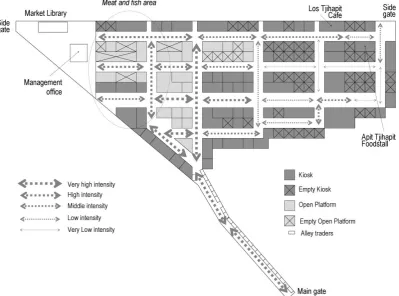
trading tables in the entrance alley to the building. In the building, there are two kind of trading space: kiosk and open platform, which occupied 70% of all formal trading spaces.
Fig. 1. Map of Pasar Cihapit
The empty kiosks are located in uneasy accessible area. Meanwhile, all of alleys space is fulfilled by the traders. It is indicated that intensity of space consumption by traders is determined by accessibility (fig.1).
The intensity of consumed space by market consumers is identified in circulation space. Different with trading space, circulation space intensity, beside is determined by accessibility, is also influenced by specific commodities as attractor. Meat and fish commodities, and also cafe of Los Tjihapit can attract people to come although the kiosks is far from the main entrance (fig.1).
Controversies Mapping
Many actors in Pasar Cihapit generated many controversies, and the controversies also involve the artifacts creation. In Actor-Network Theory perspective, controversies are seen as actors process to gain knowledge. Mapping the controversies is a way to understand how actors build their collective existences. The controversies is a ‘hybrid forum’,: a space of conflict and negotiation between actors (Latour, 2005: 23-25, Yeneva, 2012:4,60). By this standpoint, a public market is good example to interpret as “hybrid forum”, because historicaly the urbanized human civilization begin on a place named “Agora”, a greek name of city center containing public market activities, when transform in Roman period as a “Forum” (Tangiers, 2008:9-10).
Controversies in Pasar Cihapit actually is happen among traditional traders, but the controveries have been stabilized.
Controversy among formal traders inside the market building, for example, can be seen in fairness of zoning for commodities and trading space types. Properly by functional
consideration kiosks should be used for dry commodities, where open platforms for wet commodities. But in the field, there are wet commodities sold in the kiosk and vice versa: not by function but rather by rent-price consideration. There are also controversies between formal and informal traders who occupy the side of entrance alley. They alley traders got more good accessibility to be reach by consumers, although they are not administratively admitted by the market management.
Two creative groups, Apit Tjihapit and Los Tjihapit, are also generate controversy. Apit Tjihapit community works and is organized by capitalism mode through building formal relation with bussiness school of an university, that can be attract political actors and big enterprises to gain economic capital to fund their social activities. On the other side, Los Tjihapit community is more socialist, works and organizes through informal relation with grassroot activists. Artifacts produced by Apit Tjihapit tends to be monumental and able to attract the public massively, meanwhile Los Tjihapit created small events with deep of social struggle contents.
[image:5.595.84.484.117.413.2]capabilities and authority to innovate the market and give incentives to attract more consumers. Although Pasar Cihapit management involves in many creative events, but this effort does not increase the market economic performance significantly. There are many empty kiosks still empty, no many traders joining to the the market.
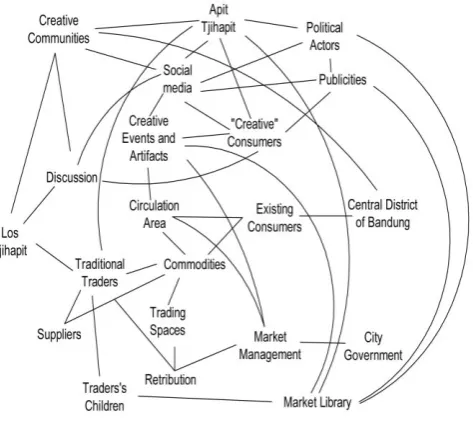
Fig. 2. Actors-artifacts network before (left) and after (right) creative movement
Traditionality and Creativity Translation
Translation is a term of Actor-Networ Theory used to decribe the process how network is made. Callon (1986, 19–34) describe four stages in actors or actor groups translation: problematization, interessement, enrolment, mobilization. Socio-technical assemblage among actors and artifactscan be illustrated on a sociotechnogram. Actor-artifact relation map is able to disentangle the controversies. Before the creative movement, Pasar Cihapit was a common market: its network are constructed by relation among consumers, traders, and suppliers of daily goods. This market has special consumers who came from middle-up class. The market management rented the trading spaces and collect retribution from traders (fig.2 left).
After creative movement in the end of 2014, more actors are involved, network enlarges. The existing actors network is still kept. Creative groups create creative events, and the social media publish them to attract other actors come to the market. Public attention improve the market image as Bandung cultural identity.
Although be able to attract public attention, there are no mobilized translation between the existing traditional consumers and new “creative” consumers. Two consumer groups come from different group, and they do not have significant mutual relationship that can accumulated market consumers significantly. Because there are no consument accumulation, there are significant economic increase in this market: the empty trading spaces is still empty.
Conclusion
This research get early finding, that creative movement in Pasar Cihapit Bandung can contribute public market role as socio-cultural place, but have not already yet as economic place. This movement is able to create public attention to increase urban identity of the public market. But there are no significant translation to accumulate “creative” consumers and “traditional” consumers that potentially increase economic activities in this market.
By exercising assemblage approach, this research shows that a small place such as public market is constructed by urban assemblage. A social movement will involve many actors who generate controversies and contestation, because each groups will strugle and represent their desires into produced artifacts. Research about urban assemblage in public market directs to the concept of “urban learning assemblages”, to see an urban place is representation of the actors’ feeling of way of finding to their world through combined action of human and nonhuman agencies’ (Macfarlane, 2011:1)
[image:6.595.286.523.155.373.2]References
AlSayyad, N. (ed.). (2004). The end of tradition? London: Routledge
Callon, M., Law, J. & Rip, A. (eds.) (1986). Map-ing the Dynamics of Science and Technology. London: Macmillan, p.
Callon, M. & Law, J (2003), On Qualculation, Agency And Otherness.
http://www.lancaster.ac.uk/fass/resources/sociology- online-papers/papers/callon-law-qualculation-agency-otherness.pdf (retrieved Dec 20, 2016)
Callon, M. & Muniesa, F. (2005). Economic Markets as Calculative Collective Devices. Organization Studies,
Vol. 26, 8, 2005. Pp.1229–1250
Dinas Pengelolaan Pasar Kota Bandung (2007). Data Potensi Pasar Kota Bandung 2007.
DeLanda, M. (2006) A New Philosophy of Society. New York, NY: Continuum.
Deleuze, G. & Guattari, F. (1980) Thousand Plateaus: Capitalism and Schizophrenia. London, UK: Continuum.
Dovey, K. (2010) Becoming Places: Urbanism/Architecture/Identity/Power. London and New York, UK & US: Routledge
Dovey K., & Pafka, E. (2017): What is functional mix? An assemblage approach: Planning Theory & Practice, DOI: 10.1080/14649357.2017.1281996
Ekomadyo, A.S. (2012). Menelusuri Genius Loci Pasar Tradisional sebagai Ruang Sosial Nusantara. Seminar Nasional Semesta Arsitektur Nusantara 1 (SAN1)
Universitas Brawijaya Malang,
Ekomadyo, A.S., Zahra, A., dan Najmi, I. (2012). Tracing Social-Economic Forces In Construction Of Urban Place; Case: Pasar Pamoyanan Bandung. Paper presented in International Seminar on Place Making and Identity: Rethinking Urban Ap.roaches to Built Environment . partment of Architecture, Universitas Pembangunan Jaya,
Florida, R. (2005). Cities and the creative class. New York: Routledge,
Helmy C. (2016). Semangat Perubahan di Jantung Kota. Article in Kompas. June, 5, 2016.
Latour, B. (2005) Reassembling the Social An Introduction to Actor-Network-Theory. Oxford: Oxford University Press
Lefebvre, H. (1991) The Production of Space, Oxford: Blackwell.
McFarlane, C. 2011 Learning the City Knowledge and Translocal Assemblage. West Sussex, UK: Blackwell Publishing - John Wiley & Sons John Wiley & Sons, Ltd.,
Morgan, P. (2010) Towards a developmental theory of place attachment. Journal of Environmental Psychology, Vol. 30, pp. 11-22.
Philips, J. (2006). Agencement/ Assemblages. Theory, Culture & Society, Vol 23, Issue 2-3, 2006. Pp. 108-109.
Poesoro, A. (2007). Measuring the Impact of Supermarkets of Traditional Markets. SMERU Newsletter, 22, 3-10 Sabianti, D.S. (2012). Pasar Bahan Bakar Nabati (BBN)
Nyamplung Di Jawa Tengah dalam Perspektif Teori Jaringan – Aktor. Theses. Develompet Studies Master Program. Institut Teknologi Bandung
Smith, D., & Protevi, J. (2008). Gilles Deleuze. plato.stanford.edu. Retrieved 29 Sept 2017, from http://plato.stanford.edu/entries/deleuze/#ThoPla Wiryawan M. R. (2012). Cihapit: Surga dan Masa yang
Kelam Bandung.
https://komunitasaleut.com/2012/03/01/cihapit-surga-dan-masa-yang-kelam-bandung/
Wise, J., & Slack, J. (2014). Culture and Technology. New York, NY: Lang, Peter New York.
Yaneva, A. (2012). Mapping Controversies in Architecture.