ISSN 0252-8266
%
eurostat
EUROSTATISTIK
Daten zur Konjunkturanalyse
EUROSTATISTICS
Data for short-term economic analysis
EUROSTATISTIQUES
Données pour l'analyse de la conjoncture
Monatlich D Monthly D Mensuel
4 D 1991
eurostat
OFICINA ESTADÍSTICA DE LAS COMUNIDADES EUROPEAS
DE EUROPÆISKE FÆLLESSKABERS STATISTISKE KONTOR
STATISTISCHESAMT DER EUROPÄISCHEN GEMEINSCHAFTEN
ΣΤΑΤΙΣΤΙΚΗ ΥΠΗΡΕΣΙΑ ΤΩΝ
ΕΥΡΩΠΑΪΚΩΝ ΚΟΙΝΟΤΗΤΩΝ
STATISTICAL OFFICE OF THE EUROPEAN COMMUNITIES
OFFICE STATISTIQUE DES
COMMUNAUTÉS EUROPÉENNES
ISTITUTO STATISTICO DELLE COMUNITÀ EUROPEE
BUREAU VOOR DE STATISTIEK DER EUROPESE GEMEENSCHAPPEN
SERVIÇO DE ESTATÍSTICA DAS COMUNIDADES EUROPEIAS
L2920 Luxembourg Tél. 43011 Télex : Comeur Lu 3423
B1049 Bruxelles, bâtiment Berlaymont, rue de la Loi 200 (bureau de liaison) Tél. 2351111
Las publicaciones de Eurostat están clasificadas por temas y por series. La clasificación se encuentra al
final de la obra. Para mayor información sobre las publicaciones, rogamos se pongan en contacto con
Eurostat.
Para los pedidos, diríjanse a las oficinas de venta cuyas direcciones figuran en la página interior de la
contracubierta.
Eurostats publikationer er klassificeret efter emne og serie. En oversigt herover findes bag i hæftet.
Yderligere oplysninger om publikationerne kan fås ved henvendelse til Eurostat.
Bestilling kan afgives til de salgssteder, der er anført på omslagets side 3.
Die Veröffentlichungen von Eurostat sind nach Themenkreisen und Reihen gegliedert. Die Gliederung ist
hinten in jedem Band aufgeführt. Genauere Auskünfte über die Veröffentlichungen erteilt Eurostat.
Ihre Bestellungen richten Sie bitte an die Verkaufsbüros, deren Anschriften jeweils auf der dritten
Umschlagseite der Veröffentlichungen zu finden sind.
Οι
εκδόσεις της Eurostat ταξινομούνται κατά θέμα και κατά σειρά. Η ακριβής ταξινόμηση αναφέρεται στο
τέλος κάθε έκδοσης. Για λεπτομερέστερες πληροφορίες σχετικά με τις εκδόσεις, μπορείτε να απευθύνεσθε
στην Eurostat.
Για τις παραγγελίες μπορείτε να απευθύνεσθε στα γραφεία πώλησης, των οποίων οι διευθύνσεις αναγράφονται
στη σελίδα 3 του εξωφύλλου.
Eurostat's publications are classified according to themes and series. This classification is indicated at the
end of the publication. For more detailed information on publications, contact Eurostat.
Orders are obtainable from the sales offices mentioned on the inside back cover.
Les publications d'Eurostat sont classées par thème et par série. Cette classification est précisée à la fin
de l'ouvrage. Pour des informations plus détaillées sur les publications, contactez Eurostat.
Pour les commandes, adressez-vous aux bureaux de vente dont les adresses sont indiquées à la page 3
de la couverture.
Le pubblicazioni dell'Eurostat sono classificate per tema e per serie. Tale classificazione è precisata alla
fine dell'opera. Per informazioni più dettagliate sulle pubblicazioni rivolgersi all'Eurostat.
Per eventuali ordinazioni rivolgersi a uno degli uffici di vendita i cui indirizzi figurano nella 3a pagina
della copertina.
De publikaties van Eurostat zijn ingedeeld naar onderwerp en serie. Deze indeling is achter in het boek
opgenomen. Voor nadere informatie over de publikaties kunt u zich wenden tot Eurostat.
Gelieve bestellingen op te geven bij de verkoopbureaus, waarvan de adressen op bladzijde 3 van de
omslag zijn vermeld.
EUROSTATISTIK
Daten zur Konjunkturanalyse
EUROSTATISTICS
Data for short-term economic analysis
EUROSTATISTIQUES
Données pour l'analyse de la conjuncture
ACHTUNG: Analyse und Kommentar auf S. 7
ATTENTION: Analysis and commentary on p. 11
ATTENTION: Analyse et commentaires à la page 15
Luxembourg: Office des publications officielles des Communautés européennes, 1991
Kat./cat.: CA-BJ-91-004-3A-C
© EGKS-EWG-EAG, Brüssel — Luxemburg, 1991
Nachdruck — ausgenommen zu kommerziellen Zwecken — mit Quellenangabe gestattet.
©
ECSC-EEC-EAEC, Brussels — Luxembourg, 1991
Reproduction is authorized, except for commercial purposes, provided the source is acknowledged.
© CECA-CEE-CEEA, Bruxelles — Luxembourg, 1991
Reproduction autorisée, sauf à des fins commerciales, moyennant mention de la source.
EUROSTATISTICS
ON DISKETTE
The Statistical Office of the
European Communities in
collaboration with the
company DSI, is offering all
the historical data and the
monthly updating of
Eurostatistics on floppy disks,
so you can consult these data
on your personal computer.
L'Office statistiques des
Communautés européennes,
avec la compagnie DSI, offre
sur disquettes toutes les
données historiques et les
mises à jour mensuelles'
d'Eurostatistiques, que vous
pouvez consulter sur votre
ordinateur personnel.
Das Statistische Amt der
Europäischen Gemeinschaften
in Zusammenarbeit mit der
Firma DSI bietet Ihnen alle
historischen Daten sowie
deren monatliche
Aktualisierung auf Diskette
an, so daß Sie dieselben
jederzeit auf Ihrem PC
abrufen können.
Bureau d'information :
Division A3
Office statistique des Communautés européennes
Bâtiment Jean Monnet
L-2920 Luxembourg
N a m e / N o m
Company/Entreprise/Gesellschaft
Vorwort
Mit der monatlich erscheinenden Veröffentlichung „Eurostatistik" - Daten zur
Konjunk-turanalyse werden innerhalb kürzester Frist die neuesten statistischen Daten über die
Europäische Gemeinschaft als Ganzes (EUR 12), über jedes Mitgliedsland sowie über
die Vereinigten Staaten und Japan bekanntgegeben.
„Eurostatistik" enthält nicht die Gesamtheit des bei Eurostat verfügbaren statistischen
Materials, sondern eine Auswahl der relevantesten Reihen über die konjunkturelle
Ent-wicklung.
Die Reihen werden jeweils für die letzten 15 Monate, die letzten fünf Quartale und die
letzten vier Jahre veröffentlicht, um eine kurz- oder mittelfristige Analyse -
gegebenen-falls mit überarbeiteten Zahlen - zu ermöglichen.
Schnelligkeit und Pünktlichkeit sind die wichtigsten Vorzüge dieser Veröffentlichung.
Aus diesem Grunde wurde sie im Umfang bewußt klein gehalten und enthält keine
Anmerkungen zur Methodik, die im übrigen in den spezialisierten Veröffentlichungen
von Eurostat zu finden sind.
„Eurostatistik" besteht aus vier Teilen:
- Die Rubrik „kurz notiert" gibt die wichtigsten Ereignisse und Entwicklungen der
jüngsten Zeit im wirtschaftlichen, finanziellen und sozialen Bereich wieder.
- Im Schaubilderteil werden die wichtigsten Reihen über die wirtschaftliche
Entwick-lung in der Gemeinschaft, den Mitgliedstaaten, den Vereinigten Staaten und Japan
veranschaulicht.
- Im Konjunkturdatenteil werden die Daten, die von Eurostat auf der Grundlage
gemeinsamer Kriterien harmonisiert wurden, für sämtliche Mitgliedstaaten
darge-stellt und mit den Daten der Vereinigten Staaten und Japans verglichen.
- Der Ländertabellenteil schließlich gibt für jedes Land auf je einer Seite die
wirt-schaftliche Entwicklung auf der Grundlage einer Anzahl von Indikatoren wieder, die
übrigens immer im Konjunkturdatenteil veröffentlicht werden.
Die in „Eurostatistik" veröffentlichten Daten stammen aus dem „ICG"-Bereich der
On-Iine-Datenbank „Cronos" von Eurostat.
Wer Zugang zu Cronos besitzt, kann jederzeit die Tabellen dieser Veröffentlichung
abfragen, wobei die Daten täglich auf den neuesten Stand gebracht werden. Hinweise
zur ,,on-line"-Benutzung finden sich auf S. 111.
Weitere Informationen über „Eurostatistik" können bei folgender Stelle angefordert
werden:
Eurostat - Direktion A
L-2920 LUXEMBURG
Telephon: (352) 4301-2046
4301-2038
9
Inhaltsverzeichnis
Zeichen und Abkürzungen
„KURZ NOTIERT'
SCHAUBILDER
.
KONJUNKTURDATEN
1. Volkswirtschaftliche Gesamtrechnungen
2. Beschäftigung
3. Arbeitslosigkeit
4. Industrielle Produktion
5. Meinungsumfrage in der Industrie
6. Industrieerzeugnisse
7. Einzelhandel
8. Landwirtschaftliche Erzeugnisse
9. Außenhandel
10. Verbraucherpreise
11. Landwirtschaftliche Erzeugerpreise
12. Löhne und Gehälter
13. Finanzstatistiken
14. Zahlungsbilanz
LÄNDERTABELLEN
Titel (vollständiges Verzeichnis)
1. BR Deutschland
2. France
3. Italia
4. Nederland
5. Belgique/België
6. Luxembourg
7. United Kingdom
8. Ireland
9. Danmark
10. España
11. Hellas
12. Portugal
13. United States of America
14. Japan
7
17
37
41
44
47
54
58
62
63
65
86
89
90
91
95
98
99
100
101
102
103
104
105
106
107
108
109
110
111
112
%
%,T4/T0
%,T12/T0
%,T/T12
%,SALDO
1 9 8 5 = 1 0 0
EUR 1 0 = 100
EUR 1 2 = 100
MIO
MRD
Τ
TR0EE
GWH
M3
Β
OK
D
GR
E
F
IRL
I
L
NL
Ρ
UK
USA
JAP
USD
ECU
SZR
EG
Eurostat
EUR 10
EUR 12
UEBL/BLEU
ACP
ESUG
NACE
SITC
Weniger als die Hälfte der verwendeten
Einheit
Prozent
Prozentualer Zuwachs eines Vierteljahres
gegenüber dem entsprechenden Vierteljahr
des Vorjahres
Prozentualer Zuwachs eines Monats
gegenüber dem entsprechenden Monat
des Vorjahres
Saldo zwischen den positiven Antworten
(Zunahme, Verbesserung der Situation) und
den negativen Antworten (Abnahme,
Verschlechterung der Situation) der
Konjunkturbefragung bei den
Unternehmern in der Gemeinschaft,
saisonbereinigt (Ländertabellen)
Basisjahr
Prozentuale Angaben im Verhältnis zur
Gemeinschaft der 10 oder 12 ( = 100)
Million
Milliarde
Metrische Tonne
Tonne Rohöleinheiten
Gigawattstunde = 1 0
6k W h
Kubikmeter
Belgique/België
Danmark
BR Deutschland
Ελλάδα/Griechenland
España
France
Ireland
Italia
Luxembourg
Nederland
Portugal
United Kingdom
United States of America
Japan
US-Dollar
Europäische Währungseinheit
Sonderziehungsrechte
Europäische Gemeinschaft[en]
Statistisches Amt der Europäischen
Gemeinschaften
Gesamtheit der Mitgliedsländer der
Europäischen Gemeinschaften vor bzw.
nach dem Beitritt Spaniens und Portugals
Belgisch-luxemburgische Wirtschaftsunion
Länder Afrikas, der Karibik und des Pazifiks
— Abkommen von Lomé
Europäisches System Volkswirtschaftlicher
Gesamtrechnungen
Allgemeine Systematik der
Wirtschaftszweige in den Europäischen
Gemeinschaften
KURZ NOTIERT
Soweit nicht anders angegeben, beziehen sich die Angaben auf den Gebietsstand der Bundesrepublik Deutschland vor dem 3.10.1990; sie schließen Berlin (West) ein.
WECHSELKURSE: Dollar Anfang März wieder stärker
Auf den deutlichen Wertverlust des US-Dollar Anfang Februar, über den im letzten Monat berichtet wurde, folgte Anfang März ein ebenso deutlicher Kursgewinn. Zwar fiel der Dollar am 4. Februar kurzzeitig auf 1,456 DM, er verbesserte sich jedoch bis zum 20. Februar auf 1,49 und erreichte bis zum 19. März 1,67 DM, womit er beinahe 15 % über seinem Tiefstpunkt lag. Der Kursanstieg des Dollar gegenüber dem Yen von der ersten Februar-woche bis zum 20. März betrug 7,5 % und war damit weniger spektakulär. In diesem Zeitraum griffen die Zentralbanken auf breiter Front in den Markt ein, um den Aufschwung des Dollar aufzuhalten.
Diese Wertsteigerung des Dollar dürfte in erster Linie auf ein gestiegenes Vertrauen in die amerikanische Volkswirtschaft sowie auf Hoffnungen zurückzuführen sein, daß die Wirt-schaft in den USA die Talsohle der Rezession nunmehr durchschritten hat und der Aufschwung bald einsetzen wird. Der Kurs des Dollar stieg, obwohl der Leitzins für Federal Funds am 8. März um weitere 0,25 % auf 6,0 % gekürzt wurde; allerdings wurde dieser Satz später wieder heraufgesetzt.
Innerhalb des Wechselkursmechanismus des EWS bewegten sich die Wechselkurse Im Februar nur wenig; die größten Kursänderungen verzeichneten die Peseta ( + 0,75 % gegenüber dem Ecu) und das Pfund Sterling (- 0,3 %). Außerhalb des Wechselkursmecha-nismus gewann der Escudo knapp 1,3 %, während die Drachme um 1,2 % abwertete. Damit hat die Drachme in den vergangenen zwölf Monaten gegenüber dem Ecu beinahe 13 % verloren.
Ende Februar und in den ersten Wochen im März wurden die Geldmarktsätze In den EG-Mitgliedstaaten erneut angepaßt. Die Leitzinsen im Vereinigten Königreich wurden am 27. Februar um weitere 0,5 % (auf 13 %) herabgesetzt, ohne daß das Pfund Sterling nennenswert an Wert verlor, und weitere Senkungen werden in absehbarer Zelt erwartet. Die Peseta, monatelang die stärkste Währung im Wechselkursmechanismus, erreichte in den vergangenen Wochen immer wieder die Obergrenze ihrer Schwankungsbreite im Wechselkursmechanismus, so daß der Banco de Espana an den Devisenmärkten intervenie-ren und auch aufgrund binnenwirtschaftlichen Drucks seinen Tagesgeldsatz am 15. März um einen Prozentpunkt auf 13,5 % reduzieren mußte. Vorausgegangen war dieser Maßnahme Mitte Februar eine Senkung um 0,2 %.
Auf die Herabsetzung der spanischen Zinssätze folgte am 18. März eine Reduzierung des Interventionssatzes der Banque de France um 0,25 % auf 9 %. Diese Maßnahme war eine Überraschung für die Finanzmärkte, da der französische Franc seit einigen Wochen nahe seinem niedrigsten Niveau gegenüber der Peseta gehandelt wurde. Er bleibt nach wie vor die schwächste Währung im Wechselkursmechanismus.
Die dänischen Zinssätze wurde am 19. März ebenfalls herabgesetzt, als die dänische Notenbank ihren Ausleihsatz für Geschäftsbanken um 0,5 % auf 10 % senkte. Hierdurch schwächte sich die Krone gegenüber anderen Währungen im Wechselkursmechanismus leicht ab.
RENDITEN VON STAATSANLEIHEN: Weiterhin allgemeiner
Rückgang der Renditen
Im Februar sanken die Renditen für Staatsanleihen in allen Ländern, über die hier berichtet wird') und für die Februarangaben vorliegen. Am stärksten war der Rückgang in Dänemark (wo die Renditen in diesem Jahr bisher um einen vollen Prozentpunkt gesunken sind), Belgien, Frankreich und der Bundesrepublik Deutschland.
Unter den EG-Ländern verzeichnet Portugal seit vielen Monaten die höchsten Renditen für Staatsanleihen, gefolgt von Spanien. Luxemburg und die Bundesrepublik Deutschland weisen derzeit die niedrigsten Renditen auf und sind die beiden einzigen EG-Länder, in denen die Renditen für Staatsanleihen unter 9 % liegen. Der EG-Durchschnitt für den Monat Februar (auf der Grundlage der verfügbaren Daten) betrug 10,2 % gegenüber 10,5 % im Januar. Demgegenüber lagen die Anleiherenditen in den USA bei 8 % und in Japan bei 6,7 % (Februarangaben).
Diese Abwärtsbewegung der Anleiherenditen spiegelt den derzeit weltweit zu beobachten-den Rückgang der Zinssätze wider; es wird allgemein davon ausgegangen, daß die Erhöhungen der Zinssätze über die letzten Monate betrachtet nunmehr Ihren Höchststand erreicht haben und In den meisten Ländern im Laufe der nächsten Monate weiter heruntergehen werden.
Die Renditen für Staatsanleihen in der Bundesrepublik Deutschland betrugen Im Februar durchschnittlich 8,6 % und sind damit trotz der Heraufsetzung der Sätze am deutschen Geldmarkt Ende Januar auf Ihrem niedrigsten Stand seit Januar 1990. Das gleiche gilt für die Niederlande sowie für Spanien und das Vereinigte Königreich, wo nach den jüngsten Senkungen der Nominalzinsen in absehbarer Zeit ebenfalls weitere Verminderungen der Renditen für Staatsanleihen erwartet werden können.
GELDVOLUMEN: Weitere Verlangsamung des
Geldmengen-wachstums in den meisten betrachteten Ländern
Das Geldmengenwachstum verlangsamt sich in den meisten Ländern, über die hier berichtet wird, beträchtlich. In manchen Fällen stockte es geradezu dramatisch: In Frankreich betrug das Wachstum von M2 in den zwölf Monaten bis Dezember nur 0,7 % 2), und die Ausweitung von M4 im Vereinigten Königreich belief sich Im Januar auf 11,1 %, verglichen mit 19,3 % im Januar 1990 (Jahresraten).
Auch in Belgien vermindert sich das Geldmengenwachstum; dort stieg M2 im dritten Quartal 1990 um 6,6 % (auf Jahresrate umgerechnet), verglichen mit einer Steigerungsrate von 10,6 % im gleichen Quartal 1989. Die gleiche Entwicklung ist auch in Dänemark zu beobachten, wo das Wachstum von M2 sich im November im vierten aufeinanderfolgenden Monat verminderte. In Japan sank die Zuwachsrate von M2 in den letzten Monaten ebenfalls; von Ihrem Höchststand von 13,2 % Im Jahre 1990 ging sie - auf Jahresrate
Mit Ausnahme Italiens, wo die Renditen In den vergangenen Monaten bei 12,5 %
umgerechnet - im Dezember auf 8,6 % herunter, was dem niedrigsten Stand seit Dezember 1986 entspricht.
Diese Abschwächung des Geldmengenwachstums dürfte in den meisten Fällen auf die Hochzinsperiode, die die meisten Ländern Im Jahre 1990 verzeichneten, zurückzuführen sein. Diese hat jedoch nicht in allen Ländern zu demselben Ergebnis geführt: Sowohl die Bundesrepublik Deutschland als auch Spanien wiesen in den letzten Monaten ein stärkeres Geldmengenwachstum auf. Die Zuwachsrate der Geldmenge ALP in Spanien stieg von etwa 8,6 % im Juni 1990 auf 11,9 % zum Jahresende und lag damit mehr als 2 Prozentpunkte über der Obergrenze des Zielkorridors des Banco de Espana. Das Wachstum von M3 in der Bundesrepublik Deutschland betrug 1990 auf Jahresrate umgerechnet schließlich 5,9 % und blieb damit gerade noch im Zielkorridor von 4 % bis 6 %, den die Bundesbank festgelegt hatte. Diese höher als erwartet ausfallende Wachstumsrate ist auf den mit der deutschen Einigung verbundenen finanziellen Druck zurückzuführen.
AMTLICHE WAHRUNGSRESERVEN: Reserven von EUR 12
erhö-hen sich 1990 um 8 %
Die amtlichen Währungsreserven (ohne Gold) von EUR 12 erhöhten sich 1990 um beinahe 8 % auf 233 Mio. ECU; allerdings ist diese Zahl niedriger als der Jahreshöchststand 1990 von fast 238 Mio. ECU, der im September verzeichnet wurde.
Die Reserveposition der größten hier betrachteten Länder veränderte sich im Januar kaum: in den USA, Japan und der Bundesrepublik Deutschland lagen die Veränderungen gleichermaßen unter 1 %. Die stärksten Schwankungen wiesen Griechenland (fast - 22 %) und Dänemark ( - 7 %) auf. Reservezuflüsse ergaben sich in Irland ( + 12 %) und Spanien ( + 2 %); aufgrund der Stärke der Peseta wuchsen die spanischen Reserven In den letzten zwölf Monaten um beinahe 13 % an.
VIERTELJÄHRLICHE KONTEN: Im dritten Quartal
Wirtschafts-entwicklung in der Gemeinschaft weiterhin nicht eindeutig.
Kennzeichnend für die wirtschaftliche Entwicklung in der Gemeinschaft insgesamt war im dritten Quartal 1990 eine Neubelebung des Wirtschaftswachstums (BIP +0,6 %). Diese leichte Wiederbelebung, die im Widerspruch zu den wichtigsten Konjunkturindikatoren zu stehen scheint, bedarf einer eingehenderen Betrachtung. Zunächst gilt es darauf hinzuwei-sen, daß das dritte Quartal wegen der Sommerurlaubszeit in starkem Maße durch die Saisonbereinigungsverfahren beeinflußt ist, die in Phasen einer unklaren Wirtschaftsent-wicklung zu einer Überbewertung der Wirtschaftstätigkeit führen können.
Daneben darf nicht vergessen werden, daß der wirtschaftliche Aufschwung im dritten Quartal zumindest teilweise auf das bei den Volkswirtschaften häufig zu beobachtende Phänomen zurückzuführen ist, daß nach einer negativen Entwicklung, wie sie Im zweiten Quartal zu verzeichnen war, eine gewisse Erholung stattfindet. Nicht unerwähnt bleiben sollte schließlich die Tatsache, daß die Währungsunion In Deutschland zu einer merklichen Erhöhung der finanziellen Ressourcen in der Bundesrepublik Deutschland geführt hat. Angesichts dieser Sachlage, die außerdem durch die ersten Ergebnisse für das vierte Quartal bestätigt wird, ist bei der Interpretation der derzeitigen wirtschaftlichen Entwicklung beträchtliche Vorsicht geboten, auch wenn eine Verlangsamung im Vergleich zum Vorjahr nur zu offensichtlich scheint.
Was die durch den impliziten BIP-Deflator gemessene Inflation angeht, so ¡st auf Quartalsbasis ein leichter Rückgang ( + 1,0 %), auf Jahresbasis dagegen ein Anstieg ( + 5 , 1 %) festzustellen. Der Wertverlust des Dollars auf dem Devisenmarkt hat den seit der Golfkrise noch ausgeprägteren Anstieg der Ölpreise praktisch ausgeglichen.
In den einzelnen Mitgliedstaaten stellte sich die Situation folgendermaßen dar:
- in der Bundesrepublik Deutschland, aus der Daten für das vierte Quartal vorliegen: spürbare Verlangsamung von Produktionstätigkeit und Inflation ( + 0,3 % bzw. +3,5 %), merkliche Belebung der Investitionstätigkeit ( + 1,6 %),
- in Frankreich, aus dem die ersten volumenmäßigen Ergebnisse für das vierte Quartal vorliegen: leichter Rückgang der Produktion und der Investitionen
( - 0 , 1 % bzw. 0,8 %),
- in Italien: leichte Belebung der Produktionstätigkeit ( + 0,7 %), Rückgang sowohl der vierteljährlichen als auch der jährlichen Inflationsrate (+0,7 % bzw. +6,9 %), Stagnation der Investitionen ( + 0,0 %),
- im Vereinigten Königreich: beträchtlicher Rückgang von Produktion und Investitionen ( - 1 , 3 % bzw. - 3 , 8 %), starker Anstieg sowohl der vierteljährlichen als auch der jährlichen Inflationsrate ( + 1,9 % bzw. +7,0 %).
In den Vereinigten Staaten, aus denen Daten für das vierte Quartal vorliegen, ist eine merkliche Abschwächung der Produktionstätigkeit ( - 0 , 5 %) bei einem gleichzeitigen leichten Rückgang sowohl der vierteljährlichen als auch der jährlichen Inflationsrate ( + 0,6 % und +4,0 %) festzustellen. Bei den Komponenten des BIP waren interessanter-weise ein beträchtliches Nachlassen der Investitionstätigkeit (-1,9%) und ein nicht ganz so ausgeprägter Rückgang des privaten Verbrauchs (-0,8%) zu beobachten, während der Staatsverbrauch in starkem Maße zugenommen hat ( + 1,2 %).
In Japan war das dritte Quartal durch eine positive Entwicklung des BIP ( + 1,0 %) bei einer Inflationsrate von 0,0 % gekennzeichnet.Bei den Komponenten der Nachfrage war eine unvermindert rasche Zunahme derlnvestitionstätlgkeit ( + 2,2 %) zu beobachten, während der private Verbrauch und der Staatsverbrauch nur wenig gestiegen sind ( + 0,4 % bzw.
+ 0,1 %).
PREISE: Leichter Anstieg für EUR-12 im Februar (+ 0,4 %)
Jährliche Inflationsrate bei 5,5 %
Zwischen Januar und Februar stieg der Verbraucherpreisindex für die Gemeinschaft um 0,4 %. Der stärkste Zuwachs war in Portugal ( + 1,8 %) und in Italien ( + 0,9 %) zu verzeichnen. Die niedrigsten Raten wiesen Spanien ( - 0 , 1 %), Griechenland und die Niederlande auf (beide + 0,1 %).
Die auf die letzten 12 Monate umgerechneten Inflationsraten sowie die für den Vergleichs-zeitraum im Vorjahr sind nachstehend in wachsender Reihenfolge der gegenwärtigen Inflationswerte aufgeführt:
Dänemark Irland Niederlands
Deutschland Frankreich Belgien
Februar 91 Februar 90 2,6% 2,6% 2,6%
2,7% 3,5% 4,0%
Februar 90 Februar 89 3,2% 4,2% 2 , 1 %
2,7% 3,4% 3,4%
Spanien Italien Vereinigtes Königreich Portugal Griechenland Eur 12
Februar 91 Februar 90 5,9% 6,4% 8,9%
12,3% 21,8% 5,5%
Februar 90 Februar 89 7,3% 6,5% 7,5%
13,1% 16,5% 5,3%
Anmerkung: Aus technischen Gründen lagen die Monatsindizes für Januar und Februar für Luxemburg bei Redaktionsschluß nicht vor.
ARBEITSLOSIGKEIT IN DER GEMEINSCHAFT
Eurostat schätzt die Arbeitslosenquote in der Gemeinschaft für Januar 1991 auf 8,4%. Dieser Wert ist saisonbereinigt, Einflüsse der unterschiedlichen nationalen Methoden zur Erfassung der Arbeitslosigkeit sind weitgehend ausgeschaltet. Gegenüber dem Vormonat ist die Quote unverändert, im Vergleich mit Januar 1990 ¡st jedoch ein leichter Rückgang um 0,1 Prozentpunkt zu verzeichnen.
Die über die letzen sechs Monate zu beobachtende Stagnation der Arbeitslosenquote in der Gemeinschaft insgesamt verdeckt jedoch gegensätzliche Entwicklungen in den einzelnen Mitgliedstaten: einen kontinuierlischen Anstieg der Arbeftlosenquote im Vereinigten König-reich von 6,3% auf 7,2% sowie einen anhaltenden Rückgang von 0,5 Prozentpunkten in den alten Ländern der Bundesrepublik Deutschland.
In wenigstens zwei Mitglledstaaten scheint eine Tendenzwende einzutreten: In Irland, wo nach kontinuierlichem Rückgang von 2,4 Prozentpunkten zwischen 1987 und 1990 in den letzen drei Monaten ein Anstieg um 0,5 Prozentpunkte festzustellen ¡st und ¡n Dänemark, wo die Arbeitlosenquote zwischen 1987 und 1990 um 2,2 Prozentpunkte angestiegen war und in den letzen drei Monaten um 0,6 Prozentpunkte gefallen ist.
Die Arbeitlosenquote der Jugendlichen in der Gemeinschaft hat sich in den letzen Monaten günstiger entwickelt als die der Arbeitslosen insgesamt ( - 0 , 5 Prozentpunkte gegen - 0 , 1 ) . Beträchtlichten Rückgängen in Spanien ( - 2 , 5 Punkte) und Italien ( - 0 , 9 Punkte) stehen jedoch Zunahmen von 1,8 Punkten im Vereinigten Königreich und 1,5 Punkten in Irland gegenüber.
INDUSTRIELLE PRODUKTION: Weitere
Konjunkturabschwä-chung in der Industrie, aber nur geringe Auswirkung der
Golf-krise
Der Produktionsindex wird für Dezember 1990 für die Europäische Gemeinschaft (EUR-12) derzeit auf 113,5 geschätzt (1985=100); dies entspricht einer Steigerung von - 0 , 1 % gegenüber Dezember 1989.
In den Vereinigten Staaten war im gleichen Monat eine Änderungsrate von - 1 , 7 % zu beobachten, in Japan +5,8 %. Somit ¡st in Japan auch im Dezember erhebliches in-dustrielles Wachstum zu beobachten, während sich In den USA der Abwärtstrend der Industriekonjunktur deutlich fortsetzt und in der Europäischen Gemeinschaft Stagnation vorherrscht.
Nach Saisonbereinigung beträgt der geschätzte Index im Dezember 114,4 für die Europäische Gemeinschaft (November 1990: 114,3), 113,3 für die USA (Vormonat 114,6) und 127,8 für Japan (Vormonat 128,7).
Für die letzten drei Monate Oktober bis Dezember 1990 beläuft sich die Steigerung des Produktionsindex für EUR- 12 gegenüber dem gleichen Vorjahreszeitraum auf 0,5 %. Betrachtet man die letzten drei verfügbaren Monate des saisonbereinigten Produktionsindex und setzt diese in Bezug zu den drei davor liegenden Monaten Juli bis September, so ergibt sich eine Veränderungsrate von - 0 , 1 %.
Aufgegliedert nach Verwendungszwecken sind für die Europäische Gemeinschaft in den letzten drei Monaten (Oktober bis Dezember 1990) folgende Veränderungen gegenüber den drei davor liegenden Monaten festzustellen:
- 0 , 4 % bei Grundstoffen und Produktionsgütern (USA: - 1 , 6 %, Japan 2,2 %), - 1 , 2 % bei Investitionsgütern (USA: - 0 , 8 %, Japan 2,6 %),
+0,7 % bei Verbrauchsgütern (USA: - 1 , 5 %, Japan 3,0 %).
Seit Anfang 1989 werden in der Industrie der EG wieder Arbeitsplätze geschaffen, das Angebot an Beschäftigung nimmt zu. Allerdings zeigen sich hier ebenso wie für die Produktionsentwicklung deutliche Unterschiede zwischen den Mitgliedsstaaten. In Deutsch-land ( + 5 %), IrDeutsch-land ( + 4 %), Belgien ( + 2 %), den NiederDeutsch-landen ( + 1 %) und Frankreich ( + 1 %) zeigt sich eine positive Entwicklung, während in Italien, Luxembourg und das Vereinigte Königreich die Beschäftigtenzahl auch In den letzten zwei Jahren weiter gesunken ¡st.
Die Golfkrise zeigt bis Dezember 1990 kaum Auswirkungen In den Konjunkturindikatoren. Eine Analyse nach Ländern und einzelnen Wirtschaftszweigen zeigt keine auffälligen Veränderungen. Nur in der Industrie der Mineralölerzeugnisse (NACE 14) ist für EUR-12 Ende 1990 der Erzeugerpreisindex auf +25 % Jahreswachstum gestiegen (Vgl. auch Schaubild Seite 23 für NACE 1) und die Produktion um 14 % gesunken.
JAHRESÜBERBLICK 1990
Mittlerweile lassen sich auch Jahresindizes für 1990 berechnen bzw. schätzen. Dabei ergibt sich folgende Rangfolge der Wachstumsraten der mengenmäßigen Industrie- produktlon 1990 in bezug auf 1989 für die einzelnen Mitgliedsstaaten:
Starkes Wachstum in Portugal (8,1 %), in Deutschland (5,5 %), in Irland (4,5 %) und in Belgien (4,0 %). Deutliches Wachstum in den Niederlanden (2,6 %). Eher Stagnation in den übrigen Ländern Frankreich (0,8 %), Spanien (0,3 %), Dänemark (0,2 %), bis hin zur Abschwächung das vereinigte Königreich ( - 0 , 4 %), in Luxembourg ( - 0 , 6 %) und Italien (-0,8 %).
ZAHLUNGSBILANZ
GESAMTTENDENZEN: Januar bis September 1990 -
Leistungs-bilanz der Gemeinschaft negativ, jedoch Tendenz steigend;
beträchtlicher Abbau des Leistungsbilanzdefizits in den USA und
des Überschusses in Japan.
Erste Schätzungen des Leistungsbilanzsaldos der Gemeinschaft in den ersten neun Monaten 1990 lassen ein Defizit von 4,8 Milliarden ECU erkennen, verglichen mit einem Überschuß von 1,9 Milliarden im gleichen Zeitraum 1989. Dieser Rückgang ist insbesonde-re auf die Verminderung des Saldos aus Dienstleistungen und Übertragungen Im Vorjahinsbesonde-res- Vorjahres-vergleich um 14,9 Milliarden ECU in den beiden ersten Quartalen 1990 zurückzuführen, wobei die Entwicklung im zweiten Quartal besonders steil nach unten verlief. Im dritten Quartal zeichnet sich jedoch bei den Dienstleistungen und Übertragungen wieder eine gewisse Erholung ab. Im gleichen Zeitraum verzeichnete der Handelsbilanzsaldo eine stetige Verbesserung und lag schließlich 6 Milliarden ECU höher als Im gleichen Neunmonatszelt-raum 1989.
Das Leistungsbilanzdefizit der USA lag in jedem der ersten drei Quartale 1990 sowohl in Dollar als auch in Ecu gerechnet deutlich unter dem Vorjahresniveau. Das Defizit im Zeitraum Januar-September zusammengenommen betrug 54,6 Milliarden ECU (68,2 Milliarden Dollar) gegenüber 75,3 Milliarden ECU (82,1 Milliarden Dollar) im gleichen Zeitraum 1989. Besser als zuvor fielen sowohl das US- Handelsbilanzdefizit (-15,7 Milliarden ECU) als auch die Bilanz der Dienstleistungen und Übertragungen ( + 4,9 Milliarden ECU) aus. Erwähnenswert bei den Dienstleistungen und Übertragungen ist die Verminderung der Kapitalertragszahlungen der USA.
Unterdessen setzte sich der starke Abbau des japanischen Leistungsbilanzüberschusses in den ersten neun Monaten 1990 zunehmend fort. Im Zeitraum Januar bis September betrug der Leistungsbilanzsaldo 22,4 Milliarden ECU (4 130 Milliarden Yen) gegenüber 41,2 Milliarden ECU (6 150 Milliarden Yen) In den ersten neun Monaten 1989, wobei der Rückgang im zweiten und dritten Quartal besonders ausgeprägt war. Diese Abwärtstendenz ist eine Folge der stetigen Verminderung des japanischen Handelsbilanzüberschusses in diesem Zeitraum.
EINZELNE MITGLIEDSTAATEN: Januar bis September 1990: in
einigen Fällen beträchtlicher Rückgang der Dienstleistungs- und
Übertragungsbilanzsalden in den ersten sechs Monaten, aber
Stabilisierung im dritten Quartal.
Einige Mitgliedstaaten (Bundesrepublik Deutschland, Spanien, Frankreich, Italien und Vereinigtes Königreich) verzeichneten im ersten Halbjahr erheblich niedrigere Dienstlei-stungs- und Übertragungsbilanzsalden als im gleichen Sechsmonatszeitraum 1989. Im dritten Quartal zeigte sich bei den Dienstleistungen und Übertragungen jedoch ein deutlicher Aufschwung. In der Leistungsbilanzentwicklung gab es Unterschiede. In Dänemark und den Niederlanden, wo die Dienstleistungs- und Übertragungsbllanzen Im Zeitraum Januar bis September 1990 höhere Salden aufwiesen, stieg auch der Leistungsbilanzsaldo. Die portugiesische Leistungsbilanz zeigte sich gegenüber demselben Neunmonatszeitraum 1989 nur geringfügig verändert. Trotz eines Rückgangs bei den Dienstleistungen und Übertragungen verbesserte das Vereinigte Königreich seine Leistungsbilanz aufgrund des andauernden Abbaus seines Handelsbilanzdefizits um 5,2 Milliarden ECU. Das Ergebnis der Leistungstransaktionen in der Bundesrepublik Deutschland und Frankreich fiel niedriger aus (-8,5 Milliarden ECU bzw. - 4 Milliarden ECU), da die Salden sowohl in der Handelsbilanz als auch bei den Dienstleistungen und Übertragungen erheblich zurückgingen. Aufgrund schlechterer Ergebnisse bei den Dienstleistungen und Übertragungen sank der Leistungsbi-lanzsaldo sowohl in Spanien als auch in Italien, wenngleich die italienische Handelsbilanz in den ersten neun Monaten 1990 eine deutliche Verbesserung aufwies.
AUSSENHANDEL
GESAMTTENDENZEN: Ergebnisse im November 1990
Die Handelsbilanz der Gemeinschaft wies Im November ein recht hohes Defizit in Höhe von 6,4 Milliarden Ecu aus; im November 1989 waren es erst 2 Milliarden. Die Verschärfung des Defizits der Gemeinschaft, die im September 1990 einsetzte, hält also an. Das Gesamtdefizit in den ersten 11 Monaten des Jahres 1990 belauft sich auf 44 Milliarden Ecu, während es Im gleichen Zeitraum des Jahres 1989 nur 36,8 Milliarden betrug. Bis August war die Zahlungsbilanz weniger defizitär als im Jahr zuvor. Eine Trendwende trat zwischen September und November ein, einem Zeitraum, in dem das Defizit von 8,3 Milliarden im Vergleichszeitraum 1989 auf 18,4 Milliarden stieg. Der Ölpreis ist mitverantwortlich für diese überaus negative Entwicklung. Die Rohöl-Beschaffungskosten der Gemeinschaft in CIF-Prelsen stiegen von 17,7 $ das Barril im Juli auf 36,1 $ im Oktober und fielen im November wieder auf 32,9 Î . Die Verschlechterung Im November ist jedoch nicht ausschließlich dem Erdölpreis anzulasten. Bei der Einfuhr (+6,7 % gegenüber November 1989) und bei der Ausfuhr ( - 4 , 8 %) lief die Entwicklung immer weiter auseinander. Das amerikanische Handelsbilanzdefizit weist für November 1990 in Ecu eine deutliche Verbesserung auf (8,5 Milliarden Ecu gegenüber 11,2 Milliarden Ecu im November 1989). Im Vergleich zum November 1989 ging die Einfuhr um 13,8 %, die Ausfuhr um 9,5 % zurück. In den ersten zehn Monaten des Jahres schrumpfte das amerikanische Defizit erheblich (von 99 Milliarden Ecu Im Jahre 1989 auf 80,3 Milliarden im Jahre 1990). Der japanische Überschuß im November ging ebenfalls von 3,2 Milliarden Ecu im Jahre 1989 auf 2,4 Milliarden im Jahre 1990 zurück. Schuld daran war ein geringeres Wachstum der Ausfuhr gegenüber der Einfuhr ( - 2 % bzw. +2,3 %). In den ersten zehn Monaten des Jahres schrumpfte der japanische Überschuß gegenüber dem gleichen Zeltraum 1989 von 49,9 auf 35,8 Milliarden Ecu.
Foreword
Eurostatistics
-
data for short-term economic analysis-
is a monthly publication aimed
at providing, as rapidly as possible, the latest statistical data on the European
Com-munity as a whole (EUR 12), each Member State, the United States and Japan.
Eurostatistics
does not present all the statistics held by Eurostat, but a selection of the
most relevant series on the economic situation.
The series are published for the last 15 months, the last five quarters and the last four
years, thus permitting short- or medium-term analysis with figures that may have been
revised where necessary.
Speed of publication and punctuality are the main features of this publication; that is
why it is deliberately streamlined and does not contain any methodological notes, which
are given in Eurostat's specialized publications.
Eurostatistics
comprises four sections:
- The 'In brief' section outlines the main recent events and trends in the economic,
financial and social fields.
- The 'Graphs' section illustrates the most significant economic series for the
Com-munity, its Member States, the United States and Japan.
- The 'Short-term trends' section presents data harmonized by Eurostat on the basis
of common criteria for the Member States as a whole, with comparisons with the
USA and Japan.
- Lastly, the 'Tables by country' section shows on one page the trends in the
econo-mic situation in each country on the basis of a number of indicators, which are not
always published in the 'Short-term trends' section.
The data published in
Eurostatistics
are taken from the ICG domain of Eurostat's
on-line data bank, Cronos.
By linking up to Cronos it is possible to obtain daily the tables presented in this
publica-tion, containing data updated daily. The method of consultation can be found on p. 111
of this publication.
Further information about
Eurostatistics
can be obtained from the following address:
Eurostat - Directorate A
L-2920 Luxembourg
Tel.: (352)4301-2046
4301-2038
Contents
Symbols and abbreviations
Page
'IN BRIEF'
GRAPHICS
SHORT-TERM TRENDS
1. National accounts
2. Employment
3. Unemployment
4. Industrial production
5. Opinions in industry
6. Industrial products
7. Retail sales
8. Agricultural products
9. External trade
10. Consumer prices
11. Producer prices of agricultural products
12. Wages and salaries
13. Financial statistics
14. Balance of payments
TABLES BY COUNTRY
Titles (complete list)
1. BR Deutschland
2. France
3. Italia
4. Nederland
5. Belgique/Belgie
6. Luxembourg
7. United Kingdom
8. Ireland
9. Danmark
10. Espana
11. Hellas
12. Portugal
13. United States of America
14. Japan
11
17
37
41
44
47
54
58
62
63
65
86
89
90
91
95
0
%
%,T4/T0
%,T12/T0 1
%,T/T-12 ƒ
%,BALANCE
«
1985 = 1 0 0
EUR 1 0 = 1 0 0
EUR 1 2 = 1 0 0
MIO
MRD
Τ
TOE
GWH
M3
Β
98
99
100
101
102
103
104
105
106
107
108
109
110
111
112
1 HL
I
L
NL
Ρ
UK
USA
JAP
USD
ECU
SDR
EC
Eurostat
EUR 10 I
EUR 12 }
UEBL/BLEU
ACP
ESA
NACE
SITC
Data less than half the unit used
Percent
Percentage increase on the corresponding
quarter of the previous year
Percentage increase on the corresponding
month of the previous year
Balance between positive replies (increase,
improvement in the situation) and negative
replies (reduction, worsening of the
situation) in the short-term-trends inquiry
conducted among heads of enterprises in
the Community
Seasonally adjusted (Tables by country)
Reference year
Data for countries expressed as a
percentage of the Community of 10 or
12
( = 100)
Million
Thousand million
Tonne
Tonne of oil equivalent
G i g a w a t t h o u r ( = 106kWh)
Cubic metre
Belgique/België
Danmark
BR Deutschland
Ελλάδα/Greece
España
France
Ireland
Italia
Luxembourg
Nederland
Portugal
United Kingdom
United States
Japan
US dollar
European currency unit
Special Drawing Right
European Communities
Statistical Office of the European
Communities
Total of the member countries of the EC
before and after the accession of Spain and
Portugal
Belgo-Luxembourg Economic Union
African, Caribbean and Pacific countries of
the Lomé Convention
European System of Integrated Economic
Accounts
General Industrial Classification of
Economic Activities within the European
Communities
£f^î
IN BRIEF
Unless otherwise stated, data for the Federal Republic of Germany, including West Berlin, as constituted prior to 3 October 1990.
EXCHANGE RATES: Dollar regains strength in early March
The significant depreciation of the US dollar In early February reported on last month was followed in early March by an equally significant appreciation. Although the dollar briefly touched the DM1.456 level on February 4, by February 20 It had strengthened to 1.49, and by March 19th It touched DM1.67, almost 15% above its' low point. The dollar's rise against the yen was less spectacular, gaining 7.5% between the first week of February and March 20. There was widescale intervention by central banks during this period in an attempt to stem the dollar's rise.
The main causes of this dollar appreciation seem to have been an increase in confidence levels in the American economy, and hopes that the US recession has bottomed out and recovery will soon occur. The dollar's rise occurred despite a further 0.25% cut in the key Federal Funds rate on March 8, to stand at 6%, although this rate was later Increased again.
Within the exchange rate mechanism (ERM) of the EMS, there was little exchange rate movement in February; the greatest deviations were an appreciation of the peseta against the ecu of 0.75%, and a depreciation of sterling of 0.3%. Outside the ERM, the escudo appreciated by almost 1.3% and the drachma depreciated by 1.2%. The drachma's depreciation against the ecu in the last twelve months now stands at almost 13%. There were further changes in short term interest amongst EC Member States at the end of February and in the first weeks of March. UK base rates fell a further 0.5% on 27 February (now 13%), without any significant depreciation of sterling, and further falls are expected in the short term. The peseta, for many months the strongest currency in the ERM, has been periodically touching its upper ERM celling In the last few weeks, forcing the Banco de Espana to intervene in the currency markets, and this, together with internal pressure, led the Spanish central bank to reduce its' overnight intervention rate by 1 percentage point to 13.5% on March 15. This follows the 0.2% reduction which occurred in mid-February. The reduction In Spanish interest rates was followed on March 18 by a 0.25% reduction in the Banque de France's intervention rate, which now stands at 9%. This move came as a surprise to the financial markets, since the French franc had been trading close to its' floor against the peseta for some weeks. It remains the weakest currency in the ERM. Danish interest rates were also decreased on March 19 when the Danish central bank reduced Its' lending rate to commercial banks by 0.5% to 10%. This led to a slight weakening In the Krona vis-à-vis other ERM currencies.
GOVERNMENT BOND YIELDS: generalised fall in yields
continues
In February, government bond yields fell in all countries surveyed' for which February data are available. The largest falls occurred in Denmark, where-yields have fallen by a full percentage point so far this year, Belgium, France and Germany.
Portugal still has the highest government bond yields In the EC, as has been the case for many months, followed by Spain. Luxembourg and Germany currently have the lowest yields, and are the only two EC economies where government bond yields are less than 9%. The EC average for February (on the basis of available data) was 10.2%, down from 10.5% in January. This compares to bond yields of 8% in the US and 6.7% In Japan (data for February).
These falls in bond yields are indicative of the world- wide falls in interest rates that are currently occurring; it is widely felt that the increases in rates seen over the last few months has plateaued, and that they will continue to decrease in most economies in the next few months.
German government bond yields, which stood at an average of 8.6% In February, are lower than at any time since January 1990. This is despite the increase In German short term rates that occurred at the end of January. The same Is true for the Netherlands, and also for Spain and the UK, where further reductions in the level of government bond yields can also be expected in the near future following the recent falls in nominal rates.
MONEY SUPPLY: continued slow-down in monetary growth in
most countries surveyed
Monetary growth is slowing considerably in most of the economies surveyed. The slow-down has in some cases been dramatic: in France, for example, M2 growth in the year to December was only 0.7%,2 and M4 growth In the UK was 11.1% in January, as compared to 19.3% in January 1990 (both annualised rates).
Monetary growth is also slowing in Belgium, where M2 growth for the third quarter of 1990 was 6.6% (annualised), as compared to a rate of 10.6% in the same quarter of 1989, and in Denmark, where M2 growth decreased in November for the fourth successive month. In Japan too the growth rate of M2 has been slowing in recent months; from a 1990 peak of 13.2%. its' annualised growth rate slowed to 8.6% in December, which Is the lowest achieved since December 1986.
This slow-down in monetary growth rates can be seen in most cases as a result of the period of high interest rates in most economies during 1990. However, this has not brought about the same result in all economies: both Germany and Spain have experienced higher rates of monetary growth in recent months. The growth rate of ALP in Spain has accelerated from around 8.6% in June 1990 to 11.9% at the end of the year, over 2% above the upper limit of the Banco de Espana's target range. M3 growth in Germany ended 1990 at an annualised growth rate of 5.9%, Just scraping into the Bundesbank's 4-6% target range. This higher than expected growth rate can be explained by the financial pressures of German re-unification.
FOREIGN OFFICIAL RESERVES: EUR-12 reserves increase by
8% in 1990
EUR-12's foreign official reserves (excluding gold) rose by almost 8% during 1990 to stand at ecu 233 million, although this figure is lower than their 1990 peak figure of almost ecu 238 million, which occurred in September.
There was little change in the reserve position of the largest economies surveyed during January: the US, Japan and Germany all experienced changes of less than 1 % . The greatest movements were experienced by Greece (outflow of almost 22%) and Denmark (outflow of 7%). Inflows of reserves occurred in Ireland (12%) and Spain (2%); the letter's reserves have increased by almost 13% in the last twelve months, as a result of the strength of the peseta.
for the Community's
QUARTERLY ACCOUNTS: Uncertainty
economy continues in the third quarter.
The third quarter of 1990 was marked by an upturn in the economic growth of the Community as a whole (GDP +0.6%). This slight upturn, which appears to contradict the main short-term indicators, requires closer analysis. First of all, it should be noted that, because of the summer holidays, the third quarter is considerably affected by seasonal adjustments which, in a period of uncertainty, can easily lead to an overestimation of economic activity.
Secondly, we must consider that the slight upturn recorded In the third quarter derives, at least in part, from the usual tendency of an economy to return to its previous level of performance after a downturn such as that recorded in the second quarter. Lastly, we think that it Is worth emphasizing that the economic unification of Germany has brought about a significant increase in resources in the Federal Republic of Germany. These factors, which are also reflected in the initial data for the fourth quarter, indicate that the present economic phase should be interpreted with great caution, even though the year-on-year slowdown seems fairly obvious.
The rate of inflation, as measured by the implicit deflator of GDP, fell slightly on a quarterly basis ( + 1.0%), although on an annual basis it is accelerating ( + 5.1%). The fall in the value of the dollar in fact offset to some extent the rise in prices of petroleum products, which became even more marked following the Gulf crisis.
The situation in the various Member States was as follows.
- In the Federal Republic of Germany, for which data are available on the fourth quarter, there was a marked slowdown In production and inflation ( - 0 . 3 % and +3.5%
respectively), and a strong rally in Investment ( + 1.6%).
- In France, for which preliminary volume data are available on the fourth quarter, there was a slight drop in production and investment ( - 0 . 1 % and - 0 . 8 % respectively). - In Italy there was a slight upturn in production (+0.7%), a drop in inflation on both a
quarterly and an annual basis (+0.7% and + 6 . 9 % respectively), and stagnation in investment ( + 0.0%).
- In the United Kingdom there was a marked drop In production and investment ( - 1 . 3 % and - 3 . 8 % respectively), and a sharp increase in Inflation on both a quarterly and an annual basis ( + 1.9% and +7.0% respectively).
In the United States, for which data are available on the fourth quarter, there was a marked drop in production (-0.5%), accompanied by a slight slowdown in inflation on both a quarterly and an annual basis ( + 0.6% and +4.0% respectively).
Among the components of GDP, it is interesting to note the marked drop in investment (-1.9%), accompanied by a lesser drop in private consumption (-0.8%), whereas public consumption increased considerably ( + 1.2%).
In Japan GDP rose in the third quarter ( + 1.0%), and was accompanied by zero inflation ( + 0.0%). Of the components of demand, investment continued to rise sharply ( + 2.2%), but the growth rates for private and public consumption both slowed down (+0.4% and + 0 . 1 % respectively).
PRICES: Moderate increase for EUR-12 in February ( + 0.4%).
Annual inflation rate at 5.5%.
Between January and February the CPI for the Community as a whole went up by 0.4%. The biggest Increases In the monthly index were recorded in Portugal ( + 1.8%) and Italy ( + 0.9%). The lowest rates were in Spain (-0.1%), and in Greece and the Netherlands (both +0.1%).
The quarterly Index for Ireland rose by + 0.8% between mid-November 1990 and mid-February 1991.
The inflation rate over 12 months for the EC as a whole is 5.5% (February 1991 compared with February 1990), the same level as before the start of the Gulf crisis, after having risen to a peak of 6.3% in October 1990.
By comparison: the annual inflation rates for February 1991 in the USA and Japan were 5.3% and 3.9% respectively.
Inflation rates over the last 12 months and those at the same period a year ago, are shown below in order of increasing current inflation rates:
Denmark Ireland Netherlands
Germany France Belgium
Febr. 91 Febr. 90 2.6% 2.6% 2.6%
2.7% 3.5% 4.0%
Febr. 90 Febr. 89 3.2% 4.2% 2 . 1 %
2.7% 3.4% 3.4%
Spain Italy United Kingdom Portugal Greece EUR 12
Febr. 91 Febr. 90 5.9% 6.4% 8.9%
12.3% 21.8% 5.5%
Febr. 90 Febr. 89 7.3% 6.5% 7.5%
13.1% 16.5% 5.3%
the previous month and a decrease of 0.1% in relation to January 1990.
The stability of the unemployment rate for the whole Community, observed over the last 6 months masks contrasting trends in various Member States: a continuing increase in the United Kingdom where the rate has risen from 6.3% to 7.2% and a continuing decrease in the Federal Republic of Germany (former Länder) where the rate has fallen 0.5%. In at least two Member States, there seems to have been a reversal in the trend: Ireland, whose rate of unemployment decreased continually between 1987 and 1990 (-2.4%), has experienced an increase of 0.5% over the last 3 months, while during the same period there has been a decrease of 0.6% in Denmark where there was an upward trend ( + 2.2%) between 1987 and 1990.
The trend in the unemployment rate among young persons in relation to January 1990 is more favourable than among unemployed persons as a whole ( - 0 . 5 against -0.1%)). Considerable decreases in Spain (-2.5%) and in Italy (-0.9%) and significant increases in the United Kingdom ( + 1.8%) and in Ireland ( + 1.5%) have been observed.
Downward trend continues, but effects of Gulf crisis only slight
The production index for the European Community (EUR-12) is currently estimated at 113.5 (for December 1990) (1985=100) - 0 . 3 % down on December 1989.
The rate of change in the same month was - 1 . 7 % in the United States and +5.8% in Japan. Thus, industrial growth in Japan was also substantial in December, while in the
United States and the European Community the downward trend in industry clearly continued.
After seasonal adjustment the estimated December index is 114.4 for the European Community (114.3 In November 1990), 113.3 for the United States (114.6 in the previous month) and 127.8 for Japan (128.7 in the previous month).
Over the last three months from October to December 1990 the production index for EUR 12 was up 0.5% on the same period in the previous year. A comparison of the seasonally adjusted production index for the last three months available with the three previous months (July to September) gives a rate of change of - 0 . 1 % .
As regards the various types of goods in the last three months (October to December 1990), the changes in the European Community compared with the preceding three months were as follows:
- 0 . 4 % for raw materials and producer goods (USA: - 1 . 6 % , Japan 2.2%), - 1 . 2 % for capital goods (USA: - 0 . 8 % , Japan 2.6%),
+ 0.7% for consumer goods (USA: - 1 . 5 % , Japan 3.0%).
Since the beginning of 1989, there has been an increase in employment In the European Community, the number of jobs offered rose, but the situation differs considerably from one Member State to another, as in the case of production trends.
Germany ( + 5%). Ireland (+4%), Belgium ( + 2%), the Netherlands ( + 1%) and France (+1%) show a positive trend; while in Italy, Luxembourg and the United Kingdom employment has been decreasing over the last two years.
Up to December 1990 the Gulf crisis has had hardly any effect on the short-term economic indicators: an analysis by countries and individual branches reveals no appreciable changes with the exception of a +25% growth by the end of 1990 in the producer price index for petroleum products (NACE 14) for EUR-12 together with a 14% drop In production.
YEAR REVIEW 1990
It has now become possible to calculate or estimate annual indices for 1990. The rates of growth in the volume of industrial production in 1990 compared with 1989 were as follows for the Individual Member States (in descending order):
Substantial growth in Portugal (8.1%), Germany (5.5%), Ireland (4.5%) and Belgium (4.0%). Appreciable growth in the Netherlands (2.6%). Relative stagnation in the remaining countries: France (0.8%), Spain (0.3%), Denmark (0.2%) and Greece (0%). Downward trend in the United Kingdom (-0.4%), Luxembourg (-0.6%), and Italy (-0.8%). The growth rate for the European Community was 1.7%, compared with 1.0% for the United States and 4.7% for Japan.
BALANCE OF PAYMENTS
GLOBAL TRENDS : January-September 1990 - Community's
current account balance in deficit, but steadying; US current
deficit and Japanese surplus both fall substantially.
Initial estimates of the Community's current account balance for the first nine months of 1990 show a deficit of 4.8 billion ecus, compared with a 1.9 billion surplus for the same period in 1989. The main factor behind this fall was a year-on-year drop of 14.9 billion ecus
on the invisibles balance in the first two quarters of 1990, the decrease In the second quarter being particularly dramatic. Third quarter figures for invisibles, however, suggest some recovery. During the same period, the trade balance registered a steady improvement, ending 6 billion ecus up on the same nine months in 1989.
The USA's current account deficit registered a clear year- on-year fall in each of the first three quarters in 1990, both in dollar and in ecu terms. The cumulative deficit for January-September 1990 was 54.6 billion ecus ($68.2 billion) compared with 75.3 billion ecus ($82.1 billion) for the same period In 1989. Improvements were recorded both on the US trade deficit, which fell 15.7 billion ecus, and on the invisibles balance, which rose by 4.9 billion ecus. Notable In the Invisibles development has been a reduction in US payments of investment income.
Meanwhile, Japan's current account surplus fell increasingly sharply during the first nine months of 1990. The January-September current balance was 22.4 billion ecus (4130 billion yen) compared with 41.2 billion ecus (6150 billion yen) for the first nine months of 1989, this fall being particularly pronounced in the second and third quarters. This downward trend stems from the consistent decline in the Japanese trade surplus over this period. INDIVIDUAL MEMBER STATES : January-September 1990: some significant decreases on invisibles balances in first six months, but third quarter steadier.
Several Member States (Germany, Spain, France Italy, and UK) registered considerably lower first-half invisibles balances than for the same six months in 1989. However, third quarter invisibles generally showed a distinct recovery. Current account movements were mixed. Denmark and the Netherlands, who registered higher Invisibles balances for January-September 1990, also recorded increases on current account balance. Portugal's current balance was little changed on the same nine months in 1989. In spite of Its declining invisibles balance, UK improved its current balance by 5.2 billion ecus due to the sustained fall of its trade deficit. Germany and France experienced lower current balances (down 8.5 and 4 billion ecus respectively) due to significant drops on both trade and invisibles balances. Meanwhile, Spain and Italy's current balances both fell, due to lower invisibles results, although Italy's trade balance did show a clear Improvement during the first nine months of 1990.
EXTERNAL TRADE
Results for November 1990
The Community trade balance for November showed a marked deficit of ECU 6 400 million, compared with ECU 2 000 million in November 1989. The worsening of the Community deficit that began in September 1990 is thus continuing. The deficit for the first 11 months of 1990 was ECU 44 000 million, compared with ECU 36 800 million for the same period in 1989. Until August, the Community trade balance showed less of a deficit than the previous year. However, the trend returned, and between September and November the deficit grew by ECU 18 400 million, compared with a mere ECU 8 300 million for the same period in 1989. Increased oil prices were partly responsible for this marked deterioration. The CIF cost of supplying crude oil to the Community increased from $17.7 per barrel in July to $36.1 in October, returning to $32.9 in November. But November's poor showing was not entirety due to oil prices. The trend was for a marked divergence between imports (6.7% up on November 1989) and exports (down by 4.8%).
The US trade deficit showed a net improvement in 1990 in ecu terms, totalling 8 500 million compared with 11 200 million In November 1989. Compared with November 1989, imports were down by 13.8% and exports by 9.5%. The deficit for the first ten months of the year showed a marked reduction (ECU 99 000 million in 1989, ECU 80 300 million in 1990). Japan's trade surplus for November showed a reduction, falling from ECU 3 200 million in 1989 to ECU 2 400 million in 1990. This was because exports grew at a slower rate than imports ( - 2 % and +2.3% respectively). The Japanese surplus for the first ten months of the year showed a net reduction compared with the same period In 1989, falling from ECU 49 900 million to ECU 35 800 million.
As regards trade by Member States, there was a reduction in the imbalances of the Federal Republic and the United Kingdom, but a worsening in those of other countries. The Federal Republic's trade surplus was virtually zero in November 1990, representing a major reduction in comparison with November 1989, when the surplus was ECU 5 100 million. Imports by the Federal Republic grew more rapidly than during the previous year ( + 21.4% compared with +18%) as a result of the Increase In the price of oil, but the main feature was the stagnation of exports. For technical reasons, German statistics do not yet include trade by the former GDR. Including these data would effectively lessen the reduction in the Federal Republic's surplus.
Avant-propos
«Eurostatistiques - Données pour l'analyse de la conjoncture» est une publication
men-suelle qui a comme but de fournir dans les meilleurs délais les données statistiques les
plus récentes pour la Communauté européenne en tant qu'ensemble (EUR 12), pour les
pays membres ainsi que pour leurs principaux partenaires extracommunautaires
(États-Unis d'Amérique et Japon).
«Eurostatistiques» ne publie pas d'une manière exhaustive toutes les statistiques
dispo-nibles auprès d'Eurostat, mais les importantes parmi celles-ci.
Afin de permettre des analyses diverses et, si nécessaire, à plus long terme, sont
publiées généralement des données annuelles sur une période de quatre ans, des
don-nées trimestrielles pour les cinq derniers trimestres et des dondon-nées mensuelles pour
les quinze derniers mois disponibles.
Cette publication se veut rapide et facilement maniable. Pour cette raison, elle ne
comporte pas de notes méthodologiques, disponibles d'ailleurs dans les publications
spécialisées d'Eurostat.
«Eurostatistiques» contient quatre types d'informations, actualisés mensuellement:
- la rubrique «en bref» commente les principaux événements et tendances résultant
des évaluations récentes;
- la partie «Graphiques» illustre les séries économiques les plus importantes pour la
Communauté, les États membres, les États-Unis et le Japon;
- la partie «Données conjoncturelles» présente des données harmonisées par Eurostat
sur la base des critères communs, pour l'ensemble des États membres et avec des
comparaisons avec les États-Unis et le Japon;
- la partie «Tableaux par pays» présente enfin en une page l'évolution de la situation
économique dans chaque pays sur base d'un certain nombre d'indicateurs qui ne
sont d'ailleurs pas toujours publiés dans la partie «Données conjoncturelles».
Les données publiées dans «Eurostatistiques» proviennent du domaine «ICG» de la
base de données Cronos.
En se connectant à Cronos, il est possible de suivre la mise à jour des tableaux de
cette publication journellement en consultant les données en temps réel. Le mode de
consultation «on line» se trouve à la page 111 de cette publication.
De plus amples informations concernant «Eurostatistiques» peuvent être obtenues à
l'adresse suivante:
Eurostat - Direction A
L-2920 Luxembourg
Tél.: (352) 4301-2046
4301-2038
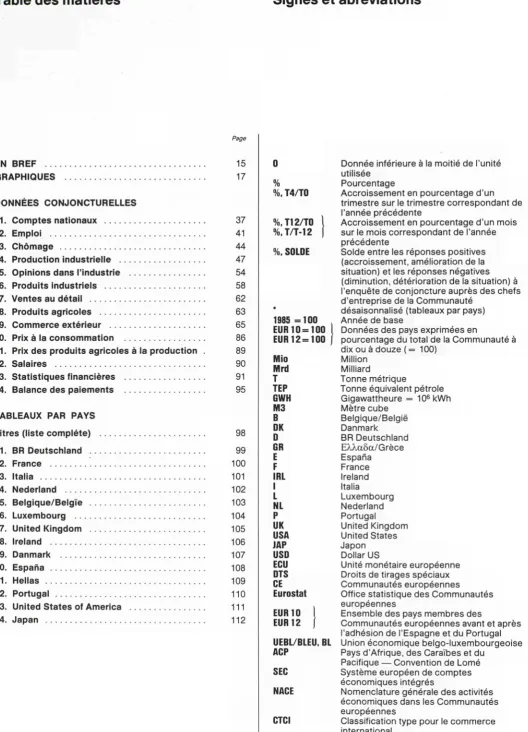
Table des matières
Signes et abréviations
EN BREF
GRAPHIQUES
DONNÉES CONJONCTURELLES
1. Comptes nationaux
2. Emploi
3. Chômage
4. Production industrielle
5. Opinions dans l'industrie
6. Produits industriels
7. Ventes au détail
8. Produits agricoles
9. Commerce extérieur
10. Prix à la consommation
11. Prix des produits agricoles à la production
12. Salaires
13. Statistiques financières
14. Balance des paiements
TABLEAUX PAR PAYS
Titres (liste complète)
1. BR Deutschland
2. France
3. Italia
4. Nederland
5. Belgique/Belgïe
6. Luxembourg
7. United Kingdom
8. Ireland
9. Danmark
10. España
11. Hellas
12. Portugal
13. United States of America
14. Japan
Page
15
17
37
41
44
47
54
58
62
63
65
86
89
90
91
95
98
99
100
101
102
103
104
105
106
107
108
109
110
111
112
0
%
í>,
T4/T0
%,T12/T0
%, Τ/Τ12
%. SOLDE
1985 = 1 0 0
EUR 1 0 = 100
EUR 1 2 = 100
Mio
Mrd
Τ
TEP
GWH
M3
Β
DK
D
GR
E
F
IRL
I
L
NL
Ρ
UK
USA
JAP
USD
ECU
DTS
CE
Eurostat
EUR 10
EUR 12
UEBL/BLEU, BL
ACP
SEC
NACE
CTCI
Donnée inférieure à la moitié de l'unité
utilisée
Pourcentage
Accroissement en pourcentage d'un
trimestre sur le trimestre correspondant de
l'année précédente
Accroissement en pourcentage d'un mois
sur le mois correspondant de l'année
précédente
Solde entre les réponses positives
(accroissement, amélioration de la
situation) et les réponses négatives
(diminution, détérioration de la situation) à
l'enquête de conjoncture auprès des chefs
d'entreprise de la Communauté
désaisonnalisé (tableaux par pays)
Année de base
Données des pays exprimées en
pourcentage du total de la Communauté à
dix ou à douze ( = 100)
Million
Milliard
Tonne métrique
Tonne équivalent pétrole
Gigawattheure = 10
6kWh
Mètre cube
Belgique/België
Danmark
BR Deutschland
Ελλαδα/Grèce
España
France
Ireland
Italia
Luxembourg
Nederland
Portugal
United Kingdom
United States
Japon
Dollar US
Unité monétaire européenne
Droits de tirages spéciaux
Communautés européennes
Office statistique des Communautés
européennes
Ensemble des pays membres des
Communautés européennes avant et après
l'adhésion de l'Espagne et du Portugal
Union économique belgoluxembourgeoise
Pays d'Afrique, des Caraïbes et du
Pacifique — Convention de Lomé
Système européen de comptes
économiques intégrés
Nomenclature générale des activités
économiques dans les Communautés
européennes
TAUX DE CHANGE: Remontée du dollar au début du mois de
mars
La dépréciation sensible enregistrée début février par le dollar des Etats-Unis, dont il a été fait état le mois dernier, a été suivie début mars par une remontée tout aussi importante. Bien que le dollar soit brièvement tombé à 1,456 DM le 4 février, il était repassé à 1,49 DM le 20 février, puis à 1,67 DM le 9 mars, ce qui représente une hausse de prés de 15 % par rapport à son niveau le plus bas. Face au yen, la hausse du dollar a été moins spectaculaire: + 7,5 % entre la première semaine de février et le 20 mars. Durant cette période, on a assisté à une intervention à grande échelle des banques centrales cherchant à endiguer l'envolée du dollar.
Cette hausse du dollar semble s'expliquer principalement par une confiance accrue dans l'économie américaine et par l'espoir que la phase la plus dure de la récession est dépassée aux Etats-Unis et que le redressement est pour bientôt. La remontée du dollar s'est produite malgré une nouvelle diminution de 0,25 % du taux des Federal Funds le 8 mars, au niveau de 6 %, bien que ce taux ait ë nouveau été relevé par la suite.
Au sein du mécanisme des taux de change (MTC) du SME, les taux ont peu bougé en février, les mouvements les plus Importants étant une hausse de 0,75 % de la peseta par rapport à l'ècu et une dépréciation de 0,3 % de la livre sterling. En dehors du MTC, l'escudo s'est apprécié de près de 1,3 %, tandis que la drachme s'est dépréciée de 1,2 %. La dépréciation de la drachme par rapport à l'êcu atteint ainsi près de 13 % au cours des douze derniers mois.
Les Etats membres de la CE ont enregistré de nouvelles modifications des taux d'intérêt à court terme à la fin du mois de février et au cours des premières semaines de mars. Les taux de base du Royaume-Uni ont encore baissé de 0,5 % le 27 février (leur niveau est de 13 % à présent), sans dépréciation sensible de la livre, et de nouvelles réductions sont prévues à brève échéance. La peseta, monnaie la plus forte du MTC depuis de nombreux mois, a régulièrement atteint son plafond dans le MTC au cours des dernières semaines, forçant ainsi la Banco de Espana à intervenir sur les marchés monétaires; s'ajoutant aux pressions internes, cela a amené la banque centrale espagnole, le 15 mars, à abaisser d'un point son taux d'intervention au ¡our le jour qui est passé à 13,5 %. Ce taux avait déjà été réduit de 0,2 % à la mi-février.
La réduction des taux d'intérêt espagnols a été suivie le 18 mars par une diminution de 0,25 % du taux d'intervention de la Banque de France qui se situe à présent à 9 %. Cette décision a provoqué la surprise sur les marchés financiers, puisque le franc français se négociait près de son cours plancher avec la peseta depuis quelques semaines. Il reste la monnaie la plus faible du MTC.
Les taux d'intérêt danois ont également été baissés le 19 mars lorsque la banque centrale du Danemark a ramené à 10 % (diminution de 0,5 %) son taux prêteur envers les banques commerciales. Cela a entraîné un léger affaiblissement de la couronne par rapport aux autres monnaies du MTC.
RENDEMENT DES OBLIGATIONS DU SECTEUR PUBLIC:
Poursuite de la baisse généralisée des rendements
En février, les rendements des obligations du secteur public ont baissé dans tous les pays examinés (') pour lesquels on disposait de chiffres pour février. Les baisses les plus importantes ont été enregistrées au Danemark, où les rendements ont chuté d'un point entier depuis le début de l'année, en Belgique, en France et en Allemagne.
Le Portugal a, depuis de nombreux mois, le rendement le plus élevé de la CE. suivi par l'Espagne. C'est au Luxembourg et en Allemagne que les rendements sont les plus faibles actuellement, ces deux pays étant les seuls de la CE où ils sont inférieurs à 9 %. La moyenne communautaire (sur la base des données disponibles) était de 10,2 % en février, contre 10.5 % en janvier. Aux Etats-Unis et au Japon, les rendements étaient respective-ment de 8 % et 6,7 % (données pour février).
Ce recul des rendements des obligations est représentatif de la diminution actuelle des taux d'intérêt dans le monde entier: on estime généralement que les augmentations des taux enregistrées au cours des derniers mois ont atteint un plateau et que la baisse se poursuivra dans la plupart des pays au cours des prochains mois.
En Allemagne, les rendements des obligations du secteur public, qui étaient de 8,6 % en moyenne en février, sont à leur minimum depuis janvier 1990, en dépit de l'augmentation des taux à court terme à la fin de janvier. Il en est de même aux Pays-Bas ainsi qu'en Espagne et au Royaume-Uni où de nouvelles baisses du niveau des rendements des obligations du secteur public sont également à escompter dans un proche avenir, à la suite des récentes diminutions des taux nominaux.