White Rose Research Online URL for this paper:
http://eprints.whiterose.ac.uk/109432/
Version: Accepted Version
Article:
Alves Costa Pacheco, Ana, Sherwood, James orcid.org/0000-0001-5431-2032, Zhenova,
Anna et al. (9 more authors) (2016) Intelligent approach to solvent substitution : the
identification of a new class of levoglucosenone derivatives. CHEMSUSCHEM. pp.
3503-3512. ISSN 1864-5631
https://doi.org/10.1002/cssc.201600795
Reuse
Items deposited in White Rose Research Online are protected by copyright, with all rights reserved unless
indicated otherwise. They may be downloaded and/or printed for private study, or other acts as permitted by
national copyright laws. The publisher or other rights holders may allow further reproduction and re-use of
the full text version. This is indicated by the licence information on the White Rose Research Online record
for the item.
Takedown
If you consider content in White Rose Research Online to be in breach of UK law, please notify us by
class of levoglucosenone derivatives
--Manuscript
Draft--Manuscript Number: cssc.201600795R1
Article Type: Full Paper
Corresponding Author: James Clark
University of York York, UNITED KINGDOM Corresponding Author E-Mail: [email protected]
Other Authors: Ana Alves Costa Pacheco
James Sherwood Anna Zhenova Con R. McElroy Andrew J. Hunt Helen L. Parker Thomas J. Farmer Andri Constantinou Mario De bruyn Adrian C. Whitwood Warwick Raverty
Order of Authors (with Contributor Roles): Ana Alves Costa Pacheco James Sherwood
Anna Zhenova Con R. McElroy Andrew J. Hunt Helen L. Parker Thomas J. Farmer Andri Constantinou Mario De bruyn Adrian C. Whitwood Warwick Raverty James Clark
economic consideration.
Our response: We have successfully carried out an additional test of Cygnet 0.0 as a reaction solvent and have included the new data along with additional text, and we have added a paragraph about the economic aspects of the work, highlighting the new manufacturing process and making an estimation of price.
Reviewer 3: It would also be interesting to learn about the economic aspect of these solvents. That would be very interesting to the readers in order to understand the scope of this study.
Our response: We have added a paragraph about the economic aspects of the work, highlighting the new manufacturing process and making an estimation of price. Section/Category:
Additional Information:
Question Response
FULL PAPER
An intelligent approach to solvent substitution resulting in the
identification of a new class of levoglucosenone derivatives
Ana Alves Costa Pacheco,
[a]James Sherwood,
[a]Anna Zhenova,
[a]Con R. McElroy,
[a]Andrew J.
Hunt,
[a]Helen L. Parker,
[a]Thomas J. Farmer,
[a]Andri Constantinou,
[a]Mario De bruyn,
[a]Adrian C.
Whitwood,
[a]Warwick Raverty,
[b]and James H. Clark*
[a]Abstract: With the increasing restriction and control of hazardous solvents safer alternatives need to be identified. Here a contemporary approach to solvent selection and substitution is presented, offering a more scientific alternative to a simple ‘like
-for-like’ exchange. A new family of levoglucosenone-derived compounds are proposed, modelled to determine their solvent properties, synthesised, and tested. These novel molecules show promise as replacements for polar aprotic solvents with chronic toxicity issues such as dichloromethane, nitrobenzene, and N-methylpyrrolidinone. The success of this approach makes it possible for academia and industry to make calculated, intelligent choices for solvent substitution in the future.
Introduction
The substitution of hazardous chemicals is a priority worldwide with the European Union (EU) leading on the identification of Substances of Very High Concern (SVHC).[1]
While organisations such as the European Chemicals Agency process the toxicity and other data of thousands of chemicals, large corporations are anticipating the inevitable consequences of new legislation and declaring their intention to stop using all SVHC.[2] Ultimately EU regulation concerning the Registration,
Evaluation, Authorisation and Restriction of Chemicals (REACH) will prevent widespread use of SVHC.[3] One class of
compounds that is severely impacted by SVHC categorisation is solvents. Some of the most widely used types of solvent, including halogenated compounds and amides, are among the solvents under threat. The challenge for the research community is to design new, safer and more sustainable alternatives that can match (or exceed) the often complex combinations of properties needed for various applications. There are few off-the-shelf candidates in this respect. In the case of amides, some alternative polar aprotic solvents do exist, notably sulphoxides and sulphones, although these are not without safety concerns and are not renewable.[4] Finding replacements for halogenated
compounds (including solvents) is notoriously difficult, largely because of the quite apparent unique properties that halogens
can confer on organic molecules.[5] As the evidence of
environmental and health problems of such compounds accumulates many industry sectors face a very uncertain future.[6] It seems clear that rather than hoping better candidates
are eventually identified through serendipity, we need a more intelligent approach to solvent substitution based on the fundamental understanding of key solvent properties.
There has been some very recent but limited progress in seeking greener polar aprotic solvents without the functionalities associated with human toxicity,[7-9] but because each substitute
falls into a specific niche more alternatives are required. Bio-based solvents have begun to generate significant interest in academic studies and across a number of chemical industries.[10,11] However they are often derived from potential
foodstuffs, namely sugars and vegetable oils. By contrast cellulosic biomass, a renewable and low cost feedstock, is widely available from a range of waste streams generated by the forestry, agriculture and food processing sectors.[12] This makes
it a satisfactory sustainable feedstock for the production of bio-based solvents. We recently reported the use of levoglucosenone (1), obtained in one step from cellulose, to make the solvent dihydrolevoglucosenone (Cyrene, 2) (Scheme 1).[7] Cyrene has been demonstrated to be an effective substitute
for popular dipolar aprotic solvents, e.g. N-methylpyrrolidinone (NMP). This class of solvents are under enormous pressure from REACH due to their chronic toxicity and other end-of-life problems (e.g. NOx formation upon incineration).[1,3]
Levoglucosenone, given its straightforward preparation from abundant cellulosic biomass and its synthetic versatility, offers a useful template for the preparation of further compounds that might have properties suitable for use as solvents (among other applications). The preparation of bio-based levoglucosenone has been demonstrated at a commercially significant scale for a platform molecule,[13] therefore providing the potential to open up
new fields of chemistry to industry.
Scheme 1. The synthetic steps to make Cyrene.
This work presents an evaluation of potential solvents made from levoglucosenone. The approach is based on comparisons to existing solvents, especially those with known
hazards. Solvent selection is usually performed on a ‘like
-for-like’ substitution basis,[14] but history tells us such a simple
[a] A. Alves Costa Pacheco, Dr. J. Sherwood, A. Zhenova, Dr. C. R. McElroy, Dr. A. J. Hunt, Dr. H. L. Parker, Dr. T. J. Farmer, A. Constantinou, Dr. M. De bruyn, Dr. A. C. Whitwood, and Prof. J. H. Clark*
Department of Chemistry, University of York, Heslington, York, YO10 5DD, UK.
E-mail: [email protected] [b] Dr. W. Raverty
Circa Group Pty Ltd, 551 Burwood Highway, Knoxfield, Victoria, 3180, Australia.
Supporting information for this article is given via a link at the end of
approach is never likely to allow users to completely escape the toxicity, safety issues or environmental impact of one type of solvent. For example toluene was once embraced as a replacement for benzene, but it too is now subject to restrictions because of its reproductive toxicity and capacity for chronic organ damage.[3] Similarly, at one time NMP was claimed to be
non-toxic,[15] but it is now recognised to be reprotoxic and
therefore a SVHC.[1]
The polarity of multifunctional solvents can be difficult to predict intuitively, and so computer generated models are a focused means by which to identify promising solvents from a large number of possible candidates. Herein three approaches to solvent polarity modelling have been performed and evaluated for levoglucosenone derivatives. Firstly, computed
Hansen solubility parameters, and secondly, the “COnductor like Screening MOdel for Realistic Solvation” (COSMO-RS) were used to guide the design of new solvents. This combination of techniques was previously used by Moity et al. to describe four glycerol derivatives.[16] This informative study of commercial
products characterised the solvents but did not seek a specific application. By contrast the present work has identified a novel class of solvent from a screening of more than 100 candidates, and found a relevant application for them based on the strength of their properties. Furthermore, this work substantially extends the basis of the prior art as it also incorporates a third approach to solvent modelling. Experimental solvatochromic parameters were used to populate a solvent polarity map and identify a suitable application for the most promising levoglucosenone derived solvent.
Although the synthesis and application of a new solvent has been achieved, it is not the primary focus of this work. The multifaceted methodology of in silico solvent evaluation (and the identification of suitable applications) is the reason for reporting these results. The syntheses required here are intentionally limited to routine procedures (so that the product can be considered as a cost effective solvent), and the representative application (the Heck reaction) has strong literature precedent. For these reasons much of this information is presented separately as Electronic Supporting Information.
Results and Discussion
Main solvent candidate shortlist
Candidate molecules derived from levoglucosenone were extracted from research articles published between 1995 and 2015.‡ Potential solvents were identified from this literature search of recently reported levoglucosenone derivatives if the melting point (where available) did not exceed 100 °C. This lenient cut-off is consistent with the (somewhat arbitrary) definition of an ionic liquid.[17] Obvious derivatives were also
considered to introduce novel compounds to the shortlist. To do this unsaturated carbon-carbon bonds were also listed as the saturated analogue, and alcohols also listed as the corresponding acetate ester, methyl ether, and ethyl ether where deemed appropriate. For solvents especially, removal of alkenes through hydrogenation provides valuable stability. There is an abundance of green alcohol solvents (most importantly bio-ethanol) and so the conversion of alcohols to ethers and esters leads to more valuable aprotic solvents.
Inspection of the selected literature compounds suggested that the functional group interconversion of a ketone into the corresponding ketal could be useful for developing solvents from levoglucosenone.[18,19] Not only is a different functionality
introduced relatively easily, but removing the reactive ketone group is also advantageous. Therefore ketal derivatives were also considered as solvent candidates, primarily through the reaction of ethylene glycol with the ketone functionality of levoglucosenone. This completed the list of solvent candidates (featuring 96 literature compounds and 68 of their novel derivatives), which is presented in full as Electronic Supporting Information (Table S1).
Model 1: Hansen solubility parameters
The Hansen solubility parameters are regularly used to characterise the polarity of solvents in terms of their dispersion
forces ( D), the degree of polarity arising from any dipoles ( P),
and capacity for hydrogen bonding ( H).[20] The experimental
procedures required to directly determine the Hansen solubility parameters are tedious, and so experiments are now generally done by observing the solubility of reference substances in different solvents.[21] Even so, calculation methods are now quite
accurate and extremely fast to compute, allowing for rapid in silico screening of large numbers of compounds. This has been taken advantage of in this work for the quick identification of potential solvents without needing to synthesise and test them all. Hansen solubility parameters were calculated using HSPiP (version 4.1.04, 2013).
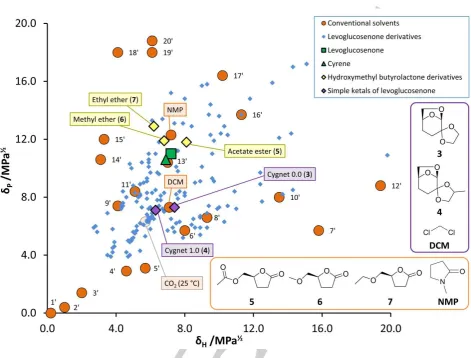
Figure 1. A two-dimensional Hansen solubility parameter map. Key: 1’, cyclohexane; β’, triethylamine; γ’, toluene; 4’, diethyl ether; 5’, chloroform; 6’,
tetrahydrofuran; 7’, 1-butanol; 8’, 1,γ-dioxolane; 9’, 1,β-dichloroethane; 10’, acetic acid; 11’, cyclohexanone; 1β’, ethanol; 1γ’, acetone; 14’, nitrobenzene; 15’,
benzonitrile; 16’, DMF; 17’, dimethylsulphoxide; 18’, propylene carbonate; 19’, acetonitrile; β0’ nitromethane. Data is tabulated in the Electronic Supporting Information (Table S5).
The Hansen dispersion forces ( D) expressed by solvents
tend to be reasonably similar, and so for a simpler
representation of the Hansen solubility parameters P can be
plotted against H to represent different types of solvent in a
two-dimensional graph (Figure 1). The full shortlist of levoglucosenone derived solvent candidates covers a large area of the so-called Hansen space. This permits selective targeting of a number of solvents, including those most in need of substitution. High polarity aprotic solvent classes were prioritised because of the inherent properties of the levoglucosenone template lends itself to creating polar solvents. Halogenated solvents and nitrohydrocarbons, e.g. dichloromethane (DCM) and nitrobenzene,[1] are known to cause cancer and are
therefore worthy targets for substitution. Similarly, many dipolar aprotic amides including NMP and N,N-dimethyl formamide (DMF) are reprotoxic.[1]
Areas of the Hansen map not well represented by levoglucosenone derivatives are the regions occupied by hydrocarbon (including aromatic) solvents, and strongly
hydrogen bonding compounds (represented by water, and low molecular weight alcohols including polyols). Finding replacements for the latter is not necessary from a green chemistry perspective.[4,14] Hydrocarbons are useful for
[image:6.595.62.534.93.451.2]extractions, but strongly associated with safety concerns caused because of their flammability, but also sometimes toxicity (e.g. n-hexane and toluene). Although levoglucosenone is not particularly suited as a platform molecule for renewable hydrocarbons, other bio-based feedstocks can be used for this purpose,[22] or in some instances replaced by carbon dioxide
(Figure 1).[23]
Two solvents, DCM and NMP, were picked as appropriate targets for substitution. These are solvents that are very widely used, e.g. for polymer processing,[24] and are major targets for
substitution, representative of the situation for halogenated solvents and dipolar aprotics generally. All the solvent candidates within 3 MPa½ of DCM or NMP in terms of the
three-dimensional Hansen space were identified. This led to 53 possible DCM replacements and 21 possible alternatives to
NMP made from the levoglucoseone platform molecule. To further reduce the candidates in the solvent screening, the more
important Pand H parameters of DCM and NMP were used as
target values, with a radius in this two-dimensional Hansen space restricted to within 1.2 MPa½ for DCM and 2.4 MPa½ for
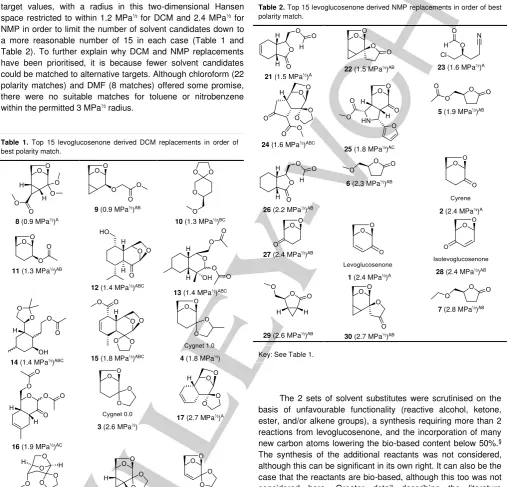
NMP in order to limit the number of solvent candidates down to a more reasonable number of 15 in each case (Table 1 and Table 2). To further explain why DCM and NMP replacements have been prioritised, it is because fewer solvent candidates could be matched to alternative targets. Although chloroform (22 polarity matches) and DMF (8 matches) offered some promise, there were no suitable matches for toluene or nitrobenzene within the permitted 3 MPa½ radius.
Table 1. Top 15 levoglucosenone derived DCM replacements in order of best polarity match.
8 (0.9 MPa½)A
9 (0.9 MPa½)AB
10 (1.3 MPa½)BC
11 (1.3 MPa½)AB
12 (1.4 MPa½)ABC
13 (1.4 MPa½)ABC
14 (1.4 MPa½)ABC 15 (1.8 MPa½)ABC 4 (1.8 MPa½)
16 (1.9 MPa½)AC
3 (2.6 MPa½)
17 (2.7 MPa½)A
18 (2.8 MPa½)C
19 (2.9 MPa½)B 20 (2.9 MPa ½)A
Key to identified solvent issues: A, reactive functionalities; B, synthesis requires more than 2 reactions from levoglucosenone; C, bio-based carbon content below 50%.§ Distance from target solvent in the 3D Hansen space
given in brackets.
Table 2. Top 15 levoglucosenone derived NMP replacements in order of best polarity match.
21 (1.5 MPa½)A 22 (1.5 MPa
½)AB 23 (1.6 MPa½)A
24 (1.6 MPa½)ABC
25 (1.8 MPa½)AC
5 (1.9 MPa½)AB
26 (2.2 MPa½)AB
6 (2.3 MPa½)AB
2 (2.4 MPa½)A
27 (2.4 MPa½)AB
1 (2.4 MPa½)A 28 (2.4 MPa ½)AB
29 (2.6 MPa½)AB
30 (2.7 MPa½)AB
7 (2.8 MPa½)AB
Key: See Table 1.
The 2 sets of solvent substitutes were scrutinised on the basis of unfavourable functionality (reactive alcohol, ketone, ester, and/or alkene groups), a synthesis requiring more than 2 reactions from levoglucosenone, and the incorporation of many new carbon atoms lowering the bio-based content below 50%.§
The synthesis of the additional reactants was not considered, although this can be significant in its own right. It can also be the case that the reactants are bio-based, although this too was not considered here. Greater detail describing the literature synthesis of each candidate can be found in the Electronic Supporting Information Table S3 and Table S4). The entries in Table 1 and Table 2 are labelled according to the aforementioned issues.
The Cygnets (an informal name for the ketals of Cyrene) are a new type of solvent, of which 3 and 4 occupy the same region of the Hansen space as the chlorinated solvent DCM (Figure 1). Some conventional ketones and ethers (e.g. cyclohexanone and tetrahydrofuran) are also found in this polarity region and so the distinction between the different types of solvent is not absolute. However, 3 and 4 are the only solvent
[image:7.595.46.557.117.604.2]candidates to also meet all three structural and synthetic requirements (Table 1). These compounds were originally added to the list of solvent candidates because the literature compound
20 (also in Table 1),[18] the unsaturated equivalent of 3, was
identified to have potential following hydrogenation of the alkene. The Cygnets are named according to any substitution occurring at positions 4 and 5 on the dioxolane ring (Scheme 2). The principle is the same as that used for glycerol derivatives in the work of García et al.[25] The reaction of ethylene glycol with
Cyrene to give Cygnet 0.0 (3) is straightforward (see the Electronic Supporting Information), and bio-based ethylene glycol can be obtained from commercial sources.[11] The
resultant product is spiro[6,8-dioxabicyclo[3.2.1]octane-4,2'-[1,3]dioxolane] (3), the most hydrogen bonding (as an acceptor) and the most dipolar of the Cygnets. For these reasons 3 was selected to represent the new Cygnet family of solvents in this preliminary work. The synthesis of Cygnet 1.0 (4), Cygnet 1.1 (31), Cygnet 2.0 (32), and Cygnet 4.0 (33), will be reported in a subsequent publication, as will the incorporation of 1,3- and 1,4-substituted bio-derived diols. Estimations obtained from the ACD/I-lab service indicate the Cygnets are not expected to be genotoxic or mutagenic.[26] The only health effect predicted with
high probability is to the lungs, which for a series of low-volatility compounds is less significant than many of the hazards known for conventional solvents.
Scheme 2. Ketal derivatives of Cyrene.
Despite the suitable polarity match of Cygnet 0.0 with DCM, implementing replacements for chlorinated solvents is made difficult by the unique electronic structure and resulting properties of the halogenated hydrocarbons. It is important to note that the hydrogen bonding of oxygenated compounds is basic in character (i.e. electron donating), whereas it has been shown computationally using COSMO-RS theory that the H
value of chlorinated solvents is actually acidic in character.[27]
The H value of amphiprotic molecules is the combination of
both modes of hydrogen bonding (hydrogen donating and accepting, as is the case for alcohols). Furthermore, low boiling chlorinated solvents such as DCM and chloroform are often employed in extractions because they can be removed easily after the process. The Cygnets are not suitable for this type of application, and substitutions need to be assessed on a case-by-case basis.
The acetate ester (5), methyl ether (6), and ethyl ether (7) of (S)- -hydroxymethyl- -butyrolactone (34), itself possible to produce bio-catalytically from levoglucoseonone,[28] meet the
requirements of a suitable NMP substitute (Table 2). This family of solvents have a straightforward chemical synthesis (Scheme 3), and have notably larger P values than the Cygnets (Figure
1). As reported elsewhere for the related compound -valerolactone, lactones are dipolar enough to substitute amide solvents in selected applications.[8] The ester functionality of the
lactones can be considered as a weakness, but there is a similar problem with the potentially reactive ketone of Cyrene. The other possible NMP replacements in Table 2 are synthetically complex, including iso-levoglucosenone and the equivalent constitutional isomer of Cyrene.[29]
Scheme 3. Lactones produced by the Baeyer–Villiger oxidation of levoglucosenone.
None of the potential NMP replacements identified in Table 2 are without issues. The development of the hydroxylactones elsewhere,[28] and the prior discovery of Cyrene,[7]
-valerolactone,[8] and cyclic carbonates,[9] as viable NMP
replacements meant that after consideration only the Cygnet family of compounds was carried forward for further analysis.
Modelling with the Hansen solubility parameters is useful for qualitative solubility predictions only. The precise solubility of substrates, or the relationship between the solvent and observable phenomena in reaction chemistry, requires the use of further techniques in order to understand these processes. With the Hansen solubility parameters effectively being used to reduce the list of possible solvent candidates to a more manageable number of promising compounds, other modelling approaches were then pursued in a more focused manner.
Model 2: COSMO-RS
COSMO-RS theory can be used to calculate the chemical
potential, ( ), of the surface of different solvent molecules in terms of their affinity towards a hypothetical solute with a
polarisable charge density .[30,31] Graphical plots calculated with
COSMOthermX (version C30_1501, 2015) use COSMO-RS theory to show repulsion or attraction at different regions of the molecular surface according to how the solvent interacts. At the simplest level of interpretation, the resulting chemical potential plots can be used to indicate the strength of electron pair donation and hydrogen bond donation of the solvent. This has obvious benefits over the description of hydrogen bonding
provided by the Hansen solubility parameter H, which does not
distinguish between hydrogen bond donating and accepting ability.
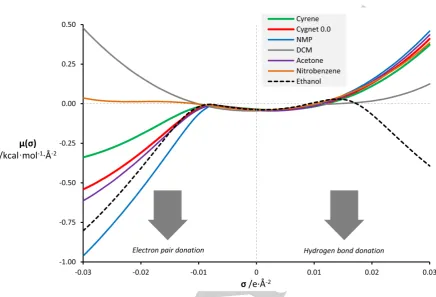
Dipolar aprotic solvents have a distinctive ‘S’-shaped chemical potential curve, indicating the electron rich portions of the solvent molecular surface provide an opportunity to accept hydrogen bonds, but do not donate hydrogen bonds (Figure 2).[31] The Cygnets in Scheme 2 are virtually indistinguishable
using the COSMO-RS interpretation of solvent polarity and so only Cygnet 0.0 is shown in Figure 2 (an additional graph is provided in the Electronic Supporting Information, Figure S3). This analysis indicates that contrary to the Hansen solubility parameter assessment, the Cygnet family of solvents are not
similar to DCM, and by the same measure Cyrene is not comparable to NMP (at least in terms of electron pair donation). Instead Cygnet 0.0 appears more similar to the typical oxygenated solvents such as acetone.
Clearly the Hansen solubility parameters, originally derived from empirical observations of solvent cohesive energy, and the computational COSMO-RS approach differ in how they represent solvent polarity. The Hansen solubility parameters are calculated independently of a solute, and are therefore based on solvent-solvent interactions only. Nevertheless they can provide an indication of any thermodynamic preference for a solute to dissolve (or not) in a solvent, through their proximity in the Hansen space. This approach does not provide quantitative estimates of solubility. The theoretical COSMO-RS calculations introduce a reference solute (only defined by its surface charge) and the data generated can be used to estimate the thermodynamic properties of liquids and to predict equilibria and relative solvation energies on a quantitative basis.[30]
The application of COSMO-RS resolves the ambiguity of the Hansen space, where chlorinated solvents occupy the same region as ethers. Differences in hydrogen bond character shown through COSMO-RS theory indicate possible limitations for Cyrene and the Cygnet solvents in applications currently dependent on either NMP or DCM respectively. However experimental studies using Cyrene as a solvent have shown it to be comparable to NMP in many respects. Missing from the representation of solvent polarity in Figure 2 is a clear account of the dipole interactions that can exist between solvent and solute. Some indication of solvent dipolarity can be derived from the COSMOthermX chemical potential plots, but this requires a principle component analysis in which the true physicochemical meaning of the solvent properties is lost.[31] Instead, the
assessment was continued with alternative measures of solvent polarity to give greater significance to non-specific solvent-solute interactions (as obtained experimentally).
Figure 2. Chemical potentials of selected solvents (as a function of ) in a comparison with Cygnet 0.0.
Model 3: Solvatochromic parameter mapping
Despite the different conclusions of the two models used thus far, both are providing a thermodynamic understanding of solvent effects. Only the experimental determination of solvent polarity, for example with the use of solvatochromic dyes, is able to provide a robust link between solvent polarity and observations in kinetic chemical systems (as well as thermodynamically controlled systems).[32] In reaction chemistry
this is often much more preferable. The Kamlet-Abboud-Taft parameters are a reliable set of solvent polarity scales able to describe linear free energy relationships for chemical kinetics, product selectivities, reaction equilibria, partition coefficients, and a number of spectroscopic phenomena.[33]
The Kamlet-Abboud-Taft parameters are divided into three scales of solvent polarity (but not related to the Hansen solubility
parameters). These are hydrogen bond donating ability ( ), hydrogen bond accepting ability ( ) and dipolarity and polarisability ( *). Each scale is unitless because it is normalised between 0.00 and 1.00. The Kamlet-Abboud-Taft parameters
were obtained using Reichardt’s dye, 4-nitroaniline, and N,N-diethyl-4-nitroaniline as previously described in the literature.[34]
The separation of the two modes of hydrogen bonding (as and
) has an obvious link to the chemical potential plots generated
using COSMO-RS theory, but the introduction of a distinct
measurement of permanent and induced dipoles ( *) is a key
addition when attempting to understand the role of the solvent in a chemical process. For example, NMP and Cyrene have been
found to accelerate reactions to a similar extent when the kinetics are dependent on solvent dipolarity, not hydrogen bonding.[7] Accordingly the Kamlet-Abboud-Taft * parameter
correlates to the reaction rate, which is not possible to achieve with the thermodynamic basis of the Hansen solubility parameters, or in COSMO-RS theory.
The solvatochromism of Cygnet 0.0 (3) demonstrates that
this solvent is highly dipolar (Table γ). The value of * obtained
is typical of both conventional dipolar aprotic solvents and chlorinated solvents, including DCM. However the low hydrogen
bond accepting ability ( ) is consistent with the previous Hansen
Table 3. The polarity parameters of solvents.
Solvent D /MPa½ P /MPa½ H /MPa½ *
DCM[35] 17.0 7.3 7.1 0.10 0.82
Nitrobenzene[35] 20.0 10.6 3.1 0.30 1.01
NMP[7] 18.0 12.3 7.2 0.75 0.90
Cyrene[7] 18.8 10.6 6.9 0.61 0.93
Cygnet 0.0 (3) 18.3 7.3 7.4 0.17 1.09
is zero in all instances except DCM (0.1γ).[35] DCM and nitrobenzene
Kamlet-Abboud-Taft parameters are averages of different dye sets. Values of
and * for 3 were obtained at 60 °C rather than room temperature.
It is important to note that the determination of the Kamlet-Abboud-Taft parameters was performed at an elevated temperature in the case of Cygnet 0.0 because of its high melting point. This can make the usual comparison between solvents biased by the thermosolvatochromic behaviour of the
dyes.[36] However it should be appreciated that while the *
value for chlorinated solvents is quite temperature dependent,[36]
the Kamlet-Abboud-Taft parameters of oxygenated solvents are much less so. For example literature data for ethanol shows that
decreases only slightly with each β5 °C increase in temperature, while * falls even less significantly.[37] Therefore it
interesting to note that Cygnet 0.0 has the Kamlet-Abboud-Taft parameter profile of a chlorinated solvent but at higher temperatures.
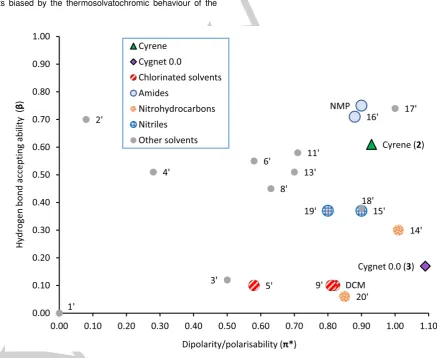
As with the Hansen solubility parameters, it is convenient to represent solvent polarity as a map using just two of the three scales. In the case of the Kamlet-Abboud-Taft solvatochromic
parameters, is sacrificed because the solvents of interest here are aprotic (Figure 3). The polarity of Cygnet 0.0 occupies an area of the solvent map not yet currently populated by any known bio-based solvents and no green solvents (as explained further in the Electronic Supporting Information, Figure S5).[38,39]
This means Cygnet 0.0 could be an incredibly useful addition to the existing catalogue of bio-based solvents. In particular there are many examples of high temperature reaction chemistry that could benefit from the use of the Cygnet solvents in place of nitrobenzene for example.[40]
Figure 3. A Kamlet-Abboud-Taft polarity map. Key: See Figure 1. Data is tabulated in the Electronic Supporting Information (Table S5).
[image:11.595.73.511.349.707.2]Test applications: Heck reaction and fluorination
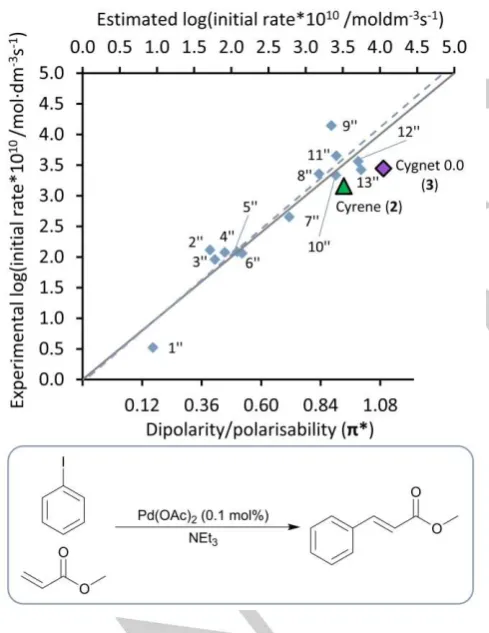
The high dipolarity of Cygnet 0.0 could be used advantageously in a number of chemical transformations where polarised activated complexes must be stabilised by the solvent to provide acceptable reaction kinetics. The Heck reaction between methyl acrylate and iodobenzene to give methyl cinnamate is one example. Cross couplings are an important reaction in the pharmaceutical industry due to the high synthetic potential they provide.[41]
A linear solvation energy relationship (LSER) correlating
the kinetics of this Heck reaction with * is available from the
literature,[9] vindicating the typical choice of highly polar solvents
for cross coupling reactions. If * is known the rate of reaction in
a solvent can be estimated. To represent this, the horizontal axes in Figure 4 are scaled to be equivalent. Validation of the reaction confirmed the experimental initial rates of reaction (vertical axis, Figure 4) in Cyrene and Cygnet 0.0 (3) to be comparable to NMP and dimethyl sulphoxide, slightly below the estimations. Dichloromethane could not be added to the dataset because the reaction is conducted at 100 °C, whereas Cygnet 0.0 is capable of application under such conditions.
Figure 4. A LSER of the kinetics of the model Heck reaction (as shown) correlated with solvent dipolarity. An equivalence line between experimental and estimated reaction rates is drawn in grey. The actual data trend is given
by the dashed line. Key: 1’’, limonene; β’’, p-cymene; γ’’, cyclopentyl methyl
ether; 4’’, diethyl carbonate; 5’’, toluene; 6’’, 1,4-dioxane; 7’’, cyclohexanone;
8’’, -valerolactone; 9’’, DMF; 10’’, propylene carbonate; 11’’, NMP; 1β’’, ethylene carbonate; 1γ’’, dimethyl sulphoxide.
Figure 5. Reaction rates for the model fluorination reaction (as shown) for conventional dipolar aprotic solvents as well as Cygnet 0.0. Fluorination was performed at 85C.
Another important application of dipolar aprotic solvents can be found in fluorination reactions, which are commonly used in the pharmaceutical industry. Greener methods of performing fluorination are in high demand, having been identified as a key green chemistry research area by the ACS GCI Pharmaceutical Roundtable.[42] Fluorine can most easily be introduced into an
aromatic molecule via an SNAr reaction in which the charged
Meisenheimer intermediate must be stabilized by a dipolar aprotic solvent.[43]
To further test the suitability of Cygnet 0.0 in practical chemical transformation, its ability to promote an SNAr
fluorination reaction was compared against conventional dipolar aprotic solvents (Figure 5). Cygnet 0.0 was found to be a suitable solvent, providing kinetics comparable to those of DMF and performing better than NMP. This is an improvement over the performance of Cyrene in the same reaction, and shows the applicability of Cygnet 0.0 as a replacement solvent under standard reaction conditions.[7]
Economic considerations
While Cygnet 0.0 is not currently commercially available, its precursors, levoglucosenone and Cyrene, are now being manufactured by Circa Group Pty in the world’s first scalable continuous process for making levoglucosenone from waste sawdust.[13] At the low production volumes expected in 2017,
Cygnet 0.0 will sell at speciality chemical prices, but if the manufacture of levoglucosenone substantially increases and it becomes a platform molecule, then the price of this compound will drop significantly, possibly lower than €10/kg.
[image:12.595.305.544.90.568.2] [image:12.595.47.292.337.654.2]Conclusions
While there is rapidly increasing demand for safer and more sustainable solvents, the properties of commercially available bio-based solvents currently fill a limited proportion of the solvent space. Bio-based molecules such as Cygnet 0.0 and Cyrene are helping to cover the full range of solvent polarity through their unique properties. The variety of solvent properties expressed by levoglucosenone derivatives is potentially quite substantial, and our future studies will look to take advantage of this.
The use of different approaches to represent solvent polarity in this work has emphasised the importance of context. After all, it is the performance of the application that matters, be it a reaction, extraction, formulation, or cleaning product, not the identity of the solvent itself. When developing solvent replacements, not all the properties of the solvent to be substituted will be relevant. How these properties are defined and represented will change the conclusion. With this in mind it is essential to understand the role of the solvent in an application and the limitations of each interpretation of solvent polarity.
The primary disadvantage of Cygnet 0.0 is that (like ethylene carbonate for example) it is solid at room temperature. It is also miscible in water which is a concern for aqueous separations following reaction chemistry and other processes. However, it is a problem equally faced by many conventional solvents such as NMP.
The application of Cygnet 0.0 in two pharmaceutically relevant syntheses has again demonstrated the levoglucosenone platform is capable of producing valuable solvents, as was shown by the prior discovery of Cyrene.[7] Other
possible applications for the Cygnet compounds include their use as chelators, fuel additives, and viscosity modifiers, all options that will be explored in subsequent studies.
Experimental Section
Experimental Details and computational methods are presented separately as Electronic Supporting Information.
Acknowledgements
The authors thank Circa Group for their financial support. The authors would also like to acknowledge Dr Seishi Shimizu and our other colleagues from the Department of Chemistry at the University of York for their discussions and help in the preparation of this manuscript.
Keywords: Green chemistry • Solvents • Molecular modelling • Levoglucosenone • Solvatochromism
‡ The literature search (17/11/2015) was conducted using the Scopus®
database for articles containing ‘levoglucosenone’ in the title, abstract,
or as a keyword.
§ Bio-based content can be measured analytically by 14C isotopic
analysis, and is reported on the basis of carbon mass. A European standard technical report describing the procedure is available (CEN/TS 16640:2014), as is the ASTM standard D6866-12.
[1] Candidate List of Substances of Very High Concern for Authorisation, http://echa.europa.eu/candidate-list-table (accessed 8th June 2016). [2] Roche SHE goals and performance,
http://www.roche.com/sustainability/for_communities_and_environment /environment/our_she_goals_and_performance.htm (accessed 8th June 2016); Roche to phase out SVHCs within ten years of listing, https://chemicalwatch.com/43487/roche-to-phase-out-svhcs-within-ten-years-of-listing (accessed 25th January 2016).
[3] Regulation (EC) 1907/2006 of the European Parliament and of the Council of 18 December 2006 Concerning the Registration, Evaluation, Authorisation and Restriction of Chemicals (REACH), http://eur- lex.europa.eu/legal-content/EN/TXT/?uri=CELEX:02006R1907-20140410 (accessed 11th May 2016).
[4] D. Prat, A. Wells, J. Hayler, H. Sneddon, C. R. McElroy, S. Abou-Shehada, P. J. Dunn, Green Chem.2016, 18, 288-296.
[5] R. D Morrison, B. Murphy in Chlorinated solvents: a forensic evaluation, RSC Publishing, Cambridge, 2013; R. B. Thomas in Evaluation of alternatives to chlorinated solvents for metal cleaning, U.S. Environmental Protection Agency National Risk Management Research Laboratory, Cincinnati, 1997.
[6] R. Hossaini, M. P. Chipperfield, S. A. Montzka, A. Rap, S. Dhomse and W. E. Feng, Nat Geosci.2015, 8, 186-190.
[7] J. Sherwood, M. De bruyn, A. Constantinou, L. Moity, C. R. McElroy, T. J. Farmer, T. Duncan, W. Raverty, A. J. Hunt, J. H. Clark, Chem. Comm.2014, 50, 9650-9652.
[8] G. Strappaveccia, E. Ismalaj, C. Petrucci, D. Lanari, A. Marrocchi, M. Drees, A. Facchetti, L. Vaccaro, Green Chem.2015, 17, 365-372. [9] H. L. Parker, J. Sherwood, A. J. Hunt, J. H. Clark, ACS Sustainable
Chem. Eng. 2014, 7, 1739-1742.
[10] A. G. Corrêa, M. W. Paixão, R. S. Schwab, Curr. Org. Synth.2015, 12, 675-695; Y. Gu, F. Jérôme, Chem. Soc. Rev.2013, 42, 9550-9570. [11] J. H. Clark, T. J. Farmer, A. J. Hunt, J. Sherwood, Int. J. Mol. Sci.2015,
16, 17101-17159.
[12] M. Lancaster in Green chemistry: an introductory text, RSC Publishing, Cambridge, 2002.
[13] New multi-million-dollar industry in non-petroleum based solvent could come to Tasmania, http://www.abc.net.au/news/2015-11-13/tasmanias-new-multi-billion-dollar-green-chemical-industry/6939522 (accessed 8th June 2016).
[14] R. K. Henderson, C. Jiménez-González, D. J. C. Constable, S. R. Alston, G. G. A. Inglis, G. Fisher, J. Sherwood, S. P. Binks, A. D. Curzons, Green Chem.2011, 13, 854-862.
[15] P. Taylor, Plat. Surf. Finish.1989, 76, 42-43; M. Reisch, Chem. Eng. News2008, 86, 32.
[16] L. Moity, A. Benazzouz, V. Molinier, V. Nardello-Rataj, M. K. Elmkaddem, P. de Caro, S. Thiébaud-Roux, V. Gerbaud, P. Marione, J.
–M. Aubry, Green Chem.2015, 17, 1779-1792.
[17] J. L. Anthony, J. F. Brennecke, J. D. Holbrey, E. J. Maginn, R. A. Mantz, R. D. Rogers, P. C. Trulove, A. E. Visser, T. Welton in Ionic Liquids in Synthesis, 1st edition (eds.: P. Wasserscheid, T. Welton), Wiley-VCH, Weinheim, 2002, pp. 41.
[18] A. R. Tagirov, I. M. Biktagirov, Yu. S. Galimova, L. Kh. Faizullina, Sh. M. Salikhov, F. A. Valeev, Russ. J. Org. Chem.2015, 51, 569-575. [19] M. M. Iskakova, I. M. Biktagirov, L. Kh. Faizullina, Sh. M. Salikhov, M.
G. Safarov, F. A. Valeev, Russ. J. Org. Chem.2014, 50, 105-109; A. N. Pilipenko, B. T. Sharipov, F. A. Valeev, Russ. J. Org. Chem.2014, 50, 1504-1510; B. T. Sharipov, O. Yu. Krasnoslobodtseva, L. V. Spirikhin, F. A. Valeev, Russ. J. Org. Chem.2010, 46, 226-235.
[20] C. M. Hansen in Hansen Solubility Parameters: A User’s Handbook,
2nd edition, CRC Press, Boca Raton, 2007.
[21] A. Benazzouz, L. Moity, C. Pierlot, M. Sergent, V. Molinier, J. –M. Aubry, Ind. Eng. Chem. Res.2013, 52, 16585-16597.
[22] H. Wang, H. Ruan, H. Pei, H. Wang, X. Chen, M. P. Tucker, J. R. Cort, B. Yang, Green Chem. 2015, 17, 5131-5135; G. W. Huber, J. N. Chheda, C. J. Barrett, J. A. Dumesic, Science2005, 308, 1446-1450. [23] X. Zhang, S. Heinonen, E. A. Levänen, RSC Adv.2014, 4,
61137-61152; J. Hunt, E. H. K. Sin, R. Marriott, J. H. Clark, ChemSusChem 2010, 3, 306-322.
[24] Y. Liu, H. Ma, Y. Tian, F. Xie, X. Wang, Macromol. Chem. Phys.2014,
215, 1446-1455; J. Ran, L. Wu, J. R. Varcoe, A. L. Ong, S. D. Poynton, T. Wu, J. Membr. Sci.2012, 415-416, 242-249; K. Baruah, S. Hazarika, S. Borthakur, N. N. Dutta, J. Appl. Polym. Sci.2012, 125, 3888-3898. [25] J. I. García, H. García-Marín, J. A. Mayoral, P. Pérez, Green Chem.
2010, 12, 426-434.
[26] ACD/I-lab version 2.0, http://ilab.cds.rsc.org (accessed through the National Chemical Database Service (RSC), 8th June 2016).
[27] E. Stefanis, C. Panayiotou, Int. J. Pharm.2012, 426, 29-43.
[28] A. L. Flourat, A. A. M. Peru, A. R. S. Teixeira, F. Brunissen, F. Allais,
Green Chem.2015, 17, 404-412.
[29] I. M. Biktagirov, L. Kh. Faizullina, Sh. M. Salikhov, M. G. Safarov, F. A. Valeev, Russ. J. Org. Chem. 2014, 50, 1317-1322; A. M. Sarotti,
Carbohydr. Res. 2014, 390, 76-80; Z. J. Witczak, P. Kaplon, M. Kolodziej, J. Carbohydr. Chem. 2002, 21, 143-148.
[30] A. Klamt, Wiley Interdiscip. Rev.: Comput. Mol. Sci.2011, 1, 699-709. [31] M. Durand, V. Molinier, W. Kunz, J. –M. Aubry, Chem. Eur. J.2011, 17,
1-11; L. Moity, M. Durand, A. Benazzouz, C. Pierlot, V. Molinier, J. –M. Aubry, Green Chem. 2012, 14, 1132-1145.
[32] C. Reichardt, Chem. Rev.1994, 94, 2319-2358.
[33] R. W. Taft, J. –L. M. Abboud, M. J. Kamlet, M. H. Abraham, J. Solution Chem. 1985, 14, 153-186; C. Reichardt in Solvents and Solvent Effects in Organic Chemistry, 3rd edition, Wiley-VCH, Weinheim, 2003. [34] L. Crowhurst, P. R. Mawdsley, J. M. Perez-Arlandis, P. A. Salter, T.
Welton, Phys. Chem. Chem. Phys.2003, 5, 2790-2794. [35] Y. Marcus, Chem. Soc. Rev.1993, 22, 409-416.
[36] P. Nicolet, C. Laurence, J. Chem. Soc., Perkin Trans. 21986, 7, 1071-1079.
[37] J. Lu, E. C. Boughner, C. L. Liotta, C. A. Eckert, Fluid Phase Equilib. 2002, 198, 37-49.
[38] P. G. Jessop, Green Chem.2011, 13, 1391-1398.
[39] P. G. Jessop, D. A. Jessop, D. Fu, L. Phan, Green Chem.2012, 14, 1245-1259.
[40] J. –W. Kim, S. –H. Hwang, Y. –K. Kim, H. –J. Jung, J. –H. Park, E. –Y. Lee, J. –O. Lim, S. –H. Han, K. –H. Kim, E. –J. Jeong, S. –Y. Kim, US pat., 20150069344, 2015.
[41] A. F. P. Biajoli, C. S. Schwalm, J. Limberger, T. S. Claudino, A. L. Monteiro, J. Braz. Chem. Soc.2014, 25, 2186-2214; C. Torborg, M. Beller, Adv. Synth. Catal. 2009, 351, 3027-3043; J. –P. Corbet, G. Mignani, Chem. Rev.2006, 106, 2651-2710.
[42] D. J. C. Constable, P. J. Dunn, J. D. Hayler, G. R. Humphrey, J. L. Leazer, Jr., R. J. Linderman, K. Lorenz, J. Manley, B. A. Pearlman, A. Wells, A. Zaks, T. Y. Zhang, Green Chem.2007, 9, 411-420.
[43] J. H. Clark, D. J. Macquarrie, J. Fluorine Chem.1987, 35, 591.
Layout 1:
FULL PAPER
Text for Table of Contents: The pressing need for sustainable alternatives to polar aprotic solvents has led to the discovery of new solvents derived from
levoglucosenone. Various data models were used to create a rational basis for solvent design.
Author(s), Corresponding Author(s)*
Page No. – Page No. Title
Layout 2:
FULL PAPER
Text for Table of Contents
Author(s), Corresponding Author(s)*
Page No. – Page No. Title
((Insert TOC Graphic here; max. width: 11.5 cm; max. height: 2.5 cm))