Pairing effects in nuclear dynamic
Denis Lacroix1, Guillaume Scamps2 and Yusuke Tanimura1
1Institut de Physique Nucl´eaire, IN2P3-CNRS, Universit´e Paris-Sud,
F-91406 Orsay Cedex, France
2 Department of Physics, Tohoku University, Sendai 980-8578, Japan.
Abstract
In recent years, efforts have been made to account for super-fluidity in time-dependent mean-field description of nuclear dynamic [1–5]. In-clusion of pairing is important to achieve a realistic description of static properties of nuclei. Here,we show that pairing can also affect the nu-clear motion. State of the art TDHF approach can describe from small to large amplitude collective motion as well as the collision between nuclei. Very recently, this microscopic approach has been improved to include pairing either in the BCS or HFB framework. Recent ap-plications of the 3D TDHF + BCS (TDHF+BCS) model introduced in [4] will be presented. The role of super-fluidity on collective mo-tion [6, 7], on one- and two-particle transfer [8] and on fission [9, 10] will be illustrated.
1
Introduction
the perspective to uncover expected or new dynamical phenomena emerging from pairing dynamics. It is indeed well known, especially in condensed matter that the occurrence of Cooper pairs can lead to new macroscopic effects like the occurrence of Josephson effect or vortex dynamic [17].
In this proceedings, we highlight recent progresses in the field and illus-trate through applications how superfluidity can affect the nuclear motion either at the level of one nucleus or when two nuclei are involved like during Heavy-Ions collisions.
2
TD-EDF with pairing
The TD-EDF with pairing generalizes the usual TD-EDF by propagating in time both the normal and anomalous densitiesρ andκ. These two densities are defined through
ρij(t) = ˆa†jaˆi, κij(t) =ˆajˆai,
where (ˆa†i,ˆai) correspond to creation/annihilation operators of a complete set of single-particle states. The TD-EDF equation of motion are similar to the TDHFB ones and can be written as (see for instance [18, 19]):
i¯hd
dtρ = [h(ρ), ρ] +κΔ
∗−Δκ∗, (1)
i¯hd
dtκ = h(ρ)κ+κh
∗(ρ)−ρΔ−Δρ∗+ Δ. (2)
Here h(ρ) and Δ are respectively the mean-field and pairing field matrix. These operators can be generically written as:
h(ρ)ij =
p2
2m
ij
+Uij(ρ) = p2 2m ij + kl
vikjlM ρlk (3)
Δij = 1 2
kl
vijklP κkl. (4)
whereU is the mean-field potential. HerevM andvP denote effective vertex respectively in the particle-hole and particle-particle channels and can be directly defined as functional derivative of the energy. In the nuclear context, the difference between TDHFB and TD-EDF stems from the flexibility in choosing the effective interactions.
• Pairing effect on one-body evolution. Let us consider a collec-tive one-body degree of freedom ˆQ=iji|Qˆ|jˆa†iˆaj. Its evolution is obtained through:
i¯hdQˆ
dt = i¯hTr
Qdρ dt
= Tr (Q[h(ρ), ρ]) + Tr (Q[κΔ∗−Δκ∗]). = Tr (Q[h(ρ), ρ])
The fact that the pairing field disappears in the last line has been proved in [10] for local pairing interaction. This does not however mean that pairing does not affect one-body motion. Indeed, pairing directly change the one-body density matrix property, and ultimately the expectation valueQˆ= Tr (Qρ(t)).
• Pairing effect and correlations. A more direct evidence of pairing effects is on two-body correlations. Indeed, considering the fluctuation of the observable ˆQ, we have:
σQ2 = QˆQˆ − QˆQˆ=
ijkl
i|Qˆ|jk|Qˆ|la†iaja†kal − ai†aja†kal
= Tr(QρQ(1−ρ)) +
ijkl
i|Qˆ|jk|Qˆ|lκ∗kiκlj (5)
where the first term is the standard expectation value in Fermi system when pairing is neglected, while the second term is directly due to pairing. Due to pairing correlation two-body correlation are expected to be enhanced.
In the following, we will illustrate either the influence of pairing on one-body evolution (on vibration and fission) or directly on correlations (two-particle transfer).
3
Small amplitude vibrations
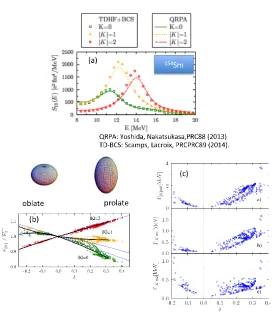
Figure 1: Giant quadrupole collective motion described with TD-EDF including pairing. (a) Comparison between the time-dependent calculation (called in the figure TDHF-BCS) and the QRPA response of ref. [20]. (b) Systematic study of the giant quadrupole energy splitting due to deformation. Each point in this figure corresponds to one nucleus with a given value of the deformation parameter
study axially deformed nuclei or nuclei with triaxial deformation. Recently, the isoscalar (IS) and isovector (IV) Giant Quadrupole Response (GQR) of more than 700 nuclei has been systematically investigated in Refs. [6, 7]. Important information can be inferred from these studies:
• First, the TD-EDF gives results that are consistent with QRPA even if the BCS approximation is used in the former while the full Hartree-Fock Bogolyubov theory is implemented in the latter (see panel (a) of Fig. 1). With symmetry unrestricted codes, nuclei without specific axis of symmetry that still challenge state of the art QRPA codes, can also be studied without additional difficulty compared to axially symmetric nuclei.
• The effect of deformation on the splitting of isoscalar GQR has been specifically studied. This splitting is well reproduced by the hydro-dynamical model of Ref. [21] and essentially depends on the initial deformation as well as the coupling to the isoscalar giant monopole motion (see panel (b) of Fig. 1).
• The TD-EDF as well as the QRPA theories are globally able to de-scribe the energy of the first low-lying 2+ state but fails to reproduce its collectivity.
• The TD-EDF approach is unable to describe the life-time (width of the response) in spherical nuclei, even if pairing is included. As it is well known, damping mechanisms require to include the coupling to complex internal degrees of freedom. As a matter of fact, see panel (c) of Fig. 1, the width of the response significantly increases as the deformation increases. Interestingly enough, at large deformation, the fragmentation obtained in strongly deformed nuclei seems compatible with the experimental width. Therefore, as far as the damping width is concerned, a transition seems to occur between spherical nuclei, where correlations dominate, to deformed nuclei, where one-body dissipation seems to dominate.
4
Fission dynamic
Figure 3: Illustration of the transfer process for a central collision 40Ca + 48Ca with energy below the Coulomb barrier. Top: snapshot of the density at different time of the reaction. Top-left: the density of the two nuclei are shown. Top-Middle (resp. Top-Right): the density of nucleons initially in the 48Ca (resp. 40Ca) and eventually transmitted to the other nucleus are shown. Bottom: probability to transfer one P1n or 2 nucleons P2n as a function of the center of mass energy for
the reaction40Ca +46Ca, the latter nucleus being superfluid.
slow and nearly adiabatic motion before scission and a mean-field+pairing like dynamics around the scission point [9]. Work is actually underway to connect microscopic mean-field theory and macroscopic transport proper-ties [10].
5
Binary collisions below the Coulomb barrier
One interest of time-dependent EDF approach is that it allows to treat a single nucleus or binary systems in a unified framework. We summarize below some recent results obtained when describing collisions of superfluid nuclei. More precisely, central collisions below the Coulomb barrier have been considered. This study was motivated by the recent experimental ob-servation of the 1 particle, 2 particles and 3 particles transfer probabilities, denoted hereafter by resp. P1n,P2n and P3n [28].
6
Conclusion
We presented here most recent applications of TD-EDF including pairing correlation. In recent years, it was demonstrated that pairing can be ac-curately incorporated in quantum transport theories. This has opened the possibility to describe realistically the evolution of superfluid nuclei all along the nuclear chart including the heaviest ones. When the BCS approximation is made, a rather versatile and computational friendly approach is obtained leading to a unified description of many processes in nuclei from small to large amplitude collective motion.
Acknowledgments
We thank P2IO for Y. T. postdoctoral grant. G.S. acknowledges the Japan Society for the Promotion of Science for the JSPS postdoctoral fellowship for foreign researchers. This work was supported by Grant-in-Aid for JSPS Fellows No. 14F04769.
References
[1] B. Avez, C. Simenel, and Ph. Chomaz, Phys. Rev. C 78, 044318 (2008).
[2] S. Ebata, T. Nakatsukasa, T. Inakura, K. Yoshida, Y. Hashimoto, and K. Yabana, Phys. Rev. C 82, 034306 (2010).
[3] I. Stetcu, A. Bulgac, P. Magierski, and K. J. Roche, Phys. Rev. C 84, 051309 (2011).
[4] G. Scamps, D. Lacroix, G. F. Bertsch, and K. Washiyama, Phys. Rev. C 85, 034328 (2012).
[5] Y. Hashimoto, Eur. Phys. J. A 48, 1 (2012).
[6] G. Scamps and D. Lacroix, Phys. Rev. C 88, 044310 (2013).
[7] G. Scamps and D. Lacroix, Phys. Rev. C 89, 034314 (2014).
[8] G. Scamps and D. Lacroix, Phys. Rev. C 87, 014605 (2013).
[10] Y. Tanimura, D. Lacroix and G. Scamps, Phys. Rev. C 92, 034601 (2015).
[11] K.-H. Kim, T. Otsuka, and P. Bonche, J. Phys.G23, 1267 (1997).
[12] C. Simenel, Ph. Chomaz, and G. de France, Phys. Rev. Lett.86, 2971 (2001).
[13] T. Nakatsukasa and K. Yabana, Phys. Rev. C 71, 024301 (2005).
[14] J. A. Maruhn, P.-G. Reinhard, P. D. Stevenson, J. R. Stone, and M. R. Strayer, Phys. Rev.C 71, 064328 (2005).
[15] A. S. Umar and V. E. Oberacker, Phys. Rev. C 71, 034314 (2005).
[16] K. Washiyama and D. Lacroix, Phys. Rev.C 78, 024610 (2008).
[17] P.-G. de Gennes, Superconductivity of Metals and Alloys, Westview Press (1999).
[18] J.P. Blaizot, G. Ripka,Quantum Theory of Finite Systems, MIT Press, Cambridge, Massachusetts, (1986).
[19] C. Simenel, D. Lacroix, and B. Avez,Quantum Many-Body Dynamics: Applications to Nuclear Reactions(VDM Verlag, Sarrebruck, Germany, 2010).
[20] K. Yoshida and T. Nakatsukasa, Phys. Rev.C88, 034309 (2013).
[21] S. Nishizaki and K. Ando, Prog. Theor. Phys.73, 889 (1985).
[22] J.W. Negele, Rev. Mod. Phys. 54, 913 (1982).
[23] J.W. Negele, Nucl. Phys.A502, 371c (1989).
[24] D. Lacroix, arXiv:1504.01499.
[25] C. Simenel and A. S. Umar, Phys. Rev. C89, 031601 (2014).
[26] Ph. M. Goddard, A Microscopic Study of Nuclear Fission using the Time-Dependent Hartree-Fock MethodPhD thesis, (University of Sur-rey, 2014).
[27] P. M. Goddard, P. D. Stevenson, A. Rios, arXiv:1504.00919.
[28] L. Corradi et al., Phys. Rev.C 84, 034603 (2011).