This is a repository copy of
Model of advanced recording media : The angular dependence
of the coercivity including the effect of exchange interaction
.
White Rose Research Online URL for this paper:
http://eprints.whiterose.ac.uk/101624/
Version: Accepted Version
Article:
Chureemart, P., Chureemart, J. and Chantrell, R. W. orcid.org/0000-0001-5410-5615
(2016) Model of advanced recording media : The angular dependence of the coercivity
including the effect of exchange interaction. Journal of Applied Physics. 063903. ISSN
0021-8979
https://doi.org/10.1063/1.4941787
[email protected] https://eprints.whiterose.ac.uk/
Reuse
Items deposited in White Rose Research Online are protected by copyright, with all rights reserved unless indicated otherwise. They may be downloaded and/or printed for private study, or other acts as permitted by national copyright laws. The publisher or other rights holders may allow further reproduction and re-use of the full text version. This is indicated by the licence information on the White Rose Research Online record for the item.
Takedown
If you consider content in White Rose Research Online to be in breach of UK law, please notify us by
including the effect of exchange interaction
P. Chureemart,1J. Chureemart,1,a)and R. W. Chantrell21)Computational and Experimental Magnetism Group, Department of Physics, Mahasarakham University, Mahasarakham, 44150,
Thailand
2)Department of Physics, University of York, York, YO10 5DD, United Kingdom
(Dated: 25 May 2016)
We use a micromagnetic model based on the kinetic Monte Carlo (kMC) approach to investigate theoretically the magnetic properties of advanced recording media. The model is employed to examine the impact of the magnetostatic and exchange interaction between grains of realistic perpendicular recording media on the angular-dependent coercivity since the exchange field between grains is an important factor in recording performance. The micromagnetic model allows to take the easy axis distribution and the exchange interaction between grains into account. The results confirm the importance of exchange interaction since the variation of coercivity with angle between the applied field and the orientation of easy axis which is perpendicular to the film plane, (θ) is seen to broaden with decreasing exchange field. We show that a two-stage fitting procedure involving the separate determination of the exchange field and easy axis dispersion provides a useful tool for the characterization of media for perpendicular recording and heat assisted recording. We find excellent agreement between previous experimental results and the simulations including exchange interactions leading to estimates of the exchange coupling and easy axis dispersion.
I. INTRODUCTION
Granular perpendicular recording media (PRM) are cur-rently used to store information in hard disk drives1,2. The PRM is commonly based on alloys of CoCrPt:SiO2 where SiO2is introduced to create non-magnetic grain boundaries to achieve smaller grain size and to reduce the exchange field re-sulting in improved signal to noise ratios and increasing areal density3. However, complete exchange decoupling between grains would be detrimental since it counterbalances the de-magnetizing field and promotes thermal stability. Hence, ex-change and magnetostatic interactions may make an important contribution to the recording performance. One of the most critical factors to enhance the recording performance in PRM is the switching field distribution (SFD) which is the disper-sion of the field required to reverse the direction of magnetiza-tion of each grain. It is crucial to understand the nature of the SFD in order to improve the performance of magnetic record-ing media. The SFD originates from several factors such as the distribution of the grain size as well as the distribution of composition, i.e., the anisotropy constant, K and saturation magnetization,Ms. However, a large contribution to the SFD comes from the angular dispersion of the easy axis orientation (σφ) as a small deviation from the perpendicular orientation leads to a large change in the switching field. This leads to a distribution of the intrinsic switching fields which can be described by
Hs=αK
Ms
(1)
whereHsis the switching field of the grain andαis an align-ment factor which describes the orientation of the grains. The value of α depends on the crystal structure. In the case of
a)Electronic mail: [email protected]
uniaxial structure, the value ofαvaries from 0.96 to 2.0 for random orientation of the grains and the perfect alignment respectively4. Because of the rapid reduction of switching field with angle the effect of easy axis distribution on the mag-netic properties is clearly an important factor contributing to the SFD as shown theoretically by Hovorkaet al.5.
There have been several works proposing experimental6,7 and theoretical8–10methods to investigate the easy axis distri-bution. Experimentally, the measurement of crystalline dis-persion or c-axis dispersion characterized by the full-width half maximum (FWHM) of the X-ray rocking curve6,7 is often-used. Although the effect of the intergranular magne-tostatic and the exchange interaction are significant and com-plicated for the reversal processes, they are not evident in the crystalline dispersion measurement. Therefore, the measure-ment of hysteresis properties, for example M/H loops, which include both effects, is often used to investigate the easy axis dispersion. In the past, the variation of remanence technique was often used to investigate the easy axis distribution6,7,11. However, this method is highly complex in perpendicular recording media due to the presence of a large demagnetis-ing field,HD=−4πMswhich is difficult to correct using an internal demagnetising fieldHi=Ha−HDwhereHais the ap-plied field andHiis the internal field,12–16essentially because in practice the demagnetising field is not a constant; it varies with the magnetization.
re-2
quired to extract the easy axis distribution of the realistic PRM since the previous study19indicates the significant importance of the exchange coupling between grains on the variation of coercivity with angle.
In this paper, we develop an advanced micromagnetic model based on the kinetic Monte Carlo (kMC) approach to simulate media including a realistic approach to the introduc-tion of interacintroduc-tions. This approach allows to investigate the effect of intergranular exchange interaction and dipolar inter-action and to study the magnetic behavior for the long time scale associated with thermally assisted grain reversal based on the Arrhenius-N´eel Law8,10,21. We perform simulations of PRM using the kMC model to investigate theoretically the an-gular dependence of the coercivity including the influence of exchange interaction. The paper is organized as follows. We first outline the basis of the computational model followed by an investigation of the effect of intergranular interactions and easy axis dispersion on the coercivity. Finally we compare the model calculations with previous experimental work in Ref. 19. Good agreement is found between theory and experiment and it is shown that a 2-stage fitting process leads to estimates of the exchange field and standard deviation of the easy axis dispersion.
II. MODEL DESCRIPTION
The microstructure of recording layer models a CoCrPt al-loy in which the magnetic grains are separated by the segre-gation of non-magnetic grain boundaries such as SiO2to the grain boundaries. The grain size dispersion of the medium strongly depends on the grain boundaries and the incomplete grain boundary segregation also leads to the intergranular ex-change coupling effect22,23. Previously, the grains of storage layer were modeled as having uniform grain size as shown in Fig. 1 (a)24–26. In order to model more realistic media with irregular shapes of grains separated by non-magnetic ma-terial, the Voronoi construction was employed to generate a series of microstructures with specified grain size and grain size distribution25,27,28. Grain structures were produced as fol-lows. Starting with a regular hexagonal lattice, the grain cen-ters are shifted randomly within a radius∆following which the grain structures are produced using the randomized seed points. For large∆the microstructures become non-physically distorted, but for small∆the distribution of grain size is ap-proximately lognormal and there is a functional dependence of the standard deviation on∆, which we have determined nu-merically and inverted to determine the input ∆value for a required value ofσ.
Typical structures of advanced PRM with non-uniform grains produced using a Voronoi construction are illustrated in Fig. 1 (b) and (c). High standard deviation of grain size dispersion results in more non-uniform grains in the record-ing layer. The magnetization within each grain is assumed to be uniform and a single magnetic moment is used to represent the magnetic moment for each grain,µ=MsV, whereMs is the saturation magnetization andVis the grain volume.
To investigate the performance of the real PRM via
simu-FIG. 1. (Color online) Voronoi construction of PRM with different grain size distributions: a) uniform structure, b) non-uniform case and c) more non-uniform case. Red grains indicate the first layer of translated grains from the imposition of periodic boundary condi-tions as a visual indication that the PBC are in place.
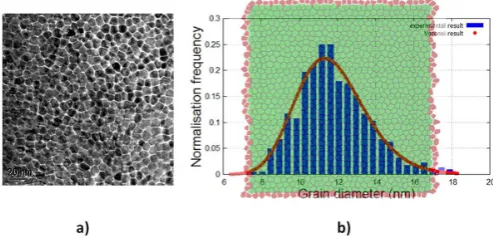
FIG. 2. (Color online) a) Bright field in-plane TEM image19 and b)the comparison of grain size distribution between Voronoi and ex-perimental results
[image:3.595.321.562.52.207.2] [image:3.595.324.571.289.408.2]In order to investigate the effect of the easy axis distri-bution of the grains on the angular dependence of the co-ercivity, we develop a model based on the kMC approach, which allows grain switching with a probability determined using the Arrhenius-N´eel relaxation time. The influence of the intergranular exchange interaction and dipolar interac-tion are taken into account. The granular model consists of many grains whose position and structure are produced by the Voronoi construction. The easy axes of the grains are gen-erated randomly from a Gaussian distribution with specified standard deviation. The behavior of the granular medium is simulated using a kinetic Monte-Carlo (kMC) based model8, within which the grain dynamics are simulated via a rate equa-tion based on the Arrhenius-N´eel relaxaequa-tion time. The energy barriers to switching are calculated using the free energy of the grain from Stoner-Wohlfarth theory:
E=KV(e·m)2−µµµ·HT (2)
whereK is the anisotropy constant, V is the volume of the grain,eandmare unit vector of the easy axis and the
mag-netization respectively andµµµis the magnetic moment of each grain. The total local field acting on each grain,HT, is the
con-tribution of the applied field (Ha), the dipolar field (Hdip) as
well as the intergranular exchange field (He). Therefore, the
total field acting on grainiis given by,HT=Ha+Hdip+He,
with
Hdip,i=
∑
i̸=j[
3(µˆj·rˆi j)rˆi j−µˆj
|⃗ri j|3
]
(3)
where ˆµj is the unit vector of the magnetic moment of the
grain number j,|⃗ri j|is the distance and ˆri jis the
correspond-ing unit vector between grainsiand j.
The intergranular exchange interaction is formulated as in the work of Peng et.al.29 under the assumption that the ex-change energy is proportional to the contact area between neighbouring grains, taken to be proportional to the contact lengthLi j. The approach also allows for a dispersion in the
exchangeJi jdue to variations in grain boundary thickness and
composition. In terms of reduced parameters (relative to the median valuesLm, Am and Jm), withAi the cross-sectional
area of grainiwhich are set by the Voronoi construction,
Hi j
e =Hexch
(J
i j
Jm
) (L
i j Lm ) ( Am Ai ) ˆ
µj, (4)
whereHexch=JmLm/(a2MsAm) whereLi jis the contact length
between grains i and j andais the lattice constant. In practice Hexch is set by the requirement that the average exchange at saturation has a certain valueHsat
exch, that is;
Hexchsat =Hexch
N
∑
i j∈n
∑
.n(J
i j
Jm
) (L
i j
Lm
) (A
m Ai
)
. (5)
We note that a similar approach has been used by Miles et. al.30, who use an intergranular exchange term which is also
proportional to ˆµi·µˆj. However, in ref30 the exchange is
de-rived from a micromagnetic-like approach under the assump-tion of a linear variaassump-tion of the magnetizaassump-tion across the grain boundary, whereas Peng et.al.29 invoke the Heisenberg form directly. The dependence of the exchange coupling on the intergranular separation can be introduced viaJi jusing
exper-imental observations, for example Sokalski et al31or theoret-ically23.
The time evolution of the magnetization is driven by ther-mal activation over the free energy barrier for a given grain under the influence of the total local field. Thermal activa-tion is introduced into the model via the Arrhenius-N´eel re-laxation time expressed in terms of an energy barrier (Eb) and
attempt frequency (f0),τ−1= f0exp(−Eb/kT). The attempt frequency is explicitly assumed to be constant with a typical value of 1 GHz32–34leading to large energy barriers 25kT for the slow dynamic magnetization processes typical of hystere-sis measurements.
It is important to note that the magnetic moment of PRM with large energy barrier tends to be localized in one or other of the energy minima due to the small transition probabilities. Therefore, the two-state system will be employed8,21. To con-sider the direction of magnetic moment of each grain in PRM, the algorithm starts with calculating the transition probability as the following equation
Pt=1−e−tm/τ (6)
wheretmis the measuring time and τis the Arrhenius-Neel relaxation time calculated from energy barrier. The model en-ables to take the contribution of easy axis distribution into ac-count. Specifically, an approximate expression for the energy barrier with the inclusion of the angular dependence35is given by
Eb(HT,ψ) =KV[1−HT/g(ψ)]κ(ψ) (7)
with g(ψ) = [cos2/3ψ+sin2/3ψ]−3/2 and κ(ψ) =0.86+ 1.14g(ψ) where the angle ψ denotes the orientation of the easy axis with respect to the total local field (HT) acting on
the grain. The energy barrier in Eq. (7) is subsequently used to calculate the transition probability in Eq. (6). The mag-netic moment of the grain has two states, and the total relax-ation time can be obtained from the transition rate between the states,τ−1=τ−1
12 +τ
−1
21. The transition between states can be considered by comparing the probabilityPtwith the generated random numberx(0<x<1). IfPt>x, the grain reversal is allowed. For a grain undergoing switching, the new direction of the magnetic moment with the minimum energy is deter-mined. The kMC algorithm is applied to all grains of the PRM at each field step to investigate the magnetic behavior.
III. RESULTS AND DISCUSSION
4
FIG. 3. (Color online) Schematic representation of the typical half hysteresis loop of the perfect alignment case with different exchange interaction fields
of real PRM based on CoCrPt alloy via Voronoi construction with the lateral size of 300×300 grains and the thickness of 11.2 nm. In order to remove finite size effects the system size is extended using periodic boundary conditions. The impor-tance of the angular variation of coercivity was pointed out by Miles et. al.30in the context of a model for parametric optimi-sation of perpendicular recording. Here we introduce the dis-persion of easy axis disdis-persion and interactions use the model to develop a two-stage fitting procedure involving the separate determination of the exchange field and easy axis dispersion provides a useful tool for the characterization of media for perpendicular recording and heat assisted recording. We start by consideration of the case of a system with perfectly aligned interaction, which gives results in qualitative agreement with ref30
A. Perfect alignment case
In order to establish the intrinsic effect of the intergranu-lar interactions on the variation of coercivity with angle, we consider first the perfect alignment case ofσφ= 0◦. The effect of the intergranular exchange interaction on the magnetization reversal process is studied by means of the kMC approach as mentioned previously. The following material parameters are used: the anisotropy constant is 5.1×10⁶erg/cc, the saturation magnetization is 600 emu/cc and the Curie temperature is 700 K. The exchange interaction can be calculated from Eq. (4) by using the exchange strength between grains provided by Voronoi microstructure. The effect of exchange interaction is investigated by varying the average exchange field from 1 kOe to 8 kOe with a field step of 1 kOe. The normalized hysteresis loops with different exchange fields are calculated using the kMC model by applying the external magnetic field in the di-rection of easy axis, i.e.,θ= 0◦. As illustrated in Fig. 3, the variation of magnetization with field strongly depends on the intergranular exchange interaction. For a strongly interacting
FIG. 4. (Color online) Variation of the normalised coercivity with varying of the exchange interaction and angleθfor the aligned case
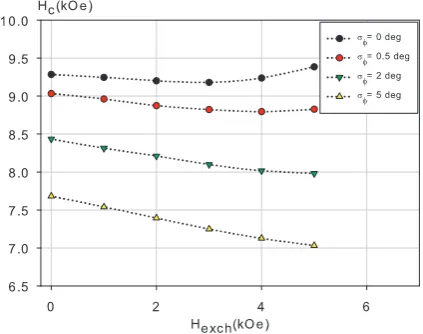
FIG. 5. (Color online) Variation of the normalised coercivity with the exchange interaction for the different easy axis distribution; 0, 0.5, 2 and 5 degrees.
case, it is clear that the slope of the normalized magnetiza-tion curve at the coercivity point (Hc) is steeper than that of weak exchange. This is due to the fact that the intergranular exchange interaction field tends to stabilise the magnetisation against the demagnetising field. Interestingly, it can be seen that the value of coercivity is non-monotonic for zero angle; an initial decrease is followed by an increase for strong ex-change coupling. This non-monotonic behavior will be inves-tigated shortly; first we illustrate the overall dependence ofHc on the angle with the exchange fieldHexchas a parameter.
[image:5.595.69.284.45.221.2] [image:5.595.331.547.58.234.2] [image:5.595.333.545.304.471.2]interac-tion on the variainterac-tion of coercivity with angleθranging from 0◦to 15◦. Figure 4 shows the calculation of the coercivity ver-sus the angleθfor various exchange interaction fields up to 5 kOe. The variation ofHcwith the decreasing exchange field for the perfectly aligned case (σφ = 0◦) is seen to broaden. This confirms that the intergranular exchange interaction be-comes an important factor for the variation of coercivity and cannot be ignored. The previous work in Ref. 19 calculated the variation of coercivity with different easy axis distribu-tion by the approach based on the Stoner-Wohlfarth model in which the exchange interaction and dipolar interaction were not included. As a result, the model could not describe the behavior of real PRM although the easy axis distribution was taken into account.
The non-monotonic behavior referred to earlier is further investigated in Fig. 5 which shows the variation ofHcwith ex-change field for various values of the orientation of easy axis relative to the field. All orientations show an initial decrease ofHcwithHexch. However, the casesσφ=0◦,0.5◦show an increase ofHcwithHexchfor largeHexch. The initial decrease is due to the tendency of the exchange to initiate a collective nucleation/propagation mechanism. The increase is probably due to an increase in the effective activation volume of rever-sal with increasing exchange, which mitigates against thermal activation of nucleation sites and compensates for the initial decrease. Interestingly, the exchange field corresponding to the minimum coercivity shifts to larger values with increasing angle. This suggests that the increase of activation volume with exchange is slower at large angles.
B. Determination of exchange field and easy axis distribution
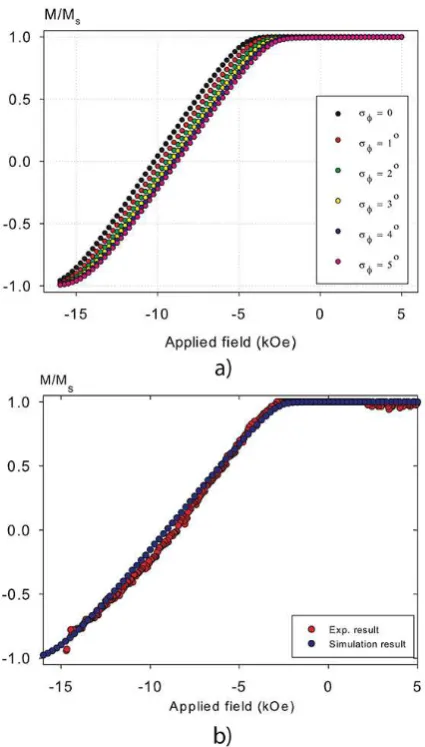
We now proceed to investigate the coercivity of realistic PRM by including effects of easy axis distribution, intergran-ular exchange interaction and the dipolar field. To develop a realistic model of a granular medium, the exchange field of recording media is investigated. Subsequently, the effect of the easy axis distribution is introduced via a Gaussian distri-bution with a standard deviationσφallowing its contribution to the magnetic behavior to be investigated. Figure 6 a) shows the kMC calculation of the typical half hysteresis loop atHexch = 2 kOe andθ= 0◦. The effect of the easy axis dispersion is investigated by varying the standard deviation from 0◦to 5◦. It is found that the easy axis distribution affects only the value of coercivity but not the form of the hysteresis loop. The co-ercivity is decreased with increasing of the standard deviation σφ30. This allows to extract the exchange field and the angular dispersion of easy axes using the following 2-step procedure. Firstly, the intergranular exchange field of realistic PRM can be extracted by fitting the half hysteresis loop of the experi-ment with simulation results under the assumption of perfect alignment since the form of the loop is not strongly depen-dent on the easy axis dispersion. The gradient of the hystere-sis loop at coercivity depends on the relative strength of the magnetostatic and intergranular exchange fields. The mag-netostatic term is dependent on the saturation magnetization, which is accurately known, so the gradient is most sensitive
FIG. 6. (Color online) a) The typical half hysteresis loop of kMC calculation atHexch= 2 kOe with the different easy axis dispersion
from 0oto 5o. b)The comparison of half hysteresis loop between the experimental results and the kMC calculation atHexch= 2 kOe
to the exchange field, which can therefore be determined by comparison between simulations and experiment. As illus-trated in Fig. 6 b), the half hysteresis loop of the real granular media is in excellent agreement with that of kMC simulation with an exchange field of 2 kOe.
[image:6.595.332.545.66.440.2]6
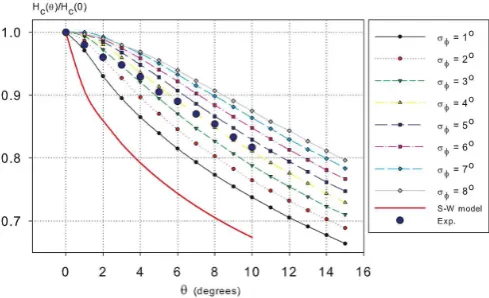
FIG. 7. (Color online) Variation of coercivity with angleθfrom the experimental results19, S-W model and kMC calculations
comparison we include the Stoner-Wohlfarth model predic-tion for granular medium with the narrow easy axis distribu-tion and without the inclusion of intergranular exchange and dipolar interactions. As demonstrated, the variation ofHc is seen to broaden as the easy axis distribution increases which is due to the combined effect of the orientation distribution and exchange interaction. In practice, the easy axis distribution and the intergranular exchange interaction strongly affects the behavior of the real PRM. The experimental result is in ex-cellent agreement with the kMC calculation with an easy axis distribution ofσφ= 4◦and the exchange interaction field of 2 kOe, both of which are reasonable values. The results confirm that the exchange interaction effect is an important factor for the behavior of advanced recording media.
IV. CONCLUSION
We performed calculations using a kMC model including the intergranular exchange field and dipolar fields in order to extract the easy axis distribution of the real PRM since the Stoner-Wohlfarth model cannot adequately describe the mag-netic behavior of real PRM due to the effect of the interlar exchange interaction. The physical structure of the granu-lar media in Ref. 19 is modeled via a Voronoi microstructure and the magnetic behavior of the media is then simulated by means of the kMC approach taking into account the intergran-ular magnetostatic and exchange interaction. The variation of coercivity with angleθfor different easy axis distribution was calculated. The result demonstrates a significant effect of the exchange interaction on the variation of the coercivity. The experimental result is compared with the simulated result to achieve the easy axis distribution.
The fitting approach is based on a 2-stage procedure. Firstly we use the dependence of the slope of the hysteresis loop at coercivity on the exchange coupling and its weak depen-dence on the easy axis dispersion to determine the exchange field. Simulations of the angular dependence ofHc, depen-dent on both exchange field and easy axis dispersion, are then
used to determine the easy axis dispersion by fitting to exper-iment using the previously determined value of the exchange field. The experimental measurements on granular media in Ref. 19 are fitted well to the simulated results with an easy axis distribution ofσφ= 4◦and an exchange interaction field of 2 kOe, both of which are reasonable for current record-ing media. Thus it is suggested that the fittrecord-ing of the kMC model calculations to experimental data is potentially a useful characterisation tool for the determination of exchange fields and angular dispersion of practical media for perpendicular magnetic recording. Finally, although the method was devel-oped specifically for perpendicular recording media, this is the geometry adopted for Heat Assisted Magnetic Recording (HAMR). Thus the current approach is likely also to provide an important characterisation tool for HAMR media.
J.C. gratefully acknowledges the research funding 2014 from faculty of Science, Mahasarakham University and Ma-hasarakham University Development Fund. Financial sup-port of Seagate technology is also gratefully acknowledged. P.C. would like to gracefully acknowledge the Newton Fund:researcher links travel grant 2015.
1S. N. Piramanayagam, Journal of Applied Physics102, 011301 (2007). 2S. Piramanayagam and K. Srinivasan, Journal of Magnetism and Magnetic
Materials321, 485 (2009).
3B. Varghese, S. Piramanayagam, W. K. Lee, and H. K. Tan, Magnetics, IEEE Transactions on50, 1 (2014).
4F. E. Luborsky, Journal of Applied Physics32, S171 (1961).
5O. Hovorka, J. Pressesky, G. Ju, A. Berger, and R. W. Chantrell, Applied Physics Letters101, 182405 (2012).
6X. Wu, H. Zhou, R. van de Veerdonk, T. Klemmer, and D. Weller, Journal of Magnetism and Magnetic Materials278, 285 (2004).
7V. Voznyuk, A. Misra, W. Doyle, P. Visscher, and R. Chantrell, Journal of Applied Physics97, 10N508 (2005).
8R. W. Chantrell, N. Walmsley, J. Gore, and M. Maylin, Phys. Rev. B63,
024410 (2000).
9J. Lee et al., Applied Physics Letters99, 062505 (2011).
10M. L. Plumer, J. van Ek, J. P. Whitehead, T. J. Fal, and J. I. Mercer, Journal of Applied Physics116, 123910 (2014).
11X. Wu, H. Zhou, D. Weller, and H. Richter, Journal of Magnetism and Magnetic Materials303, 5 (2006).
12J. Wu et al., Magnetics, IEEE Transactions on38, 1682 (2002).
13T. Deakin, C. Bunce, S. Wu, and K. O’Grady, Magnetics, IEEE Transac-tions on44, 3515 (2008).
14T. Deakin, F. Garcia-Sanchez, S. Wu, O. Chubykalo-Fesenko, and K. O’Grady, Magnetics, IEEE Transactions on45, 856 (2009).
15R. van de Veerdonk, X. Wu, and D. Weller, Magnetics, IEEE Transactions on38, 2450 (2002).
16R. van de Veerdonk, X. Wu, and D. Weller, Magnetics, IEEE Transactions on39, 590 (2003).
17A. Carter et al., Journal of Magnetism and Magnetic Materials320, 2269
(2008).
18J. Chureemart, P. Chureemart, R. Evans, R. W. Chantrell, and K. O. Grady, J. Phys. D44, 455002 (2011).
19J. Chureemart, P. Chureemart, J. Pressesky, T. Nolan, and K. O’Grady, Magnetics, IEEE Transactions on49, 3592 (2013).
20E. C. Stoner and E. P. Wohlfarth, Phil. Trans. R. Soc. Lond.240, 599
(1948).
21T. J. Fal et al., Phys. Rev. B87, 064405 (2013).
22J. Zhu and H. N. Bertram, Journal of Applied Physics63, 3248 (1988).
23R. F. L. Evans et al., Journal of Physics D: Applied Physics47, 502001
(2014).
24J. Miles and B. Middleton, Magnetics, IEEE Transactions on26, 2137 (1990).
25B. Valcu and N.-H. Yeh, Magnetics, IEEE Transactions on46, 2160 (2010).
[image:7.595.59.304.60.209.2]High Peformance Computing on Vector System, edited by M. Resch et al., Springer, 2007.
27J. Miles, M. Wdowin, J. Oakley, and B. Middleton, Magnetics, IEEE Trans-actions on31, 1013 (1995).
28M. Jones and J. Miles, Journal of Magnetism and Magnetic Materials171, 190 (1997).
29Y. Peng et al., Journal of Applied Physics109, 123907 (2011).
30J. Miles, D. McKirdy, R. Chantrell, and R. Wood, Magnetics, IEEE Trans-actions on39, 1876 (2003).
31V Sokalski, D E Laughlin and J G Zhu, Applied Physics Letters95, 102507
(2009)
32E. Kneller, Fine particle theory, inMagnetism and Metallurgy, pages 365– 471, Academic Press, London and New York, 1969.
33A. Moser et al., Journal of Physics D: Applied Physics35, R157 (2002). 34J. Brown, W., Magnetics, IEEE Transactions on15, 1196 (1979).