University of New Orleans University of New Orleans
ScholarWorks@UNO
ScholarWorks@UNO
University of New Orleans Theses and
Dissertations Dissertations and Theses
5-20-2011
Staging Modernism
Staging Modernism
Jason Derouin
University of New Orleans
Follow this and additional works at: https://scholarworks.uno.edu/td
Recommended Citation Recommended Citation
Derouin, Jason, "Staging Modernism" (2011). University of New Orleans Theses and Dissertations. 117.
https://scholarworks.uno.edu/td/117
This Thesis-Restricted is protected by copyright and/or related rights. It has been brought to you by
ScholarWorks@UNO with permission from the rights-holder(s). You are free to use this Thesis-Restricted in any way that is permitted by the copyright and related rights legislation that applies to your use. For other uses you need to obtain permission from the rights-holder(s) directly, unless additional rights are indicated by a Creative Commons license in the record and/or on the work itself.
Staging Modernism
A Thesis
Submitted to the Graduate Faculty of the University of New Orleans in partial fulfillment of the requirements for the degree of
Master of Fine Arts in
Fine Arts
by
Jason Derouin
B.A. McGill University, 2003 B.F.A. University of Ottawa, 2006
ACKNOWLEDGEMENTS
I would like to express my gratitude to my sponsor, Richard Johnson, for showing
consideration for my independence. I would also like to thank Jim Richard and Christopher
TABLE OF CONTENTS
List of Figures... v
Abstract...vi
Introduction...1
Part 1: The Modern Period Bachelor and His Pad...3
Emergence of the Modern Bachelor... 3
The Masculine Consumer... 4
The Bachelor Pad...5
Interior Decoration and Seduction... 6
Part 2: Creative Practice, Process and Influences...8
Creative Practice... 8
Process... 10
Influences...16
Conclusion... 17
References...23
LIST OF FIGURES
Bookcases and Screen Blocks (#4)...9
Wall, Bookcase and Yellow Gate...10
Jens Risom Striped Side Chair with Skirt (Small)... 12
George Nelson Executive Desk with Skirts (Small)... 13
Gates and Screen Blocks (#3)... 15
Playboy Bed, 1965... 18
Destroyed Space (A)...20
ABSTRACT
This thesis, which supports an exhibition of visual art, develops from Jean Baudrillard's
philosophy of seduction. I have focused on the representation of the bachelor and his pad in
American men's magazines from the mid-twentieth century. During this period, magazines such
as Playboy, Escapade and Rogue created features on modern living to reassure an independent
and affluent man that a dwelling with style and taste would ensure a happy bachelor life and
facilitate intimacy. My photographs and collages add complexity to this portrait by framing this
unique space as a stage where an unmarried man encircled by his lusty decor acted to entrance a
woman.
Bachelor, Jean Baudrillard, Collage, Design, Mid-twentieth century, Modernism, Photography,
INTRODUCTION
This essay, which supports an exhibition of visual art, develops from Jean Baudrillard’s
philosophy of seduction: "For [it] to occur an illusion must intervene and mix up the images; a
stroke has to bring disconnected things together, as if in a dream."1 The problem is to achieve
this law or rule. Few sleights of hand surprise anymore. In our world of ready-made
satisfactions, a thwarting of expectations is difficult to achieve. I propose that there existed a
space where this activity occurred: the modern bachelor pad. The tricked dwellings presented in
men’s magazines in the 1950s and 60s were designed to seduce. Readers of Playboy were
encouraged to enrich their spaces with modern furniture and artwork. If the reader followed
instructions on interior decoration – layout and lighting, for example – women would submit to
the hypnotic power of such expressions. Seduction was the strategy, intention and destination of
Playboy’s imagined reader, and the magazine filled the role of authority on its execution.
Baudrillard’s “illusion” or “stroke” inspires my creative practice. I have focused on the
representation of the bachelor and his pad in American men's magazines from the mid-twentieth
century. During this period, magazines such as Playboy, Escapade and Rogue created features
on modern living to reassure an independent and affluent man that a dwelling with style and taste
would ensure a happy bachelor life and facilitate intimacy. Armed with a gadget-laden pad and
an understanding of the "feminine mystique," a man was certain to realise his primal desires. I
want to add complexity to this portrait by framing this unique space as a stage where an
unmarried man encircled by his lusty decor acted to entrance a woman. I shall attempt to
decipher this spectacle and answer how its effects worked and what "illusions" they conjured up
for the participants. A detailed visual analysis of the bachelor pads from issues of the
1 Baudrillard, Jean. Seduction. Trans. Brian Singer. (Montreal: New World Perspectives
aforementioned magazines will help to apprehend the design of these spaces and the artwork I
PART 1: THE MODERN PERIOD BACHELOR AND HIS PAD
Emergence of the Modern Bachelor
My approach to the notion that a carefully composed bachelor space has the potential to
seduce begins by critically assessing the conditions for bachelorhood to flourish. According to
sources dedicated to the topic, unattached men and women constituted a significant proportion of
the population in many American communities in the mid-nineteenth century. They “raised
consternation among their families, instigated disorder on the city streets, and provoked
admonitions from clergy and educators.”2 The male component of this group attracted the most
attention. The bachelor was considered an anomaly. He was presumed to be perverted, reverting
to his baser urges and renouncing a traditional family life. Or he was pathologically abnormal
and unacceptable to women as a marriage partner. His existence was suspicious, inviting at once
curiosity and contempt. His bachelorhood was considered to be symptomatic of an emotional or
mental disturbance.
Reaction to the modern age unmarried man did not improve. The bachelor is affected by the
sexual values of his time. In 1949 and 1953, Alfred Kinsey published reports about the sexual
behaviour of American men and women, “thrusting sex to the forefront of the national
consciousness, [pointing] to a vast, clandestine world of sexual experience sharply at odds with
publicly espoused norms of probity, fidelity and heterosexuality.”3 According to Barbara
Ehrenreich, author of The Hearts of Men: American Dreams and the Flight from Commitment,
during the 1950s “there was the firm expectation […] that required men to grow up, marry and
2 Chudacoff, Howard P. The Age of the Bachelor: Creating an American Subculture. (Princeton: Princeton University Press, 1999), 3.
3 Osgerby, Bill. "The Bachelor Pad as Cultural Icon: Masculinity, Consumption and Interior Design in
support their wives. To do anything else was less than grown up, and the man who willfully
deviated was judged to be somehow ‘less of a man’”4.
The Masculine Consumer
During the 1950s the ‘breadwinner’ archetype was circulating widely in a variety of popular
magazines, films and TV shows, but other important shifts registered in the American middle
class at the same time. As ideals of the family-oriented man were promoted, so did other
constructions of masculinity. The post-war consumer boom included an unlikely source of
revenue: the pockets of single, career-minded men. This convergence of consumerism and
spirited careerism benefited the bachelor. Publicly he was still reviled, but he was acknowledged
as an important player in national financial betterment. In his article, The Bachelor Pad as
Cultural Icon: Masculinity, Consumption and Interior Design in American Men’s Magazines,
1930-65, Bill Osgerby describes the counter-effect of post-war consumerism on prevailing
conservatism: “the traditional gendering of consumption as ‘feminine’ retained influence – hence
a degree of suspicion still surrounded the consuming male’s claims to ‘manliness’ – but, within
the culture of the new middle class, masculine identities posited on a consumerist agenda were
increasingly revered.”5
New magazines emerged as torchbearers for the masculine consumer. From the outset,
Playboy magazine promoted the bachelor lifestyle. Its ideal reader was unattached and
cosmopolitan. He was from the new generation of male consumers: invested in his career and
wanting to luxuriate in his success. From its inception in 1953 through the 60s, articles in
4 Ehrenreich, Barbara. The Hearts of Men: American Dreams and the Flight from Commitment. (Garden
City: Anchor Press Doubleday, 1983), 11-12.
Playboy rarely mentioned a man’s wife or family. The Playboy reader was liberated from the
responsibilities of family life.
The Bachelor Pad
The carefully composed space of the single man is frequently interpreted as vulgar. Parodies of
the bachelor show a pleasure-seeking rake luring a woman to his lair where he performs a dance
to woo. He whirls and gyrates, pressing buttons to tune his pad to the right romantic level. A
prominently displayed Pollock is lit from overhead, a bookcase revolves to reveal a bar, a
fireplace is ignited automatically, and a round rotating bed starts to turn. In Structures of Interior
Design, Jean Baudrillard describes the trend whereby the use values (or functions) of furniture
objects were being supplanted by organizational values (or atmosphere). Objects embody moves
in a game.6 This phenomenon is observed in the modern bachelor pad. Consider, for example,
the first ‘Playboy Bed’. In November 1959, Playboy published an artist rendering including
dimensions of a rectangular behemoth bed. With its wraparound frame, the object measured
approximately 10-feet wide and 8-feet long. The accompanying text illustrates Baudrillard’s
statement:
Playboy contends that a gentleman’s bed is much, much more than a place to placidly
assume a supine position after a wearying day at the office. It is, or should be, a major
furnishing in any well-appointed bachelor’s diggings […]. In addition to the solid
comfort of the bed itself, he should have fingertip control of what goes on, and off, in his
pad […], plus a convenient, functional setup for assuaging his basic entertainment and
6 Baudrillard, Jean. "Structures of Interior Design." The Everyday Life Reader. Ed. Ben Highmore. (New
gustatorial needs […]. A 22” expanse of open shelf space permits you to conduct your
own exhibition of objects d’art .7
The ‘game’ is seduction, and the Playboy Bed embodies the ‘move’. The gargantuan bed is
meant to extend the living room, the usual entertainment space. With access to sensory delights
like a hi-fi stereo system and a gallery to display art, a man might move seamlessly from casual
conversation at the bed’s edge, to an erotic encounter on the expanse of bedding behind him.
Interior Decoration and Seduction
Illusion is paramount. “For seduction to occur an illusion must intervene and mix up the
images; a stroke has to bring disconnected things together, as if in a dream”.8 The Playboy
method of seduction relies on a psychological response to design. The decor must be creative,
fantastic, to conjure a dream-like response. Design within the bachelor pad must have the effect
of suspending belief:
Seduction has two simultaneous moments, or two instants of a single moment. [A
woman’s] entire character, all her feminine resources must be mobilized, and
simultaneously suspended. It is not a question of surprising her in the passivity of her
innocence; her freedom of action must be in play. Because it is by this freedom, by its
movement – and by the curves and sudden twists imparted to it by seduction – that she
must, seemingly spontaneously, reach that point where, unbeknownst to herself, she will
be lost.9
So it is not enough to surprise; the object of the bachelor’s desire must engage with the illusion
he invents. If there is a mythology to the bachelor pad it is because its elements are frequently
7 “Playboy Bed.” Playboy 6.11 (1959): 66. 8 Baudrillard, Seduction, 103.
fantastic, unbelievable. Many of objects promoted by Playboy magazine were unrealized. They
were proposals to spark the imagination of the reader determined to enjoy his bachelorhood. The
1959 version of the Playboy Bed was not available for purchase. Dimensions were provided in
text, with advice to find a skilled carpenter. The man who was ambitious enough to commission
its making would benefit from the engagement it promised. Top-of-the-line technology was
supposed to be built into the bed frame, including an intercom, speakerphone, and buttons to
control surrounding lighting. Shelves overhead could hold a library of books and, as indicated
PART 2: CREATIVE PRACTICE, PROCESS AND INFLUENCES
CREATIVE PRACTICE
The works appearing in my thesis exhibition – a survey of three years of creative practice – do
not illustrate the modern-period bachelor pad: they develop the bachelor pad-form. Architectural
details from mid-twentieth century residential and commercial buildings were recreated in
miniature, arranged as different tableaux, and then photographed. The one-twelfth scale model
objects are presented in photographs as illusions of life-size. “Iron” filigree gates, “concrete”
wall blocks, “pine” bookcases, and “mineral” clusters are arranged like props before “plywood”
walls (Figure 1 & 2). The action of staging canonical designs from the modern period was
important; the process was critical to my understanding of Baudrillard’s rules of seduction.
I have heard this statement applied to my artwork: “This is not seductive.” It is true: my
photographs and collages do not exhibit mechanical, orgasm-centered sexuality. They are
noticeably lacking sensuous strokes. The human figure is not represented. There is no phallus,
no chasm. And obvious stand-ins were avoided: I did not build a tiny Playboy Bed. The
gestures that provoke enticement are refined. I tried to create perfect artifice. The “iron” gates
and “concrete” wall blocks were cut with a laser to resemble filigree and tracery. The “mineral”
clusters were composed of folded paper, glued and gilded. The “plywood” panels were made of
museum board with a “veneer” of scaled wood grain. These details are in many ways seductive.
In Seduction, Baudrillard poses the question, what is the characteristic of the seducer? The
answer would define my approach to art making. “The scenario of seduction is […] spiritual. It
demands a certain spirit in the eighteenth century sense, that is to say, intelligence, charm and
refinement, but also in the modern sense of the Witz or stroke of wit”.10 There exist two types of
Figure 1
Bookcases and Screen Blocks (#4) Inkjet print on Stonehenge 8.5 x 11 inches
Figure 2
Wall, Bookcase and Yellow Gate Archival inkjet print on fiber paper 12 x 12 inches
seducers: the pure and the impure. The pure seducer is endowed with features already mentioned
– intelligence, charm and refinement.11 The impure seducer flies from one sexual conquest to
another; he seduces for pleasure without attaining the "spiritual” dimension of seduction.
Playboy spoke to the “pure” type of seducer. Within a single issue of its magazine, readers were
presented with articles about modern living, politics and philosophy. Nudity comprised a very
small portion of each issue, and, generally, readers’ attitudes to women lacked a misogynistic
component.12 However, I do not want to diminish or ignore analyses of Playboy that indicate an
oppression of women.
The modernist dialogue of art and design has its particular set of gender biases: it privileges
the masculine. I mean to be careful with feminine signifiers in my work. I want to make a
provocative contribution to our understanding of male space, but I do not want to add to a
discussion that subordinates women. Do my collages of furniture with skirts offend? (Figure 3 &
4) The conjunction of masculine forms and feminine dress was conceived as a proposal. I
wondered: What would a heterosexual man knowledgeable about design own to fill the space of
a woman? What would be a satisfactory substitute for real feminine presence? There exist
material sexual surrogates, like silicone vaginas. What would Playboy suggest?
The magazine promoted designers Charles and Ray Eames, Florence Knoll, George Nelson,
Jens Risom, Eero Saarinen, and Edward Wormley, to name a few. Their simple geometric
furniture was considered suitable for male space: they were stripped of the loft and
embellishment of female-inflected decor. Chairs, with their arms and legs, present as analogues
to the human form, so I responded by dressing them with skirts. Paper folded into pleats, some
with masking tape stripes, were tucked into incisions on prints of chairs, desks, tables and chests.
11 Ibid., 102.
12 Beggan, James K. and Scott T. Allison. “What Sort of Man Reads Playboy? The Self-Reported
Figure 3
Jens Risom Striped Side Chair with Skirt (Small) Collage
Figure 4
George Nelson Executive Desk with Skirts (Small) Collage
The collages are open: they have multiple meanings. They are a reaction to readings about
bachelor pads, and they engage with broader topics of modern design and sexuality.
The skirt treatment may be viewed as a disguise: a scaled back slipcover intended to soften the
stark silhouette of the seats and surfaces and ease their transition into the home. Or it is a
gesture, a Baudrillardian “stroke,” to queer the mannish furniture.
PROCESS
My early photographs were supposed to be translated into drawings and paintings – creative
expressions that were familiar to me. I had experience with photography, but did not plan it to
become the primary medium of my practice. A lot of the activity of photography is out of the
control of the artist. Printing is particularly unpredictable: printer model, its technician, and
many other variables influence it. When my first series of photographs received a favourable
response, I had to find a printing process responsive to my vision.
I aimed for an effect to resemble the offset printing of early Playboy magazines. The concept
relied on a toothy surface, but my home-use printer – an Epson Stylus C120 – was not designed
to accept heavy weight paper. Additionally, there do not exist computer programs, known as
"drivers", for printing on untreated cotton fiber. However, I obtained phenomenal performance
from my economy model by altering its feed mechanism and manually calibrating for drawing
paper. The 'hills' and 'valleys' of coarse paper interrupt the inkjet dot pattern and yield a
noticeable loss of clarity. Undesirable traces of my hand – a ragged cut, a drop of glue, some
untrimmed tape – do not appear in the final prints. The tint of the paper helped conceal my hand,
too, although it complicated the four-colour system of the printer. Compensating for an overall
Figure 5
Gates and Screen Blocks (#3) Inkjet print on Rives BFK 8.5 x 10 inches
The prints’ diminutive size – most are eight-and-a-half by eleven inches – relates to the
home-use printer and business correspondence. The dimensions suggest ‘casual’ and ‘throwaway.’
However, the numbers of prints that compose a series, and their specialised surface, oppose such
an impression. The small scenes seem intimate. They invite close viewing.
INFLUENCES
The architectural model is generally a proposal, a speculative offering or a pitch resting
between sketch and actualization. Some well-known artists work in this territory. Dutch
photographer-sculptor Thomas Demand photographs life-scale models of culturally or politically
charged scenes. The Clearing (2003), which shows daybreak viewed through a cluster of
thousands of leaves, is an extraordinary example from his oeuvre. Demand’s paper and
cardboard reconstruction is wholly seductive. The image, which is about sixteen-feet wide and
six-feet tall, suspends a sublime moment of mist rising in response to the first rays of the sun.
The Clearing is a beginning or apocalyptic end.
Demand’s only record of his installations is the photography. In contrast, I maintain an
inventory of props to pluck from. I delight in making an archive of modern bric-a-brac,
however, like Demand, I am opposed to their presentation. The illusion of scale and secrets of
construction become exposed and the attempt at seduction fails.
I frequently consult the work of American photographer-sculptor James Casebere, whose
architectural models illustrate a standard of finish I want to achieve. Furthermore, as a
consequence of excluding figures and accessories, Casebere’s photographs are formally similar
CONCLUSION
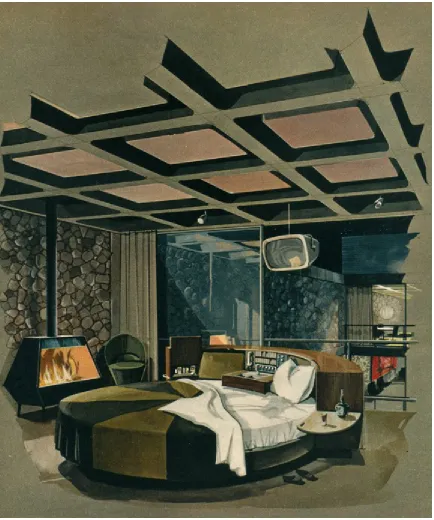
A second version of the Playboy Bed appeared in the April 1965 issue of Playboy (Figure 6).
This object is a particularly good example of design being programmed for seduction. Above all,
it profits from the power of geometric forms. In Manufactured Pleasures: Psychological
Responses to Design, author Ray Crozier considers the view that there may be something
inherent in the form of objects that produces a positive emotional response. There seems to be
something pleasing about simple, geometric forms.13 The aesthetic triumph of the 1965-version
of the Playboy Bed lies in its roundness. It is a round bed capable of rotating 360 degrees. It is
an architectural analogue to a bird’s nest.
In The Poetics of Space, Gaston Bachelard presents a phenomenological meditation on the
issue of roundness. The declaration 'being is round' is accepted but unsubstantiated. Bachelard
employs the metaphysician's way of arriving at proof by enriching the statement with examples.
In the chapter “The Phenomenology of Roundness,” Bachelard summarizes the lure of round
objects:
If we take them in their suddenness, we realize that we think of nothing else, that we are
entirely in the being of this expression. If we submit to the hypnotic power of such
expressions of roundness, suddenly we find ourselves entirely in the roundness of this
being, we live in the roundness of life.14
Round objects bear the mark of primitivity: they are evocations of intimacy and refuge.15 It is as
if we are congenitally predisposed to like round objects. The bachelor with his round bed
circling around him is at an advantage, then.
13 Crozier, Ray. Manufactured Pleasures: Psychological Responses to Design. (New York: Manchester
University Press, 1994), 74.
Figure 6
Further on the ‘nest’ image, Bachelard devotes a whole chapter to its examination. The
daydreaming that is prompted by seeing or considering a nest stems from the remarkable
industry of birds:
The enterprise and skill with which animals make their nests is so efficient that it is not
possible to do better, so entirely do they surpass all masons, carpenters and builders; for
there is not a man who would be able to make a house better suited to himself and to his
children than these little animals build for themselves. This is so true, in fact, that we
have a proverb according to which men can do everything except build a bird's nest.16
However, Bachelard is careful to dissuade any human association with nests. He writes,
positively speaking, there is nothing more absurd than images that attribute human
qualities to a nest. [...] The ridiculous nature of this image would become evident if the
cosy "little nest," the warm "little nest" that lovers promise each other, were actually
compared with the real nest, lost in the foliage. Among birds, need I recall, love is a
strictly extracurricular affair, and the nest is not built until later, when the mad love-chase
across the fields is over. [...] In short, in literature, the nest image is generally childish.17
In design, though, the nest image is effective and a legitimate form for comparison. Considering
its capacity to entice, it is understandable why so much of the design promoted by Playboy after
the mid-60s was round.
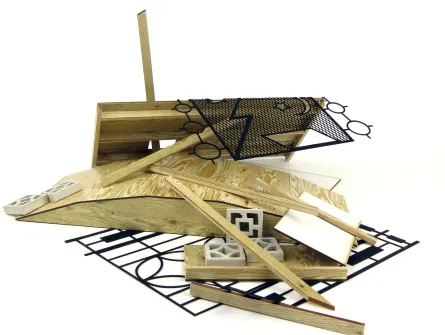
The works Destroyed Space (A) and Destroyed Space (B) (2011) (Figure 7 & 8) are
expressions of nesting. Here, an imagined bachelor has heaped up elements of modern
architecture to surround his beloved. The Destroyed Space duo illustrates the end of
bachelorhood. The “mad-love chase” is over.
Figure 7
Destroyed Space (A) Inkjet print on Stonehenge 8.5 x 14 inches
Figure 8
Destroyed Space (B) Inkjet print on Stonehenge 8.5 x 14 inches
Inspired by the Kinsey Reports and enabled by post-war prosperity, Playboy magazine
attracted and retained a unique demographic and guided them through their bachelorhood. The
intergenerational passing of Playboy from fathers to sons makes sense when the magazine is
viewed in this manner. A program of seduction, as imagined by Playboy, is destined to succeed.
A man’s fate is to be married, it seems. This view is echoed in Baudrillard’s examination of The
Seducer’s Diary, by Søren Kierkegaard:
None of the seducer's calculations, none of his manoeuvres fail. It all unfolds with an
infallibility that is neither real nor psychological, but mythical. The artifice's perfection,
the apparent inevitability that guide's the seducer's actions, simply reflects, as in a mirror,
the perfection of the girl's innate grace, and the inexorable necessity of her sacrifice. This
doesn't result from any specific person's strategy. It is fate, Johannes being only its
instrument and, therefore, infallible.18
Baudrillard’s philosophy on seduction is noteworthy, especially for its opposition to Kierkegaard.
In Seduction, Baudrillard warns of the inevitable failure of programmed seduction: "Doesn't the
seducer end up losing himself in his strategy, as in an emotional labyrinth? Doesn't he invent the
strategy in order to lose himself in it? And he who believes himself the game's master, isn't he the
first victim of strategy's tragic myth?"19 Obviously, this is a sentiment not shared by Playboy.
References
Bachelard, Gaston. The Poetics of Space. Trans. Maria Jolas. Boston: Beacon Press,
1994.
Baudrillard, Jean. Seduction. Trans. Brian Singer. Montreal: New World Perspectives
CultureTexts Series, 1990.
Baudrillard, Jean. "Structures of Interior Design." The Everyday Life Reader. Ed. Ben
Highmore. New York: Routledge, 2002. 308-318.
Baudrillard, Jean. Mass, Identity, Architecture: Architectural Writings of Jean
Baudrillard. Ed. Francesco Proto. Chichester: Wiley-Academic, 2003.
Beggan, James K. and Scott T. Allison. “What Sort of Man Reads Playboy? The
Self-Reported Influence of Playboy on the Construction of Masculinity.” Journal of Men’s
Studies 11.2 (2003): 189-206.
Breazeale, Kenon. “In Spite of Women: ‘Esquire’ Magazine and the Construction of the
Male Consumer.” Signs 20.1 (1994): 1-22.
Chudacoff, Howard P. The Age of the Bachelor: Creating an American Subculture.
Princeton: Princeton University Press, 1999.
Crozier, Ray. Manufactured Pleasures: Psychological Responses to Design. New York:
Manchester University Press, 1994.
Ehrenreich, Barbara. The Hearts of Men: American Dreams and the Flight from
Commitment. Garden City: Anchor Press Doubleday, 1983.
Osgerby, Bill. "The Bachelor Pad as Cultural Icon: Masculinity, Consumption and
Interior Design in American Men's Magazines, 1930-65." Journal of Design History 18.1
“Playboy Bed.” Playboy 6.11 (1959): 66-68.
Vita
Jason Derouin was born in Ottawa, Ontario, Canada, in 1976. He holds a Bachelor of Fine Arts
degree from the University of Ottawa (Ottawa, ON, CAN), and a Bachelor of Arts degree from
McGill University (Montreal, QC, CAN), where he studied Mathematics and the Social Studies
of Medicine. Jason joined the University of New Orleans in 2008 to pursue studies leading to a