UNIVERSITI TEKNIKAL MALAYSIA MELAKA
Design and Development of Piezoelectric Energy Harvester for Ultra
Low Energy Electronics
This report submitted in accordance with requirement of the Universiti Teknikal Malaysia Melaka (UTeM) for the Bachelor Degree of Engineering Technology
By
MUHAMMAD IMRAN KASIMEE BIN MAZELAN B071310601
940221-13-5339
UNIVERSITI TEKNIKAL MALAYSIA MELAKA
BORANG PENGESAHAN STATUS LAPORAN PROJEK SARJANA MUDA
TAJUK:
DESIGN AND DEVELOPMENT OF PIEZOELECTRIC ENERGY HARVESTER
FOR ULTRA LOW ENERGY ELECTRONICS
SESI PENGAJIAN: 2016/17 Semester 2
Saya MUHAMMAD IMRAN KASIMEE BIN MAZELAN
mengaku membenarkan Laporan PSM ini disimpan di Perpustakaan Universiti Teknikal Malaysia Melaka (UTeM) dengan syarat-syarat kegunaan seperti berikut:
1. Laporan PSM adalah hak milik Universiti Teknikal Malaysia Melaka dan penulis. 2. Perpustakaan Universiti Teknikal Malaysia Melaka dibenarkan membuat salinan untuk
tujuan pengajian sahaja dengan izin penulis.
3. Perpustakaan dibenarkan membuat salinan laporan PSM ini sebagai bahan pertukaran antara institusi pengajian tinggi.
4. **Sila tandakan ( )
SULIT
TERHAD (Mengandungi maklumat yang berdarjah keselamatan atau kepentingan Malaysia sebagaimana yang termaktub dalam AKTA RAHSIA RASMI 1972)
(Mengandungi maklumat TERHAD yang telah ditentukan oleh organisasi/badan di mana penyelidikan dijalankan)
___________________________ Alamat Tetap:
JA 8146, TAMAN MEKAR
AIR BAROK,
77000 JASIN, MELAKA
Tarikh: 09 DECEMBER 2016
Disahkan oleh:
_________________________
Cop Rasmi:
Tarikh: _______________________
** Jika Laporan PSM ini SULIT atau TERHAD, sila lampirkan surat daripada pihak berkuasa/organisasi berkenaan dengan menyatakan sekali sebab dan tempoh laporan PSM ini perlu dikelaskan sebagai SULIT atau TERHAD.
3
DECLARATION
I hereby, declared this report entitled “DESIGN AND DEVELOPMENT OF PIEZOELECTRIC ENERGY HARVESTER FOR ULTRA LOW ENERGY ELECTRONICS” is the results of my own research except as cited in references.
Signature :……….
4
APPROVAL
This report is submitted to the Faculty of Engineering Technology of UTeM as a partial fulfillment of the requirements for the degree of Bachelor of Electrical Engineering Technology (Industrial Power) with Honor’s. The member of the supervisory is as follow:
5
ABSTRAK
6
ABSTRACT
7
DEDICATION
8
ACKNOWLEDGEMENT
9
TABLE OF CONTENT
Declaration i
Approval ii
Abstrak iii
Abstract iv
Dedication v
Acknowledment vi
Table of Content vii
List of Tables x
List of Figures xi
List of Abreviations, Symbol and Nomenclature xiii
CHAPTER 1: INTRODUCTION
11.1 Background 1
1.2 Problem Statement 3
1.3 Objectives 4
1.4 Scope 4
1.5 Project Significant 5
CHAPTER 2: LITERATURE REVIEW
62.0 Introduction 6
2.1 Piezoelectric Device 6
2.2 Piezoelectric Material 7
10
2.2.2 Barium Titanate Ceramics 9
2.2.3 Lead- Zirconate- Titanate (PZT) Ceramics 10
2.3 Applications for the Piezoelectric Effect 11
2.3.1 High Voltage and Power Sources 14
2.3.2 High Temperature Applications 14
2.3.3 Piezoelectric Motors 14
2.4 Connection of the Piezoelectric Sensor 15
CHAPTER 3: METHODOLOGY
173.1 Introduction 17
3.2 Flow Chart 18
3.3 Piezoelectric Sensor Development 19
3.4 General Piezoelectric Energy Harvesting System Flow Chart 20
3.5 Piezoelectric System Setup 21
3.5.1 The Energy Harvesting Part Setup 22
3.5.2 The Component That Used In Circuit 25
3.5.2.1 Full Wave Bridge Rectifier 25
3.5.2.2 Supercapacitor 26
3.5.3 Step Up USB DC 27
3.6 Design and Simulations 29
3.6.1 The Harvesting Energy Part Simulation 30
3.7 Conclusion 32
CHAPTER 4: RESULT AND DISCUSSION
334.1 Introduction 33
4.2 Testing and Checking 34
11 4.3.1 Analyze the performance the first type of piezoelectric
(quartz piezoelectric crystals) 36
4.4 Measurement data using the first type of piezoelectric
(quartz piezoelectric crystals) 40
4.4.1 Power analysis by using quartz piezoelectric crystal 41 4.5 Analyze the performance of second type of piezoelectric (PZT) 42 4.6 Measurement Data using the second type of piezoelectric (PZT) 45
4.7 Discussion 46
CHAPTER 5: CONCLUSION & RECOMMENDATION
495.1 Conclusion 49
5.2 Recommendation 40
12
LIST OF TABLES
2.1 Room temperature properties of common piezoelectric crystal 9
2.2 The application of Barium Titanate Ceramics 10
2.3 Properties of Lead Zirconate Titanate (PZT) ceramics 11
4.4 Data analysis measurement value 41
4.6 Data analysis measurement value 44
13
LIST OF FIGURE
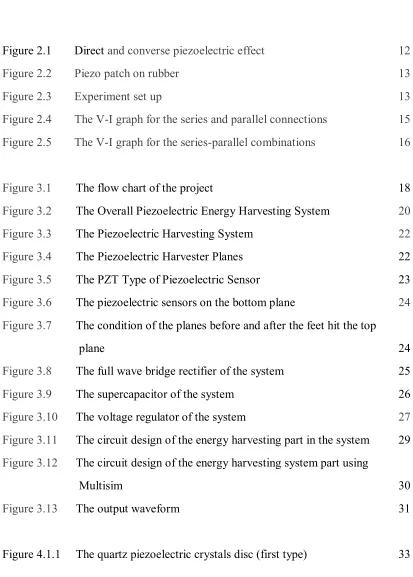
Figure 2.1 Direct and converse piezoelectric effect 12
Figure 2.2 Piezo patch on rubber 13
Figure 2.3 Experiment set up 13
Figure 2.4 The V-I graph for the series and parallel connections 15
[image:13.612.111.524.144.721.2]Figure 2.5 The V-I graph for the series-parallel combinations 16
Figure 3.1 The flow chart of the project 18
Figure 3.2 The Overall Piezoelectric Energy Harvesting System 20
Figure 3.3 The Piezoelectric Harvesting System 22
Figure 3.4 The Piezoelectric Harvester Planes 22
Figure 3.5 The PZT Type of Piezoelectric Sensor 23
Figure 3.6 The piezoelectric sensors on the bottom plane 24
Figure 3.7 The condition of the planes before and after the feet hit the top
plane 24
Figure 3.8 The full wave bridge rectifier of the system 25
Figure 3.9 The supercapacitor of the system 26
Figure 3.10 The voltage regulator of the system 27
Figure 3.11 The circuit design of the energy harvesting part in the system 29
Figure 3.12 The circuit design of the energy harvesting system part using
Multisim 30
Figure 3.13 The output waveform 31
14 Figure 4.1.2: The PZT of piezoelectric disc (second type) 34
Figure 4.2.1: Check the connection of output 35
Figure 4.2.2: Result of output voltage at 3 minute 35
Figure 4.3.1.1: Measure the voltage 36
Figure 4.3.1.2: The connection of first type of piezoelectric 37 Figure 4.3.1.3: Data of the voltage using multimeter at 1 minute 37 Figure 4.3.1.4: Data of the current using multimeter at 1 minute 38 Figure 4.3.1.5: Data of the voltage using multimeter at 5 minute 39 Figure 4.3.1.6: Data of the current using multimeter at 5 minute 39 Figure 4.3.1.7: Data of the current using multimeter at 7 minute 40 Figure 4.4.1.1 Output of voltage against power by using one side
piezoelectric crystal 42
Figure 4.5.1: Tab the probe of multimeter at the series condition 43 Figure 4.5.2: Data of the voltage using multimeter at 1 minute 44 Figure 4.5.3: Data of the current using multimeter at 1 minute 44
15
LIST OF ABREVIATIONS, SYMBOLS AND
NOMENCLATURE
AC - Alternating Current
DC - Direct Current
MEMS - Micro Electro Mechanical System
MHz - Mega Hertz
PZT - Lead Zirconate Titanate BaTiO3 - Barium Titanate
E - Energy Consumed
V - Voltage
C - Storage Capacitor
USB - Universal Serial Bus BJT - Bipolar Junction Transistor
MOSFET - Metal Oxide Semiconductor Field Effect Transistor
mF - Mili Farad
Ω - Ohm
H - Hertz
16
CHAPTER 1
INTRODUCTION
1.0 Introduction
This section explains the project background, objectives, scope, problem statement and project significant.
1.1 Background
17 Besides that, electrical energy will produced because idea of the piezoelectric energy harvesting is concentrating on the system that captures wasted energy from vibration to get some electricity. The power created can be put away in the capacity device and then used to power electronic such as mobile phone, mp3 especially for athlete that utilization sport shoes. The innovation depends on a standard called the piezoelectric impact, in which certain materials can develop an electrical charge from having vibration and strain applies to them.
Capacitor that are use is super capacitor that have high storage to store energy, they typically store 10 to 100 times more than electrolytic capacitor, can accept and deliver charge much faster than batteries. The harvested energy is then will be rectified and changed into power electric before exchanged to energy storage device.
18
1.2 Problem statement
Electronics and electric is very important in our daily life as energy is one of the most thing needed in the world. Bad management of energy will affect the development of company and social growth and in the same time will also affect human life. Nowadays, there are lot of electronics product in market that need energy as a power supply such as mobile phone, radio and so on. Without power supply, mobile phone will run out of the battery, radio will not be able to function well, human are not able to watch television since there are no power to switch the TV on.
Nowadays, there are so many wasted energy. Human activity is overloading the atmosphere with carbon dioxide and other global warming emission, which trap heat, steadily drive up the planet’s temperature, and create significant and harmful impact on our health, our environment, and our climate. The energy that have been wasted actually can be renewed and converted to the useful form such as eco-system project.
19 However, the biggest problem for this renewal energy system is, the cost are higher than non-renewable energy and sometimes it contribute to serve air pollution problem. New ideas are being tested by researchers from all over the world and also by various innovative pilot project around the world. Beside than that, other solution that can be investigated are some other new assets, for example, hydroelectric power generators. So the easiest, cheapest and suitable to eco-system should be consider first.
1.3 Objective
The objective of this project are:
(a) The aim of this project is to develop a system that can generate power from movement using the concept of piezoelectric effect.
(b) To analyse the performance of designed system.
1.4 Scope
20
1.5 Project Significant
21
CHAPTER 2
LITERATURE REVIEW
2.0 Introduction
In this literature review section, it involves from the journal on the web, paper procedures and research, books and lectures. The literature review includes the cases investigation of the project that might be emerge to conquer the problem furthermore gives a capable learning on the basics of the fundamental project.
2.1 Piezoelectric Device
22 materials, you get a charge separation within a crystal and a voltage across the crystal that is sometimes extremely high (Colenso, 2008). When a pressure is applied to a piezoelectric material, it causes a mechanical distortion and a displacement of charges which are highly proportional to the applied pressure. Placing piezoelectric devices that are used to capture energy from shoes especially for athlete sport that can get a lot of vibration so it can effectively capture electrical energy and send it back to the power grid through rectifier, which are needed in order to convert the AC power, from the piezoelectric, into DC power to use for ultra-low power energy electronics like mobile phone, radio and so on.
2.2 Piezoelectric Material
Piezoelectric materials can be used as mechanisms to transfer ambient vibrations into electrical energy that can be stored and used to power other devices. With the recent surge of micro scale devices, Piezoelectric power generation can provide a conventional alternative to traditional power sources used to operate certain types of sensors/actuators, telemetry, and MEMS devices. (Henry et al, 2012).
23 One of the first applications of the piezoelectric effect was an ultrasonic submarine detector developed during the First World War. A mosaic of thin quartz crystals glued between two steel plates acted as a transducer that resonated at 50MHz (Heung et al, 2011). By submerging the device and applying a voltage they succeeded in emitting a high frequency 'chirp' underwater, which enabled them to measure the depth by timing the return echo. This was the basis for sonar and the development encouraged other applications using piezoelectric devices both resonating and non-resonating such as microphones, signal filters and ultrasonic transducers. However many devices were not commercially viable due to the limited performance of the materials at the time.
The piezoelectric is a property of certain crystalline material such as quartz, Lead Zirconate Titanate (PZT), barium titanate ceramics and Rochelle salt which will develop electricity when the pressure is applied on the direct effect (Heung et al, 2011).
2.2.1 Crystal Quartz
It was found that for a small mass uniformly deposited over the crystal surface, the shift in resonant frequentcy is linearly proportional to the mass. Because of this simplicity, piezoelectric quartz crystals microbalances have been extensively used in thin film deposition processes as thickness and rate monitors. ( Lu , 1975).
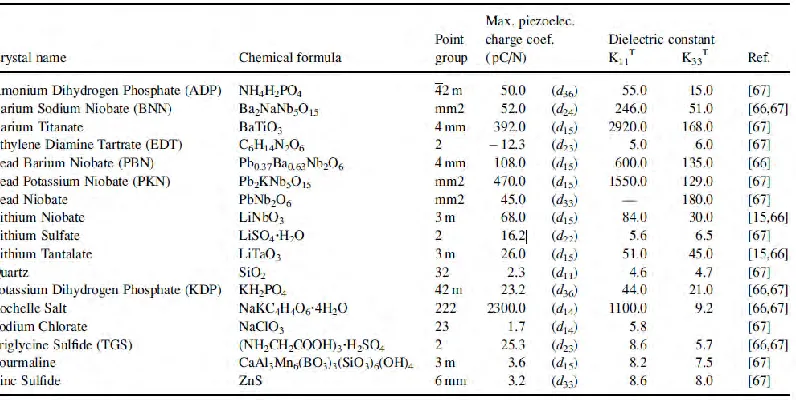
24 conserved in the oscillating system. ( Skladal , 2003). The room temperature properties will be shown as Table 2.1.
Table 2.1: Room temperature properties of common piezoelectric crystals (James et al, 1998)
2.2.2 Barium Titanate Ceramics
Barium titanate, BaTiO3 is the first ceramic piezoelectric material as in historical where it shows a high possibility of being revitalized as a popular lead-free piezoelectric material. This titanate is a ferroelectric ceramic material with piezoelectric properties. (Jaffe , 2012)