
The application of prediction markets to project prioritization in the not-for-profit sector
302
0
0
Full text
(2) The application of prediction markets to project prioritization in the not-for-profit sector. Daniel Ali Grainger, BE hons (University of Queensland), MBA (University of Melbourne), Grad. Dip. Ed. (Macquarie University). August 2017. A thesis submitted for the degree of Doctor of Philosophy. in the College of Business, Law and Governance James Cook University Australia.
(3) Acknowledgements This work would not be possible without the support, inspiration and guidance of the following people and organizations. My Advisory Panel consisting of Associate Professor Sizhong Sun, Doctor Felecia WatkinLui, and Professor Peter Case have been the strong supportive team guiding me along this PhD journey. Their impressive coherent teamwork not only provided me with good guidance to ensure the quality of my thesis, but have also provided me opportunities in research consulting and academic roles that have enriched my thesis work. The Australian Aboriginal and Torres Strait Islander Centre provided the necessary reminder that my work was a part of a larger agenda contributing to the development of Aboriginal and Torres Strait Islander people and their Countries.. Their research excellence workshops. connected me to a cohort of impressive people who continue to inspire my work. I am grateful for the assistance of the staff of the James Cook University. The College of Business, Law, & Governance has provided the day-to-day resources necessary for my study. The Graduate Research School has provided the necessary research skills development via coaches and professional development workshops. The funding from the APA Scholarships has made my study over these years a viable investment. I am grateful for the guidance, opportunities & inspiration offered by Professors Cadet-James & Stoeckl, Associate Professors Welters & Beg and Doctors Esparon & Farr. I remain impressed how generously they have given of their time. I am also grateful for the support of my family and friends over the years. In particular my wife (Shelley) and son (PJ) have been my solace and happiness throughout this endeavour. This work is for the Country you Care for… wherever you Belong.. ii.
(4) Statement of the Contribution of Others Nature of Assistance. Contribution. Names. Review and feedback of thesis chapters and underlying investigations. All thesis chapters and underlying investigations have been guided by review and feedback from my Advisory Panel. Associate Professor Sizhong Sun, Doctor Felecia Watkin-Lui, Professor Peter Case. Recruiting participants for the prediction market webgames investigation. The testing and actual experiment phase required human participants that were recruited across various university classes. Doctor Esparon, Doctor Liu, Doctor Chaiechi, Professor Zhou. Feedback on experimental designs and statistical analyses. The two experimental investigations and the realworld data analysis were double-checked by experienced researchers with statistical expertise. Associate Professor Welters, Doctor Beg. Copy editing. The thesis layout and formatting was reviewed and copy-edited. Katharine J Fowler. Every reasonable effort has been made to gain permission and acknowledge the owners of copyright material. I would be pleased to hear from any copyright owner who has been omitted or incorrectly acknowledged. Daniel A Grainger. iii.
(5) Abstract The principal objectives and scope of the study The goal of this thesis is to ultimately propose how prediction markets may be used to select the best possible portfolio of projects in a not-for-profit setting. The first logical principal objective is to identify a quality signal that demarcates a good from a bad market prediction (or decision). Upon doing so, the second principal objective of configuring prediction markets (into a decision market) to decide if a project should be in or out of the project portfolio, and importantly the probability that this selection is the best possible one, is achievable. This objective is achieved via a novel theoretical model introduced in this thesis and by three investigations to test the theory. The third and final principal objective is to consider synthesize the finding of this thesis to propose how to improve current prediction markets and create a new type of prediction and decision market that is augmented or embedded with the quality signal identified by the thesis theory and investigations. Due to time and budget constraints the scope of this thesis does not extend to building a realworld implementation of the prediction and decision market types introduced by this thesis for real-world organizations. However, at the time of writing a joint venture arrangement between the university and other stakeholders is in development to implement this thesis’ decision market for project selection in possibly two not-for-profit organizations. The methodology employed The keystone and novel contribution of this thesis is the identification of a quality signal that can be used to improve prediction and decision markets. The methodology to achieve this is to first establish a theoretical model that builds upon the work of previous research but that provides an original contribution in its focus on quality signals in prediction markets. The idealized theoretical model suggests a possible quality signal candidate denoted as relevant information level i.e. the proportion of the market bids that are conditioned on private information. Given relevant information is arrived at theoretically, it is important to robustly test the hypotheses that increasing relevant information increases the probability of prediction and decision markets attaining the best possible (fully informed) predictions and decision respectively.. iv.
(6) The first investigation is a computer simulated control-treatment setup in which each control and treatment prediction (and decision) market is identical in every way except for the relevant information level. The statistical significance of relevant information level is then analyzed. The benefit of computer simulations is the large number of prediction and decision market games that can be run. The weakness is that all traders are rational. Therefore, the second investigation incorporates, into the prediction and decision markets, human participants. The second investigation involves a prediction market web-game created by the PhD candidate. Multiple prediction market web-games are run in a control-treatment setup in which relevant information is allowed to vary with all else being held the same for each control and its treatment. The statistical significance of relevant information level is then analyzed. The strength of this investigation is the incorporation of human idiosyncrasies; however, the weakness is this investigation remains within the confines of the laboratory setting. Hence the third and final investigation involves the analysis of real-world prediction market data. The analysis of real-world prediction market data is undertaken to extend the testing of the hypotheses into a real-world setting. The strength of this is that the hygienic conditions of the laboratory are removed, however, the weakness is the potential endogeneity and confounding problems that can arise. To counter these potential problems, a control function approach is used to control for endogeneity and a fine strata continuous propensity score approach is used to control for confounding. Summary of the results The new theoretical model finds relevant information level to be a sufficient and necessary condition for prediction and decision markets to attain the best possible predictions and decision respectively. The computer simulations find that increasing relevant information level is a statistically significant effect that leads to improving the probability of prediction and decision markets attaining the best possible predictions and decisions. The prediction market web-games with human participants also confirms that relevant information is a statistically significant effect that when increased leads to increasing the probability of attaining the best possible prediction. Finally, the analysis of real-world prediction market. v.
(7) data confirms that relevant information is a statistically significant effect that when increased leads to increasing the probability of attaining best possible decisions. The principal conclusions There are several conclusions able to be drawn from this thesis as follows: Relevant information level is robustly tested in this thesis as a quality signal for prediction and decision markets to demarcate good prediction and decisions from bad ones. This is the key contribution by this thesis to research on prediction and decision markets. Prior to this work there existed no metric to assess the quality of a prediction or decision emanating from these markets. Without such a ‘quality’ metric, confidence in the associated predictions and decisions would remain logically unjustified. Hence ‘relevant information level’, as a quality signal, proposed and robustly tested by this thesis brings with it the ability to justly demarcate a good prediction or decision from a bad one. Current real-world prediction markets may be simply augmented with a publicized measure of their relevant information level to improve markets in much the same way that Akerlof quality signals do so. That is, the implication of this thesis does not require radical changes to current real world prediction and decision markets. Rather, by simply publicising the ‘relevant information level’ metric, the confidence warranted in a prediction or decision market is revealed. In much the same way that Akerlof quality signals were embodied in small changes (e.g., second-hand car guarantees), ‘relevant information level’ as a quality signal is a small change i.e. publicising and therefore a guarantee of the efficacy of a prediction or decision market. The new prediction and decision markets that were built in this thesis have the potential to select the best possible portfolio of projects. With high quality decision market selection comes the confidence that the best possible selection is made. The selection of the best possible portfolio of projects is a logical extension to this feature. Establishing a means of measuring how well prediction and decision markets select the best possible portfolio of projects is an important and novel contribution by this thesis. The ultimate goal of confidently guiding project selection so as to best leverage scare economic resources is made possible in this thesis.. vi.
(8) Table of Contents Acknowledgements.................................................................................................. ii Statement of the Contribution of Others ............................................................... iii Abstract.................................................................................................................... iv Table of Contents ................................................................................................... vii List of Tables ........................................................................................................... xi List of Figures ........................................................................................................ xii Chapter. 1. Introduction ....................................................................................... 1. 1.1 The Problem: How to Identify the Best Possible Prioritization and Portfolio of Not-For-Profit Projects? ................................................................................................. 4 1.2 Research design and rationale................................................................................. 7 1.3 Possible solution and the contribution.................................................................... 8 1.4 The Structure of the Thesis .................................................................................... 10. Chapter. 2. Literature Review ............................................................................ 13. 2.1 Resource Misallocation and The Problem of Project Portfolio Management in Not-For-Profit Firms ...................................................................................................... 14 2.2 Conventional Decision Support Tools and Their Inapplicability to The Not-ForProfit Setting.................................................................................................................. 15 2.3 Prediction and Decision Markets and Their Applicability to The Not-For-Profit Setting............................................................................................................................ 17 2.4 Theoretical Models to Understand Prediction and Decision Markets ................. 18 2.5 Computer Simulations, Games with Humans and Real-world Analysis to Investigate Prediction and Decision Markets .............................................................. 20 2.6 Policy Parameters for Prediction and Decision Markets ...................................... 23. Chapter. 3. A Simple Decision Market Model ................................................... 26. 3.1 Introduction ............................................................................................................. 27 3.2 Related Work ........................................................................................................... 28 3.2.1 Early theoretical work on information markets .................................................... 29 3.2.2 Boolean finite state space models of prediction markets .................................... 29 3.2.3 Price formation mechanisms of prediction markets ............................................. 30 3.2.4 Strategic bidding in models................................................................................. 31 3.2.5 Decision markets ................................................................................................ 32 3.3 Generally Accepted Prediction Market Model ....................................................... 33 3.4 New Prediction Market Model ................................................................................. 34. vii.
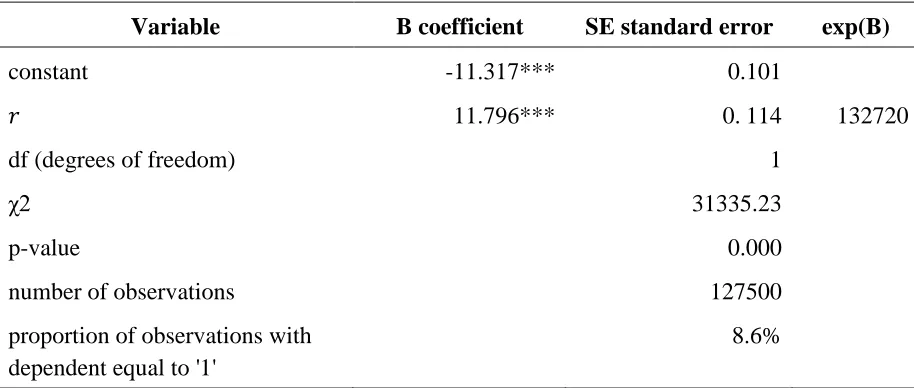
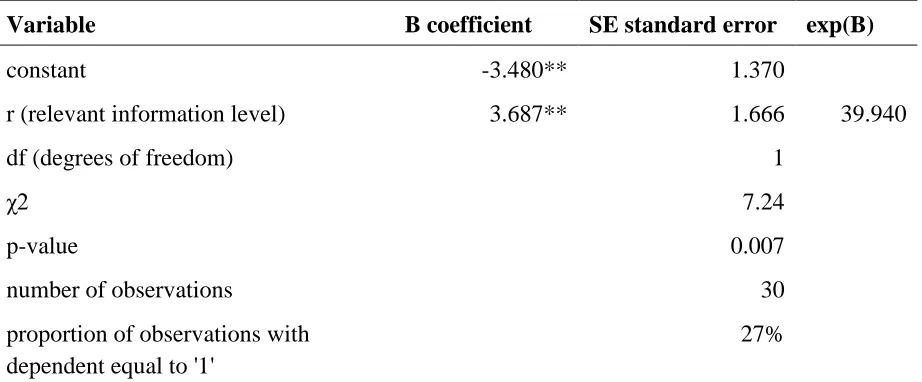
(9) 3.4.1 Proper market price axioms ................................................................................ 35 3.4.2 Definition (proper information market)................................................................. 36 3.4.3 Definition (relevant information) .......................................................................... 36 3.4.4 Main information market theorems ..................................................................... 37 3.5 Discussion ............................................................................................................... 42 3.6 Conclusion & Future Work ..................................................................................... 47. Chapter. 4. Computer Simulation of a Simple Decision Market...................... 49. 4.1 Introduction ............................................................................................................. 51 4.2 Related Literature .................................................................................................... 55 4.2.1 Computer simulated prediction and decision markets ......................................... 55 4.2.2 Computer algorithm Market Scoring Rule (MSR) ................................................ 56 4.2.3 Related computer simulation research................................................................ 61 4.3 Hypotheses for the Computer Simulated Experiments ........................................ 61 4.3.1 Theoretical model: prediction market with proper market prices ......................... 62 4.3.2 Theorems implied by the theoretical model ........................................................ 64 4.4 Experimental Design and Methodology ................................................................. 67 4.4.1 Computer simulation experimental design .......................................................... 67 4.4.2 Experimental methodology ................................................................................. 68 4.4.3 Key elements of the computer simulated markets .............................................. 70 4.4.4 Specifics of the experimental methods ............................................................... 76 4.5 Results ..................................................................................................................... 80 4.5.1 Prediction markets with dependence across information .................................... 80 4.5.2 Decision markets with dependence across information ...................................... 82 4.6 Analysis ................................................................................................................... 83 4.6.1 Prediction market simulations ............................................................................. 83 4.6.2 Decision market simulations ............................................................................... 85 4.7 Discussion ............................................................................................................... 87 4.7.1 Prediction market simulation and implications .................................................... 87 4.7.2 Decision market simulation and implications....................................................... 87 4.7.3 The big ideas inspired by this research............................................................... 88 4.8 Conclusion & Future Research .............................................................................. 90. Chapter. 5. Prediction Market Games with Human Participants..................... 93. 5.1 Introduction ............................................................................................................. 94 5.2 Related Literature .................................................................................................... 95 5.2.1 Background of prediction markets with human participants ................................ 95 5.2.2 The rational human assumption.......................................................................... 95 5.2.3 Centaurs are humans usefully augmented with machines .................................. 97 5.2.4 Games with humans ........................................................................................... 98 5.2.5 Grainger’s theoretical prediction market model to be tested ............................. 100. viii.
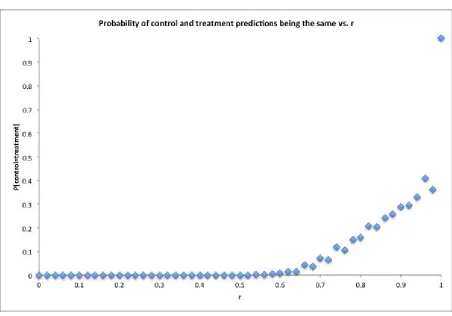
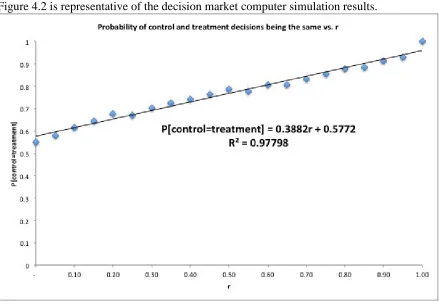
(10) 5.3 Experimental Setup ............................................................................................... 103 5.3.1 Hypothesis under test and methodological justification ..................................... 104 5.3.2 Justification of experiment design and method to analyze results ..................... 104 5.3.3 The final web-based game used for the actual experiment ............................... 106 5.3.4 The actual experiment ...................................................................................... 108 5.4 Results ................................................................................................................... 110 5.5 Analysis ................................................................................................................. 112 5.6 Discussion ............................................................................................................. 113 5.7 Conclusion & Future Research ............................................................................ 116. Chapter. 6 The Iowa Electronic Market Data for the 2008 U.S. Presidential Election: Real-world Analysis ............................................................................. 118 6.1 Introduction ........................................................................................................... 119 6.2 Related Literature .................................................................................................. 120 6.2.1 Theoretical versus real-world prediction and decision markets ......................... 120 6.2.2 The IEM 2008 US presidential election prediction market, determinants and covariates for analysis ............................................................................................... 122 6.2.3 Methodology and methods in literature to analyze real-world empirical data .... 124 6.3 The Data and Methodology ................................................................................... 128 6.3.1 Implied decision market data within the IEM 2008 presidential election prediction market ....................................................................................................................... 128 6.3.2 Hypothesis under test ....................................................................................... 129 6.3.3 Proxy for the response of the implied decision market ...................................... 129 6.3.4 Proxy for relevant information level (explanatory variable) on a daily basis ...... 131 6.3.5 The methodology.............................................................................................. 132 6.4 Analysis of the IEM 2008 Presidential Election Data .......................................... 140 6.4.1 Multivariate analysis method ............................................................................ 142 6.4.2 Instrumental variable (IV) analysis using the control function approach ............ 145 6.4.3 Propensity scoring analysis method ................................................................. 148 6.5 Discussion ............................................................................................................. 152 6.6 Conclusion & Future Research ............................................................................ 157. Chapter. 7. Policy Implications for Project Prioritization .............................. 159. 7.1 Introduction ........................................................................................................... 160 7.2 Decision-Making Relating to Project Prioritization in an Indigenous Not-ForProfit Setting................................................................................................................ 161 7.3 Relevant Information and Policy Implications..................................................... 163 7.3.1 Relevant information level to measure prediction and decision market performance .............................................................................................................. 163 7.3.2 Introduction of trading rules to ensure high relevant information levels in prediction and decision markets ................................................................................................ 164 7.4 The Important Prediction and Decision Market Link........................................... 164. ix.
(11) 7.4.1 Prediction markets should imply a decision market........................................... 164 7.4.2 Decision markets instead of prediction markets as decision support tools ........ 165 7.5 Example Application of Prediction Markets to a Project Prioritization Problem in a Not-For-Profit Firm ................................................................................................... 165 7.5.1 Indigenous firm setting ..................................................................................... 165 7.5.2 Corporate strategy view of project prioritization and application of decision market .................................................................................................................................. 167 7.5.3 Best possible projects portfolio as an NP hard problem solved in a computationally tractable way by prediction and decision markets ............................ 168 7.5.4 The prediction and decision market link to utility and money ............................ 168 7.5.5 Short run decision market game as a decision support tool .............................. 169 7.5.6 Application of prediction markets to project prioritization decisions in a not for profit Indigenous Australian firm ................................................................................ 170 7.6 Conclusion & Future Research ............................................................................ 172. References ............................................................................................................ 174 Appendix A: Chapter 3 Appendices ................................................................... 198 Appendix B: Chapter 4 Appendices ................................................................... 210 Appendix C: Chapter 5 Appendices ................................................................... 224 Appendix D: Chapter 6 Appendices ................................................................... 253 Appendix E: Chapter 7 Appendices.................................................................... 287. x.
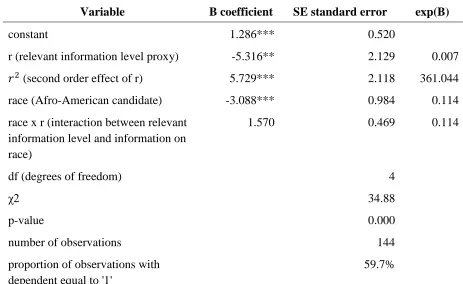
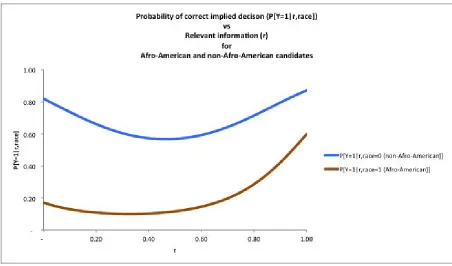
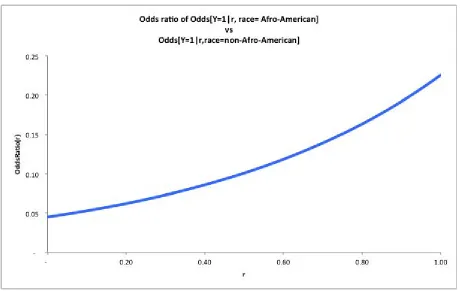
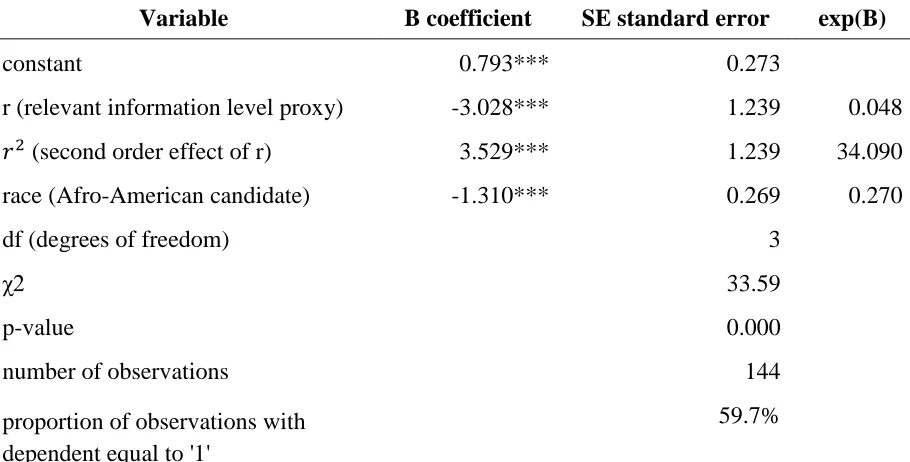
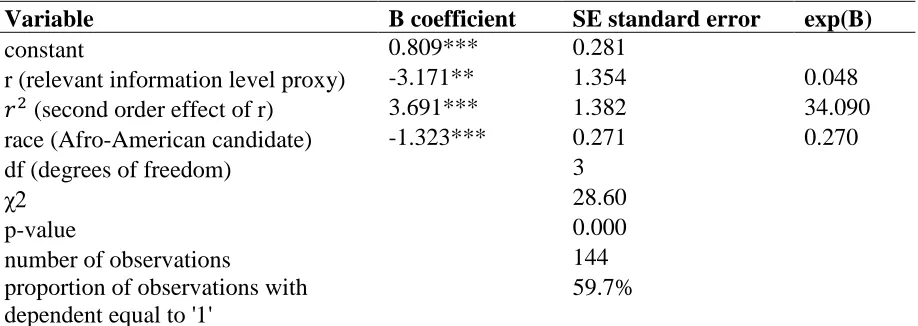
(12) List of Tables Table 4.1 Binary logit analysis of same treatment and control prediction market prices in the second round of bidding. ............................................................................................ 84 Table 4.2 Binary logit analysis of same treatment and control decision market decisions in the second round of bidding. ............................................................................................ 85 Table 5.1 Results of 60 games depicting control and treatment prediction markets converging (1) or not (0) for the two stocks traded (DFB and Not-DFB). ...................... 111 Table 5.2 Binary logistic regression of the convergence of control and treatment prediction markets for the DFB stock vs. relevant information level r. ......................... 112. Table 6.1 Binary logistic regression of the implied decision market being consistent with the real-world outcome (Obama) vs. relevant information level (r and higher order r2) and race. ................................................................................................................................ 142 Table 6.2 Probit model of the implied decision market being consistent with the realworld outcome (Obama) vs. relevant information level (r and higher order r2) and race. ................................................................................................................................................ 146 Table 6.3 IV control function approach depicting no endogeneity problem in probit model (the implied decision market being consistent with the real-world outcome (Obama) vs. relevant information level (r and higher order r2) and race). ................... 147 Table 6.4 Binary logistic regression of the rb (propensity score balanced relevant information level) vs. previous day’s DJIA (DJIAprev)................................................... 150. Table 6.5 Fine strata PSA binary logistic regression of the implied decision market being consistent with the real-world outcome (Obama) vs. rb = 1-rbalanced (propensity score rbalanced is the relevant information level in the usual sense). ............................ 151. xi.
(13) List of Figures Figure 4.1 Probability of control and treatment prediction markets converge to the same prediction price vs. r . .................................................................................................. 80 Figure 4.2 Probability of control and treatment decision markets selecting the same decision vs. r. .......................................................................................................................... 82 Figure 6.1 Binary logistic regression of the implied decision market being consistent with the real-world outcome (Obama) vs. relevant information level (r and higher order r2) and race........................................................................................................................... 143 Figure 6.2 Odds ratio of correct implied decisions vs. relevant information level (r). .. 145 Figure 6.3 Binary logistic regression of the implied decision market being consistent with the real-world outcome (Obama) vs. fine strata PSA proxy for relevant information level. ................................................................................................................. 152 Appendix Figure 1 Chi-squared test with the Null hypothesis being “normality exists”. ................................................................................................................................................ 233 Appendix Figure 2 Chi-squared test with the Null hypothesis being “βr = 0”. ............ 234. xii.
(14) Chapter. 1 Introduction “If you don't know where you are going, any road can take you there.” Charles Dodgson Key Message of Chapter: • • • • •. Research gaps in the literature are identified Research questions are formulated Research design to address research questions is justified Original contributions – theoretical, methodological and empirical - are summarized The thesis structure is presented. Researchers and practitioners have long been trying to investigate and develop a pragmatic decision support tool that prioritizes projects optimally in not-for-profit settings. Contributing to this strand of research, this thesis investigates the development and application of high quality prediction and decision markets, one of the decision support tools, with an intent to introduce a means to reduce wasted resources due to poor project portfolios. At the project management and portfolio of project management level, there exists a lack of a high-quality decision support tool, which is particularly noticed in not-for-profit project prioritization activities. The application of a multitude of decision support tools including Net Present Valuations (NPV), Real Options Analysis (ROA), and a family of Cost Benefit Analysis (CBA) tools cannot satisfactorily solve project prioritization problems. Project optimisation using CBA is not possible given that it considers in isolation the costs and benefits of a particular project and is not amenable to inter-project comparisons that would facilitate project ranking. Whilst NPV and ROA allow for inter-project comparison to facilitate ranking, they suffer from the underlying Capital Asset Pricing Model (CAPM) assumptions; whereby typically poor or absent project level comparables lead to poor beta estimates and therefore highly uncertain project valuations that would underpin the ranking exercise. These techniques ultimately share ambiguity driven by unmet assumptions. Importantly, they lack a quality signal to guarantee their efficacy. It is important that a decision support tool incorporates a quality signal indicating the efficacy of its output. Similar to other tools, the prediction and decision markets currently lack a quality signal and as such their predictions and decisions remain questionable. In view of this, this thesis provides an original contribution in the form of identifying a quality signal for prediction and decision markets. The role of the quality signal is simply to demarcate a good 1.
(15) prediction or decision market from a bad one. The quality signal identified in this thesis is called ‘relevant information level’. It is the proportion of traders in the prediction and decision markets that submit bids that express relevant information; where a bid is said to express relevant information if its value changes when the trader’s information changes. The original proposal of this thesis is to augment prediction and decision markets with a quality signal (i.e., relevant information level) to indicate the credibility of predictions and decisions respectively. The ultimate aim is to determine how to build prediction and decision markets that are able to select, with a high probability, the best possible portfolio of projects in a not for profit setting. To this end, the central focus of this thesis is to determine the statistical significance of ‘relevant information level’ in prediction and decision markets. The role of the original theoretical model developed in this thesis is simply to identify a possible quality signal. To this end, ‘relevant information level’ is theoretically identified as the quality signal. Because the theoretical model is idealized, relevant information level as the identified quality signal needs to be robustly validated in experiments and analysis. Hence, the statistically significant effect of relevant information level (as a quality signal) is tested in computer simulated prediction and decision market control-treatment experimental setups 1, it is then tested in prediction market webgames with human participants controltreatment experimental setups, and finally tested via analysis of real-world decision market data. This methodology represents a logical progression from tests with the rational computer simulated traders, to those beyond the rational trader assumption (i.e., a prediction market webgame incorporating human idiosyncrasies) in a laboratory setting, to a real-world setting incorporating human behavior beyond the confines of the laboratory. Together these three investigations represent a logically sequenced robust test of the theoretically identified quality signal (relevant information level). The computer simulated experiments of prediction and decision markets considers a context in which the selection of a not for profit project is required to be determined as either in or out of a best possible project portfolio. The prediction market webgames with human participants consider whether the hypothetical not for profit dog-friendly-beach project is selected as either in or out of the Townsville Pet Society’s best possible project portfolio. The analysis of the implied decision market data for the Iowa Electronic Market’s 2008 U.S. 1. A control and its respective treatment are identical in every way except for a possible difference in the value of relevant information level.. 2.
(16) Presidential Election is a candidate selection problem that, in form, is a not for profit project selection problem to determine whether the project (i.e., candidate) is either in or out of best possible project portfolio. The important takeaway, is that all three tests apply prediction and decision markets to a portfolio of project selection problem in a not for profit setting. The key findings and policy implications of this thesis are: 1. Increasing relevant information level in prediction and decision markets increases the probability of attaining best possible predictions and decisions 2. Augmenting current real-world prediction and decision markets with relevant information level is an immediately feasible policy change to improve these markets. 3. Building a real-world implementation of prediction and decision markets of the type proposed in this thesis (already having, by design, the embedded the relevant information level quality signal) to select, with high probability, the best portfolio of projects in a not for profit setting is both possible and in current demand. For example, at the time of writing, the PhD candidate has been presented with a postdoctoral opportunity in the form of a University-Indigenous Community health organization joint venture and is currently in the process of adapting the decision market (that he built for this thesis) to select the best possible portfolio of health projects. This real-world build, of the prediction and decision markets of the type advocated by this thesis, was a result of the stakeholders considering the quality signal an attractive feature; revealing to them how likely the best possible portfolio of health projects is selected by this (thesis’ decision market) decision support tool. This thesis initially mathematically proves that a relevant information level of one (i.e., all traders submit informed bids) is a sufficient and necessary condition for prediction markets to converge to best possible predictions. It also mathematically proves that increasing relevant information level leads to an increase in the probability of decision markets converging to the best possible decision. The thesis then tests these idealized findings and ultimately reveals the statistical significance of relevant information level in computer simulations of prediction and decision markets, in prediction market web-games with human participants, and in real-world prediction market data containing an implied decision market. In all settings, relevant information level is a statistically significant effect whereby increasing relevant information. 3.
(17) level leads to increasing the probability of prediction and decision markets converging to the best possible predictions and decisions respectively. Ultimately, this thesis finds that high relevant information level is an important requirement for prediction and decision market as decision support tools. Prediction and decision markets with high relevant information level guarantee good prediction and decision performance. In practical terms, a good quality signal (high relevant information level) guarantees that it is highly probable that the prediction and decision markets correctly select and prioritize the best possible portfolio of projects. That is, a prediction and decision markets, as decision support tools accompanied by a good quality signal guarantee, delivers confidence to a manager or group of managers advocating the (prediction and decision market) derived selection and prioritization of the portfolio of projects to their project sponsors, project governance, or firm board. Accordingly, this thesis advocates the use of this type of (relevant information level augmented) prediction and decision market, as a decision support tool, to facilitate the difficult task of credibly prioritizing and identifying a firm’s best possible portfolio of projects in a not-for-profit setting. 1.1 The Problem: How to Identify the Best Possible Prioritization and Portfolio of Not-For-Profit Projects? Portfolio of project management is the dominant method to achieve desired outcomes of firms globally (Too and Weaver, 2014); including in small to medium enterprises (SMEs) which represent 90% of global firms (Inyang, 2013; Marcelino-Sádaba et al., 2014). The $12 trillion US dollars per annum expenditure on projects (estimated in 2013), the estimated 8% of global GDP in 2014 (Flyvbjerg, 2014), and the propensity of firms to use a portfolio of projects to achieve desired outcomes, has motivated the investigation of techniques to select the best possible portfolio of projects for a firm (Hall et al., 2015; Abbassi et al., 2014). Selection of projects into a firm’s portfolio is complex, and ultimately requires the consideration of what portfolio of projects best share the scarce firm resources so as to increase the likelihood of the firm achieving its desired outcome (Martinsuo, 2013; Patanakul, 2015). Poor project prioritization and the selection of the wrong portfolio of projects, to implement in a not-for-profit setting, is still considered an open problem; requiring resolution in the 21st Century in order to reduce the misallocation of scare global resources (Lacerda et al., 2016; Silvius and Schipper, 2014; Sánchez, 2015). The selection of a portfolio of projects that align with corporate strategy is considered a key competitive. 4.
(18) advantage of the firm (Mikkola, 2001; Cooper et al., 2001; Kaiser et al., 2015); with noncommercial (not-for-profit) project portfolios also aligned to a firm’s corporate strategy considered important for the economy and the firm’s long-run sustainability (Martinsuo and Killen, 2014; Marcelino-Sádaba et al., 2015). At one extreme the social license to operate motivates some Australian firms to invest in not-for-profit projects (Lyons, 2016) and at the other extreme a moral obligation motivates Italian family owned and operated firms to invest in not-for-profit projects (Campopiano and De Massis, 2015). In view of this, there is a practical need (namely gap) for the development of a decision support tool to select and prioritize a portfolio of projects in a not-for-profit setting. Poor project prioritization metrics reduce potential benefits of not-for-profit conservation project investments by 30% to 50% (Pannell and Gibson, 2016). Of these investments, approximately $20b per annum has been spent on projects to protect imperilled fauna and flora globally (Waldron et al., 2013). This implies an estimated $6b to $10b per annum in wasted resources. Furthermore, an estimated $13.8t to $23t per annum of resources are wasted by a portfolio projects attempting to maintain the global ecosystem (valued at $46 trillion per annum as at 2007) (Costanza et al., 2014). This being the case, a 1% portfolio of project management improvement would save at least $1t per annum of resources dedicated to maintaining the global ecosystem. Specifically, adequate prioritization and selection of the best possible portfolio of projects for each firm can improve the allocation of scarce and valuable resources (thereby reducing wasted resources) and ultimately increasing the likelihood of success, i.e., achieving the desired outcome (Teller et al., 2014). Therefore, in addition to developing a decision support tool to select and prioritize a portfolio of projects in a not-for-profit setting, one will need to ensure the tool is effective, namely that the decision support tool, with high probability, selects and prioritizes the best possible portfolio of projects. Portfolio theory has been applied in order to identify a project’s ‘in or out’ status in relation to the firm’s project portfolio (Heydari et al., 2016; Kaiser et al., 2015). Conventional valuation techniques, including discounted cash flow (DCF) and real options analysis (ROA), have been applied in an attempt to value portfolios of corporate social responsibility not-forprofit projects (Mooney and Lin, 2014). However, the need to consider both internal and external values to shareholders (in maximizing the firm’s value) and stakeholders (with 5.
(19) interests beyond maximization of the firm’s value) respectively (Jensen and Meckling, 1976) is pivotal to sustainable project portfolio success; where success is not merely project efficiency and satisfied shareholders, but also satisfied stakeholders (Serrador and Turner, 2015). Notably, the external stakeholder’s value is absent in conventional valuation techniques (Petro and Gardiner, 2015). Additionally, a more obvious and significant complication of conventional techniques is the difficulty to monetize benefits of not-forprofit projects (Mooney and Lin, 2014). The alternative Cost Benefit Analysis and scoring rule techniques that are used to estimate the value of these benefits can also suffer distortions, e.g., from the diverse background and expertise of the participants informing the estimations (Liao et al., 2015). Furthermore, in uncertain contexts with distributed information beyond the boundary of the firm - e.g., collaborative projects (vom Brocke and Lippe, 2015) conventional methods fail to aggregate all pertinent information associated with the portfolio of projects (Petro and Gardiner, 2015). Participatory approaches allowing the continuous revelation of information, over the implementation life of the decision support tool, to select the best possible portfolio of projects is considered invaluable (Nowak, 2013). Prediction and decision markets as decision support tools inherently operate in this way; allowing participation by a diversity of people and continuous revelation of information in its market game implementation (Malone et al., 2009). However, these market type decision support tools only work well if they are information efficient (Roth, 2008), e.g., the real-world Iowa Electronic (prediction) Market (IEM) is not always information efficient and as such not always accurate (Schmitz, 2011). Therefore, the conditions guaranteeing market efficiency are of principal interest (Jackman, 2015; Treynor, 1987; Goodell et al., 2015; Chen and Pennock, 2010) and specifically of central concern to the IEM, i.e., guaranteeing consistently accurate predictions by way of guaranteeing efficient aggregation of information (Berg and Rietz, 2006; Chen and Pennock, 2010; Cowgill et al., 2009). However, new decision support tools, such as the prediction and decision market type investigated in this thesis, can face uptake challenges driven by the absence of quality signals guaranteeing their effectiveness (Scott and Scott, 2016). Hence, a quality signal is both a monitor and guarantee of the accuracy of prediction and decision markets, and logically leads to their increased utilization as a decision support tool.. 6.
(20) Therefore, in order to ensure the efficacy of prediction and decision markets, one needs to identify a quality signal that guarantees prediction and decision markets are performing well or not. In summary, the research gaps that this thesis will address are: 1. The investigation of a quality signal to demarcate the good from bad prediction and decision markets. 2. The use of prediction and decision markets to, with a high probability, correctly select and prioritize the best possible portfolio of projects in a not-for-profit firm setting. The research questions addressed by this thesis and directly associated with the research gaps are: 1. What is the quality signal for prediction markets? 2. How are decision markets to decide the best possible project portfolio and prioritization built using prediction markets? 3. Do prediction markets have the potential to be successfully applied as a high-quality decision support tool to prioritize and select the best possible portfolio of projects in a not-for-profit firm setting? 1.2 Research design and rationale The research design and rationale addressing the three research questions (RQ) is presented as follows: RQ1: What is the quality signal for prediction markets? A new theoretical model is constructed by reflecting on literature on the theory of prediction and decision markets. This theoretical model identifies that a prediction and decision market characteristic, denoted as relevant information level, is a sufficient and necessary condition for convergence to the best possible prediction and decisions. Although the model setup is idealized, it logically motivates further investigation via computer simulations, games with human participants, and empirical analysis of real-world prediction market data.. 7.
(21) RQ2: How are decision markets to decide the best possible project portfolio and prioritization built using prediction markets? The theoretical model is tested initially in computer simulations (with Matlab) and then in games with human participants (using a fully functioning web-based prediction and decision market webgame built by the researcher). Given that the selection of the best possible portfolio of projects may be reduced to considering whether each project is in or out of the project portfolio, it was sufficient to consider an environment of one project in both the computer simulations and the games with humans. This analysis was then extended to a multi-project setting embodied in Presidential Candidates of the empirical study of this thesis. Finally, a hypothetical setting in the policy implications chapter directly addresses the application of prediction and decision markets to address the more general best possible portfolio project selection problem. RQ3: Do prediction markets have the potential to be successfully applied as a highquality decision support tool to prioritize and select the best possible portfolio of projects in a not-for-profit firm setting? The quality signal (relevant information level) for prediction and decision markets is of central importance in this thesis. Firstly, a computer simulation runs thousands of prediction and decision markets to determine that the quality signal plays a statistically significant role in ensuring the markets achieve the optimal outcome (i.e. the best possible prediction and decision). Secondly, the human behavior element is introduced via multiple web-games with human and computer agents in a control and treatment experimental setup (where a control and treatment differs only in the quality signal value i.e. the relevant information level value); statistical significance again holds. Thirdly, empirical analysis of a real-world prediction market is undertaken to determine if the quality signal is still significant outside of the hygienic laboratory conditions; it is. Finally, a hypothetical scenario elucidates the potential application of prediction and decision markets that possess a good quality signal; providing both a step-by-step guide for implementation and a rigorous investigation of potential policy implications. 1.3 Possible solution and the contribution This thesis provides an original contribution to research on prediction and decision markets as decision support tools. Specifically, it provides the quality signal that enables a user to 8.
(22) demarcate a good (well-functioning) prediction and decision market from a bad one. This quality signal, called relevant information level, is the keystone of this thesis. In short, this thesis constructs a theoretical model and then validates the theoretically derived hypotheses, through experimental and empirical methods, that relevant information level is found to play a statistically significant role in achieving the best outcome and that increasing it also increases the probability of better predictions and decisions. The thesis title is “the application of prediction markets to project prioritization decisions in the not-for-profit sector” which suggests that this thesis is an investigation into how prediction markets may be configured to prioritize projects in not-for-profit firms. With the review of literature in mind, a quality signal that ensures a well-functioning prediction market to prioritize projects is currently lacking. This thesis theorizes and validates a useful quality signal. Ultimately, high quality prediction markets in this thesis are configured to create a simple decision market to select whether a project is in or out of the best possible project portfolio; the best possible portfolio of projects being the collection of projects, when implemented by a firm, maximizes the probability of achieving the desired outcome of the firm’s shareholder or, depending on the outcome specified, its stakeholders (Jensen and Meckling, 1976).This thesis provides a means to improve current real-world prediction markets that exist in both the public arena and within firms. Specifically, it presents a way to measure the quality (relevant information level) of a prediction market that, when publicized, informs and changes trading behavior. The key desired outcome is, ultimately, to rid the world of poorly performing prediction markets; in much the same way as guarantees and warranties removed the lemons from the used-cars market (Akerlof, 1970). It also advocates the use of prediction markets having implied decision markets; given it is the conditional probability information that firms truly require. That is, a firm is primarily interested in the active selection of projects to maximize the chance of achieving outcomes; rather than passively predicting outcomes. In general, this thesis suggests that prediction and decision markets benefit from high relevant information levels; which can be achieved by publicizing at regular intervals the relevant information level of a prediction and decision market, e.g., publicizing the daily relevant information level of the Iowa Electronic Market, or every 5 minutes in the case of the simple decision market that was built in this thesis investigation. For example, a publicized low relevant information level (of a prediction market) signals to traders that there. 9.
(23) exist arbitrage opportunities in the market that may be leveraged via their informed trading. This informed trading, in turn, increases the relevant information level; as arbitrage opportunities are exhausted. Finally, a way to utilize the simple decision market game is demonstrated by way of a hypothetical example. The example provides a justification (building upon the validation of the significance of relevant information level undertaken in earlier chapters), and also serves as a simple and concrete step-by-step guide describing how to prioritize not-for-profit projects using the decision market game.. 1.4 The Structure of the Thesis This thesis comprises seven chapters. Chapter 2 is a literature review that provides the reader a concise foundational overview of relevant literature and elaborates further on the justification for the core research problems and subsequent theoretical and experimental investigations. Chapters 3 to 7 each provide the necessary and more comprehensive review of literature that precedes that chapter’s specific investigation. Chapter 3 sets out a theoretical model that reveals relevant information level as a sufficient and necessary condition for well-function prediction and decision markets of the specific type described in that chapter 2. Importantly, it provided theoretical justification to pursue subsequent experimental and empirical analysis to validate the significance of relevant information level. Chapter 4 describes the comprehensive series of computer simulations of prediction and decision markets of the type described in Chapter 3. It both circumvents the need to establish a difficult analytic solution and also simplifies statistical analysis via the very large number of prediction and decision markets runs. Ultimately, it establishes that relevant information level plays a statistically significant role. Chapter 5 requires the development of a prediction market web-game to experimentally test the significance of relevant information level when humans participate. This game incorporates both algorithmic and human traders. The addition of human traders is the logical next step from the purely algorithmic setting of Chapter 4. 30 ‘control’ games were paired 2. This chapter was published in the peer reviewed Journal of Prediction Markets.. 10.
(24) with 30 ‘treatment’ games; the only difference between a control and treatment pairing being the relevant information level. The response of interest was the convergence of the control and treatment to the same prediction. If they differed, it was logically due to relevant information level. Relevant information level was found to play a statistically significant role in this series of games with human participants. Chapter 6 is an analysis of data from a real-world prediction market. Because Chapters 4 and 5 are experiments in laboratory conditions, a real-world analysis is warranted to determine whether relevant information level also plays a statistically significant role in a real-world prediction market. The Iowa Electronic (prediction) Market (IEM) data on the 2008 US Presidential Elections are analyzed. Importantly, the data contained an implied decision market that unambiguously reported the best possible Presidential Candidate on each day prior to Election Day. Of interest is the probability of the correct implied decision as a function of the proxy for relevant information level. A logistic regression is performed that also includes other control variables informed by a literature review presented in the chapter. The best specification is achieved by employing forward and backward stepwise regression alongside the log likelihood ratio. Importantly, the best specification undergoes post-hoc tests (to ensure assumptions of normality hold and a continuity correction factor is not required) and also controlled for endogeneity and confounding. Ultimately, this chapter finds that relevant information level in a real-world prediction market indeed plays a statistically significant role and, in so doing, also provides a means to measure relevant information level. Chapter 7 specifies the policy implications and conclusions of this thesis. By way of an example, in the form of a hypothetical not-for-profit Indigenous Australian firm, it provides comprehensive justification of a simple step-by-step approach to prioritizing the best possible portfolio of projects. This is done to transparently justify and facilitate the rollout of prediction and decision market games (of the type advocated by this thesis) as decision support tools in not-for-profit firm settings. Importantly, so long as high relevant information level exists, the decision market game identifies and prioritizes the best possible portfolio of projects for a given budget so as to maximize the likelihood of achieving the desired outcome. By way of qualification, it should be noted that the prediction and decision market game of this thesis could be employed beyond the not-for-profit setting. It is ultimately a simple 11.
(25) decision support tool to identify the best portfolio of projects for any firm. However, the interest and portfolio of project management work experience of the researcher lies primarily in the complex not for profit project selection space, the three investigations to test the theoretical model were deliberately contextualized as portfolio of project selection problems, and finally a post-doctoral implementation and evaluation of the prediction and decision markets of this thesis to portfolio of project selection in a real-world not for profit setting was sought by the researcher and at the time of writing exists in a University-Indigenous Community Health organization joint venture. Importantly, the prediction and decision market of this thesis is a decision support tool that provides a measure of the quality of its output in the form of the reported relevant information level. For example, if the prediction and decision market game is implemented in a firm and the highest relevant information level is achieved, then it is highly likely that the best possible prioritization and portfolio of projects has been identified by the game. In conclusion, it is hoped that the quality measure (provided by this thesis) of the prediction and decision market as a decision support tool leads to an increase in their uptake; to credibly prioritize the best possible portfolio of not-for-profit projects and ultimately reduce wasted resources resulting from poor project selection.. 12.
(26) Chapter. 2 Literature Review “Prediction is very difficult, especially if it's about the future.” Niels Bohr Key Message of Chapter: •. Literature pertinent to this thesis is reviewed. •. Subsequent chapters focus on particular research areas and extend the literature review to greater depths. •. This chapter provides a concise and coherent consolidation of key ideas of thesis relevant literature in one place. A concise review of literature relevant to the central problematic of the entire thesis is presented in this chapter. Subsequent chapters provide more in-depth, subject and research question specific, detail relating to their particular investigations. The main ideas reviewed in the literature and relevant to this thesis are presented in this chapter as follows: 1. Resource misallocation and the problem of project portfolio management 2. Conventional decision support tools and their inapplicability to the not-for-profit setting 3. Prediction and decision markets and their applicability to the not-for-profit setting 4. Theoretical models to understand prediction and decision markets 5. Computer simulations, games with humans and real-world analysis to investigate prediction and decision markets 6. Policy parameters for prediction and decision markets These six areas of research literature tie back to the problem this thesis is ultimately addressing and its associated research questions in Chapter 1. Ultimately, this thesis is attempting to address the problem of resource wastage due to poor portfolio of project selection and prioritization. This thesis is basically advocating as a solution, high quality prediction and decision markets. To this end, a description of the problem of waste in portfolio of project management is required and delivered in section 2.1 of this chapter i.e., resource misallocation and the problem of project portfolio management. Because this thesis is advocating a specific prediction and decision market approach, other 13.
(27) approaches are considered in section 2.2 of this chapter i.e., conventional decision support tools and their inapplicability to the not-for-profit setting. A review of research that has already utilized prediction and decision market in a not-for-profit setting is necessarily undertaken in section 2.3 of this chapter i.e., prediction and decision markets and their applicability to the not-for-profit setting. Of significant interest are the established theoretical models, that inform the new theoretical model of this thesis, and that are reviewed in section 2.4 of this chapter i.e., theoretical models to understand prediction and decision markets. This thesis tests the implied hypothesis of the new theoretical model (detailed in Chapter 3) by using computer-simulated experiments, games with human participants and real-world prediction market data analysis; hence section 2.5 of this chapter reviews the related research literature i.e., computer simulations, games with humans and real-world analysis to investigate prediction and decision markets. Ultimately, the useful mandate of the thesis is to suggest changes in policies of existing prediction and decision markets and to inform their future design. As such, a review on prediction and decision market policies is undertaken in section 2.6 of this chapter i.e., policy parameters for prediction and decision markets. 2.1 Resource Misallocation and The Problem of Project Portfolio Management in Not-For-Profit Firms A review of research associated with ‘resource misallocation and the problem of project portfolio management in not-for-profit firms’ is important to undertake in order to establish the size and nature of the problem that this thesis addresses. This review connects directly to the research problem of suboptimal portfolio of project selection. Specifically, the enormity of wasted resources due to poor portfolio of project selection motivates the investigation of the new approach proposed in this thesis.. Portfolio of project management is the main way firms (globally) achieve outcomes (Too and Weaver, 2014); with small to medium enterprises (SMEs) representing 90% of global firms (Inyang, 2013; Marcelino-Sádaba et al., 2014). The per annum spend on projects was estimated at $12 trillion US dollars in 2013 and 8% of global GDP in 2014 (Flyvbjerg, 2014). An estimated $20b per annum has been spent on not-for-profit conservation projects globally (Waldron et al., 2013) to maintain the global ecosystem services valued at $46 trillion per annum (Costanza et al., 2014), but poor project prioritization has caused 30% to 50% of wasted economic value (Pannell and Gibson, 2016). The recognition of this wastage of scarce 14.
(28) global resources resulting from poor project portfolio management (Lacerda et al., 2016; Sánchez, 2015; Hall et al., 2015; Abbassi et al., 2014) has led to a focus on how to prioritize and select the best possible portfolio of projects in not-for-profit settings (Lacerda et al., 2016; Silvius and Schipper, 2014; Martinsuo, 2013; Patanakul, 2015). Firms are incentivized to select a best possible portfolio of projects that aligns with its corporate strategy in order to secure a sustainable competitive advantage (Mikkola, 2001; Cooper et al., 2001; Kaiser et al., 2015; Martinsuo and Killen, 2014; Marcelino-Sádaba et al., 2015; Teller et al., 2014). 2.2 Conventional Decision Support Tools and Their Inapplicability to The NotFor-Profit Setting A review of research associated with ‘conventional decision support tools and their inapplicability to the not-for-profit setting’ is important undertake given that the new prediction and decision market (proposed in this thesis) is envisaged to be utilized as a decision support tool instead of conventional ones in firms running not-for-profit projects. This ties back to the researcher’s experience in managing projects and portfolio of projects where leveraging conventional decision support tools proved inadequate. The review of literature in this section provides insight beyond the researcher’s experience and more broadly validates the inadequacies of conventional tools applied to not for profit project settings. Decision support tools are defined as tools that integrate multiple pieces of information to assist in decision making (Bagstad et al., 2013); a subset of which are applicable to the notfor-profit setting (Eom et al., 1998). They can be categorized in many different ways depending on the criteria (or dimensions) defining each category (Ness et al., 2007). Complicating the categorization exercise further, they may be integrated to produce new families of integrated decision support tools (Oxley et al., 2004). To draw out thesis-relevant ideas in a concise way in this chapter, decision support tools are categorized into 3 broad categories: (1) ratio analysis tools; (2) monetary valuation tools; and (3) game theory tools. Ratio analysis tools provide information comparing the quantity of something with something else. For example, DuPont analysis provides a means for management to consider and then change operational characteristics of interest in their firm (Soliman, 2008). A manager interested in increasing the gross profit to asset ratio (i.e., a return on asset measure), could choose to decompose this as the product of the gross profit to sales ratio and the sales to asset ratio; the former ratio being called the gross profit margin and the latter being called the asset 15.
(29) turns ratio. Increasing either the gross profit margin or the asset turns are different strategies that lead to increasing the return on investment. In a not-for-profit organization the benefit to cost ratio is typically applied to inform decisions by firstly attempting to transform and aggregate multiple benefits and costs into monetary amounts (a somewhat difficult and subjective exercise), and then comparing the benefit to cost ratio of various alternative decisions to find the greatest one to implement (Ackerman and Heinzerling, 2002). The subjectivity involved in monetizing non-market benefits and costs have resulted in the complete removal of the monetization step whereby a management discussion of benefits and costs culminates in a consensus decision, e.g., SWOT analysis (Leigh and Pershing, 2006). However, the absence of the monetization step creates a vacuum that is filled by arbitrary weights that are used to construct an ambiguous ratio informing decisions (Leigh and Pershing, 2006). Valuation tools focus primarily on assigning monetary value to alternative decisions (Bagstad et al., 2013). A popular valuation tool used to monetize market tradable assets, albeit inconsistently applied, is the discounted cash flow (DCF) valuation (Oded and Michel, 2007). Extending the DCF technique further, non-market valuation tools are used to value assets not explicitly traded in a market place (Gómez-Baggethun et al., 2010). Such non-market valuation techniques include hedonic pricing, travel cost method, contingent valuation and choice experiments 3 . They all assume an underlying random utility model which, when applied to revealed or stated preference data, implies trade-offs and a valuation of the nonmarket traded good. Theoretically, valuation is possible irrespective of whether assets are traded in a market or not; so long as their utility is able to be inferred (Arnold and Shockley, 2002). However, utility theory underpinning valuation theory suffers from logical inconsistencies when attempting to select the best decision for a society (Arrow, 1950). In response to this fundamental problem, the idea of Pareto optimality (and Kaldor-Hicks optimality) gained prominence (Coleman, 1980; Baujard, 2013). Pareto optimality entails making decisions that lead to an economic gain in value by at least one person without incurring an irreversible economic value loss to anyone else (Blaug, 2007). Despite the prevalent use of valuation, a key criticism of valuation tools has been that not all things can or should be monetized in an anthropocentric way (Brennan, 1992; Baujard, 2013), e.g., the value of ecosystem services 3. See for example Gómez-Baggethun et al., (2010) for a historical review of non-market valuation and related concepts.. 16.
(30) should not only be measured in terms of utility to humans (Gómez-Baggethun and RuizPérez, 2011). Game theory may be seen as a generalization of valuing the best decisions; whereby value to both human and nature (Kadane and Larkey, 1982) can be considered, and money is only one of numerous scores to measure the impact of decisions (Von Neumann and Morgenstern, 2007; Nash, 1953; Nalebuff and Brandenburger, 1997). However, the sometimes arbitrary and subjective assignment of probabilities (Kadane and Larkey, 1982) and scores (or payoffs) remains a limitation of conventional game theory (Gneiting and Raftery, 2007; Guala, 2006). Game theory is used both to determine the best behavior (or strategy) for a player to enact to achieve a desired outcome in a given setting (Nash, 1953), or to design the best possible rules to incentivize specific player behaviors (Papadimitriou, 2001). The latter - called inverse game theory or mechanism design (Papadimitriou, 2001) - has been used to elicit and aggregate decision relevant information (Aumann, 1976; Harsanyi, 2004; Samuelson, 2004), e.g., as is implemented in (arguably non-conventional game theoretic) real-world prediction markets (Camerer and Fehr, 2006; Thompson, 2012; Chen and Pennock, 2010). 2.3 Prediction and Decision Markets and Their Applicability to The Not-ForProfit Setting Whilst, prediction and decision markets were seen as having great potential to the researcher’s projects’ management work, the large project investments and the uncertain quality of prediction and decision markets was considered too much of a risk to implement. There is a deliberate line of connection with research question 1 (what is the quality signal for prediction markets?); for having the ability to determine the quality of a prediction and decision market output, project management will employ them with greater confidence. This section provides a view on the applicability of current prediction and decision markets to the not-for-profit project setting. Real-world evidence suggests that behavioral assumptions in valuation and game theory decision support tools, being the maximization of individual utility and profit, do not typically hold (Kahneman, 2003; Van Den Bergh et al., 2000; Conitzer, 2009). However, prediction and decision markets are premised largely on mechanism design, in a market game, which elicits and aggregates information distributed across players (traders) to ultimately determine a best possible prediction or decision (Conitzer, 2009; Plott and Chen, 2002). Whereas prediction markets attempt to elicit the best possible predictions, decision 17.
(31) markets attempt to elicit the best possible decisions (Hanson, 1999; Othman and Sandholm, 2010). Both are a generalization of the stock market and trade stocks on any random event (Wolfers and Zitzewitz, 2004); including predicted company performance (Plott and Chen, 2002) that the stock market is dedicated to. The valuation approach has been utilized in an attempt to identify the best corporate social responsibility not-for-profit project portfolio (Mooney and Lin, 2014; Heydari et al., 2016; Kaiser et al., 2015; vom Brocke and Lippe, 2015; Petro and Gardiner, 2015), however, the need to consider internal and external values to shareholders and stakeholders (Serrador and Turner, 2015; Jensen and Meckling, 1976) are not catered for (Petro and Gardiner, 2015). The difficulty to quantify not-for-profit projects generally (Mooney and Lin, 2014) impairs the effectiveness of ratio methods and some game theory (e.g., scoring rule) approaches (Liao et al., 2015). In contrast, prediction and decision markets are decision support tools that encourage best practice participation of a diversity of people to continuously aggregate and elicit information to ultimately identify the best possible prioritization and project portfolio (Malone et al., 2009; Nowak, 2013; Hahn and Tetlock, 2005); including in a not-for-profit setting (Arrow et al., 2008). However, such market-based decision support tools fail dismally when market efficiency does not hold (Roth, 2008; Schmitz, 2011). Therefore, a (quality signal) guarantee of prediction and decision market efficiency is considered important (Jackman, 2015; Treynor, 1987; Goodell et al., 2015; Chen and Pennock, 2010; Berg and Rietz, 2006; Cowgill et al., 2009) and a quality signal (Akerlof, 1970) that would likely lead to their increased use (Scott and Scott, 2016). 2.4 Theoretical Models to Understand Prediction and Decision Markets A review of research associated with ‘theoretical models to understand prediction and decision markets’ is important to ensure that the model proposed in this thesis is indeed new and also builds upon the strong foundations already laid in theoretical prediction and decision market research. There is a line of connection between this section and the first two research questions. Research question 1 (What is the quality signal for prediction markets?) is closely aligned to prior research on aggregation and accuracy in prediction and decision markets. Research question 2 (How are decision markets to decide the best possible project portfolio and prioritization built using prediction markets?) is adjacent to observations in reviewed research on implied decision markets in election candidate markets; effectively the candidate selection problem is a homomorphism of the project selection problem.. 18.
Figure

+7
Outline
Computer Simulations, Games with Humans and Real-world Analysis to
Main information market theorems
Discussion
Conclusion & Future Work
Computer algorithm Market Scoring Rule (MSR)
Experimental methodology
Key elements of the computer simulated markets
Grainger’s theoretical prediction market model to be tested
Methodology and methods in literature to analyze real-world empirical data
Application of prediction markets to project prioritization decisions in a not for
Related documents