DEVELOPMENT OF INTELLIGENT TRAFFIC LIGHT CONTROL USING FUZZY LOGIC
HAFIZAH BINTI KA’AB
This report is submitted in partial fulfillment of requirement for the award of Bachelor of Electronic Engineering (Computer Engineering) With Honours
Faculty of Electronic and Computer Engineering Universiti Teknikal Malaysia Melaka
ABSTRACT
ABSTRAK
CHAPTER 1
INTRODUCTION
Chapter 1 will cover the introduction of the project where it involve of the objectives, problem statements, scope and methodology.
1.1 Introduction
Transportation research has the goal to optimize transportation flow of people and goods. The monitoring and control of city traffic is becoming a major problem in many countries. As the number of road users constantly increases, and resources provided by current infrastructures are limited, the Traffic Monitoring Authority or the Transport Ministry as the authority is known here in Malaysia has to find new ways or measures of overcoming such a problem. It is understandable that automatic control systems should relieve humans from manual control however such automatic system does not work well in many circumstances especially during oversaturated or unusual load conditions which could be due to limitations of the algorithms or sensing devices.
2
developed to simulate and control the operation of traffic junction. This project able to solve the traffic problem which is becoming a major problem in many countries.
1.2 Objective
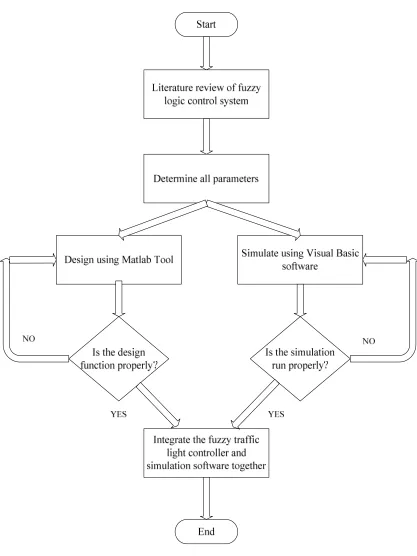
The objective of this project is to design fuzzy logic controller in controlling traffic lights system. This controller is implemented using MATLAB tool. The second objective is to develop simulation software in simulating the traffic lights environment of fuzzy controlled. An isolated Traffic Intersection is simulated using Visual Basic environment. The third objective of this project is to compare the performance between the conventional fixed-time controller and fuzzy traffic lights controller.
1.3 Problem Statement
This project has been proposed to reduce the traffic congestion which is becoming a major problem in many countries. Fuzzy traffic lights controller is an alternative to the conventional traffic lights controller which can be used for a wider array of traffic patterns at an intersection. By using fuzzy traffic lights controller, it can sense the numbers of cars waiting at the traffic not only sense the presence of a car waiting at the junction. Fuzzy traffic lights controller will improve the flow of conventional traffic lights controller.
1.4 Scope Of Work
3
4
[image:17.612.135.552.101.657.2]1.5 Methodology
5
6
CHAPTER 2
LITERATURE REVIEW
2.1 Introduction to Fuzzy Logic
Fuzzy logic is a form of multi-valued logic derived from fuzzy set theory to deal with reasoning that is approximate rather than precise. In contrast with "crisp logic", where binary sets have binary logic, the fuzzy logic variables may have a membership value of not only 0 or 1 that is, the degree of truth of a statement can range between 0 and 1 and is not constrained to the two truth values of classic propositional logic. Furthermore, when linguistic variables are used, these degrees may be managed by specific functions. Fuzzy logic has proved to be particularly useful in expert system and other artificial intelligence applications. It is also used in some spell checkers to suggest a list of probable words to replace a misspelled one.
7
be a excellent choice for many control system applications since it mimics human control logic. It can be built into anything from small, hand-held products to large computerized process control systems. It uses an imprecise but very descriptive language to deal with input data more like a human operator. It is very robust and forgiving of operator and data input and often works when first implemented with little or no tuning.
Although genetic algorithms and neural networks can perform just as well as fuzzy logic in many cases (in fact, certain neural networks can be shown to be mathematically equivalent to certain fuzzy logic systems[1]), fuzzy logic has the advantage that the solution to the problem can be cast in terms that human operators can understand, so that their experience can be used in the design of the controller. This makes it easier to mechanize tasks that are already successfully performed by humans.
Fuzzy logic has some strengths over conventional control algorithms like for example Proportional-Integral-Derivative control. Often biological systems are nonlinear, difficult, or impossible to model mathematically. However, fuzzy logic is empirically-based and model free, thus opens doors for control systems that would normally be deemed unfeasible for automation. Furthermore, fuzzy logic is very robust and does not need precise and noise-free inputs to generate usable outputs. Finally, it can easily be modified and fine tuned during operation. Fuzzy logic can be most readily applied to expert systems whose information is inherently fuzzy. Doctors, lawyers, engineers can diagnose problems a lot quicker if the expert system they use to diagnose the problem lists a few fuzzy solutions that they can use to augment their own findings.
8
Fuzzy logic is a technology that translates natural languages description of design policies in to an algorithm using a mathematical model. This mathematical model implements the flexibility of human logic. This model consists of following three major sections which are fuzzification, fuzzy logic inference using if-then rules and defuzzification.
• Fuzzification: Fuzzification means using the Membership Functions of Linguistic Variables to compute each term’s degree of validity at a specific operation point of the process.
• Fuzzy logic Inference using IF-THEN rules: All numerical values have to be converted into linguistic values. Production rules consist of a condition (IF-part) and a conclusion (THEN-part). The IF-part can consist of more than one precondition linked together by linguistic conjunctions like AND and OR. Each rule is assigned a Degree of Support in the interval [0,1] representing the individual importance of the rule. The validity of a conclusion is calculated by a linking of the validity of the entire condition with the degree of support by a composition operator.
• Defuzzification: Membership functions are used to retranslate the fuzzy output into a crisp value. This retranslating is known as defuzzification. First a typical value is computed for each term in the linguistic variable and finally a best compromise is determined by balancing out the results using different methods like center of maximum(CoM), center of area(CoA) and mean of maximum(MoM).
2.1.1 History of Fuzzy Logic
9
control. If feedback controllers could be programmed to accept noisy, imprecise input, they would be much more effective and perhaps easier to implement.
Anyway, that was the day fuzzy logic the way we know it today was born; with fuzzy logic you can tell an air-conditioner to slow down as soon as it gets chilly. It took a long time until fuzzy logic got accepted even though it fascinated some people right from the beginning. Besides engineers, philosophers, psychologists, and sociologists soon became interested in applying fuzzy logic into their sciences.
In the year 1987, the first subway system was built which worked with a fuzzy logic-based automatic train operation control system in Japan. It was a big success and resulted in a fuzzy boom. Universities as well as industries got interested in developing the new ideas. First, this was mainly the case in Japan. Since the religions in Japan accepted that things can contain parts of their opposites, it wasn't such a frightening idea as in most other parts of the world. And fuzzy logic promised lots of money to the industries, which was of course welcome too.
10
2.1.2 Origin of Fuzzy Concepts
The origin of fuzzy concepts is partly due to the fact that the human brain does not operate like a computer, i.e. it is capable of making all kinds of neural associations according to all kinds of ordering principles (or fairly chaotically) in patterns which are not logical, but nevertheless meaningful. Something can be meaningful although we cannot name it, or we might only be able to name it and nothing else.
In part, fuzzy concepts are also due to the fact that learning or the growth of understanding involves a transition from a vague awareness which cannot orient behaviour greatly, to clearer insight which can orient behaviour. Some logicians argue that fuzzy concepts are a necessary consequence of the reality that any kind of distinction we might like to draw has limits of application. As a certain level of generality, it works fine. But if we pursued its application in a very exact and rigorous manner, or overextend its application, it appears that the distinction simply does not apply in some areas or contexts, or that we cannot fully specify how it should be drawn. An analogy might be that zooming a telescope, camera or microscope in and out reveals that a pattern which is sharply focused at a certain distance disappears at another distance.
11
really possible in practice; at best, we may be able to assume of infer indirectly a certain distribution of quantities.
It also can be argued that fuzzy concepts are generated by a certain sort of lifestyle or way of working which evades definite distinctions makes them impossible or inoperable, or which is in some way chaotic. To obtain concepts which are not fuzzy, it must be possible to test out their application in some way. But in the absence of any relevant clear distinctions, or when everything is "in a state of flux" or in transition, it may not be possible to do so, so that the amount of fuzziness increases.
2.2 Input And Output Membership Functions
The membership function is a graphical representation of the magnitude of participation of each input. It associates a weighting with each of the inputs that are processed, define functional overlap between inputs, and ultimately determines an output response. The rules use the input membership values as weighting factors to determine their influence on the fuzzy output sets of the final output conclusion. Once the functions are inferred, scaled, and combined, they are defuzzified into a crisp output which drives the system.
There are different membership functions associated with each input and output response. The membership function of a fuzzy set is a generalization of the indicator function in classical sets. In fuzzy logic, it represents the degree of truth as an extension of valuation. Degrees of truth are often confused with probabilities, although they are conceptually distinct, because fuzzy truth represents membership in vaguely defined sets, not likelihood of some event or condition.