NUMERICAL SOLUTION OF BERGERS’ EQUATION
IN A ONE-DIMENSIONAL GROUNDWATER
RECHARGE BY SPREADING USING FINITE
DIFFERENCE METHOD
Ravi N. Borana
1, V. H. Pradhan
2, and M. N. Mehta
31
Department of Mathematics,
Bhavan’s Sheth R. A. College of Science, Ahmedabad, (India)
2, 3
Department of Applied Mathematics and Humanities,
S. V. National Institute of Technology, Surat, (India)
ABSTRACT
The ground water is recharged by spreading of the water in downward direction and the moisture content of soil increases. The mathematical formulation of the phenomena leads to the governing equation, which is a non-linear partial differential equation in the form of Burgers’ equation which has been solved by using Crank-Nicolson finite difference scheme with appropriate initial and boundary conditions. The average diffusivity coefficient over the whole range of moisture content is regarded as constant. It is concluded that the moisture content of soil increases with the depth
Z
and increasing timeT
. The numerical solutions of the governing equation have been obtained in the form of tables and graphs by using MATLAB coding. The numerical solution represents moisture content distribution in the vertically downward direction at any depthZ
for time0
T
.
This type of problems appears particularly in soil mechanics, hydrology, ceramic engineering and petroleum technology.Keywords: Moisture Content, Unsaturated Porous Medium, Burgers’ Equation, Finite Difference
Method.
I. INTRODUCTION
The soil plays one of the most important roles in the hydrological cycle. Moisture content is the quantity of
water contained in a material, such as soil (called soil moisture). The saturated zone is one in which the entire
void space is occupied by water. In the unsaturated zone only part of the void space is occupied by water. The
phreatic surface (or water table), is an imaginary surface that bounds the saturated zone from above. It separates
the saturated and unsaturated zones. In the dry soil there is no moisture, so the value of moisture content is 0 in
the unsaturated porous medium and its value is 1, when the porous medium is fully saturated by water. The
range of moisture content is [0, 1].The region of the unsaturated soil is known as Vadose zone (or unsaturated
the water table the void space is practically fully saturated for a certain distance. This region is called the
capillary fringe, or capillary zone. The term moisture content is used in hydrogeology, soil sciences and soil
Mechanics. In saturated ground water aquifers, all available pore spaces are filled with water. Above a capillary
fringe pore spaces have air in them too. If the porous medium is soil, water content is same as the soil moisture.
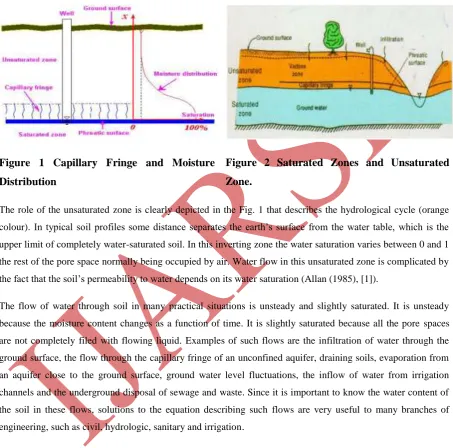
Figure 1 Capillary Fringe and Moisture
Distribution
Figure 2 Saturated Zones and Unsaturated
Zone.
The role of the unsaturated zone is clearly depicted in the Fig. 1 that describes the hydrological cycle (orange
colour). In typical soil profiles some distance separates the earth’s surface from the water table, which is the
upper limit of completely water-saturated soil. In this inverting zone the water saturation varies between 0 and 1
the rest of the pore space normally being occupied by air. Water flow in this unsaturated zone is complicated by
the fact that the soil’s permeability to water depends on its water saturation (Allan (1985), [1]).
The flow of water through soil in many practical situations is unsteady and slightly saturated. It is unsteady
because the moisture content changes as a function of time. It is slightly saturated because all the pore spaces
are not completely filed with flowing liquid. Examples of such flows are the infiltration of water through the
ground surface, the flow through the capillary fringe of an unconfined aquifer, draining soils, evaporation from
an aquifer close to the ground surface, ground water level fluctuations, the inflow of water from irrigation
channels and the underground disposal of sewage and waste. Since it is important to know the water content of
the soil in these flows, solutions to the equation describing such flows are very useful to many branches of
engineering, such as civil, hydrologic, sanitary and irrigation.
The phenomenon of the one dimensional vertical groundwater recharge by spreading is of great importance to
hydrologists, agriculturists and for the people related with water resources sciences. The hydrological situation
of such problem is confirmed by Verma (1973). The water infiltration system, seepage problem and the
underground disposal of wastewater, all harmonize with the flow discussed in the present paper.
This phenomenon has been discussed by many researchers from the different viewpoints. Here are some of the
examples-Klute (1952)[2], has reduced diffusion equation to an ordinary differential equation and
a linear diffusion coefficient. Swartzendruber uses Philip’s (1970) method to get graphical illustration of the
mathematical solution for horizontal water function. Verma (1969)[3], has employed Laplace transformation
technique to solve this problem; Mehta (1975)[4], has obtained an approximate solution considering average
diffusivity coefficient of the whole range of moisture content and treated as small constant by the method of
singular perturbation technique. Allan (1985) had reviewed modification, assumptions and different techniques
used by other researchers. Hari Prasad et al. (2001)[5], had developed a numerical model to simulate water flow
through unsaturated zones and study the effect of unsaturated soil parameters on water movement during
different processes such as gravity drainage and infiltration. They had developed a numerical model to simulate
moisture flow through unsaturated zones using the finite element method. This model is also applied to predict
moisture contents during a field internal drainage test. De varies and Simmers (2002) had discussed processes
and challenges principally on recharge of unconfined aquifers, then the most readily available and affordable
source of water in (semi-unconfined aquifers), (semi-) arid regions. Faybishenko (2004) has given review of the
theoretical concepts, presented results, and provided perspectives on investigations of flow and transport in
unsaturated heterogeneous soils and fractured rock, using the methods of nonlinear dynamics and determine
chaos. Patel and Mehta (2006) [6], have studied ground water recharge by spreading in vertical downward
direction. They constitute governing differential equation as Burgers equation, with permeability as nonlinear
function of moisture content. Mishra and Verma (1973) obtained a similarity solution of a unidimensional
vertical ground water recharges through porous media. Mehta and Saroj (2007) [7], have considered aqueous
conductivity directly proportional to depth, moisture content and inversely proportional to time. They obtained
an approximate solution for the vertical groundwater recharge problem in slightly saturated porous media by
using small parameter method.
The moisture in wet porous media migrates generally due to the following causes: the total pressure gradient,
the moisture content gradient, and the temperature gradient. Under negligible total pressure gradient or in a
medium with poor permeability, the moisture migrations caused by the later two causes are prevailing. Hunt
1978; Piatnitskii 2005; Mikelic 2009; Meher 2010 ([8] and [9]) discussed it from different point of view. In the
present paper the mathematical formulation of the moisture content phenomena yields a non-linear partial
differential equation in the form of Burgers’ equation, its numerical solution has been obtained by using Finite
Difference methods. The diffusivity coefficient is assumed to be constant over a whole range of moisture
content and permeability of the porous media is assumed to be varying directly to the square of the moisture
content (Verma (1972), [10]).
II. STATEMENT OF THE PROBLEM
In the investigated model it is considered that the ground water recharge takes place over a large basin (taken as
a homogeneous porous medium) of such geological configuration that the sides are limited by rigid boundaries
while the bottom is confined by a thick layer of water table. Under these circumstances, water, from the
spreading grounds, will flow vertically downwards through the unsaturated porous medium (negligible amount
of water may spread in other directions; hence, it is ignored comparing to the large size of basin). That is initial
coefficient is equivalent to its average value over the whole range of moisture content; it is small enough
constant and, regarded as a perturbation parameter. Further the permeability of the medium is considered to vary
directly as square of the moisture content. For the present analysis the following assumptions have been made
(Hari Prasad et al. (2001)): The medium is homogenous. There is no air resistance to the flow (i.e. the porous
medium contains only the flowing liquid water and empty voids). The air in the void space is approximately at
atmospheric pressure i.e. air is stationary. The soil properties are taken to be constant. The flowing liquid
(water) is considered continuous at a microscopic level, incompressible and isothermal. The initial moisture
content is uniform throughout the soil profile and the moisture content at the soil surface is constant and near
saturation also rainfall or irrigation rate is constant. Darcy’s law is applicable.
III.
MATHEMATICAL FORMULATION
The motion of water in isotropic, homogenous porous medium is given by Darcy’s law (Bear 1972) as,
V
K
(1)Where,
V
is the volume flux of the moisture content,
K
is the coefficient of aqueous conductivity and
is the gradient of the whole (total) moisture potential.
The motion of water flow through unsaturated porous media is governed by the continuity equation,
s
M
t
(2)Where,
sis the bulk density of medium on dry weight basis,
is the moisture content at any depth
z
on
a dry weight basis and
M
is the mass of flux of moisture at any time
t
0
.
Here, moisture content
PS
(John 1976),where,
P
is the porosity of the medium andS
is the saturation of the water.Using incompressibility of the water, from the equations (1) and (2) it follows that
s
V
K
t
(3)
where,
is the flux density of the medium. Since, in the present problem, flow takes place only in the vertical
direction, therefore equation (3) reduces to:
s
K
Kg
t
z
z
z
(4)Where, ‘
’
is the pressure (capillary) potential,g
is the gravitation constant, and
zg
the positiveConsidering
and
to be connected by a single valued function, equation (4) [11], may be written as
s
K
D
g
t
z
z
z
(5)where,
s s
D
K
K
and is called the diffusivity coefficient. Replacing
D
by its average value
‘
D
a’
over the whole range of the moisture content (Mehta 1977) andK
2 (Mehta 2006)i.e.
K
K
0
2,
where ‘K
0’ is constant. Hence, equation (5) becomes
2
0 2
2
as
gK
D
t
z
z
(6)Substituting
2
0 1s
gK
K
, equation (6) becomes2
1 a 2
K
D
t
z
z
(7)For the sake of simplicity of the problem, the value of the constant
K
1
1
is considered.
IV. CRANK-NICOLSON SCHEME FOR THE GOVERNING EQUATION
To obtain the numerical solution of the equation (7), choose new variables
Z
z
L
&
1
t
T
and
0
z
L
, hence,0
Z
1.
And also
0
T
1
Hence, the equation (7) can be written as
2
2
; 0
1
a
D
Z
T
Z
Z
(8)The expression (8) is the governing non-linear partial differential equation known as Burgers’ equation for the
moisture content distribution phenomenon. The term
D
ais an average diffusivity coefficient over the whole
range of the moisture content. Consider
0 as the initial moisture content. Since, the moisture content of thesoil increases as the depth Z increases (Ramakant (2010) [8]); considered the initial moisture content as
0
1
, 0
Z; 0
1
Z
Z
Ze
Z
(9)Also the moisture content at the top (i.e. depth Z = 0), in the unsaturated porous media is very small and at the
bottom the moisture content of soil will be fully saturated. So, it is suitable to choose the boundary conditions as
00,
0.01
1,
1
0
1
T
T
T
(10)The Crank-Nicolson finite difference scheme to the governing equation (8) with the appropriate conditions of
the expression (9) and expression (10) has been employed as under ([13], [14]).
Introducing, the stability ratio
2T
r
Z
, we have, for
i
1
,
1 1, 1 1 2, 1 1 1,
1, 1, 1,
2 2 2
1 2, 1
1, 1,
2 2
1 1, 1, 2, 1, 1, 2
2
1
1
2
1
3
3
2
2
2
1
0.02 2
... 11
2
with
0.02
2
4
n n n
n n n
n
n n
n n n n
n
a a a
a a
D
Z
D
Z
D
Z
r
r
D
Z
D
Z
r
Z
D
a
2,n
3
1,n
0.02
For
2
i
R
1
,
1 1, 1 , 1 1 1, 1
, ,
2 2
1 1, , 1 1,
, ,
2 2
1 , , 1,
, 2
1
1
1
2
2
2
1
1
1
2
... 12
2
2
with
.
4
i n a i n i n
i n i n
i n a i n i n
i n i n
i n i n i n
i n
a a
a a
D
Z
D
D
Z
r
D
Z
D
D
Z
r
r
i1,n
Z
2
D
a
i1,n
2
i n,
i1,n
For
i
R
,
1 1, 1 1 , 1 1 1,
, , ,
2 2 2
1 , 1
, ,
2 2
1 , , , 1,
, 2
1
2
1
1
3
2
2
2
2
1
1
3
4
... 13
2
2
with
.
2
2
4
R n R n R n
R n R n R n
R n
R n R n
R n R n R n R n
R n
a a a
a a
a
D
Z
D
Z
D
Z
r
D
Z
D
Z
r
r
Z
D
R1,n
3
R n,
2
The expressions (11), (12) and (13) represent the Crank-Nicolson finite difference scheme about the point
, 1
2
,
i i n
the whole range of the moisture content has been considered as a constant value 1. The solution of the
expression (8) in form of tables and graphs is obtained using MATLAB coding.
V. NUMERICAL AND GRAPHICAL REPRESENTATION OF THE SOLUTION
0 0.1 0.2 0.3 0.4 0.5 0.6 0.7 0.8 0.9 1 0
0.1 0.2 0.3 0.4 0.5 0.6 0.7 0.8 0.9 1
dZ=0.025 , dT=0.0003 r = 0.48
The values of Z
M
o
is
tu
re
C
o
n
te
n
t
T
h
e
ta
(Z
,
T
)
T= 0.06 T= 0.12 T= 0.18 T= 0.24 T= 0.30
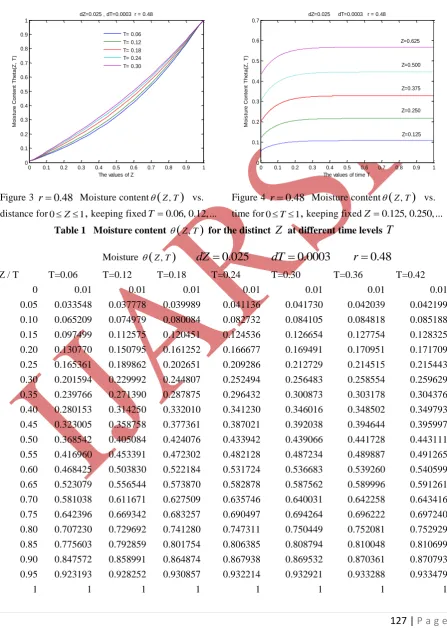
Figure 3
r
0.48
Moisture content
Z T,
vs. distance for 0 Z 1, keeping fixed
T0.06, 0.12,...0 0.1 0.2 0.3 0.4 0.5 0.6 0.7 0.8 0.9 1 0
0.1 0.2 0.3 0.4 0.5 0.6 0.7
The values of time T
M
o
is
tu
re
C
o
n
te
n
t
T
h
e
ta
(Z
,
T
)
dZ=0.025 dT=0.0003 r = 0.48
Z=0.625
Z=0.500
Z=0.375
Z=0.250
Z=0.125
Figure 4
r
0.48
Moisture content
Z T,
vs. time for 0 T 1, keeping fixed
Z0.125, 0.250,...Table 1 Moisture content
Z T,
for the distinctZ
at different time levelsT
Moisture
Z T,
dZ
0.025
dT
0.0003
r
0.48
Z / T T=0.06 T=0.12 T=0.18 T=0.24 T=0.30 T=0.36 T=0.42
0 0.01 0.01 0.01 0.01 0.01 0.01 0.01
0.05 0.033548 0.037778 0.039989 0.041136 0.041730 0.042039 0.042199
0.10 0.065209 0.074979 0.080084 0.082732 0.084105 0.084818 0.085188
0.15 0.097499 0.112575 0.120451 0.124536 0.126654 0.127754 0.128325
0.20 0.130770 0.150795 0.161252 0.166677 0.169491 0.170951 0.171709
0.25 0.165361 0.189862 0.202651 0.209286 0.212729 0.214515 0.215443
0.30 0.201594 0.229992 0.244807 0.252494 0.256483 0.258554 0.259629
0.35 0.239766 0.271390 0.287875 0.296432 0.300873 0.303178 0.304376
0.40 0.280153 0.314250 0.332010 0.341230 0.346016 0.348502 0.349793
0.45 0.323005 0.358758 0.377361 0.387021 0.392038 0.394644 0.395997
0.50 0.368542 0.405084 0.424076 0.433942 0.439066 0.441728 0.443111
0.55 0.416960 0.453391 0.472302 0.482128 0.487234 0.489887 0.491265
0.60 0.468425 0.503830 0.522184 0.531724 0.536683 0.539260 0.540599
0.65 0.523079 0.556544 0.573870 0.582878 0.587562 0.589996 0.591261
0.70 0.581038 0.611671 0.627509 0.635746 0.640031 0.642258 0.643416
0.75 0.642396 0.669342 0.683257 0.690497 0.694264 0.696222 0.697240
0.80 0.707230 0.729692 0.741280 0.747311 0.750449 0.752081 0.752929
0.85 0.775603 0.792859 0.801754 0.806385 0.808794 0.810048 0.810699
0.90 0.847572 0.858991 0.864874 0.867938 0.869532 0.870361 0.870793
0.95 0.923193 0.928252 0.930857 0.932214 0.932921 0.933288 0.933479
0 0.1 0.2 0.3 0.4 0.5 0.6 0.7 0.8 0.9 1 0
0.1 0.2 0.3 0.4 0.5 0.6 0.7 0.8 0.9 1
dZ=0.025 dT=0.0005 r = .8
The values of Z
M
o
is
tu
re
C
o
n
te
n
t
T
h
e
ta
(Z
,
T
)
T=0.05 T=0.10 T=0.20 T=0.30 T=0.40
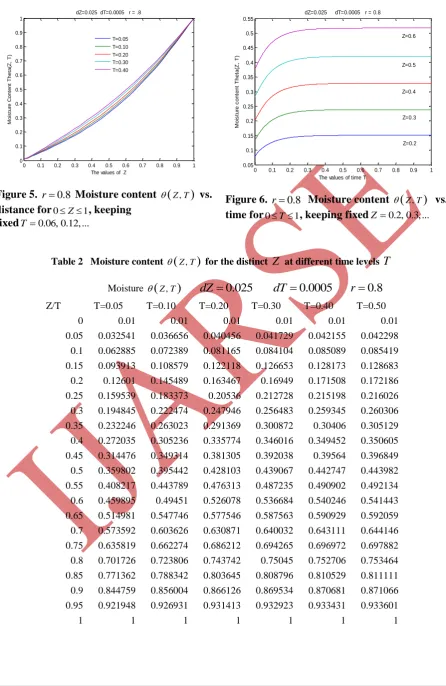
Figure 5.
r
0.8
Moisture content
Z T,
vs.
distance for
0 Z 1, keeping
fixed
T 0.06, 0.12,...0 0.1 0.2 0.3 0.4 0.5 0.6 0.7 0.8 0.9 1 0.05
0.1 0.15 0.2 0.25 0.3 0.35 0.4 0.45 0.5 0.55
dZ=0.025 dT=0.0005 r = 0.8
The values of time T
M
o
is
tu
re
c
o
n
te
n
t
T
h
e
ta
(Z
,
T
)
Z=0.6
Z=0.4
Z=0.3 Z=0.5
Z=0.2
Figure 6.
r
0.8
Moisture content
Z T,
vs.
time for
0 T 1, keeping fixed
Z0.2, 0.3,...Table 2 Moisture content
Z T,
for the distinctZ
at different time levelsT
Moisture
Z T,
dZ
0.025
dT
0.0005
r
0.8
Z/T T=0.05 T=0.10 T=0.20 T=0.30 T=0.40 T=0.50
0 0.01 0.01 0.01 0.01 0.01 0.01
0.05 0.032541 0.036656 0.040456 0.041729 0.042155 0.042298
0.1 0.062885 0.072389 0.081165 0.084104 0.085089 0.085419
0.15 0.093913 0.108579 0.122118 0.126653 0.128173 0.128683
0.2 0.12601 0.145489 0.163467 0.16949 0.171508 0.172186
0.25 0.159539 0.183373 0.20536 0.212728 0.215198 0.216026
0.3 0.194845 0.222474 0.247946 0.256483 0.259345 0.260306
0.35 0.232246 0.263023 0.291369 0.300872 0.30406 0.305129
0.4 0.272035 0.305236 0.335774 0.346016 0.349452 0.350605
0.45 0.314476 0.349314 0.381305 0.392038 0.39564 0.396849
0.5 0.359802 0.395442 0.428103 0.439067 0.442747 0.443982
0.55 0.408217 0.443789 0.476313 0.487235 0.490902 0.492134
0.6 0.459895 0.49451 0.526078 0.536684 0.540246 0.541443
0.65 0.514981 0.547746 0.577546 0.587563 0.590929 0.592059
0.7 0.573592 0.603626 0.630871 0.640032 0.643111 0.644146
0.75 0.635819 0.662274 0.686212 0.694265 0.696972 0.697882
0.8 0.701726 0.723806 0.743742 0.75045 0.752706 0.753464
0.85 0.771362 0.788342 0.803645 0.808796 0.810529 0.811111
0.9 0.844759 0.856004 0.866126 0.869534 0.870681 0.871066
0.95 0.921948 0.926931 0.931413 0.932923 0.933431 0.933601
0 0.1 0.2 0.3 0.4 0.5 0.6 0.7 0.8 0.9 1 0
0.1 0.2 0.3 0.4 0.5 0.6 0.7 0.8 0.9 1
dZ=0.025 dT=0.001 r = 1.6
The values of Z
M
o
is
tu
re
C
o
n
te
n
t
T
h
e
ta
(Z
,
T
)
T=0.05 T=0.10 T=0.15 T=0.20 T=0.25
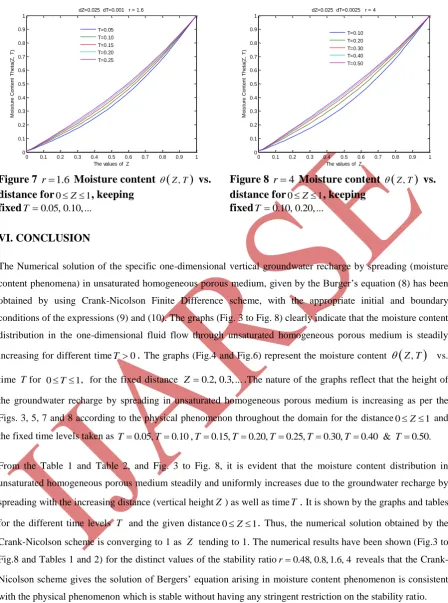
Figure 7
r
1.6
Moisture content
Z T,
vs.
distance for
0 Z 1, keeping
fixed
T0.05, 0.10,...0 0.1 0.2 0.3 0.4 0.5 0.6 0.7 0.8 0.9 1 0
0.1 0.2 0.3 0.4 0.5 0.6 0.7 0.8 0.9 1
dZ=0.025 dT=0.0025 r = 4
The values of Z
M
o
is
tu
re
C
o
n
te
n
t
T
h
e
ta
(Z
,
T
)
T=0.10 T=0.20 T=0.30 T=0.40 T=0.50
Figure 8
r
4
Moisture content
Z T,
vs.
distance for
0 Z 1, keeping
fixed
T0.10, 0.20,...VI. CONCLUSION
The Numerical solution of the specific one-dimensional vertical groundwater recharge by spreading (moisture
content phenomena) in unsaturated homogeneous porous medium, given by the Burger’s equation (8) has been
obtained by using Crank-Nicolson Finite Difference scheme, with the appropriate initial and boundary
conditions of the expressions (9) and (10). The graphs (Fig. 3 to Fig. 8) clearly indicate that the moisture content
distribution in the one-dimensional fluid flow through unsaturated homogeneous porous medium is steadily
increasing for different timeT0
. The graphs (Fig.4 and Fig.6) represent the moisture content
Z T,
vs. time Tfor 0 T 1, for the fixed distance Z 0.2, 0.3,....The nature of the graphs reflect that the height of
the groundwater recharge by spreading in unsaturated homogeneous porous medium is increasing as per theFigs. 3, 5, 7 and 8 according to the physical phenomenon throughout the domain for the distance 0 Z 1 and the fixed time levels taken as T0.05,T0.10 ,T0.15,T0.20,T0.25,T0.30,T0.40 & T0.50.
From the Table 1 and Table 2, and Fig. 3 to Fig. 8, it is evident that the moisture content distribution in
unsaturated homogeneous porous medium steadily and uniformly increases due to the groundwater recharge by
spreading with the increasing distance (vertical heightZ ) as well as timeT
. It is shown by the graphs and tables
for the different time levels T
and the given distance 0
Z 1.
Thus, the numerical solution obtained by the Crank-Nicolson scheme is converging to 1 as Z tending to 1. The numerical results have been shown (Fig.3 toFig.8 and Tables 1 and 2) for the distinct values of the stability ratior0.48, 0.8, 1.6, 4 reveals that the Crank-Nicolson scheme gives the solution of Bergers’ equation arising in moisture content phenomenon is consistent
ACKNOWLEDGEMENT
I am full of gratitude and gratefulness towards my mother institute Bhartiya Vidhya Bhavan, Ahmedabad
Kendra, for giving me an opportunity to begin research work. This work would have been completely
impossible without the constant motivation, support and encouragement of my former Principal C. B. Gemawat.
REFERENCES
[1] M. B. Allen, Numerical modelling of multiphase flow in porous media. Adv. Water Resources, Volume 8, December,
1985, 162-187.
[2] A. A. Klute, A numerical method for solving the flow equation for water in unsaturated materials. Soil Science, 1952,
73-105.
[3] A. P. Verma, The Laplace transform solution of one dimensional groundwater recharge by spreading. Annalidi Geofisica
XXII-1, 1969, 25-31.
[4] M. N. Mehta, A singular perturbation solution of one-dimensional flow in unsaturated porous media with small diffusivity
coefficient, Proc. 1975, FMFP E1 to E4.
[5] K. S. Hari Prasad, M. S. Mohan and M. Shekhar, Modelling Flow Through Unsaturated Zone: Sensitivity to Unsaturated
Soil Properties. Sadhana, Indian Academy of Sciences, 26(6), 2001, 517-528.
[6] M. N. Mehta and Patel T, A solution of Burgers’ equation type one-dimensional Groundwater Recharge by spreading in
Porous Media. The Journal of the Indian Academy of Mathematics, 28(1), 2006, 25-32.
[7] M. N. Mehta and S. R. Yadav, Solution of Problem arising during vertical groundwater recharge by spreading in slightly
saturated Porous Media, Journal of Ultra Scientists of Physical Sciences. Vol.19(3), 2007, 541-546.
[8] R. Meher, M. N. Mehta and S. K. Meher, Adomian decomposition method for moisture content in one-dimensional fluid
flow through unsaturated porous media. International Journal of Applied Mathematics and Mechanics. 6(7), 2010, 13-23.
[9] M. S. Joshi, N. B. Desai and M. N. Mehta, One-dimensional and Unsaturated Fluid flow through Porous Media.
International Journal of Applied Mathematics and Mechanics. 6(18), 2010, 66-79.
[10] A. P. Verma, A mathematical solution of one-dimensional groundwater recharge for a very deep water table. Proc. 16th
ISTAM, 1972.
[11] J. Bear, Dynamics of Fluids in Porous Media, 1972,.American Elsevier Publishing Company, Inc.
[12] P. Ya Polubarinova-Kochina, Theory of Groundwater Movement. Princeton University Press, 1962,499-500.
[13] D. U. Von Rosenberg, Methods for the Numerical Solution of Partial Differential Equations, 1969, American Elsevier
Publishing Company, Inc., New York.
[14] G. D. Smith, Numerical Solution of Partial Differential Equations Finite Difference Methods, 3rd ed., 1965, Oxford