The work reported in this article formed part of the Wireless Access area of the Core Research Pro-gram of the Virtual Centre of Excellence in Mobile & Personal Communica-tions, Mobile VCE, www.mobilevce.com, whose funding support, including that of EPSRC, is gratefully acknowl-edged. Fully detailed tech-nical reports on this research are available to Industrial Member Com-panies of Mobile VCE.
1In addition to the Wire-less Access research stream, two other research streams were established which undertook research in Software Based Sys-tems and Networks & Ser-vices for future mobile systems. The work described herein com-prised Mobile VCE’s Core 2 program, undertaken in the period 20002004.
I
NTRODUCTION
The structure of this article reflects the objec-tives of the Movile VCE Wireless Access research program to identify and extend practi-cable B3G techniques that would result in imple-mentable transceivers. In the first article, Part I, issues related to multiple-input multiple-output (MIMO) channel modeling and methods to exploit the MIMO nature of the communication system were reported. In Part II the focus was more on the exploitation of traditional and dis-tributed MIMO transceivers and their perfor-mance characterization.
Following on from the first two articles, the performance and complexity reduction of
vari-ous B3G code-division multiple access (CDMA)-based transceiver structures in a multi-user envi-ronment is the focus of this article. We introduce novel space-time trellis codes suitable for B3G systems. We introduce novel receiver strategies that drastically decrease the complexity in single-input single-output (SISO) multi-user systems. This analysis is complemented in a later section, which deals with multicarrier (MC)-CDMA schemes for B3G wireless systems. The CDMA-based multi-user analysis is then extended to generic MIMO systems; again, complexity reduc-tion facilitating implementareduc-tion has been a major concern. Finally, low-complexity iterative receivers for MIMO CDMA systems are pre-sented.
D
ESIGN OF
N
OVEL
S
PACE
-T
IME
T
RELLIS
C
ODES
INTRODUCTION
The use of multiple antennas (space diversity) is a well-known concept to combat the effect of multipath fading over wireless channels. This can be found in one form or another in present com-munication systems, and traditionally has formed part of the receiver side of the system (receive diversity). When applying this to present day small receiver systems, such as mobile handsets, several parameters must be considered, such as size, complexity, and signal correlation. Howev-er, this results in the limited use of multiple receiving antennas and motivates the need to move complexity to the base station: this is achieved by introducing several transmit anten-nas (transmit diversity). Additionally, error cor-recting codes can be employed, giving rise to the concept of space-time coding (STC). STC can be found in several forms, such as space-time block coding (STBC), space-time trellis coded modula-tion (STTCM), and layered space-time architec-ture (LST) [1–3].
A
BSTRACT
This article presents a comprehensive overview of some of the research conducted within Mobile VCE’s Core Wireless Access Research Programme,1a key focus of which has
naturally been on MIMO transceivers. The series of articles offers a coherent view of how the work was structured and comprises a compila-tion of material that has been presented in detail elsewhere (see references within the article). In this article MIMO channel measurements, analy-sis, and modeling, which were presented previ-ously in the first article in this series of four, are utilized to develop compact and distributed antenna arrays. Parallel activities led to research into low-complexity MIMO single-user space-time coding techniques, as well as SISO and MIMO multi-user CDMA-based transceivers for B3G systems. As well as feeding into the indus-try’s in-house research program, significant extensions of this work are now in hand, within Mobile VCE’s own core activity, aiming toward securing major improvements in delivery effi-ciency in future wireless systems through cross-layer operation.
TOPICS IN
RADIO
COMMUNICATIONS
Mischa Dohler, France Telecom R&D
Stephen McLaughlin, University of Edinburgh
Peter Sweeney, University of Surrey
Lajos Hanzo, University of Southampton
As part of the work undertaken, the design, performance, and application of STTCM is con-sidered as a means for achieving high-data-rate transmissions over wireless fading channels with no penalty in bandwidth efficiency. The design of STTCM jointly incorporates trellis-based channel coding, modulation, transmit diversity, and, optionally, receive diversity. The major con-tribution of the work is summarized in subse-quent sections.
FAST
SEARCH
TECHNIQUES FOR
STTCM OVER
RAYLEIGH
FADING
CHANNELS
A fast search technique was developed to obtain novel space-time trellis codes that are construct-ed for up to six transmit antennas, modulation of up to 32-quadrature amplitude modulation (QAM), and trellis coding with up to 64 states. The codes for slow fading channels are obtained according to the rank and determinantcriteria [1], when the diversity order of the system (i.e., the product of the rank and the number of receiving antennas) is less than 4. Alternatively, the codes are obtained by satisfying the rank and tracecriteria. These novel techniques reduce the overall code search by up to twice the factorial of the number of transmit antennas under con-sideration. In turn, this enables the search for STTCM for 4-phase shift keying (PSK )codes; with 4, 8, 16, 32, and 64 states for up to 6 trans-mit antennas in an allowable timeframe [4]. Also, STTCM are obtained for 8-PSK, 16-QAM, and 32-QAM for up to 4 transmit antennas [5]. The performance of these new codes is evaluat-ed by means of Monte Carlo simulation giving the result as a function of signal-to-noise ratio (SNR) against frame error rate (FER). Results showed improvements with increasing number of transmit antennas and transitional states of the STTCM.
ERROR
ANALYSIS OF
STTCM:
CONCATENATION
REQUIREMENT
The characteristics and error analysis of STTCM were studied. This enabled a better understand-ing of concatenatunderstand-ing space-time trellis codes (STTCs) with other channel coding schemes [6]. Analyses of STTCM concatenated with outer channel codes, such as convolutional codes and Bose-Chaudhuri-Hocquenghem (BCH) codes, were performed, and the optimal combination of inner and outer codes was investigated. The per-formance results were further enhanced by use of a random interleaver and a recursive STTC as the inner code. The results demonstrate gains of up to 4 dB for a 4-PSK, 2-antenna, 4-state code at an FER of 10–2(frame length 130 4-PSK
sym-bols), but this comes at the expense of reduced spectral efficiency.
PUNCTURED
STTCM FOR
SPECTRALLY
EFFICIENT
TRANSMISSIONS
The concatenations considered achieve consider-able gains, but these are produced at the expense of reduced spectral efficiency. This reduction, in turn, is compensated by constructing punctured STTCM. A search is performed over the
appro-priate puncturing pattern, which provides the best design criteria parameters. The puncturing reduces the overall rank of the matrix, and there-by leads to reduced performance over MIMO channels. However, concatenation with outer codes compensates for this loss. Results are obtained for punctured STTCM for a 2-antenna case with 4, 8, 16 and 32 states. For a punctured STTCM with rate 5/4 and concatenated with a half-rate convolutional encoder, the results show a loss of 1 dB at FER of 10–2(frame length 130
PSK symbols) compared to a non-punctured 4-PSK, two-antenna, four-state STTCM concate-nated scenario. A gain of 1.5 dB is maintained in comparison to a non-concatenated non-punc-tured four-state scenario.
STTCM FOR
VIRTUAL
ANTENNA
ARRAYS
The obtained STTCs are applied to a virtual antenna array (VAA) scheme introduced in Part II of this series of articles, which involves a mutually cooperating group of mobile users. With codes obtained for up to six transmit anten-nas, ST trellis ccoded VAA schemes with, say, two transmit and four relaying terminals can be realized. Results show substantial coding advan-tages over a non-coded VAA scheme. For instance, a scheme with three transmitters and two cooperating mobiles employing STTCM of eight states can achieve a 10 dB gain at a FER of 10–2(frame length 130 4-PSK symbols) over anon-coded scheme.
L
OW
-C
OMPLEXITY
SISO CDMA
M
ULTI
-U
SER
R
ECEIVERS
INTRODUCTION
Many multi-user detectors (MUDs) for CDMA systems have been the subject of intense investi-gation over the years. The majority of such receivers can be classified into four main cate-gories. The first category includes linear filter-based receivers, the most common examples of which are the matched filter (MF), decorrelator (DECOR), and minimum mean square error (MMSE) detectors. The second category is the cancellation type, for example, the successive and parallel cancellation receivers, SIC and PIC, respectively. Tree-search-based MUDs, such as the optimum maximum likelihood (ML), Viterbi algorithm (VA), and MT algorithm, among many others constitute the third category. Final-ly, there also exists the hybrid category of receivers, which includes the MMSE-PIC, DECOR-SIC, and DECOR-PIC. While the MF receiver is the simplest of all, it is also consid-ered the optimum receiver when the received signal is composed of orthogonal spreading codes with modulated symbols. Orthogonality of the spreading codes is often difficult, if not impossible, to preserve due to the presence of common channel impairments such as multipath, Doppler dispersion, and asynchronous transmis-sion. This leads to the undesirable creation of multiple access interference (MAI). While in the case of the MF receiver no attempt is made to remove the MAI effect (i.e., MAI is treated as additive noise), the rest of the above mentioned MUDs each use a unique strategy to try to
elimi-The performance of these new codes is evaluated by means of Monte Carlo simulation giving the
result as a function of signal-to-noise ratio against frame
error rate. Results showed improvements with increasing number of
nate most/some of the MAI; therefore, they have better bit error rate (BER) performance than the MF receiver. The DECOR receiver requires an estimate of the cross-correlation matrix of the received data signal to eliminate the MAI, but suffers from noise enhancement associated with the zero-forcing criterion it uses. The MMSE receiver, on the other hand, requires knowledge of the cross-correlation matrix of the data as well as that of the noise to eliminate the MAI, and hence has a better performance than the DECOR at low SNR values. In cancellation and hybrid MUDs, the MAI is estimated and subtracted from the wanted signal in an iterative fashion. The performance of these detectors depends on the reliability of their initial esti-mates and the order in which users are can-celled; they are especially efficient when there is a significant imbalance in the powers of the received users. In tree-search-based MUDs the received signal is decoded by comparing it to a set of possible transmitted bit combinations (in the MLMUD all possible combinations are test-ed) and choosing the closest match as the most likely transmitted combination. In general, all suboptimum receivers require considerably less computational complexity than the optimum MLMUD, but this is at the expense of some BER performance degradation that becomes more pronounced in proportion to the percent-age load. A good introduction to these families of receivers can be found in [6] along with a brief review of the advantages and disadvantages of these receivers.
COMBINED
FEC-MUD RECEIVER
Recent research in multi-user detection has shown that significant performance improvement can be gained from combining the multi-user detection process with the forward error correc-tion (FEC) stage at the receiver. Giallorenzi andWilson [7] have shown that the optimal decoding scheme for an asynchronous convolutionally coded CDMA system combines the trellis of both the asynchronous MUD and the convolu-tional code. This, however, resulted in a highly complex receiver with a minimum complexity of 2Uv, where Uis the number of users and vis the
constraint length of the FEC code. Subsequent papers from various authors reported that it is possible to achieve single-user performance even for a highly loaded multi-user system. A theoret-ical analysis showed that a combination of FEC coding and random interleavers overcame the limitations of a multi-user receiver in a highly loaded system. Suboptimal turbo-based iterative combined FEC interference cancellation receivers were subsequently proposed. Such a receiver was shown to provide significantly bet-ter performance than the traditional non-ibet-tera- non-itera-tive structure and nearly completely overcome the channel-associated problems of MAI and intersymbol interference (ISI).
Part of the work conducted was to design a low-complexity iterative MUD that has low com-plexity but can also provide system performance very similar to that achieved when using the optimal maximum likelihood based iterative receiver. The proposed receiver uses adaptive preselection in order to minimize complexity without degrading the system performance.
THE
PRESELECTION
ITERATIVE
RECEIVER
The proposed receiver, inspired by Berrou’s turbo principle, combines iterative detection with selective partial soft cancellation in order to minimize the MAI and improve the probability of correct detection. After initial estimates of the individual components of the received signal have been established by the matched filters (MFs), these estimates are passed on to the pre-selection control unit in the form of log likeli-hood ratios (LLRs).Depending on the selected mode of the receiver and the magnitude of the received LLRs, the preselection control unit passes on to the cancellation stage soft estimates of the most likely symbols to be correctly detected. These soft estimates represent the symbols whose esti-mated LLRs have a magnitude larger than a specified threshold and are calculated using the relationship of the possible symbol values to their corresponding LLRs.
SELECTED
RESULTS
This type of receiver can be operated in three modes. One mode hard limits the maximum number of symbols that can be detected by the sub-tree-search unit. This is referred to as prese-lection with fixed tree-search (PSF). The second mode is called preselection with capped tree-search (PSC) in which there is a limit on the maximum number of symbols that can be detect-ed by the tree-search. Finally, there is the uncapped preselection mode (PS-UC) where there is no limit on the maximum number of symbols to be estimated by the tree-search unit. The main difference between these modes is that the instantaneous complexity of the PSF mode is fixed, while that of the other two modes, capped or uncapped, is variable.
■Figure 1.BER performance vs. number of users at Eb/N0= 8 dB, number of
outer iterations =4.
Number of users 2
10-4
Average BER
10-3
10-2
10-1
4 6 8 10 12
MC-CDMA S
CHEMES FOR
N
EXT
-G
ENERATION
W
IRELESS
S
YSTEMS
INTRODUCTION
In the context of CDMA communication, there are two fundamental types of spread-spectrum schemes. The first scheme spreads the original data stream in the time (T) domain [8], while the second in the frequency (F) domain, result-ing in the scheme known as F-domain spread MC-CDMA. As a further advance, in [8] an attractive amalgam of the above T-domain, F-domain, and even spatial (S)-domain spreading schemes mapping the signal to be transmitted to several transmit antennas has been developed. Explicitly, the original data stream is spread in the T-domain, the F-domain, as well as possibly the S-domain, for the sake of achieving the high-est possible diversity order. Hence, each user may be assigned three spreading sequences for this operation, a T-domain, an F-domain, and an S-domain sequence. This system exhibits high flexibility, since variable spreading factors may be used in that particular domain, where the highest diversity order may be achieved. This measure also results in reduced MUD complexi-ty, since when requiring a total spreading factor (SF) of 512, an SF of 8 is sufficient in each of the three domains.
TIME- AND
FREQUENCY-DOMAIN
SPREADING
ASSISTED
MC DS-CDMA USING
INTERFERENCE
REJECTION
SPREADING
CODES
FORQUASI-SYNCHRONOUS
COMMUNICATIONS
The team at Southampton University also con-sidered the employment of various novel fami-lies of spreading codes as the T-domain spreading code, which are known as generalized orthogonal codes [8]. These codes exhibit a so-called interference free window (IFW). Over the duration of the IFW both the cross-correlation and auto-correlation of the spreading codes is zero. The benefit of employing these specific codes as the T-domain code is that we are capa-ble of achieving near-single-user performance without a T-domain MUD, since the MUI com-ponents arriving within this IFW do not contam-inate the desired signal at all. Even if a T-domain MUD is invoked, its complexity is reduced, because only a small fraction of the total number of users has to be separated and detected by the MUD in the F-domain, just those, which belong to a given MUD group described the common T-domain code. By contrast, again, the set of users, who are differentiated with the aid of unique user-specific T-domain spreading codes, having an IFW do not interfere with each other, as a benefit of the IFW provided by the T-domain codes used. Another advantage of the proposed scheme is that we can significantly extend the width of the IFW in comparison to a single-carrier DS-CDMA system, because as a benefit of distributing the bits to several subcar-riers, MC DS-CDMA has the potential to signif-icantly reduce the chip rate, thereby extending the duration Tcof the chips. This also allows usto extend the width of the IFW, which renders the system more insensitive to timing
imperfec-tions, since larger timing errors can be accumu-lated without imposing interference.
GENETIC
ALGORITHM
ASSISTED
MULTI-USER
DETECTION FOR
ASYNCHRONOUS
MULTICARRIER
CDMA
Numerous MUD schemes have been proposed in the literature. For example, the MMSE MUD and its numerous variants have been described in [8], along with various interference cancella-tion (IC) schemes. In [9] the ML MUD designed for MC-CDMA was considered. In this specific MUD the receiver constructs all the possible combinations of the transmitted signal and employs the estimated channel transfer function for generating all possible received signals in order to find the one that has the smallest Euclidean distance from the received signal. Hence, the ML-detection-based MUD designed for MC-CDMA is capable of achieving the opti-mum performance. However, it requires the cal-culation of 2K possible received signal combinations in conjunction with binary PSK (BPSK) modulation. In other words, the ML-detection-based MUD’s complexity will increase exponentially with the number of users K. Hence, the complexity imposed will become excessive when the number of users Kis high.
Therefore, genetic algorithms (GAs) were invoked [8, 10, 11] to reduce the complexity of the ML-detection-based MUD employed in MC-CDMA systems. The GA-based MUD was first proposed by Juntti et al.[10] for a synchronous DS-CDMA system communicating over an addi-tive white Gaussian noise (AWGN) channel. Yen and Hanzo [11] further improved the per-formance of the GA-based MUD, demonstrating that its performance approaches the single-user performance bound at significantly lower com-putational complexity than that of Verdu’s opti-mum MUD. Furthermore, the team at Southampton University also proposed GA assisted MUD schemes as a suboptimal MUD technique applicable to asynchronous MC-CDMA systems communicating over broadband frequency-selective fading channels. We assumed that each subcarrier obeys independent Rayleigh fading. The performance of this specific
GA-■Table 1.Complexity vs. number of users at Eb/N0= 8 dB, number of outer
iterations =4.
Number of users
Log2(Number of operations)
ML PSF PSC-0 PSC-1 PSC-2 PS-UC
2 4 4 3.29 3.53 3.53 3.53
4 6 5 3.62 3.74 4.09 4.09
6 8 6 4.03 4.12 4.22 4.73
8 10 7 4.57 4.57 4.67 5.42
10 12 8 5.34 5.27 5.26 6.24
assisted MUD was investigated as a function of the affordable detection complexity.
CODED
MODULATION
ASSISTED
ITERATIVE
PARALLEL
INTERFERENCE
CANCELLATION
AIDED
CDMA
Following the philosophy of iterative turbo detection [8, 12], in recent years iterative MUD has captured growing interest in the wireless communications community. In [13] an iterative decoding scheme designed for synchronous CDMA systems has been characterized. The algorithm proposed in [18] has a computational complexity proportional to the order of O(2Kv),
where Kis the number of users supported, and v
is the channel codec’s memory length. These iterative MUDs, designed and characterized in [13], exhibit near single-user performance. How-ever, its excessive complexity renders real-time implementations unrealistic, except when the number of users supported is low.
In [8] several sophisticated channel coded schemes were proposed for reducing the imple-mentational complexity imposed. In this set of schemes interference cancellation (IC)-based iterative MUD exhibits the lowest complexity, rendering the complexity proportional to the order of O(K⋅2v).
In [14] an IC-based iterative MU was devel-oped that exhibits acceptable implementational complexity. These schemes invoked a novel sym-bol probability-based iterative MUD-assisted receiver for employment in a trellis coded lation (TCM) [20] and turbo trellis coded modu-lation (TTCM) [15] aided system. Symbol-based maximum a posteriori(MAP) algorithms [20] were employed for both the TCM and TTCM decoders, which are capable of feeding back the symbol probabilities to the soft symbol estima-tion and IC stages. More specifically, this algo-rithm relied on utilizing the probabilities of the channel-coded information symbols for symbol estimation, rather than employing the individual APP of the coded TCM/TTCM bits. A turbo MUD was analyzed in detail from a unified the-oretical perspective in the excellent treatise of Boutros and Caire in 2002 under the assumption of using random spreading.
I
TERATIVE
R
ECEIVERS FOR
MIMO CDMA S
YSTEMS
INTRODUCTION
It is vital to make the best possible use of the limited radio spectrum in order to maximize the number of users and data rate available to each user. Recently, iterative processing has attracted vast attention due to its successful application in many areas of coding and signal processing, such as turbo coding and iterative detection for wide-band CDMA (WCDMA) systems. Additionally, space-time coding techniques have been shown to provide significant improvement in spectral efficiency over fading wireless channels, by exploiting transmit and receive diversity. STTCs in particular have been extensively studied for the case of flat fading MIMO channels, and vari-ous code design criteria have been developed in order to achieve the highest possible antenna diversity and coding gain.
However, the presence of multiple antennas at the transmitter, along with multipath and mul-tiple users, inevitably introduces not only ISI and MAI, but also intra-antenna interference (IAI) among the transmit antennas. Thus, the conven-tional matched-filter detector, which neglects the presence of the MAI and IAI, is not sufficient to cope with such a highly interfering scenario, and an enhanced detector is required to obtain sig-nificant improvement.
PARALLEL
INTERFERENCE
CANCELLER
A very simple and efficient iterative receiver for WCDMA coded systems employs a parallel interference canceller (PIC) followed by a bank of space-time matched filters (STMFs). At each iteration, the a posterioriprobabilities at the out-put of each user’s decoder are used to calculate an estimated mean value of the transmitted sym-bols, and hence to regenerate the MAI on the■Figure 2.BER performance comparison of SO1-MMSE and IMU-MMSE with 2-antennas 16-states STTC, Eb/N0= 6dB, spreading-factor= 32 and 2
receive antennas for different number of users and paths L.
Users (Eb/N0= 6 dB) 8
1 1.00E-04
BE
R
1.00E-05 1.00E-03 1.00E-02 1.00E-01 1.00E+00
16 24 32
SO1L= 1n= 4 SO1L= 2n= 4 SO1L= 3n= 4 IMU L= 1n= 0 IMU L= 2n= 0 IMU L= 3n= 0 IMU L= 1n= 3 IMU L= 2n= 3 IMU L= 3n= 3
■Table 2.Iterative MMSE detectors: computa-tional complexity (K= 16, L= 3, n= 3 in Fig. 4, CS = chip synchronous).
Detector Multiplication/symbol
IMU-CS-MMSE 96,991,008
SO1-CS-MMSE 64,788,640
SO2-CS-MMSE 63,698,976
IMU-STMF-MMSE 183,617,824
SO1-STMF-MMSE 318,464
desired user. The regenerated interference is cancelled from the received signal at the output of the PIC and fed into the STMF. The resulting receiver has a very good trade-off between per-formance and complexity, and it is able to approach the single-user performance on the error rate at any load (i.e., for any number of active users in the system) by effectively remov-ing the MAI.
ITERATIVE
MMSE MULTI-USER
RECEIVERS FOR
MIMO SYSTEMS
We have shown that the iterative receiver PIC performs very well for frequency-selective SIMO systems, where no transmit diversity is employed. In the case of STTC CDMA MIMO systems with frequency-selective subchannels, the pres-ence of IAI further distorts the signal at the receiver, yielding performance degradation of the simple PIC detector with STMF. We have, therefore investigated iterative multi-user MMSE detectors for multipath CDMA systems and extended them to multiple antennas. An iterative multi-user MMSE detector is derived by directly equalizing the received signal at the chip level or, alternatively, filtering the sufficient statistics at the output of a space-time matched filter at the symbol level. This detector exploits the knowledge of signals detected at the previ-ous iteration and enhances the overall perfor-mance of the receiver by a process of regeneration/cancellation of the MAI and IAI. At each iteration, the output of the decoders from the previous iteration is processed by a feedback filter, which is able to regenerate both MAI and IAI on the desired users’ and transmit antennas’ signal. It is shown that this iterative multi-user MMSE detector can effectively remove the interference even in highly loaded scenarios by reaching the single-user error rate lower bound after a sufficient number of stages, as shown in Fig. 2. Unfortunately, this is possible only at high computational cost. Therefore, two suboptimal MMSE detectors, with an acceptable trade-off between performance and computa-tional complexity, are investigated, and we show that they still outperform the conventional nonit-erative multi-user MMSE receiver (Fig. 2).
SUBOPTIMAL
ITERATIVE
MU MMSE
RECEIVERS FOR
MIMO SYSTEMS
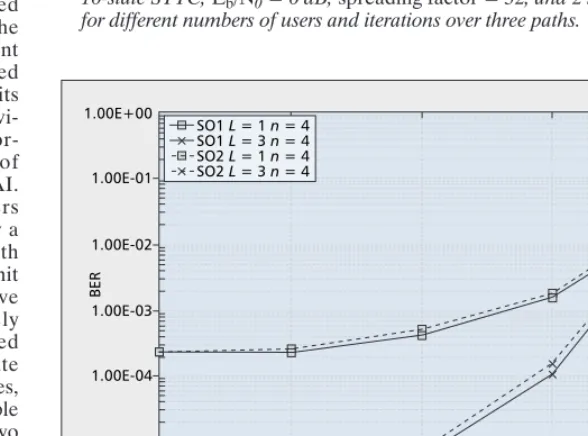
[image:6.657.251.545.309.527.2]These suboptimal solutions exploit the fact that, after a sufficient number of iterations, the overall MAI and IAI is mitigated at the input of the MMSE filter. Therefore, it is possible to equalize either the signal of the desired user jointly over all the transmit antennas (SO1-MMSE receiver), ignoring the MAI from the remaining users at each iteration, or simply apply single-user MMSE filters to each signal of the desired user coming from each single transmit antenna (SO2-MMSE receiver). The resulting suboptimal detectors show a consistent complexity reduction of up to three orders of magnitude from the iterative optimal multi-user MMSE solution (IMU-MMSE receiver). This is illustrated in the example in Table 2 after n= 3 iterations for a half loaded system over n= 3 multipaths in the channel.
Fig-ure 3 shows the improvement of SO2-MMSE over the simpler STMF-PIC receiver, and Fig. 4 shows a performance comparison of SO1-MMSE and SO2-MMSE receivers. It is clear that the best trade-off between performance and com-plexity is given by the SO2-STMF-MMSE solu-tion, where the symbol level MMSE detection noticeably reduces the complexity of the receiver from that of the chip synchronous one. More-over, the PIC with only STMF suffers from ISI, MAI, and IAI in a STTC MIMO system, where-as stronger detectors, such where-as iterative MMSE receivers, either optimal or suboptimal, can guarantee higher system capacity.
■Figure 3.BER performance of SO2-MMSE and STMF-PIC with 2-antenna 16-state STTC, Eb/N0= 6 dB, spreading factor= 32, and 2 receive antennas
for different numbers of users and iterations over three paths.
Users (Eb/N0= 6 dB) 8
1 1.00E-04
BE
R
1.00E-05 1.00E-03 1.00E-02 1.00E-01 1.00E+00
16 24 32
SO2L = 3 SO2L = 3n= 1 SO2L = 3n= 2 SO2L = 3n= 3 SO2L = 3n= 4 STMFL = 3 STMFL = 3n= 1 STMFL = 3n= 2 STMFL = 3n= 3 STMFL = 3n= 4
■Figure 4.BER performance comparison of SO1-MMSE and SO2-MMSE with 4-antenna 4-state STTC, Eb/N0= 6 dB, spreading factor= 16, and 2
receive antennas for different numbers of users over flat fading and 3 paths fading after 4 iterations.
Users (Eb/N0= 6 dB) 4
1
BE
R
1.00E-06 1.00E-01
1.00E-02
1.00E-03
1.00E-04
1.00E-05 1.00E+00
8 12 16
C
ONCLUDING
R
EMARKS
This article, the third of four, has presented the technical activities within Mobile VCE’s Wire-less Access research area. Since the research was defined and driven by the leading companies in mobile communications, the research naturally focused on the provision of wireless access in future networks.
The research outcome clearly demonstrated that an extension from SISO to MIMO transceivers facilitates the high data rates required for media-centric applications and that such efficient implementations are feasible. Algorithmic beyond third generation (B3G) transceiver technologies have been suggested. To improve the B3G link capacity, various multi-user schemes have been analyzed with major focus on complexity reduction. The developed SISO and MIMO, iterative and noniterative CDMA-based detection schemes have been assessed in terms of their advantages and disad-vantages, as well their range of potential applica-tion. It has been demonstrated that the achieved trade-off between performance and complexity reduction indeed facilitates B3G terminal designs.
REFERENCES
[1] V. Tarokh, N. Seshadri, and A. Calderbank, “Space-Time Codes for High Data-Rate Communication: Performance Criterion and Code Construction,” IEEE Trans. Info. The-ory, vol.44, no.2, Mar. 1998, pp. 744–65.
[2] S. M. Alamouti, “A Simple Transmit Diversity Technique for Wireless Communications,” IEEE JSAC, Oct. 1998, pp. 1451–58.
[3] G. J. Foschini, “Layered Space-Time Architecture for Wireless Communication in a Fading Environment When using Multi-Element Antennas,” Bell Labs Tech. J., vol. 1, no. 2, Autumn 1996, pp. 41–59.
[4] B. Rassool et al., “4-PSK Space-Time Trellis Codes with Five and Six Transmit Antennas for Slow Rayleigh Fad-ing Channels,” IEE Elect. Lett., vol. 39, no. 3, Feb. 2003, pp. 296–98.
[5] B. A. Rassool et al., “Error Analysis of Optimal and Sub-Optimal Space-Time Trellis Codes: Concatenation Require-ments,” PIMRC 2003, Beijing, China, Sept, 2003, CD-ROM. [6] D. Koulakiotis and A. H. Aghvami, “Data Detection
Tech-niques for DS/CDMA Mobile Systems: A Review,” IEEE Pers. Commun., vol. 6, no. 1, June 2000, pp. 24–34.
[7] T. R. Giallorenzi and S. G. Wilson, “Multiuser ML Sequence Estimation for Convolutionally Coded Asyn-chronous DS-CDMA Systems,” IEEE Trans. Commun., vol. COM-44, Aug. 1996, pp. 1064–70.
[8] L. Hanzo et al., Single- and Multi-Carrier CDMA, Wiley and IEEE Press, Jul. 2003.
[9] M. Moher, “An Iterative Multiuser Decoder for Near-capacity Communications,” IEEE Trans. Commun., vol. 46, no. 7, July 1998, pp. 870–80.
[10] M. J. Juntti, “Genetic Algorithms for Multiuser Detec-tion in Synchronous CDMA,” IEEE Int’l. Symp. Info. The-ory, 1997, p. 492.
[11] K. Yen and L. Hanzo, “Hybrid Genetic Algorithm Based Multiuser Detection Schemes for Synchronous CDMA Systems,” 51st IEEE VTC, Tokyo, Japan, 18 May 2000, pp. 1400–04.
[12] L. Hanzo, T. H. Liew, and B. L. Yeap, Turbo Coding, Turbo Equalisation and Space-Time Coding for
Trans-mission over Fading Channels, Wiley-IEEE Press, 2002.
[13] M.C. Reed et al., “Iterative Multiuser Detection for CDMA with FEC: Near Single User Performance,” IEEE
Trans. Commun., vol. 46, Dec. 1999, pp. 1693–99.
[14] M. C. Reed, “Iterative Receiver Techniques for Coded Multiple Access Communication System,” Ph.D. thesis, Univ. of South Australia, 1999.
[15] L. Hanzo, T. H. Liew, and B. L, Yeap, Turbo Coding, Turbo Equalization and Space-Time Coding for
Trans-mission over Fading Channels, Wiley-IEEE Press, 2002.
BIOGRAPHIES
MISCHADOHLER[M] ([email protected]) obtained his M.Sc. degree in telecommunications from King's College London, United Kingdom, in 1999, his Diplo-ma in electrical engineering from Dresden University of Technology, Germany, in 2000, and his Ph.D. from King's College London in 2003. He was a lecturer at King's Col-lege London, Centre for Telecommunications Research, until June 2005. He is now a senior expert in the R&D Department of France Telecom working on distributed/ cooperative communication systems, sensor networks, and cognitive radio. In the framework of the Mobile VCE he has pioneered research on distributed cooperative space-time encoded communication systems, dating back to December 1999. Prior to telecommunications, he studied physics in Moscow. He has won various competitions in mathematics and physics, and participated in the third round of the International Physics Olympics for Germany. He has been the Student Representative of the IEEE UKRI Section, a member of the Student Activity Committee of IEEE Region 8, and the London Technology Network Busi-ness Fellow for King's College London. He has published over 80 technical journal and conference papers, holds sev-eral patents, co-edited and contributed to sevsev-eral books, and has given numerous international short courses. He has been TPC member and co-chair of various conferences and is an Editor for EURASIP Journal, IEEE Communications
Letters, IEEE Transactions on Vehicular Technology, IEEE
Wireless Communications, and IET Communications
(for-merly IEE Proceedings in Communications).
STEPHENMCLAUGHLIN[SM] ([email protected]) received a B.Sc. degree in electronics and electrical engi-neering from the University of Glasgow, United Kingdom, in 1981 and a Ph.D. degree from the University of Edinburgh, United Kingdom, in 1989. From 1981 to 1984 he was a development engineer with Barr & Stroud Ltd., Glasgow, involved in the design and simulation of integrated thermal imaging and fire control systems. From 1984 to 1986 he worked on the design and development of high-frequency data communication systems with MEL Ltd. In 1986 he joined the Department of Electronics and Electrical Engi-neering at the University of Edinburgh as a research fellow, where he studied the performance of linear adaptive algo-rithms in high-noise and nonstationary environments. In 1988 he joined the academic staff at Edinburgh, and from 1991 until 2001 he held a Royal Society University Research Fellowship to study nonlinear signal processing techniques. In 2002 he was awarded a personal Chair in electronic com-munication systems at the University of Edinburgh. His research interests lie in the fields of adaptive signal process-ing and nonlinear dynamical systems theory, and their applications to biomedical and communication systems. He is a Fellow of the Institute of Engineering and Technology and a Fellow of the Royal Society of Edinburgh.
PETERSWEENEY([email protected])
LAJOSHANZO[F] ([email protected]), a Fellow of the Royal Academy of Engineering (FREng), received his Master degree in electronics in 1976 and his doctorate in 1983. In 2004 he was awarded a D.Sc. degree by the University of Southamp-ton, United Kingdom. During his 28-year career in telecom-munications he has held various research and academic posts in Hungary, Germany, and the United Kingdom. Since 1986 he has been a member of academic staff in the School of Electronics and Computer Science, University of Southampton, where he currently holds the Chair in Telecommunications. He has co-authored 10 Wiley/IEEE Press books totaling about 8000 pages on mobile radio communi-cations, published in excess of 500 research papers, orga-nized and chaired conference sessions, presented overview lectures, and been awarded a number of distinctions. Cur-rently he heads an academic research team working on a range of research projects in the field of wireless multimedia communications sponsored by industry, the Engineering and Physical Sciences Research Council (EPSRC) UK, the European IST Programme, and the Mobile Virtual Centre of Excellence (VCE), United Kingdom. He is an enthusiastic supporter of industrial and academic liaison, and offers a range of indus-trial courses. He is also an IEEE Distinguished Lecturer of both the Communications Society and the Vehicular Society as well as a Fellow of the IEE. For further information on research in progress and associated publications please refer to http://wwwmobile.ecs.soton.ac.uk
The research outcome clearly demonstrated that an extension from SISO to MIMO transceivers facilitates
the high data rates required for media-centric applications and that
such efficient implementations