Resources of the Sea
MINERALS FROM THE OCEANS
by Petor J. CookBureau of Mineral Resources, Canberra
(with nine tables, eight text--figures and three plates)
ABSTRACT
Mineral resources are present offshore either as bedrock or superficial
Bedrock deposits include petroleum, coal, sulphur, evaporites, and metals. Many of these deposits can be exploited in shallow water using currently-available technology including drilling platforms, solution extraction, and underground mining from onshore installations which extend offshore. Genetically, there are two kinds of superficial deposits; those which formed on the continent but which were subsequently submerged by the post-glacial rise in sea level (lateritic deposits and some types of placer deposits), and those which have formed under submarine conditions at the present time or in the recent past. Deposits of this second group include construction materials, some placer deposits, phosphorites, and glauconite, all of which are found primarily on the shelf and upper slope; and deposits of the deeper oceans, including deep-sea oozes, manganese nodul es, and metall iferous muds and brines. Dredg ing techniques are used for exploiting superficial deposits in shallow waters; various types of dredges are being tested, or are planned for the deeper-water deposits. Although it is probable that many offshore mineral deposits will not be exploited in the near future, they nevertheless constitute long-term resources of considerable
INTRODUCTION
In response to a growing awareness of the finite nature of onshore mineral deposits and the great technological advances of the past 20 to 30 years, man's atten-tion is turning increasingly to the mineral resources of the oceans. The oceans cover 70.8 percent of the earth's surface (table 1) . Much of this area is sti1 rclatively unknown, but already we knoll7 of many mineral deposits on the underlying seafloor. The ocean is not however a vast cornucopia of minerals just waiting to be ited. The costs of developing an offshore mineral deposit are general very
Most of the known deposits are unl.ikely to be developed during century. Never-theless they may constitute an important resource for the future and each will be examined here briefly, whether is imminent or not.
the minerai _, j t is necessary to consider first the
various physiographic ions of the earth, and thc
oceans, bearing these have on mineTill potential,
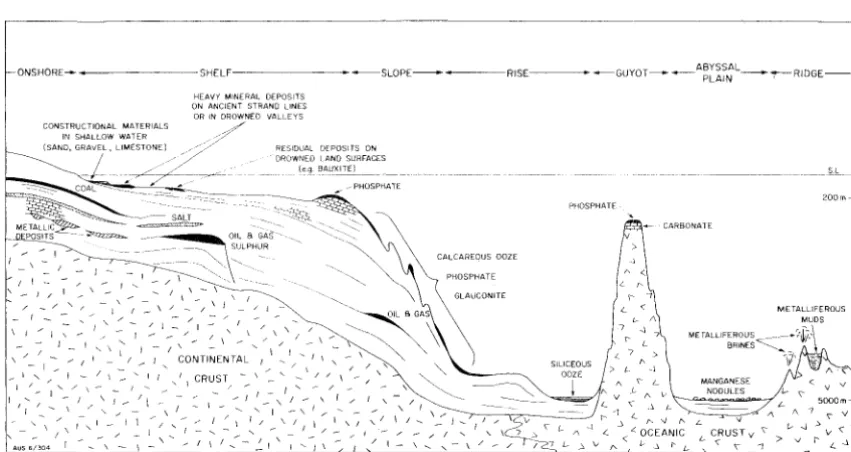
into oceanic crust cont inental crust. The cont inental crust is compo sed of 1 ight sialic rocks, and underlies the continent and the continental margin including the continental shelf, the slope, and possibly the rise, .14 ). Oceanic crust under-lies the abyssal regions of the oceans; it is iron-rich, and generally basaltic Thus physiographically and geologically there are two different provinces, each with its own particular features and mineral potential (fig. 15). The continental margins which extend from the high water mark to the base of the slope at a of 4000-5000 m have many geological (and mineral) affinities with the onshore coniinental mass. The continental shelf in particular is commonly underlain by much the same geological succession as is present in the adjacent onshore area. The abyssal zone on tho other hand bas many unique features, particularly the ve-r'Y slow rate of sedimentation in most deep-water areas, and the attendant thin sedimentary sequence (seldom mOTe than 1000 In,
commonly very much less). This i,; reflected in the fact that the mineral deposits
Minerals from the Oceans
[image:2.484.144.361.127.558.2]41
Peter
J.Cook
--~---~---~.---.---.--.---
--- - ---1
ABYSSAL
---i
-ONSH:o:::u=~
MAlERIALS
-SHELF--~- ~---SLOPE---"R1SE~-- ~-~----
GUYOT--~
PIAIN
~~-
R,DGE- 1 1'1
IN SHALLOW WAfER
(SAND, , LIMESTONE) RE~:IDUAl DEPOSiTS ON Of\OWNED L.AI'W SURFACES
200m
I I
FIG. 15. - Schematic representation of the structure of the continental margin and adjacent ocean, and the location of mineral deposits.
TABLE 1
AREAS OF MAJOR PHYSIOGRAPHIC FEATURES OF THE WORLD'S OCEANS (after Menard and Smith 1966)
Land Ocean
Continental shelf Continental slope Continental rise Mid ocean ridges Abyssal plain
Trench
&
associated features Miscellaneous (volcano es, etc.)area
(milli~ns
of km ) 143 362
27.1 28.3 19.2 118.6 151.5 6.1 11.2
percentage of the seafloor
7.5 7.8 5.3 32.7 41.8 1.7 3.2
found in the deep oceans are rather different from those found on land or on the continental margin.
Reviews of offshore minerals published in recent years include those by Emery and Noakes (1969), McKelvey and Wang (1969), Mero (1965), Noakes (1970), Noakes and Jones
[image:3.481.22.448.67.293.2]TABLE 2
OFFSHORE MINERr'l.L DEPOSITS
~--- ~~---1---.---~----~Ma----"'I
ENVIRONr-iENT
CONTINENTAL
SHELF
I
CONTINENTAL
SLOPE AND RISE
DEEP OCEAN
(ABYSSALP LA IN Al".JD
SEAiI10UNTED-OCEAN
RIDGE,
TRENCH)
SUPERFICIAL TYPE OF DEPOSIT
r,
. 0 ~
bauxlte (chemical) ~
&
1 . . , ( h "ri'""
.... aterltlc Iron weatl ering)
C'..-gold, tin., diamonds (placer)§ ~ gravel (construction) ;;;'
2-....
rutile, zircon (mineral sands) siliceous sand (construction) carbonate reef and sand manganese nodules
barite
EXAMPLE
Solomon Island
SE .A.sia, SW Africa North Sea
E Australia
E
U.S.A.Queensland British Columbia NW Tasmania; SW Africa
manganese nodules and crusts Pacific
glauconite
carbonate mud and oOZe
)
carbonate reef)
e
siliceous ooze
carbonate ooze
and brines
New Zealand
Chile
I
E Indian Ocean Central PacificPacific
Red Sea; E Pacific
BEDROCK
TYPE OF DEPOSIT oil and gas coal
metalliferous deposits
sulphur
evaporites
oil and gas
metalliferous sulphur
evaporites
oil and gas evaporites
EXAMPLE
Bass Strait, North Sea
Europe SW England
Gulf of Mexico
North Sea
ii' Gulf of Hexico, N Atlantic , Tasmania
Gulf of Mexico Red Sea
Sigsbee Knoll s Red Sea
[image:4.712.80.659.65.404.2]Peter
J.Cook
TYPES OF OFFSHORE DEPOSITS
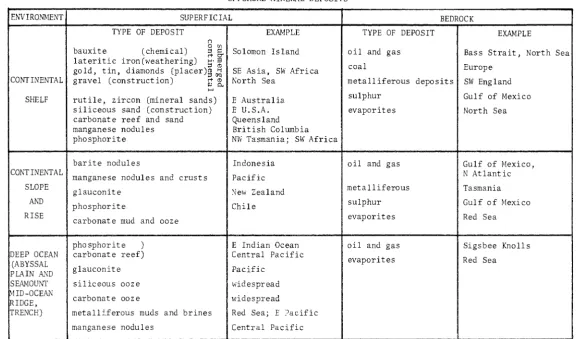
The two basic types of offshore mineral deposits are termed here "bedrock" (table 2). Superficial deposits are located on the seaf1001:' extend no more than a few metres below the sediment -water interface. predominantly, though not exclusively, in response to marino conditions the present time or in the recent A small group of
are, however, the submerged counterparts onshore deposits; these include lateritic iron and bauxite, both the of lateritic weathering; placeT such as gold, tin and diamonds, which are found in drol-med river g1:'avels or drowned glacial
43
outwash deposits. Bedrock deposits occur at of up to thousands of metres below the sedinlent-water interface and represent the sub-aqueous of onshore mineral deposits, including petroleum, coal, metalliferous and
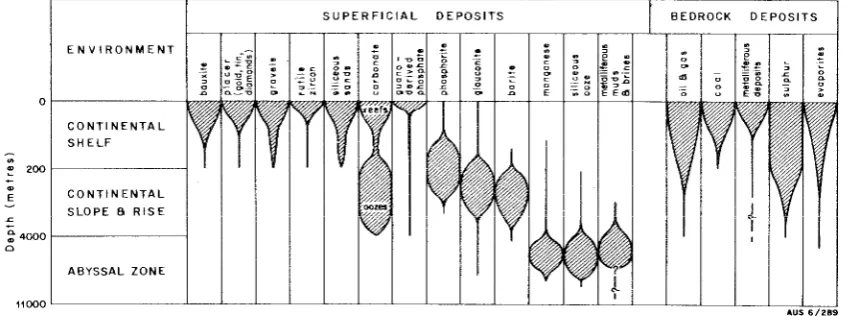
evaporites. Deposits of this type appear to be abundant under , present to a lesser extent under the slope and the rise, and rare to absent in the abyssal zone (fig. 16).
ENVIRONMENT
0
CONTINENTAL SHELF
-;;;
m 200
m
CONTINENTAL
E
SLOPE 8 RISE
£ ~4000
0
ABYSSAL ZONE
11000
FIG. 16. - Vertical extent of offshore mineral deposits.
Petroleum: Petroleum is dealt with by detail here. Weeks (1969) has estimated
of the order of 90 bill iOIl barrel s. Total excess of this but our present lack of our ability to give an accurate forecast. and the slope are 1
Foundered portions of western Australia, may he
(this volume) and is not considered in proven offshore recoverable reserves are reserves are 1 to be considerably in
of the sediments inhibits The sediments the outer shelf
eum fields in many as the Exmouth
of the world. off north-about the sediments of the continental 1'].se,
ers in the futuTe. Little j s known EmeTY (1969) considers that there in these sediments. The sediments
is of suitable reservoi.r' rocks
of the .20n_0 are generally too thin and commonly too poor in organic -material to constitute good TKltential petroleum producers. Nevertheless cannot be ete-ly discounted as oil and gas has been penetrated in deep water the course
the Deep Sea Drilling Project. This includes the Sigsbee site in the Gulf of Mexico, vihich encountered oil and gas at a water of 3582 ill
ex ax.
1969), and in the Tasmanian regjon at Deep Sea Drilling 280 and 282 (water of 4181 ill and 4207 m ;,Inere oil staining \\la5 also encountered (Kennett d11£.,
1975). The present limitations to the itation of oU and gas beyond the shelf edge are [image:5.478.24.452.238.396.2]Minerals from the Oceans
there seems little doubt that an increasing proportion of the world's petroleum production will come from offshore.
Coal: Sub-sea coal seams have been exploited from onshore-based underground mine workings for many years off the coasts of Japan, the United Kingdom, and Canada. A number of the east Australian sedimentary basins which are coal-bearing onshore are known to extend offshore. The offshore Sydney Basin in particular is likely to contain coal seams of potential economic importance, which might feasibly be worked from shore-based workings. Coal seams undoubtedly extend to the edge of the shelf in places. Their extent in the slope sediments is less certain though it is reasonable to assume that they will be considerably less abundant there than under the shelf. There are reports of coal from deep water; brown coal was reported from site 214 on the Ninety East Ridge at a water depth of 1665 m and a depth of about 400 m below the sediment-water interface (von der Borch ~
at.
1974). It is highly unlikely that sub-sea coal will be mined any further than a few tens of kilometres from the present shoreline in th.e foreseeable future. The United Nations (1970) predicts that with existing techno-logy, conventional mining operations could be extended sub-sea up to 24 km from the coastline, and that changes in technology could extend this to as much as 50 km from the shoreline within the next 20 years.Metalliferous Deposits: Most types of onshore metalliferous deposits might reasonably be expected to be present in places under the continental shelf. The summary by the United Nations (1970, p. 41) reports that "more than 100 sub-sea underground mines with
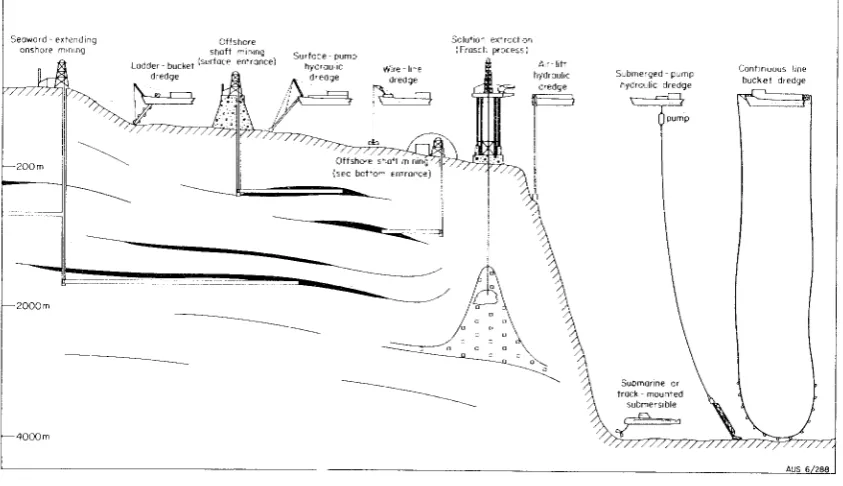
inclined or vertical shaft entry from land, islands or artificial islands have recovered minerals such as coal, iron ore, nickel-copper ores, tin and limestone off the coasts of Australia, Canada, Chile, Finland, France, Greece, Ireland, Japan, Pol-and, Spain, China (Taiwan), Turkey, the United Kingdom and the United States". Except where mining is carried out under a very shallow rock cover, sub-sea mining does not pose severe technological problems and conventional mining techniques can be employed for the most part. The major limitation is posed by having shafts extending consider-able distances from the mining entrance resulting in major logistical and economic problems. Offshore shaft mining either with a surface or sea-bottom entrance may over-come this problem (fig. 17). It is reasonable to expect that sub-sea metalliferous mining in bedrock may eventually extend to the edge of the continental shelf in places. Whether there are likely to be metalliferous deposits of any significance in the bed-rock underlying the Slope is not known. However, if any high-value metalliferous d~posi ts are present and the shelf is narrow, bedrock mining might conceivably continue under the upper part of the slope. One of the few positive indications of mineralization in bedrock in deep ocean areas comes from the results of Deep Sea Drill-ing (Site 282) off northwest Tasmania where native copper has been reported in basalt
(Kennett ~
at.
1975).Sulphur: Native SUlphur is obtained from salt domes in the Gulf of Mexico area, using the Frasch extraction process (fig. 17). Offshore extraction has been undertaken at two sites and a number of other salt-domes underlying the shelf in the Gulf are also likely to contain sulphur. In addition, drilling of the Sigsbee Knolls proved the presence of SUlphur in a water depth of 3582 metres. Salt domes are present offshore in many parts of the world, particularly underlying the shelf and the slope (e.g. off northwestern Australia). Diapiric structures are also present in the abyssal zone e.g. in the northeast Indian Ocean but commonly there is no indication of whether these diapirs are salt domes or clay diapirs. Outside of the Gulf of Mexico, no off-shore SUlphur-bearing salt domes are known, but the geological conditions prevailing in diapirs elsewhere, are commonly similar to those encountered in the Gulf of Mexico, and drilling of such structures should ultimately result in the discovery of further offshore sulphur deposits.
45
Peter
J.Cook
Bonaparte Gulf where haUte is present in both bedded and diapiric forms, the offshore portion of the Carnarvon Bas in where there are up to tens of metres of bedded salt deposit, and the Browse Basin in the Northwest Shelf and the offshore Capricorn Basin
(at the southern end of the Great Barrier Reef) where theTe are thin beds of anhydrite. The offshore portions of the Canning Basin and the Adelaide Geosyncline may also contain sal t but have not been tested by deep drill lng. There are no known offshore occurrences of potash in th e Aus tra1 ian reg ion.
---4000m
FIG. 17.
Contli1~lOUS !me
ouck'-'"i
AUS 6 288
Some offshore mlnlng methods in use at the present time or likely to be used in the future.
Sal t deposits al so extend under the s lope and into the abyssal zone. Deep Sea Drilling has established the presence of evaporites in the Red Sea, the Mediterranean, and the Gulf of Mexico, and analyses of pore waters also indicate that salt deposits are present near the Timor Trough (Veevers
e-t
((X. 1974) and elsewhere.Superficial Deposits
Unlike bedrock sub-sea mineral deposits, superficial deposits must be mined off the sea bottom using extraction plants which are either floating, submersible, or semi-submersible (fig. 17). In very shallow water the same mining procedures (dredges) can be used as for shoreline deposits but more com1l10nly new methods are necessary,
involving long suction lines, or bucket ladders, submarines, and various other sub-mersible mobile mining systems especially in deeper water. In general, costs must be expected to increase substantially with increasing water depth.
[image:7.478.28.450.145.388.2]Minerals from the Oceans
---;--',t/\RS B"'( 10 3 --_
1~~ __ ~p
__
~L_~9 __ ~~_i~ __8p
91°_
lf2-
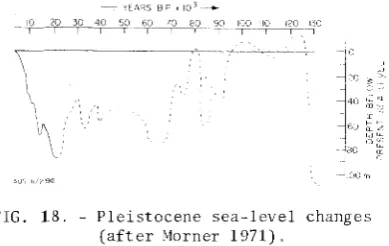
Ii,? I;~Q_~()FIG. 18. - Pleistocene sea-level (aft er Morner 1 971) .
offshore exploration appeal':; to have been undertaken for
a1 though they are 1 spread, particularly at
t.his nature, tu fairly
wide-lcH'J' lat itudes where there has -been extensivE' lateritic weather-ing. In view' of the abundance of onshore
such s are unlikely the; near futu.re 0
h('21:V/- pl~lC2T mincra s,
and c-.rrrnmite,~ termed s by Em;:~TY and Noakes
normally found in fluvial gravels, 15 knl or less from their- source. Because of their Ifie
they are seldom, if ever, in the marine enVirOI1J1;ent. are
present in offshore Pleistocene stream beds, as extensions of present continental placer deposits which have been by the post rise in sea level (fig. 18). Such deposits are unl to extend far across shelf because potential source areas are likel.y to have been covered by a veneer of older interglacial sedi-ments which would have protected them from erosion.
Beach deposits at Nome, Alaska, have yielded an est:iJnated 190,000 kg of gold (Archer 1972), and as a consequence active exploration have been undertaken on the Alaskan Shelf. Signi.ficant of have found III m311Y areas but no offshore mining has been and tin have also been reported in the Sov ieto sector of the has been made to explo it these
depo si ts. were taken out off the south coast of
New South Wales some acent to an old onshore gold working. The company (Planet Gold
subsequently reI not encouraging.
.) did not annourlce the results of the SUT~l/ey, but as it the leases it is reasonable to assume that the results were
Offshore tin operations have been more successful. As tin was
dredged offshore, Until recently the only waters but
no\-! they have moved inti) more open waters and work in water depths of up to 40 m. Dredges have operated successfully off the coasts of Malaysia, Indonesia and Thailand
(fig. 19). Exploration has been undertaken in other parts of the world, and cassiter-ite-bearing sands have been off Cornwall (Lee 1968), No commercial deposits appear to have been in Australian waters; a limited exploration program has been undertaken offshore from the North Queensland Herberton tinfields, but as Noakes and ,Jones (1975) point out the tinfields are some distance inland and are unlikely to have contributed any significant alllount of tin to the coast, Some exploration was carried out in the Oyster Bay area off Tasmania. A more
was undertaken off northeast Tasmania near Ringarooma Bay by Ocean Mining A,G. on of a consortium of The program i.ncluded surveys to determine the course of the Pleistocene Hingarooma River, and an extensive drilling program, Intersections of tin were recoTded in a number of the drillholes; however, Young (1969) reported that oveTall, tin concentrates were ratheT but detailed work might delineate richer patches, Increasing tin !liay revive interest in offshore Tasmanian tin deposits,
[image:8.478.50.245.75.198.2]Peter
J.Coo k
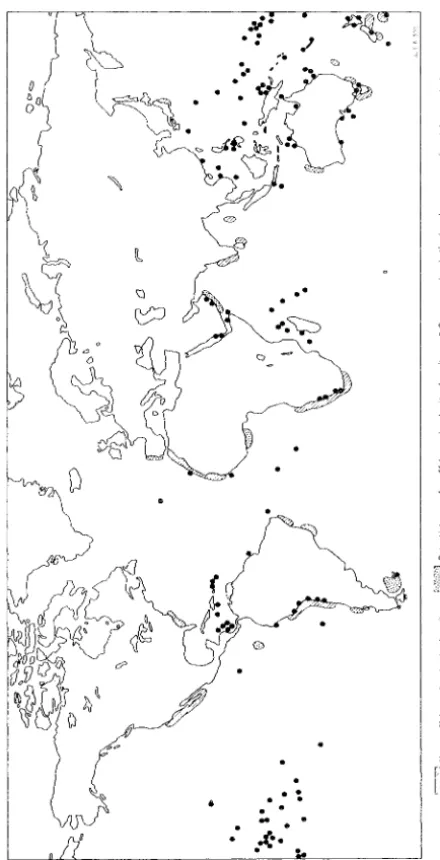
FIG. 19. - Location of some offshore mineral deposits (after McKelvey and Wang 1971).
[image:9.481.128.357.94.534.2]Minerals from the Oceans
diamond-bearing sediments to the north of the Orange River (the principal source of the diamonds) is probably the :result of present-day current patterns.
The De Beers group has undertaken an extensive has successfully dredged (by airlift)
40 m. The offshore deposits are of a some 0.75 million carats had been mined
in excess of those of onshore mining, and offshore suspended at the present time. Few (if any) other regarded as having any potential for diamond-bearIng nearby diamondiferous source rocks.
program off South.!est Africa, and sediments from water of
the onshore deposits. By 1969, operating costs were considerably
are bel ieved to be areas in the world are sediments because of the Jack of
Sand and Gravel: Extensive sand and gTavel deposi'ts aTe present on the cont inental shel! in a number of areas, particularly off the coast of western Europe and the north·, eastern United States (fig. 19). The European and NOTth A.merican gravels are believed to be derived from the Pleistocene glacial and fluvioglacial deposits which were deposited on the shelf areas during the last low sea-level stand. Consequently, the gravel s are mostly continental d epo si ts which have been subsequently submerg ed. Much of the sand in these areas is probably also derived from glacial and fluvioglacial sediments which have also been subjected to redistribution by the prevailing currents. In addition, sands are also being carried onto shelves by present-day coastal
drainage.
Siliceous sands and gravels are used extensively as construction materials, and increasingly in Europe and the United States these commodities are being obtained off-shore (fig. 19). In 1968, the United Kingdom obtained 10 percent of its sand and gravel needs (equivalent to 11 million tons and worth 6.5 million) from offshore sources (Dunham 1970). By 1970 the amount dredged had increased to 13 million tons, equivalent to 12.4 percent of the total of sand and gravel in the United Kingdom. Archer (1972) reports that
shore deposits, up to 120 km from the home port and in water In the United States, where offshore aggregates provide 2 to .3 percent of total production, most of the material is from estuaries rather than shelf. It is 1 ikely that there too the search for suitable aggregates will
[nformation available on the east Aus tralian shelf (Davies and Marshall 1972) indicates that the chances of finding suitable sand and gravel are not particularly good owing to an abundance of carbonate and a lack of coarse sediment (because of the absence of glacial sediments). Nevertheless, there is an increasing need to find suitable sources of offshore sand and gravel for the Newcastl
conurbation, a need which is likely to act as a catalyst for further offshore exploration.
Calcium carbonate is used concrete manufactuTe. Tt
in the cons tru,c t ion
form of ,LVi .5.i;tu reef material, as carbonate sands and gravels derived either from the of reefal mate-rir.Ll or from shelly detritus, coli tic
forms are of biochemical origin.
and oozes. All of these
Coral reefs are abundant along lllany and coasts, including those of northern Australia. Curnmtly, from Moreton Bay,
49
Peter
J. Cook
Elsewhere, a number of carbonate dredging operations have been established including dredging shell banks off Iceland in 45 m of water. Oyster shell accummu-lation in shallow bays off Texas, Louisiana and Florida are also mined, total production from this source in 1968 being 18 million tons with a value of about $US 30 millions
(Archer 1972). Aragonitic muds are also extracted (by suction dredging) from a water depth of up to 30 m on the Bahama Banks.
Enormous quantities of carbonate ooze, resulting from the accummulation of the tests of calcareous micro-organisms, particularly foraminifera, are found on many continental slopes and marginal plateaux within 40 degrees of the equator and where there is little or no terrigenous sedimentation. The deposits extend to the carbonate compensation depth at approximately 4000 - 5000 metres. Below this depth calcium carb-onate dissolves. Some areas of the abyssal plain are covered by calcareous ooze as a result of abnormally high carbonate productivity in the surface waters (e.g. near the equator) or as a consequence of turbidity flows bringing calcareous slope sediments into the abyssal zone. It is unlikely that any of these deep-sea carbonates will be mined in the foreseeable future, because of the presence of virtually unexhaustible
supplies on the continents and the shelf.
Mineral Sands: Rutile, zircon, ilmenite, magnetite and monazite (termed the light heavy minerals by Emery and Noakes 1969) are present as beach deposits in various parts of the world including Australia, Brazil, Ceylon, Egypt, India, New Zealand, and Japan (fig. 19). From previous discussions on the .use of onshore deposits as indi-cators of the presence of offshore deposits and also the effects of Pleistocene and Holocene sea-level changes, it would be reasonable to expect fossil strandline deposits to occur seaward of the beach deposits.
An
extensive exploration program was undertaken off the east Australian coast between Newcastle and Brisbane by Planet Metals (Brown and MacCulloch 1970) using various drilling and sampling techniques and an accurate positioning system. A number of strandlines were identified at about 30-36 m, 79-80 m, and at 120 m. Only the -30 metre beach was examined in detail. Noakes and Jones (1975) refer to offshore mineral sand reserves of 375 million tons with rutile plus zircon averaging 0.20 to 0.22percent. This is significantly less than onshore grades (averaging 0.3 to 0.4 percent), and consequently the offshore deposits are uneconomic at present; however, onshore environmental considerations, particularly the high cost of restoring dunes to their pre-mined condition, could radically alter the economics of onshore operations and may make the offshore deposits a much more attractive proposition. Minor deposits of rutile and zircon occur off King Island in Bass Strait, and might also be expected offshore from the ilmenite beach deposits of central Queensland and south-western Western Australia, but any accummulations are likely to be even more marginal than those already discovered between Newcastle and Brisbane. Despite this, all of these deposits constitute an important resource for the future. In addition further explor-ation programs and improvements in metallurgical technology could upgrade the prospects of many areas.
Minerals from the Oceans
"
~•
~ ~!
~ ~~
~
CZ> ~
~
"
.~
I
"
~
!
.
'I
"
.~
i
1i. ~0
:!i
'\;
,l;
.~
~
bl:
~
.~
!
~
~
~ ~ ~
;,
'\;
~
~
~
.
:
:",.
. .
..
.
.
.
.
.(0 •
[image:12.485.143.363.99.529.2]Peter
J.Cook
Phosphate Deposits: There are three types of phosphate (or guano-derived) deposits and igneous apatites.
bodies such as those of the Kola peninsula in northeasteTn under the continental shelf, but such deposits are rare on both to discoveT and to work commercially offshore.
51
- phosphorit(os, guano igneous
Russia might be land and would
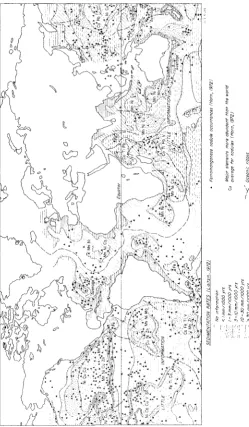
Guano deposits occur widely (White and Warin 1964; Hutchinson 1950), particulaTly in areas with a high organic productivity in the surrounding ocean, and where t.he island is isolated (fig. 20). Those factors a large bird population, and an attendant abundance of avian guano. the guano forms a
source of phosphate. More commonly, and leaching
phate-rich ground-wateTs which phosphatize the rocks, generally ime-stones, though in some cases there is also of underlying volcanic rocks such as on Christmas Island in the northeast Ocean (Trueman 1965). Some such guano-derived deposits have been submerged below sea-level as a result of a relative rise in sea-level. Offshore deposits of this type have been prospected for in the central Pacific by Barrie (pel's. conun.), and Cook (1974) has used oceanographic data for the southwest Pacific to delineate areas where offshore deposits might also be found. In the Indian Ocean, Bezrukov (1973) has discov01:ed a number of seamounts capped by phosphate, which are thought to be submerged guano deposits.
Offshore phosphori tes are more extensive than guano deposits. They are now known to occur off southern Africa, southern California, Baja California, the eastern United States, northwest Africa, southeastern South America, nOTthern Chile and Peru, the Andaman Island (Indian Ocean), eastern Australia, northwest Tasmania, and the eastern and southern coasts of the South Island of New Zealand (fig" 20). Kolodny (1969) and Kolodny and Kaplan (1970) have shown that most of these shelf phosphorites are residual phosphoTites of Tertiary age. Phosphorites are forming at the ent day off south-west Af:f'ica (Baturin 1969, 1970, 1971; Baturin
ex
at.
1972) off Peru and northern Chile (Veeh e;t aE. 1973). Both areas are regions of extensive ing and abnormally high organic productivity. For many years it was thought that collophane (carbon-ate-fluorapatite) precipitated inorganically in the water column, in response to an incTease in pH as the cold water ascended (Kazakov 1937). However, it now appears that phosphorites form primarily by the phosphatization of sediments below the sediment-water interface. 11115 produces localized patches of collophane. Increased current veloci ties and/or changes in sea-l evel 1 cad to subs equent reworking of the sediments. The coarser patches of phosphatized sediment remain as a lag deposit and the finer matrix is winnowed out, resulting in the phosphatic sediment being upgraded to a high-grade phosphorite (Cook 1967; 1975). This upgrading is also demonstrated in table 3 by the increasing P20S content of offshore deposits, with increasing lithificationTABLE 3
!VfAJOR ELEMENT COMPOS ITION OF OFF SHOflE PHOSPHORITES
?(j % Yo % %
P20S CaO CO2 F Si0 2
1 50ft nodules 23.85 35.92 5.30 2.45 14.80 2 hard nodules 32.74 46.42 6.33 3.02 0.15 3 50ft nodules 15.73 24.90 2.31 1.60 22.23 4 hard nodules 25.62 38.64 3.04 2.55 12.30 5 hard nodules 10.0 17.7 4.J 1.05 10,.6 Samples 1 and 2 from the southwest and African shelf; samples 3 and 4 from the Chile shelf (after Baturin 1971); sample 5 from the Tasmanian shelf (Cook unpubl.).
q6
A1 20 3 0.45 0.04 6.11 3.31 2.:)
% %
F NgO
IVI inera 1 s from the Oceans
10 em
... ~~ l.iii ... .! ..
''1·'··r ..
t:~-,-l'!''''~PLATE 1. - Portion of a phosphatic pavement from off the East Australian coast. Similar phosphorites are also known from the Chatham Rise and the Campbell Plateau (Norris 1964, Summerhayes 1967a, Watters 1969) off New Zealand. All the known Australian occurrences are fairly low grade (tab 1 e 3 ) and are of the nodular type, with few consolidated beds. All are bel ieved to be Tertiary
(Miocene?), though there may have been some more recent surface phosphatization.
The east Australian deposits range in water depth from 197 to 38S m and con-tain up to 21.2% P20 S ' The Tasmanian phosphorites which were discovered by Ocean Mining A.G. range in water depth from 65-165 m and contain up to 26 per-cent P 2°5' No estimate of reserves is availa51e though the Tasmanian deposits are probably considerably largeT than the east coast deposits. Thus, at
present the TasID<j.nian phosphoTites, being richer, more abundant and in shallo'wer water than the East Australian deposits are of greater cow~ercial
The ites presently exposed on the shelf are in. the forra of
con-solidated beds or pavement (off parts of southern California), nod1Jles
(Algulhas Sank; Blake Plateau) j sands
Baja California)" and mud_s (off ile and Peru) < They DC-CuT in VJater
rang Erom 50 Tn or 1 ess off Baja CalifoYl1ia to
i\lgul has Bank
~)800 m (yEf the ter phos-e Pphos-eTTiv ian~Chil can tes occur
at: water s of 100 to 400 In (Veeh
eA~ af~ 197 :. \\,}lereas those off
south-wes tAfT ica ar (:': form ing on the inneI' shelf between 50 and 150 m (Senin 1970).
In the Australian region, offshore phosphorites are present on the outer edge of the east Australian shelf
(Marshall 1971, von del' Borch 1970) as a capping on some of the seamounts of the Tasman Sea (plate 1), and on the west Tasmanian shelf (plate 2).
10 em
PLATE 2. - Phosphorite nodules coated with a calcareous veneer; sample off the northwest Tasmanian coast.
interest. However, in common with all other offshore phosphorites they have the dis-advantage of being a fairly low-priced commodity. Recent steep price rises to about $US70 per ton (April 1975) are unlikely to continue as there are abundant onshore supplIes. Under the present pricing conditions, some offshore phosphorites off southern California have attracted much interest from mining companies (Wilson and Mero 1966) in the hope that the high costs of dredging (probably in excess of $US20 per
ton) can be offset by the nearness of the southern Californian market.
pTospects fur firtding furthcL
slow rates of an.d
Australia
Africa, Portugal, potentia] areas couId
data and then deta.iled marint:'
e;t
ai.
1970) and cxteY1S exploration program can bePeter' ~ Cook
by Jones (.1973)
Qce'::iI~~ and the
be i(leIltj~fitxl} init:ia 1y using
cherr~ical \'lfork, 11nac:rwatel sciIlitiJ..l(Jmeters pTograms"
qucs tionahl e in v iew of abundance of o:Dshore deposits -} HOWeVeT.1 u.s t<2S a2~C also nhosts H
their future significa.nce ca~nnot lely on e content.
Glauconite: Glauconite
--~--.-,-with a slow rate of warm. Deposits are 200 and 1000 Ill, but
thes e deep glaucon i te caTried into the
is ~lb"cHldant on c:Jntinental margins J pcL'":'ti.cula::c ly thos
or (:alca.-ceOHS sediment.a:tion.~ ctnd where waters are
icuIa:rly conmlon 011 the o:f the slope betwee-.n about also found jon the zone. ~. uncertain w1'lether
the -i.::·o}."ma tion, or hav-e been
currents ~
53
Glauconite is used as a water softener, and as a source of potassium; it may also be used as a ication soil--additive. No details aTe available on the eco-nomics of offshoTe glauconite mining, t.here are sufficient o11shore glauconite deposits to make offshoY8 ext1'actio11 uneconomic in most areas for some consideTabJ e time. However Norris (1964) suggested that in view of the high rate of potash application to New Zealand soHs, the glauccJEite deposits of the Chatham Rise merit consideratioD 8S a soil additive for the Ne"ltv- Zealand market. Glauconite is present as an accessory mineral to lO?5) in A1JstTalian shelf sediments (Jones, pers ,-comlJl.) but nowhere is it knoVin to sufficiently abundant to constitute a
which might merit mini ng In the future. However our pres ent knowl edge of
AustTal ian shelf is poor, and large deposits may be pres ent particular lyon the out er shelf in aTeas where there is 1 i ttl e or no sedimentation.
~aTite : Barite nodul es occur at sca ttered 10 cal ities on the out er part of the shel f and on the slope off Ceylon, southeTn California and Indonesia (United Nations 1970). They have also been intercepted at a number of dTilling sites in the Deep Sea Drilling Pro j ect. OffshoTe barite is cUITently being mined off Alaska in up to 25 m of water. The barite is a bedrock it which is mined by blasting artd dTedging (Stevens 1970). The ecol1ondcs of cannot, however, be
baTite noduI e pTognlm because of the nearby, and in
the case of the offshore Al aSKan bedrock barite. Barite to he too sea ttered for dn::dging opera tions to be INi th o11shoTe
Man.E:~~£~:: M2_ngane.se nodu.les (also kn(nvn as polY1TIetal -i.e or multimetal1ic nodules) covel' 1arge' areas of the sea flo0T 0 21), 'They are mest abundant on abyss{:11 plains but also present on ffit:ll'ginaJ plateaux (e~g. Blake Plateau) and in places arc found in shallow nea:cshor-c waters ( ~g~ the Baltic Sed and the Arctic Ocean) .
Manganese inCTustations
to subma_:cine ft~m(lTo 1 es , cia} intcrc5t~
«ceur ~~n places) p;-trtieu} arly on mid--occnn ridges and a.djac{~nt
I!OWCVCl', only tlte abyssal zo:ne nodUles aTe of preseI1t
cornmCT-An extensive 1 itc)"rature on manganese nodules has
dealing ),>,11 their occurrence _~ geochemistry.~ s
it is only .intended, to d_eal \vith the here in c:utliDc~
o i yen by Bezrukov and AnortLSh henko a no 'fooms
Horn (t972)) 1101'n
e;ta.f~
97)J I-Iubred 96S)JSW;JTl (1974) rtnd looms (Lt 19(9) ~
in the past few years ta tion. Cens equently Detailed accounts are
asby (1972a) ,>
Minerals from the Oceans
~
~
"
~~
l
1l -t~ , ~~~
~ ~ i5
H
-~' ~~
~~
"
,
u y
f
[image:16.481.149.399.105.533.2]Peter
J.Cook
Manganese nodules range in shape from spheroidal to disc-like (plate 3), and in size from micronodules of one em or less to one m or more in diameter and weighing up to several tom1es. Most are two to five cm in diameter. Their external surface is smooth, botryoidal or cracked. Internally they are horizontally, eon-· centrically or radially layered. They commonly contain a nucleus such as a volcanic fragment, a bone fragment, a sharks tooth, or clay. The manganif-erous coating around th e incl us ion is composed predominantly of lOS. manganite at shallow-water sites and Mn0 2 at deep-water sites (Glasby 1972b). Their elemental composition is rather variable. Manganese and iron are dominant, with cobalt, nickel and copper present in
PU-;.TE 3. - Manganes e nodul es, from th e Southern Ocean.
55
minor amounts and trace amounts of molybdenum, chromium, platinium, titanium, gold and zinc (tabl es 4 and 5). Increas ingly, it is the higher than average concentrations of the minor and trace elements which are being sought rather than the nodules with a high manganese content, with cobalt, nickel and copper being of particulaT importance. The maximum values so far recorded for these metals in manganese nodules are 1.8 per-cent copper (Goldberg 1954), 2.5 perper-cent cobalt and 2.0 perper-cent nickel (Fraser and Arrhenius 1972). The central and eastern Pacific nodules are richer in copper, cobalt and nickel than elsewhere in the world's oceans. The ratio Co/Ni ... Cu is found to increase with decreasing water depth. .Just how these high concentrations arise is not known; theories for the enrichment include entrapment of cations by negatively charged oxide ions, concentration by bacteria, and various types of diagenetic reactions. Similarly, theTe are various theories to account for the source of the manganese and the formation of the manganese nodules. These include terrigenous, volcanic, sub-marine fumarolic or extra-terrestrial sources, with concentration of the manganese by chemical precipitation, biochemical precipitation (by the action of bacteria), sub-marine weathering, or diagenetic remobilization of the manganese below the sediment-water interface. The rate of nodule growth appears to be very slow (only a few
millimetres per million years); in many instances slower than the rate of sedimentation of the deep-sea clays in which they occur. This presents a problem, for the nodules are present only as a surface veneer. There are nevertheless instances of shells from World War II being found covered with a manganese coating several millimetres thick. Therefore in some circumstances the rate of manganiferous sedimentation can be quite rapid, though the overall rate is slow because of long breaks in the sedimentation.
% Mn Fe Ni Co Cu
TABLE 4
AVERAGE COMPOSITION OF MANGANESE NODULES IN THE ATLANTIC, PACIFIC AND INDIAN OCEANS (after Cronan 1972)
Atlantic Pacific Indian
16.18 19.75 18.03
21.82 14.29 16.25
0.297 0.722 0.510
0.309 0.381 0.279
0.109 0.366 0.223
M i nera"1 s from the Oceans
areas known to date both from the point of 'vic\v of their cobalt, nickel. and
conten1: and from the point of vieW of abundance of nodules ,He in p
4 ) 1 particularly the centTal and cast Pacific ~ Hubred (1975) consid.ers tha-t a typical
potent ial m~ning site in the c.entral Pacific W'ould have a Jlodul e dens j cqui val ent to 10 kID. ~per ill of ocean floor and would cover an area of about :5()0,OOO He
an 1.5 ill tonnes peT year~ but even at this Tate mining> it would take 1000 years to mine the out ~ Mero (1967) es·timated the Pacific reserves of
nodules at 1.7 x t011S, 4 10" x
of nickel ~ 8 ~8 x S ~8 x c,Gb;;~d_ t ~ Sine e the time 0-£ that estimates fu.rther
may be conservatiiJe~
been discoveTed the Mero est:imate
TABLE
AVERAGE METAL CONTENT Of MANGANESE NODULES IN THE AUSTRI\LASIAN REGION AND SURROUND ING AREAS
Pacific and Indian Ocean values after Cronan and Tooms 1969. Australian values after Noakes and Jones (1975).
western eastern
central southern Indian Indian Australian
% Pacific Pacific Ocean
Mn
15.71 16.61 13 .56Fe 9.06 1.3 . 92 15.75
Ni
0.956 0.433 0.:~22Co 0.213 0.595 (L358
eu
0.711 0.185 0.102A number of methods have been for the including contimlOus .. line bucket dredges, hydraulic
and various types of 5ublneTsiLl es. Some
Ocean region
15.83 13.3
11.2;1 11 .. 3
0.512 0.47
o
~153 0.130.330 0.37
of nodules (fig, 17) suction
,
up to the time of writing (March 1975)basis, an indication not onl y of the
had started mining on a c.ommercia.l sti11 to be solved, but also of the legal
NeveI'theless in Novembe!' 1974 the Tenneco Inc.) filed claim to
an inea of 60,000 ,1300 km west of Baja 2300 to 5000 m (Anon 1974).
of Govermllen·t for California, in wateI' depths I'anging from
Noakes and Jones (1975) consider Iy tht' distribution of manganese nod-ules in the Austral ian region and found that out of 143 stations, nodul es
were present at 52~ record th_at the Q'l"E-:atest concentra.tion of nodules occurs sou.th of 500S; ho·wever, this lncty be ynore aV
reflection of the considerable amOllnt of work undertaken by the U;tCtvun. in the southe:rn Ocean a.nd the lack of worK elsewhe-re than the true distribution patte:rn~ The few analyses so far u:n(Iertaken to Noakes and Jones that the nodules of the region are ess rich in. cobal t, and
than those of the centra Pacific (table 5) ~ HoW'eveT,~ too few analyses Llye
and an extensive of abyssal zone :Lng is arou<.nd Aust the region can ly evalua ted ,. Be(';B.use of the abundance of" t erri-genous sedimentation in the Tasman Sea the chances of high~-mctal nodules aTe
The region south of Australia ha.s sornewha."t better p:rospects-, but the writer ieves that the southeast Indian Ocean has the best prospects because of the indication there of hoth a slow Tate of sedimentation and the wide areas of
clays below the carbonate In addition, the marginal plateaux, such as the Naturaliste Plateau some of the mid-ocean ridges merit attention. For the present, however, there is insufficient information available on the abyssal sediments
%
S10 2
AJP3
F020S
C::tO
MgO
Nap
KZO
MuO
P20S Ti02 CO 2 total H20
Peter
J.
Cook
TABLE 6
AVER4.GE COMPOSITION OF DEEP SEA
(recalculated from El Wakeel and Riley 19t1)
calca.reous 27.0
?'8~5
2.3
1.5
0.15
0,44
23~3
sedime11t
laceous
3.8
3.3
OA7
0,,14
0.84
O~77
siliceous
64,.
0.9
1.9
0.41 0.27
0.65
0.93
7.1
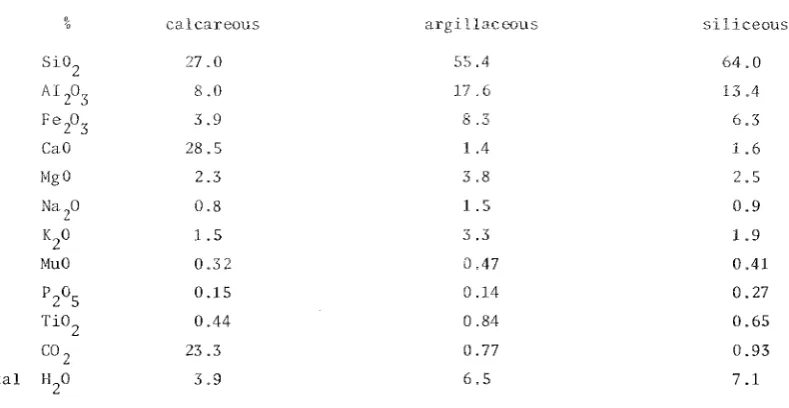
Siliceous Oozes: Siliceous oozes (table 6 ), of the tests of diatoms and
radiof~i:rIa:-CO'\/eT large areas of the sea floOT. aTe abundant in
57
areas of high ty ill and sub-polar waters, below the carbonate compens-ation level (below about 4000 ,and in areas of upwell such as the zone of up-welling associated with the equatorial counteT~·current ~ l01",,-·latit"lH.1e ooze is well-developed in, for instance, the northeast Indian Ocean. Pure siliceous ooze in the form of diatomaceous earth is used extensively for insulation, as a filter. and as a concrete additive. Where it is present in relatively shallow wateT and near to potential markets i t is 1 that siliceous oozes will be mined in the futuTe. No potential sites with these attributes are known in the Australian region, though the region south of Tasmania has the greatest
Pelagic clays may also be consideTed a reSOUTce of the future. of the ocean below about 4000 m (estimated by the United Nat:ions
100 million and contain abundant iron and aluminium (table 6 ,as well as greater than average concentrations of manganese, copper, cobalt, nickel, lead, van~
adium, 31ld. rare earths (table 7 ) ~ However constitute very low-grade itoreSn.1 and this, combined with the Df \ .. .,rateT in which they occur_~ makes them a
resource for the distant only.
contain
Muds and Bxin,es: Metal-rich muds and brines have been discovered in the and :more recently on the mid-Atlantic All
to be the result of submarine volcanic (fUJnarolic) activity compar~
t11a t documented by FeTguson and Lambert (1972) from the shallo\,er Harbour, No,,, Guinea. The bes t known of these occurrences is the II Deep of the Red Sea in about 2000 ill water depth, where the bottom muds
2.690 zinc, O.lgo lead, as well as
average of silver, gold and tin (table 8 ). Maximum
COI1-known inc tude 21 go ZnO i'
sediments are ge1-1 ike and contain
4'l-'0 C'l(' - ... U:t V ') 8!lc PbC}-~ (; " ' Sr.!lc v a _ r Pe ? 0 3 _"_ ;;): .. a-nd F "9< f !J Vin 0 1.. ~ . " 'fhe .0.
[image:19.478.41.436.120.324.2]f>linerals from the Oceans
iron oxides and hydroxides, sphalerite, pyrite, marcasite, manganese oxides and hydro-xides, and sulphides and carbonates of cappel' and lead. The Atlantis T muds have been penetrated to a depth of 10 TIl using piston coyes (Degens and Ross 1969). Seismic information suggests that the sedimenta:ry column may be as thick as IOO m, but drilling at DSDP Site 226 indicated only 5 m of sediment, resting on basaJ t (Whitmarsh
e,t
ai.1974); theTefore the total thickness of metalliferous sediments is somewhat uncertain.
Sr Ba Li Cu
Pb
Zn Co Ni Si Al Fe Mg Ca Ti Mn Ag As B Ba Cd Co Creu
Mo
Ni Pb Sn Sr V W Zn 2rTABLE 7
AVERAGE TRACE ELEMENT CONTENT OF DEEP SEA SEDIMENTS
after (a) Goldberg and Arrhenius (1958) and (b) Turekian and 1 (1961)
Pad fie average cl.ay aveTage
CaJ
(b)(ppm) 710 390 59 740 150 160 320 TABLE 8
180 2300 2.6 250 80 165 74 225
AVERAGE METAL CONTENTS OF BOTTOM SEDIMENTS IN THE ATLANTIS II DEEP (after Manheim and Siems 1974). DSDP Site 226.
range of metal contents in sediments
(ppm) 2 - 12 1 - 5 1.5 - 10 0.15 - 2 3 - 20 .002 - 0.7 .007 - 0.7 3 - 100
N
10 - 20
N - 75000
N -
100 15 - 200N - 200
1000 - 7000 5 - 200
N - 100
70 - 5000
N
150 - 1000 10 - 200
N - 50 500 - 10000
N 1 r
- L '
N - not detected. mean metal
59
Peter
J.Coo k
T1le hot brines in the Atlantis II Deep and other Deeps also contain metal contents. Because of their density the brines have settled in the Deeps. '11'0 compos-i tcompos-ion of brcompos-ines compos-in the Atlantcompos-is II Deep and the Dcompos-iscovery Deep are gcompos-iven compos-in Tabl e 9. These figures show that sal initios and metal contents are much greater in the brines than in normal seawater - in some cases thousands of times greater. The Atlantis II Deep covers an area of about 12 x 5 km, the Discove:ry Deep about 4 x 2.5 km; cons 0-· quently a considerable volume of metalliferous brine is present in A process involving pumping such brines to the surface is
though it may not yet be commercially viable. In the Australasian
muds and brines might be present in localized basins associated with some of the active ocean ridges, such as the Australian - Antarctic ridge; in volcanic regions where there are likely to be submarine fumaroles such as in the New Britain region and in the Bay of Pl enty (New Zealand); a1 teTna tively some basins of the southwest Pacific such as the Laue Basin may be potent,jal areas. In general, however> prospects for
metalliferous muds and brines in the vicinity of Australia are poOL TABLE 9
COMPOSITIONAL RANGE OF SOME HOT BRINES
Red Sea values after Manheim (1974); Matupi values after Ferguson and Lambert (1972). Normal seawater values after Goldberg (1961).
Average seawater
(ppm)
C1 19000
Ag .003
Ba .03
Co .005
Cu .003
Fe .01
Mn .002
Ni .002
Pb .00003
Sr 8.0
U .003
Zn .01
Red Sea bottom water (ppm) 22500 9.2 3.3
Atlantis II Deep Brine
(ppm)
156000 0.1 0.9 0.16 .03 - .52
82 - 100 82 - 100 0.5 - 0.6 45 - 48
.48 4.6 - 10
CONCLUSIONS
Discovery Deep brine
(ppm)
155000 0.1 0.3 0.13 .01 - .34 .05 - .15 55 - 66 .002 - 0.34
.08 - .21 44 - 46 0.8 - 2.8
Matupi area thermal waters
(ppm)
l4000 - 46000
.05 - .06 3.5 - 108 2.7 - 111 .05 - .09
.03 - 2.53
In the foreseeable future, petroleum will continue to be by far the most important offshore resource. Sulphur will continue to be extracted by solution mining and this method may eventuall y extend to eva pori t es, part icularly potash. Underground "bedrock" mining will extend progressively farther under the continental shelf as onshore
resources are depleted, but high mining costs probably preclude mining extending more than 20 lan from the shoreline in this century; or more than 50 km in the foreseeable future. The future progress of offshore mining of superficial minerals is difficult to gauge. Construction materials (sand, gravel, shallow-water carbonates) will inereas-ingly be obtained offshore, manganese nodules will probably be mined commercially before the end of the century, and perhaps before the end of the decade if deposits
[image:21.478.39.435.272.460.2]Mineral~
from the Oceans
eventually recommCIlce s~.)uth··-west j\frica~ Tlutilet 'zircon
minel"a1.sl f 'i\"'il1 not be wcrr.1 fTom IYt'(--;sently-known offs"hor'e fossil
strand lines iJIWnediate futu1.°e" but tnB_y prove if richeT ts can he found or as onshore d a T e eted, ts, deep-sea barite
deposits and calca:reous and siliceous oozes rf:sources for the d5stant future. In conclusion thells theTC al';C extensive offshore winera tCSoUI'ces.~ of which are beil1g the present,
future and many which 'will only- be
all the geological, remains the Jegal
presently rega.rd.ed as interr1::tt.ionl-ll wat.ers ~
cuI t obstacl e to the futuTe
ACKNOWLEDGEMENTS
ml:ned in the fa __ irl v nCCtJ:: di..stant ~futu::re~ even if
can. be ovey~come." thel'c stjll
mi r1t;"l'als in \'Jhat 3re
to m.ost
diffi-~rhe adv ic e a,nd assistance of Dr ~ i-LA ~ Jones during wTi ti ng of this rev iew s greatly appreciated, 1.11'. C. Robison ed much of the information used. MT. !l.R. Melson was for the dTai'ting and L. Higginson undertook the editing. Pub 1 is with the permission of the Acting Director of the Bureau of Mineri.d Resources, Canberra.
REFERENCES
Anon, 1974: First US ocean mining claim filed by Deepsea Ventures, Sea (Veeembe,'1), 15.
Archer J A .. A .. , 1972: Economics of offshore
mineral s. Inter~regional seminar on the
the continentaJ shelf.
(1rri:ted
NCtt~O;/lv6$Netv
of solid
xesources of
Baturill, G.N., 1969: Authigenic phosphate concentrations in Recent sediments of the southwest African Shelf. (TlLaVl-6) VohlAlmd. NauL SSR 1 1359-1362.
,1970: Recent authigenic phosphorite formation on the Southwest
- - A f r
icm·sh elf "i.n
F.M. Delany (Ed.), THE GEOLOGY OF THE EAST ATLANTIC CONTINENTALMARGIN. l;u,.t, CeoL Sec.t. London f<e.p., 70/13, .89-97.
1971: Stages ef phosphorite fm:1llatioll on the ocean floor. Na:tU!1(!'
--·--TPhYA4..cdi Suence6
J i 232 (29), 61-62.K.I. andChalov, 1'.1., 1972: Radiometric evidence of of nodules in marine shelf sediments. /vi(VUH(!' Geof., 10, 37 -41.
BeZTUkov., P",L~3 197:): Basic scientific result'_s of the 54th Cruise NTS
V.Ltvctzvo.
in the lndian and Pacific Oceans~ 1.~173 . 13(5) 92J,~926.and AndrushcheTtko, P"F'jl 19']4: GeochCl1LLstry OT iron··-mangrtn.c~se nodules
-·---{i:Oifi
the-'Indja n Ocea n a In;t" 9 eo..L .. Rvu ~ 1 16 (9) j> 1 044 ,~1061 .B!'Ot~n;; G~J.\_~ nd MacCu.lloch, IaR Investigation for hea:vy min.BraJs off the east ocast of Austra.lia. 2, 983-1001.
Cook} P~J~JI 1967: Winno~l[i.ng - an important process in the cuncentration of the
61 Petel' d. Cook
_-=_~' 1974:
Pacific. PMC
deposits in the Soutln+lest E:v.,-t, Apia. (in press). , 1975:
--ORE DEPOSITS.
Sedimentary phosphate deposits.
i.n
LA. Wolf (Ed.), SEDIMENTARY Ei'.-6evieJL. Am{,;trJLdanl (in press).Cronan, D.S., 1972: Composition of Atlantic manganese nodules. Ncctw'LC 1
Sc.{.eJ1Cel,), 235(61), 171···1'12.
and Tooms, J~S~:t 1969; The of manganese nodules and
----a-ssociated pelagic deposits from the Pacific and Indian Oceans . ( . ( ( , . 6 . ,
16, 335-359.
Davies, P.J. and Marshall, J.E., 1972: EMIl. marino cruise in the Tasman Sea and Bass Strait. BulL.
Mil1eJL. Re1,OWL. AUlA.
Re.c. 1972/93 .).Degens, E.T. and Ross, D.A. (Eds.), 1969: HOT BRINES AND RECENT HEAVY METAL DEPOSITS
IN THE RED SEA. SplL..cngeJI. VeJ11.ag. New YOfL/;c.
Dunham, K.C., 1970: Gravel, sand, metallic placer and other mineral deposits on the East Atlantic continental margin. In THE GEOLOGY OF THE EAST ATLANTIC CONTINENTAL MARGIN. II1M. ge.o£.
SceL
Rep. 70/13, 81-85.E1 Wakeel, S.K. and Riley, J.P., 1961: Chemical and mineralogical studies of deep sea sediments.
Geochhrl. ceo-6mocehim.
Acta, 13,
153-212.Emery, K.O., 1969: Continental rises and their oil potential. Oi.1. Gal.> J., 67(19),
231-243.
and Noakes, L.C., 1969: Economic placer deposits of the continental shelf.
066l.>hOlLe, 29(3) . .
Ewing, M., Worzel, J.L., e.:t eeL, 1969: Initial reports of the Deep Sea Drilling Proj ecL Vo lume
1,
Washington US GOVeJinme.n-t PfL..i.n:ting0ntic.e.
Ferguson, J. and Lambert, LB., 1972: Volcanic exhalations and metal enrichments at Matupi Harbour, New Britain, TPNG.
Eceon. GwL,
67(l}, 25-37.Fleming, N.C., 1972: Methods and technology of offshore production of solid minerals. Inter-regional seminar on the development of the mineral resources of the
continental shelf. UrU;ted Nation6, New York, 63-74.
Fraser, J.Z. and Arrhenius, G., 1972: Worldwide distribution of ferromanganese nodules and element concentrations in sel ected Pacific Ocean nodul es .
IVOE T e.c.h.
Rep. Z. WMiungwn.
Glasby, G.P., 19720.: Selected bibliography of marine manganese nodules. NZ Oc.earwglL.
II1-6,c Rec.. 1(2), 5-35.
,1972b: The mineralogy of manganese nodules from a range of marine ---environments.
MafLil1e GeoL,
13, 57--72.Goldberg, E.D., 1954: Marine geochemistry. 1. Chemical scavengers of the sea. J.
Geoi.,
62, 249-265_, 1961: The oceans as a chemical system.
in.
N .IVI. Hill (Ed.), 111E SEA.Minerals from the Oceans
and Arrhenius, G., 1958: Chemistry of Pacific pelagic sediments. ----~G~en~e7hlm~-.-e-o~moehim. Acta, 13, 153-212.
Horn, D.R. (Ed.), 1972: Ferromanganese deposits of the ocean floor.
IVOE-NSF
WlL6fUng.ton,
293 pp.____ ~, Ewing, M., Horn, B.M. and Delach, N.M., 1972: Worldwide distribution of manganese nodules.
Oeean
Ind.(Januany),
26-29.Hubred, G., 1975: Deep sea manganese nodules: a review of the literature. M~n~
Su. Engng,
7(1), 71-85.Hutchinson, G.E., 1950: The biogeochemistry of vertebrate excretion.
Am.
MlL6eum
Na.t.H~.t.
&tU.
96.Jones, H.A., 1973: A preliminary account of the sediments and morphology of part of the northwest Australian continental shelf and upper continental slope. ~.
M~n~. Re6o~.
AlL6.t. Rec.
1968/84 (unpubl.).Kazakov, A.V., 1937: The phosphorite facies and the genesis of phosphorites.
In.t.
Gen!. Congo
17th
Se6~., 95-113.Keiffer, E. (Ed.), 1968: Mineral resources of the world ocean. University of Rhode Island, Kingston. OeelL6~na.1
Pub!.
4, 108 pp.Kennett, J., Houtz, R. and others, 1975: Initial reports of the Deep Sea Drilling Project, Volume 29 Washington,
US Gov. P4inting
066~ee.Kolodny, Y., 1969: Are marine phosphorites forming today? N~e, 244, 1017-1019.
and Kaplan, I.R., 1970: Uranium isotopes in seafloor phosphorites.
----'G~eo~eT.h2m~·
.
eo~moehim. Acta, 34, 3-24.Lee, G.S., 1968: Prospecting for tin in the sands of St. Ives Bay.
IYl6.t.
M~~ngM~.
TnaYl6.
77, 49-64.Lisitzin, A.P., 1972: Sedimentation in the world ocean.
Soe. Eeon. Paieon.t.
M~n~.Spec.
Pub!.
17, 218 pp.McKelvey, V.E. and Wang, F.F.H., 1969: World sub-sea mineral resources - A discussion to accompany Miscellaneous Geologic Investigations map 1 - 632.
US Gen!.
S~v.,17 pp.
Manheim, F.T., 1974: Red Sea geochemistry. ~n R.B. Whitmarsh, O.E. Weser, D.A. Ross
e.t ai.,
Initial Reports of the Deep Sea Drilling Project, Volume 23WlL6hing.ton,
US Gov.t. P4inting
066~ee, 975-998.and Siems, D.E., 1974: Chemical analyses of Red Sea sediments. ~n R.B.
----~Wh~i~tm--a-r~sh, O.E. Weser, D.A. Ross
e.t ai.,
Initial Reports of the Deep Sea DrillingProject, Volume 23.
US
Gov.t.
P4inting
066~ee, 923-938.Marshall, J.E., 1971: Phosphatic sediments on the eastern Australian upper continental slope. ~.
Mine4.
Re6o~. Au~.t.Rec.
1971/59 (unpubl.).Menard, H.W. and Smith, S.M., 1966: Hypsometry of ocean basin provinces. Geophy~.
R~., 71, 271-286.
Peter J. Cook
~1orner, N.A., 1971: TIle pOSJtlon of the ocean level 30,000 BP. A discussion from a climatic-glaciological
J. EaJL:th SI2.i., 8, 132-143.
the interstadial at about of view. Ci1nad~fl.n
63
Murray, L.G., Joynt, R.ll., O'Shea, D.O., Foster, R.W. and Kleinjan, L., 1970: The Geological environment of some diamond deposits off the coast of South West. Africa. In THE GEOLOGY OF THE EAST ATLANTIC MARGIN.
Inh;t, GeoE.
SeLRep.
70/13,123-141.
Nesbitt, A.C., 1967: Diamond mining at sea.
P"W1c.
F.i!u,:t Wot(}'.dYontz, 697-725.
Con6., New
Noakes, L.C., 1970: Mineral resources offshore with Acu,t. M.ineJL. Ind. QuMt. Rev., 23(2).
reference to Australia.
and Jones, B.A., 1975: Mineral resources offshore . .in C.L. Kinght (Ed.), ---"'E"'C""'O"'N""O;";M=IC GEOLOGY OF AUSTRALIA AND PAPUA NEW GUINEA. Aiv~;t. I Ylh;t. M.in. MeXa.-t.f .• ,
MetboWtne.
Norris, R.A., 1964: Sediments of Chatham Rise, NZ. Oc.eaYl.ogn. Inb.t.
Mem.,
26, 40 pp. Okana, T., Shimazaki, Y. and Maruyamas, 1968: Offshore detrital heavy minerals. B(U£..Geo!. SWtv. Japa.n, 19(6),47-54.
Senin, Yu. M., 1970: Phosphorus in bottom sediments of the South West African Shelf.
kU.an.;t;A..e
Su.
Ref.,.Inh;t. Fv,h.ing
Oeeanoiogy, Kalini.J'tgMd, 1, 11-26.Stevens, J.F., 1970: Mining in the Alaskan seas. Ol2ean Irwv.J.,:tJLy, 5(11),47-51. Suwmerhayes, C.P.,
New Zealand:
1967a: Mineral envirorunents of economic mineral deposition around a review. NZ J. MM. Fltv.,hwa..teJt Re.-s., 1(3), 267-282.
,1967b: Manganese nodules from the southwestern Pacific. MZ J.
---,.;G-eo--"t-.--,.,Gc-eo-pTh-yf., "
10, 13 7 2 --13 81._ _ _ _ _ _ -,--,-_ _ ' Hazelhoff, G.H., Tooms, J.S. and Smith, D.B., 1970: Phosphorite prospecting using a submersible scintillation counter. Ec.on. Geo!., 65, 718-723. Swan, D.A., 1974: The potential of manganese nodUles as a future mineral resource.
MaIL. Teehnology, 11, 9-18.
Tooms, T.S., Summerhayes, C.P. and Cronan, D.S., 1969: Geochemistry of marine phosphate and manganese deposits. OeeanogJt. MaIL. B.ial. Ann. Rev., 7,49-100. Trueman, N.A., 1965: The phosphate, volcanic and carbonate rocks of Christmas Island,
Indian Ocean. J.
GeoL
Soc.. Acu,;t., 12(2), 261-268.Turekian, K.K. and Wedepohl, K.tl., 1961: Distribution of the elements in some major rock units in the earth's crust. BulL. GeoL Soe. Am., 172, 175-192.
United Nations, 1970: MINERAL RESOURCES OF THE SEA. Un.i;te.d Na;tioYlh, New YoJttz, 49 pp. ,1972: Inter-regional seminar on the development of the mineral
resources of the continental shelf Port-of-Spain, Trinidad and Tobago, 5-16 April 1971, Tech. Papers. Unde.d NawlU, New
Yank
172 pp.Minerals from the Oceans
Veevers, J.J., Heirtzlcr, J.R., r&t al., 1974: Initial reDorts of the
Pro j ect, Volume 27, Wah hA-ng
ton,
US GO\li. PlL-cn:f:£ng066·tcce.
Sea DrillillBVon der Borch, C.C., 1970; Phosphatic concentrations and nodules from the upper continental shelf of northern New South Wales. J.
GwL Soc. Au/:,L,
16, 755-759., Sclater, J .G., d a-L, 1974: Initial reports of the Deep Sea Dr-l'"" l;-;l""io-n-_g--'p""r-o-'j:--ect, Volume 22 Wa.!Jfungton, US Guvi. PfLintirIg
Watters, W.A., 1969: Phosphorite and occurrences and e reserves in
New
Zealand and outlying islands. PROCEEDINGSOF THE
ON SOURCES OF
MINERAL RAW MATERIALS FOR THE FERTILIZER INDUSTRY IN ASIA AND THE FAR EAST.
UrU;ted Na:tWnIJ, New VOfLR, M.tneJL. RC6UUfL.
Deuce.?
SC./L., 32, 144-151.Weeks, L.G., 1969: Offshore petroleum developments and resources. JUWL. P(>t'LoivWYI
Tec.hnoiagy, 21, 377-385.
White, W.C. and Warin,
a.N.,
1964: Pacific and Australian waters.A survey of phosphate deposits in the Southwest BUll. MJ..rteJW£ ReMwL. AU1J;t. Btu~t., 69, 173 pp. Whitmarsh, R.B., Weser, O.E., Ross, D.A.
et
af.,
1974: Initial reports of the DeepSea Drilling Project, Volume 23. Wah Mng:ton, US Govt:. Pl1A.n.ling
06Mee.
Wilson, T.A. and Mero, J.L., 1966: Economic deposits of the Californian offshore area. CaU6UfLrUaVJ..vi!JJ.on IvknC6 B~U., 190, 343-353.
Young, Ii.J., 1969: Ringarooma Bay, Tasmania Summary Report. M.ince4 Vcept:. Tah!'VI.