Vicky McQuillan
Childhood and Inclusive Education School of Education
University of Leeds Leeds LS2 9JT
Email address for correspondence: [email protected]
Abstract
Importance of the Development of Movement Skills
Most children follow a similar pattern of development and sequentially gain mastery of their movement skills that enables them to participate in increasingly complex activities of daily life. A typical baby learns to balance and sit independently, crawl and take their first tentative steps all before or around his or her first birthday. By school entry age he or she will have an extensive repertoire of movement skills, which are then honed until early adulthood. We do not normally give this a second thought until something occurs that gives us cause for concern. Almost everything we do involves movement to some extent, and so any difficulty with movement will impact extensively on most areas of daily life. Often, all but the most severe movement difficulties are only brought to light when a child is observed being unable to perform a particular age appropriate activity, and the age and nature of this will depend upon the task undertaken, the context of the task and the particular skill deficits. An education setting is often where these difficulties are first identified. For example,
difficulty with complex fine motor coordination may only be noticed as demands are made on the child to produce independent legible handwriting or fasten clothing independently. However, the approach to understanding child development, both typical and atypical, includes the need to understand the processes of how children grow and develop as well as the outcomes. This involves integrating findings from a range of sources as well as at different levels of analysis, as influences on development throughout the lifespan are determined by an interaction of biological and environmental factors (Smith, Cowie & Blades, 2003).
Stability and Change: the character of the development process
Bergman and colleagues succinctly describe this interaction of the factors associated with human development,
Developmental research is concerned with which psychological and biological factors in the individual and which factors in the proximal and distal environment are involved and operating in the
developmental process. An essential feature of the process is that these factors are in constant, reciprocal interaction. (Bergman, Eklund & Magnusson, 1994, p 2).
Since development involves a process of change over time, longitudinal research is the only method able to investigate development. However, it is fraught with difficulty, not least the choice of which factors to investigate that may influence the course of development. Baltes et al. (1980, cited in Smith et al. 2003) suggest three types of influence on lifespan
for example following a compulsory national curriculum, and finally, there are ‘non normative life events’ that do not occur in any age-graded or history-graded manner for most individuals. These might include events such as moving house, loss of parent, serious illness, birth of a sibling, being bullied, divorce of parents etc., the effects of which may have a profound impact on a child’s development and should not be overlooked.
Thus the process of typical development involves an intricate interaction of influences and the same is true of atypical development, but which are the children with atypical
movement development?
Categories of Movement Difficulties in Children
Having established that skillful movement is a necessary requisite for daily function and that movement difficulty gives cause for concern, how likely is it that the average teacher will encounter a child with movement difficulties?
Hadders-Algra (2000) suggests two major categories of movement disorders, namely cerebral palsy (CP) which is attributed to lesions in the young brain, and clumsiness; the latter now being classified as developmental coordination disorder (DCD), but has an unknown aetiology (Sugden et al., 2006). The prevalence of CP is around 2 per 1000 live births (Oskoui et al., 2013); however, prevalence of CP is much higher in preterm and low birth weight babies. While the prevalence of DCD depends upon the diagnostic criteria used; it was found to be 1.8% using strict criteria and 4.9% using “probable DCD” criteria in a UK birth cohort of 7 year olds (Lingam et al., 2009). Thus prevalence of DCD is much higher than that of CP. Most schools are therefore likely to encounter a child with DCD and it is this category of movement difficulties that will be the focus of this paper. It is however possible that there is an overlap between milder forms of CP and DCD, and there is some suggestion of there being a continuum between the conditions (Barnett, 2011; Pearsall-Jones, Piek & Levy, 2010), but that discussion lies outside the scope of this paper. Another important category of movement difficulties found in children is caused by much less prevalent
degenerative neurological conditions, and discussion of that too lies outside the scope of this paper. The diagnostic terms for DCD will now be explained in more detail, as they are
pivotal for research investigating the condition.
Diagnosis of Developmental Coordination Disorder (DCD)
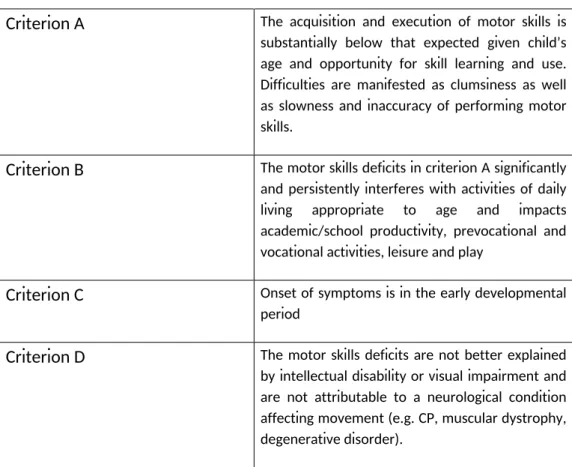
Table 1: DSM V (APA, 2013) diagnostic criteria for DCD
Criterion A The acquisition and execution of motor skills is substantially below that expected given child’s age and opportunity for skill learning and use. Difficulties are manifested as clumsiness as well as slowness and inaccuracy of performing motor skills.
Criterion B The motor skills deficits in criterion A significantly and persistently interferes with activities of daily living appropriate to age and impacts academic/school productivity, prevocational and vocational activities, leisure and play
Criterion C Onset of symptoms is in the early developmental period
Criterion D The motor skills deficits are not better explained by intellectual disability or visual impairment and are not attributable to a neurological condition affecting movement (e.g. CP, muscular dystrophy, degenerative disorder).
The diagnosis of DCD is made by a clinical synthesis of the history (developmental and medical), physical examination, school or workplace report and individual assessment using psychometrically sound and culturally appropriate standardized tests (DSM V, APA, p 74, 2013).
The current criteria have only recently been revised and important differences from previous criteria include the removal of an IQ discrepancy and the acknowledgment that many
children meet the criteria for more than one developmental disorder, and so for the first time, dual diagnoses are permitted. This is a point to which I will return later. In addition the terms ‘severe DCD’ and ‘moderate or probable DCD’ have started to appear in the literature to highlight the different severity of DCD and refer to cut off points on a standardized test. Severe DCD refers to scores of less than the 5% cut off and probable or moderate DCD refers to scores between the 5 and 15% on a standardized test of movement ability.
Current Understanding of the Nature of DCD
motor performance (Smits-Engelsman et al., 2012); the neural correlates of DCD (Peters et al., 2013) and two reviews on physical activity and fitness in children with DCD (Rivilis et al., 2011; Cairney & Velduizen, 2013). Furthermore, European clinical guidelines have been published on definition, diagnosis and intervention for DCD (Blank et al., 2012) and a briefing note on diagnosis of DCD by the UK college of Occupational Therapy (COT, 2013) has also been published, reflecting considerable interest and importance of the condition.
So what do we know? Firstly, it is important to understand that research findings are inevitably going to reflect the areas that were examined and these in turn will reflect the paradigms used in order to understand the condition. An example of this is shown in research involving examining deficits in order to understand the underlying cause of the observed behavior. As Wilson and colleagues note from their recent review, earlier studies reflected a more cognitivist approach, where behavior is explained by defining the set of internal cognitive processes that support it, for example working memory and executive function, and so many of the research findings reflected visuospatial deficits, response inhibition and dual task performance deficits (Wilson et al., 2012). Whereas alternative paradigms, such as dynamic systems perspective, where the assumption is the interaction of the individual, multiple task and environmental constraints in the organization of movement, have shown deficits in rhythmic coordination and inter limb coordination in children with DCD (Wilson et al., 2012).
However, what is clear from research studies is that children with DCD differ significantly from typically developing children in numerous areas of motor activity, such as strength, stamina and fatigue (Hands & Larkin, 2002) and physical fitness (Cairney et al., 2010) and this in turn impacts on their function and interaction in every day life. Returning to our current understanding of human development involving reciprocal interaction of the child’s biology and psychology, behavior and environment, it is likely that a child with motor deficits will encounter different interactions with their environment and this in turn will shape their development. For example, children with poor motor ability are more likely to select passive activities and further limit their opportunities for motor practice and experience.
Furthermore, other non-motor characteristics have also regularly been observed in children with DCD, such as attention difficulties, social difficulties and specific learning difficulties (Lingam et al., 2010). Do these associated conditions cause secondary difficulties such as problems with self-esteem, anxiety etc. or are they part of the biology and psychology of the condition? Returning to our understanding of the reciprocal interactional nature of
development – is it chicken or egg?
Current Understanding of the Impact of DCD on Education and Development
disorder rather than to change as the child develops (Hulme & Snowling, 2009). A few longitudinal studies comparing DCD to typically developing children (TDC) have been reported and provide empirical evidence that DCD persists into adolescence (Losse et al., 1991; Geuze & Borger, 1993; Cantell, Smyth & Ahonen, 2003) and into adulthood
(Rasmussen & Gillberg, 2000). What is less clear, however, is how to predict the prognosis for each child and some studies appear to suggest a group that may ‘catch up’ and improve motor performance around the time of adolescence (Cantell et al., 2003; Visser et al., 1998). It appears not only is DCD a heterogeneous condition (Wilson & McKenzie, 1998), for
example, with some children presenting with gross motor difficulty, some with fine motor and some with both, but some children may also have non motor difficulties in areas such as attention control, language, social interaction and reading to name a few. Indeed some children’s non-motor problems actually meet the criteria for other developmental disorders, such as Attention Deficit and Hyperactivity Disorder (ADHD), Specific Language Impairment (SLI), Autistic Spectrum Disorder (ASD) and Dyslexia (Missiuna et al., 2011; Hill, 1998; Green & Baird et al., 2002). Yet, so far, little is known in detail about the impact of additional disorders on the outcomes for children with DCD.
Furthermore, distinction between the severity of DCD, which is often overlooked in studies, may also prove to be important, because even children who present with
‘probable/moderate DCD’ appear to go on to encounter significant difficulties in areas such as response inhibition (Chen, Wilson & Wu, 2012); reduced physical activity (Green, Lingam et al. 2011), and reduced proficiency in activities of daily living at home and school (Wang, Tseng et al. 2009). These warrant attention, yet little is known about their trajectory. Moreover differential effects are important when considering the impact of intervention, studies that have investigated intervention over time have also stated difficulty identifying which children will respond better to intervention than others (Sugden & Chambers, 2006; Green et al., 2008).
So why is this important in educational research? Well, apart from the high prevalence of the condition in children, there is considerable empirical evidence that without identification and intervention children with DCD experience difficulty playing ball games, participating in organized sports, getting dressed and poor handwriting (Magalheas, Cardoso & Missiuna, 2011). Furthermore they are at serious risk from bullying (Campbell et al., 2012), poor self-worth (Piek et al., 2006), depression (Missiuna et al., 2014), reduced participation in physical activity and increased risk of obesity (Cairney et al, 2010), academic underachievement (Losse et al., 1991) and even delinquency (Rasmussen & Gillberg, 2000)
Yet few of these studies report whether the children with DCD had other non-motor
what is already known about the trajectories for some of these other associated conditions in order to better understand or predict their influence in children with DCD.
Understanding Trajectories for Associated Developmental Disorders
Some studies have been reported about the trajectories for children with other associated developmental disorders. For example children with SLI perform much worse than the national average in all subjects, despite special access arrangements (Knox, 2002) and are at risk of bullying (Knox & Conti- Ramsden, 2003). Moreover, there are three identified
subtypes for ADHD: the inattentive, the hyperactive/impulsive and the combined type. Yet these do not appear to remain stable over time, with children shifting from one type to another suggesting that the subtypes are neither stable nor discrete (Larsson et al., 2011). However, the inattentive type appears to be associated with poorer academic achievement (Polderman et al., 2010).
Furthermore, children comorbid with two conditions seem to fare worse than those with one. For example Germano et al. (2010) suggest that children comorbid for ADHD and reading difficulty had more severe cognitive deficits and worse academic and behavioural outcomes and Cohen et al., (2000) found that children with ADHD and language impairment had worse academic achievement than those with each condition alone. Jang et al. (2013) found that children with ASD were two to four times more likely to experience mental health problems than typically developing children and, when ASD was comorbid with ADHD, the children experienced higher rates of anxiety and depression and more severe symptoms than children with ASD or ADHD alone. Indeed the DSM V (APA, 2013) diagnostic criteria acknowledge that prognosis appears worse for children with both ADHD and DCD.
Thus it is highly likely that children with DCD will have additional associated characteristics and it becomes important to identify those children at risk and instigate some intervention as soon as possible.
Outstanding Issues for Understanding Stability and Change in DCD
Despite mounting research, several areas surrounding DCD still remain unclear. One such area under question is the ratio of boys and girls diagnosed with developmental disorders. Missiuna and colleagues found that in population-based studies the ratio of children meeting the diagnostic criteria was more equal than that often reported in clinic populations
behavioral outbursts, as do their younger male counterparts (Skuse, 2014). Skuse argues that current diagnostic tools for ASD contain gender-biased questions and so miss important symptoms in girls (Skuse, 2014). Could this point to underlying structural bias and social barriers in existing research? Surely if issues such as this are not explored we run the danger of amplifying existing shadows in research. The question then remains how do such issues relate to development? What is the interaction between these various factors, and what does this look like in terms of outcomes for the children? Indeed it should not be
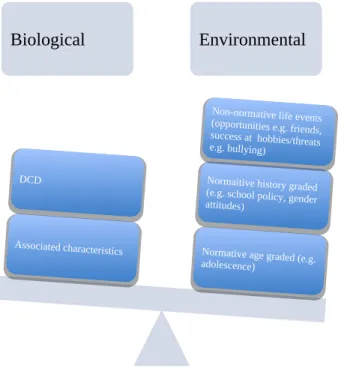
overlooked that late diagnosis may well contribute to the behavioural outcomes reported. Perhaps we can return to Baltes et al. (1980) and the ideas of the three areas of influence on lifespan development, to investigate these issues.
Biological Environmental
Normative age graded (e.g. adolescence)
Normaitive history graded (e.g. school policy, gender attitudes)
Non-normative life events (opportunities e.g. friends, success at hobbies/threats e.g. bullying)
Associated characteristics DCD
Fig. 1: Possible influence systems on lifespan development in DCD
Important future research questions should therefore include: Does motor ability in DCD really improve in adolescence? Is it the same for girls? Is there gender difference in
Concluding remarks
It has been discussed that, despite a growing body of research, a number of areas of
potential influence have been overlooked that may illuminate our understanding of stability and change in DCD. These include a closer investigation of the differential effects of severity of DCD, gender influence and the existence of associated characteristics. Although we know children with DCD differ significantly from TDC we do not have sufficient information to determine how they differ from each other. Furthermore, we do not yet have detailed information about the nature of interaction of children with DCD within their environmental context and, given the reciprocal interactional nature of development, this constitutes a large gap; for example, what about influence of personality or family or school resources? So is there a way forward? I intend to address this gap in my doctoral research by applying the innovative conceptual framework proposed by Bronfenbrenner’s bioecological model (Bronfenbrenner, 1979), as it provides a theoretical framework with which to examine this interaction in more detail at different levels of analysis. Bronfenbrenner explained the importance for human development of interrelated ecological levels, conceived of as nested systems (Lerner, 2005 in Bronfenbrenner, 2005) and these can be applied at child, family, school and community levels.
This will be operationalized by mixed methods research allowing both the empirical
measurement of the severity of DCD, the number and type of associated characteristics and any change in motor ability over time, whilst allowing examination of the context of change. It also permits the possibility of showing children’s agency in their own development by giving voice to their own experiences and even possible solutions to the problems they encounter. Here is an opportunity to for research to look in ‘the shadows’ and question whether referral processes and tools accurately reflect issues for both genders and for children with both DCD and DCD with associated characteristics and throw additional light on the nature of stability and change over time.
References
American Psychiatric Association (APA) 2013.Diagnostic and Statistical Manual of Mental Disorders, Fifth edition (DSM V).Arlington, VA: American Psychiatric Association. Baltes, P.B., Reese, H.W. and Lipsitt, L.P. 1980. Life-span developmental psychology. Annual
Review of Psychology,31, pp. 65-110. In: Smith, P.K., Cowie, H. and Blades, M. 2003. Understanding Children’s Development, 4thedition, Oxford: Blackwell Publishing.
Bergman, L.R., Eklund, G. and, Magnusson, D. 1994. Studying individual development:
problems and methods. In: Magnusson, D., Bergman, L.R., Rudinger, G, and Torestad, B. ed(s). 1994.Problems and methods in longitudinal research: stability and change. Cambridge: Cambridge University Press.
Blank, R., Smits-Engelsman, B., Polatajko, H. and Wilson, P. 2012. European Academy for Childhood Disability (EACD): Recommendations on the definition, diagnosis and intervention of developmental coordination disorder (long version). Developmental Medicine and Child Neurology.54, pp. 54-93.
Bronfenbrenner, U. 2005.Making Human Beings Human, bioecological perspectives on human development. London: Sage Publications.
Bronfenbrenner, U. 1979.The Ecology of Human Development, experiments by nature and design. Cambridge, USA: Harvard University Press.
Cairney, J., Hay, J., Veldhuizen, S., Missiuna, C. and Faught, B. 2010. Developmental coordination disorder, sex and activity deficit over time: a longitudinal analysis of participation trajectories in children with and without coordination difficulties. Developmental Medicine and Child Neurology.52, pp. 67-72.
Cairney, J. and Veldhuizen, S. 2013. Is developmental coordination disorder a fundamental cause of inactivity and poor health-related fitness in children?Developmental Medicine and Child Neurology,55,pp. 56-58.
Camden, C., Wilson, B., Kirby, A., Sugden, D. and Missiuna, C. 2014. Best practice principles for management of children with developmental coordination disorder (DCD): results of a scoping review.Child care, health and development, 41, pp. 147-159.
Campbell, W.N., Missiuna, C. and Vaillancourt, T. 2012. Peer victimization and depression in children with and without motor coordination difficulties. Psychology in Schools.
49(4), pp. 328-341
Cantell, M., Smyth, M. and Ahonen, T. 2003. Two distinct pathways for developmental coordination disorder: Persistence and resolution.Human Movement Science22, pp. 413-431.
Chen, W., Wilson, P. and Wu, S. 2012. Deficits in the covert orienting of attention in children with Developmental coordination disorder: does severity of DCD count? Research in Developmental Disabilities33, pp. 1516-1522.
College of Occupational Therapy 2013 Briefing on diagnosis of Developmental coordination disorder.
Geuze, R. and Borger, H. 1993. Children who are clumsy: five years later. Adapted Physical Quarterly, 1993, 10, pp. 10-21.
Germano, E., Gagliano, A. and Curatolo, P. 2010. Comorbidity of ADHD and Dyslexia. Developmental Neuropsychology, 35 (5) pp. 475-493.
Green, D., Baird, G., Barnett, A.L., Henderson, L., Huber, J. and Henderson, S.E. 2002. The nature and severity of motor impairment in Asperger’s syndrome: a comparison with Specific developmental disorder of motor function. Journal of child Psychology and Psychiatry, 43: 5 pp. 655-668.
Green, D., Chambers, M.E. and Sugden, D.A. 2008. Does subtype of developmental coordination disorder count: is there a differential effect on outcome following intervention? Human Movement Science, 27 pp. 363-382.
Green, D., Lingam, R., Mattocks, C., Riddoch, C., Ness, A. and Emond, A. 2011. The risk of reduced physical activity in children with probable developmental coordination disorder: a prospective longitudinal study. Research in Developmental Disabilities 32 pp. 1332-1342.
Hadders-Algra, M. 2000. The neuronal group selection theory: promising principles for understanding and treating developmental motor disorders. Developmental Medicine and Child Neurology 2000, 42: pp. 707-715.
Hands, B. and Larkin, D. 2002. Physical fitness and Developmental Coordination Disorder, chapter 9 in Cermak, S. and Larkin, D. 2002.Developmental Coordination Disorder, New York: Delamar Thomson Learning.
Hill, E.L. 1998. A dyspraxic deficit in specific language impairment and developmental coordination disorder? Evidence from hand and arm movements. Developmental Medicine and Child Neurology, 1998, 40: pp. 388-395.
Hulme, C. and Snowling, M. 2009. Developmental Disorders of Language and Cognition. Chichester: Wiley-Blackwell.
Jang, J., Matson, J.L., Williams, L.W., Turek, K., Goldin, R.L. and Cervantes, P.E. 2013. Rates of comorbid symptoms in children with ASD, ADHD and comorbid ASD and ADHD. Research in Developmental Disabilities 34 pp. 2369-2378.
language impairment (SLI): does school placement matter?International Journal of Language and communication disorders 2003, Vol. 38, No. 1, pp. 1-12
(doi:10.1080/13682820304817)
Lerner, R.M. 2005. Foreward in Bronfenbrenner, U. 2005.Making Human Beings Human, bioecological perspectives on human development, London: Sage Publications. Lingam, R., Hunt, L., Golding, J., Jongmans, M. and Emond, A. 2009. Prevalence of
Developmental Coordination Disorder using the DSM-IV at 7 years of age: a UK population-based study.Paediatrics, Vol.123, No. 4, April 2009.
Lingam, R., Golding, J., Jongmans, M., Hunt, L., Ellis, M. and Emond, A. 2010. The association between developmental coordination disorder and other developmental traits. Paediatrics, Vol. 126, No.5, November, 2010, e1109-e1118. DOI:10.1542/peds.2009-2789.
Larsson, H., Dilshad, R., Lichtenstien, P. and Barker, E. 2011. Developmental trajectories of DSM IV symptoms of attention deficit/hyperactivity disorder: genetic effects, family risk and associated psychopathology. Journal of Child Psychology and Psychiatry, 52: 9 pp. 954-963.
Losse, A., Henderson, S., Elliman, D., Knight, E. and Jongmans, M. 1991. Clumsiness in children – do they grow out of it? A 10 year follow up study. Developmental Medicine and Child Neurology, 1991, 33, pp. 55-68.
Magalheas, L.C., Cardoso, A.A. and Missiuna, C. 2011. Activities and participation in children with developmental coordination disorder: a systematic review. Research in
Developmental Disabilities 32 pp. 1309-1316.
Missiuna, C., Cairney, J., Pollock, N., Russell, D., Macdonald, K., Cousins, M., Veldhuizen, S. and Schmidt, L. 2011. A staged approach for identifying children with developmental coordination disorder from the population. Research in Developmental Disabilities, 32 pp. 549-559.
Missiuna, C., Cairney, J., Pollock, N., Campbell, W., Russel, D., Macdonald, K., Schmidt, L., Heath, N., Veldhuizen, S. and Cousins, M. 2014. Psychological distress in children with developmental coordination disorder and attention-deficit hyperactivity disorder. Research in Developmental Disabilities 2014 article in press
http://dx.doi.org/10.1016/j.ridd.2014.01.007
Pearsall-Jones, J., Piek, J. and Levy, F. 2010a. Developmental Coordination Disorder and cerebral palsy: Categories or a continuum?Human Movement Science 29 pp. 787-798.
Peters, L.H., Maathuis, C. and Hadders-Algra, M. 2013. Neural correlates of developmental coordination disorder. Developmental Medicine and Child Neurology, 55: pp. 59-64. Piek, J., Baynam, G. and Barrett, N. 2006. The relationship between fine and gross motor
ability, self-perceptions and self-worth in children and adolescents. Human Movement Science 25 pp. 65-75.
Polderman, T., Boomsma, D., Verhulst, F. and Huizink, A. 2010. A systematic review of prospective studies on attention problems and academic achievement. Acta Psychiatrica Scandanavica 2010: 122: pp. 271-284.
Rasmussen, P. and Gillberg, C. 2000. Natural outcome of ADHD and Developmental
Coordination Disorder at age 22 years: A controlled, longitudinal, community-based study. Journal of American Academy of Child Adolescent Psychiatry, 31: 11,
November 2000.
Rivalis, I., Hay, J., Cairney, J., Klentrou, P., Liu, J. and Faught, B. 2011. Physical activity and fitness in children with developmental coordination disorder: a systematic review. Research in Developmental Disabilities, 32 pp. 894-910.
Smits-Engelsman, B., Blank, R., Van Der Kray, A., Mosterd-Van Meijs, R., Vlugt-Van Den Brand, E., Polatajko, H. and Wilson, P. 2013. Efficacy of interventions to improve motor performance in children with developmental coordination disorder: a
combined systematic review and meta-analysis. Developmental Medicine and Child Neurology 2013, 55: pp. 229-237.
Smith, P.K., Cowie, H. and Blades, M. 2003. Understanding Children’s Development, 4th
edition, Oxford: Blackwell Publishing.
Skuse, D. 2014. All in the Mind, BBC Radio 4, 17/6/2014.
Sugden, D.A. and Chambers, M.E. 2006. Stability and change in children with developmental coordination disorder.Child: Care, health and development, 33, 5, pp. 520-528. Sugden, D.A., Chambers, M. and Utley, A. 2006. Leeds consensus statement, Developmental
Coordination as a Specific Learning Difficulty. ESRC research seminar series 2004-2005 in collaboration with A. Kirby, Dyscovery Centre, Cardiff.
Wang, T., Tseng, M., Wilson, B. and Hu, F. 2009. Functional performance of children with developmental coordination disorder at home and at school. Developmental Medicine and Child Neurology 2009, 51: pp. 817-825.
Wilson, P.H., Ruddock, S., Smits-Engelsman, B., Polatajko, H. and Blank, R. 2012.
Understanding performance deficits in developmental coordination disorder: a meta-analysis of recent research. Developmental Medicine and Child Neurology, 2013, 55, pp. 217-228.
Wilson, P. and McKenzie, B. 1998. Information processing deficits associated with
Developmental Coordination Disorder: A meta-analysis of research findings. Journal of Child Psychology and Psychiatry. 39 (6) pp. 829-840.