Interventions for Software Security
Creating a Lightweight Program of Assurance Techniques for Developers
Charles Weir Security Lancaster Lancaster University
United Kingdom [email protected]
Ingolf Becker Security and Crime Science University College London
United Kingdom [email protected]
James Noble
Engineering and Computer Science Victoria University of Wellington,
New Zealand [email protected]
Lynne Blair
Computing and Communications Lancaster University
United Kingdom [email protected]
M. Angela Sasse Computer Science University College London
United Kingdom [email protected]
Awais Rashid Bristol Cyber Security Group
Bristol University United Kingdom [email protected]
Abstract— Though some software development teams are highly effective at delivering security, others either do not care or do not have access to security experts to teach them how. Unfortu-nately, these latter teams are still responsible for the security of the systems they build: systems that are ever more important to ever more people. We propose that a series of lightweight inter-ventions, six hours of facilitated workshops delivered over three months, can improve a team’s motivation to consider security and awareness of assurance techniques, changing its security culture even when no security experts are involved. The interventions were developed after an Appreciative Inquiry and Grounded The-ory survey of security professionals to find out what approaches work best. They were then validated in fieldwork with a Partici-patory Action Research study that delivered the workshops to three development organizations. This approach has the potential to be applied by many development teams, improving the security of software worldwide.
Keywords— Developer centered security; software security; soft-ware developer; intervention; action research
I. INTRODUCTION
Software security and privacy are becoming major issues: almost every week we hear that yet another organization’s soft-ware systems have been compromised [1]. While there are many aspects to security and privacy, the security of an organ-ization’s software clearly has a large impact on whether such breaches happen. Therefore, the effectiveness of development teams at creating secure software is vital1.
Many if not most developers, unfortunately, consider soft-ware security to be ‘not their problem’ [2]. Developers may ex-pect security to be handled by a different team; or consider it too expensive to incorporate without a significant drive from product management. In the past, many organizations have ad-dressed the issue with prescriptive instructions for development teams to follow or specifications of tools for developers to use; this approach of giving instructions to ‘passive’ developers has not been widely adopted [3].
1 Throughout this paper we use ‘secure’ and ‘security’ to refer to the security and privacy aspects of software development; and ‘developers’ to refer to all those involved with creating software: programmers, analysts, designers, test-ers, and managers.
Existing research has identified a range of well-understood assurance techniques [4] used by security professionals to help improve the security of a system. Yet if we are to improve soft-ware security in a wide range of teams, we need approaches that work where resources may be limited and security expertise un-available. So, in this paper we explore:
1. What are inexpensive ways to introduce such tech-niques within a software development team?
2. How can the techniques be introduced in situations where there are no security experts directly involved? This paper presents research into these questions: a survey of security professionals who work with software developers to address the first question; and based on the results, the subse-quent creation and trials of a package, ‘Developer Security Es-sentials’, to address the second.
The contribution of this paper is:
• Industry evidence that motivating developers to intro-duce security changes is a primary way of introducing security improvements in development teams
• Identification of eight primary techniques currently in use, including two types of motivational workshop not previously identified.
• Proof that a package based on these techniques can im-prove the security of code delivered by a development team that has no access to security experts.
II. BACKGROUND
Recent research related to assurance techniques to improve developer security has taken a variety of approaches. This sec-tion examines the existing academic literature and related pub-lications on the subject of helping and encouraging developers to improve their software security. We explore several areas in turn, examining the existing research available in each, and moving from technical to more sociological approaches.
Code Analysis Tools
There has been considerable recent security research into solving software security problems with code analysis tools. Five research groups [5]–[9] have created security defect detec-tion tools to help developers improve code, using feedback via IDEs or elsewhere. Nguyen et al. [8] explored the impact of their tool on Android developers, concluding a high value for ‘quick fixes’: changes requiring little effort on the part of the programmer. Xie et al. [10] explored the impact of their IDE-based security analysis tool for web applications on a sample of 21 students and 6 professionals and found two interesting con-clusions:
Users do not mind real-time warnings, but do not seem to want them to persist, even if they choose to ignore them. And even when creating secure code is relatively easy … users still need to be motivated to make the needed changes.
Adoption of Security-Enhancing Activities
A different approach to improving software quality has been via changes to development processes, and there has been significant research into applying such changes to software se-curity improvement. Indeed, prior to about 2010 the way of im-proving software security was a ‘Secure Development Lifecy-cle’ (SDL), a prescriptive set of instructions to managers, de-velopers and stakeholders on how to add security activities to the development process. De Win et al. [11] compare the three major SDLs of that time, OWASP’s CLASP, Microsoft’s SDL and McGraw’s Touchpoints, contrasting their features in the context of a simple project. Since 2010, SDLs have been re-placed by ‘Security Capability Maturity Models’ [12], which measure the effectiveness of corporate security enhancements rather than mandating how they are achieved.
Meanwhile, however, other research suggests resistance from development teams to adopting a prescriptive methodol-ogy. For example Conradi and Dybå found in a survey that de-velopers are skeptical about adopting the formal routines found in traditional quality systems [13]; others came to the same con-clusion [14]–[16]. Indeed Geer’s online survey of 46 develop-ers recruited from those already specializing in secure software development found only 30% of them using SDLs [17]; Xiao et al.’s later survey of 40 developers [3], found only 2 using them. While these sample sizes were fairly small, their findings pro-vide a plausible explanation for the abandonment of SDLs.
Taking a different approach, Such et al. investigated the economics of software security, surveying 150 security special-ists to analyze the economics of different assurance techniques
[4]. The survey generated a taxonomy of twenty assurance tech-niques and found wide variations in the perceived cost-effec-tiveness of each.
Consultancy and Training Interventions
Several research teams have explored the impact of train-ing and external involvement on teams’ delivery of secure soft-ware. Türpe et al. [18] explored the effect of a single penetra-tion testing session and workshop on 37 members of a large ge-ographically-dispersed project. The results were not encourag-ing; the main reason was that the workshop consultant high-lighted problems without offering much in the way of solutions.
Poller et al.’s later study [19] followed an unsuccessful at-tempt to improve long term security practices in an agile devel-opment team of about 15 people. The study investigated the ef-fect of security consultants whose task ‘was not to advise the product group on how to change their organizational routines, but to challenge and teach them about security issues of their product’. This proved insufficient, for two reasons. First, pres-sure to add functionality meant that attention was not given to security issues. Second, developers had trouble ‘improving se-curity’ because their normal work procedures and ways of structuring their work did not support that kind of quality goal. The authors concluded that successful interventions would need “to investigate the potential business value of security, thus making it a more tangible development goal”; and that security is best promoted as a team, not individual, effort.
Improving Security Experts’ Interactions with Developers Recent work by Ashenden and Lawrence [20] took a different approach. They used an Action Research method to investigate and improve the relationships between security professionals and business people in a single company, and found the approach effective in improving communication, though no evidence is yet available of longer-term impact.
Other work has also investigated the impact of different kinds of relationship on software security: Werlinger et al.’s ethnographic study and survey [21] explored the relationships of security practitioners (mainly operations staff) on the effec-tiveness of security, and proposed several tool enhancements to improve this, particularly in the control of information being communicated to other stakeholders. Haney and Lutters found from a survey of security practitioners [22] that the role is ser-vice-oriented and involves both customer service and advocacy skills.
Limitations of Existing Literature
The code analysis tools required other interventions to get them adopted; and the other approaches required both security professionals and interventions that were costly in terms of ef-fort involved. We are aware of no academic literature investi-gating lightweight ways to encourage developers to adopt suc-cessful security practices. In this work we offer one possible such approach.
III. METHODOLOGY
Survey Methodology
The open nature of the question ‘What are effective ways to introduce such techniques within a software development team?’ required an inductive approach. We therefore inter-viewed a range of professional software security practitioners to ask how they achieved successful security-enhancing inter-ventions to software development teams. Interviewees were chosen opportunistically; our connections in industry provided introductions to a number of successful, and mostly senior, practitioners with considerable experience of helping teams achieve software security. We interviewed 15 different experts from 14 different organizations. 12 were based in the UK, 2 in Germany, and one in the USA. They are described briefly in Table 1, which assigns an identifier, P1 to P15, to each.
The successfulness of their interventions was self-reported; all the organizations involved, however, have strong track rec-ords in achieving secure software. Specifically, P3, P4, P5, P6, P8 and P10 are from well-known organisations associated with effective security; P1, P2, P7, P9, P11, P12, P14, P15 and P16 are in businesses successfully selling secure services; and P13 is respected in the security research community. The survey was not looking for certainty that the interventions led to secure software; instead it sought the most promising techniques.
We wanted a firm basis on which to postulate theories, and therefore adopted Grounded Theory [23], which provides an ac-ademically rigorous basis, and has been widely used to investi-gate software development practice [24].
To achieve as good communication as possible, all the in-terviews were face-to-face, usually at the interviewee’s work-place. Our questions aimed to draw out what participants had found most effective, and what they had seen to be most effec-tive in other teams. To emphasize the posieffec-tive, we used open questions about successful techniques known to the interview-ees, avoiding asking questions about perceived problems or un-successful approaches. This approach relates to the Apprecia-tive Inquiry school of Action Research [25], and indeed we used questions based on Appreciative Inquiry’s ‘Discovery’ of best past practice, and ‘Dream’ of ideal future practice.
Survey Analysis
Grounded Theory involves line by line textual analysis of research data, in this case of transcriptions of the interviews along with notes and comments made by the interviewer. We used guidelines from a survey of previous software engineering Grounded Theory studies [24] to guide the research. As is typ-ical in such work, we recorded the interviews and transcribed them manually. The lead author did the coding, categorizing and sorting operations on the data using the commercial tool NVivo. The final code book consisted of 4 families of codes and a total of 132 codes, applied to 1125 quotations in total.
In our coding, we were looking for the assurance tech-niques used by our interviewees and their ways of introducing them; and for comments and strategy related to them and their effectiveness. We also wanted a ‘core category’ to cover the
2 The Action Research is ‘Participatory’ in that research subjects worked with researchers to create security outcomes; the subjects did not influence the in-tervention design.
widest possible scope of concepts discussed by the interview-ees.
Section V.A describes how we then used the learning, from this ‘core category’ and the identified techniques, as a basis to construct an ‘intervention package’ to be delivered by the re-searchers to development teams, based on the best practice de-scribed by the interviewees.
Package Trials Methodology
Given that the researchers themselves directly influence the behavior of the research participants—the researchers
pro-vide the intervention—an ethnographic research approach was
deemed inappropriate. Instead an accepted methodology, used in many forms of academic social research, including software engineering [26], [27], is Action Research [28]. This is an ap-proach to research in communities that emphasizes participa-tion and acparticipa-tion; Acparticipa-tion Research aims at understanding a situa-tion in a practical context and aims at improving it by changing the situation.
Specifically, we used Participatory Action Research [29], with the lead author working as ‘intervener’, directly with the participants2. We had a Pragmatic approach, since the intention
was to primarily to trial the impact of the interventions. This stage of the project involved only a single feedback cycle [30].
The key research question was: ‘What security effects did the intervention package have?’ To measure an effect, we needed a baseline with no intervention. A-B testing, requiring a different team working in parallel, was not practical. Instead, we used a longitudinal approach, deducing a baseline (‘no in-tervention situation’) from the initial situation plus a knowledge of the original plans by the team leaders to improve security over the same timescale.
First, we interviewed a selection of the future participants to establish a baseline in terms of their current understanding, practice and plans related to secure software development. We then carried out a series of intervention workshops with mem-bers of the development teams, led by the intervener. Finally, a suitable time after the final intervention workshop, we re-inter-viewed the same participants as before.
Package Trials Analysis
The recordings of the interviews and most of the work-shops—a total of 19 hours of audio—were transcribed and qualitatively analyzed. In an iterative process, two of the au-thors coded all transcripts. Initially both auau-thors used open cod-ing [23] on the first two hours of material, then agreed on a coding scheme based on that and the research questions. Dif-ferences in coding were discussed and resolved between us. This final code book consisted of 5 families of codes, making a total of 41 codes, applied to 1405 quotations in total.
the team, new activities related to security, and evidence of im-provements in the security of developed software; we also rec-orded evidence of security activities and awareness before the start of the interventions.
Both studies were approved by the Lancaster University Faculty of Science and Technology Research Ethics committee.
IV. SURVEY RESULTS
From the survey we derived an overview theme (‘core cat-egory’), and also the experts’ successful intervention practices.
Overview Theme
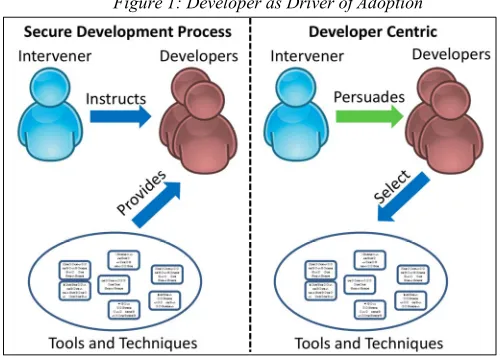
In our analysis, the key theme we found was the perception of developers themselves as the drivers of security adoption. This is different from the perception of developers as agents to be controlled by a ‘Secure Development Process’.
Figure 1 illustrates the difference. In the Secure Develop-ment Process approach, the role of the intervener is to tell the developers what to do, and to provide the techniques and tools that the developers are required to use [11]. Instead we found our interviewees promoted a ‘Developer Centric’ approach, with role of the intervener as sensitizing the developers to their security needs, allowing them to choose for themselves which tools and techniques to use.
One interviewee described the difference as follows: It’s not just about educating the developers, well, I guess it was, but we had to get the developers on side, the devel-opers had to understand why we were doing this, as well as what it was that we needed them to do, so it was a kind of two pronged thing. (P2)
Most implied security motivation as a fundamental require-ment:
I think the learning component is a very strong thing, and the second thing is they are proud people, and they want to produce code they are proud of, and also producing se-curity needs to be part of that. (P6)
They were clear that even those with power in the organization still have to work by persuasion, not coercion. For example, even though P8 is Head of Security for a large multinational company, he told us:
So, working with Dev Teams ... you can’t go in and say, “you must do it this way”, it would never work… What you have got to do is go in there, and you have to convince them that it is to their advantage to do it that way. (P8) Intervention Practices
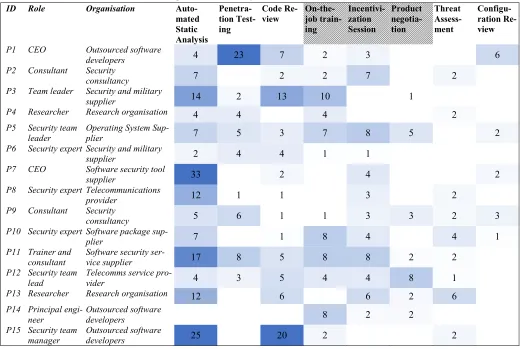
The coding process generated a set of intervention tech-niques, as shown in Table 1. The majority of these are already well known and documented; for these we have used the termi-nology defined by Such et al. [4]. However, three of the prac-tices—On-the-job Training, Incentivization Session, and Product Negotiation—are new in the context of security as-surance techniques. These, shaded diagonally in the table, are specific to motivating and empowering developers to make their own security decisions. These techniques are not novel, since they are in use in industry; they are however seldom dis-cussed in developer security literature.
Table 1 also provides an indication of the share of the in-terviewees’ discussion taken by each technique. The numbers indicate the percentage of identified quotations for each inter-viewee that discussed each intervention technique; cells are highlighted based on their values.
All interviewees but one discussed Automated Static Analysis tools, many in some depth, though few described them as particularly valuable. Several warned about the risk of developers believing that using a tool on its own would achieve security.
To a degree, yes, they are useful. … But the danger with them is that you think that is making your code secure, and it is not. It is just finding a certain class of problems in it. (P2)
Many interviewees stressed the importance of Penetration Testing. As discussed in Section II.C, this can be part of an Incentivization Session; however, it is more often used as a supporting technique.
If the team has developed something new… and it is a sig-nificant change, we might get it externally pen tested, if we think that we can’t test it ourselves. (P12)
Unfortunately, all forms of Penetration Testing require expertise; this expertise is in short supply currently, which makes the technique unsuitable for teams on a budget.
I fairly often get rolled out to persuade clients that [a pen test] is necessary. It is quite expensive. (P1)
Code Review, scheduled meetings or pair programming to analyze code for security defects, was also popular. It requires a particular culture in the programming team:
It is in the culture. We do reviews; we always have to do reviews. We set things up, and it is not regarded as a sec-ond class. (P6)
On-the-Job Training was widely used. This could be in-formal training (only P11 provided in-formal training),
[Our security specialist] will … provide a show and tell … a few times a year. (P1)
mentoring,
[image:4.612.46.296.241.420.2]We send people on site, and we embed them into other teams. Our processes … [are] then taken up by the cus-tomer [developer] teams. (P3)
or via a ‘security champion’ selected from the team:
Security Champions, … one person in the team more in-terested in security. ... You need that person in a team, you actually do. (P11)
The Incentivization Session, to motivate developers might be a one-to-one talk,
Everyone who joins [this company] gets a security talk… And it includes examples of things that have gone wrong and why, and how badly these things can go wrong, and how easy it is to screw it up, and some pointers on things to read about, to learn about. (P1)
or a training course or workshop.
So, we run a very large-scale education program … where we … tell developers exactly what happens in the real world, how TalkTalk was hacked, how Sony was hacked… Then we also show them all the stuff that our red teams do—our internal hackers—which really scares them! (P5)
Surprising for us was the importance of the technique of Product Negotiation, empowering product management to make security decisions.
[A security enhancement] will go into a planning cycle. You can’t just … say ‘everyone has to do this tomorrow’
because people are already maxed. It has to be planned. (P5)
This requires developers to be able to explain security risks and mitigation costs:
We don’t normally struggle with getting developers to do things; we do struggle with management to understand that security has an implementation cost, and if you want security features you need different sprints to be allocated. (P11)
Threat Assessment, or ‘threat modelling’ was seen as im-portant not just for its innate value:
Your answer to any kind of security question anywhere should almost always start with a threat model. (P9) but also for the learning the modelling process provides to developers:
Threat modelling: what I see as the big benefit here is… putting the team into the perspective, to think about the functionality from a different aspect, from a different point of view. (P10)
Configuration Review, choosing secure components and frameworks, and keeping them up-to-date, was the last of the techniques described:
[image:5.612.59.579.70.419.2]So, from an attacker’s point of view, you look at whatever the system is, you don’t need to look at the code at all,
Table 1: Percentage Discussion Share for Each Interviewee about Each Intervention
ID Role Organisation
Auto-mated Static Analysis
Penetra-tion Test-ing
Code Re-view
On-the-job train-ing
Incentivi-zation Session
Product negotia-tion
Threat Assess-ment
Configu-ration Re-view
P1 CEO Outsourced software
developers 4 23 7 2 3 6
P2 Consultant Security
consultancy 7 2 2 7 2
P3 Team leader Security and military
supplier 14 2 13 10 1
P4 Researcher Research organisation 4 4 4 2
P5 Security team
leader Operating System Sup-plier 7 5 3 7 8 5 2
P6 Security expertSecurity and military
supplier 2 4 4 1 1
P7 CEO Software security tool
supplier 33 2 4 2
P8 Security expertTelecommunications
provider 12 1 1 3 2
P9 Consultant Security
consultancy 5 6 1 1 3 3 2 3
P10 Security expertSoftware package
sup-plier 7 1 8 4 4 1
P11 Trainer and consultant
Software security
ser-vice supplier 17 8 5 8 8 2 2
P12 Security team lead
Telecomms service
pro-vider 4 3 5 4 4 8 1
P13 Researcher Research organisation 12 6 6 2 6
P14 Principal engi-neer
Outsourced software
developers 8 2 2
P15 Security team manager
Outsourced software
developers 25 20 2 2
what [components] would they have used to produce this... And you’ll find code exploits! You’ll find the OWASP top 10 [types of vulnerability] in one [compo-nent] alone! (P9)
V. CREATING AND TRIALLING THE INTERVENTIONS
PACKAGE
As our next step, we wanted to translate these findings into practical support for development teams, including those where resources may be limited and security expertise unavailable. This section explores how we developed a package of activities, ‘Developer Security Essentials’, to provide a low-cost interven-tion for such teams, and describes the commercial development teams who trialed it.
To trial the package, we arranged to work with three dif-ferent commercial development teams, to find out the impact of the package on each.
Creating the Package
Each intervention identified from the survey had a variety of forms, suitable for different development budgets, team sizes, and team cultures. Looking at the list of interventions, we observed that three—Incentivization Session, Threat Assess-ment, and On-the-Job Training—are ‘process interventions’ and can be implemented for limited cost by an external facilita-tor. Three more—Automatic Static Analysis, Configuration Review, and Product Negotiation—require commitment by the developers to go ahead. And the last two—Penetration Testing and Code Review—are often considered relatively ex-pensive [31] and outside the range of activities affordable for some development teams; the authors’ experience as consult-ants suggested that persuading teams to spend several thousand pounds on commercial Penetration Testing, or to change cul-ture to support Code Review, would both be difficult. We, therefore, concentrated on the first three, and used opportunities within the consultancy to consider the remaining interventions. Note that the researchers carrying out the interventions were not themselves ‘security experts’, and lacked specific knowledge of the issues and solutions for each of the domains and applica-tions involved; we needed approaches that drew on the knowledge and expertise of the developers themselves.
Our biggest challenge was to find a suitable way to provide the Incentivization Session. The versions described by our
in-terviewees were not suitable for a lightweight intervention. In-stead we used the ‘Agile Security Game’ [32], invented by the lead author. This was based on the ‘Mumba’ role-playing game, invented by Frey [33] to help elicit participants’ prior experi-ence of real-life security attacks.
Threat Assessment, too, was also challenging to imple-ment. Much of the literature [34], [35] describes a heavyweight process taking a while to set up and requiring considerable knowledge of possible technical threats, preferably with sup-port from a professional with a detailed understanding of both the industry sector and current cyber threats to it. Neither knowledge nor expert were available. However, as technical lead for a major mobile money project the lead author had faced this problem and developed a lightweight brainstorming pro-cess to identify threats and mitigations. This had delivered a banking product with successful security [36]. Accordingly, we decided to trial the same approach here.
From the authors’ own consultancy experience, and the ex-perience of Türpe et al. and Poller et al. [18], [19], we knew that a single intervention was unlikely to be successful on its own. Therefore, we agreed to a monthly meeting, as On-the-Job Training; its main purpose was to act as a regular ‘nudge’ of the importance of security.
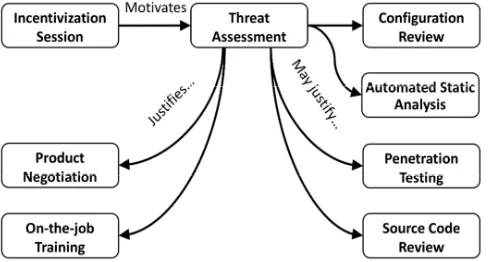
To introduce the remaining interventions, we used an ad-hoc approach, as shown in Figure 2. The facilitator mentioned and discussed each of these interventions with the developers during the Threat Assessment, the mitigation discussions, and the subsequent sessions, using comments from the developers as cues.
The Development Teams Involved
We trialed the package with three development teams in three different companies, selected opportunistically; the fol-lowing were the teams involved. The individual members we interviewed are identified using the team letter and a number: ‘A1’.
1) Team A
Team A works for a company employing around 50 people in the UK. Their software product manages sensitive manage-ment data, and is used by some very large organizations, includ-ing several that are household names.
The company development teams show some of the enthu-siasm and characteristics of a start-up. We observed a culture of technological improvement, and a willingness to embrace change. We worked with some dozen developers, including team lead A1 and programmers with a wide range of experience (such as A2, A3, A4).
2) Team B
Team B is a tiny non-profit start-up, run on a part-time ba-sis by two professionals: an educationalist and a software pro-ject manager. Their purpose is to provide work experience for promising young people who would otherwise be unable to get initial jobs in Information Technology. They undertake pro-bono software development projects for charities.
[image:6.612.52.296.553.684.2]The development team constituted the educationalist as team lead (B1), the project manager (B2), and two student de-velopers (B3, B4).
3) Team C
Team C work for a well-known and long-established multi-national company, providing services via the Internet to a range of companies and individuals. The product is mature software, with a policy of continuous improvement.
We worked with a dozen team members including Quality Assurance (C1, C4), managers (C2) and programmers (C3, C5). All the team were competent and experienced professionals; in contrast to Team A we noted more emphasis on inter-depart-mental politics.
During the interventions, Team C’s company changed pol-icy on testing and three of our participants took redundancy. The changes meant that we managed only one ‘continuous re-minder’ session after two months, though we achieved exit in-terviews with all of the participants except C4.
VI. TRIAL RESULTS
This section describes the results of the Action Research-based trials in terms of cost, impact on the development pro-cess, and learning by the participants.
Intervention Time Requirements
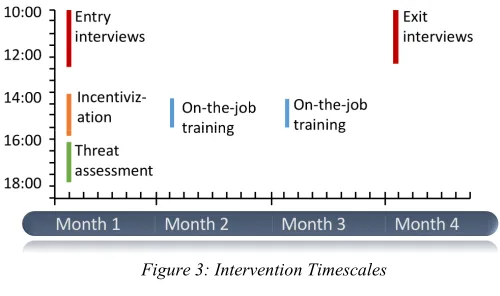
Figure 3 shows the timeline for the program. It will be seen that, despite three months elapsed time, the total effort required from the intervener was only a total of two days, of which four hours were research interviews and not part of the intervention itself. So, including preparation, the total time spent by the in-tervener was less than two working days for each company. In terms of team effort involved, the approximate participant num-bers and times involved were as shown in Table 2.
There were no significant financial costs apart from travel costs for the researcher.
We can therefore summarize the cost of this set of inter-ventions as follows:
Intervention facilitator: 15 man hours Development team: 20 - 70 man hours Financial cost: minimal
The cost of the interventions, therefore, is within the scope of a wide range of organizations.
Security Outcomes for Each Team
This section identifies the concrete outcomes attributable to the interventions. Quotations are attributed to the speaker where identifiable, or else to the appropriate session.
1) Outcomes for Team A
There were at least two significant improvements in Team A’s product and process security as a result of the interventions. Beforehand, the developers had been thinking of security im-provements as line by line imim-provements in the code they them-selves had written. Afterwards, they understood that their most effective security improvements were likely to be elsewhere:
I find it a little concerning that there are so many attacks that we traditionally haven’t mitigated against. (A Work-shop)
Specifically, they made two changes. First, they introduced a component security checker to their build cycle, and embarked on a program of updating and replacing components according to their security vulnerabilities.
We [have built] the OWASP dependency checker into our build process, … and established a process for how we deal with new vulnerabilities in existing libraries, or add-ing new libraries or upgradadd-ing libraries. (A1)
Second, they identified their own existing customers as competitors with each other, and therefore potential ‘attackers’, and identified that the permissions functionality was therefore a major privacy issue; making fixes in this area was likely to give security wins:
I have a … task to check user permissions, and check that a user has access to that specific entity or a set of those entities (A2)
They also introduced team sessions studying the OWASP ‘Top Ten’ vulnerabilities These had been mooted prior to the interventions but were only carried out after the initial work-shops. And in later On-the-job Training sessions they estab-lished that the prioritization of security features required prod-uct management, not development, decisions.
That is where the priority call would come from. I think [Product Management] do understand it, … but there is always going to be that element of weighing up (Group Session)
2) Outcomes for Team B
[image:7.612.46.296.53.201.2]Team B, with very little prior security experience, had more potential improvements in process and in product secu-rity. As a result of the first Threat Assessment process they made several changes.
[image:7.612.45.296.555.662.2]Figure 3: Intervention Timescales
Table 2: Participant Time Cost in Person Hours
Elapsed Team A Team B Team C
Incentivization
session 1.5 18 6 18
Threat modelling workshop
1.5 18 6 18
Follow-up 1 1 6 4
Follow-up 2 1 6 4 8
Exit workshop 1 10 4
First, they introduced improved security for development workstations and code repositories, against the threat of mali-cious code modifications or access to personal data:
[We did] an audit on our computer systems: on our lap-tops… and the laptops that the students are bringing. We do scans, and make sure that the antivirus and anti-mal-ware protection is all up-to-date. (B1)
Next, they changed the planned design of the website not to use local databases for storing form data:
We said about the form, that it would send an email to the applicant. (B1)
Plus, the student developers improved their security hygiene: I also update my data a lot more, I back it up, not just to a file server but with a USB. (B2)
The laptop I’ve been using, I’ve been making sure that the anti-virus is up to date. (B4)
The Threat Assessment for Team B’s later project led to caution with web service access keys:
We need to make sure that we are absolutely totally aware of how we make sure that those [API] keys don’t become public, and that all students know that we have to do that. (B1)
Finally, Threat Assessment is now being used for later projects: We developed a threat model at the start of our current project and it is used in the code reviews and testing. (B1) Given that Company B’s purpose is to help introduce stu-dents to IT roles, we note also that one student developer, B4, showed aptitude for identifying security threats in the work-shops, and expressed an interest in a security-related career.
3) Outcomes for Team C
There were no identifiable improvements to Team C’s pro-cess or product as a result of the interventions. The primary rea-son for this is that their security knowledge and practice as a team were already good: better than they may have realized.
I’m not sure too many changes were made. (C1) Thus, while some security improvements were made,
I’m much happier because we started working with Two Factor Authentication… for our client… admins… (C5) we believe these were the result of a wider awareness of security needs within the organization rather than because of the interventions (authentication issues were not discussed in the workshops). Indeed, the two main issues highlighted from the
Threat Assessment—control of physical access to developer workstations and the relationship with the company’s security department—were outside the control of the participants in the workshops.
The participants did, though, identify improved communi-cation and understanding resulting from the interventions:
I think it got everyone talking about security a bit more, especially within our team... There was a lot of security things going on that I didn’t know about. (C1)
Summary of Techniques Adopted
Table 3 summarizes the above outcomes: shaded cells dicate new assurance techniques adopted as a result of the in-tervention process.
Security Learning as a Result of the Interventions
The outcomes in the previous section are valuable, but even more important for long term impact is the ability of the teams and individuals within them to implement secure software in future. To assess this, the exit interviews included an open ques-tion to elicit whether the participants appreciated the need for Threat Assessment and other interventions. We coded state-ments that showed evidence of an appreciation and internaliza-tion of the various techniques.
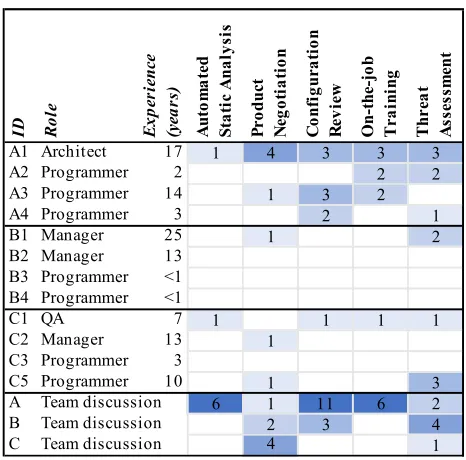
Table 4 shows the results of that analysis, along with brief descriptions of each participant. The top lines (A1–C5) con-sider the exit interviews for each participant and identify how many statements indicated internalized understanding of each assurance technique. The bottom three lines consider group dis-cussions towards the end of the process and show the number of participant statements that showed similar understanding.
[image:8.612.323.556.66.296.2]There was little discussion of Penetration Testing and Code Review, and only A1 showed appreciation of the Incen-tivization Session; these are not shown in the table.
Table 3: Summary of Techniques Adopted
Team A Team B Team C
Incentiviza-tion Session Provided by Intervener Provided by Intervener Provided by Intervener Threat
Assessment Led by Intervener Introduced for subsequent projects Led by Intervener On-the-Job Training Instigated study of OWASP T10
Introduced due to intervention
Already in place
Product Negotiation
Introduced due to Intervention
Already in place
Configuration
Review Introduced due to Intervention Introduced due to intervention Already in place Automated S.
Analysis Already in place
Pen. Testing Already in place Already in place
Code Review Already in place Already in place
Table 4: Evidence of Learning
Key: deeper shades of blue indicate higher counts
ID Ro le Ex p er ie n ce (y ea rs ) Au to m a te d St at ic A n al ys is Pr od u ct Ne g ot ia ti o n Co n fi gu ra ti o n Re v ie w On -t he -j o b Tr a ini n g Thr ea t As se ss m en t
A1 Architect 17 1 4 3 3 3
A2 Programmer 2 2 2
A3 Programmer 14 1 3 2
A4 Programmer 3 2 1
B1 Manager 25 1 2
B2 Manager 13
B3 Programmer <1 B4 Programmer <1
C1 QA 7 1 1 1 1
C2 Manager 13 1
C3 Programmer 3
C5 Programmer 10 1 3
A Team discussion 6 1 11 6 2
B Team discussion 2 3 4
[image:8.612.49.295.560.735.2]As Table 4 shows, though both teams B and C imple-mented many of the assurance techniques, many of the individ-uals we interviewed did not evince a strong understanding of the reasons and approach to do so for future projects. Note how-ever that since there were no explicit interview questions about each technique, the omission may not reflect the true under-standing of the participants involved.
However, members of the Company A gained a good un-derstanding of the techniques; we can conclude they did not im-plement Automatic Static Analysis as a positive decision based on discussion. The leaders of teams A and B indicated they had learned aspects of future Product Negotiation:
I guess, one challenge, as always, is playing what we, as architects, believe are the most pressing security con-cerns, against what customers are asking for in terms of dealing with security concerns. (A1)
I would …feel confident to be able to talk to people about our security policies and how we manage security (B1) And of Threat Assessment:
[If I was advising a team on security] I think brainstorm-ing threats and vulnerabilities and assets is really helpful. (A1)
And one of the things that I think we probably are doing, as a result of being part of this process, is that auditing, that thinking things through first, what are our security issues, what are our risks, and how we are going to deal with those, in terms of the design. (B1)
VII. DISCUSSION AND FUTURE WORK
This research shows that an affordable program of inter-ventions, costing limited effort on the part of a facilitator and a development team—and not requiring the involvement of a se-curity expert—can measurably improve the ability of that team to deliver secure software. Specifically, we conclude from Ta-ble 3 that such a program can be effective with teams with lim-ited or no security experience.
The impact of the interventions differed hugely between teams: not only in the nature of the security issues addressed; but also in the teams’ responses to the interventions and in how they benefitted. Team A introduced better development pro-cesses; Team B gained an awareness of several specific security improvements and the need for Threat Assessment; and for Team C the interventions prompted better communication and understanding (Section VI).
The successes identified came through the developers’ choices. As the expert survey concluded (Section IV.A), to be effective a program needs to motivate rather than simply direct the teams involved. And, indeed, the interventions were suc-cessful to the extent that they could change the developers’ thinking, understanding and motivation. The interventions in-volved, predominantly, conversations between developers, al-lowing them to learn mainly from each other, and to motivate themselves rather than respond to outside pressures. Table 3 and Table 4 suggest that this was an effective motivation and learning approach.
Future Work
We identified two key areas for future work on the inter-ventions. First, the participant-driven nature of the workshops meant that not every technique was covered for every team: Team B did not discuss Automated Static Analysis, Penetra-tion Testing, nor Code Review, for example. One participant suggested a checklist or take-away sheet after the first day’s presentation:
I think maybe some sort of tick sheet in terms of “have you got these things in place?” to take away, that might be a good addition (A1).
Second, for the program to scale to a wider number of par-ticipant teams, we need program leaders who appreciate the aims of the different sessions, such as the importance of moti-vation to achieve team empowerment hence Incentivization Session. Yet Table 4 suggests that this knowledge was not suc-cessfully conveyed to many of the participants. Nor did the par-ticipants learn how to use the program themselves. Also, to use the techniques, participants will need to facilitate some of the sessions; it is unclear yet what this will require.
In future we plan to address this problem in a second Ac-tion Research cycle, by providing the intervenAc-tions program materials in book form, and by coaching ‘interveners’ to pro-vide the training workshops and techniques in their own devel-opment teams, merely supported by the researchers.
Considering the design of the trials, the limited number of development teams involved, and the relatively short three-month term of each trial, both offer scope for improvement. Furthermore, the changes resulting from the interventions were self-reported: the trials do not provide evidence that the techniques were indeed implemented; nor that they improved the security of the resulting code.
To address the first issue, our next Action Research cycle will involve a larger number of teams; to address the second we plan follow-up interviews after one year where possible for each team; to address the last, we plan to request details of im-provements made and vulnerabilities removed.
The data set from this larger set of teams may also permit analysis of which assurance methods can be applied success-fully in which kinds of software engineering practice.
VIII. CONCLUSION
Lightweight, facilitation-based, interventions of the kind reported here offer the potential to help software development teams with limited current security skills to improve their soft-ware security. Widescale adoption of programs of this kind will empower developers, and play a much-needed role in improv-ing software security for all end users.
REFERENCES
[1] Forbes, “Top 2016 Cybersecurity Reports Out From AT&T, Cisco, Dell, Google, IBM, McAfee, Symantec And Verizon,” Forbes, 2017. [Online]. Available:
https://www.forbes.com/sites/stevemorgan/2016/05/09/top-2016- cybersecurity-reports-out-from-att-cisco-dell-google-ibm-mcafee-symantec-and-verizon/. [Accessed: 25-Sep-2017].
[2] J. Xie, H. R. Lipford, and B. Chu, “Why Do Programmers Make Security Errors?,” in IEEE Symposium on Visual Languages and
[3] S. Xiao, J. Witschey, and E. Murphy-Hill, “Social Influences on Secure Development Tool Adoption: Why Security Tools Spread,”
in ACM Conference on Computer Supported Cooperative Work,
2014, pp. 1095–1106.
[4] J. M. Such, A. Gouglidis, W. Knowles, G. Misra, and A. Rashid, “Information Assurance Techniques: Perceived Cost Effectiveness,”
Comput. Secur., vol. 60, pp. 117–133, 2016.
[5] Y. R. Smeets, “Improving the Adoption of Dynamic Web Security Vulnerability Scanners,” Radboud University, NL, 2015. [6] J. Xie, B. Chu, H. R. Lipford, and J. T. Melton, “ASIDE: IDE
Support for Web Application Security,” in 27th Annual Computer
Security Applications Conference, 2011, p. 267.
[7] I. Pribik and A. Felfernig, “Towards Persuasive Technology for Software Development Environments: An Empirical Study,” in
International Conference on Persuasive Technology, 2012, pp. 227–
238.
[8] D. C. Nguyen, D. Wermke, M. Backes, C. Weir, and S. Fahl, “A Stitch in Time: Supporting Android Developers in Writing Secure Code,” in ACM SIGSAC Conference on Computer &
Communications Security, 2017.
[9] L. N. Q. Do, K. Ali, B. Livshits, E. Bodden, J. Smith, and E. Murphy-Hill, “Just-in-time Static Analysis,” in 26th ACM SIGSOFT
International Symposium on Software Testing and Analysis, 2017,
pp. 307–317.
[10] J. Xie, H. R. Lipford, and B. B.-T. Chu, “Evaluating Interactive Support for Secure Programming,” in SIGCHI Conference on
Human Factors in Computing Systems, 2012, pp. 2707–2716.
[11] B. De Win, R. Scandariato, K. Buyens, J. Grégoire, and W. Joosen, “On the Secure Software Development Process: CLASP, SDL and Touchpoints Compared,” Inf. Softw. Technol., vol. 51, no. 7, pp. 1152–1171, Jul. 2009.
[12] G. Mcgraw, S. Migues, and J. West, “Building Security in Maturity Model 8.” 2017.
[13] R. Conradi and T. Dybå, “An Empirical Study on the Utility of Formal Routines to Transfer Knowledge and Experience,” ACM
SIGSOFT Softw. Eng. Notes, vol. 26, no. 5, pp. 268–276, 2001.
[14] B. Hardgrave, F. Davis, and C. Riemenschneider, “Investigating Determinants of Software Developers’ Intentions to Follow Methodologies,” J. Manag. Inf. Syst., vol. 20, no. 1, pp. 123–151, Jul. 2003.
[15] M. Lavallee and P. N. Robillard, “The Impacts of Software Process Improvement on Developers: A Systematic Review,” in 34th
International Conference on Software Engineering, ICSE 2012,
2012, pp. 113–122.
[16] C. K. Riemenschneider, B. C. Hardgrave, and F. D. Davis, “Explaining Software Developer Acceptance of Methodologies: A Comparison of Five Theoretical Models,” IEEE Trans. Softw. Eng., vol. 28, no. 12, pp. 1135–1145, Dec. 2002.
[17] D. Geer, “Are Companies Actually Using Secure Development Life Cycles?,” IEEE Computer, vol. June, pp. 12–16, 2010.
[18] S. Türpe, L. Kocksch, and A. Poller, “Penetration Tests a Turning Point in Security Practices? Organizational Challenges and Implications in a Software Development Team,” in Second
Workshop on Security Information Workers, 2016.
[19] A. Poller, L. Kocksch, S. Türpe, F. A. Epp, and K. Kinder-Kurlanda, “Can Security Become a Routine? A Study of
Organizational Change in an Agile Software Development Group,”
in ACM Conference on Computer Supported Cooperative Work,
2017, pp. 2489–2503.
[20] D. Ashenden and D. Lawrence, “Security Dialogues : Building Better Relationships,” IEEE Secur. Priv. Mag., vol. 14, no. 3, pp. 82–87, 2016.
[21] R. Werlinger, K. Hawkey, D. Botta, and K. Beznosov, “Security Practitioners in Context: Their Activities and Interactions with Other Stakeholders within Organizations,” Int. J. Hum. Comput.
Stud., vol. 67, no. 7, pp. 584–606, 2009.
[22] J. M. Haney and W. G. Lutters, “Skills and Characteristics of Successful Cybersecurity Advocates,” in Third Workshop on
Security Information Workers, 2017.
[23] B. G. Glaser and A. L. Strauss, The Discovery of Grounded Theory:
Strategies for Qualitative Research. Chicago: Aldine Transaction,
1973.
[24] K. Stol, P. Ralph, and B. Fitzgerald, “Grounded Theory in Software Engineering Research: A Critical Review and Guidelines,” in 38th
International Conference on Software Engineering, 2015, pp. 120–
131.
[25] D. L. Cooperrider and D. Whitney, “Appreciative Inquiry: A Positive Revolution in Change,” Appreciative Inq., p. 30, 2005. [26] H. Sharp, Y. Dittrich, and C. R. B. De Souza, “The Role of
Ethnographic Studies in Empirical Software Engineering,” IEEE
Trans. Softw. Eng., vol. 42, no. 8, pp. 786–804, 2016.
[27] Y. Dittrich, K. Rönkkö, J. Eriksson, C. Hansson, and O. Lindeberg, “Cooperative Method Development: Combining Qualitative Empirical Research With Method, Technique and Process Improvement,” Empir. Softw. Eng., vol. 13, no. 3, pp. 231–260, 2008.
[28] W. F. Whyte, Participatory Action Research. Sage Publications, Inc, 1991.
[29] R. L. Baskerville, “Investigating Information Systems with Action Research,” Commun. AIS, vol. 2, no. 3es, p. 4, 1999.
[30] K. Petersen, C. Gencel, N. Asghari, D. Baca, and S. Betz, “Action Research as a Model for Industry-Academia Collaboration in the Software Engineering Context,” in International Workshop on
Long-Term Industrial Collaboration on Software Engineering,
2014, pp. 55–62.
[31] J. M. Such, A. Gouglidis, W. Knowles, G. Misra, and A. Rashid, “The Economics of Assurance Activities,” 2015.
[32] C. Weir, “The Agile App Security Game – Leader’s Instructions,” 2017. [Online]. Available:
https://www.securedevelopment.org/app/download/11233441072/T heAgileAppSecurityGame.zip. [Accessed: 28-Mar-2018]. [33] S. Frey, “Mumba Role Playing Game: The Rulebook.” 2016. [34] A. Shostack, Threat Modeling: Designing for Security. John Wiley
& Sons, 2014.
[35] Microsoft, “Microsoft Secure Development Lifecycle.” [Online]. Available: https://www.microsoft.com/en-us/sdl/. [Accessed: 29-Mar-2018].