This is a repository copy of Workplace physical activity interventions: a systematic review
.
White Rose Research Online URL for this paper:
http://eprints.whiterose.ac.uk/3578/
Article:
Dugdill, L, Brettle, A, Hulme, C et al. (2 more authors) (2008) Workplace physical activity
interventions: a systematic review. International Journal of Workplace Health
Management, 1 (1). pp. 20-40. ISSN 1753-8351
promoting access to White Rose research papers
Universities of Leeds, Sheffield and York
http://eprints.whiterose.ac.uk/
This is an author produced version of a paper published in International Journal
of Workplace Health Management.
White Rose Research Online URL for this paper:
http://eprints.whiterose.ac.uk/3578/
Published paper
Workplace Physical Activity Interventions: a Systematic Review
Authors: Dugdill L1, Brettle A2, Hulme C3, McCluskey S4and Long AF5
1Centre for Public Health Research, University of Salford.
Address for correspondence: Allerton Building, Frederick Road Campus, University of Salford, Greater Manchester, M5 4WT.
2Centre for Nursing, Midwifery and Collaborative Research, University of Salford.
3 Academic Unit of Health Economics, University of Leeds
4University of Leeds
5School of Healthcare, University of Leeds
Keywords: Workplace, physical activity, interventions, effectiveness, systematic review.
Workplace Physical Activity Interventions: a Systematic Review
Abstract
Purpose:This paper reports a synopsis of a recent systematic review of the literature regarding the effectiveness of workplace physical activity interventions, commissioned by the National Institute for Health and Clinical Excellence (NICE), UK (Dugdill et al., 2007).
Methods: A search for English-language papers published between 1996-2007 was conducted using 12 relevant databases and associated grey literature. Search protocols and analysis regarding study quality as recommended by NICE were utilised (NICE, 2006). Key inclusion criteria were 1) workplace intervention aiming to increase physical activity, 2) intervention aimed at working adults, 3) intervention initiated/endorsed by the employer, 4) physical activity outcome. Thirty three studies (38 papers) met the inclusion criteria and were independently reviewed (checked by 2 reviewers) with a narrative synthesis of findings.
Findings:Fourteen studies were graded as++(high quality) or+(good quality). Evidence from previous systematic reviews was inconclusive. Data regarding the effectiveness of stair walking interventions was limited and intervention effects were short-lived. Three public sector studies provided evidence that workplace walking interventions using pedometers can increase daily step counts. One good quality study reported a positive intervention effect on walking to work behaviour (active travel) in economically advantaged female employees. There was strong evidence that workplace counselling influenced physical activity behaviour. There is a dearth of evidence for small and medium enterprises (SMEs).
Limitations:Due to the necessary UK focus and time constraints, only studies from Europe, Australia, New Zealand and Canada were included.
Workplace Physical Activity Interventions: a Systematic Review
Background
The benefits of a physically active lifestyle in health promotion and disease prevention are well-documented (DH, 2004; WHO, 2004). Populations, especially in the developed world, are becoming increasingly sedentary in their behaviour (WHO, 2004). Every year, physical inactivity is estimated to cause 600,000 deaths in the EU region (about 6% of the total), and conditions such as obesity contribute to over 1 million more deaths. Approximately 31% adults (aged 15+), in the European Region, take sufficient physical activity (that is moderate physical activity for 30 minutes on at least 5 days of the week)(Sjostrom et al., 2006). This varies across countries, from 44% taking sufficient physical activity for health in the Netherlands, to 28% in the UK and only 23% in Sweden (Cavill et al., 2006).
The more sedentary nature of work, alongside increasing use of the car is affecting a decline in physical activity behaviour amongst adults (National Travel Survey, 2002). ‘Not enough time’is often the most commonly cited barrier to being physically active. Indeed, the UK workforce tends to spend more hours at work than most other EU countries and have less paid leave/annum (The Work Foundation, 2005). Although the workplace setting affords great potential for the promotion of physical activity, managers have been slow to respond to these opportunities, perhaps because they have yet to be convinced of the effectiveness of such interventions. Against this background, the National Institute for Health and Clinical Excellence (NICE) commissioned a review of workplace physical activity intervention effectiveness with a view to developing guidelines for public health for England (NICE, 2006).
Objectives
Take in Figure 1 here.
The electronic searches identified 4564 unique references. Titles and abstracts of all these references were screened by one member of a team of five. Full papers of relevant studies were screened by one member of a team of four (n=423). At both stages, a minimum 20% sample of papers were checked by a second reviewer. Studies were eligible for inclusion if they fell within the criteria set out in Figure 1 (n=68).
Take in Figure 2 here.
Due to the necessary UK focus and time constraints, only studies from Europe, Australia, New Zealand and Canada with similar cultural contents and potential applicability to the UK were included. A total of 38 papers representing 33 studies were included, and critically appraised using tools provided in the NICE protocol (2006). Each study was reviewed by one team member, checked by another two and graded according to the following criteria: ++ high quality,+good quality,-poor quality.
Results
Systematic Reviews
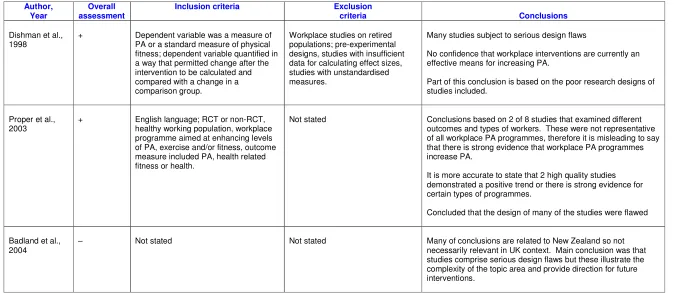
Three systematic reviews were identified for inclusion (Table 1). These reviews examined the effectiveness of workplace interventions which aimed to increase physical activity, and/or fitness and/or health in employees. Two of these were of good quality and both included US studies. One (Dishman et al., 1998) concluded that workplace physical activity interventions have a small, non-significant positive effect on physical activity or fitness, which is not sustained over time. The other (Proper et al., 2003) concluded that there was a significant intervention effect for physical activity, but this was made on the basis of only two high quality studies (both RCTs). Both reviews (Dishman et al., 1998; Proper et al., 2003) reported that the methodological quality of the published literature was weak due to poor study design, and outcomes being measured solely by self-reported physical activity. Hence, there is inconclusive review-level evidence that workplace physical activity interventions have a significant effect on physical activity.
Stair Walking
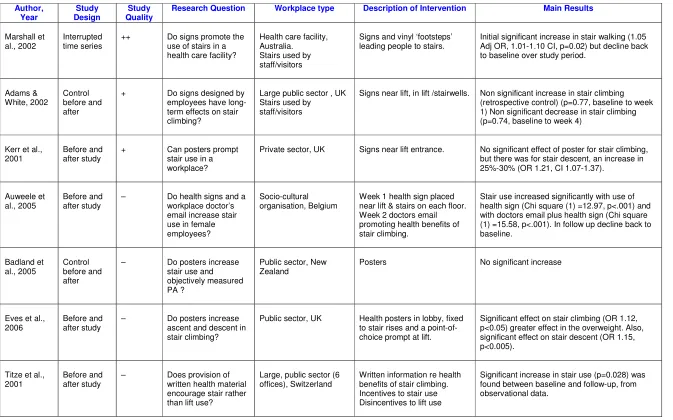
Seven studies (Table 2) assessed the effectiveness of health signs (posters) or health messages/information (written, email or doctor’s email) on workplace stair walking. With the exception of one study (Badland et al., 2005) measurement consisted of behavioural observation of stair/lift usage in a workplace setting rather than objective tracking of individual physical activity behaviour. Three of the studies (Titze et al., 2001; Auweele et al., 2005; Eves et al., 2006) used overt rather than covert methods of observation which may have influenced employee behaviour. Baseline data varied widely with 158,350 observational counts for stair/lift usage (and employee self-reported data, n=53) in the best quality study (Marshall et al., 2002) to only a few thousand observational counts (Titze et al., 2001; Auweele et al., 2005). Another methodological weakness was the lack of control over who entered the building during the observational periods and inability to distinguish employees from visitors in the sample counts (Adams and White et al., 2002; Marshall et al., 2002). Two studies (Titze et al., 2001; Marshall et al., 2002) used automatic counting devices on lifts and stairs but there were inconsistencies when correlated with observational data (Titze et al., 2001).
Four studies (Kerr et al., 2001; Marshall et al., 2002; Auweele et al., 2005,Eves et al., 2006) demonstrated that the use of posters/signs can increase stair (instead of lift) use. Two other studies (both poor quality) reported significant increases in stair use which were sustained between baseline and follow up (Titze et al., 2001; Eves et al., 2006) However, in the other two studies, stair usage declined back to baseline levels at follow up (Auweele et al., 2005) or by the end of the study period(Marshall et al., 2002) suggesting that the effectiveness of posters is short term. Kerr at al., (2001) reported no significant intervention effect for stair climbing only stair descent. In addition, two studies (Adams and White, 2002; Badland et al., 2005) reported a decline in stair use/step count. When posters were visible in the workplace mean step counts decreased (Badland et al., 2005). In summary, the studies identified showed little evidence of the effectiveness of interventions to increase stair walking; further research is required.
Walking Interventions
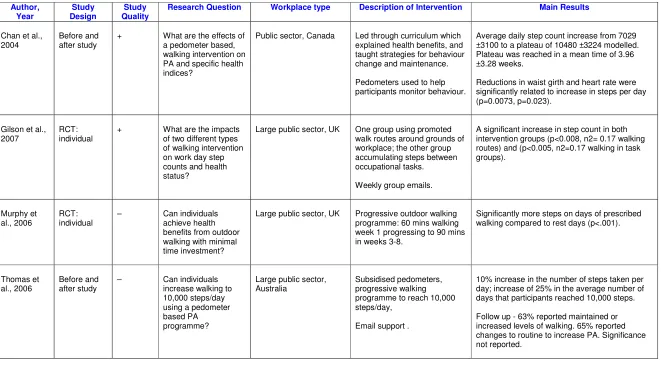
Four studies which aimed to increase walking (step counts) in employees (but not as part of active travel) met the inclusion criteria (Table 3). Three of the studies (Chan et al., 2004; Murphy et al., 2006; Gilson et al., 2007) measured physical activity objectively with pedometers (giving daily step counts of employees). All the studies relied on self-reported step counts/walking activity which could result in bias and over-estimation.
The study by Gilson et al. (2007) aimed to assess the impact of two different types of walking intervention (n= 70). This study showed a significant effect for both intervention groups compared with controls (p<0.008). Small non-significant changes were reported in % body fat, waist circumference and blood pressure. Chan et al. (2004) reported an average daily step count increase from 7,029 ± 3,100 to a plateau of 10,480 ± 3,224 Significant decreases were reported in BMI, waist girth and resting heart rate (p<0.001 for all).
Murphy et al. (2006) reported significantly more steps on days of prescribed walking compared to rest days (p<0.001) but the sample size was small (n=37) and it was unclear if the mean number of steps had increased. Thomas et al. (2006) reported a 10% increase in the number of steps taken per day and a 25% increase in the average number of days that participants reached 10,000 steps.At follow-up, 63% of participants reported maintained or increased levels of walking and 65% reported changes to routine to increase physical activity. However, it was unclear
if these changes were statistically significant. (Please review)In summary, evidence from public sector studies indicated that workplace walking interventions using pedometers can increase daily step counts, where accompanied by facilitated goal setting (Chan et al., 2004; Thomas et al., 2006), diaries and self monitoring (Chan et al., 2004; Murphy et al., 2006; Thomas et al., 2006) and walking routes (Gilson et al., 2007).
Take in Table 3 here.
Active Travel
Three studies were identified for inclusion, all of which primarily aimed to increase the active travel of employees (Mutrie et al., 2002; Wen et al., 2005; Gatersleben and Appleton, 2007). (Table 4)
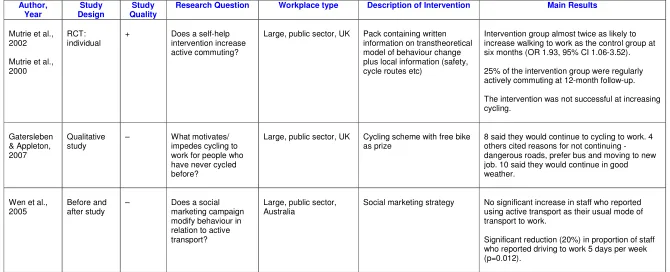
Mutrie et al. (2002) reported on the ‘Walk in to Work Out’intervention which aimed to increase walking and cycling to work through the use of written health materials. Participants were mainly economically advantaged women. The intervention group (received health pack at baseline), were almost twice as likely to report walking to work after 6 months as the control (received pack at 6 months): a significant effect was seen. Twenty five percent of the intervention group were also regularly, actively commuting at 12 month follow-up. However, the intervention had no significant effect on cycling.
Wen et al. (2005) assessed the impact of a social marketing campaign on active travel (walking and cycling) to work. Although no significant increase in reported active travel to work at 12 weeks was found, there was a significant reduction in the proportion of staff who reported driving to work 5 days/week (p=0.012).
In summary, there is evidence from one UK public sector workplace (Mutrie et al., 2002) that a walking and cycling to work campaign, through use of written health materials distributed to employees, can increase walking (but not cycling) to work in economically advantaged women.
Other - including multi-component interventions
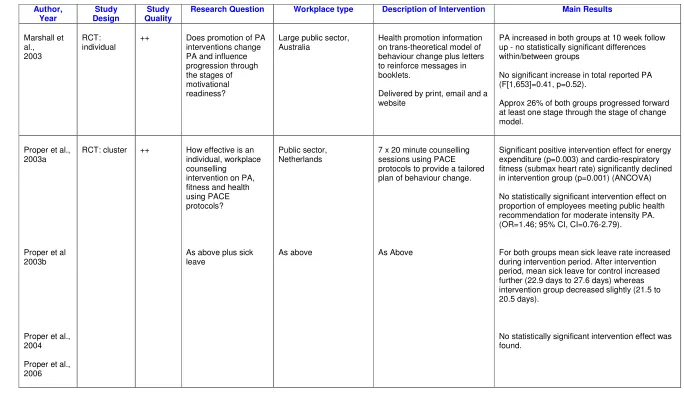
Sixteen studies (Table 5) were included, covering a range of intervention types (counselling, motivational interviewing, health checks, screening, health promotion messages, information, led activity sessions, active travel or combinations of all of these i.e. multi-component programmes). For many, it was difficult to attribute intervention effects to any particular component of the intervention due to their complexity (multi-component). In several instances increasing physical activity was only one of the primary objectives of the intervention.
Four of the studies (Talvi et al., 1999;; Proper et al., 2003; Aittasalo et al., 2004; Osteras and Hammer, 2006) indicated that workplace counselling had positive effects on physical activity. Of the two studies that focused solely on counselling, Proper et al (2003) showed positive effects on increasing physical activity compared to the control. Another (Aittasalo et al., 2004) whilst showing positive improvements, showed no significant difference between groups receiving counselling, counselling and fitness testing or the control. The other two studies (Talvi et al., 1999; Osteras and Hammer, 2006) were multi-component interventions that included counselling, motivational interviewing and health screening, making it difficult to attribute effects to a single factor.
Discussion
The purpose of this review was to clarify the effectiveness of workplace physical activity interventions with respect to physical activity behaviour change. It builds on the previous evidence base as presented by Dishman et al., (1998) and Proper et al., (2003) which overall revealed inconclusive evidence of effectiveness.
Our review differs somewhat in approach from previous reviews. Dishman et al (1998) used a quantitative approach to quality assessment of studies whereas both Proper et al., (2003) and this review used a qualitative approach. A paradigmatic shift in thinking about the relative importance of the RCT, as a gold standard in intervention research, has led to a more inclusive model with a broader range of study designs becoming more widely accepted within intervention research (Coote et al., 2004). This is especially important in the evaluation of complex programmes (which fits the model of many interventions included in this review) where the application of a RCT design may be methodologically and ethically inappropriate. This review embraced this wider philosophy.
The issue of the quality of the evidence remains important. Both Dishman et al. (1998) and Proper et al. (2003) concluded that the methodological quality of studies in this field was generally poor. Proper et al. (2003) graded 6 RCTs (from 26 included studies) as of high methodological quality. Our review, embracing additional study designs found that 3 of the included studies were of high quality (++) and 11, of good (+) quality. The high category included one interrupted time series (Marshall et al., 2002), one individual RCT (Marshall et al., 2003) and one cluster RCT (Proper et al., 2003). Overall, we would suggest that there is a slight improvement in the quality of study since the publication of the review by Proper et al. (2003).
Conclusion
In this review the evidence of the effectiveness of stair walking interventions was limited and intervention effects were short-lived (Marshall et al., 2002; Auweele et al., 2005). Three public sector studies provided evidence that workplace walking interventions using pedometers can increase daily step counts, if accompanied by: facilitated goal setting (Chan et al., 2004; Thomas et al., 2006), diaries and self monitoring (Chan et al., 2004; Murphy et al., 2006; Thomas et al., 2006) and walking routes (Gilson et al., 2007). One good quality study (Mutrie et al., 2002) reported a positive intervention effect on walking to work behaviour (active travel) in middle-class, female employees. There was strong evidence from four studies (Talvi et al., 1999;; Proper et al., 2003; Aittasalo et al., 2004; Osteras and Hammer, 2006) that workplace counselling influenced physical activity behaviour. Further, well-designed research studies are required to boost the developing evidence base on workplace physical activity interventions. Emphasis needs to be on researching workplaces that have so far been under-represented – the SME and voluntary sectors in particular.
Acknowledgments
References
ADAMS, J. & WHITE, M. (2002). A systematic approach to the development and evaluation of an intervention promoting stair use.Health Education Journal, 61, 272-286.
ADDLEY, K., MCQUILLAN, P. & RUDDLE, M. (2001) Creating healthy workplaces in Northern Ireland: evaluation of a lifestyle and physical activity assessment programme.Occupational Medicine (Oxford),51, 439-449.
AITTASALO, M., MIILUNPALO, S. & SUNI, J. (2004) The effectiveness of physical activity counseling in a work-site setting. A randomized, controlled trial.Patient Education & Counseling,55, 193-202.
AUWEELE, Y. V., BOEN, F., SCHAPENDONK, W. & DORNEZ, K. (2005) Promoting stair use among female employees: The effects of a health sign followed by an e-mail.Journal of Sport & Exercise Psychology,27, 188-196.
BADLAND, H. M. & SCHOFIELD, G. M. (2004) Physical Activity Interventions in the Workplace: A Review and Future for New Zealand Research.New Zealand Journal of Sports Medicine32, 14-19.
BADLAND, H. M. & SCHOFIELD, G. M. (2005) Posters in a sample of professional workplaces have no effect on objectively measured physical activity.Health Promotion Journal of Australia,16, 78-81.
CAVILL, N., KAHLMEIER, S. AND RACIOPPI, F. (2006) Physical Activity and Health in Europe: evidence for action. WHO Europe; Copenhagen.
CHAN, C. B., RYAN, D. A. & TUDOR-LOCKE, C. (2004) Health benefits of a pedometer-based physical activity intervention in sedentary workers.Preventive Medicine,39, 1215-1222.
DISHMAN, R. K., OLDENBURG, B., O'NEAL, H. & SHEPHARD, R. J. (1998) Workplace physical activity interventions.American Journal of Preventive Medicine,15, 344-361.
DUGDILL, L., BRETTLE, A., HULME, C., MCCLUSKEY, S., & LONG, A.F. (2007) Intervention Guidance on Workplace Health Promotion with reference to Physical Activity and what works in Motivating and Changing Employees’ Health Behaviour. Systematic Review for the National Institute of Health and Clinical Excellence, UK, University of Salford.
EUROPEAN UNION ON HEALTH AND SAFETY AT WORK (2003) Improving occupational safety and health in SMEs: examples of effective assistance. European Agency for Safety and Health at Work; Belgium.
EVES, F. F., WEBB, O. J. & MUTRIE, N. (2006) A workplace intervention to promote stair climbing: greater effects in the overweight.Obesity, 14, 2210-2216.
GATERSLEBEN, B. & APPLETON, K. M. (2007) Contemplating cycling to work: Attitudes and perceptions in different stages of change.Transportation Research Part A-Policy and Practice, 41, 302-312.
GILSON, N., MCKENNA, J., COOKE, C. & BROWN, W. (2007) Walking towards health in a university community: a feasibility study.Preventive Medicine, 44, 167-169.
HANLON, P., CAREY, L., TANNAHILL, C., KELLY, M., GILMOUR, H., TANNAHILL, A. & MCEWEN, J. (1998) Behaviour change following a workplace health check: how much change occurs and who changes?Health Promotion International,13, 131-139.
KERR, J., EVES, F. & CARROLL, D. (2001) Can posters prompt stair use in a workplace environment?Journal of Occupational Health, 43, 205-207.
MUTRIE, N., CARNEY, C., BLAMEY, A., WHITELAW, A., CRAWFORD, F. & AITCHISON, T. (2000) Can active commuting increase quality of life? Three-month results from a randomized control trial.Journal of Sports Sciences,
18, 18-19.
MUTRIE, N., CARNEY, C., BLAMEY, A., CRAWFORD, F., AITCHISON, T. & WHITELAW, A. (2002) "Walk in to Work Out": a randomised controlled trial of a self help intervention to promote active commuting. Journal of Epidemiology & Community Health, 56, 407-412.
NATIONAL INSTITUTE of HEALTH and CLINICAL EXCELLENCE. (2006) Public Health Guidance: Development Process and Methods. NICE; London
NATIONAL TRAVEL SURVEY (2002 – revised July 2004) Main trends
http://www.dft.gov.uk/stellent/groups/dft_transstats/documents/page/dft_transstats_030036.pdf(accessed 14/12/06)
O'LOUGHLIN, J., RENAUD, L., PARADIS, G. & MESHEFEDJIAN, G. (1996) Screening school personnel for cardiovascular disease risk factors: short-term impact on behavior and perceived role as promoters of heart health.
Preventive Medicine, 25, 660-667.
OSTERAS, H. & HAMMER, S. (2006) The effectiveness of a pragmatic workplace physical activity program on maximal oxygen consumption and the physical activity level in healthy people.Journal of Bodywork & Movement Therapies,10, 51-57.
PERKIO-MAKELA, M. (1999) Influence of exercise-focused group activities on the physical activity, functional capacity, and work ability of female farmers--a three-year follow-Up. International Journal of Occupational Safety & Ergonomics, 5, 381-394.
PROPER, K., HILDEBRANDT, V., VAN DER, B. A. & GREEN, B. B. (2003) A patient-centred, workplace-based counselling programme may increase workers' physical activity.Evidence-Based Healthcare, 7, 138-139.
PROPER, K. I., DE BRUYNE, M. C., HILDEBRANDT, V. H. & VAN DER BEEK, A. J. (2003) A workplace physical activity and nutrition counselling program improves submaximal heart rate and energy expenditure at higher costs. Improving outcomes through Health Technology Assessment, 19th Annual Meeting of the International Society of Technology Assessment in Health Care. 2003 Jun 22 25 334p. .
PROPER, K. I., VAN DER BEEK, A. J., HILDEBRANDT, V. H., TWISK, J. W. & VAN, M. W. (2004) Workplace health promotion using individual counselling and the effectiveness on sick leave; results of a randomised controlled trial.
Occupational & Environmental Medicine, 61, 275-279.
PROPER, K. I., HEYMANS, M. W., PAW, M. J., VAN SLUIJS, E. M., VAN POPPEL, M. N. & VAN, M. W. (2006) Promoting physical activity with people in different places--a Dutch perspective.Journal of Science & Medicine in Sport, 9, 371-377.
RICE, V. J. & SAUNDERS, J. E. (2001) Understanding participation in physical activity - an inductive analysis of a workplace active and healthy lifestyle program.ACHPER Healthy Lifestyles Journal48, 18-21.
SJOGREN, T., NISSINEN, K. J., JARVENPAA, S. K., OJANEN, M. T., VANHARANTA, H. & MALKIA, E. A. (2006) Effects of a physical exercise intervention on subjective physical well-being, psychosocial functioning and general well-being among office workers: a cluster randomized-controlled cross-over design.Scandinavian Journal of Medicine & Science in Sports,16, 381-390.
TITZE, S., MARTIN, B. W., SEILER, R., STRONEGGER, W. & MARTI, B. (2001) Effects of a lifestyle physical activity intervention on stages of change and energy expenditure in sedentary employees.Psychology of Sport & Exercise2, 103-116.
WEN, L. M., ORR, N., BINDON, J. & RISSEL, C. (2005) Promoting active transport in a workplace setting: evaluation of a pilot study in Australia.Health Promotion International,20, 123-133.
THE WORK FOUNDATION, (2005) News release http://www.prnewswire.co.uk/cgi/news/release?id=143751
(Accessed 15/12/06)
WORLD HEALTH ORGANSIATION. (2004) Global Strategy on Diet, Physical Activity and Health (http://who.int/hpr/global.strategy.shtml).
WRIGHT, M., MARSDEN, S, AND ANTONELLI, A. (2004) Building an Evidence Base for the HSC Strategy to 2010 and beyond: a literature review of interventions to improve health and safety compliance. Research Report, 196.
Appendix 1
Electronic Databases Searched from 1996-2007
ABI Inform
ASSIA
Cinahl
CDSR
CENTRAL
DARE
Embase
Psycinfo
Social Science Citation Index
Social Policy and Practice
SportsDISCUS
Table 1: Systematic Reviews
Author, Year
Overall assessment
Inclusion criteria Exclusion
criteria Conclusions
Dishman et al.,
1998 + Dependent variable was a measure ofPA or a standard measure of physical fitness; dependent variable quantified in a way that permitted change after the intervention to be calculated and compared with a change in a comparison group.
Workplace studies on retired populations; pre-experimental designs, studies with insufficient data for calculating effect sizes, studies with unstandardised measures.
Many studies subject to serious design flaws
No confidence that workplace interventions are currently an effective means for increasing PA.
Part of this conclusion is based on the poor research designs of studies included.
Proper et al.,
2003 + English language; RCT or non-RCT,healthy working population, workplace programme aimed at enhancing levels of PA, exercise and/or fitness, outcome measure included PA, health related
Table 2: Stair Walking Author, Year Study Design Study Quality
Research Question Workplace type Description of Intervention Main Results
Marshall et al., 2002
Interrupted time series
++ Do signs promote the use of stairs in a health care facility?
Health care facility, Australia.
Stairs used by staff/visitors
Signs and vinyl ‘footsteps’ leading people to stairs.
Initial significant increase in stair walking (1.05 Adj OR, 1.01-1.10 CI, p=0.02) but decline back to baseline over study period.
Adams &
White, 2002 Controlbefore and after
+ Do signs designed by employees have long-term effects on stair climbing?
Large public sector , UK Stairs used by
staff/visitors
Signs near lift, in lift /stairwells. Non significant increase in stair climbing (retrospective control) (p=0.77, baseline to week 1) Non significant decrease in stair climbing (p=0.74, baseline to week 4)
Kerr et al.,
2001 Before andafter study + Can posters promptstair use in a workplace?
Private sector, UK Signs near lift entrance. No significant effect of poster for stair climbing, but there was for stair descent, an increase in 25%-30% (OR 1.21, CI 1.07-1.37).
Auweele et
Table 3: Walking Interventions Author, Year Study Design Study Quality
Research Question Workplace type Description of Intervention Main Results
Chan et al., 2004
Before and after study
+ What are the effects of a pedometer based, walking intervention on PA and specific health indices?
Public sector, Canada Led through curriculum which explained health benefits, and taught strategies for behaviour change and maintenance.
Pedometers used to help participants monitor behaviour.
Average daily step count increase from 7029 ±3100 to a plateau of 10480 ±3224 modelled. Plateau was reached in a mean time of 3.96 ±3.28 weeks.
Reductions in waist girth and heart rate were significantly related to increase in steps per day (p=0.0073, p=0.023).
Gilson et al.,
2007 RCT:individual + What are the impactsof two different types of walking intervention on work day step counts and health status?
Large public sector, UK One group using promoted walk routes around grounds of workplace; the other group accumulating steps between occupational tasks.
Weekly group emails.
Table 4: Active Travel Author, Year Study Design Study Quality
Research Question Workplace type Description of Intervention Main Results
Mutrie et al., 2002
Mutrie et al., 2000
RCT: individual
+ Does a self-help intervention increase active commuting?
Large, public sector, UK Pack containing written information on transtheoretical model of behaviour change plus local information (safety, cycle routes etc)
Intervention group almost twice as likely to increase walking to work as the control group at six months (OR 1.93, 95% CI 1.06-3.52).
25% of the intervention group were regularly actively commuting at 12-month follow-up.
The intervention was not successful at increasing cycling.
Gatersleben & Appleton, 2007
Qualitative
study – What motivates/impedes cycling to work for people who have never cycled
Large, public sector, UK Cycling scheme with free bike
Table 5: Other - including multi-component interventions Author, Year Study Design Study Quality
Research Question Workplace type Description of Intervention Main Results
Marshall et al., 2003
RCT: individual
++ Does promotion of PA interventions change PA and influence progression through the stages of motivational readiness?
Large public sector, Australia
Health promotion information on trans-theoretical model of behaviour change plus letters to reinforce messages in booklets.
Delivered by print, email and a website
PA increased in both groups at 10 week follow up - no statistically significant differences within/between groups
No significant increase in total reported PA (F[1,653]=0.41, p=0.52).
Approx 26% of both groups progressed forward at least one stage through the stage of change model.
Proper et al.,
2003a RCT: cluster ++ How effective is anindividual, workplace counselling
intervention on PA, fitness and health
Public sector,
Netherlands 7 x 20 minute counsellingsessions using PACE protocols to provide a tailored plan of behaviour change.
Author, Year Study Design Study Quality
Research Question Workplace type Description of
Intervention
Main Results
Aittasalo et al ., 2004
RCT: individual
+ Does counselling, and/or fitness testing have long term effects on sedentary employees’ leisure time PA ?
Range of private and public sector companies, Finland
Counselling sessions with occupational health staff
Physiotherapists who administered fitness testing
No statistically significant differences between groups in any PA measures at follow up.
Statistically significant improvement in a number of measures inbothgroups at 12 month follow up: increased energy expenditure (p=0.011); fulfilment of health enhancing PA (HEPA) recommendation at 12 month follow up (p=0.049).
Cook et al.,
2001 RCT:individual + Can low intensity workplaceintervention improve dietary behaviours, increase PA, reduce blood pressure and weight? Large, public sector, New Zealand Health checks/screening, Health promotion workshops and literature
Significant increase in time spent in PA (p=0.0005) from baseline to 12 months in intervention group, whilst decreasing in control (p=0.002).
O’Loughlin et
Author, Year Study Design Study Quality
Research Question Workplace type Description of Intervention Main Results
Titze et al., 2001
Control before and after
+ What impact does a lifestyle PA intervention have on stages of change and energy expenditure in sedentary employees?
Large, public sector, Switzerland.
Cycling, walking to work, counselling/motivational interview, health checks/ screening, led sessions, stair walking, subsidies/ incentives, walking programme
Control sites had significant lower median of energy expenditure (1389 kcal vs 1590 kcal, p=0.046) and significant fewer participants in stages of action and maintenance (35.7% vs 49.3%, p=0.034) cf intervention sites.
Addley et al.,
2001 Crosssectional (survey)
– Does a workplace lifestyle and PA activity programme influence the adoption of positive healthy lifestyle behaviours?
Large, public sector, UK Health check/screening carried out by occ health dept, tailored, written literature given post check
62% increased PA (n=626); successful maintenance after 6 months in nearly 50%.
1:5 did not attempt change; 1:3 tried and failed
Author, Year Study Design Study Quality
Research Question Workplace type Description of Intervention Main Results
Perkio-Makela, 1999
RCT: individual
– What is the effect of exercise-focused, group activities on female farmers’ PA, functional capacity, and work ability over three years?
Private, Finland Led sessions, group exercise, lectures on lifting,
musculoskeletal disorders
Leisure time PA increased significantly post intervention (2.5 months) in both the intervention (p=.000) and control group (p=.001) but the increment was larger in the intervention group (p=.001). LTPA in the intervention group, at 1 year follow up, was still significantly raised (p=.001). By 3 year follow up LTPA had decreased to pre-intervention level.
Pert,
1997 Before andafter study – Can sedentaryemployees be influenced to become more physically active?
Medium, public, UK Health promotion, health
check on bicycle ergometer, Following intervention, more people reportedtaking regular PA, overall decrease in reported barriers of 17%.