A KNOWLEDGE-ORIENTED DATA
MODEL AND
ITS LANGUAGE
Dan Zhou
A thesis submitted for the degree of
Doctor of Philosophy
of The Australian National University
Statement
I hereby state that this thesis contains only my own original work except where explicit reference has been made to the work of others.
J~a4i:.---Dan Zhou
Dedicated to
my
parents, Jianchang Zhou and Qi Guo
Acknowledgments
This work could not have been completed without help, support and encouragement from many people.
My sincere thanks go first to my supervisor, Professor 1VIike Papazoglow, for his many invaluable suggestions and comments. Many of the ideas presented in this work originated in the discussions with Mike. Without his guidance, this work would not have been possible.
I would like to express my gratitude to Dr Brendan McKay, for his continuous encouragement, help, unlimited patient reading of this draft at every stage, and his kindness and friendship one can count on.
I have also benefited from help and discussions with Professor Robin Stanton and Dr Vicki Peterson. I would also like to thank all the staff 1ne1nbers and research students in the Department of Cornputer Science for creating and 1naintaining such a nice research environment.
My special thanks to all my friends at University House for the love and support that they have given me.
And a very special thanks to 1ny family for being there.
Abstract
In this thesis we propose a data model and its language which aim at capturing more semantics and representing the naturalness of the real-world. It concentrates on a set of goals which have been attracting the attention of both researchers and practitioners for many years. These include: representing knowledge in the database domain to reflect the static and dynamic aspects of data, supporting relationships in the object-oriented data model in a generic manner, and providing a uniform programming language at the conceptual level. The thesis describes the design and imple1nentation of a knowledge-oriented data model called KOM which is implemented by tight integration of the expert system shell CLIPS and the object-oriented database system ONTOS.
KOM is composed of some primitive concepts: object and type, and a set of pro-gramming statements to perform operations. Every object holds a type and the se-mantics of the object is described by this type. A type in KOM has four components: attributes, constraints, 1nethods and triggers. Attributes describe the states of objects and constraints restrict the possible states of objects. Here, both passive and active constraints are allowed and son1e additional logical constructs are provided. With ac-tive constraints, one can enforce restrictions on causally related objects. This means that the modification of one party of objects can cause the constraints of other parties to be checked, even though the involved objects belong to different types. Methods are interface functions which are allowed to operate on the attributes of objects. Fi-nally, triggers are defined as a set of rules which act on events that include updates of attributes, catching of 1nessages and violation of constraints. The actions of triggers are classified as "before", "after" and "deferred" actions. The execution of triggers depends on the rule firing strategies and the semantics defined for transactions. More general condHions and actions compared with previous trigger mechanisms are pro-vided. Arbitrary program1ning statements can be used in the action bodies of triggers.
The design objective of the KOM relationship 1nodel is to provide a common theory for defining binary or n-ary relationships. This theory supports relationships as first-class objects that possess all the semantics held by ordinary objects. In addition, the concepts of slices and slice types are developed in order to capture sen1antics which is unique to relationships. The instances of a relationship type are not merely tuples, but rather sets of tuples. New constructs are introduced to describe the properties for both the relationship instances and the tuples defining the instances. Finally, complete rules for inheritance of relationship types are provided.
The final contribution of KOM is to support the concept of transactions in its language. This permits objects to be te1nporarily protected from constraint checking
during a critical sequence of operations. Also, the incorporation of rules into KOM requires the system to distinguish when and where to check constraints or fire rules or continue the execution of operations. Both explicitly defined transaction statements and implicitly generated ones are provided by the language. Execution semantics are given for single transactions, nested transactions, dynamically derived transactions and rescue statements.
Vl
Contents
1 Introduction 1.1 Overview
1.2 Structure of the Thesis .
2 Background of the Research
2.1
Introduction . . .. . .
2.2
Architectures of Expert Database Systems2.2.1
Loose Coupling EDSs2.2.2
Tight Coupling EDSs2.2.3
Summary of Previous Systems2.3
Issues in Knowledge-Based Data Modeling and Languages2.4
Early Experimental Prototypes2.4.1
Architectures Used . . .2.4.2
Data Models and Languages Supported2.4.3
Analysis of Transformation Alternatives2.4.4
Discussion . . . .2.5
Introduction to the Knowledge-Oriented, Data Model2.5.1
Design Considerations. . .
2.5.2
The Knowledge-Oriented Model3 The Knowledge-Oriented Model - KOM
3.1
Introduction . . . .3.2
Type Specification3.2.1
Object States, Attributes and RepresentationVll
1 1 3
5
5
7
9
12
15
15
18
19
21
22
26
27
27
29
3.3
3.4
3.5
3.2.2 Object Behavior, Methods and Polymorphism . 3.2.3 Object Semantics, Rules and Knowledge . . . Constraints: Ensuring Semantic Integrity of Objects 3.3.1 Introduction
3.3.2 Passive Constraints . 3.3.3 Active Constraints 3.3.4 Constraint Evaluation
Trigger Mechanism: Dynamic Maintenance of Object Semantics . 3.4.1 Motivation . . . .
3.4.2 Syntax and Semantics of Rules 3.4.3 Run-time Semantics
inheritance 3.5.1 3.5.2 3.5.3 3.5.4 3.5.5 3.5.6 Introduction
Inheritance of Attributes Inheritance of Constraints Inheritance of Methods Inheritance of Triggers Dynamic Binding . 3.6 Comparison . . .
4 General Functionality of the KOM Language 4.1 Progra1nn1ing Statements
4.1.1 General Statements 4.1.2 Database Operations 4.2 Transactions
Motivation
Transaction Syntax . 4.2.1
4.2.2 4.2.3 4.2.4
Execution Semantics of Transactions Failure Handling
4.2.5 C01nparison .. 4.3 Functions and Methods
4.3.1
KOM Programs . . .4.3.2
Construction of Objects4.3.3
Methods for Accessing Object States4.3.4
Constraint Methods4.4
Query Statements - Part I4.4.1
Single Query Statements .4.4.2
Embedded Queries . . . .5 Relationships: Description of Associations among Objects
5.1
Overview..
5.2
Definitions and Se1nantics of Relationships .5.3
Modeling Relationships5.3.1
Slice Types5.3.2
Attributes .5.3.3
Constraints5.3.4
Methods .5.3.5
Triggers5.4
Generic Relationship Type .5.5
Inheritance5.5.1
Introduction5.5.2
Inheritance of Participants5.5.3
Inheritance of Slices5.5.4
Inheritance of Attributes, Constraints, Methods and Triggers5.5.5
Dynamic Binding .5.6
Query Staten1ents - Part II5.7
Discussion .6 Imple1nentation of KOM and its Language
6.1
Introduction . . . .6.2
Interface between Clips and Ontos6.3
Transformation fro1n KOM Progra1ns to C++ Functions6.4
Enforcement of Constraints . . . .6.5
Trigger Mechanism . . . .6.6
Implementation of Transactions and Rescues 6. 7 Construction of Relationships6.8
Inheritance Mechanism .7 Conclusion
7.1
Summary7.2
Future ResearchA Examples of KOM Programs
A.l
Introduction . . .A.2
Type Lecturer DefinitionA.2.1
The lecturer. def FileA.2.2
The lecturer. fun FileA.2.3
The lecturer. h File .A.2.4
The lecturer. c File .A.2.5
The lecturer. rule File .A.2.6
The lecturerfun. c File .A.3
Relationship Type take DefinitionA.3.1
The take. def FileA.3.2
The take. fun FileA.3.3
The take. h FileA.3.4
The take. c FileA.3.5
The take. rule FileA.3.6
The takefun. c FileA.3.7
The take_slices. h FileA.3.8
The take_slices. c FileList of Tables
2.1 Summary of Features of Previous Systems . . . . 2.2 Comparison and Summary of Features of Prototypical Systems 3.1 Syntax of Types
3.2 Syntax of Attributes 3.3 Syntax of Methods 3.4 Syntax of Constraints
3.5 Syntax of Passive Constraints 3.6 Syntax of Active Constraints 3. 7 Syntax of Triggers . . . .
4.1 Syntax of General Programming Statements . 4.2 Syntax of Database Operations
4.3 Syntax of Object Operations 4.4 Syntax of Transactions
4.5 Syntax of Rescues
4.6 Syntax of Functions and Methods . 4.7 Syntax of Progra1ns . .
4.8 Syntax of Constructors . 5.1 Syntax of Relationship Types 5.2 Syntax of Slice Types . . . . 5.3 Syntax of Relationship Attributes .
Xl
15 23 34 35 36 40
41 45 49
69
71
7274
77 82 82
82
93
List of Figures
2.1 Architecture of Loose Coupling EDSs .
2.2 Architecture of Tight Coupling EDSs .
3.1 Definitions of Type Person and Lecturer 3.2 Attributes of Type Person . . . .
3.3 Example of Casual Related Constraints
3.4 Example of Active Constraints . .
3.5 Local Variables in Rule Definitions
3.6 An Event and its Transaction
3. 7 Partnerships . . . .
3.8 KOM Type Hierarchy
3.9 Dynarnic Binding of Attributes 3.10 The Order of Dynamic Binding 4.1 Salary Transaction . . . .
4.2 Illustration of Transaction Execution
4.3 Rescue Statment in Method newSalary () 4.4 Constructor for Type Lecturer
4.5 Example of Query Statements .
4.6 Example of Embedded Query Statements
5.1 Relationship of Students Taking Courses on Some Majors
5.2 Relationship Type take 5.3 Method Specifications
5.4 Transactions on Relationships
5.5 Relationship Type Hierarchy
5.6 Querying Participants of Relationship Type take
5. 7 Querying Instances of Relationship Type take . . . 114 5. Querying Tuples Contained in Each Instance of Relationship Type take 114
5.9 Querying Elements of Instances of Relationship Type take . . . 114
5.10 Another Way of Querying Elements of Instances of Relationship Type
take . . . . 6.1 Clips Facts
6.2 Clips Rules
115
118
119
6.3 Assign and Retrieve Values of Relationship Attributes 131
6.4 Generated C++ Codes for the assignAttribute() and retrieveAttributeO Methods . . . 132
6.5 Insert Slices and Query of Slices and Relationship Instances
6.6 Generated C++ Codes for the insertSlices () Method . . 6. 7 Generated C++ Codes for the queryRelationships () Method
Xlll
134
135
Chapter
1
Introduction
1.1
Ov
e
rview
The work described in this thesis was originally part of a large project which
was planning to investigate issues in the area of Knowledge-Based Database Systems and design a new-generation information system featuring by knowledge and object-orientation. It started with the investigation of new architectures of expert database systems and later on went to the integration of DBMSs with expert system shells.
Several important research topics were proposed in the area, including reflective
archi-tecture, meta-level specification and reasoning, representation of knowledge and data
under one unified scheme, etc. Two trial prototypes have developed and the feasibility of designing such systems was shown. As the research proceeded, interest switched from the architecture and meta-object issues to more fundamental ones, data modeling
and database language. We found that before any of these new ideas could be realized,
we needed to know what are the essential constructors for a data model, whether and how they can be represented and i1nplemented as a real database system. Thus,
cap-turing more semantics and knowledge in a database model became the centre issues in this research. This is finally accomplished by the construction and implementation of
a knowledge-oriented data model KOM and its language.
In Chapter 2, the background of the research is reviewed. One can still see the outline of previous research and the results of prototype systems. The reason that we include these into the thesis is that those issues affect the way that we ended with
Chapter 1. Introduction 2
designing KOM and its language, specially the features provided by the KOM system. Like most of the expert database systems which try to capture knowledge into their data models, KOM pursued the same aim but resulted in a slightly different direction. The difference is that KOM uses an object-oriented language to represent its model. Unlike traditional database languages, the new one is an enhancement of the integration of object-oriented programming languages and expert systems.
The KOM system supports persistent storage of objects. Tha.t is a.ll the objects de-fined by the KOM language a.re persistent, except for temporary variables. In general, DBMSs allow 1nultiple users and thus mechanis1ns for concurrency control and transac-tions are provided. However, the imple1nentation of KOM only supports a single user at this stage. Many issues like rule firing and transaction execution are only discussed under the single-user assumption. This results in the execution environ1nent of KOM being rather liinited.
The concept of rules is used very often in the whole thesis. In KOM, two components of an object type can be regarded as rules. One is constraints which restrict the semantic domain of objects. Since constraints imposed on one object may be related to or inherited from other objects, the checking of constraints in different orders 1nay result in different evaluation results. To avoid non-detenninisn1 of constraint checking, rules or orders 1nust be enforced and they should be consistent with inheritance and rule firing.
The other type of rule in KOM is the trigger. Triggers behave like rules in expert systems and they are fired when certain conditions a.re satisfied. Different from triggers in relational databases which fire rules according to the update of a set of data, rules here are defined for objects and thus react regarding of individual object's behavior. In other words, triggers are activated before or after object updates or method execu-tion. However, they are only fired when the syste1n decides so. Questions like when rules' conditions are checked and fired, how rules' actions are executed, and more fun-da1nentally how to specify the behavior of rules are answered. The solutions to these problems are proposed under the KOM execution assumption. More desirable features or extension to the solutions are left for future research.
Chapter 1. Introduction 3
the work that has been done for designing KOM. Before that, we conclude this chapter by the structure of the thesis.
1.2
Structure of the Thesis
In Chapter 2, the review of the literature is given and three types of architectures
used for building expert database systems are compared. In addition, some important
issues in this area are investigated and possible solutions are described. The basic
design considerations for the knowledge-oriented data model and an overview of KOM
were shown at the end of the chapter.
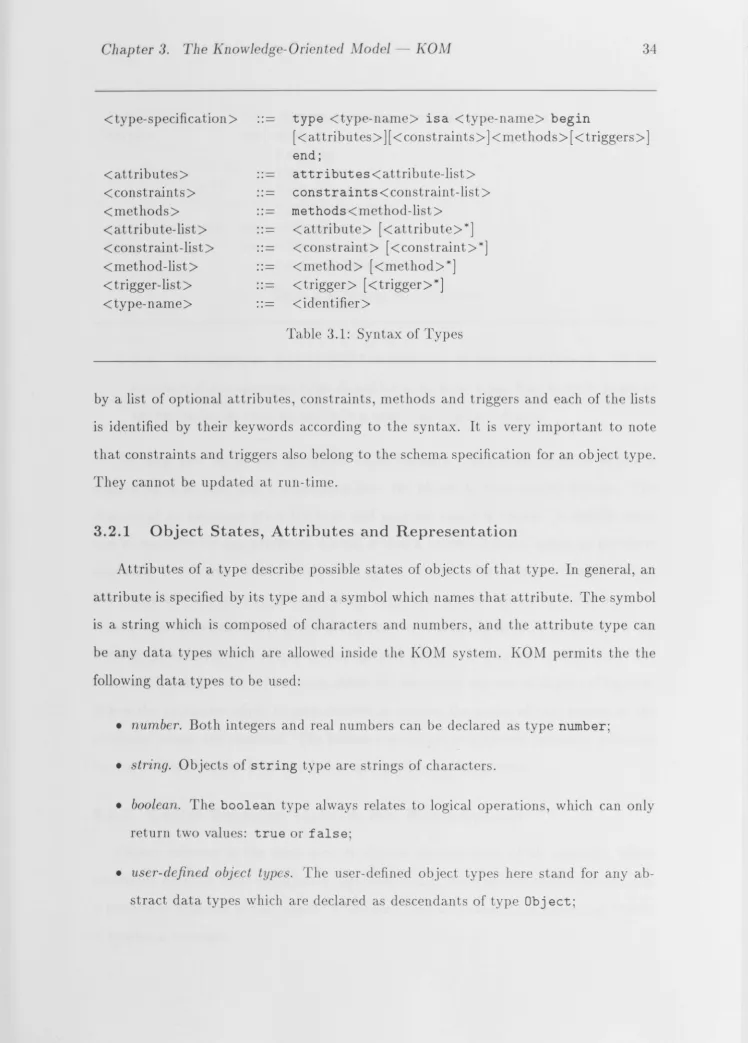
Chapter 3 starts with the introduction of basic concepts used for KOM type
defi-nitions and the syntax. Three major issues are discussed in detail, namely constraints,
triggers and inheritance. The semantics and precise uses of constraints and triggers are
described. At the end of the chapter, inheritance between types is elaborated in the
context of KOM.
Chapter 4 introduces the details of the KOM language which is defined in this
unified environ1nent. S01ne specific operations allowed on KOM databases are
intro-duced. In addition, methods generated by the KONI system for user-defined types are described. The central parts of the language including the transaction and rescue
statements are introduced. Se1nantics of transactions on conceptual levels is defined
and several approaches for execution of them are described.
To support full object-orientation for the data model, associations of objects are
regarded as first class objects in KOM. Chapter 5 investigates the proble1ns and missing
semantics of in current models or definitions, and discovers a series of completely new
constructs to model n-ary relationships. This is a generk model which can be applied
to any object-oriented systems. Query language and inheritance related to relationship
objects and types are also proposed.
Chapter 6 reports the i1nplementation results from the experiments which have
done to build the KOM system. Two basic syste1ns contributed to our experiments are
Ian-Chapter 1. Introduction 4
guage, and extensions of Ontos are made to achieve the persistent knowledge base.
In particular, issues such as constraints, triggers, transaction and rescue statements,
inheritance and relationship constructions are mainly discussed in this chapter. The
transformation from the KOM language to C++ is introduced and realized by means
of the software tools: Yacc++ and Lex++.
Chapter 7 provides a summary of the whole thesis and further discussion on building
of the knowledge-oriented data model and its language. Future directions of work are
proposed to meet the challenge of new generation of knowledge-based database systems.
Finally, Appendix A gives the KOM programs for the exan1ples used in this thesis.
These are followed by the C++ code which are generated by the KOM compiler and
Chapter
2
Background of the Resea
r
ch
2.1
Introduction
A pnmary research objective in the database area is to develop more advanced
database languages and richer data models to accommodate complex applications. The
emergence of numerous data models has demonstrated that new generation database
systems should provide multiple functionalities, high level representation and combined
techniques from different disciplines. This demands that characteristics from AI and
programming paradigms are incorporated into data modeling constructors. Several
types of systems have been developed in the past few years which claim that both
knowledge and data semantics of objects from the real world should be captured at a
conceptually natural level.
Combining AI technology, 1.e., knowledge or rules, into data models is regarded
as the most common and feasible approach for achieving advanced functionalities of
database systems. In general, rules can be integrated into database syste1ns in two
general forms(59]. Firstly, a declarative rule takes the form of if A is true, then B is
true which states that the hypothesis A implies the hypothesis B. When the facts of
A exist, the new infonnation B is deduced. Database systems integrated with logic
programming languages like Prolog are often designed in this way (24] [95] (109]. Sec-ondly, an imperative rule holds the form of if A is true, then do C, which means that
actions C must be taken when conditions A becomes true. The new actions C can be
statements which enable or disable conditions, or cause other actions to be executed.
Chapter 2. Background of the Research 6
This is very useful for database systems to monitor and control users' operations, and
maintain the integrity of data [50] [98] [108]. For example, updates of database objects
may result in the changes of objects' states and constraints are thus violated. If rules
are attached to objects in the database, actions can be automatically taken to repair
the constraint violation. A sequence of events can be conducted through rule firing.
Rules from the AI paradigm offer a key contribution to building new types of
database systems [2] [70]
[89].
In addition, programming languages, particularlyobject-oriented programming languages, are incorporated into the design of current database
systems to assist the implementation of procedure-based applications
[54].
Thecate-gories of database systems can be classified through the ways of how database systems
integrate with rules or knowledge. For example,
1. Semantic Databases: Semantic data models allow database designers to represent
objects of interest and their relationships within an application in a manner that
closely resemble the view that the user has of these objects and relationships
[13]
[47][81]
.
Since the integrity and inter-consistency between objects are part ofthe semantics of objects, sen1antic n1odels provide mechanisms for the definition
of integrity constraints and at the same time allow them to be maintained to get
correct view of databases. Here, rules are used to specify and enforce constraints
on objects.
2. Active Databases: In active database systems, rules are used as a general
mecha-nism to support timely critical situations and monitoring the changes of system's
states. Constructors such as assertions, alerters, triggers and database
proce-dures are adopted to provide timing constraints, access control and inferencing
[20] [62] [ OJ. Basically rules are used to act as the specified changes in data or
other events occur.
3. Deductive Databases: These usually refer to those systems which use logic
pro-gramming languages as the main vehicle to specify, manipulate and reason about
objects in databa es
[40] [104].
The logic programming paradigm supportsde-duction and new information can be derived from reasoning on existing data in
Chapter 2. Background of the Research 7
4. Knowledge-Based Databases: Knowledge-based database syste1ns are charac-terized by having declarative languages and supporting principle capabilities of database systems [104]. The functionalities of knowledge-based database sys-tems include putting rich knowledge representation schemes into data models, providing deductive reasoning facilities, and improving performance of data and knowledge management. Rules in knowledge-based database systems can be used to express different types of semantics and functionalities, and emphasize differ-ent perspectives of applications
[16]
[34] [84]. The enhanced syste1ns could be a combination of some types of the systems 1nentioned above.The systems which are more interesting to us are the knowledge-based database systems since they capture most promising and essential features for the next generation of information technology. Sometimes, this type of system is called an expert database system (EDS) because it is commonly i1nplemented by integrating expert and database systems. In the following chapters of this thesis, we investigate the problems existing the current expert database systems and propose a new data 1nodel and its language based on our research.
This chapter is organized into four sections. It starts by reviewing the architectures of expert database systems and is followed by the summary of previous systems. In Section 2.3, several important issues related to the knowledge-based database systems are pointed out and possible new directions of developing the systems are described. Section 2.4 shows the earlier experimental prototypes developed by the author and how they affected the design of our new 1nodel and its language. The last section gives the principles of design and a brief description of KOM.
2.2
Architectur
es
of E
x
p
ert
D
atabase Systems
Chapter 2. Background of the Research
combine knowledge- and data-driven search techniques into efficient inference schemes. Alternatively, expertjse may reside outside the system in knowledge-based applications,
with database systems simply utilized to store data. In this case, expert systems inter-pret data retrieved from databases, make decisions based on them and send the results
back to the databases. Since the behavior of expert database systems strongly depends
on the way that database systems are integrated with expert systems, the study of
possible system architectures is very necessary and has attracted a lot of attention in
the past few years.
The design and construction of expert database systems may take many forms
ac-cording to application requirements. Theoretically, they can be classified into three types: indirect-coupling, loose coupling and tight coupling. In an indirect-coupling sys-tem, the linkage between the DBMS and ES is established by using external software
written in a high level language, such as Pascal and C. This is very similar to writing
application programs which call the conventional databases. Obviously, it is very
in-convenient for users since every application requiring to access the database requires
its own interface program.
A loose coupling EDS is one where the expert and database systen1s 1naintain their
original functionalities and c01nmunicate through a well-defined interface. Frain this
structure, we know that the transformation between the two systems has to be consid-ered by users who use either the database or the expert systen1 as the major system.
The resulting system usually produces a user interface which e1nbeds one language of
a system into another.
To provide a uniform interface and a better performance overall, an architecture
of tight coupling EDSs is chosen in which one of the integrated syste1ns is used as the
front-end and the other system is embedded into it. Under this structure, users interact
with a single interface which can be the language of either of the integrated systems or a completely new one defined for the resulting system. The communication interface
Chapter 2. Background of the Research 9
2.2.1 Loose Coupling EDSs
A loose coupling structure is a feasible approach to integrate database systems and AI technology
[51)
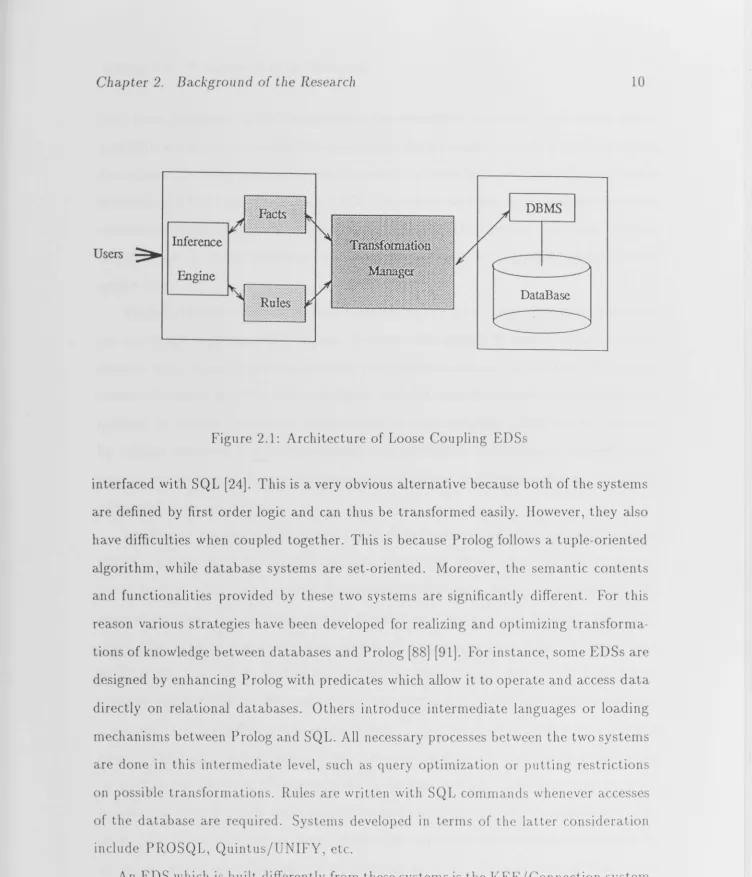
[93) in some circumstances. Under this structure, a DBMS usually a.cts a.s a. data. resource providing fa.ctua.l da.ta. a.nd a.n expert system uses them to perform reasoning. A typical architecture for a loose coupling EDS is depicted in Figure 2.1. Here, the expert system is used a.s the major system to communicate with users, and the database is used for persistent storage of facts and rules. The transformation manager is required between the two systems so tha.t the forn1s of facts and rules in the expert syste1n can be translated into the forn1s of data in the database system, and vice versa.Internally, the knowledge ba.se of the expert system is a.ssun1ed to ha.ve both rules and facts. In most cases, the transformation between the DBMS database and the expert system only affects the fa.ct component of the knowledge base, since rules usu-ally have 1nuch smaller size and much more complex structure compared with facts. Moreover, the transformation of rules between the two systen1s can greatly decrease the system performance [72). Facts are fetched fro1n the database into the knowledge base on a.n as-needed basis, with no clear policy on when it is required. In reverse, revised facts copied back fro1n the expert syste1n into the persistent store of the DBMS face the same kind of situation.
Loose coupling architectures require users to consider when and how knowledge can be transferred between the two systems. For example, the user must issue commands to explicitly retrieve necessary facts fro1n da.ta.ba.ses before or when a.ctiva.ting rules. Generally, query commands used to access facts in the database are embedded inside rule specifications. They ca.n be executed whenever rules' conditions are satisfied a.nd rules are fired. Since loose coupling syste1ns leave the responsibility of the interaction between the two syste1ns to users, a weakness of this type of structures is that the uses of data.base systems are not transparent. The user needs to take ca.re of two systems a.nd to use two different types of languages a.s well.
Chapter 2. Background of the Resea.rch 10
DBMS
Inference Users
Engine
DataBase
Figure 2.1: Architecture of Loose Coupling EDSs
interfaced with SQL (24]. This is a very obvious alternative because both of the systems
are defined by first order logic and can thus be transformed easily. However, they also
have difficulties when coupled together. This is because Prolog follows a tuple-oriented
algorithm, while database systems are set-oriented. :Moreover, the semantic contents
and functionalities provided by these two systems are significantly different. For this
reason various strategies have been developed for realizing and optimizing
transforma-tions of knowledge between databases and Prolog (88] (91]. For instance, some EDSs are
designed by enhancing Prolog with predicates which allow it to operate and access data
directly on relational databases. Others introduce intermediate languages or loading
mechanisms between Prolog a.nd SQL. All necessary processes between the two systems
are done in this intermediate level, such a.s query optirnization or putting restrictions
on possible transformations. Rules are written with SQL commands whenever accesses
of the database are required. Systems developed in terms of the la.t ter consideration
include PROSQL, Quintus/UNIFY, etc.
An EDS which is built differently from these systems is the KEE/Connection system
[l]
[3]. It permits the transformation of the frame-ba.sed informa.lion into a fully nor-malized relationa.l database structure. Data. transformation of KEE/Connection works
[image:23.782.15.767.24.901.2]Chapter 2. Background of the Research 11
data from databases, KEE/Connection's transfonnation module is used which gener-ates SQL statements to realize the appropriate data transfer according to the mapping formulate. The SQL statements are then sent to the DBMS and the retrieval data is returned to KEE/Connection. The KEE/Connection then translates the data from the relational format back to frame structures. With this architecture, facts can be main-tained in one or more relational databases and accessed by a number of KEE- based applications.
Analysis of loose coupling architectures shows the result that they have fairly sim-ple and easily imsim-plen1ented structure. However, this results in that in certain circum-stances, loose coupling systems produce poor perfonna.nce due to the la.ck of consider-ations of mismatch of the two paradigms, and the overall concern of optimization of queries. In certain extent, the performance of loose coupling EDSs can be improved by adding expertise into transformation managers (72). Performance related issues, such as complexity of the queries, frequency of queries and access patterns have to be addressed in the expertise.
Chapter 2. Background of the Research
12
systems is that the integrated systems make knowledge persistent and provide facilities to manage them in the database as well.
The architecture of integration of expert systems with object-oriented databases is very similar to those with relational ones. However, the expert system can be used at either the front-end or back-end but in both cases object-oriented database systems are utilized for storage of persistent knowledge. Of course, the transformation policy is much simpler compared with the previous ones.
Unlike relational database systems, object-oriented databases support storage of complex and varied lengths of data without losing their efficiency. Individual rules can be simply stored in their plain forn1s without decomposition or in intermediate data structures as used in AI systems. The choices really depend on the systems to be integrated and application requirements. Sets of rules are classified into different classes in accordance with their application needs. The retrieval of facts and rules from underlying database syste1ns is quite simple and is done by retrieving objects from certain classes which store them.
2
.
2.2
Tight Coupling EDSs
As pointed out in [97], the loose coupling architecture has several severe disadvan-tages. Due to the separation of facts in main 1nemory and facts from the database, it may happen that during the inference period, the facts stored in the database have been modified, but their copies in cache for reasoning still remain the same, or vice versa. This causes inconsistency of facts and produces wrong results for either the expert syste1n or database users. Most loose coupling expert database syste1ns do not provide persistent rule bases. Hence, any changes to rules would not be preserved un-less manual procedures to save them are utilized. Moreover, the rule bases which are shared and modified 1nay not be noticed by other concurrent users. Because of these disadvantages and those addressed previously, an architecture called tight coupling is proposed. Using this approach, both the database and rule base are managed under the same regime.
Chapter 2. Background of the Research
Werence
Engine
Unif orrn Language
, • •
,
DBMS
facts and rules
Figure 2.2: Architecture of Tight Coupling EDSs
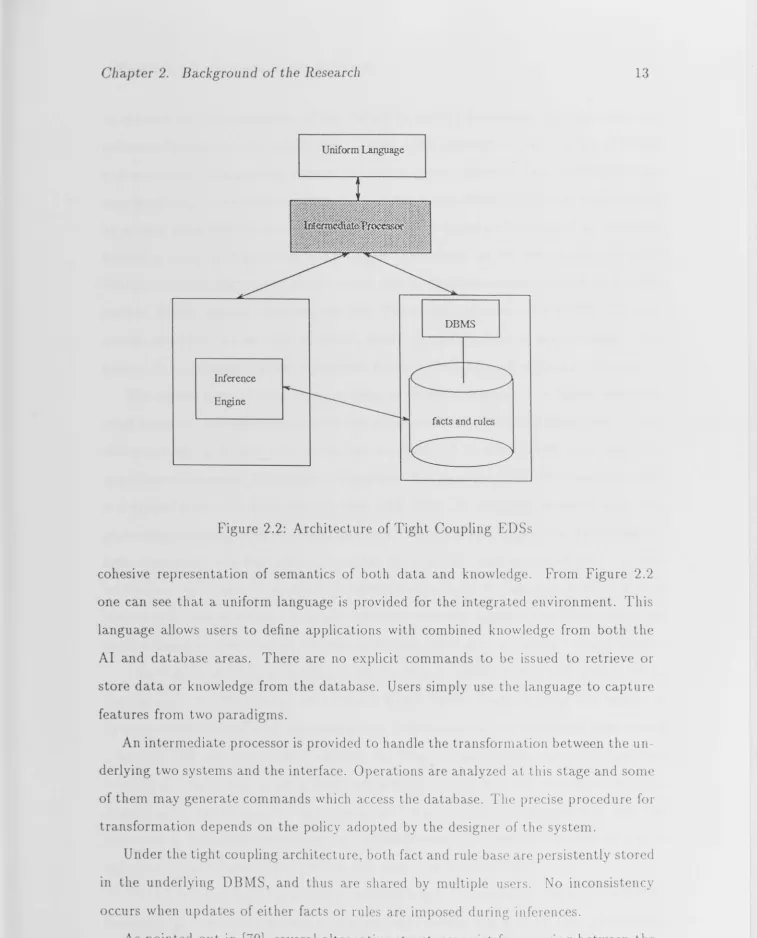
13
cohesive representation of semantics of both data and knowledge. From Figure 2.2
one can see that a uniform language is provided for the integrated environment. This
language allows users to define applications with combined knowledge from both the
AI and database areas. There are no explicit commands to be issued to retrieve or
store data or knowledge from the data.base. Users simply use the language to capture
features from two paradigms.
An intermediate processor is provided to handle the tra.nsforma.tion between the un
-derlying two systems and the interface. Operations are analyzed a.t this stage and some of them may generate commands which access the databa.se. The precise procedure for
transformation depends on the policy adopted by the designer of the system.
Under the tight coupling architecture, both fact and rule base are persistently stored
in the underlying DBMS, and thus are shared by multiple users. . o inconsistency
occurs when updates of either facts or rules a.re imposed during inferences.
As poi n tee! out in (79), severa.l al tern a ti ve structures exist for rncrgi ng between the
[image:26.782.11.768.26.964.2]Chapter 2. Background of the Research 14
to enhance the functionalities of the DBMS by adding knowledge representation and
inference facility into the data model. Usually these systems are built on top of DBMS
and use rules to implen1ent constraints and triggers. Systems like POSTGRES are
very good examples to illustrate this type of structures. POSTGRES was implemented
by adding rules into the relational database system Ingres and enhanced by providing
control of integrity constraints and a trigger mechanism. In the rule system of
POST-GRES, rules are triggered by events, which can be database operations such as retrieve,
replace, delete, append, new and old [98]. The actions of rules are POSTQUEL
com-mands and they can be used to reject, derive or update data in the database. Two control flows of reasoning are supported: forward chaining and backward chaining.
The second type of tight coupling uses an expert system shell or logical
program-ming language as a main component and enhances it by DBMS functionalities. Under
this structure, facts and rules are in fact n1anipulated on a persistent basis and
opti-mization of queries of knowledge is achieved. For example, LDL developed at MCC
is a typical system to illustrate this idea [103] [102]. As designed to enrich logic
pro-gramming paradigm with relational database primitives and constructs, LDL supports
data structures including atoms, complex objects, lists and sets of objects. It uses
bottom-up evaluation technique and retrieves data from the database a set at a time
instead of a tuple at a time. It adopts extensive semantic analysis and optin1ization for
queries based on a whole rule set, thus achieving the notion of tightly coupled EDSs.
The third type of tight coupling architecture is a unified system built from scratch.
For instance, the Knowledge Data Model KDM [84] is designed using this approach
to support conceptual level representation. It is rooted on the functional data model
DAPLEX [94] and proposed to capture the data and knowledge semantics from one
enterprise. Basic abstractions from semantic or object-oriented paradigm, such as classification, generalization, aggregation and membership are incorporated into the
data model. Knowledge represented as constraints and heuristics is captured by a type
definition. The behavior of objects is not supported at this stage.
The last type of tight coupling architecture treats the expert system and the DBMS
independently and merges the1n as separate subsysten1s into a single one. Apparently,
Chapter 2. Background of the Research
15
Features KEE/Connection POSTGRES KDM
Architecture Loose Coupling Tight Coupling Tight Coupling
Implementation Transformation BuHt on Built fron1
between KEE Ingres Scratch
and Oracle
Persistent KB Facts No No
Representation Frame-Based Relational Functional
Enhancement KEE Ingres
Knowledge Demons and Triggers Heuristics
Lisp Rules
Programming Lisp None KDL
Language
Table 2.1: Su1n1nary of Features of Previous Syste1ns
discussed later due to that the syste1n concerned in this thesis is mainly designed
under this structure.
2.2.3 Summary of Previous Systems
A summary of features of previous expert database systems is given in Table 2.1.
It compares three famous systems: KEE/Connection, POSTGRES and KDM by
con-sidering features such as architectures used, i1nple1nentation methods, the knowledge
bases provided, the enhanced systems, representation based and other abilities. The
attempt is to show the design philosophy of different expert database systems.
2.3
Issues in Knowledge-Based Data Modeling and
Lan-guages
Despite the fact that knowledge-based systems and databases have become
ma-ture over the past two decades and despite the fact that more advanced technologies
have been developed, we are still faced with problems of providing sufficient and more
advanced tools for complex applications. Also, different computing technologies are
developed in isolation and the capabilities of integrated technologies have not been
[image:28.775.12.758.25.913.2]Chapter 2. Background of the Research
16
headed for a revolutionary transition of database technology.
As mentioned above, research has been carried out on the integration of databases
with AI systems to enrich data models by adding inference engines into DBMSs.
Also, the incorporation of features from program1ning languages into database
sys-tems became popular as object-oriented programming languages appeared. A number
of database systems have been designed for this purpose, such as KD M and
STAR-BURST. A few years ago, a knowledge-based database language called KDL was
de-veloped by Potter which is based on the Knowledge Data Model (KDM) [84]. KDM
is an extension of semantic data 1nodels and provides an object-oriented view of both
data and knowledge. KDM models primitives which cmne from three areas: semantic
data models, object-oriented programming languages and AI knowledge representation
formalisms. In detail, the constructors defined in KDM include generalization,
classi-fication, aggregation, membership, te1nporal, constraints and heuristics. Constraints
and heuristics are the two prin1itives which are presented as knowledge of objects and
both the integrity of data and specification of rules are allowed to be defined within
ob-ject types. The major contribution of KDM is to find an appropriate way to represent
data and knowledge in a unifonn manner.
STARBURST is another good example of co1nbining knowledge and data within
one data model [59]. STARBURST has been developed to capture features of the next
generation of database systems which are influenced by modern programming languages
and expert system techniques. Characterized by modeling application-specific
seman-tics and behavior and user-defined production rules, the new language is facilitated
by unstructured and structured con1plex objects, user-defined types, functions, and
rules. The rules defined in STARBURST provide an alert trigger system under which
users can define triggers at high level abstractions and with different se1nantics. Unlike
KDM, STARBURST is built as an extension of relational database systems.
Even though the integrations produce several new types of database systems which
stress different aspects of con1plex applications, the capabilities of them are not fully
developed. In many situations, they are not sufficient enough to provide advantages for
richer data models and functionalities obtained from each paradigm. The user interfaces
Chapter 2. Background of the Research
17
two technologies [8). Indeed, some fundamental issues are not well proposed or solved
in the design of knowledge-based database systems, which include, for example,
• complex architectures: The loose coupling and tight coupling provide the basic
architectures for integration of expert and database systems. However, they
are not sufficient to meet some specific requirements of increasingly complex
applications. More powerful architectures must be developed to accommodate
specific functionality in database systems [32]
[60) [61].
For example, in somecases, a system is required to describe what it can do and how it performs [39).
Similarly to the way that meta-rules control the firing of rules in AI systems [6]
[29] [28) [45), meta-data or even 1neta-knowledge can be specified at the
meta-level in databases to reflect what the systen1 has in the conceptual schema meta-level
or object level [48]
[60] [77].
The n1eta-knowledge represented is subjected tothe require1nents of applications. For instance, meta-knowledge can be used to
monitor the systems, control the behavior of databases and provide information
for in1plementations
[18)
[25) [33) [36) [43). The relationships between object level,type level and meta-level of the systems are explored in order to support more
sophisticated integration architectures.
• the synthesis of knowledge and data representation and management: The issue
here is in what forms that knowledge can be incorporated into one data model to
enrich its capabilities
[15] [100).
Further, 1nore sen1antic abstractions areinves-tigated and the language constructors corresponding to the abstractions need to
be expressed (73] (82]. Finally, the appropriate features of unified languages have
to be studied. Languages which incorporate features of programming languages,
database operations and knowledge representation need to be developed.
• different perspectives of real world, like the concept of view used in relational
systems: Relational database systems support derivation of user-defined views
of databases according to the sche1na definitions in databases. Object-oriented
database systems do not support view concepts since they are newly developed
systems and the structures of objects are quite complicated. Suitable but
Chapter 2. Ba.ckground of tl1e Research 1
difficult to construct. With the combined knowledge in a database system, the knowledge- based database systems should be able to generate multiple perspec-tives of the user's view automatically according to the user's descriptions and
underlying data [74]. With regard to knowledge and data stored in a database, hypotheses can be proved and information about the real world can be gained by
reasornng.
• active database systems: Most database systems are passive 1n the sense that they do not react to the events or errors occurring in databases. The new types of database systems can be characterized by their provision of auton1atic object behavior. Features like inter-object 1nessage passing, actively 1naintaining object
semantics and reflections on updates of databases will be captured by active
database systems. More importantly, the behavior of object activity itself is part of its semantics and the execution of it will help users to make decisions on both
objects and applications.
This thesis only examines some of the issues addressed above. Basically, it em-phasizes the se1nantic enrichn1ent of data models by utilizing knowledge representation from the AI paradigm. In addition, son1e funda1nental issues of object orientation are
reconsidered and improvements are proposed. The work presented in this thesis is con-cerned about designing a knowledge-oriented data model and its language by means of integration of expert systems and DBMSs.
2.4
Early Experimental Prototyp
es
Two prototypes have been developed by the author to study the behavior of expert
database systems. They use the relational database system Oracle, the expert system shell Clips and the object-oriented database system Ontos, respectively. Here, Clips is designed with an interface to an advanced program1ning language, such as C and
Pascal. Ontos is implemented by C++ and any C++ definitions are compatible with it.
Chapter 2. Background of the Research
19
Clips. Clips was used as a front-end and queries from SQL embedded into production
rules. Rules, facts and database data stored in the Oracle database in order to make
the knowledge persistent. We call this prototype Clips+ Oracle.
The second prototype was loosely coupled Clips and Ontos. In this case, the
knowledge-based database system is enhanced by Ontos which allows more efficient
storage of knowledge into the database and more powerful representation forms. In
addition, rules are included in object type definitions to help make general inferences
on object states and behavior. We call this prototype Clips+ Ontos.
These two prototypes were experi1nental syste1ns i1nplen1ented using siinilar
meth-ods to those of previous systems. They were aimed gaining some first-hand
experimen-tal results to support the third prototype mainly discussed in this thesis. The purposes
for the experiments were
1. comparing the benefits and shortcomings of two different methods for integrating
similar pairs of systems.
2. gaining insight into the nature of the integration problem in particular identifying
the most necessary characteristics of the systems being integrated.
2.4.1
Architectures Used
Loosely Coupled Clips with Oracle
Integration of Clips and Oracle was the first experi1nent of our research. In the
combined system, Clips is used to process data and make inferences on existing facts.
Oracle is si1nply a storage facility and SQL is the language which sends data to Clips
and stores then1 back fr0111 reasoning. Co1111nunication between the two syste1ns is not
very complicated and a C language interface between Clips and Oracle is provided so
as to imple1nent the transfonnation channel between the two systems.
Clips and Oracle have different mechanisms to process data or facts. Clips fires
rules by considering one fact each time. Rules are activated when that fact makes the
rule's conditions satisfied. On the other hand, Oracle is a set-oriented syste111 which
retrieves a set of tuples once a c01nmand is issued. The execution of one SQL co1nmand
Chapter 2. Background of the Research
20
facts must be pre-prepared before a certain set of rules is fired. This problem is solved
by loading or saving sets of rules and facts before one application task is executed.
SQL commands can also be specified in a rule declaration. Consistency between the
two systems is considered by users when they define the rules.
Once a large number of rules are defined, rules have to be grouped into different small tasks in terms of a classification of the subtasks provided by the user. Only those
rules related to a single task or a subtask are kept in memory at any moment. Facts
and rules are cleared after one task or one subtask has been completed. The loosely
coupled system requires users to consider which and when data and rules are retrieved
from an Oracle database into 1ne1nory and when and which of them need to be cleaned up. Commands for clean up, save or load tasks are implen1ented as rules or actions of rules. They are executed when certain conditions are satisfied.
Loosely Coupled Clips wi
t
h On
t
o
s
The architecture of loosely coupled Clips and Ontos is very close to that of tight
coupling, where Ontos is considered as the major enhance1nent. Due to the flexibility and capability of Ontos, two interfaces can be provided at the sa1ne time and allow users to comn1unicate with the resulting systen1 either fron1 Clips side or from Ontos
side. When users interact Ontos through Clips, commands of database operations are issued through firing of rules. These commands are i1nplemented by the Clips external function interface and embedded into rule specifications. Rules can be invoked by
Ontos through Clips' C interface to perfonn operations on Ontos objects. In addition, knowledge from Clips can be organized into different sets in terms of the tasks that
they execute. vVhen the set class Rules and the set class Facts are defined, rules and facts corresponding to certain tasks are stored as one set of objects and a unique
identifier related to the task is assigned. The structure can be extended by defining
new classes of either Rules or Facts. Unlike the integration of Clips with Oracle, there is no explicit transformation occurring between Clips and Ontos due to that both of
them are compatible with C language and Ontos also adopts one object processing
Chapter 2. Background of the Research 21
2.4.2 Data Models and Languages Supported
These experimental prototypes aim at providing a set of database and expert system functionalities in their own systems. Thus, data models or languages are enriched from their original ones. Briefly, the integrated systems have been studied to overcome the basic limitations of either the original data or knowledge representation or languages.
The enhancements thus are provided which are based on the following considerations:
1. The integration of abstraction mechanisms of data models into expert systems can
support more efficient and powerful storage and queries of data and knowledge.
2. It helps to deal with various aspects of data, including se1nantic and operational perspectives. This result is strongly influenced by AI knowledge representation
formalis1ns
[17]
[34].3. It allows the develop1nent of 1nore expressive languages for database operations
and inferences on the1n.
Although the experimental prototypes have been developed to address the same ap-plication domain, they differ fro1n each other in the way that the database operations
are supported. In the following, the major characteristics of the languages and
repre-sentational forms are sum1narized and compared according to some general principles.
Static Features
Chapter 2. Background of the Research 22
by foreign keys. Representing relationships or abstract data types is another feature of object-oriented database systems. Abstract mechanisms, such as generalization, clas-sification, aggregation, association and other semantic constructors [7)
[81],
are not fully supported by every database system. Thus, they may not be provided by the integrated ones. The static feature also concerns integrity constraints. To enforce the correct information on databases, integrity constraints are defined and evaluated on the states of objects and inter-relationships among objects.In addition, the static features also include the representation of relations among different objects types. When several objects are related to each other, an update of one object will affect the states of other objects linked by relations. Knowledge can be captured into the descriptions of objects to aut01natically react on database events and object operations. Consistency and relations arnong objects are achieved through the definition of rules inside object types.
Dynan1ic Features
Dynamic features of database objects refer to their behavior and reactions to database events. Usually they are pieces of functions which are defined to describe certain actions of objects. In conventional database systerns, only the structure of an application is described in the schen1as. Prograrns or operations on database objects are separated from them. In object-oriented databases, an attempt is made to capture both attributes and behavior of objects in their types. Database systems can store both methods and object states with their schema definitions.
The cornparison of the functionalities of data rnodels is based on the features dis-cussed above. The integrated systems may support the features either explicitly or implicitly in tenns of whether they allow to specify thern directly or not. A sumrnary of the functionality of the integrated systems is given in Table 2.2.
2.4.3 Analysis of Transforination Alternatives
Chapter 2. Background of the Research 23
II
FeaturesII
Clips+Oracle Clips+OntosII
Entities Tables and Tuples Classes and Objects Attributes Fields AttributesRelationships Abstract Data Types
Methods Member Functions
Rules Rules
II
ConstrajntsII
II
Object-Orientation Object-Oriented
Database Operations SQL Ontos
Database Queries SQL Ontos
Programming Language Implicit Explicit
Table 2.2: Comparison and Summary of Features of Prototypical Systems
of totally different methods. This section discusses how knowledge is transformed
when the integration of Clips and Oracle, and the integration of Clips and Ontos are
concerned. Knowledge in Clips is basically divided into facts and rules. The details
of mappings are not indicated, and only structural perspectives which influence the
methods of integrations are considered. In the following we discuss the approaches of
uploading and downloading for both facts and rules in the integrated systems.
Uploading and Downloading of Facts
Clips has a good rule-based programming style and provides several types of forms
to represent facts. Facts in Clips can be declared by deffacts, deftemplate or other
constructors. They basically have the structure that each field describes a certain
at-tribute of facts, and fact names are given with respect to thefr rneanings in applications.
Clips facts are free-formed which means that facts are not required to have the same
lengths and the same fonns of organization. Fields are pennitted to be rnissing when
facts are declared.
Clips with Oracle
Facts in Clips are translated into relational tables according to two transformation
rules:
1. a fact-list defined by either deff acts or deftemplate corresponds to one table.
The fact-list nan1e is the table nan1e and each field narne of that relational table
Chapter 2. Background of the Research 24
or by generating it in terms of the longest facts in fact-list. The first field of the
relational table is added by the processor to capture the keys of the table. They
define an unique fact name for each individual fact.
2. when facts have various lengths inside a relational table, the longest facts are
chosen to define the fields of the table and for those facts with undefined fields,
zero is used to fill the fields with numeric types and NULL with scalar types.
Apparantly, this 1nay cause the redundancy of data which is not the major issue
concerned in this thesis.
3. A global table is defined which gives the general infonnation about the transfor-mation of facts. Information of fact tables related to an application and the types
of facts are stored, e.g., the application involved and relationships to other facts
and rules.
The extended Clips also provides a new function called persistent to query the
Oracle database. This function is defined in Clips rule conditions with a set of
ar-guments that correspond to the From and Where state1nents in SQL. The database
operations should be taken in the rule actions which can be the insert, delete or select
commands in SQL. Data in the data.base can directly be stored and accessed by rules in
Clips. The SQL-like commands are simulated which in fact communicate with Oracle
through the Pro*C interface.
Clips with Ontos
Transformation of facts between Clips and Ontos is n1uch simpler than between
Clips and Oracle. First, Ontos supports variable-length storage of data without losing efficiency. Data are classified into different classes according the abstract relationships a1nong <la.ta.. Second, Clips facts can be simply structured in Ontos. They can be stored in a generic class FactSet with type Set to specify the information about the
fact-list name, whkh application is related, and the reference to a fact-list. A fact-list
can be one object of a set which contains a list of facts. Individual facts are stored
into class Facts which is defined according to the fact-lists. The general specification
of them can only be as simple as having one field which stores facts as their text. More
Chapter 2. Background of the Research
25
that they can define the attributes in tenns of fact fields. Facts stored in the generic
class FactSet are only grouped by the object-identifiers rather than real contents of facts.
Uploading and Downloading of Rules
Rules stored in databases have more complex forms than facts because they do not
follow any regular expressions. Clips defines rules by the constructor defrule which
specifies the rule name, conditions and actions. The number of conditions and actions
are varied and there is no restriction upon them.
Expert database systems should allow rules to be stored into the database which
are treated as data first and later as queries. Therefore, rules are the text which are
organized by the consideration of efficiency of querying the database. The solution for
our prototypes are always to separate storage of rules with facts and different strategies
are supported for the transforn1ation of them.
Clips with Oracle
Rules in Oracle are constructed in a flat form
[91].
Basically, two types of tables areprovided: one is called table Rules and the other is called Patterns. The table Rules has fields for the rule identifier, rule na1ne and the nu1nber of conditions and actions
that are defined in each rule. Rule identifiers are distinguished fron1 rule na1nes in case
that different applications 1nay define rules with the san1e nan1e. That is rule identifier
provides an unique name for every rule in the database. Rule identifiers are generated
by the processor when they are saved in Clips.
The table Patterns has the information of rule conditions and actions. Each
con-dition and action a.re considered as one pattern a.nq they are not decomposed in order
to preserve the meaning and completeness of rules. The fields of the table Patterns
are pattern identifier, rule name, signal of condition or action described for the current
tuple, the order of conditions or actions and the contents of then1. Note that each
application can provide its own Rules and Patterns tables with the sa1ne structure
defined above.
Clips with Ontos
Chapter 2. Background of the Research
26
Rules are classified by applications and regarded as first class objects. Instance rules
are created when they are transferred from Clips into Ontos. A class named Rules is provided which stores each individual rule as one object. Global information is specified
by another class called RuleSet and it refers to a set of rules as one instance. Instances attached to applications are retrieved when a task is performed, and all rules stored as
these instances are loaded back to Clips. Clips runs those rules and any updates on either facts or rules need to be saved back to Ontos.
2.4.4
Discussion
The two prototypes are irnple1nented as 1n a fashion analogous to previous loose coupling systems, with the intention achieving a common type of integrated architecture
and gaining the insight into the integration proble1n. Among many technical difficulties, three issues are identified which n1ust be resolved in the i1nple1nentation of a realistic integrated system:
1. When the barrier of interfacing the two syste1ns is too high, problems are usually solved by use of si1nplified transfonnation 1nethods or by taking too much effort
to develop new systems. It seems likely that an appropriate choice of the systems can remove some of the difficulties and obtain even better results. For example,
the integration of Ontos and Clips makes the transformation very simple since
Clips has a good interface with C.
2. We need to support 1nore powerful representation rather than simply integrating two types of paradigms. According to the implementation, a simply integrated
system cannot be used in complex and large applications as they are expected.
Also, with the support of integrated system, a powerful interface is relatively easy
to build.
3. As pointed out by [79], more advanced architectures are required for designing next generation of database syste1ns. This concerns about how to choose existing systems, reduce comn1unication burden and optimize the queries of knowledge in
the database. We stress that object-oriented database systems and tight coupling