promoting access to White Rose research papers
White Rose Research Online
Universities of Leeds, Sheffield and York
http://eprints.whiterose.ac.uk/
This is an author produced version of a paper published in
Physics Letters A
.
White Rose Research Online URL for this paper:
Published paper
We
L
, H.L., Billings, S.A. (2009)
Power-law behaviour evaluation from foreign
exchange market data using a wavelet transform method
, Physics Letters A, 373
(37), pp. 3324-3329
A pre-publication draft for the paper published on Physics Letters A, Vol 373, Issue 37, Pages: 3324-3329, 2009.
Power-Law Behaviour Evaluation from Foreign Exchange
Market Data Using a Wavelet Transform Method
H. L. Wei and S. A. Billings
Department of Automatic Control and Systems Engineering, the University of Sheffield, (*)
Mappin Street, Sheffield, S1 3JD, UK.
Abstract: Numerous studies in the literature have shown that the dynamics of many time series including observations in foreign exchange markets exhibit scaling behaviours. A simple new statistical approach, derived from the concept of the continuous wavelet transform correlation function (WTCF), is proposed for the evaluation of power-law properties from observed data. The new method reveals that foreign exchange rates obey power-laws and thus belong to the class of self-similarity processes.
Keywords: Wavelet transform, correlation function, foreign exchange rates, power law. PACS: 89.65.Gh (Economics, business, and financial markets)
(*) Corresponding Author: Professor Stephen A. Billings
Department of Automatic Control and Systems Engineering, The University of Sheffield,
Mappin Street, Sheffield, S1 3JD,
UK.
1. Introduction
The wavelet transform [1,2] provides a powerful tool for analyzing and synthesizing signals. The wavelet transform has the property of localisation both in time and frequency. In wavelet analysis, the scale that can be used to look at data at different resolution levels plays a special role, because wavelet algorithms process data at different scales or resolutions. At a coarse resolution level, one would notice gross features. Similarly, at a fine resolution level, one would get detailed features. This enables us to see both the ‘forest’ and the ‘trees’, so to speak, and makes wavelets very useful [3] for data modelling and analysis in diverse fields including dynamical systems modelling [4-12], as well as random signal processing and analysis in for example statistical self-similarity detection and fractal property characterization [13-34].
Numerous studies in the literature have shown that the dynamics of many time series in foreign exchange markets exhibit scaling behaviours [35-45]. For example, Muller et al. [35] and Guillaume1et al. [38] have shown that the mean absolute price changes over certain time intervals for foreign exchange rates obey scaling laws. Recently, Xu and Gencay [44] have shown that US dollar to Deutschemark (USD-DEM) returns present scaling and multifractal properties.
The objective of this paper is to introduce a
) ( 2 R
L
simple new wavelet transform based approach to detect and evaluate the fractal self-similarity properties from observed time series. The new method involves the calculation of a continuous wavelet transform correlation function (WTCF), which plays a key role in linking the time-domain data with the associated scaling law properties that are explicitly presented by the wavelet scale (revolution) parameter. The introduction of the wavelet transform correlation function (WTCF) here is not original; it can be viewed as an extension of the commonly used second order moment of the associated transforms such as the wavelet transform or cross-coherence/correlation [16-21]. However, unlike most existing wavelet based methods where the continuous wavelet transform is adapted and developed to estimate the Hurst exponent for given fractal signals or where the standard dyadic discrete wavelet transform is used to estimate the associated scaling exponents, the proposed approach here uses the wavelet transform correlation function to directly calculate the power-law exponent parameter that is related to but different from the Hurst exponent.
2. The Wavelet Transform Correlation Method
2.1 The wavelet transform
Let f(t) be a square integrable function defined in . For a given mother wavelet
ψ
, the continuous wavelet transform (CWT) of the function f(t) is defined as [1,2]dt t t f a
b
Wf
∫
ba∞ +
∞ −
= ( ) , ( )
) ,
(
ψ
ψ
dt a
b t t f a
∫
∞ +
∞
−
−
where b,a(t)=a 1/2 ((t−b)/a) − ψ
ψ ,
a
∈
R
+ andb
∈
R
are the dilation (scale) and translation (shift)parameters, respectively. The over-bar above the function
ψ
(
⋅
)
indicates the complex conjugate. In order to guarantee (1) is invertible so thatf
can be reconstructed fromW
ψf , the following admissible condition is required∞ <
=
∫
∞ ωω ω ψ ψ d C 0 2 ) ( ˆ (2)
where ψˆ is the Fourier transform of the function ψ .
For a stochastic process f(t), the wavelet transform Wf (b,a)
ψ
can be viewed as a random field on the upper (positive) half plane. For a given scale parameter a, the transform Wf (b,a)
ψ contains a piece
of information of the original process at this given scale. Extensive research has been done in recent years to exploit the wavelet transform to analyze and determine the characteristics of random or fractal processes [24-34, 46-53].
2.2 The wavelet transform correlation function
Let x(t) be a wide-sense (weak-sense) stationary random process that is square integrable in )
( 2
R
L . For a chosen wavelet
ψ
, the wavelet transform correlation function (WTCF) of the signalx(t), with respect to the locations b1andb2 at scales a1and a2, is defined as below] ) , ( ) , ( [ ) , ; ,
( 1 2 1 2 1 1 2 2
,x b b a a EWx b a Wx b a
x ψ ψ ψ = Φ 2 1 2 2 2 1 1 1 2 1 2 1 ] ) ( ) ( [
1 τ τ ψ τ ψ τ τ τ
d d a b a b x x E a
a
∫ ∫
∞ ∞ − ∞ ∞ − − −
= (3)
Note that Rx,x(τ1,τ2)=E[x(τ1)x(τ2)] is the correlation function of x(t) . Using the property that )
, ( 1 2 ,x τ τ x
R =Rx,x(τ2−τ1,0) =Rx(τ2−τ1) =E[x(t)x(t+τ2−τ1)], it can be derived from equation (3) that
) , ; ,
( 1 2 1 2 ,x b b a a x
ψ
Φ , ( 1, 2) , ( 1) , ( 2) 1 2
2 2 1
1 τ ψ τ τ τ
ψ τ
τ d d
Rxx b a b a
∫ ∫
−∞∞ ∞ ∞ − =∫ ∫
∞ ∞ − ∞ ∞ − −= ( 2 1) , ( 1) 1 , ( 2) 2
2 2 1
1 τ τ ψ τ τ
ψ τ
τ d d
Rx b a b a
[
]
∫
−∞∞ ∗= ( , ( 2) , ( 2) 2
2 2 1
1 τ ψ τ τ
ψ d
Rx b a b a (4)
Assume that the power spectrumPx(ω)of the signal x(t)exits. From Parseval’s theorem, which states that the inner product of two functions is equal to the inner product of the Fourier transforms of the two individual functions, as well as the convolution theorem that states that under suitable conditions the Fourier transform of a convolution is the pointwise product of the Fourier transforms of the two individual functions, it can then be further derived that
) , ; ,
( 1 2 1 2 ,x b b a a x
ψ
Φ ωψ ωψ ω ω
π
∫
Px b a b a d∞
∞ −
= ( )ˆ , ( )ˆ , ( )
2 1 2 2 1 1 ω ω ψ ω ψ ω
π P a a e ωd
a
a ib b
x
∫
−∞∞ − − = ( ) 2 1 21 1 2
) ( ˆ ) ( ˆ ) (
2 (5)
This shows that for the wide-sense stationary process x(t) , the wavelet transform correlation function x,x(b1,b2;a1,a2)
ψ
Φ , with respect to the locations b1 and b2 at given scales
a
1anda
2, is afunction of b1 and b2only through the difference (b2−b1). Here, the relationship between the time-domain signal and the frequency-time-domain behaviour, presented by the spectra of the signal and the associated wavelet transform correlation, is derived by means of the Parseval’s theorem and the convolution theorem.
2.3 The power-law case
As a special case of the wavelet transform correlation function, the wavelet transform autocorrelation function (WTAF) of the signalx(t), at scale a, can be calculated from (5) by letting
a a
a1= 2 = and b2 =b1 =b, that is,
] | ) , ( [| )
(a E Wx b a 2
x
ψ
ψ =
Φ ω ψ ω ω
π P a d
a x
∫
−∞∞ = 2 | ) ( ˆ | ) (2 (6) Now assume that the dynamics of the process x(t) exhibits a power-law behaviour, that is, the power spectral density of the process has a power-law dependence in frequency as given below
β
ω
ω ∝ −
| | ) (
x
P (7)
It can then be obtained from (6) that
) (a x ψ Φ ω ω ω ψ
π
∫
β∞
∞ −
= a a d
2 ) ( ˆ
2 ω ω
ω ψ π β β d a
∫
∞ ∞ − = 2 ) ( ˆ 2 β Ca= (8)
where =
∫
<∞∞
∞ −
− ψ ω ω
ω π
β
d C ˆ( )2
2 1
. Equation (8) suggests that for a power-law signal x(t) that obeys
the power-law given by (7), the wavelet transform autocorrelation function x(a)
ψ
same as in the original power-law presentation but with an opposite symbol, that is−β in (7) becomes
β
+ in (8). Therefore, the new introduced formulas (8) can be used to estimate the power-law exponent of the signal x(t). Note that the relationship between the power-law exponent β, the Hurst exponent H, and the fractal dimension D is given by β=2H +1=5−2D . For a self-affine process,0≤H ≤1, 1≤D≤2 and 1<β <3; for a Brownian motion,H =0.5, D=1.5 and β =2.
3. Results for foreign exchange rates
Monthly average dollar exchange rates, taken from the Federal Reserve Bank of St. Louis for a selection of twenty countries, were considered in this study, and these are shown in Table 1. Monthly average exchange rates are of more interest than daily exchange rates for at least four groups of investors [33]: program traders, investors who follow deterministic rules, investors who routinely accept exposure approximately one month or longer, and currency hedgers.
The proposed wavelet algorithm was used to analyze the twenty datasets. The calculation procedure is as below:
• For each dataset, apply the continuous wavelet transform to calculate the wavelet coefficient
)
,
(
b
a
W
xψ , where four different types of Daubechies’ wavelets of order 3, 6, 12 and 20 were respectively used, and the objective is to inspect whether the choice of wavelet basis would significantly affect the associated calculation results. The scale parameter a was allowed to vary from 1 to 16, and the shift parameter b was allowed to vary from 1 to N (N is the data length).• For each single value of the scale (or resolution level) parameter a, calculate the expectation ]
| ) , ( [| )
(a E Wx b a 2
x
ψ
ψ =
Φ var[Wx (b,a)]
ψ
= 2
) , ( >
<
+ Wx b a
ψ , where ‘var’ indicates calculating the
variance and ‘< >’ indicates taking the average of the relevant signal; x(a)
ψ
Φ is a function of the scale parameter a.
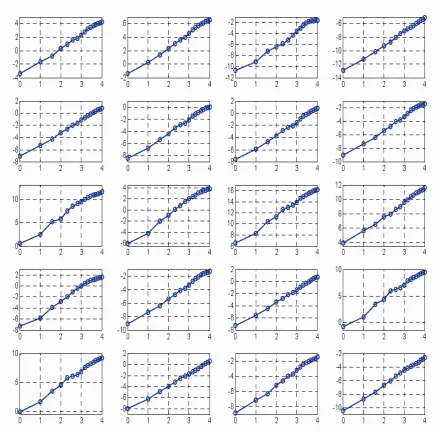
• Plot the graph of log2[ x(a)]
ψ
Φ (vertical axis) versus log2(a)(horizontal axis).
• Calculate the slope of the plot formed by log2[ x(a)]
ψ
Φ and log2(a); the value of the slope can be viewed as an estimate of the power-law exponentβ.
average dollar exchange rates for some countries and it has been observed that relevant results are very similar to those that were obtained for the associated monthly average cases.
[ Table 1 is here ] [ Fig.1 is here ] [ Fig.2 is here ] [ Fig.3 is here ] [ Fig.4 is here
•
]
Note that in the above calculation the original datasets were directly used to test and evaluate the power-law properties of the foreign exchange rates; no data pre-processing procedure has been performed. Data normalization for example mean-removal might very slightly affect the estimation results.
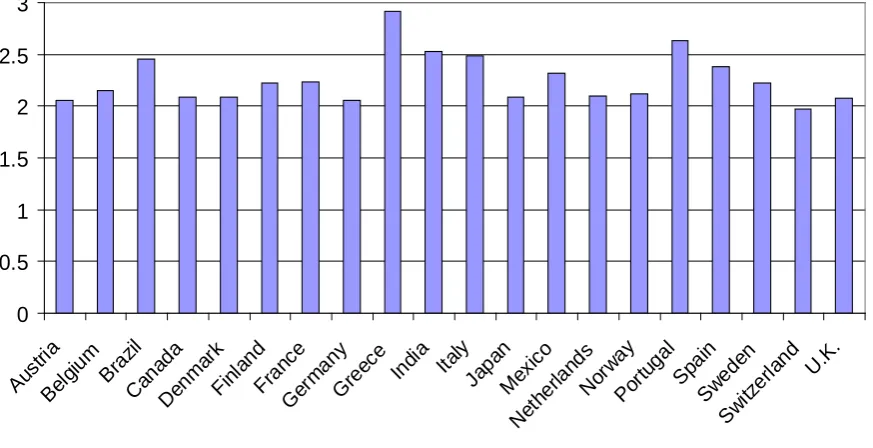
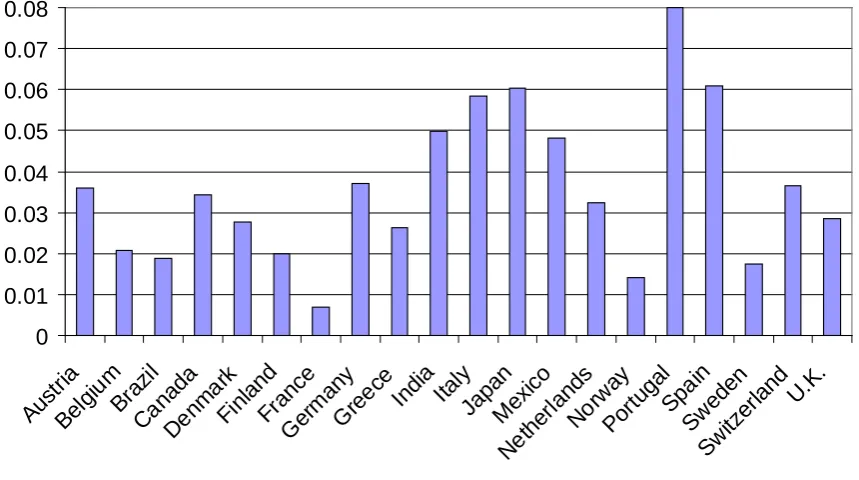
From Table 1 and Figures 2 and 3, the following observations can be obtained:
The choice of wavelet basis affects the estimate of the power-law exponent, but the effect is not significant. In other words, different wavelet bases would lead to slightly different estimates for the power-law parameter.
• Among the twenty datasets considered here, the power-law parameter corresponding to the foreign currency exchange rate of Greece against the U.S. is the largest, with β =2.8873 (‘db20’) and
β=2.9148 (mean), which is followed by the rate of Portugal against the U.S., with β =2.6922 (‘db20’) and β=2.6345 (mean). From fractal Brownian motion theory, these would suggest that there exist stronger persistence (or long-range positive correlation) in the two exchange rates compared with others, meaning that if the amplitude of such rates increases in an interval over a time horizon, then it is more likely to continue the increasing trend in the period immediately following.
• The power-law parameter β for many of the countries considered here is just slightly greater than 2, meaning that there exists weak persistence in these time series.
• There are some cases for example Switzerland where the corresponding power-law parameter β is very close to (or even less than) 2. This means that there exists no correlation or very weak long-range correlation in the relevant time series. This would suggest that the process exhibits some stochastic behaviour possessed by the Brownian motion.
4. Discussions and Conclusions
estimation methods which require data smoothing (windowing) and which are sensitive to the window ‘shapes’, the new method does not need any windowing techniques. Moreover, this new non-parametric method can be performed speedily and efficiently using existing tools for continuous wavelet transform calculation in Matlab. The presented results have shown that the foreign exchange rates, for the twenty countries considered, exhibit power-laws and thus belong to the class of fractal self-similarity processes.
It should be pointed out that the analysis result here is not our final destination along this research direction, but rather this is only one preliminary stage and the presented result will be used as a basis for the next step. For example, we plan to extend and adapt the recently developed nonlinear system and identification methods and algorithms including some wavelet based dynamical modelling approaches [7-12, 54] to forecast foreign exchange rates. One direct application of the result here is to aid the selection and determination of model variables using the value of the power-law parameter β . It is known from Taken’s embedding theorem [55] that in order to sufficiently characterize a dynamical process, the embedding dimension (number of model variables) should be d ≥ 2D+1 where D is the relevant fractal dimension. Using the embedding theorem and the result here, along with other variable selection methods [56], we can determine the best model variables used for constructing dynamical models that are suitable for predicting individual foreign exchange rates. It is also believed that the reported result has another potential application, that is, it can be used to aid the determination of wavelet scale parameters if dynamical multiscale or multiresolution wavelet models [7-12], which have been proved to be very effective for dynamical system modelling, are to be employed to model and forecast foreign exchange rates, where wavelet models for different individual exchange rates will require different wavelet scale parameters.
Acknowledgements
The authors gratefully acknowledge that this work was supported by the Engineering and Physical Sciences Research Council (EPSRC), U.K.
References
1. I. Daubechies, Ten Lectures on Wavelets, SIAM, Philaelphia, PA, 1992.
2. S. Mallat, A Wavelet Tour of Signal Processing, Academic Press, San Diego,1998. 3. A. Graps, Introduction to wavelets, IEEE Comput. Sci. Eng, 2(2) (1995) 50-61.
4. M. J. Jensen, Using wavelets to obtain a consistent ordinary least squares estimator of the long-memory parameter, J. Forecasting
evidence from spectral and wavelet analyses, Stud. Nonlinear Dynam. Econometrics, , 18(1) (1999) 17-32.
5. M. J. Jensen, An alternative maximum likelihood estimator of long-memory processes using compactly supported wavelets, J. Econ. Dynam. Control, 24(3) (2000) 361-387.
7 (2003) 1183-1200.
7. S. A. Billings, H. L. Wei, A new class of wavelet networks for nonlinear system identification, IEEE Trans. Neural Networks, 16 (2005) 862–874.
8. S. A. Billings, H. L. Wei, The wavelet-NARMAX representation: a hybrid model structure
combining polynomial models and multiresolution wavelet decompositions, Int. J. Systems Science, 36(3) (2005) 137–152.
9. H. L. Wei, S. A. Billings, A unified wavelet-based modelling framework for nonlinear system identification: the WANARX model structure, Int. J. Control, 77 (2004) 351–366.
10. H. L. Wei, S. A. Billings, Identification and reconstruction of chaotic systems using ultiresolution wavelet decompositions, Int. J. Systems Science, 35 (2004) 511–526.
11. H. L. Wei, S. A. Billings, Long term prediction of nonlinear time series using multiresolution wavelet models, Int. J. Control, 79 (2006) 569–580.
12. H. L. Wei, S. A. Billings, A comparative study of global wavelet and polynomial models for non- linear regime-switching systems, Int. J. Modelling, Identification and Control, 2 (2007) 273–282.
13. F. Argoul, A. Arneodo, J. Elezgaray, G. Grasseau, R. Murenzi, Phys. Lett. A, 1351 (1989) 327-336.
14. J. F. Muzy, E. Bacry, and A. Arneodo, Wavelets and multifractal formalism for singular signals-application to turbulence data, Phys. Rev. Lett., 67 (1991) 3515-3518.
15. E. Bacry, J. F. Muzy, and A. Arneodo, Singularity spectrum of fractal signals from wavelet analysis-Exact results, J. Statist. Physics, 70 (1993) 635-674.
16. L. Hudgins, C. A. Friehe, and M. E. Mayer, Wavelet transforms and atmospheric turbulence, Phys. Rev. Lett., 71 (1993) 3279-3282.
17. J. F. Muzy, E. Bacry, and A. Arneodo, The multifractal formalism revisited with wavelets, Int. J. Bifurcation and Chaos, 4 (1994) 245-302.
18. B. Ph. Van Milligen, C. Hidalgo, E. Sanchez, Nonlinear phenomena and intermittency in plasma turbulence, Phys. Rev. Lett., 74 (1993) 395-398.
19. B. Ph. Van Milligen, E. Sanchez, T. Estrada, C. Hidalgo, B. Branas, B. Carreras, and L. Garcial, Wavelet bicoherence: A new turbulence analysis tool, Phys. Plasmas, 2 (1995) 3017-3032.
20. A. Arneodo, E. Bacry, S. Manneville, and J. F. Muzy, Analysis of random cascades using space-scale correlation functions, Phys. Rev. Lett., 80 (1998) 708-711.
21. C. Torrence and P. J. Webster, The annual cycle of persistence in the EI nino/southern oscilation,
Q. J. R. Meteorol. Soc., 124 (1998) 1985-2004.
22. R. Everson, L. Sirovich, K. R. Sreenivasan ,Wavelet analysis of the turbulent jet, Phys. Lett. A, 145(6-7) (1990) 314-322.
24. Z. R. Struzik, Wavelet methods in (financial) time-series processing, Physics A, 296(1-2) (2001) 23. B. J. W. Fleming, D. Yu, R.G. Harrison, D. Jubb, Wavelet-based detection of coherent
307-319.
25. R. Gencay, F. Selcuk, B. Whitcher, Differentiating intraday seasonalities through wavelet multi- scaling, Physics A, 289(3-4) (2001) 543-556.
26. D. Stratimirovic, S. Milosevic, S. Blesic, M. Ljubisavljevic, Wavelet analysis of discharge dynamics of fusimotor neurons, Physics A, 291(1-4) (2001) 13-23.
27. Z. R. Struzik, A. P. J. M. Siebes, Wavelet transform based multifractal formalism in outlier detection and localisation for financial time series, Physics A, 309(3-4) (2002) 388-402. 28. A. M. Kowalski, M. T. Martin, A. Plastino, A. N. Proto, and O. A. Rosso, Wavelet statistical complexity analysis of the classical limit, Phys. Lett. A, 311(2-3) (2003) 180-191.
29. H. F. Liu, W. F. Li, Z. H. Dai, and Z. H. Yu, The dimension of chaotic dynamical system in wavelet space and its application, Phys. Lett. A, 316(1-2) (2003) 44-54.
30. H. Huang, H. B. Xie, Z. Z. Wang, The analysis of VF and VT with wavelet-based Tsallis information measure, Phys. Lett. A, 336(2-3) (2005) 180-187.
31. F. In, S. Kim, The hedge ratio and the empirical relationship between the stock and futures markets: a new approach using wavelet analysis, J. Business, 79 (2006) 799-820.
32. V. Venugopal, S. G. Roux, E. Foufoula-Georgiou, A. Arneodo, Scaling behavior of high resolution temporal rainfall: new insights from a wavelet-based cumulant analysis, Phys. Lett. A, 348(3-6) (2006) 335-345.
33. P. M. Crowley, A guide to wavelets for economists, J. Econ. Surveys, 21 (2007) 207-267. 34. D. G. Perez, L. Zunino, M. T. Martin, M. Garavaglia, A. Plastino, and O. A. Rosso, Model-free stochastic processes studied with q-wavelet-based informational tools, Phys. Lett. A, 364(3-4)
41. R. F. Mulligan, A fractal analysis of foreign exchange markets, Int. Advances Econ. Res., 6 (2000) (2007) 259-266.
35. U. A. Muller, M. M. Dacorogna, R. B. Olsen, O. V. Pictet, M. Schwarz, C. Morgenegg, Statistical study of foreign exchange rates, empirical evidence of a price change scaling law, and intraday analysis?, J. Banking Finance, 14 (1990) 1189-1208.
36. R. N. Mantegna, H. E. Stanley, Scaling behaviour in the dynamics of an economic index, Nature, 376 (1995) 46-49.
37. M. M. Dacorogna, C. L. Gauvreau, U. A. Muller, R. B. Olsen, O. V. Pictet, Changing time scale for short-term forecasting in financial markets, J. Forecasting, 15 (1996) 203-227.
38. D. M. Guillaume1, M. M. Dacorogna, R. R. Dave, U. A. Muller, R. B. Olsen, O. V. Pictet, From the bird’s eye to the microscope: a survey of new stylized facts of the intra-daily foreign exchange markets?, Finance Stochastics, 1 (1997) 95-129.
39. N. Vandewallea, M. Ausloos, Multi-affine analysis of typical currency exchange rates, Eur. Phys.
J. B, 4 (1998) 257-261.
33-49.
42. R. Gencay, F. Selcuk, B. Whitcher, Scaling properties of foreign exchange volatility, Physica A, 289 (2001), 249-266.
43. S. V. Muniandya, S. C. Lima, R. Muruganb, Inhomogeneous scaling behaviors in malaysian foreign currency exchange rates, Physica A, 301 (2001) 407-428.
44. Z. X. Xu, R. Gencay, Scaling, self-similarity and multifractality in FX markets, Physica A, 323 (2003) 578-590.
45. J. Jiang, K. Ma, X. Cai, Scaling and correlations in foreign exchange market, Physica A, 375 (2007) 274-280.
46. A. Arneodo, E. Bacry, and J. F. Muzy, The thermodynamics of fractals revisited with wavelets,
Physica A, 213 (1995) 232-275.
47. A. Arneodo, Y. D'Aubenton-Carafa, B. Audit, E. Bacry, J. F. Muzy, and C. Thermes, What can we learn with wavelets about DNA sequences?, Physica A, 249 (1998) 439-448.
48. J. B. Ramsey, C. Lampart, The decomposition of economic relationships by time scale using wavelets: expenditure and income, Stud. Nonlinear Dynam. Econometrics, 3 (1998)
23-42.
49. J. F. Muzy and E. Bacry, Multifractal stationary random measures and multifractal random walks with log infinitely divisible scaling laws, Phys. Rev. E., 66 (2002) 056121.
50. J. Ramsey, Wavelets in economics and finance: past and future, Stud. Nonlinear Dynam. Econometrics, 6 (2002) 1-27.
51. B. Audit, E. Bacry, J. F. Muzy, and A. Arneodo, Wavelet-based estimators of scaling behavior,
IEEE Trans. Information Theory , 48 (2002) 2938-2954.
52. J. Connor, R. Rossiter, Wavelet transforms and commodity prices, Stud. Nonlinear Dynam. Econometrics, 9 (2005), 1170-1170.
53. M. Gallegati, M. Gallegati, Wavelet variance analysis of output in G-7 countries, Stud. Nonlinear Dynam. Econometrics, 11 (2007) 1435-1435.
54. H. L. Wei and S. A. Billings, Model structure selection using an integrated forward orthogonal search algorithm assisted by squared correlation and mutual information, Int. J. Modelling, Identification and Control, 3 (2008) 341-356.
55.
F. Takens, Detecting strange attractors in turbulence, in
Lecture Notes in Mathematics
,
898 (1981) 366-381, Springer-Verlag.
Table 1 The power-law exponents estimated using the wavelet transform correlation function for the monthly average dollar exchange rates of twenty countries. The data came from the Federal Reserve Bank of St. Louis.
Country Observation period of the rates (dd/mm/yy) Data length highest rates Lowest and Power-law exponentβ
db3 db6 db12 db20 Mean Std
Austria 01/01/1971—01/12/2001 372 9.72 / 25.873 2.0809 2.0824 2.0302 2.0113 2.0512 0.0360
Belgium 01/01/1971—01/12/2001 372 27.96 / 66.31 2.1676 2.1620 2.1376 2.1235 2.1477 0.0207
Brazil 01/01/1995—01/12/2007 156 0.84 /3.80 2.4512 2.4261 2.4671 2.4642 2.4522 0.0187
Canada 01/01/1971—01/12/2007 444 0.96/1.60 2.1239 2.1189 2.0722 2.0544 2.0923 0.0344
Denmark 01/01/1971—01/12/2007 444 5.08 /11.81 2.1212 2.1105 2.0751 2.0630 2.0924 0.0278
Finland 01/01/1971—01/12/2001 372 3.49/6.96 2.2180 2.1976 2.2365 2.2413 2.2233 0.0199
France 01/01/1971—01/12/2001 372 4.00 /10.09 2.2443 2.2300 2.2414 2.2331 2.2372 0.0068
Germany 01/01/1971—01/12/2001 372 1.38/3.64 2.0874 2.0851 2.0329 2.0137 2.0548 0.0372
Greece 01/01/1981—01/12/2000 237 53.18 /398.29 2.8976 2.9332 2.9410 2.8873 2.9148 0.0263
India 01/01/1973—01/12/2007 420 7.27 /49.02 2.5134 2.4704 2.5803 2.5634 2.5319 0.0499
Italy 01/01/1971—01/12/2001 372 265.26/2271 2.4575 2.4152 2.5316 2.5347 2.4848 0.0585
Japan 01/01/1971—01/12/2007 444 83.69 /358.02 2.1381 2.1433 2.0618 2.0193 2.0906 0.0604
Mexico 01/01/1993—01/12/2007 170 3.108 /11.52 2.2763 2.2678 2.3543 2.3566 2.3138 0.0483
Netherlands 01/01/1971—01/12/2001 372 1.55 / 3.74 2.1222 2.1223 2.0764 2.0589 2.0949 0.0323
Norway 01/01/1971—01/12/2007 444 4.82 /9.47 2.1324 2.1314 2.1075 2.1079 2.1198 0.0140
Portugal 01/01/1973—01/12/2001 348 22.41 /235.17 2.5917 2.5436 2.7104 2.6922 2.6345 0.0800
Spain 01/01/1973—01/12/2001 348 55.8 /195.17 2.3453 2.3066 2.4219 2.4333 2.3768 0.0610
Sweden 01/01/1971—01/12/2007 444 3.92 /10.79 2.2080 2.2109 2.2329 2.2444 2.2241 0.0175
Switzerland 01/01/1971—01/12/2007 444 1.12/4.31 2.0154 1.9670 1.9592 1.9271 1.9672 0.0365
U.K. 01/01/1971—01/12/2007 444 1.09/2.62 2.0963 2.0973 2.0479 2.0470 2.0721 0.0285
Figure 1 Graphs of the wavelet transform correlation function defined by (8) for the twenty datasets of foreign exchange rates listed in Table 1 where Daubechies’ wavelet of order 20 was used. From left to right and from top to bottom, these are displayed in order that is exactly the same as in Table 1. In these graphs, the vertical axis is log2[ x(a)]
ψ
Figure 2 Values of the power-law exponentβ calculated by using Daubechies’ wavelets of order 3, 6, 12, and 20, respectively, for each of the exchange rates of the twenty countries.
Figure 3 The average of the power-law exponentβ calculated from the four types of Daubechies’ wavelets for each of the exchange rates of the twenty countries.
0 0.5 1 1.5 2 2.5 3 Aus tria Bel
giumBrazi l CanadaDenm ark Finl and Franc e Ger many Greec e Indi a Ital y
JapanMexi co
Nether lands
Nor way
Portugal Spai n
Sweden Swi
tzer land U.K
. 0 0.5 1 1.5 2 2.5 3 Aus tria Bel giumBra
zil Can ada Den mar k Finl and Franc e Ger many Gre
ece India Italy Jap an Mexi co Net herla nds Nor way Por tug al Spa in Sw ede n Sw itzer
[image:14.595.82.519.473.697.2]Figure 4 The standard deviation of the power-law exponentβ calculated from the four types of Daubechies’ wavelets for each of the exchange rates of the twenty countries.
0 0.01 0.02 0.03 0.04 0.05 0.06 0.07 0.08
Aust ria
Bel
giumBrazi l
CanadaDenma rk
Finl and
France Ger
many
Greece Indi a
Italy JapanMexi
co
Net her
lands Norw
ay
PortugalSp ain
Sweden Sw
itze rland U.
[image:15.595.84.514.104.344.2]