Applied arts and design in museums:
USA and Milan experience
Besana, Angela
Department of Economics and Marketing- IULM University
11 January 2009
Online at
https://mpra.ub.uni-muenchen.de/12472/
1
Applied Arts and Design in Museums:
USA and Milan Experience
by Angela Besana
Adjoint Professor of Economics
IULM University
Milan
[email protected]
This paper was presented at the 33rd Conference on Social Theory, Politics and the Arts in October
2007, 11-13, New York University-NYU’s Helen and Martin Kimmel Center for University Life.
Many Thanks to Marcella Re – 2007’s “Heritage and Cultural Events Management” Specialization
Degree Program at IULM University - who wrote the second paragraph.
Many Thanks to Andrea Cancellato, General Director of La Triennale, Milan.
Many Thanks to Francesca Appiani, Magda Marsili and Laura Pinchiroli of the Association
Museimpresa, Milan.
Abstract
The Design represents an innovative work of art. Chairs, spoons, teapots could be an example of designed arts. Creativity and daily utility, they both “evolve in” arts.
Design Museums are often collections of famous designers, stylists and firms. The supply chain of brands could find an exhibition in “Museum Rooms”.
Design Museums develop own fundraising techniques. Through networks and partnerships with Industrial Museums and Fairs, they focus on targets like entrepreneurs, institutions and research centres.
Merchandising could also turn out to be an opportunity in order to raise funds. The range of merchandising could really be multiple and attractive for visitors, usually engaged – in “ordinary” museums - in the choice of t-shirts or calendars.
The aim of the paper is the investigation of strategies of Design Museums. How do they transform industrial concepts in museum concepts and attract resources? The analysis will be focused on USA Museums whose collections give evidence of applied arts and design..
The recently born Milan Design Museum will be illustrated as regards the collection, partnerships, networks and fundraising priorities.
The Association Museimpresa as a promoter of Italian industrial collections will be presented in the ending part.
Keywords: museum, applied arts, design, contemporary, strategy, fundraising
Index
1. The Design as Bridging Arts. The Museum of Design: a multiple definition 2. Museums’ priorities: what’s going on
3. Branding, Networking and Education Programs in the Museum of Design 4. Fundraising and other Strategies in the Museum of Design
5. The Museum of Design in Milan: the Collection of The Italian Genius
6. The Association Museimpresa in Milan: the Highlighted Curators of Made in Italy Concluding remarks
Bibliography Web references
1. The Design as Bridging Arts. The Museum of Design: a multiple definition
From the ancient craft to the contemporary industrial one, the Design is a work of art, combining an aesthetic value with a utility, a daily utility. It bridges arts with basketry, textiles, pottery, metal, wood, leather. It allows focus both on artistic contents and practicality.
The Design is often called the Young Heritage in comparison with the Old Heritage, as it seems having assumed the dignity of works of art only recently. Crafts have a practical purpose while sculptures or paintings are created without a functional form or target. If on one side by crafting, humankind have always produced tools necessary for vital needs, on the other side traditional artefacts have at the same time represented an essential part of a community’s culture due to the fact that, in the production of these artefacts, were embedded also the artistic talents, traditional knowledge and
2
The physical shape and the function of these artefacts were, and still are, the outcome of local raw materials and traditional knowledge, uses, specific “cultural standards”.
The ranking - among the arts - is still argued. At first the Man invented (designed) tools and only later he painted. Designed tools were exhibited for the collective pleasure and they assumed an aesthetic value only after paintings and sculptures. They were separated from entertainment and cultural consumption, as they were first meant as a day-to-day utility.
They have been legitimated as works of art or material culture in national and international sessions recently.
With the 2003 Convention for the Safeguarding of the Intangible Cultural Heritage (Paris, 17th October 2003), Unesco underlined the meaningfulness of intangible cultural heritage as a mainspring of cultural diversity and as a guarantee of sustainable development. The split between tangible and intangible heritage was assessed, but not only this assessment was a decisive parisienne performance on that day.
In the Unesco’s definition “intangible cultural heritage” includes “… the instruments, objects, artefacts and cultural spaces that communities, groups and, in some cases, individuals recognize as part of their cultural heritage. This intangible cultural heritage, transmitted from generation to generation, is constantly recreated by communities, groups,
firms in response to their environment and provides them with a sense of identity and continuity, thus promoting respect for cultural diversity and human creativity.” Material culture is, therefore, included in such a definition and material culture studies have their origins on such an acknowledgment that objects reproduce the characteristics of a particular territory and culture, reflecting the combination of aesthetics and technology.
The main characteristic of material culture is in fact the communitarian aspect: material cultural heritage is not the outstanding masterpiece of an artist, though a personal design idea could emerge, but it is made by the products and objects resulting from a traditional knowledge, from a traditional skill and from a common economical cluster.1 It is often part of the Social Capital of a community, main feature and peculiar of community links and relationships. At the same time, the Museum of Applied Arts and, particularly, Design is the latest show among museums, galleries and exhibition.
The Museum of Design could be classified in the following way:
a. The Museum of (industrial) Design collects modern and contemporary designed objects, with some retrospection of past designed art.
b. The Museum of Modern and Contemporary Arts – more often than the Museum of Arts - selects rooms in order to display designed works of the permanent collection or of touring exhibitions.
c. The Museum of Crafts displays the history of a supply chain, locally referred to a past production tradition. d. The Firm or Industry Museum shows the history and the latest advancement of a specific supply chain,
referred to a specific industry, still with an ongoing commitment to innovation.
It cab be easily recognized that Design is in “traditionally meant” Museums but also in displaying rooms of Firms, showing their past and present history of their production. The Museum of Design has not, therefore, an international reputation of a unique identity. Most of organizations could be classified in the second above mentioned definition as a mixing of art contents, where design is not the main focus and design has acquired the prestige of a work of art next to other works of art recently.
The Design has been gaining esteem much more in international exhibitions like fairs – where the boundary between an art exhibition and a commercial opportunity is very fragile - than in a proper location such as a Museum for more than fifty years. European Museums of design are well-developed institutions that are now gaining overwhelming renown through international sessions, fairs not excluded.
Museums of Modern and Contemporary Arts are now testing their design collection and their design shows in order to enhance their partnerships and networks with local communities. Design does not only bridge arts – aesthetic values with functionality in several artistic shapes, bridging the gap between ancient and contemporary crafts – but it is also an opportunity in order to increase partnerships and growth potentials. Two examples could be mentioned: the Artist Studio or the Artist in Residence, where the artist is engaged to produce in the Museum, having him as a guest for an internship program. The Artist could even produce one-of-a-kind objects for sale as Merchandising or Museum retail. Summer Schools or networks with Schools and Universities are another example: Museums supply their skilled employees for the education of the young generation in creative works.
In the following sections it will be discussed of the strategies of exploitation of design collections and exhibitions by a selected sample of Museums of Modern and Contemporary Arts and Design Institutions (Society, School too), USA
1
Clustering is the latest approach in the analysis of spatial economics. Cultural Clusters collect common skills, the same jobs and artistic competences in a common place, often rebuilt and planned as a case of urban re-generation of (in the past) industrial quarters.
Hitters E. and G. Richards (2002), “The creation and management of cultural clusters”, Creativity and Innovation Management, 11.
Berg L. van den, E. Braun e W. van Winden (2001),”Growth Clusters in European Cities: an Integral Approach”,
Urban Studies, 38(1): 185-205.
3
cultural organisations screened on the website www.guidestar.org through the “search input” design museum as a classification criteria and testing the result through the analysis of websites. 472 art museums were classified and examined through a cluster analysis – hierarchical with the Ward Method and JMP IN The Statistical Discovery Software - of their main economic performances.
In the last part it will be discussed of the first Italian Museum of Design inaugurated on the 6th of December 2007 in Milan. A sample of the Italian Design on show in the Town of Design, Milan, where several partnerships and relations are now implemented in order to promote The Italian Design and Making Style. Last but not least the Association “Museimpresa” will be discussed as regards the connecting and promoting role of Italian Design Firms.
2. Museums’ priorities: what’s going on3
In the current working context it’s fundamental to overcome the old dichotomy between art and economics. The public support to culture and arts is continuously shrinking, even if in a different manner depending on geographical areas and legislations, and the road to take for the majority of cultural institutions, including museums, is the one that leads to a complete independence by public and private financing. Museums’ management is granted more and more often to people who have specific competencies not only in the field of arts but also in business, economics, marketing, and human resources.
Basically speaking museums offer a service represented by a mixture of five key elements: physical infrastructure, expositions, information and support materials, general services and additional and collateral services. These elements do sustain the basic activities that the museum must perform: maintenance, filing, R&D, valuation, masterpieces exposure, education and communication.
Overall a museum can use both internal resources, like the proceeds from the tickets or from the services offered, merchandising and royalties, as well as external resources which are divided between public (public financing, use of public domain) and private (sponsorships and emoluments).
Hence a good marketing strategy has a key role since it allows to sustain the competitive pressure and to gain the wider audience the museum reaches out to, represented by visitors, stakeholders and financiers.
A museum must therefore find the right marketing mix considering all the elements that make the famous “4P” (Product – Price- Placement – Promotion).4
The product of a museum can be articulated with additional services that add value to the visitors’ experience. Besides the typical cafes and book-shops, where it’s possible to buy the merchandising, today you can find museums where it’s possible to buy true design pieces, such as at the Good Design Store of the Chicago Athenaeum, or where you can relax in reading rooms available for visitors who want to deepen their knowledge on the artists, such as at San Jose Institute. Prices can have an important impact on the visitors’ behaviour and on the reputation of an institution; prices can also have several solutions aiming at a growing differentiation and personalization, through the creation of pricing ranges, cards, discounts (except in the cases where the visit is free).
At the same time promotions have today a stronger impact. Given the high level of competition, direct and not, communication has gained value, as well as the various ways of cooperation with schools, corporate and public administration; the organization of events and temporary expositions play a very important role as well.
In the end it’s necessary not to undervalue the importance of placement that, in the case of a museum, refers to the agreements for lending of masterpieces and collections, and for information diffusion.
Like in a real corporate it is important for the museum to know its public, distinguishing between frequent visitors, occasional ones, and potential ones, and to analyse the reasons that determine their attitudes. It is necessary to know the factors that lead the consumers to choose how to spend their free time and use them to develop programs aimed at increasing the visibility and attractiveness of a museum offering. Market segmentation and the identification of a reference target allow concentrate investment efforts on specific communication programs, without wasting resources. Except of the attention for potential demand it’s important to invest in creating a strong and stable link with current visitors, implementing fidelity programs.
One of the activities that today are more useful to reach this goal is a “ teaching approach”, that in the last years has experienced a noticeable development and change of role, and that has changed the traditional educational function into original and interactive teaching programs, diversified according to the type of target (children, teenagers, families, specialists).
2
It is obviously not excluded that other criteria could aggregate other museums. The museum - here mentioned - is more related to the second above-written definition than to the other ones. As it is pointed out later in the paper, the analysis will compare strategies of Museums of Modern and Contemporary Arts, whose rooms locate design too, with Design Museums, exclusively born for design exhibiting.
3
By Marcella Re, Heritage and Cultural Events Management Specialization Degree Program at IULM University,
www.iulm.it .
4
Colbert F., Damperal M., “Exploring key relationship marketing variables among art organizations”, Papers and Proceedings of AIMAC 2007 Conference on Arts and Cultural Management, Valencia, Spain 2007.
4
The purpose, beyond having the museum more actual and closer to the visitor, is also to make sure that there will be a long term relationship with the client, who will have the chance to participate to the initiatives organised by the museum at different stages of his life, each time according to his intellectual expertise.
The San Jose Institute of Contemporary Art, for example, has a print center for education, experimenting art creation. Except for the organisation of workshops and open access days, it allows room renting for projecting.
Through these activities a museum can also create a strong link with the territory, representing a reference-point for the community and sometimes even becoming a meeting-place.
The Chicago Athenaeum has a residence outside the town, the International Sculpture Park, where you can combine a relaxing walk in the nature and contemplation of several masterpieces that you find along the path.
Moreover a lot of museums carry on an intense activity sustaining and facilitating the development of the local artistic environment. More and more often museums announce competitions aimed at helping young artists to come out, sometimes also placing areas and funds at their disposal.
The Houston Center for Contemporary Craft has announced a competition: the winners will be living in a real residence inside the institution complex and will have at their disposal areas and all the necessary to create and experiment. Moreover visitors will have the opportunity to attend directly the artists’ performances and participate in their work. In this way the museum enlarges its supply offering a really innovative and interesting service and, at the same time, actually supports the cultural and artistic growth of the city.
As a consequence of the functions’ enlargement it has been necessary to improve the business management and to find new and substantial sources of funding. Overall in Great Britain and USA contexts, fundraising has already a long tradition.
Usually museums have a membership program, people can join in different ways to, depending on how much they would like to get involved. Patrons, “friends”, benefactors, underwriters are all stakeholders who give a contribution to the life of museums, and, consequently, can enjoy some benefits that the institution give them, such as discounts, possibilities to rent museums’ areas and exclusive expositions.
The strategies to make fundraising work are more and more different and ingenious. The Museum of Contemporary Arts of Jacksonville promotes not only the membership program for the museum, but also the possibility to join an auxiliary group of people, The Contemporaries, that support the museums organizing and participating in events. Moreover this museum supplies some locations for birthday parties, where there is an educator entertaining the children with artistic games and activities.
On the other hand, the Contemporary Arts Museum of Houston takes care of its donators by organizing national and international travel programs, with curators as guides.
From all these elements it clearly appears that in the last period the museums’ activity has strongly changed tending to flexibility and interactivity with all the social actors.
3. Branding, Networking and Education Programs in the Museum of Design
From the point of view of marketing mix, the Museum whose collection is design is now taking up an innovative strategy, like branding through the replica exposure.
Several events take place in the “Museum of Applied Arts and Design”, thanks to networks with Schools, Universities, other cultural institutions (museums, libraries, etc.), public administrations, etc. The replica of events, through diversified modules but with focus on the same collection, is spreading the brand of the museum.
The museum engages in a variety of programs planned to improve, maintain and protect the image of its offerings. Branding5 is now a well-developed strategy in order to reach a lot of prospects. The public relation program and the advertising one can be a vehicle mixed with a well targeted branding strategy.
The medium of brand reveals itself more personal than other media referred to spot events. All events contain brands and refer to brands so that branding must be particularly verified, as it is a signal for good o bad reputation.
Brands must target several channels and remain unique – more than multi-branding it could be developed as an
umbrella branding -. It must enhance advocacy in advocate channels: the market, the social channels, the influencing voice of members, business associates and the export channels, the critics and the competitors.
The museum should strive to achieve “integrated marketing communications”. Integration of marketing media will produce more consistency in the identity meaning to its audiences and other publics. It firmly imposes the responsibility to portray a unified image throughout each of the organization’s many programs.
Events are supported and nourished by networks with other museums, cultural firms, fashion and design industries,
5
Bibliographic references are rare as regards the “branding of culture”. Hartley N., Harrison P., “Bonding with Cultural Brands: Exploring the Binds that Tie Us” and Bouder Pallier D., “Quelle est l’influence du design du logo des lieux de diffusion culturelle sur les attitudes et comportements des spectateurs? Propositions exploratoires” Papers and Proceedings of AIMAC 2007 Conference on Arts and Cultural Management, Valencia, Spain 2007.
5
local administrations, schools and universities. Branding and marketing of all institutions and firm are perfectly mixing. The Education Program of the Museum is meaningful for kind of experiences and audiences: from pre-schooling activities to artists’ workshops, internships and residences. The Education Program is evidence of partnership developing. The targeted group is not only of students, teachers and professors. Special opportunities are offered to families, societies, clubs and communities.
Some examples could help the explanation of these multiple targets and networking.
The Delaware Center for the Contemporary Arts is an example of multiple connections. The community replies favourably to the programming efforts, from Pre-College Art Studio to Summer Camps for lower and intermediate grades, from Art and Community Programs to Contemporary Connections, an interdisciplinary arts program with Delaware public schools in order to develop artist- and teacher-based projects that integrate arts into the curriculum subjects. The main goal is to expose students to the arts and to enhance the ways in which students learn core curriculum subjects while achieving state educational standards.
The Contemporary Art Museum of Raleigh is another well-connected museum. In February 2006 the museum signed a relationship with the College of Design at NC State University, introducing students and faculty to an enormous range of creative and learning possibilities. In this case the agreement was specifically developed with a School of Design. Scottsdale Museum of Contemporary Art’s Education Programs served more than 14.000 people, the full generational spectrum, from toddlers to senior citizens. Programs focus on art education and appreciation, the relationships between art and society, cross-disciplinary content, audience participation and social relevancy. A special initiative consists of the Brown-bag lecture. It is a free, informative and entertaining one-hour lecture by local experts that provide insights into the art of this time, followed by a docent-led tour exhibition.
Some visual art lecturing is mixed with other events: concerts, parties, special events, etc. Education Programs may be general or specifically targeted, especially referred to local communities. Education Programs allow children to enter the museum and allow children to grow with the museum. This reveals itself an opportunity to embrace children into donating to the Museum, when they are young and as it follows, when they are grown up.
4. Fundraising and other Strategies in the Museum of Design
Managing the cultural firm or the cultural event involves a lot of exceptions and trying to meet several quantitative and qualitative goals. In arts organizations a lot of people occupy multiple positions to control, for ordinary and unforeseeable variables. Since many arts organizations deal with specialized crafts and work techniques - labour and creativity intensity – it is also hard to make accurate projections about the performance levels of a multi-task staff. Creative artists must interact with management so that multiple efforts and flexibility are needed.
Fundraising is an everyday activity and an added value opportunity for every cultural entrepreneur. The quest to build, maintain and enlarge The Donors List who routinely support and believe in the organization is a full-time challenge. The changing external environments (economic, political and legal, cultural ad social, technological, etc.) could affect fundraising opportunities and fundgiving inclinations. In order to avoid slack or laziness, the Fundraising Team should concentrate on profiling needs and implementation processes.
Audiences and techniques are diversified and they need proper skills. Fundraising is not only a money-collecting activity. Several strategies are developed in order to stimulate different sides of philanthropy, achieving:
Individual/corporate Involvement: citizens and groups (firms, associations, foundations and other grant-making institutions) are targeted by an accurate fundraising planning.
Financial/in-kind/resource Involvement: not only money! Volunteering, locations for rehearsals, the organization of supporting events like charity auctions, raffles, etc, are examples of in-kind sponsorship.
Near/Far Involvement: it is possible a different ranking – in quantity and in time - of the relationship between the sponsor and the sponsee. Being a Member of the Museum Society is quite much more involving than a planned giving with mere financial collaterals. Challenge Gifts (like The Big Restoration Gift), echoing the participation of some superstars to a quite consistent fundraising campaign, are much more overwhelming than a Christmas Card.
If marketing evolves in the personalization of the product, fitting customers inclinations, it could be that clients are attracted by membership campaigns and do become loyal Donors or Friends!
Memberships are now implemented by the “Museum of Design” that attracts visitors through product and price marketing and then develop the connection through relationship marketing.
Connecting with culturally minded people and engage with contemporary art in fun means the membership Art Partners
for the Madison Museum of Contemporary Art. Art Partners connect and engage with contemporary arts through a variety of enlightening and entertaining experiences. stART collecting explores the practical side of collecting art on a limited budget. Every event offers a chance to meet an emerging artist and learn more about a particular artistic medium, reinventing found and vintage materials for example.
Membership could be planned through bequest or trusts and long-term gifts. The San Francisco Museum of Modern Art provides the donor with special programs. The Charitable Remainder Trust provides named benefits and tax benefits. Retirement Funds support the SFMOMA as beneficiary of the remainder of the pension plan. Life Estate Gifts include the gift of the donor’s home while retaining the right to liver there during the lifetime.
6
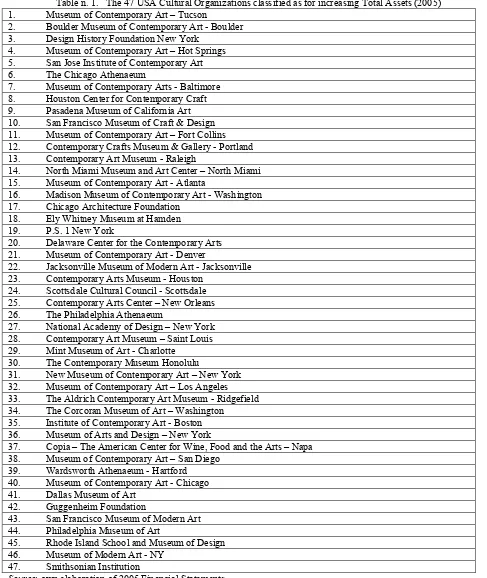
Table n. 1. The 47 USA Cultural Organizations classified as for increasing Total Assets (2005) 1. Museum of Contemporary Art – Tucson
2. Boulder Museum of Contemporary Art - Boulder 3. Design History Foundation New York
4. Museum of Contemporary Art – Hot Springs 5. San Jose Institute of Contemporary Art 6. The Chicago Athenaeum
7. Museum of Contemporary Arts - Baltimore 8. Houston Center for Contemporary Craft 9. Pasadena Museum of California Art 10. San Francisco Museum of Craft & Design 11. Museum of Contemporary Art – Fort Collins 12. Contemporary Crafts Museum & Gallery - Portland 13. Contemporary Art Museum - Raleigh
14. North Miami Museum and Art Center – North Miami 15. Museum of Contemporary Art - Atlanta
16. Madison Museum of Contemporary Art - Washington 17. Chicago Architecture Foundation
18. Ely Whitney Museum at Hamden 19. P.S. 1 New York
20. Delaware Center for the Contemporary Arts 21. Museum of Contemporary Art - Denver
22. Jacksonville Museum of Modern Art - Jacksonville 23. Contemporary Arts Museum - Houston
24. Scottsdale Cultural Council - Scottsdale 25. Contemporary Arts Center – New Orleans 26. The Philadelphia Athenaeum
27. National Academy of Design – New York 28. Contemporary Art Museum – Saint Louis 29. Mint Museum of Art - Charlotte
30. The Contemporary Museum Honolulu
31. New Museum of Contemporary Art – New York 32. Museum of Contemporary Art – Los Angeles 33. The Aldrich Contemporary Art Museum - Ridgefield 34. The Corcoran Museum of Art – Washington
35. Institute of Contemporary Art - Boston 36. Museum of Arts and Design – New York
37. Copia – The American Center for Wine, Food and the Arts – Napa 38. Museum of Contemporary Art – San Diego
39. Wardsworth Athenaeum - Hartford 40. Museum of Contemporary Art - Chicago 41. Dallas Museum of Art
42. Guggenheim Foundation
43. San Francisco Museum of Modern Art 44. Philadelphia Museum of Art
45. Rhode Island School and Museum of Design 46. Museum of Modern Art - NY
47. Smithsonian Institution
Source: own elaboration of 2005 Financial Statements
Some of them – for Total Assets, in the last rows of the table – are giants. Some are small and medium sizedjewels in the USA scenario of cultural organizations, aiming at join up with local, regional, national and international audiences. Some of them are general – or comprehensive - museums whose rooms (some of them) are devoted to design too.6 Some are Exclusively Design Museums (EDMs). The ultimate intent of this analysis is the comparison – between comprehensive ones and EDMs - of their economic performances.
The Museum of Contemporary Craft of Portland has a significant space to house its collection of more than 1,000 craft objects including works in ceramic, glass, metal, fiber and wood. The collection represents the development of West
6
7
Coast craft from the mid-20th century and the present. The Houston Center for Contemporary Craft was founded to advance education about the process, product and history of craft. The Center provides a much-needed venue for exhibition, retail and studio spaces to support the work of local and national artists and to serve as a resource for artists, educators and the community at large. The Contemporary Museum of Honolulu collects works created since 1940 by local, regional and international artists, 2,400 works whose categories are ceramics, glass, wood, metal and textiles too. The COPIA Museum is the perfect telling of winemaking and winery architecture with an always changing collection of food-related accessories, photo murals, paintings, sculptures, photography and oral histories. The permanent collection of the Museum of Contemporary Art San Diego includes more than 4,000 works representing all media and genres: paintings, sculptures, works on paper, videos, installations.
The following analysis adopts the Ward Clustering Method. Clustering is - regarding this analysis - the statistical aggregation of features of the sample through the calculus of the Euclidean Distance. In this case, Statements of Revenues and Expenses and Financial Statements of the 47 Museums were analysed in order to extrapolate indexes that are related to following records of 2005’s accounting7: Direct public support: contributions, gifts, grants and bequests received directly from the public. It includes amounts received from individuals, trusts, corporations, estates, foundations, public charities or raised by an outside professional fundraiser; Government contributions or grants: payments from the Government to a non profit organization to further the organization’s public programs; Program services revenue: fees and other monies received by an organization for services rendered. These services must relate directly to the primary purpose for which the organization received its tax-exempt status; Membership, members’ and affiliates’ fees that are not contributions; Merchandising and auxiliary revenue: revenues of collateral (not core) businesses such as merchandising, rooms location, etc.; Program services cost: fees and other monies paid by the organization for services rendered; Management and general expense: expenses for the general functioning of the organization but not related to fundraising or programs. Such expenses include the salaries of the chief officer and the chief officer’s staff for activities not related to fundraising and programs. Other costs include those associated with meetings of the board of directors or similar governing group, legal services, accounting, liability insurance, office management, auditing, personnel, preparation, publication and distribution of the annual report and investment expenses not related to programs or rental income; Fundraising expense: total expenses incurred in soliciting contributions, gifts, grants, etc.; Total assets: estimated value of land, buildings, equipment, other tangible and intangible items owned by the organization; Investments: short- and long-term investments in financial items like temporary cash, securities, etc.; Liabilities: an organization’s pecuniary obligation or debt; Net assets: own resources devoted to the core business, not at all debts; Total revenues: the total yield of sources of income for the organization for the tax period; Total expenses: the organization’s financial outlay for the tax period; Excess or deficit of the year as difference – positive or negative – between revenues and costs.
USA cultural organizations were hierarchically clustered in four groups referring to indexed performances: excess or deficit of the year 2005/total revenues; membership revenues/total revenues; fundraising expenses/total expenses; net assets/total assets; liabilities/total assets, etc.
The analysis strictly refers to 2005’s performances and it is mainly a record of monetary performances.
The figure next to the Organization Name refers to the asset size: from the smallest Museum of Contemporary Art in Tucson to the biggest Smithsonian Museum.
The comprehensive analysis is evidence of the following features:
The Red Cluster includes the highest merchandising and auxiliary revenues – in any case not more than 12% - though program service revenues are only in two cases more than 50% of total revenues. These are museums that may profit by a creative merchandising though program service revenues could also be zero. Net assets are very high. As a matter of fact, liabilities are less than 30%.
The BlueCluster refers to the highest direct public support. Summed up to membership, more than 50% of revenues. This cluster means the highest fundraising expense, up to 27%, too. Liabilities are less than 48%.
The Green Cluster regards the highest program service and management expense with prevailing net assets (as for the remaining sample, apart of very few cases).
The Orange Cluster collects different institutions: museums, schools and cultural councils. With the highest Government contributions, the cluster is also featured by less than 37% of liabilities.
Does increasing Excess of the Year result of high Direct Public Support? A Deficit of the Year may also be related to a strong Direct Public Support. A considerable Excess may also be related to revenues that derive for more than 70% of Direct Public Support.
7
8
If Direct Public Support (DPS) and Membership revenues are summed up, more than 40% of all revenues derive of relationship and institutional marketing. For 57,44% of the sample, DPS and Membership represent more than 45% of revenues.
For these museums direct public support enhancing and membership are the main strategies. Though program service revenue could be relevant for a very few of them, ticketing is not a spread strategy. Only for 14,89% of the Sample Program service revenue amounts to more than 45% of revenues.
There is not at all a correlation with the size – big or small for Total Assets estimates – of the organization. Giant and small institutions are spread in all clusters. EDMs are spread in all clusters, too.
Fundraising could be further developed. A good fundraising investment is positively correlated to brilliant performances.
Graph 1. Hierarchical Clustering of the 47 Sample
Museum of Contemporary Art - Tucson -1
Boulder Museum of Contemporary Art - Boulder -2 Design History Foundation New York -3
Museum of Contemporary Art - Hot Springs -4
San Jose Institute of Contemporary Art -5
The Chicago Athenaeum -6
Museum of Contemporary Arts - Baltimore -7
Houston Center for Contemporary Craft -8
Pasadena Museum of California Art -9
San Francisco Museum of Craft & Design -10
Museum of Contemporary Art - Fort Collins -11 Contemporary Crafts Museum & Gallery - Portland -12
Contemporary Art Museum - Raleigh -13
North Miami Museum and Art Center - North Miami -14
Museum of Contemporary Art - Atlanta -15
Madison Museum of Contemporary Art - Washington -16
Chicago Architecture Foundation -17
Ely Whitney Museum at Hamden -18 P.S. 1 New York -19
Delaware Center for the Contemporary Arts -20
Museum of Contemporary Art - Denver -21 Jacksonville Museum of Modern Art - Jacksonville -22 Contemporary Arts Museum - Houston -23
Scottsdale Cultural Council - Scottsdale -24
Contemporary Arts Center - New Orleans -25 The Philadelphia Athenaeum -26
National Academy of Design - New York -27
Contemporary Art Museum - Saint Louis -28
Mint Museum of Art - Charlotte -29
The Contemporary Museum Honolulu -30 New Museum of Contemporary Art - New York -31
Museum of Contemporary Art - Los Angeles -32
The Aldrich Contemporary Art Museum - Ridgefield -33
The Corcoran Museum of Art - Washington -34 Institute of Contemporary Art - Boston -35 Museum of Arts and Design - New York -36
Copia - The American Center for Wine, Food and the Arts - Napa -37 Museum of Contemporary Art - San Diego -38
Wardsworth Athenaeum - Hartford -39
Museum of Contemporary Art - Chicago -40
Dallas Museum of Art -41
Guggenheim Foundation -42
San Francisco Museum of Modern Art -43 Philadelphia Museum of Art -44
Rhode Island School and Museum of Design -45 Museum of Modern Art - NY -46
Smithsonian Institution -47
Source: own elaboration referring main 2005 financial performances
As summary of the previous analysis, if donors are nourishing through copious grants, the pricing strategy is not so fruitful-minded.
Most resources are devoted to program service expenses. Considerable resources may be devoted to management and general costs, though fundraising investment may amount to 27% of total costs.
Most resources are own resources and in very few museums, liabilities prevail.
9
Though these museums may account a Deficit, Net Assets are prevailing.
The data of the Sample could be summarized in the following table, selecting the main variables of the analysis.
Graph 2. The Sample Main Features (2005) Deficit or Excess of the Year
+ , Excess -, Deficit
- - D ir ec t P u b li c S u p p o rt a n d M em b er sh ip H ig h Lo w
Here is the 47 Sample …. -
N et A ss et s Lo w H ig h
Program Service Revenue
Very Low …. Low High
Source: own elaboration of 2005 Statements of Revenues and Expenses and Financial Statements.
The Sample is positively featured by high Net Assets, not prevailing Program Service revenue, high Direct Public Support and Membership – though the last one could be further developed -. Deficit of the year 2005 refers to 15 Museums out of 47.
5. The Design Museum in Milan: the Collection of the Italian Genius
Inaugurated in December 2007, the Museum of Design in Milan is born of the Permanent Collection of Fondazione La Triennale, www.triennale.it . This collection is the basis for exhibitions concerning the Italian Design but the descent will implement and nourish a continuous touring of exhibitions. The aim is to give evidence of the history of Italian industrial production, thanking Great Masters and upcoming Italian Creativity which is well known all over the world. First opened in 1997, the Collection has several historical pieces like wooden models by Giovanni Sacchi and original drawings by Alessandro Mendini. Since 1998 the Collection and the related initiatives have been curated by Silvana Annichiarico, who is the Director of the Design Museum.
Being subject of a General Agreement among public administrations, private sponsors and institutions – among them, Universities - the Design Museum is worth 12.710.000 euros, with a surface of 1.900 sm and an innovative bridge connecting La Triennale with rooms that are dedicated to objects, images, installations. Designed works of several ranges are integrated and narrated through videos, films and real objects of past and present supply chains.
The Museum will be a network opportunity for several design clusters spread over the Italian landscape. The Italian Design will remain a diffuse identity whose location and promotion pole will be La Triennale.
The target will not be to increase a collection but to exhibit what has already been affordable in the Italian Collection. Touring exhibitions will alternate in 15 months, focusing, at the beginning, on the publishing industry related to design, Galleries of Design, etc.
The first Producers of this movie are Peter Greenaway and Italo Rota who will be the first exhibition designers next to Andrea Branzi, the curator. Videos and other installations magnetize visitors who are attracted not only by contents but also by the movie-making style itself.
6. The Association Museimpresa in Milan: the Highlighted Curators of Made in Italy
Born in 2001 in Milan, the Association Museimpresa has the support of Assolombarda and Confindustria, the main associations of the Italian manufacturing industries. The main goal of the Association is the promotion of industrial (firm) collections and archives, networking with museums, firms, institutions and the culture demand. The Association develops research, education, development programs.
Main targets are: industrial museums to be promoted and advertised; firms in order to estimate the showing opportunity of their histories; the general audience in order to teach the main contents of the Made in Italy and the Corporate Culture Value.
Among the latest events are: the editing of the Guide Industrial Tourism in Italy, with Touring Club, the main Association promoting the Italian Landscapes and Heritage and the organization – Confindustria is the promoter - of
The Week of the Industrial Culture (in November), when firms are invited to show the history and designing of their past and present supply chains to several audiences, from schools to universities, from managers to curators.
In 2004 a General Agreement was signed with Rai Trade for the promotion of photos and catalogues; in 2005 a General Agreement was signed with Civita and EGG Events in order to plan definite social occasions.
10
The ultimate aim is to increase relationships between industrial culture and communities. The local, national and international reputation of the Made in Italy should be improved with connections with school and universities, Ministries of Culture and Foreign Affairs. The number of initiatives is soaring. The same is for numbers and ambitions of Agreements and detailed planning.
Concluding remarks
The expansion of the cultural and entertainment industry together with slower growth rates of available monetary resources made financial management a crucial sub-system of a modern cultural organisation and enterprise. When analyzing both budgets and the financial sources it becomes obvious that cultural finance is not a symmetric monetary business relation. Strategies of both artistic and commercial directors could spread from pricing to fundraising, from program services to education programs. An elevated cultural background and an over average knowledge in the field is therefore a key competence for the financial manager in a cultural organization, as he should – even more than the artistic director – be capable to bridge the gap between the creative content and money issues.
Museums are making efforts to get closer to their community. They get to accomplish several goals: innovate and nourish collections, improve services, try to adapt to visitors’ tastes, enhance the education and entertainment facets of museum attending and produce activities aimed to improve the visitors’ educational skills. For financial or social reasons, museums need to reach larger audiences and provide overwhelming experiences to its visitors.
Modern and Contemporary Arts, Design, Material Cultural can be an effective mean to attract new visitors. In that context, museum service and programs can be a valuable opportunity to attain growth goals and to contribute to their positive image of openness and linking toward the community.
This research showed that Museums, whose collection is exclusively or partly applied arts and design, do attract people with very different patterns of involvement, proving that it is enough appealing to pay a ticket or become a Member. Multi-media events and innovative contents like past and present supply chains’ showing can provide satisfying overall experiences to visitors and members. The results showed that visitors do become supporters and members and they sometimes prefer to be donors and members than paying customers. They are attracted by Life Cycle Strategies: when they are young, they visit rooms with classmates, they learn and test applied arts, shapes and design. They get involved till they are adult, artists or simply visitors, who love to be supporters of their local visual art organization.
In order to address the limitations of this study it would be useful to refine the “museum” segmentation. At first, within each cluster it would be interesting to analyze the attractiveness of the EDMs’ different activities, separated of other museums. Secondly, it would be useful to assess performances of those activities specially preferred by curators of rooms of general or comprehensive museums, too. Thirdly, It would be necessary to widen the analysis to meta-economic features and methods: customer satisfaction indexes, focus groups, etc.
However, USA design museums visitors can be clustered in:
- those ones who became loyal to events and programs. Therefore, it is highly likely that they return and they are interested in supporting;
- those ones who benefited from specific experiences to explore the environment and may become regular visitors thanks to targeted life-long programs. They lost their inhibitions and are interested in supporting and membership;
- those ones who were already loyal to the museum and got easily member.
11
Bibliography
ANDREONI J. (2001), “The economics of philanthropy”,
International Encyclopedia of the Social
and Behavioral Sciences
, Elsevier, London, UK
ANDRES P., ARBIZU N., RUIZ-VILLA D. (2004), “Arguments behind Different Cultural Policy
Models”,
Papers and Proceedings of 2004 International Conference on Cultural Policy Research
,
École des Hautes Études Commerciales (HEC), Montréal, Canada
BAGNASCO A. M. (2007), “Product placement between creativity and business: from the
audiovisual sector to art industries”,
Papers and Proceedings of 2007 International Conference on
Arts and Cultural Management
, Valencia, Spain
BAGNASCO A. M
.
(2005),
Progetti di arte e cultura: esperienze e riflessioni tra creatività e
business
, Editore Unicopli-CUESP, Milan, Italy
BENNET R., MOUSLEY W., ALI-CHOUDHURY R (2007), “Learning from the private sector: a
quantitative study of marketing knowledge transfers from businesses to arts and cultural
organizations”,
Papers and Proceedings of 2007 International Conference on Arts and Cultural
Management
, Valencia, Spain
BESANA A. (2007),
The Cultural Phoenix: Ashes and Roots
, Unicopli-Cuesp, Milan, Italy
BESANA A. (2006),
La Decima Musa
, Unicopli-Cuesp, Milan, Italy
BEVERLY THOMPSON J. (2005), “Sponsorship as a Form of Fundraising in the Arts: A Bilateral
Perspective Involving Relationship Marketing”,
Papers and Proceedings of 2005 International
Conference on Arts and Cultural Management
, École des Hautes Études Commerciales (HEC),
Montréal, Canada
BONEL E. (2007), “Modularity as innovation control in cultural product design and development”,
Papers and Proceedings of 2007 International Conference on Arts and Cultural Management
,
Valencia, Spain
BOUDER PALLIER D. (2007), “Quelle est l’influence du design du logo des lieux de diffusion
culturelle sur les attitudes et comportements des spectateurs? Propositions exploratoires”,
Papers
and Proceedings of 2007 Internatonal Conference on Arts and Cultural Management
, Valencia,
Spain
BOURGEON-RENAULT D., GOMBAULT A. (2007), “Marketing des Museés: le tournant
experiential”,
Papers and Proceedings of 2007 International Conference on Arts and Cultural
Management
, Valencia, Spain
BYRNES W. J. (2003),
Management and the Arts
, Focal Press, Burlington, Massachusetts, USA
CASTRO FINOCCHIARO M., RIZZO I. (2006), “The Determinants of Performance in Heritage
Conservation”,
Papers and Proceedings of 2006 International Conference on Cultural Economics
,
Vienna, Austria
CAVALIERI M., MIGNOSA M. (2006), “The role of public indirect support for culture in Italy”,
12
CLOPTON S. W., STODDARD E. (2006), “Event Preferences among Art Patrons: Implications for
Market Segmentation and Arts Management”,
International Journal of Arts Management
, École des
Hautes Études Commerciales (HEC), Montréal, Canada
COLBERT F., DAMPERAL M. (2007), “Exploring key relationship marketing variables among art
organizations”,
Papers and Proceedings of 2007 International Conference on Arts and Cultural
Management
, Valencia, Spain
COLBERT F., D’ASTOUS A., PARMENTIER M. (2004), “Consumer evaluation of Government
Sponsorship in the Arts“,
Papers and Proceedings of 2004 International Conference on Cultural
Policy Research
, École des Hautes Études Commerciales (HEC), Montréal, Canada
CONWAY T., WHITELOCK J. (2007), “Strategic Audience Communication: Its Importance for
Relationship Marketing in the Subsidized Arts”,
Papers and Proceedings of 2007 International
Conference on Arts and Cultural Management
, Valencia, Spain
COURVOISIER F., COURVOISIER F. (2004), “Communication and Marketing of Cultural
Institutions”,
Papers and Proceedings of 2004 International Conference on Cultural Policy
Research
, École des Hautes Études Commerciales (HEC), Montréal, Canada
DUELUND P. (2004), “The Rationalities of Cultural Policy”,
Papers and Proceedings of 2004
International Conference on Cultural Policy Research
, École des Hautes Études Commerciales
(HEC), Montréal, Canada
FREY B. S., MEIER S. (2003), “The Economics of Museums”,
Papers of the Institute for
Empirical Research in Economics
, University of Zurich, Switzerland
GALOPHIN M. (1997),
Les Expositions internationales au XX siècle et le Bureau internationales
des expositions
, L’Harmattan, Paris, France
GOLFETTO F. (1991),
L’impatto economico delle manifestazioni fieristiche
,
Egea Editore, Milan,
Italy
GREENFIELD J. M. (1996),
Fundraising cost effectiveness
, John Wiley and Sons Inc., New York,
USA
GROSSI R. (2004),
Politiche, strategie e strumenti per la cultura
, Secondo Rapporto Annuale
Federculture, Allemandi&C., Torino, Italy
GROSSI R., MATTIACCI A. (2000),
La gestione dei beni artistici e culturali nell’ottica del
mercato
, Guerini e associati, Milan, Italy
GROSSI R., MATTIACCI A. (2000),
Museo contro Museo. Le strategie, gli strumenti, i risultati
,
Giunti Editore, Rome, Italy
HARTLEY N., HARRISON P. (2007), “Bonding with Cultural Brands: Exploring the
Binds that
Tie Us
”,
Papers and Proceedings of 2007 International Conference on Arts and Cultural
13
HAUSMANN A. (2007), “Entrepreneurship in the Cultural Sector – background, theoretical
framework and success factors for establishing and ensuring the growth of cultural start-ups in
Germany”,
Papers and Proceedings of 2007 International Conference on Arts and Cultural
Management
, Valencia, Spain
JALLA D. (2003),
Il museo contemporaneo
. Utet Libreria, Milan, Italy
LIDSTROM B. (2004), “Arts and Business. Attitudes Towards Arts Sponsorship”,
Papers and
Proceedings of 2004 International Conference on Cultural Policy Research
, École des Hautes
Études Commerciales (HEC), Montréal, Canada
LOU Y., TSAI M., LIU G. (2007), “The Impact of Membership fee on Patronage of Arts”,
Papers
and Proceedings of 2007 International Conference on Arts and Cultural Management
, Valencia,
Spain
MORETTI A. (1997), “Le Mostre Evento ed i Musei. Prodotto, relazioni e modelli interpretative”,
Economia della Cultura
, Il Mulino, Bologna, Italy
MULCAHY K. (2006), “A Model of Cultural Policy: An alternative paradigm”,
Papers and
Proceedings of the
2006
Social Theory, Politics and the Arts Conference
, Vienna, Austria
NEGRI M. (2003),
Manuale di museologia per i musei aziendali
, Rubettino editore Srl, Catanzaro,
Italy
PAROWICZ I. (2007), “Sustainability Indicators as Tools for Analysing the Effectiveness of
Financing Heritage Conservation”,
Papers and Proceedings of 2007 International Conference on
Arts and Cultural Management
, Valencia, Spain
PETR C. (2006), “Why Occasional Theatregoers in France Do Not Become Subscribers”,
Journal
of Arts Management
, École des Hautes Études Commerciales (HEC), Montréal, Canada
PREECE S. B. (2004), “Matching Corporate Sponsorships for Arts Organizations: leveraging
Greatness or Creating a Monster?”,
Papers and Proceedings of 2004 International Conference on
Cultural Policy Research
, École des Hautes Études Commerciales (HEC), Montréal, Canada
PRNJAT D. (2007), “State, Money and the Arts Organizations”,
Papers and Proceedings of
AIMAC 2007 International Conference on Arts and Cultural Management
, Valencia, Spain
RYDELL R. W. (1993),
World of Fairs. The Century of Progress Exposition,
The Chicago Fairs,
Chicago, USA
SHOCKLEY G. (2006), “The Policy implications of the arts endowment’s political environment”,
Papers and Proceedings of the
2006
Social Theory, Politics and the Arts Conference
, Vienna,
Austria
SOLIMA L. (2004),
L’impresa culturale
, Carocci Editor, Rome, Italy
SOLIMA L. (1998),
La gestione imprenditoriale dei musei. Percorsi strategici e competitivi nel
14