Open Access
S H O R T R E P O R T
Bio
Med
Central
© 2010 Dubé et al; licensee BioMed Central Ltd. This is an Open Access article distributed under the terms of the Creative CommonsAttribution License (http://creativecommons.org/licenses/by/2.0), which permits unrestricted use, distribution, and reproduction in any medium, provided the original work is properly cited.Short Report
Canadian family physicians' and paediatricians'
knowledge, attitudes and practices regarding
A(H1N1) pandemic vaccine
Eve Dubé*
1,2, Vladimir Gilca
1,2, Chantal Sauvageau
1,2, Nicole Boulianne
1,2, François D Boucher
1, Julie A Bettinger
3,
Shelly McNeil
4, Ian Gemmill
5, France Lavoie
1and Manale Ouakki
2Abstract
Background: One of the main determinants of public immunization success is health professionals' support and recommendations. Little is known about the physicians' level of support and intentions regarding A(H1N1) pandemic influenza vaccination. The aim of this survey was to document Canadian family physicians' and paediatricians' knowledge, attitudes and practices (KAP) as well as their intentions regarding A(H1N1) pandemic influenza vaccines right before the beginning of the largest immunization campaign in Canadian history.
Findings: A self-administered, anonymous, mail-based questionnaire was sent to a random sample of family physicians and to all paediatricians practicing in Canada. All 921 questionnaires received by October 29 2009 were included in the analysis. Between 72% and 92% of respondents agreed with the statements regarding vaccine safety, effectiveness and acceptability. More than 75% of respondents intended to recommend the A(H1N1) pandemic influenza vaccine to their patients and to get vaccinated themselves. The most significant factors associated with the intention to recommend A(H1N1) pandemic vaccines were physicians' intention to be vaccinated against influenza themselves and the perceived acceptability of the vaccine by the vaccinators.
Conclusions: Most Canadian family physicians and paediatricians surveyed were supportive of the A(H1N1) pandemic influenza vaccination before its implementation and large media coverage.
Findings
In June 2009, the World Health Organization declared an influenza A(H1N1) pandemic[1]. Modelling studies have shown that vaccination is the most effective intervention in reducing A(H1N1) pandemic influenza morbidity, hos-pitalisation, and mortality [2-4]. It is commonly recog-nized that the results of an immunization campaign are determined by vaccine characteristics, vaccination cam-paign timelines and vaccine uptake. However, the success of a new vaccination campaign should not be taken for granted and public acceptance of a new vaccine should not be assumed [5-7]. Health professionals are known to be the most trusted source of information about vaccina-tion in Canada [8] and their recommendavaccina-tion is one of the main determinants of vaccine uptake [9-11]. Both
family physicians and paediatricians are involved in rou-tine vaccine delivery and are expected to play a major role in emerging pandemic vaccination campaigns. However, very little data exist about their acceptance of a pandemic vaccine and, to our knowledge, no systematically col-lected data regarding physician knowledge, attitudes and practice (KAP) on A(H1N1) pandemic vaccine have been reported.
The main aim of this paper is to document Canadian family physicians' and paediatricians' KAP regarding A(H1N1) pandemic influenza and its prevention by vac-cination prior to vaccine approval for clinical use and large media coverage of the immunization campaign.
Methods
A self-administered, anonymous, mail-based question-naire was sent between August 20 and September 30 2009 to a random sample of 1182 family physicians and to
* Correspondence: [email protected]
1 Centre de recherche du CHUL-CHUQ, Centre Hospitalier de l'Université Laval,
Québec, Canada
all 1852 Canadian paediatricians. The Canadian Medical Directory [12] was used to identify paediatricians and to obtain a random sample of family physicians. This data-base contains more than 58 000 listings of medical con-tact information and is updated each year. Based on the analytical framework for immunization programs in Can-ada [13], the first section of the questionnaire addressed the respondents' KAP regarding routinely used and newly available or candidate vaccines in Canada, including the A(H1N1) pandemic vaccine. Respondents were asked to base their answers on their own knowledge and opinion. No information on A(H1N1) pandemic influenza
[image:2.595.61.537.129.577.2]infec-tion or the vaccine was provided. Descriptive statistics were generated for all variables. Multivariate logistic regressions models were used to determine variables inde-pendently associated with the intention to recommend the A(H1N1) pandemic vaccine. Dependent variables were dichotomized: the responses "strongly agree" and "agree" versus all others. Missing responses were excluded from the analysis. Variables associated in the univariate analysis with the intention to recommend the vaccine at p ≤ 0.20 were entered into the multivariate regression models using the stepwise selection technique. Variables were reevalu-ated in the final model to check for confounding and
Table 1: Knowledge, attitudes and practices regarding A(H1N1) pandemic influenza and A(H1N1) pandemic influenza vaccine
Strongly Disagree/ Disagree
Somewhat Disagree Somewhat Agree Agree/Strongly
Agree
Family Physicans (n = 207)*
A(H1N1) pandemic influenza ...
Is a serious disease 4% 10% 32% 49%
Would occur frequently in Canada without vaccination
8% 10% 26% 52%
Generate a significant economic burden in Canada
4% 5% 17% 69%
A(H1N1) pandemic influenza vaccine will be...
Safe 5% 10% 35% 38%
Effective 4% 9% 46% 26%
Well accepted by the public 6% 17% 35% 38%
Well accepted by vaccinators 3% 8% 26% 58%
I will recommend A(H1N1) pandemic vaccine to my patients
1% 6% 20% 68%
Paediatricians (n = 714)*
A(H1N1) pandemic influenza ...
Is a serious disease 3% 6% 27% 59%
Would occur frequently in Canada without vaccination
6% 6% 24% 59%
Generate a significant economic burden in Canada
2% 3% 15% 77%
A(H1N1) pandemic influenza vaccine will be...
Safe 2% 6% 36% 43%
Effective 3% 6% 45% 28%
Well accepted by the public 5% 13% 34% 42%
Well accepted by vaccinators 2% 4% 21% 67%
I will recommend A(H1N1) pandemic vaccine to my patients
2% 3% 15% 75%
model fit. A probability level of p < 0.05 based on two-sided tests was considered statistically significant. The col-linearity was checked and the adequacy of the model was evaluated by Hosmer and Lemeshow's goodness of fit test. The Statistical Analysis Systems (SAS) software (version 9.1) was used for statistical analysis. The study protocol was approved by the Ethics Board of the Laval University Hospital Center (reference number 126.05.02).
The A(H1N1) pandemic vaccine was approved in Can-ada at the end of October 2009. Due to important educa-tional efforts undertaken afterwards and their potential impact on physicians' KAB, we have decided to perform two separate analyses. Only questionnaires received before October 29 2009 were included in this analysis.
Participation
This study is ongoing. All 921 questionnaires received by October 29 2009, after the first questionnaire mailing, were included in this report. After exclusion of 208 physi-cians no longer practicing or with wrong addresses, the overall participation rate was 31% (18% for family physi-cians and 39% for paediatriphysi-cians). Of the 207 family phy-sicians who managed to complete the survey by October 29 2009, 64% spent more than 21 hours a week in outpa-tient consultation, 51% were men and 58% had been prac-ticing medicine for 20 years or longer. Of the 714 paediatricians who managed to complete the survey by October 29 2009, 52% spent more than 21 hours a week in outpatient consultation, 42% were men and 46% had been practicing for 20 years or longer. Eighty seven per-cent of family physicians and 59% of paediatricians stated that vaccines were administered at their main practice.
Knowledge, attitudes and practices regarding A(H1N1) pandemic influenza and its prevention by vaccination
One third of family physicians (33%) and almost half of the paediatricians (46%) had had experience with
A(H1N1) pandemic influenza disease before responding to this survey. Overall, 82% of family physicians and 88% of paediatricians estimated that "A(H1N1) pandemic influenza is severe enough to take special precautions to prevent it".
Approximately 80% of both family physicians and paedi-atricians perceived A(H1N1) pandemic infection as a seri-ous disease, that would occur frequently without vaccination (Table 1). Thirty seven percent of family physi-cians and 45% of paediatriphysi-cians strongly agreed that A(H1N1) generates a significant economic burden in Can-ada. From 72% to 79% of respondents agreed with the statements regarding the usefulness and safety of the A(H1N1) pandemic influenza vaccines. Comparatively, 52% of family physicians and 72% of paediatricians agreed or strongly agreed that seasonal influenza vaccines are very useful to protect children's health. More than 70% of family physicians and paediatricians considered that the A(H1N1) pandemic vaccine would be well accepted by the public and more than 80% that it would be well accepted by the vaccinators. The majority of family physicians (88%) and paediatricians (90%) intended to recommend the A(H1N1) pandemic influenza vaccine to their patients: 30% of family physicians and 43% of paediatricians stated that they would strongly recommend it. When recom-mending new vaccines, 38% of family physicians and 54% of pediatricians stated being highly influenced by recom-mendations made by professionals associations. Seventy-seven percent (77%) of family physicians and 83% of paedi-atricians intended to get vaccinated against A(H1N1) pan-demic influenza themselves while 15% of family physicians and 13% of paediatricians were undecided.
[image:3.595.48.541.570.719.2]Finally, 47% of family physicians and 36% of paediatri-cians considered that their knowledge on the A(H1N1) pandemic influenza vaccine was insufficient, while 28% of family physicians and 30% of paediatricians considered it to be somewhat sufficient.
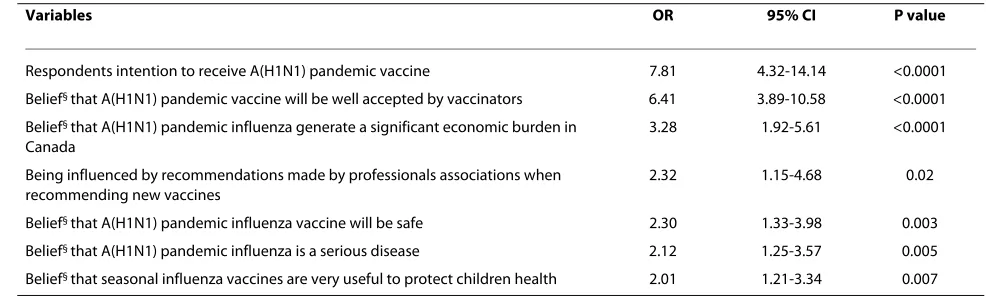
Table 2: Variables associated with respondents intention to recommend A(H1N1) pandemic vaccine*
Variables OR 95% CI P value
Respondents intention to receive A(H1N1) pandemic vaccine 7.81 4.32-14.14 <0.0001
Belief§ that A(H1N1) pandemic vaccine will be well accepted by vaccinators 6.41 3.89-10.58 <0.0001
Belief§ that A(H1N1) pandemic influenza generate a significant economic burden in
Canada
3.28 1.92-5.61 <0.0001
Being influenced by recommendations made by professionals associations when recommending new vaccines
2.32 1.15-4.68 0.02
Belief§ that A(H1N1) pandemic influenza vaccine will be safe 2.30 1.33-3.98 0.003
Belief§ that A(H1N1) pandemic influenza is a serious disease 2.12 1.25-3.57 0.005
Belief§ that seasonal influenza vaccines are very useful to protect children health 2.01 1.21-3.34 0.007
* Multivariate analyses; OR = odds ratio; CI = confidence interval
Factors associated with intention to recommend A(H1N1) pandemic vaccines
In multivariate analyses, the most significant factors asso-ciated with respondents' intention to recommend the A(H1N1) pandemic vaccine were: intention to get vacci-nated against A(H1N1) pandemic influenza themselves; belief that A(H1N1) pandemic vaccine would be well accepted by the vaccinators; perceived safety of the A(H1N1) pandemic vaccine; belief that A(H1N1) pan-demic influenza generates a significant health and eco-nomic burden; perceived usefulness of seasonal influenza vaccination and compliance with professional associa-tions' recommendations when recommending new vac-cines (Table 2).
Interpretation
This survey was conducted at a time when relatively little information about the characteristics of the second wave of A(H1N1) pandemic influenza was available and when very limited data about the new A(H1N1) pandemic vac-cines' immunogenicity and safety was disclosed. How-ever, more than one out of three respondents had had some experience with cases of A(H1N1) pandemic influ-enza and the majority of them were willing to recom-mend the A(H1N1) pandemic vaccine to their patients. More than 75% of the respondents also indicated a will-ingness to get the vaccine themselves. This proportion is high when compared to the 26% to 61% vaccination cov-erage rates for seasonal influenza among healthcare workers reported in a recent Canadian study [14].
Few studies have been done to assess healthcare profes-sionals' KAP regarding pandemic influenza and its pre-vention by immunization [15-17]. Results of an Australian survey conducted in 2007 with a convenience sample of clinical and non-clinical healthcare workers indicated that 86.8% of medical staff respondents consid-ered that a pandemic influenza would be "very serious" if one was to occur. The majority of healthcare workers sur-veyed in 2007 (77.5%) believed that the vaccine would protect them against pandemic influenza [16]. Results of another survey conducted in May 2009 with 389 hospital healthcare workers (mainly nurses) in Hong Kong indi-cated that 47.9% of them intended to accept A(H1N1) pandemic vaccination [15].
One internet survey done in April-May 2009 in Canada reported that 32% of the 213 general practitioners sur-veyed considered A(H1N1) infection to be a serious or extremely serious disease [17]. Four months later, 49% of family physicians and 59% of paediatricians who partici-pated in our survey agreed or strongly agreed that the A(H1N1) pandemic infection was a serious disease (addi-tional 27% to 32% somewhat agreed). Changes in health professionals' perceived seriousness of a pandemic dis-ease might be explained by additional information
received and by policy development regarding A(H1N1) influenza prevention over the summer of 2009.
It is of note that physicians' intention to get the vaccine for themselves and the perceived acceptability of the A(H1N1) pandemic vaccine by the vaccinators are the factors the most strongly associated with the intention to recommend the vaccine to their patients. Several studies have shown that the support of an immunization strategy by vaccinators is perceived as a crucial element in health professionals' intention to adhere to it [13,18,19].
Beliefs that A(H1N1) pandemic influenza generates a significant economic burden, beliefs that A(H1N1) pan-demic influenza is a serious disease, as well as beliefs in the safety of the A(H1N1) pandemic vaccine, were associ-ated with physicians' intention to recommend the A(H1N1) pandemic vaccine. However, this association was unexpectedly lower when compared to the perceived acceptability of vaccine by vaccinators and personal intention to be vaccinated. Finally, the influence of rec-ommendations made by professional associations on phy-sicians' intention to recommend a new vaccine is consistent with results of previous studies [20-22].
pae-diatricians' intentions to recommend A(H1N1) pandemic vaccine.
In summary, most Canadian family physicians and pae-diatricians surveyed were supportive of A(H1N1) pan-demic influenza vaccination before its implementation and large media coverage. The next phase of the survey was launched one month after the implementation of A(H1N1) pandemic influenza vaccination in Canada. Results of this first phase provide baseline data to serve as comparison for data collected during the vaccination campaign. Analysis of the responses received after Octo-ber 29 2009 will give us the opportunity to explore the effect of A(H1N1) pandemic vaccine approval as well as additional dissemination of information, including pro-fessional associations' recommendations, on physicians' KAP regarding pandemic influenza and its prevention by vaccination.
Competing interests
This study was financially supported by the Quebec Ministry of Health and Social Services and an unrestricted grant from GlaxoSmithKline. No private company or their employees were involved in study protocol/questionnaire designing, data collection or data analysis and interpretation.
Authors' contributions
All authors have been involved in the design of the study. ED, VG and CS have drafted the manuscript. MO performed the statistical analysis. All authors have read and approved the final version of the manuscript.
Acknowledgements
We thank the Canadian Association for Immunization Research and Evaluation (CAIRE) and the Canadian Paediatric Society for their collaboration in this study.
Author Details
1Centre de recherche du CHUL-CHUQ, Centre Hospitalier de l'Université Laval,
Québec, Canada, 2Institut National de Santé publique du Québec, Québec,
Canada, 3University of British Columbia, Vaccine Evaluation Center, BC
Children's Hospital, Vancouver, British Columbia, Canada, 4Canadian Center for
Vaccinology, Halifax, Nova Scotia, Canada and 5Kingston, Frontenac and
Lennox & Addington Public health Unit, Kingston, Ontario, Canada
References
1. Chan M: World now at the start of 2009 influenza pandemic. 2009 [http://www.who.int/mediacentre/news/statements/2009/
h1n1_pandemic_phase6_20090611/en/index.html]. 2009-06-11 [cited 2009-10-26]
2. Zivkovic Gojovic M, Sander B, Fisman D, Krahn MD, Bauch CT: Modelling mitigation strategies for pandemic (H1N1) 2009. CMAJ, Early release published at [http://www.cmaj.ca]. October 13, 2009
3. Nuno MCG, Gumel AB: Assessing the role of basic control measures, antivirals and vaccine in curtailing pandemic influenza: scenarios for the US, UK and Netherlands. J R Soc Interface 2007, 4:505-521. 4. Sypsa V, Pavlopoulou I, Hatzakis A: Use of an inactivated vaccine in
mitigating pandemic influenza A(H1N1) spread: a modelling study to assess the impact of vaccination timing and prioritisation strategies. Euro Surveill 2009, 14(41):19356.
5. Maurer J, et al.: Does receipt of seasonal influenza vaccine predict intention to receive novel H1N1 vaccine: evidence from a nationally representative survey of U.S. adults. Vaccine 2009, 27(42):5732-4. 6. Lau JTF, Yeung NCY, Choi KC, Cheng MYM, Tsui HY, Griffiths S:
Acceptability of A/H1N1 vaccination during pandemic phase of influenza A/H1N1 in Hong Kong: population based cross sectional survey. BMJ 2009, 2009(339):b4164.
7. Seale H, McLaws ML, Heywood AE, Ward KF, Lowbridge CP, Van D, Gralton J, MacIntyre CR: The community's attitude towards swine flu and pandemic influenza. The Medical Journal of Australia 2009, 191(5):267-269.
8. Lagarde F: Summary of Public Opinion on Immunization in Canada. Public Health Agency of Canada; 2005:19.
9. Brewer NT, Fazekas KI: Predictors of HPV vaccine acceptability: A theory-informed, systematic review. Preventive Medicine 2007, 45(2-3):107-114. 10. Zimet GD, et al.: Chapter 24: Psychosocial aspects of vaccine
acceptability. Vaccine 2006, 24(Suppl 3):S201-9.
11. Ritvo P, et al.: A Canadian national survey of attitudes and knowledge regarding preventive vaccines. J Immune Based Ther Vaccines 2003, 1(1):3.
12. 2008 MD Select National - PinPointer CD-ROM Canadian Medical Directory. Scott's Directories [http://www.mdselect.com].
13. Erickson LJ, De Wals P, Farand L: An analytical framework for immunization programs in Canada. Vaccine 2005, 23(19):2470-6. 14. 2006 Adult National Immunization Coverage Survey, Immunization
and Respiratory Infections Division (IRID), Public Health Agency of Canada. 2006.
15. Chor JSY, Ngai KLL, Goggins WB, Wong MCS, Wong SYS, Lee N, Leung TF, Rainer TH, Griffiths S, Chan PKS: Willingness of Hong Kong healthcare workers ot accept pre-pandemic influenza vaccination at different WHO alert levels: two questionnaire surveys. BMJ 2009, 339:b3391. 16. Seale H, Leask J, Po K, MacIntyre CR: "Will they just pack up and leave?" -
attitudes and intended behaviour of hospital health care workers during an influenza pandemic. BMC Health Services Research 2009, 9(30):.
17. TNS Canadian Facts. H1N1 flu virus not an extremely serious condition, most doctors say. Toronto, May 2009 [http://www.tns-cf.com/news/ 09.05.29-H1N1-charts.pdf]. (accessed 2009 October 19)
18. Gilca V, et al.: Setting priorities for new vaccination programs by using public health officers and immunization managers opinions. Vaccine 2008, 26(33):4204-9.
19. Gilca V, et al.: Attitudes of nurses toward current and proposed vaccines for public programs: a questionnaire survey. Int J Nurs Stud 2009, 46(9):1219-35.
20. Oram RJ, et al.: Impact of recommendations to suspend the birth dose of hepatitis B virus vaccine. JAMA 2001, 285(14):1874-1879.
21. Freed GL, et al.: Reactions of pediatricians to a new centers for disease control recommendation for universal immunization of infants with hepatitis B vaccine. Pediatrics 1993, 91(4):699-702.
22. Raley JC, et al.: Gynecologists' attitudes regarding human papilloma virus vaccination: a survey of Fellows of the American College of Obstetricians and Gynecologists. Infect Dis Obstet Gynecol 2004, 12(3-4):127-33.
23. Duval B, et al.: Vaccination against human papillomavirus: A baseline survey of Canadian clinicians' knowledge, attitudes and beliefs. Vaccine 2007, 25(45):7841-7.
24. Duval B, et al.: General practitioners' knowledge and attitudes about cervical cancer screening and HPV vaccination. Poster presentation, 24th International Papillomavirus Conference and Clinical Workshop, Beijing International Convention Center. China. 2007.
25. Gilca V, et al.: Will Paediatricians vaccinate against an adult disease? Human Papillomavirus vaccination dilemma. Poster presentation, 24th International Papillomavirus Conference and Clinical Workshop, Beijing International Convention Center. China. 2007. 26. Pareek M, Clark T, Dillon H, Kumar R, Stephenson I: Willingness of
healthcare workers to accept voluntary stockpiled H5N1 vaccine in advance of pandemic activity. Vaccine 2009, 27(2009):1242-1247.
doi: 10.1186/1756-0500-3-102
Cite this article as: Dubé et al., Canadian family physicians' and paediatri-cians' knowledge, attitudes and practices regarding A(H1N1) pandemic vac-cine BMC Research Notes 2010, 3:102
Received: 9 December 2009 Accepted: 14 April 2010 Published: 14 April 2010
This article is available from: http://www.biomedcentral.com/1756-0500/3/102 © 2010 Dubé et al; licensee BioMed Central Ltd.