Comparative Quality Evaluation of
Oven-Roasted and Honey-Coated Cashew
(
Anarcadium occidentale, L
.) Nut produced using
Locally Fabricated Cashew Nut Processing
Machine in Nigeria
Olalekan-Adeniran, M. A.
1and Ogunwolu S. O.
2End Use Research Department, Cocoa Research Institute of Nigeria (CRIN), Ibadan, Nigeria
1Email: madenik [email protected].
2Email: olalek [email protected].
Abstract— Raw cashew nuts were processed to obtain
cashew k ernels. Part of the k ernels was roasted using mud oven while another part was honey coated and dried. The two samples were subjected to chemical, microbial and sensory analysis to compare their quality attributes.
Differences were observed in some chemical
compositions of the two samples; moisture content value of the oven roasted k ernel was significantly (p<0.05) higher than that of honey-coated k ernel but generally below the maximum level of 8% for safe storage of k ernels. Protein, crude fibre, ash and energy value of the honey coated sample were significantly (p<0.05) higher than that of oven roasted sample, while there were no significant (p>0.05) differences in the crude fat and fatty acids. Sodium, potassium, calcium and magnesium were significantly higher (p<0.05) in the oven roasted than honey coated cashew samples. However, phosphorous in honey coated k ernel was significantly (p<0.05) higher than that of oven roasted k ernel. Total viable count of the samples are within the standard limits of 104 to less than
106 cfu/g of ready-to-eat food products, Yeast and mould counts of the two samples are within the maximum standard of 104 sfu/g. From the sensory evaluation
results, honey coated k ernel was more acceptable than oven roasted k ernel. This study revealed that there was significant difference in the chemical and sensory attributes of the oven roasted and honey coated cashew k ernel and that, coating of cashew k ernel with honey has an added nutritional advantage compared with oven roasted ready-to-eat cashew k ernel.
Keywords—Cashew kernel, Honey coated, Microbial,
Oven roasted, raw cashew nut.
I. INTRODUCTION
Adequate nutrition has been generally accepted as being central to good and healthy living [35]. In recent times, people have been increasingly aware of the quality, nutritional composition and health-promoting components of foods, proper processing and value addition of such food is necessary in other to obtain or retain maximum nutritional benefits from it [52; 47]. Nuts played an important role in diets of many cultures and civilizations for centuries due to its high energy and nutritional value as well as its huge variety of flavors and unique taste. It has also been recognized as a class of food that are rich in important nutrients including proteins and unsaturated fatty acids [45; 10]. As a good source of chemical constituents and certain vital bioactive compounds of important health benefits in human beings. Consumption of tree nuts had been linked with several health benefits during the last years [53; 30; 43]. Among tree nuts, cashew nuts ranks third in worldwide production, Vietnam was the world's largest individual producer in 2013 with 1.1 million tons while Nigeria was the largest African exporter with 0.95 million tons and second in the world [6]. However, as of 2014, rapid growth of cashew cultivation in Côte d'Ivoire made this country the top African producer with109, 583 MT [48].
disease and diabetes due to their and high content of unsaturated fatty acids [33;29].
Roasting is a cooking method that uses dry heat, whether an open flame, roaster or other heat sou rce. Roasting can enhance flavor\ through caramelization on the surface of the food. Roasting uses indirect diffused heat and is suitable for slower cooking of nuts in a larger, whole piece [9]. Temperature range of 1850C to 1900C is ideal for roasting since it is sufficiently hot to exceed the decarboxylation temperature [16]. Roasting from time in memorial remains one of the common processing methods for nuts. During the process, the nuts become more crunchy and brittle leading to an overall increase in palatability [37; 44; 2].
Honey is a natural sweet substance produced by honey bees, from the nectars of plant flowers and honey dew [12]. Honey is a supersaturated solution of sugars, of which fructose (38%) and glucose (31%) are the main contributors. Honey has a wide range of phytochemicals including polyphenols which act as antioxidants. A wide range of minor constituents is also present in honey, many of which are also known to have antioxidant properties. Bee honey is one of the few virtually totally non -allergic foods that body easily assimilates. It contains nutrients especially as energy provider [42]. It is a high-energy carbohydrate food (80–85%) and the honey sugars are easily digestible as those in many fruits [51]. In an effort to combat free-radical activity, scientists are studying the effects of increasing individuals' antioxidant levels through the diet and dietary supplements. Honey appears to act as an antioxidant in more ways than one. Antioxidant compounds found in honey includes glucose oxidase, catalase, ascorbic acid, flavonoids, phenolic acids, carotenoid derivatives, organic acids, Maillard reaction products, amino acids and proteins [8; 38]. In the body, honey can take up free radicals and contribute to better health and when used in foods, the compounds produced when honey is heated can prevent rancidity in some products [7]. Honey is primarily a high-energy carbohydrate food whose distinct flavors cannot be found elsewhere, thus, it is an enjoyable treat. The honey sugars are largely the easily digestible “simple sugars,” similar to those in many fruits. Honey can be regarded as a good food for both infants and adults [13]. Due to honey's pleasing taste, it may be more readily consumed by individuals reluctant to ingest plant derived anti-oxidants. Honey which is also sweetener can be a flavorful, supplementary source of antioxidants [25]) compared to sucrose that has no anti-oxidant value. This has prompted the coating of cashew kernel with honey as a tool for food value addition for increased utilization, improved
economic gain and enhanced nutritional benefits of the nuts.
Generally, food processing and preparation methods have been reported to have a direct effect on the quality characteristics (physical, chemical and sensory) of most foods [47; 26]. Due to the nutritional requirement and necessity of the population, there is need to critically asses both the mud- oven roasted cashew and coating of the nuts with honey after drying as a means of nutritional enhancement. Therefore, this study is aimed at comparing the effects of mud-oven roasting and honey coating on the chemical, sensory and microbiological qualities of the cashew kernels.
II. MATERIALS AND METHODS
2.1 Sample Collection and Preparation
The raw cashew nuts samples used for this work were obtained from Cocoa Research Institute of Nigeria’s cashew plantation at Ochaja sub-station in Kogi State, Nigeria. Some preliminary quality tests (floatation, cutting test, total useful kernels and kernel out- put ratio) were done to ascertain the wholesomeness of the raw cashew nut samples.
2.2 Methods
2.2.1 Cashew nut processing, Roasting and Coating process
Cashew nuts were processed using the modified method of [26] with the use of locally fabricated set of Cashew nut processing machine, consisting of Steamer, Hand operated shelling machine, Mud oven and vacuum packaging machine, designed and fabricated by an indigenous company (Annacardium Engineers Ltd, Saki, Oyo State, Nigeria).
Raw cashew nuts were steam-boiled using a steam boiler at a pressure of 4.5kg/cm for 20 mins. The steamed nuts, after cooling for 24 hrs, were shelled using hand operated shelling machine. The kernel was then removed from the shell using a small metal knife. The kernels were then pre-dried in a mud Oven at temperature of 50 - 70oC for 4 hrs to allow for the easy removal of the peels from the Kernel using the small metal knife. The peeled kernels were then further dried in the mud Oven for 5 hrs at 50 - 70°C.Part of the dried nuts were oven-roasted using the mud oven at 135 to 145°C for about 20 - 30mins, until the kernel is fully brown, while the other dried kernels were coated with honey using dip method. The two samples were then packaged in plastic bottles, air-tight sealed and stored at ambient condition [28 ± 3°Cand 78 ± 2% (relative humidity)
Fig. 1: flow chart for the production of mud oven roasted and honey coated cashew k ernels
2.3 Chemical Analysis
2.3.1 Proximate analysis: Proximate compositions
(moisture, protein, fat, ash and total carbohydrates) of the
samples were determined using the methods
recommended by the [1]. A. The nitrogen content was determined by the micro Kjeldahl method which was subsequently converted to protein by multiplying by a factor of 6.25 while the Carbohydrate content was determined by difference.
Fatty acid and metabolizable energy (KJ/100 g) were calculated using the formula described by [5]) as shown below:
Calculated fatty acids = (0.86×crude fat)
Calculated metabolizable energy (KJ/100 g) =
((Protein×17) + (Fat×37) + (Carbohydrate×17))
2.3.2 Mineral analysis: The minerals were analyzed by dry ashing the samples at 550°C to constant weight and dissolving the ash in volumetric flask using distilled,
de-ionized water with a few drops of concentrated hydrochloric acid. Calcium, magnesium, iron and phosphorous were determined by Atomic Absorption Spectro-photometry [3], while sodium and potassium were determined using flame photometry [11] using NaCl and KCl to prepare the standards.
2.3.3 Microbiological enumeration: Both oven roasted and honey coated cashew kernels samples were subjected to total bacteria count, yeast and mould count and coliform count tests as described by [20].
was completely randomized and water was provided to enable the panelists rinse their mouth after tasting each sample in order for each samples attributes to be noticeably distinct before inference could be drawn .
2.5 Statistical analysis: The data were analyzed using SPSS (Statistical Package for Social Scientist) version 15.0. The mean of the analyses were calculated and Analysis of Variance (ANOVA) was performed to determine the level of significant differences (5% significance level) between different mean of cashew kernel samples using Duncan Multiple Range Test.
RESULTS AND DISCUSSION
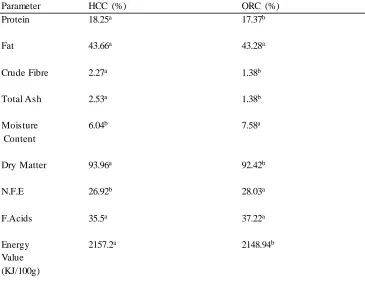
Table 1 show the results of the chemical composition of the Oven roasted cashew (ORC) and Honey coated cashew (HCC) kernels. The ranges of the chemical compositions are moisture content (%)7.58 to 6.04, protein (%) 18.25 to 17.37, fat (%) 43.66 to43.28, crude fibre (%)1.38 to 2.27, carbohydrate (%) 26.92 to 28.03, fatty acids(%) 37.55 to 37.22 and metabolizable energy(KJ/100g) 2157.24 to 2148.94.These results of the proximate composition obtained from the two cashew kernels samples shows comparison to those reported by [27] but slight differences were observed from that of [32] who has slightly higher values of protein and fat.
Table.1: Chemical composition (%) of plain roasted and honey coated cashew k ernel samples
Parameter HCC (%) ORC (%)
Protein
Fat
Crude Fibre
Total Ash
Moisture Content
Dry Matter
N.F.E
F.Acids
Energy Value
(KJ/100g)
18.25a
43.66a
2.27a
2.53a
6.04b
93.96a
26.92b
35.5a
2157.2a
17.37b
43.28a
1.38b
1.38b
7.58a
92.42b
28.03a
37.22a
2148.94b
a,b, mean values in a column having different superscripts are significantly different (p<0, 05)
Note: HCC- honey coated cashew, ORC- oven roasted cashew
Generally, the proximate composition of the two cashew nut kernels samples obtained in this study was comparable to those reported by [49]. However, some significant differences were observed in some chemical compositions of the two cashew kernel samples. The moisture content value of the Oven roasted kernel was significantly (p<0.05) higher than that of honey -coated kernel. However, the moisture content of the two cashew nut kernel samples were generally below the maximum moisture content level of 8% for safe storage of kernels as stated by both [40] and [22]. This is important especially for honey coated cashew kernel, since moisture
content of bee honey represents a major importance to its stability against fermentation and granulation, the low moisture content protects honey from microbiological activity and thus it can be preserved for longer periods [4]and [15].
content of the honey coated kernel sample compared to oven roasted kernel may be as a result of the coating of the sample with honey which is a way of protecting and enhancing the nutritional value of cashew nut.
Fat is an essential nutrient with a number of important functions. It carries fat-soluble vitamins and supplies essential fatty acids as well as contributes to overall energy value of foods [46] without adding to the bulk of the diet. They also play a structural role in providing fatty acids and cholesterol for the formation of cell membranes in all organs and much of fat necessary for the formation of these tissues are essential fatty acids. The total amount of fat in the diet and the amount of the different fatty acids in the diet can influence health. There was no significant (p>0.05) difference in the fat contents of the Oven roasted and Honey coated cashew kernels. This result is in agreement with that of [27]. This result implies that coating of cashew nut with honey does not have any significant effect on the fat content of the cashew. The fatty acid contents of the two samples also followed the same trend as that of crude fat content. This is expected since the fatty acids are the composition of crude fat.
The crude fibre is a measure of the quantity of indigestible sugars like cellulose, pentosans , lignins e.t.c that are present in foods and it helps to improve gastrointestinal function through maintenance of peristaltic movement of the intestinal tract thus, preventing constipation.[14]. Comparing the results of
crude fibre of the two samples studied, the crude fibre of the honey coated sample was significantly (p<0.05) higher than that of oven roasted sample as shown in Table 1. The result of this finding does not agree with that of a similar study reported by [5]. However, this result indicates that coating of the dried cashew nut has affected the fibre content of the nut, thus, improving its nutritional value.
The results of ash content of honey coated sample, as shown in Table 1, was significantly (p<0.05) higher than that of oven roasted sample. This suggests that small amount of ash found in honey as reported by [49] had a positive effect on the ash content of the honey coated cashew samples .
The gross energy in a food is defined as total chemical energy measured from complete combustion o f the food in a bomb calorimeter. The gross energy value of Honey coated kernel was significantly (p<0.05) higher than that of oven roasted sample as shown in Table 1. This result has shown conformity with the study of [51], who found that honey, is also a high-energy carbohydrate food (80– 85%) with the honey sugars being easily digestible as those in many fruits. This has made it a good source of energy as stated by [49]. This served as an improved nutritional value for cashew nuts whereby the energy level has been boosted by the coating of plain cashew with honey.
Table.2: Mineral Analysis (mg/100g) of Oven roasted and honey coated cashew k ernel samples
Parameter HCC ORC
Sodium 770.0 880.0
Potassium 710.0 780.0
Phosphorus 207.0 147.0
Iron 19.70 20.80
Calcium 3780.0 4470.0
Magnesium 530.0 650.0
a,b, mean values in a column having different superscripts are significantly different (p<0, 05)
Results of mineral analysis as shown in Table 2 indicated that minerals like; sodium, potassium calcium and magnesium are significantly higher (p<0.05) in the oven roasted than Honey coated cashew kernel. However,
Phosphorous content of Honey coated kernel was significantly (p<0.05) higher than that of oven roasted kernel. This result is similar to the findings of [51].
Table.3: Populations of microorganism isolated from Honey coated and Plain roasted cashew nuts samples
S/N Isolated microbes Samples/Populations
HCC ORC
1 Yeasts and Mould count 6.7x10⁴sfu/g 5.37x10⁴sfu/g
2 Total bacterial count 1.89x10⁵cfu/g 6.43x10⁴cfu/g
3 E. coli 0.00cfu/g 0.00cfu/g
Nuts and nut products in general are highly susceptible to microbial contamination primarily due to their high nutritional content as well as their pH which is conducive for microbial growth and activities [17]. Contamination of cashew nuts by moulds may also occur early in the field, and deterioration could develop during prolonged storage [19]. According to [40] most stored agricultural products, including Cashew nuts are hygroscopic and will absorb moisture from the surrounding atmosphere until they reach equilibrium, and thus the storage environment is an important concern in preserving this food. This coupled with the high ambient temperature and relative humidity in the absence of proper processing might lead to problem of microbial growth in processing nut and nut products [31].
Mesophilic bactera counts on roasted and salted Brazillian nuts ranged from 5.3 x 10³ and 1.2 x 10⁴ cfu//g [18]. These values do not differ widely with the findings
in this study as shown in Table 3, considering the fact that the counts of total bacteria for HCC was1.89x105cfu/g while that of ORC was6.43x104 cfu/g.
Yeasts and mould count of 6.7x10⁴sfu/g was recorded for HCC while 5.37x10⁴sfu/g was obtained for ORC, these values are in consonance with the results of a similar study conducted by [34], but defers from the findings of [27] who reported lower counts of yeasts and mould of 7.2×10² and 6.8×10². However, it was observed that yeast and mould count of the two samples were within the maximum standard of 10 4/g set by [23] as acceptable for packaged nuts fit for human consumption. The result of the total viable count of the cashew kernel samples are within the microbial limits/standard of 104 to less than 106 cfu/g of ready-to-eat food products as reported by Fylde Borough Council in the manual of [39].
Table.4:- Mean Sensory Evaluation Scores of the Samples
Samples Attributes
Colour Taste Flavour Crispiness General
Acceptability
HCC 6.75b 7.10a 6.40b 6.55a 7.30a
ORC 7.15a 6.95b 6.65b 6.45b 6.65b
a,b,mean values in a column having different superscripts are significantly different (p<0, 05)
HCC= Honey Coated Cashew, ORC=Oven Roasted Cashew.
The Sensory evaluation results obtained in Table 4 showed that there were significance difference in the colour, Taste, crispness and overall acceptability of the oven roasted and Honey coated Cashew kernels, while there was no significant difference (p>0.05) in flavor of the two samples. However, HCC was significantly (p<0.05) more acceptable than ORC.
III. CONCLUSSION
This study revealed that, there is significant difference in the chemical and sensory characteristics of oven roasted and honey coated cashew kernels. Also, honey coated cashew kernel has added nutritional advantage as ready-to-eat kernel, and was significantly more acceptable than oven roasted cashew by the sensory panelists.
REFERENCES
[1] A.O.A.C, 2000. Association of Official Analytical
Chemists. 17th Edn., Official Methods of
Analysis.Washington, D.C, U.S.A.
[2] Abayomi, P., Isaac A. and Ayodele O., 2002. Effects of processing conditions and packaging materials on the quality attributes of dry-roasted peanuts. J. Food
Sci. Agric., 82: 1465-1471.
[3] Agte, V. V., Borgave, S., and Joshi, S. (1998). Effect of Processing on Phytate Degradation and Mineral Solubility in Pulses. J. Food Sci. and Tech. -Mysore-35(4):330 ·
[4] Akhtar, S., Ali, J., Javid, B., Hassan, S., Abbas, S., Siddique, M., (2014). Comparative physiochemical analysis of imported and locally Produced Khyber
Pakhtunkhwa Honey. Global Journal of
Biotechnology & Biochemistry 9 (3): 55-59
[5] Aremu, M.O., Olonisakin, A., Bako, D.A. and Madu, P. C.(2006). Compositional studies and physicochemical characteristics of cashew nut (Anarcadium occidentale) flour. Pak. J. Nutr., 5(4): 328-333.
[6] Azam, S. Ali, H. and Judge E. C. (2001). Small-scale cashew nut processing. Cashew Bulletin, the publication of Sri Lanka Cashew Corporation. Pg 6 [7] Bashkir. Bee Honey, Antioxidant properties of
honey. Available from: http://info
bashkirbeehoney.com/eigenschaften/eigenschaften2. Html
properties of honey by a combination of
spectrophotometric/ fluorimetric assays and
chemometrics. Anal Chim Acta; 533: 185-91. [9] Blaisdell, S. (2002). An Illustrated Guide to Beef
Roasts. Cook's Illustrated.
en.wikipedia.org/wiki/ Roasting.
[10] Brufau, G., Boatella, J. and Rafecas, M. (2006). Nuts: Source of energy and macronutrients. Brit. J. Nutr., 96: 524-528.
[11] Chapman, D.H. and P.F. Pralt, 1961. Methods of analysis of soils, plants and waters. University of California, Division of Agricultural Science, Riverside, CA.
[12] Codex Alimentations, (2001). Draft revised standard for standard for honey (at step 10 of the Codex procedure). Alinorm 01 (25), 19–26.
[13] Doner, L. W., (1977). The Sugars of Honey-A Review. Journal of Science and Agriculture. 28 (5): 443-456.
[14] Edem, D.O., Eka, O.U. and. Ifon, E.T. (1984). Chemical evaluation of the value of the fruit of African Star apple (Chrysophyllum albidum). Food Chem., 14: 303-311.
[15] EL-Metwally, A.A. E. (2015). Factors Affecting the Physical and Chemical Characteristics of Egyptian Beehoney. Ph. D. Thesis, Fac. Agric. Cairo Univ., 320p.
[16] Fao.org. 2013. "Major Food And Agricultural
Commodities And Producers – Countries By
Commodity". Retrieved 6 September 2013[cited 2009 Aug 15].2. Ed. Toronto: University of Toronto, 2000. 439 p. 44: 31-38
[17] Fraizer, W.C. and D.C. Westhoff, (1978). Food Microbiology. 3rd Edn., Tata Mcgraw-Hill
[18] Franscisco, D.C., Oliveira, F. and Lisa, O. (2002). Bacterial and yeast counts in Brazilian commodities and spices. Brazilian Journal of Microbiology 33: 2 – 10.
[19] Freire, F. and Bargail, B.M. (2001). Microbial
deterioration of cashew nuts in Brazil.
Communication Technology 64: 43 – 48.
[20] Harrigan, W.F. and M.E. MacCance, 1976.
Laboratory Methods in Food and Dairy
Microbiology. Academic Press, London
[21] Henderson, S. (1985). The relationship between moisture content and equilibrium relative humidity of pig feed. Journal of stored products research 21, 131 –134.
[22] ICMSF (International Commission Of
Microbiological Specifications For Foods) (2000). Microorganisms in Foods 1. Their significance and methods of enumeration.
[23] ICMSF, (1986). Microorganisms in Foods 2:
Sampling for Microbiological Analysis: Principles
and Specific Applications. 2nd Edn., The
International Commission on Microbiological
Specifications for Foods. University of Toronto Press, Toronto.
[24] Irtwange, S.V. and A.O. Oshodi(2009). Shelf-life of roasted cashew nuts as affected by relative humidity, thickness of polythene packaging material and duration of storage. Res. J. Appl. Sci. Eng. Technol., 1(3): 149-153.
[25] Jaganathan, S. K., Mandal, M. (2009).
Antiproliferative Effects of Honey and of Its Polyphenols: A Review. J Biomed Biotechnol : 83: 0616.
[26] Kosoko, S.B., L.O. Sanni, A.A. Adebowale, A.O. Daramola and M.O. Oyelakin (2009). Effect of period of steaming and drying temperature on chemical properties of cas hew nut. Afr. J. Food Sci., 3(6): 156-164.
[27] Kosoko S.B., Oluwole O.B., Daramola A.O.,
Adepoju M.A., Oyelakin A.J., Tugbobo -amisu A.O., Alagbe G.O. and Elemo G.N. (2014). Comparative Quality Evaluation of Roasted Cashew Nut Kernel: Effect of Roasting Methods Advance Journal of Food Science and Technology 6(12): 1362-1371
[28] Larmond, E., 1980. Laboratory Methods of Sensory Evaluation of Food. Dept. Agric. Publications, Research Branch, Canada
[29] Mexis, S.F. and M. G. Kontominas(2009). Effect of irradiation on the physicochemical and sensory
properties of cashew nuts (Anacardium
occidentaleL.). Lebensm. Wiss. Technol., 42: 1501-1507.
[30] Nascimento, A. N., Naozuka, J. and Oliveira, P. V. (2010). In vitro evaluation of Cu and Fe bioavailability in cashew nuts by off-line coupled SEC-UV and SIMAAS. Micro-Chem. J., 96: 58-63. [31] Ogundero, W.W. (1987). Temperature and aflatoxin
production by Aspergillus flavus and A. parasiticus strains from Nigerian groundnuts. J. Basic Microb., 27: 511-514
[32] Ogunwolu , S. O., Henshaw, F. O., Mock, H. P. and
Matros, A.(2010). Production Of Protein
Concentrate And Isolate From Cashew (Anacardium occidentale L.) Nut. Afr.J. Food Agric.Nutr. and Dev. Vol.10 No 5: 2501-2514.
[33] Oliete, B., Gómez, M., Pando,V., Fernández- Fernández, E., Caballero, P. A. and Ronda, F.(2008). Effect of nut paste enrichment on physical characteristics and consumer acceptability of bread. Food Sci. Technol. Int., 14: 259-269.
Outbreak of E. coli 0157:H7 Infections Associated With Ready-To Eat Cashew Nuts in a Nigerian University Community. Afr. J. Biomed. Res. Vol. 12, No. 2, May 2009
[35] Oniang’o, R. K., Mutuku, J. M. and Malaba, S. J.(2003). Contemporary African food habits and their nutritional and health implications. Asia Pac. HJ. Clin. Nutr., 12(3): 231-236.
[36] Orhevba,B.A, Yusuf, I.B. Effect Of Roasting Temperature On Nutritional Quality Of CashewNut (Anacardium Occidentale). Int. J. of Sci. & Techn. Res. Vol. 5, Iss. 07, July 2016
[37] Ozdemir, M. and Devres, O. (2000). Kinetics of color changes of hazelnuts during roasting. J. Food Eng. 44(1):31-38.
[38] Perez, R. A., Iglesias, M. T., Pueyo, E., Gonzalez, M., de Lorenzo, C. (2007). Amino acid composition and antioxidant capacity of Spanish honeys. J. Agric Food Chem; 55: 360-5.
[39] PHLSG (2008). The Microbiological Quality of Ready-to- eat Foods Sampled at the Point of Sale. (Public Health Laboratory Service Guidelines). Brough Council, United Kingdom.
[40] Pixton, S.W., (1982). The Importance of Moisture and Equilibrium Relative Humidity in Stored Product. Trop. Stored Prod. Int., 43: 16-29b
[41] Postmes, T.,Bogaard, A. E. and Hazen, M. (1995). "The sterilization of honey with cobalt 60 gamma radiation: a study of honey spiked with spores of
Clostridium botulinum andBacillus
subtilis".Experientia.51: 986–989.
[42] Rahman, M. M., Allan, R., Azirun, M.S. (2010). Antibacterial activity of propolis and honey against
Staphylococcus aureus and Escherichia.
African journal of microbiology research
4(18):1872-1878 ·
[43] Ricard, R.,Mònica, B.,and Jordi, S. (2015). Nutritional composition of raw fresh cashew (Anacardium occidentale L.) kernels from different origin. J. Food Sci Nutr., 4(2): 329–338.
[44] Saklar, S., S. Ungan and S. Katnas, 1999. Instrumental crispness and crunchiness of roasted hazelnuts and the quality attributes of dry -roasted peanuts. J. Food Sci. Agric., 82: 1465-1471.
[45] Shakuntala, M. N. and Shadadsharaswamy, M. (1987). Food, Facts and Principles. Wiley Eastern Ltd., New Delhi.
[46] Shittu, T.A. and M.O. Lawal, 2007. Factors affecting instant properties of powdered cocoa beverages. Food Chem., 100: 91-98.
[47] Singh, S., Gamlath, S. and Wakeling, L. (2007). Nutritional aspects of food extrusion: A review. Int. J. Food Sci. Tech., 42: 916-929.
[48] Strom, Stephanie (2014-08-08). Cashew Juice, the Apple of Pepsi’s Eye.. The New York Times. ISSN 0362-4331. Retrieved 2015-11-24.
[49] USDA, 2010. USDA National Nutrient Database for
Standard Reference.
Retrievedfrom:http://www.nal.usda.gov/fnic/foodco mp/ search/ (Accessed on: March 12, 2013).
[50] Wasagu, R.S.U., Shehu, S. and Mode, Y.D.
(2013).Comparative Proximate Composition and Antioxidant Vitamins Contents of Two Honey Varieties (Light Amber and Dark Amber) from Sokoto State, Nigeria. Bayero Journal of Pure and Applied Sciences, 6(2): 118 – 120.
[51] White, J.W. and Doner, L.W. (1980). Honey Composition and Properties: Beekeeping in the United States. Agriculture Handbook No. 335.
[52] WHO (2007). Protein and amino acid requirements
in human nutrition: Report of a joint
FAO/WHO/UNU expert consultation. WHO
Technical Report Series No. 935.