Open Access
Research article
Documentation of body mass index and control of associated risk
factors in a large primary care network
Stephanie A Rose*
1, Alexander Turchin
2, Richard W Grant
3and
James B Meigs
4Address: 1Division of General Internal Medicine, University of Kentucky, 740 South Limestone Street, Kentucky Clinic K507, Lexington, KY 40536, USA, 2Clinical Informatics Research and Development, Harvard University, and Division of Endocrinology, Brigham and Women's Hospital, 221 Longwood Avenue, Boston, MA, 02115, USA, 3General Medicine Division, Massachusetts General Hospital, 50 Staniford Street, Boston, MA, 02114, USA and 4General Medicine Division, Massachusetts General Hospital, 50 Staniford Street, Boston, MA, 02114, USA
Email: Stephanie A Rose* - [email protected]; Alexander Turchin - [email protected]; Richard W Grant - [email protected]; James B Meigs - [email protected]
* Corresponding author
Abstract
Background: Body mass index (BMI) will be a reportable health measure in the United States (US) through implementation of Healthcare Effectiveness Data and Information Set (HEDIS) guidelines. We evaluated current documentation of BMI, and documentation and control of associated risk factors by BMI category, based on electronic health records from a 12-clinic primary care network.
Methods: We conducted a cross-sectional analysis of 79,947 active network patients greater than 18 years of age seen between 7/05 - 12/06. We defined BMI category as normal weight (NW, 18-24.9 kg/m2), overweight (OW, 25-29.9), and obese (OB, ≥ 30). We measured documentation (yes/
no) and control (above/below) of the following three risk factors: blood pressure (BP) ≤130/≤85 mmHg, low-density lipoprotein (LDL) ≤130 mg/dL (3.367 mmol/L), and fasting glucose <100 mg/dL (5.55 mmol/L) or casual glucose <200 mg/dL (11.1 mmol/L).
Results: BMI was documented in 48,376 patients (61%, range 34-94%), distributed as 30% OB, 34% OW, and 36% NW. Documentation of all three risk factors was higher in obesity (OB = 58%, OW = 54%, NW = 41%, p for trend <0.0001), but control of all three was lower (OB = 44%, OW = 49%, NW = 62%, p = 0.0001). The presence of cardiovascular disease (CVD) or diabetes modified some associations with obesity, and OB patients with CVD or diabetes had low rates of control of all three risk factors (CVD: OB = 49%, OW = 50%, NW = 56%; diabetes: OB = 42%, OW = 47%, NW = 48%, p < 0.0001 for adiposity-CVD or diabetes interaction).
Conclusions: In a large primary care network BMI documentation has been incomplete and for patients with BMI measured, risk factor control has been poorer in obese patients compared with NW, even in those with obesity and CVD or diabetes. Better knowledge of BMI could provide an opportunity for improved quality in obesity care.
Published: 16 December 2009
BMC Health Services Research 2009, 9:236 doi:10.1186/1472-6963-9-236
Received: 17 May 2009 Accepted: 16 December 2009
This article is available from: http://www.biomedcentral.com/1472-6963/9/236
© 2009 Rose et al; licensee BioMed Central Ltd.
Background
Obesity is a common problem in the United States that independently confers risk for chronic disease and early mortality [1]. Several studies address the importance of recognition and treatment of obesity in chronic disease management, but few evaluate body mass index (BMI) assessment and risk factor documentation and control in patients who are obese both with and without cardiovas-cular disease (CVD), diabetes or risk factors [2-6].
Assessments of BMI and CVD or diabetes risk factors are simple, inexpensive tools that can be used by primary care physicians (PCPs) to address obesity and its complica-tions. Little consensus exists in current guidelines con-cerning the need to screen for BMI and associated risk factors [7-15]. In 1998 the National Heart, Lung, and Blood Institute (NHLBI) established guidelines for BMI and risk factor measurement in all patients under 80 years of age with the goal of implementation of strategies for weight loss and risk factor control in patients with a BMI of ≥ 30 kg/m2 or 25-29.9 kg/m2 and ≥ two risk factors [10].
In 2007 the National Committee for Quality Assurance (NCQA) organized field tests of a prospective Healthcare Effectiveness Data and Information Set (HEDIS) measure to assess the percentage of members 18-74 years of age with an outpatient visit, and who had BMI documented and risk factors documented if found to have a BMI of ≥30 kg/m2 [16]. Their work led to the proposed HEDIS 2009
measure BMI Assessment [17], which is proposed for reporting by commercial, Medicaid, and Medicare plans.
Given the magnitude and clinical impact of the current obesity epidemic and its risk factors, and the potential implementation of the HEDIS BMI Assessment measure, we aimed to examine current care in BMI and risk factor assessment for patients in a large network of primary care practices that use a common electronic health record (EHR). We investigated the prevalence of BMI measure-ment and documeasure-mentation and control of the CVD and dia-betes risk factors blood pressure (BP), low density lipoprotein (LDL), and fasting and casual glucose. We examined these risk factors according to the BMI catego-ries normal weight, overweight, and obese. We hypothe-sized that documentation of BMI would vary widely in clinical practice, and that patients who were obese would be more likely to have better documentation, but poorer control, of risk factors than patients of normal weight.
Methods
Setting and Patients
We identified 138,933 patients in our primary care research network of twelve practices that make up the Massachusetts General Hospital Primary Care Practice Based Research Network (PBRN). Practices include urban academic faculty practices, private offices, and
commu-nity health centers in and around Boston, Massachusetts. These twelve practices use a common EHR that contains all clinical and utilization data for each patient. The data from the EHR data are searchable in the Research Patient Data Repository (RPDR) [18]. From these, we included 79,947 patients who were at least 18 years of age and had at least two clinic visits billed to their PCP between 7/1/05 and 12/31/06, and did not have a height greater than or equal to seven feet (2.13 meters), weight <70 or >1000 pounds (<31.8 or >453.6 kilograms), systolic BP <50 or >260 mmHg, or diastolic BP <30 or >150 mmHg. The study was approved by the Partners Health Care System Institutional Review Board.
BMI Measurement
The intent of the HEDIS initiative is to measure and increase documentation of BMI. We obtained BMI from height and weight data recorded in the EHR, where they are used to automatically calculate and display BMI. For this analysis we calculated BMI from the most recent weight in the 18-month period and the most recent height prior to 12/31/06 from structured coded entries in the EHR. For completeness, we also searched the text of narra-tive notes in the EHR using a validated Natural Language Processing abstraction tool that computationally abstracts weight, height, and BP values from the free text of clini-cian notes [19,20]. The sensitivity and specificity of the approach to abstraction (compared with a trained chart abstractor) are 87.9% and 99% for detection of height, 91.8% and 92.1% for detection of weight, and 91% and 96% for detection of BP [19,20]. Because of high rates of missing heights, we confirmed with clinic site medical directors that we had searched in all the appropriate places in the clincial record for height and weight infor-mation.
We categorized BMI using Centers for Disease Control (CDC) definitions, with underweight equal to BMI <18.5 kg/m2, normal weight equal to a BMI of 18.5-<25 kg/m2,
overweight BMI equal to 25-<30 kg/m2, and obese BMI ≤30 kg/m2 [21]. We included underweight patients when
measuring documentation of BMI, but excluded them otherwise. Among those with a documented BMI, we examined documentation and control of three risk fac-tors: blood pressure (BP), LDL cholesterol, and fasting or casual glucose levels, or both. We examined risk factor documentation and control in the clinic population over-all, and stratified by three BMI categories.
Risk Factor, CVD, and Diabetes Measurement
≤85 mmHg, LDL<130 mg/dL (3.367 mmol/L), and fast-ing glucose <100 mg/dL (5.55 mmol/L) or casual glucose <200 mg/dL (11.1 mmol/L) [22-24]. We also measured documentation and control of all three risk factors com-bined as an aggregate measure of risk factor management.
We defined clinical CVD as coronary artery disease, cere-brovascular accident, or peripheral vascular disease listed on the EHR Problem List, or as having two outpatient or one inpatient International Classification of Diseases, Ninth Revision (ICD-9) codes for CVD. We defined clini-cal diabetes as diabetes on the EHR problem list and a dia-betes medication on the medication list, or as having two outpatient or one inpatient codes related to diabetes. The definitions of diabetes, hypertension, hyperlipidemia and CVD have previously been validated [25,26]. For instance, the sensitivity of our approach for diabetes or CVD are >98% and specificity of >97% compared to the gold standard of trained research nurse chart abstraction. We used the same approach as for diabetes to define hyper-tension and hyperlipidemia. Other measurements included age, race, gender, number of PCP visits during the study period, insurance type, and clinic site.
Statistical Analysis
We conducted a cross-sectional analysis. We measured rates of BMI documentation in each clinic site and overall. Among those with a BMI, we measured risk factor docu-mentation and control overall, and stratified by the three BMI categories. We further stratified the analysis by the presence or absence of CVD or diabetes. We used general-ized linear models or chi-square tests to test levels or rates of characteristics by BMI category. We used the Breslow Day test for homogeneity of odds ratios to test for effect modification of CVD or diabetes on the association of
BMI with risk factor documentation and control. We used SAS version 9.1 (Cary, NC) for all analyses, and consid-ered a p value of <0.05 to indicate statistical significance.
Results
BMI Documentation and Characteristics of Patients with Documented BMI
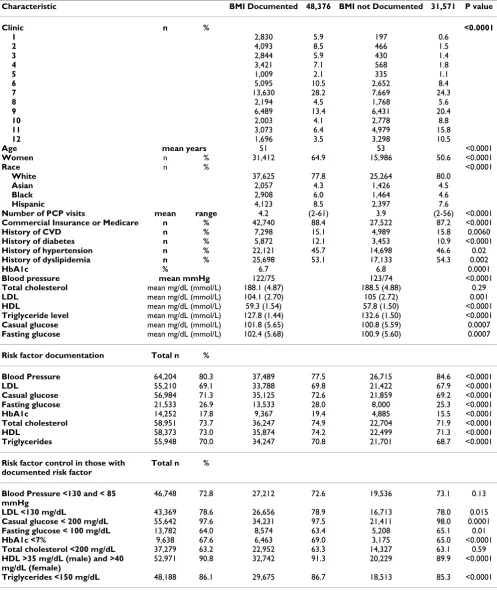
Of 79,947 patients, 72,633 (90.9%) had an available weight, 50,345 (63.0%) had an available height, and 48,376 (60.5%) had both height and weight recorded to calculate BMI (Table 1). Of those with BMI present, 14,290 patients (30%) were classified as obese, 16,402 (34%) overweight, 16,936 (36%) normal weight, and 748 (2%) underweight. Compared to those missing BMI, patients with BMI documented were younger, had a higher mean number of PCP visits, were more likely to be women, and were more likely to have commercial insur-ance or Medicare than patients without a BMI (p < 0.0001 for all; Table 2). As expected, patients with obesity were older, less likely to be women, white, or to have private insurance or Medicare, had a higher mean number of PCP visits, and were more likely to have a history of CVD, dia-betes, hypertension, and dyslipidemia than patients of normal weight (p < 0.0001 for all; Table 3).
Documentation and Control of Risk Factors
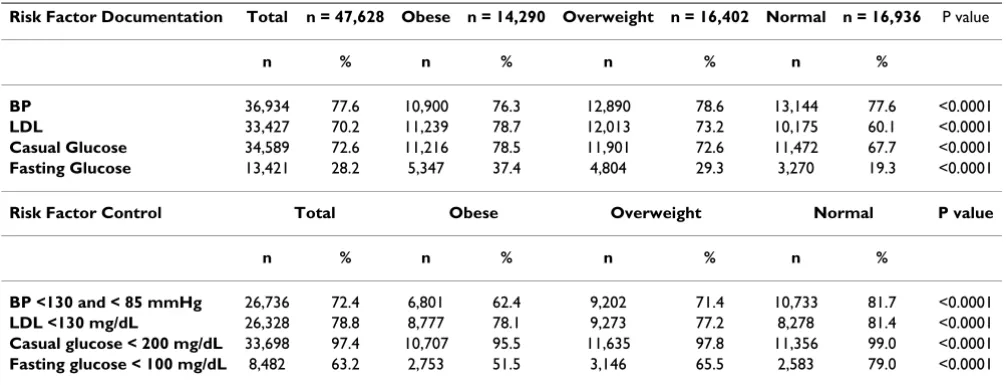
[image:3.612.53.553.524.701.2]Overall, less than 78% had at least one risk factor docu-mented and just half had all three docudocu-mented (Table 4, Figure 1). Of these, about half of all patients had all three risk factors controlled (Figure 1). Documentation of all three risk factors was higher in obesity than in overweight or normal weight (p < 0.0001), but control of all three risk factors was lower, (p < 0.0001), with only 44% of patients with obesity having all risk factors under control.
Table 1: Body Mass Index Documentation in 79,947 Patients in 12 Primary Care Clinics
Clinic N BMI Height Documented Weight Documented
% % %
1 3,027 93.5 94.1 99.1
2 4,559 89.8 95.7 91.6
3 3,274 86.9 87.5 99.1
4 3,989 85.8 94.5 87.4
5 1,344 75.1 75.2 99.5
6 7,747 65.8 66.0 99.0
7 21,299 64.0 65.8 96.1
8 3,962 55.4 55.8 98.7
9 12,919 50.2 55.4 71.1
10 4,781 41.9 44.4 78.4
11 8,052 38.2 38.3 99.0
12 4,994 34.0 35.7 88.9
Total 48,376 60.5 63.0 90.9
Data are ranked by BMI documentation rate, include patients at least 18 years of age with at least two clinic visits billed to their PCP between 7/1/
05 and 12/31/06, and include underweight patients (BMI <18.5 kg/m2) excluded from the main analysis. BMI = Body Mass Index (weight in kilograms/
Table 2: Patient Demographics and Clinical Characteristics in 79,947 Patients in 12 Primary Care Clinics by Documentation or Missingness of BMI
Characteristic BMI Documented 48,376 BMI not Documented 31,571 P value
Clinic n % <0.0001
1 2,830 5.9 197 0.6
2 4,093 8.5 466 1.5
3 2,844 5.9 430 1.4
4 3,421 7.1 568 1.8
5 1,009 2.1 335 1.1
6 5,095 10.5 2,652 8.4
7 13,630 28.2 7,669 24.3
8 2,194 4.5 1,768 5.6
9 6,489 13.4 6,431 20.4
10 2,003 4.1 2,778 8.8
11 3,073 6.4 4,979 15.8
12 1,696 3.5 3,298 10.5
Age mean years 51 53 <0.0001
Women n % 31,412 64.9 15,986 50.6 <0.0001
Race n % <0.0001
White 37,625 77.8 25,264 80.0
Asian 2,057 4.3 1,426 4.5
Black 2,908 6.0 1,464 4.6
Hispanic 4,123 8.5 2,397 7.6
Number of PCP visits mean range 4.2 (2-61) 3.9 (2-56) <0.0001
Commercial Insurance or Medicare n % 42,740 88.4 27,522 87.2 <0.0001
History of CVD n % 7,298 15.1 4,989 15.8 0.0060
History of diabetes n % 5,872 12.1 3,453 10.9 <0.0001
History of hypertension n % 22,121 45.7 14,698 46.6 0.02
History of dyslipidemia n % 25,698 53.1 17,133 54.3 0.002
HbA1c % 6.7 6.8 0.0001
Blood pressure mean mmHg 122/75 123/74 <0.0001
Total cholesterol mean mg/dL (mmol/L) 188.1 (4.87) 188.5 (4.88) 0.29
LDL mean mg/dL (mmol/L) 104.1 (2.70) 105 (2.72) 0.001
HDL mean mg/dL (mmol/L) 59.3 (1.54) 57.8 (1.50) <0.0001
Triglyceride level mean mg/dL (mmol/L) 127.8 (1.44) 132.6 (1.50) <0.0001
Casual glucose mean mg/dL (mmol/L) 101.8 (5.65) 100.8 (5.59) 0.0007
Fasting glucose mean mg/dL (mmol/L) 102.4 (5.68) 100.9 (5.60) 0.0007
Risk factor documentation Total n %
Blood Pressure 64,204 80.3 37,489 77.5 26,715 84.6 <0.0001
LDL 55,210 69.1 33,788 69.8 21,422 67.9 <0.0001
Casual glucose 56,984 71.3 35,125 72.6 21,859 69.2 <0.0001
Fasting glucose 21,533 26.9 13,533 28.0 8,000 25.3 <0.0001
HbA1c 14,252 17.8 9,367 19.4 4,885 15.5 <0.0001
Total cholesterol 58,951 73.7 36,247 74.9 22,704 71.9 <0.0001
HDL 58,373 73.0 35,874 74.2 22,499 71.3 <0.0001
Triglycerides 55,948 70.0 34,247 70.8 21,701 68.7 <0.0001
Risk factor control in those with documented risk factor
Total n %
Blood Pressure <130 and < 85 mmHg
46,748 72.8 27,212 72.6 19,536 73.1 0.13
LDL <130 mg/dL 43,369 78.6 26,656 78.9 16,713 78.0 0.015
Casual glucose < 200 mg/dL 55,642 97.6 34,231 97.5 21,411 98.0 0.0001
Fasting glucose < 100 mg/dL 13,782 64.0 8,574 63.4 5,208 65.1 0.01
HbA1c <7% 9,638 67.6 6,463 69.0 3,175 65.0 <0.0001
Total cholesterol <200 mg/dL 37,279 63.2 22,952 63.3 14,327 63.1 0.59
HDL >35 mg/dL (male) and >40 mg/dL (female)
52,971 90.8 32,742 91.3 20,229 89.9 <0.0001
Triglycerides <150 mg/dL 48,188 86.1 29,675 86.7 18,513 85.3 <0.0001
P-value compares BMI documented with BMI not documented. BMI = Body Mass Index (weight in kilograms/height in meters2), PCP = Primary Care
The presence of CVD or diabetes modified some associa-tions of BMI category with risk factor documentation and control. In patients with CVD or diabetes, the rates of doc-umentation were generally less different comparing patients with obesity with those of normal weight, while in patients without CVD or diabetes, rates of documenta-tion were strikingly higher in patients with obesity than normal weight (Figure 1, Table 5, p = 0.26 to <0.0001 for CVD- or diabetes-by-BMI category interaction). Likewise, in patients with CVD or diabetes the rates of control were generally less different comparing patients with obesity with those with normal weight, but in patients without CVD or diabetes, rates of control were strikingly lower in patients with obesity than normal weight (Figure 1, Table 6). Overall 50% or fewer of the patients with obesity and CVD or diabetes had all three risk factors under control (Figure 1, Tables 5 and 6).
Discussion
We examined the current state of BMI documentation and documentation and control of associated risk factors by BMI category, based on EHR data from almost 80,000 adult patients seen in a 12-clinic primary care network during 18 months in 2005-2006. Our findings demon-strate variations in risk factor recognition and control for obese persons compared to those of normal weight, as well as for those with and without CVD or type 2 diabetes. We found that documentation of BMI varied widely by clinic site and was overall low. Among patients with a BMI recorded, documentation of most risk factors was higher in patients with obesity compared with normal weight patients; however, control of risk factors was poorer in obesity than normal weight. Patients without a docu-mented history of CVD or diabetes had strikingly more dissimilar rates of documentation and control between weight categories than patients with CVD or diabetes. Overall, patients with obesity with or without CVD or
dia-betes had lower rates of risk factor documentation and control than may be ideal given their high absolute risk of adverse health outcomes.
[image:5.612.55.558.545.709.2]Our study builds upon findings from previous studies. Lemay et al audited medical records from 465 adult patients seen at a community health center during one week in February of 1999 to evaluate height and weight documentation and obesity diagnosis by the practitioner over a prior six-month period, and found that only 63% of their patient cohort had a height and weight docu-mented [27]. Similar to our study, Lemay looked a group of patients in normal clinical practice; however, we were able to expand upon this study in terms of a far larger study sample as well as a longer sampling frame to assess provision of services (18 months versus 6 months), potentially providing a more accurate picture of risk factor evaluation. Six years after this study and seven years after the establishment of the NHLBI guidelines, we found the percentage of BMI documentation to be essentially the same (63% versus 60.5%). Rifas-Shiman et al studied 5,025 members of the same insurance plan and group practice who were a subset of participants from a cohort study and were continuously enrolled since 1999, had a visit in 2000, had a BMI measurement between January 1, 2000 and December 31, 2000, and who did not have medical conditions related to weight loss or CVD. They found that higher BMI was an independent predictor of increased fasting glucose, triglyceride, LDL cholesterol, and HDL cholesterol screening [28]. Rifas-Shiman identi-fied lipid and glucose abnormalities over a two-year period, comparable in time to our study. Neither we nor Rifas-Shiman could evaluate attempts at management, so reasons for increased documentation such as guideline adherence could not be assessed. Our analysis extends prior studies by evaluating whether those with documen-tation of risk factors had those risk factors in control
Table 3: Characteristics of 47,628 Primary Care Patients by BMI Category
Characteristic Obese n = 14,290 Overweight n = 16,402 Normal n = 16,936 P value
Age (mean years) 53 53 48 <0.0001
Number of PCP visits (mean) 4.7 4.2 3.9 <0.0001
Women n (%) 8,565 59.9 8,899 54.3 13,272 78.4 <0.0001
Race* n (%) <0.0001
White 10,712 75.0 12,674 77.3 13,655 80.6
Asian 179 1.3 567 3.5 1,229 7.3
Black 1,244 8.7 989 6.0 649 3.8
Hispanic 1,722 12.1 1,561 9.5 811 4.8
Private Insurance or Medicare n (%) 12,104 84.7 14,502 88.4 15,467 91.3 <0.0001
History of CVD n (%) 2,647 18.5 2,699 16.5 1,862 11.0 <0.0001
History of diabetes n (%) 3,238 22.7 1,789 10.9 824 4.9 <0.0001
History of hypertension n (%) 9,116 63.8 7,895 48.1 4,931 29.1 <0.0001
History of dyslipidemia n (%) 9,235 64.6 9,495 57.9 6,769 40.0 <0.0001
P-value is for general association across BMI categories. BMI = Body Mass Index (weight in kilograms/height in meters2), PCP = Primary Care
according to Adult Treatment Panel III (ATP III) metabolic syndrome guidelines for a patient with average cardiovas-cular risk.
Molenaar et al studied rates of treatment and control of hypercholesterolemia, hypertension, and diabetes in nor-mal weight, overweight, and obese subjects with a history of these conditions utilizing a CVD-free subset of the Framingham Heart Study. They found that subjects with hypercholesterolemia and hypertension who were obese were more likely to have these conditions treated than normal weight subjects. Rates of control of hypertension and hypercholesterolemia were uniformly poor and did not differ between weight groups. Rates of control of dia-betes were poor among all three weight groups, but sub-jects who were obese were less likely to have control of fasting blood glucose than normal weight subjects. The goal of our study, however, was different from that of Molenaar. Molenaar studied rates of treatment and con-trol of hypercholesterolemia, hypertension, and diabetes in normal weight, overweight, and obese subjects with a history of these conditions who were free of CVD, a sub-group of patients with a clear indication for BMI screen-ing. Our goal was to evaluate in all patients, both with and without obesity-associated risk factors, the current state of BMI screening and subsequent screening for associated risk factors by BMI group, according to HEDIS and NHLBI guidelines. Molenaar et al examined a well-known, stand-ardized study population, where only 196 subjects had missing BMI data. Our population was a non-standard-ized data source, and our subjects were a mixture of both those with and without CVD and its risk factors, with fur-ther subanalysis in patients with a history of CVD and dia-betes. Despite these differences, findings from the
structured Framingham population and from our analysis of usual clinical care are strikingly similar. This minimizes to a large degree the concern that high rates of missing BMI information could have distorted our findings, and may explain why our percentages of control were higher than those found by Molenaar, albeit still low overall [29].
The rapidly growing prevalence of obesity has pushed BMI assessment to appropriate prominence as a newly pro-posed reportable HEDIS measure. BMI assessment will be made by several means, including survey of EHRs in health care networks. Our results suggest that the HEDIS
BMI Assessment measure has potential to provide a timely quality and safety foundation to improve care for patients with obesity. At least in our large primary care network, there clearly is substantial room for improvement in doc-umentation of BMI and docdoc-umentation and control of BMI-associated risk factors. While height and weight and BMI documentation may reflect individual physician practice styles, by speaking with medical directors we found that lack of height and weight appeared to be a clinic-level and not an individual PCP issue, with height and weight recording often performed or not performed before the PCP sees the patient. It is expected that intro-duction of the HEDIS BMI Assessment measure will improve this state of affairs, although the effectiveness of BMI documentation alone to improve care remains to be demonstrated.
According to our study, patients with already documented CVD or diabetes are more likely to have risk factor docu-mentation and control regardless of BMI category. Those without a documented history of CVD or diabetes
demon-Table 4: Documentation and Control of Risk Factors among 47,628 Primary Care Patients, by BMI Category
Risk Factor Documentation Total n = 47,628 Obese n = 14,290 Overweight n = 16,402 Normal n = 16,936 P value
n % n % n % n %
BP 36,934 77.6 10,900 76.3 12,890 78.6 13,144 77.6 <0.0001
LDL 33,427 70.2 11,239 78.7 12,013 73.2 10,175 60.1 <0.0001
Casual Glucose 34,589 72.6 11,216 78.5 11,901 72.6 11,472 67.7 <0.0001
Fasting Glucose 13,421 28.2 5,347 37.4 4,804 29.3 3,270 19.3 <0.0001
Risk Factor Control Total Obese Overweight Normal P value
n % n % n % n %
BP <130 and < 85 mmHg 26,736 72.4 6,801 62.4 9,202 71.4 10,733 81.7 <0.0001
LDL <130 mg/dL 26,328 78.8 8,777 78.1 9,273 77.2 8,278 81.4 <0.0001
Casual glucose < 200 mg/dL 33,698 97.4 10,707 95.5 11,635 97.8 11,356 99.0 <0.0001
Fasting glucose < 100 mg/dL 8,482 63.2 2,753 51.5 3,146 65.5 2,583 79.0 <0.0001
[image:6.612.54.557.100.292.2]Documentation and control of all three risk factors by BMI category Figure 1
Documentation and control of all three risk factors by BMI category. A. Documentation of all 3 risk factors by BMI category; B. Documentation of all 3 risk factors by BMI category, stratified by history of CVD; C. Documentation of all 3 risk factors by BMI category, stratified by history of diabetes. D. Control of all 3 risk factors by BMI category; E. Control of all 3 risk factors by BMI category, stratified by history of CVD; F. Control of all 3 risk factors by BMI category, stratified by history of diabetes.
A
0 10 20 30 40 50 60 70 80
Obese Overweight Normal Weight
Percentage
Ϭ ϭϬ ϮϬ ϯϬ ϰϬ ϱϬ ϲϬ ϳϬ ϴϬ
KďĞƐĞ KǀĞƌǁĞŝŐŚƚ EŽƌŵĂůtĞŝŐŚƚ
WĞƌĐĞŶƚĂŐĞ
B
0 10 20 30 40 50 60 70 80
Obese Overweight Normal Weight
Percentage
CVD No CVD
E
0 10 20 30 40 50 60 70 80
Obese Overweight Normal Weight
Percentage
C
0 10 20 30 40 50 60 70 80
Obese Overweight Normal Weight
Percentage
DM No DM
F
0 10 20 30 40 50 60 70 80
Obese Overweight Normal Weight
Table 5: Documentation of Risk Factors in 47,628 Patients in 12 Primary Care Clinics Stratified by BMI Category and History of CVD or Diabetes
Risk Factors Total Obese n = 14,290 Overweight n = 16,402 Normal
Weight
n = 16,936 P value
History of CVD
n % n % n % n %
H/O CVD n = 7,208
H/O CVD N = 2,647 H/O CVD N = 2,699 H/O CVD N = 1,862
NO H/O CVD n = 40,420
No H/O CVD N = 11,643 NO H/O CVD N = 13,703 NO H/O CVD N = 15,074
BP n = 10,900 n = 12,890 n = 13,144
H/O CVD 5,297 73.5 1,931 73.0 1,991 73.8 1,375 73.9 0.26
NO H/O CVD
31,637 78.3 8,969 77.0 10,899 79.5 11,769 78.1
LDL n = 11,239 n = 12,013 n = 10,175
H/O CVD 6,199 86.0 2,393 90.4 2,358 87.4 1,448 77.8 0.15
NO H/O CVD
27,228 67.4 8,846 76.0 9,655 70.5 8,727 57.9
Casual glucose n = 11,216 n = 11,901 n = 11,472
H/O CVD 6,305 87.5 2,355 89.0 2,322 86.0 1,628 87.4 0.0001
NO H/O CVD
28,284 70.0 8,861 76.1 9,579 69.9 9,844 65.3
Fasting glucose
n = 5,347 n = 4,804 n = 3,270
H/O CVD 2,741 38.0 1,158 43.8 1,023 37.9 560 30.1 <0.0001
NO H/O CVD
10,680 26.4 4,189 36.0 3,781 27.6 2,710 18.0
All 3 risk factors
n = 8,247 n = 8,797 n = 6,986
H/O CVD 4,417 61.3 1,696 64.1 1,693 62.7 1,028 55.2 <0.0001
NO H/O CVD
19,613 48.5 6,551 56.3 7,104 51.8 5,958 39.5
History of DM n % n % n %
H/O diabetes n = 5,851
H/O diabetes N = 3,238 H/O diabetes N = 1,789 H/O diabetes N = 824
NO H/O diabetes n = 41,777
NO H/O diabetes N = 11,052
NO H/O diabetes N = 14,613 NO H/O diabetes N =
16,112
BP n = 10,900 n = 12,890 n = 13,144
H/O diabetes
4,398 75.2 2,447 75.6 1,366 76.4 585 71.0 0.002
NO H/O diabetes
32,536 77.9 8,453 76.5 11,524 78.9 12,559 78.0
LDL n = 11,239 n = 12,013 n = 10,175
H/O diabetes
5,285 90.3 2,963 91.5 1,617 90.4 705 86.2 0.51
NO H/O diabetes
28,142 67.4 8,276 74.9 10,396 71.1 9,470 58.8
Casual glucose n = 11,216 n = 11,901 n = 11,472
H/O diabetes
5,225 89.3 2,884 89.1 1,596 89.2 745 90.4 <0.0001
NO H/O diabetes
29,634 70.9 8,332 75.4 10,305 70.5 10,727 66.6
Fasting glucose
strated more variation in risk factor documentation and control by BMI category. At least two recent studies cor-roborate these data. Melamed et al measured BMI in 289 patients in seven family practice clinics in Israel, and found that BMI was documented in only half of obese patients and 39% of overweight patients, and that patients with other chronic medical conditions were more likely to have BMI documented than those without documented comorbidities [30]. Waring et al looked at 2,330 over-weight and obese patients included in the Cholesterol Education and Research Trial, and found increased odds of overweight or obesity management in relation to weight-related comorbidities for those with moderate or severe obesity [31].
Risk factor control appears to be related to a previously diagnosed risk factor and not to obesity. These findings become even more relevant in light of recent studies that demonstrate increased CVD risk in patients who are over-weight and obese compared to normal over-weight patients, independent of hypertension and hypercholesterolemia [32]. This implies an important need to recognize over-weight and obesity, ideally using a simple technique such as BMI, in order to enhance CVD and diabetes complica-tions prevention. Our findings suggest that PCPs are aware of CVD, diabetes, and obesity as strongly tied risk factors, but that they may not recognize obesity as a risk factor for morbidity and mortality independent of these other comorbidities.
Limitations
Our results must be interpreted with some limitations in mind. This is clinical, not research, data, which naturally suffers from information that is missing and inconsistent in its recording. We carefully addressed missingness with multiple methods of ascertaining exposures, and addressed inconsistencies in data recording by removal of clinically illogical extreme outliers. Evaluation of BMI documentation rates, with the inherent missing data, was
a goal of our study. Furthermore, despite its limitations, evaluation of clinical data is a strength of this study, in that it provides a glimpse into current obesity care and insights into improving this practice. Although our data were derived from a single academic health care network, the sites included a representative mixture of urban, sub-urban, and hospital-based practices, making our findings generalizable and potentially replicable. Another impor-tant strength of our study is the use of a long-standing, widely used EHR encompassing all aspects of patient care from a large network of diverse clinics and patient popu-lations. EHRs, while not a perfect tool due to the potential for improperly entered or overlooked data, have great potential for research, with studies showing that EHRs have potential for increasing documentation and treat-ment of obese patients [33]. Finally while there were dif-ferences seen in the percentages of documentation of risk factors, this may be due mainly to test indication, whereby certain tests such as cholesterol levels are more likely to be ordered on most patients than fasting glucose. However, our overall documentation numbers were large enough to yield consistent results across BMI categories.
Conclusions
It is well-accepted that intentional weight loss mitigates many of the risk factors associated with obesity. Despite rising rates of obesity, physicians appear not to routinely assess BMI during office visits [34]. According to the NCQA, multiple organizations recommend measuring BMI as part of the routine physical examination [16,9,10,14,15]. Treatment recommendations for obesity depend on ascertainment of BMI and complications of obesity. Therefore, screening for BMI and comorbidities could change patient management. In light of new studies implicating overweight and obesity as independent risk factors for CVD, recognition of BMI becomes even more important in the primary care setting. We examined a large, diverse primary care network to evaluate current care and found that EHRs will be a useful tool to evaluate
H/O diabetes
2,736 46.8 1,619 50.0 812 45.4 305 37.0 0.003
NO H/O diabetes
10,685 25.6 3,728 33.7 3,992 27.3 2,965 18.4
All 3 risk factors
n = 8,247 n = 8,797 n = 6,986
H/O diabetes
3,936 67.3 2,197 67.9 1,240 69.3 499 60.6 0.001
NO H/O diabetes
20,094 48.1 6,050 54.7 7,557 51.7 6,487 40.3
P-value compares homogeneity of odds ratios across groups. CVD = Cardiovascular Disease, BMI = Body Mass Index (weight in kilograms/height in
meters2), BP = Blood Pressure, LDL = low density lipoprotein cholesterol, HDL = high density lipoprotein cholesterol. All 3 risk factors
[image:9.612.60.551.101.208.2]documented = documentation of BP + LDL + casual OR fasting glucose. Numbers and percentages in table reflect percentage of risk factor documented by BMI type in patients either with or without a history of CVD or DM (i.e., 1,931 = 73% of 2,647 patients who are obese with BP documented with a history of CVD).
BMC Health Services Research
2
009
,
9
:236
http://ww
w.b
iomed
central.com/1
472
-6
963
Pag
e 10 of
(page number not for citation purposes)
Documented
History of CVD n % n % n % n % n %
H/O CVD n = 7,208 NO H/O CVD n = 40,420
BP < 130 and < 85 mmHg
H/O CVD N = 1,931 H/O CVD N = 1,991 H/O CVD N = 1,375
NO H/O CVD 8,969 NO H/O CVD N = 10,899 NO H/O CVD N = 11,769
n = 6,801 n = 9,202 n = 10,733
H/O CVD 5,297 73.5 3,338 63.0 1,155 59.8 1,256 63.1 927 67.4 <0.0001
NO H/O CVD 31,637 78.3 23,399 74.0 5,647 63.0 7,946 72.9 9,806 83.3
LDL < 130 md/dL H/O CVD N = 2,393 H/O CVD N = 2,358 H/O CVD N = 1,448
NO H/O CVD N = 8,846 NO H/O CVD N = 9,655 NO H/O CVD N = 6,989
n = 8,777 n = 9,273 n = 8,278
H/O CVD 6,199 86.0 5,515 89.0 2,152 89.9 2,074 88.0 1,289 89.0 0.002
NO H/O CVD 27,228 67.4 20,813 76.4 6,625 74.9 7,199 74.6 6,989 80.1
Casual glucose < 200 mg/dL
H/O CVD N = 2,355 H/O CVD N = 2,322 H/O CVD N = 1,628
NO H/O CVD N = 8,861 NO H/O CVD N = 9,579 NO H/O CVD N = 9,844
n = 10,707 n = 11,635 n = 11,356
H/O CVD 6,305 87.5 5,979 94.8 2,173 92.3 2,218 95.5 1,588 97.5 0.13
NO H/O CVD 28,284 70.0 27,719 98.0 8,534 96.3 9,417 98.3 9,768 99.2
Fasting glucose < 100 mg/dL
H/O CVD N = 1,158 H/O CVD N = 1,023 H/O CVD N = 560
NO H/O CVD N = 4,189 NO H/O CVD N = 3,781 NO H/O CVD N = 2,710
n = 2,753 n = 3,146 n = 2,583
H/O CVD 2,741 38.0 1,325 48.3 415 35.8 561 54.8 349 62.3 0.0005
NO H/O CVD 10,680 26.4 7,157 67.0 2,338 55.8 2,585 68.4 2,234 82.4
All 3 risk factors H/O CVD N = 829 H/O CVD N = 1,693 H/O CVD N = 1,028
NO H/O CVD N = 2,767 NO H/O CVD N = 7,104 NO H/O CVD N = 5,958
n = 3,596 n = 4,344 n = 4,327
H/O CVD 4,417 61.3 2,252 51.0 829 48.9 850 50.2 573 55.7 <0.0001
[image:10.792.84.748.75.531.2]BMC Health Services Research
2
009
,
9
:236
http://ww
w.b
iomed
central.com/1
472
-6
963
Pag
e 11 of
(page number not for citation purposes)
5,851
NO H/O diabetes n = 41,777
BP < 130 and < 85 mmHg
H/O diabetes N = 2,447 H/O diabetes N = 1,366 H/O diabetes N = 585
NO H/O diabetes 8,453 NO H/O diabetes N = 11,524 NO H/O diabetes N = 12,559
n = 6,801 n = 9,202 n = 10,733
H/O diabetes 4,398 75.2 2,775 63.1 1,476 60.3 919 67.3 380 65.0 <0.0001
NO H/O diabetes 32,536 77.9 23,961 73.6 5,325 63.0 8,283 71.9 10,353 82
LDL < 130 md/dL H/O diabetes N = 2,963 H/O diabetes N = 1,617 H/O diabetes N = 705
NO H/O diabetes N = 8,276 NO H/O diabetes N = 10,396 NO H/O diabetes N = 9,470
n = 8,777 n = 9,273 n = 8,278
H/O diabetes 5,285 90.3 4,746 89.8 2,635 88.9 1,462 90.4 649 92.1 0.57
NO H/O diabetes 28,142 67.4 21,583 76.7 6,143 74.2 7,811 75.1 7,629 80.6
Casual glucose < 200 mg/dL
H/O diabetes N = 2,884 H/O diabetes N = 1,596 H/O diabetes N = 745
NO H/O diabetes N = 8,332 NO H/O diabetes N = 10,305 NO H/O diabetes N = 10,727
n = 10,707 n = 11,635 n = 11,356
H/O diabetes 5,225 89.3 4,383 83.9 2,400 83.2 1,342 84.1 641 86.0 0.015
NO H/O diabetes 29,634 70.9 29,315 98.9 8,307 99.7 10,293 99.9 10,715 99.9
Fasting glucose < 100 mg/dL
H/O diabetes N = 1,619
H/O diabetes N = 812 H/O diabetes N = 305
0.24
NO H/O diabetes N = 3,728
NO H/O diabetes N = 3,992
NO H/O diabetes 2,965
n = 2,753 n = 3,146 n = 2,583
H/O diabetes 2,736 46.8 554 20.2 285 17.6 170 20.9 99 32.5
NO H/O diabetes 10,685 25.6 7,928 74.2 2,468 66.2 2,976 74.6 2,484 83.8
All 3 risk factors H/O diabetes N = 2,197 H/O diabetes N = 1,240 H/O diabetes N = 499 <0.0001
NO H/O diabetes N = 6,050 NO H/O diabetes N = 7,557 NO H/O diabetes N = 6,487
n = 3,596 n = 4,344 n = 4,327
H/O diabetes 3,936 67.3 1,754 44.6 929 42.3 587 47.3 238 47.7
NO H/O diabetes 20,094 48.1 10,513 52.3 2,667 44.1 3,757 49.7 4,089 63.0
P-value compares homogeneity of the odds ratios across groups. CVD = Cardiovascular Disease, BMI = Body Mass Index (weight in kilograms/height in meters2), BP = Blood Pressure, LDL = Low
[image:11.792.83.749.69.507.2]BMI assessment. We demonstrate substantial opportuni-ties for improvement in the assessment and control of adi-posity and associated risk factors that are needed to address the US obesity epidemic.
Abbreviations
(ATP III): Adult Treatment Panel III; (BP): Blood Pressure; (BMI): Body Mass Index; (CVD): Cardiovascular disease; (CDC):Centers for Disease Control; (EHR): Electronic Health Record; (HEDIS): Healthcare Effectiveness Data and Information Set; (ICD-9): International Classification of Diseases, Ninth Revision; (LDL): Low-density Lipopro-tein; (MGH): Massachusetts General Hospital; (NCQA): National Committee for Quality Assurance; (NHLBI): National Heart, Lung, and Blood Institute; (NIDDK): National Institute of Diabetes and Digestive and Kidney Diseases; (NW): Normal weight; (OB): Obese; (OW): Overweight; (PBRN): Practice-Based Research Network; (PCP): Primary Care Physician; (RPDR): Research Patient Data Repository; (US): United States.
Competing interests
The authors declare that they have no competing interests.
Authors' contributions
SR helped to conceive the study, developed the study design, performed the statistical analysis, and drafted the manuscript. AT assisted with data retrieval and performed the natural language processing abstraction. RG partici-pated in the design of the study and assisted with data retrieval. JM helped to conceive the study design, assisted with data retrieval, assisted with the statistical analysis, and assisted with editing the manuscript. All authors read and approved the final manuscript.
Acknowledgements
We thank Peter Shrader and Amy Cohen for their assistance with the anal-ysis, and Daniel Singer, M.D., for review and comment on an earlier draft of the manuscript. Dr. Rose was supported by an Institutional National Research Service Award #5 T32 HP11001-19. Dr. Grant was supported by an NIDDK Career Development Award (K23 DK067452). Dr. Meigs was supported by NIDDK K24 DK080140. Dr. Meigs currently has research grants from GlaxoSmithKline and sanofi-aventis, and has consulting agree-ments with GlaxoSmithKline, sanofi-aventis, Interleukin Genetics, Kalypsis, and Outcomes Science. This work has been presented in poster form at the New England Regional Society of General Internal Medicine Conference in March of 2008, the Massachusetts Medical Society Poster Symposium in April of 2008, where it was the Second Prize Winner for Clinical Research, the Massachusetts General Hospital Clinical Research Day in May of 2008, and the Obesity Society Annual Meeting on October 6, 2008.
References
1. Pi-Sunyer F: Medical hazards of obesity. Ann Intern Med 1993, 119(7 pt 2):655-60.
2. Diabetes Prevention Program Research Group: Reduction in the incidence of type 2 diabetes with lifestyle intervention or metformin. NEJM 2002, 346:393-403.
3. Mehotra C, Naimi T, Serdula M, Bolen J, Pearson K: Arthritis, body mass index, and professional advice to lose weight:
implica-tions for clinical medicine and public health. Am J Prev Med
2004, 27(1):16-21.
4. Lopez-Jimenez F, Malinski M, Gutt M, Sierra-Johnson J, Aude Y, Rimawi AA, Mego PA, Thomas RJ, Allison TG, Kirby B, Hughes-Borst B, Somers VK: Recognition, diagnosis, and management of obesity after myocardial infarction. International journal of obesity
2005, 29:137-141.
5. Buse J, Ginsberg H, Bakris G, Clark N, Costa F, Eckel R, Fonseca V, Gerstein H, Grundy S, Nesto R, Pignone M, Plutzky J, Porte D, Red-berg R, Stitzel K, Stone N: Primary prevention of cardiovascular diseases in people with diabetes mellitus: a scientific state-ment from the American Heart Association and the Ameri-can Diabetes Association. Circulation 2007, 115:114-126. 6. Anderson J, Kendall C, Jenkins D: Importance of weight
manage-ment in type 2 diabetes: review with meta-analysis of clinical studies. Journal of the American college of nutrition 2003, 22(5):331-339.
7. Douketis JD, Feightner JW, Attia J, Feldman WF, Canadian Task Force on Preventive Health Care: Periodic health examination, 1999 update: 1. Detection, prevention and treatment of obesity.
CMAJ 1999, 160(4):.
8. Barlow SE, Dietz WH: Obesity evaluation and treatment: expert committee recommendations. Pediatrics 1998, 102:e29. 9. U.S. Preventive Services Task Force: Screening for obesity in adults: recommendations and rationale. Annals of internal med-icine 2003, 139(11):930-932.
10. Executive summary of the clinical guidelines on the identifi-cation, evaluation, and treatment of overweight and obesity in adults 1998 [http://www.ncbi.nlm.nih.gov/bookshelf/ br.fcgi?book=obesity]. Accessed May 29, 2007
11. Screening and interventions to prevent obesity in adults 2003 [http://www.ahrq.gov/clinic/USpstf/uspsobes.htm]. Accessed May 14, 2008
12. Nawaz H, Katz DL: American College of Preventive Medicine practice policy statement weight management counseling of overweight adults. Am J Prev Med 2001, 21(1):73-78.
13. Wylie-Rosett J, Albright AA, Apovian C, Clark NG, Delahanty L, Franz MJ, Hoogwerf B, Kulkarni K, Lichtenstein AH, Mayer-Davis E, Mooradian AD, Wheeler M: 2006-2007 American Diabetes Association nutrition recommendations: issues for practice translation. Journal of the American Dietetic Association 2007, 107(8):1296-1304.
14. Prevention and management of obesity (mature adolescents and adults) [http://www.guideline.gov/summary/ pdf.aspx?doc_id=10226&stat=1&string=]. Accessed May 14, 2008 15. Identification, evaluation, and treatment of overweight and
obesity in the adult [http://www.mqic.org/pdf/obesity_05.pdf]. Accessed May 14, 2008
16. Body Mass Index (BMI) Assessment for Adults (BAA) 2008 [http://www.ncqa.org/Portals/0/PublicComment/HEDIS2009/ BAA_Specs_and_Workup_PDF.pdf]. Accessed April 25, 2008 17. HEDIS 2009 Public Comment 2008 [http://www.ncqa.org/tabid/
661/Default.aspx]. Accessed July 30, 2008
18. Hivert MF, Grant RW, Shrader P, Meigs JB: Identifying primary care patients at risk for future diabetes and cardiovascular disease using electronic health records. BMC Health Serv Res
2009, 9:170.
19. Turchin A, Pendergrass ML, Kohane IS: DITTO - A tool for iden-tification of patient cohorts from the text of physician notes in the electronic medical record. Proc AMIA Symp 2005:744-8. 20. Turchin A, Kolatkar NS, Grant RW, Makhni EC, Pendergrass ML,
Ein-binder JS: Using regular expressions to abstract blood pres-sure and treatment intensification information from the text of physician notes. JAMIA 2006, 13(6):691-695.
21. Defining Overweight and Obesity 2007 [http://www.cdc.gov/ nccdphp/dnpa/obesity/defining.htm]. Accessed 5/28/08
22. Metabolic Syndrome 2007 [http://www.americanheart.org/pre senter.jhtml?identifier=534]. (Accessed 5/28/08)
23. ATP III Guidelines At-A-Glance Quick DeskReference 2001 [http://www.nhlbi.nih.gov/guidelines/cholesterol/atglance.pdf]. Accessed 5/28/08
24. Meigs JB, Cupples LA, Wilson PW: Parental transmission of type 2 diabetes: the Framingham Offspring Study. Diabetes 2000, 49(12):2201-7.
high-den-Publish with BioMed Central and every scientist can read your work free of charge
"BioMed Central will be the most significant development for disseminating the results of biomedical researc h in our lifetime."
Sir Paul Nurse, Cancer Research UK
Your research papers will be:
available free of charge to the entire biomedical community
peer reviewed and published immediately upon acceptance
cited in PubMed and archived on PubMed Central
yours — you keep the copyright
Submit your manuscript here:
http://www.biomedcentral.com/info/publishing_adv.asp
BioMedcentral sity lipoprotein cholesterol. American Journal of Cardiology 2007,
99(1):1-4.
26. Grant RW, Cagliero E, Sullivan CM, Dubey AK, Estey GA, Weil EM, Gesmundo J, Nathan DM, Singer DE, Chueh HC, Meigs JB: A con-trolled trial of population management: diabetes mellitus: putting evidence into practice (DM-PEP). Diabetes Care 2004, 27(10):2299-2305.
27. Lemay CA, Cashman S, Savageau J, Fletcher K, Kinney R, Long-Mid-dleton E: Underdiagnosis of obesity at a community health center. J Am Board Fam Pract 2003, 16(1):14-21.
28. Rifas-Shiman SL, Forman JP, Lane K, Caspard H, Gillman MW: Diabe-tes and lipid screening among patients in primary care: a cohort study. BMC health services research 2008, 8(25):.
29. Molenaar EA, Hwang S, Vasan RS, Grobbee DE, Meigs JB, D'Agostino RB, Levy D, Fox CS: Burden and rates of treatment and control of cardiovascular disease risk factors in obesity: the Framing-ham heart study. Diabetes care 2008, 31(7):1367-72.
30. Melamed OC, Nakar S, Vinker S: Suboptimal identification of obesity by family physicians. Am J Manag Care 2009, 15(9):619-24.
31. Waring ME, Roberts MB, Parker DR, Eaton CB: Documentation and management of overweight and obesity in primary care.
J Am Board Fam Med 2009, 22(5):544-52.
32. Bogers RP, Bemelmans WJ, Hoogenveen RT, Boshuizen HC, Wood-ward M, Knekt P, van Dam RM, Hu FB, Visscher TL, Menotti A, Thorpe RJ Jr, Jamrozik K, Calling S, Strand BH, Shipley MJ, for the BMI-CHD Collaboration Investigators: Association of overweight with increased risk of coronary heart disease partly inde-pendent of blood pressure and cholesterol levels: a meta-analysis of 21 cohort studies including more than 300,000 persons. Arch Intern Med 2007, 167(16):1720-8.
33. Bordowitz R, Morland K, Reich D: The use of an electronic med-ical record to improve documentation and treatment of obesity. Fam Med 2007, 39(4):274-9.
34. Jackson J, Doescher M, Saver B, Hart L: Trends in professional advice to lose weight among obese adults. J gen intern med
2005, 20:814-8.
Pre-publication history
The pre-publication history for this paper can be accessed here: