BioMed Central
Page 1 of 8
(page number not for citation purposes)
BMC Health Services Research
Open Access
Correspondence
Physicians' migration in Europe: an overview of the current
situation
Miguel A García-Pérez*
1,2, Carlos Amaya
2and Ángel Otero
1Address: 1Department of Preventive Medicine and Public Health. School of Medicine, Universidad Autónoma. Madrid, Spain and 2Department of Studies and Research, Fundación CESM. Madrid, Spain
Email: Miguel A García-Pérez* - [email protected]; Carlos Amaya - [email protected]; Ángel Otero - [email protected] * Corresponding author
Abstract
Background: The migration of medical professionals as a result of the expansion of the European Union is cause for concern. But there is a significant lack of information available about this phenomenon.
Methods: Search of secondary databases about the presence of european doctors working abroad, through two search engines in the Internet (Google and Pubmed) and a survey of professional organisations and regulators in countries of the European Union.
Results: The United Kingdom has more foreign doctors than all other European countries for which figures are available (Ireland, France, Germany, Norway, Portugal, Italy, Austria and Poland). Some 74,031 foreign doctors are registered in the UK, 30.94% of the total. European countries with the highest percentage of doctors working abroad are Ireland (47.5%, or 10,065 doctors) and Malta (23.1%, 376 doctors). The data obtained from Norway, France and Germany do not indicate an increase in the migration of professionals from countries recently incorporated into the EU.
Conclusion: There is significant mobility and heterogeneous distribution of doctors within the EEA and it should be cause for concern among health care authorities. However, there is no evidence about a possible increase in this phenomenon after the recent expansion of the EU.
Background
A key factor in providing medical care is the availability of qualified and motivated health care professionals [1-4]. However, a extended perception exists in Europe that there is an inadequate provision and/or a poor distribu-tion of them [5-7].
The current process of political and economic globalisa-tion, in which European legislation on free movement of persons take place, has caused significant migratory ten-sions. Developed countries generally act as polls of
attrac-tion for medical professionals resulting in the risk of a "brain drain" or loss of professional capital in less devel-oped countries [1,8-11]. The recent expansion of the Euro-pean Union (EU) has caused concern among authorities in recently integrated countries about the loss of profes-sionals, although figures for previous expansions do not seem to support this concern [9,12,13].
There is, however, a significant lack of information. Exist-ing analyses of the migration of medical personnel within the EU is almost exclusively based on data from the
Published: 10 December 2007
BMC Health Services Research 2007, 7:201 doi:10.1186/1472-6963-7-201
Received: 10 May 2007 Accepted: 10 December 2007
This article is available from: http://www.biomedcentral.com/1472-6963/7/201
© 2007 García-Pérez et al; licensee BioMed Central Ltd.
United Kingdom (UK). While European institutions establish reliable mechanisms to collect data, an analysis of existing data can provide valuable insights [4,14]. The purpose of this work is to gather available information and provide an initial evaluation of migratory flows of medical professionals within Europe taking in account the incomplete nature of available information.
Methods
This work analyses mobility of doctors in the European Economic Area (EEA: European Union plus some of the non-EU member states in the European Free Trade Associ-ation: Norway, Liechtenstein, Switzerland and Iceland) using existing information in medical literature, profes-sional organisations and/or profesprofes-sional regulators of the different states. Given that there are no common criteria for registration, we will refer to registered doctors (total number of registered doctors), qualified-to-practise doc-tors (docdoc-tors who meet some requirement to practise medicine, either qualifications, age, etc.) or practising doctors. Country of origin will be either the country where medical training was received (foreign-trained doctors) or the nationality (foreign doctors), according to available information in each case.
Two ways for getting information were used:
• A search in the Internet, both general (using the Pubmed and Google search engines, with the terms "doctor", "phy-sician," "foreign," "emigration" and "Europe," in various combinations, and for data after the year 2000) and spe-cific (in web pages of various professional organisations within the EU). From professional organisations, data were found for Germany (registered foreign doctors in practice, 2000–2005) [15], Italy (registered foreign doc-tors and odontologists, 2004) [16], Poland (practising foreign doctors, 2002) [17], France (practising foreign doctors, 2002–2005) [18], Norway (registered foreign doctors under the age of 67, 2001–2006) [19] and Ireland (foreign-trained doctors with full registration) [20]. Two additional sources were found through de Pubmed search that provide partial information for the year 2001 for Aus-tria, Belgium, Denmark, the UK, Norway and Switzerland [11], and for the UK (2002, foreign doctors according to country where trained) and two countries outside the EU, such as Canada (2002) and the United States (2004) (international medical graduates in training or practice in both cases) [21]. There are also partial data on the pres-ence of foreign doctors in US for the year 2006 in the web-page of the American Medical Association (AMA), although only for the twenty top-countries of origin [22]. In order to complete this information, we asked the AMA, who sent us the whole list of international medical gradu-ates registered in the AMA masterfile in September 2006.
For each country, we selected the more recent information about foreign doctors.
• A survey of professional medical organisations within the EU countries, which are members of the Standing Committee of European Doctors (SCDE – CPME) or the World Medical Association (WMA), requesting available information regarding the total number of doctors, licensed and practising doctors, doctors of foreign origin or those trained abroad (specifying countries within the EU25, European non-members, Asia, Africa, America and Oceania). We also requested data about doctors in train-ing from other countries and the number of doctors who may are training or practising abroad. It was answered by Austrian (2005) and Portuguese (2005) organisations which provided quantitative data about legally practising foreign doctors; the UK (2005) derived us to the General Medical Council, who facilitated data about training-countries of doctors registered in it; finally, Hungary (2004) and Sweden (2006) provided approximate data and qualitative evaluations about countries and regions of origin of registered foreign doctors. Then, a 20% response rate was obtained from the survey.
Data were collected during the second quarter of 2005 (except for Swedish and US's data, received in February and December 2006 respectively) and then tabulated according to the following indicators:
number of foreign doctors (in whole and by country of origin) and percentage over the total number of physi-cians in the destination countries where data were availa-ble;
number of doctors registered abroad for each European country;
emigration factor for each European country (considered as the relation between doctors practising abroad and the total number of doctors related to that country -practising in it or abroad-) [21,23].
average annual variation of doctors from European countries where temporal series were available (Germany, France and Norway), to estimate possible repercussions of EU expansion on professional migration within the EEA.
Given the recent incorporation of Rumania and Bulgaria to the EU, we show results for those countries included in the group of the new members (EU+12), all of them joined after the year 2004, although data collection refers always to periods prior to their adhesion.
¾
¾
¾
BMC Health Services Research 2007, 7:201 http://www.biomedcentral.com/1472-6963/7/201
Page 3 of 8
(page number not for citation purposes)
Results
Table 1 offers data obtained in our study according to the number of foreign doctors (with special attention to doc-tors of European origin) practising within the EEA. Figures show that the UK has more foreign doctors than all other countries included in the table. Figure 1 shows the distri-bution of foreign doctors according to their geographic origin.
Table 2 shows data on European doctors practising abroad, either within the EU or elsewhere. Ireland is the European country with the highest percentage of doctors practising abroad, 47.5%, with Malta a distant second (in both cases the majority of their doctors are registered in the UK). In the case of countries that recently joined the EU, Malta, Romania, Hungary and Poland show figures higher than 5% for medical professionals practising abroad; for non-member states, all of the EEA countries outside the EU (Iceland, Switzerland and Norway), Ser-bia-Montenegro and Albania show that levels.
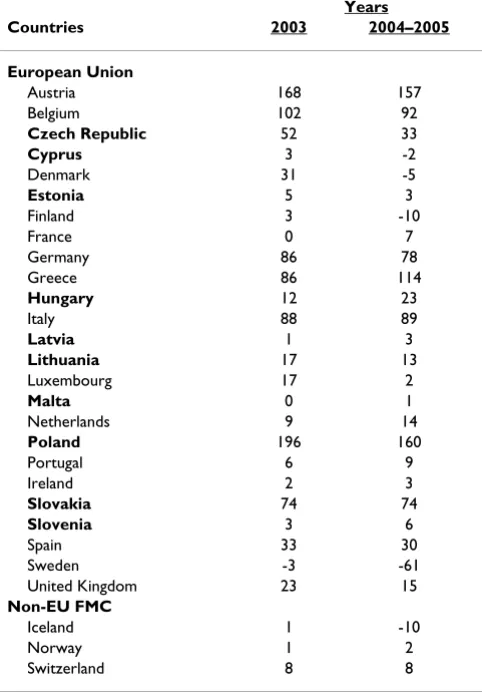
The number of professionals emigrating after the year 2004 to Germany, France and Norway have maintained previous trends (Table 3).
The main results of the qualitative evaluations received from those medical organisations responding to the sur-vey were as follows:
• Sweden: 15% of the approximately 32,000 licensed
doc-tors are foreigners, primarily from other Nordic countries, from within the EU or from Asia. Some 400 foreign doc-tors were registered in the last year and it is estimated that some 400 Swedish professionals are practising in other countries, principally in the US and Norway.
• Hungary: 8% of the approximately 36,000 licensed
doc-tors (these figures include dentists) are from other coun-tries, principally Hungarian-speaking minorities of Romania, the Ukraine and Serbia, with a smaller presence of doctors from Slovakia. A significant number of Hungar-ian doctors are practising abroad, principally in the UK, the US, Germany and Austria. Last year, over a thousand doctors requested information about the documentation necessary to practise in other countries of the European Union while there are an estimated 2,400 vacancies for doctors in the country.
• Austria: the number of foreign doctors may be
underes-timated in our study since a large number have acquired Austrian citizenship in recent years.
Discussion
The data available from different countries presents cer-tain limitations, such as the lack of uniformity in registers
and definitions [24]. In making an analysis according to countries of origin, we also must take in account that information from some countries of destination is either non-existent, outdated (most European information dates from 2001 or before) or fragmentary, except for those countries whose data were newly obtained in this research.
Previous studies revealed the existence of four poles of attraction and exchange of professionals: the UK and Ire-land, the Nordic countries, Germany-Austria and France-Belgium-Luxembourg [12,13]. Our data confirm the exist-ence of those poles, although for Ireland it is difficult to draw conclusions as up to a third of registered doctors reside outside of the country [20]; data for United King-dom could be affected, although in a lesser extent, by the same reason [24]. Switzerland, with 19·1% of doctors of foreign origin, appears also as an important destination for professionals.
There are different profiles for foreign doctors in various EU countries. While in Austria, Norway, Portugal and France more than half of all foreign doctors are from other EU countries, three quarters of foreign doctors in the UK, and possibly in Ireland, are from outside the EU, generally developing countries, a situation which may give rise to ethical questions [2,25]. Conditions in Hungary and Poland are clearly different, with most foreign doctors being from neighbouring countries.
The origin of doctors is a key question in evaluating the impact professional emigration can have on different countries. A large percentage of Irish doctors, some 47.5%, practice in other countries, especially the UK and the USA. It should be noted that medical training in Ire-land is financed to a large extent through the payments of students from outside the European Union, which explains the high number of places reserved for these stu-dents [2,26]. Countries whose registers show the country where training was received (as in the case of the UK and the US) offer figures for Ireland which are far higher than those they would offer if registering doctors with Irish nationality.
BMC Health Services Research
2
007
,
7
:201
http://ww
w.b
iomed
central.com/1
472
-6
963
Page
(page number not for citation purposes)
UK, 2005 IRE, 2007 GERM, 2005 ITA, 2004
ACTIVE/REGISTERED PHYSICIANS Total (ratio per 100,000 inhabitants) 239,274 (398.4) 15,512 (356.3)† 307,577 (372.8) 365,652 (631.7)
FOREIGN PHYSICIANS † 74,031 4,663 18,582 12,525
SOURCE COUNTRY/REGION*
EU 20,863 1,224 8,611 3,829
EU 15, 17,085 893 5,394
mainly from IRE (5,959) GERM (4,026) UK (592) GER (103) GRE (1,357) AUS (1,269) GERM (1,034) FRA (649) GRE (649)
EU+12, 3,778 331 3,217
mainly from POL (1,424) HUN (647) POL (155) HUN (59) POL (1,171) ROM (692) ROM (389) POL (207)
OTHER IN EUROPE 982 3,509 1,351
Non-EU FMC §, 222 9
mainly from SWZ (123) SWZ (7) SWZ (153) SWZ (760)
Rest of Europe 760
mainly from RUS (342) UKR (145) RUS (1,572) UKR (730) SERB (437) ALB (204)
NORTH AMERICA (US & CAN.) 344 2 235 771
CENTRAL & SOUTH AMERICA 270 420 1,753
OCEANIA 3,290 378 15 107
AFRICA 12,630 840 813 1,590
ASIA 34,816 4,723 2,328
NO SPECIFIED 836 2,210 256 107
DESTINATION COUNTRY*
AUS, 2005 PORT, 2005 FRA, 2005 NW, 2006
ACTIVE/REGISTERED PHYSICIANS Total (ratio per 100,000 inhabitants) 28,496 (347.2) 32,552 (309.2) 212,972 (340.7) 18,280 (393.9)
FOREIGN PHYSICIANS‡ 1,442 3,199 7,665 2,799
SOURCE COUNTRY/REGION*
EU 1,396 2,134 4,149 2,070
EU 15, 1,317 2,123 3,811 1,882
mainly from GERM (1,003) IT (220) SP (1,874) GERM (104) BELG (1,368) GERM (879) GERM (673) SWE (530)
EU+12, 79 11 338 188
mainly from HUN (29) CZE (23) POL (5) CZE (3) ROM (158) POL (95) POL (64) LITH (37)
OTHER IN EUROPE 25 120 103 340
Non-EU FMC §, 53 107
mainly from SWZ (46) ICE (95)
Rest of Europe 50 233
mainly from RUS (15) SERB (73) RUS (71)
NORTH AMERICA (US & CAN) 2 20 45
CENTRAL & SOUTH AMERICA 503 101
OCEANIA 2 0
AFRICA 425 2,765 23
ASIA 19 10 519 234
NO SPECIFIED 0 0 8 87
* Codes: AUS, Austria; BELA, Belarus; BELG, Belgium; CAN, Canada; CYP, Cyprus; CZE, Czech Republic; EU, European Union; EU 15, EU members before 2004; EU+12, EU new countries after 2004; FRA, France; GERM, Germany; GRE, Greece; HUN, Hungary; ICE, Iceland; I RE, Ireland; IT, Italy; LITH, Lithuania; NW, Norway; POL, Poland; PORT, Portugal; ROM, Romania; RUS, Russia (registered doctors from ex-USSR included); SERB, Serbia and Montenegro (registered doctors from ex-Yugoslavia included); SLK, Slovakia; SP, Spain; SWE, Sweden; SWZ, Switzerland; UK, United Kingdom; UKR, Ukraine.
† Foreign/foreign trained physicians (see text).
[image:4.792.83.731.71.489.2]BMC Health Services Research 2007, 7:201 http://www.biomedcentral.com/1472-6963/7/201
Page 5 of 8
(page number not for citation purposes) The information available for emigration in recent years
does not indicate an effect of EU enlargement in the exo-dus of doctors from new member states to Norway, France, and Germany. However, it should be noted that these countries still maintained strict controls over the cir-culation of workers from the new member states during the period analysed. The recent study by the European Commission evaluating the impact of temporary meas-ures governing the free movement of workers adopted by some member states in the wake of the 2004 EU expan-sion also failed to detect any significant evidence of increased migratory patterns [28], nor differences between countries where restrictions were applied and where there were not [12]. Nevertheless, physicians' migration is a growing phenomenon in Europe, as table 3 shows.
For the purposes of this study, temporal information was unavailable for the UK. Figures published in other places for 2002 are extrapolations from the National Health Service census and it is therefore difficult to compare these
figures with those of registered doctors in the General Medical Council for 2005. While taking these considera-tions into account, significant increases have been seen in doctors licensed in Poland (x4.7), Greece, Italia (x3.2 in both cases) and Germany (x2.6), although we cannot determine the impact of the EU expansion since no figures are available between 2002 and 2005. Poland is currently experiencing a significant emigration of people to the UK (some 0.69% of its population has registered to work in the UK in the last two years while these figures are sur-passed by those for Lithuania, Estonia and Slovakia), and accounted for 62% of health workers from new EU mem-ber states registered in the UK during this period [29].
Conclusion
The increasing mobility of physicians within the Euro-pean Union should be a cause for consideration for those planning health care services both at a European level and within member states [10,30]. While complete informa-tion is lacking, the existing data does provide a valuable basis for analysis and professional and international
Foreign (-trained) physicians and their distribution by origin regions in eight EEA countries
Figure 1
Foreign (-trained) physicians and their distribution by origin regions in eight EEA countries. Percentage besides the country name show the proportion of foreign (trained) physicians in that country.
EU countriesbefore 2004
EU new countries
“Free movement” countries
Rest of Europe
EU countriesbefore 2004
EU new countries
“Free movement” countries
Rest of Europe
Asia
Oceania Asia
Oceania Africa
Africa North America (US & Canada)
Central & South America
Inespecified
North America (US & Canada)
Central & South America
Inespecified
ORIGIN REGIONS UNITED
KINGDOM, 2005 (30·9%)
NORWAY, 2006 (15·3%)
PORTUGAL, 2005 (9·8%)
GERMANY, 2005 (6%) GERMANY,
2005 (6%)
AUSTRIA, 2005 (5·1%)
FRANCE, 2005 (3·6%) AUSTRIA,
2005 (5·1%)
FRANCE, 2005 (3·6%)
ITALY, 2004 (3·4%) ITALY,
2004 (3·4%) IRELAND
Table 2: Emigration factor for the European countries (European source-country perspective)
Physicians registered in other countries
European countries Physicians in the country* Total Only in other European countries Emigration factor†
EU-15
Ireland 11,141 10,065 6,019 47.5%
Luxembourg 1,206 263 263 17.9%
Greece 47,944 5,804 4,090 10.8%
Austria 27,413 2,373 1,631 8.0%
Belgium 46,268 3,936 2,519 7.8%
United Kingdom 133,641 8,824 1,708 6.2%
Spain 135,300 8,530 3,960 5.9%
Netherlands 50,854 3,103 2,250 5.8%
Germany 277,885 14,196 9,734 4.9%
Sweden 29,122 1,446 1,094 4.7%
Denmark 15,653 774 616 4.7%
Italy 241,000 8,758 3,778 3.5%
Finland 16,446 357 269 2.1%
France 203,487 3,945 2,197 1.9%
Portugal 34,440 358 199 1.0%
EU+12
Malta 1,254 376 328 23.1%
Romania 42,538 4,397 1,523 9.4%
Hungary 32,877 2,461 1,043 7.0%
Poland 95,272 6,568 3,130 6.4%
Slovakia 17,172 888 888 4.9%
Czech Republic 35,960 1,809 900 4.8%
Bulgaria 28,128 1,084 545 3.7%
Cyprus 1,864 48 48 2.5%
Latvia 6,940 172 129 2.4%
Lithuania 13,682 338 274 2.4%
Estonia 6,118 92 77 1.5%
Slovenla 4,475 44 44 1.0%
Non-EU FMC
Iceland 1,056 318 137 23.1%
Switzerland 25,921 3,085 1,101 10.6%
Norway 14,200 788 711 5.3%
Other European countries
Serbia and Mont.‡ 21,738 2,808 1,367 11.4%
Albania 4,100 390 325 8.7%
Bosnia & Herzegovina 5,576 113 113 2.0%
Croatia 10,820 176 176 1.6%
Russian Federation§ 609,043 7,099 2,039 1.2%
Ukraine 143,202 1,017 1,017 0.7%
Macedonia 4,459 10 10 0.2%
Belarus 45,027 76 76 0.2%
Moldova 11,246 5 5 0.0%
Georgia 20,962 5 5 0.0%
Uzbekistan 71,623 12 12 0.0%
*: Number of physicians in the respective country. Source: World Health Organization23.
† Emigration factor: the relation between national (national-trained) doctors practising abroad and the total number of doctors related to that country -practising in it or
BMC Health Services Research 2007, 7:201 http://www.biomedcentral.com/1472-6963/7/201
Page 7 of 8
(page number not for citation purposes) organisations are currently taking steps to update and
present their information in this issue [15-19,24]. Data retrieved in this article show varying profiles in migration figures between European countries, with different coun-tries being strong importers and exporters of physicians. Moving towards self-sufficiency in medical care personnel may prove to be an effective way to ensure health care services while deterring the migration of professionals from those countries that most need their expertise [11].
Competing interests
There isn't any external source of financing or support, so author's work has been independent from any financial pressures. All authors declare that they have no competing interests.
Authors' contributions
MAG participated in design, data collection, analysis and discussion of results and writing of the successive texts,
including the final version, and as the first author of the article, accepts full responsibility for the conduct of the research; CA participated in the discussion of study design and in the analysis of data and results; AO participated in the analysis of data and results. All the authors have con-tributed substantially to the discussion and the final ver-sion of the manuscript, and have seen and approved its final version.
Acknowledgements
Our gratitude to the medical organizations that answered the survey.
References
1. Joint Learning Initiative: Human resources for health. Overcom-ing the crisis [monograph on the Internet]. 2004 [http:// www.healthgap.org/camp/hcw_docs/JLI_exec_summary.pdf]. Cam-bridge (Mass., US): Harvard University Press
2. Simoens S, Hurst J: Matching supply with demand for the serv-ices of physicians and nurses. In The OECD Health Project. Towards high performing health systems Policy studies. Paris: OECD Publica-tions; 2004.
3. World Health Organization: Human resources and national health systems. Shaping the agenda for action [monograph on the Internet]. 2003 [http://www.who.int/entity/hrh/documents/ en/nhs_shaping_agenda.pdf]. Geneve: World Health Organization 4. Dubois CA, McKee M, Nolte E: Moving forward: building a
stra-tegic framework for the development of the health care workforce. Human resources for health in Europe 2006:235-240 [http://www.euro.who.int/observatory/Publications/20060112_3]. Berkshire (UK) – New York (US); Open University Press
5. Organisation for Economic Co-operation and Development OECD: Health at a glance. OECD indicators 2005 Paris: OECD Publications; 2005.
6. Hasselhorn HM, Müller BH, Tackenberg P, (eds.): NEXT scientific report, july 2005 [monograph on the Internet]. 2005 [http:// www.next.uni-wuppertal.de]. Wuppertal (GE): University of Wup-pertal
7. Permanent Working Group of European Junior Doctors (PWG):
Medical manpower in Europe by the year 2000: from surplus to deficit? In Handbook of Policy Statements. An update of the 1997 handbook Oporto: PWG; 2001:38-41.
8. Blumenthal D: New steam from an old cauldron. The physi-cian-supply debate. N Engl J Med 2004, 350(17):1780-7. 9. Buchan J: Migration of health workers in Europe: policy
prob-lem or policy solution? Human resources for health in Europe 2006:41-62 [http://www.euro.who.int/observatory/Publications/ 20060112_3]. Berkshire (UK) – New York (USA); Open University Press
10. Hamilton K, Yau J: The global tug-of-war for health care work-ers [monograph on the Internet]. 2006 [http://www.migration information.org/Feature/display.cfm?id=271]. Washington: Migration Policy Institute
11. Forcier MB, Simoens S, Giuffrida A: Impact, regulation and health policy implications of physician migration in OECD coun-tries. Hum Resour Health 2004, 1:12.
12. Nicholas S: The challenges of the free movement of health professionals. Health policy and European Union enlargement 2004:82-108 [http://www.euro.who.int/observatory/Studies/ 20040525_1]. Berkshire (England): Open University Press
13. Jakubowski E, Hess R: The market for physicians. Health policy and European Union enlargement 2004:131-142 [http:// www.euro.who.int/observatory/Studies/20040525_1]. Berkshire (England): Open University Press
14. Diallo K: Data on the migration of health-care workers: sources, uses and challenges. Bull World Health Organ 2004,
82:601-7 [http://www.who.int/entity/bulletin/volumes/82/8/601.pdf]. 15. Bundesärztekammer (German Medical Association): Ärztestatistik.
[http://www.bundesaerztekammer.de/page.asp?his=0.3].
[image:7.612.55.296.124.472.2]16. Perelli Ercolini M: I medici stranieri in Italia [Monograph on the Internet]. Milan: Assimedici – Steffano Group; no date [http:// www.assimedici.it/esperti/Prof%20Marco%20Perelli%20Ercolini/
Table 3: Average annual variation in the number of foreign EEA physicians working in Germany, France and Norway between 2003 and 2005.
Years
Countries 2003 2004–2005
European Union
Austria 168 157
Belgium 102 92
Czech Republic 52 33
Cyprus 3 -2
Denmark 31 -5
Estonia 5 3
Finland 3 -10
France 0 7
Germany 86 78
Greece 86 114
Hungary 12 23
Italy 88 89
Latvia 1 3
Lithuania 17 13
Luxembourg 17 2
Malta 0 1
Netherlands 9 14
Poland 196 160
Portugal 6 9
Ireland 2 3
Slovakia 74 74
Slovenia 3 6
Spain 33 30
Sweden -3 -61
United Kingdom 23 15
Non-EU FMC
Iceland 1 -10
Norway 1 2
Switzerland 8 8
In bold, EU countries joined to EU in 2004.
Publish with BioMed Central and every scientist can read your work free of charge "BioMed Central will be the most significant development for disseminating the results of biomedical researc h in our lifetime."
Sir Paul Nurse, Cancer Research UK
Your research papers will be:
available free of charge to the entire biomedical community
peer reviewed and published immediately upon acceptance
cited in PubMed and archived on PubMed Central
yours — you keep the copyright
Submit your manuscript here:
http://www.biomedcentral.com/info/publishing_adv.asp
BioMedcentral I%20MEDICI%20STRANIERI%20IN%20ITALIA%20giugno%202004.p
df].
17. Naczelna Izba Lekarska (The Polish Chamber of Physicians and Den-tists): Raport o liczbie lekarzy cudzoziemców wykonujących zawód w Polsce stan na dzieñ 30 czerwca 2002 r. [https:// www.nil.org.pl/xml/nil/tematy/komisje/0105/cudzoz/
sprawozdanie2005/raport].
18. Conseil National de l'Ordre National des Médecins: Démographie médicale française. Situation au 1er janvier 2006
[Mono-graph on the Internet]. CNONM 2006 [http://
www.web.ordre.medecin.fr/demographie/etude39.pdf].
19. Den norske lægeforening (The Norwegian Medical Association):
Leger < 67 år i Norge etter statsborgerskap 2001–06 feb./ mars (Physicians < 67 years of age in Norway by citizenship 2001–2006 Feb/Mar). [http://www.legeforeningen.no/ index.gan?id=6091].
20. Medical Council: Statistics. [http://www.medicalcouncil.ie/registra tion/statistics.asp].
21. Mullan F: The metrics of the physician brain drain. N Engl J Med 2005, 353(17):1810-8.
22. American Medical Association: International Medical Graduates in the U.S. Workforce. A discussion paper. 2006.
23. World Health Organization: The world health report 2006: working together for health 2006 [http://www.who.int/whr/2006/ whr06_en.pdf]. Geneva; World Health Organization
24. Dumont JC, Zurn P: Immigrant health workers in OECD coun-tries in the broader context of highly skilled migration. In Organisation for Economic Co-operation and Development OECD. Interna-tional Migration Outlook. Annual Report, 2007 Edition OECD Publishing; 2007.
25. Eastwood JB, Conroy RE, Naicker S, West PA, Tutt RC, Plange-Rhule J: Loss of health professionals from sub-Saharan Africa: the pivotal role of the UK. Lancet 2005, 365(9474):1893-1900. 26. Payne D: Ireland faces shortage of doctors as applications
from outside the EU fall (new). BMJ 2000, 320:961.
27. Cachia J: Human resources in Maltese healthcare. Solutions for common needs. Eurohealth [serial on the Internet] 2002,
8(417-18 [http://www.euro.who.int/document/Obs/ Eurohealth8_4.pdf].
28. Commission of the European Communities: Report on the Func-tioning of the Transitional Arrangements set out in the 2003 Accession Treaty (period 1 May 2004–30 April 2006) [mono-graph on the Internet]. Brussels; Commission of the European Com-munities 2006 [http://eur-lex.europa.eu/LexUriServ/site/en/com/ 2006/com2006_0048en01.pdf].
29. Home Office, Immigration and Nationality Directorate: Accession Monitoring Report May 2004 – June 2006. Croydon (UK); Immi-gration and Nationality Directorate 2006.
30. European Union Health Policy: Forum: Recommendations on mobility of health professionals [monograph on the Inter-net]. Brussels: EU Health Policy Forum 2003 [http://europa.eu.int/ comm/health/ph_overview/health_forum/hforum_mob_en.pdf].
Pre-publication history
The pre-publication history for this paper can be accessed here: