ASSESSING THE ACCURACY AND INTEGRITY OF RTK GPS
BENEATH HIGH VOLTAGE POWER LINES.
Peter GIBBINGS - Lecturer
B.Surv., Grad Dip (Tech Man), M.I.S.Aust., L.S.
Brent MANUEL B.Surv. (Hons.)
Rafe PENINGTON
Undergraduate Student studying B. Surv.
Kevin McDOUGALL
B.Surv.(Hons), M.Surv. & Map.Sc., M.I.S.Aust.,Registered Surveyor
Faculty of Engineering and Surveying University of Southern Queensland
TOOWOOMBA QLD 4350
Keywords: GPS, RTK, High Voltage Powerlines, Trimble 4700.
ABSTRACT
This paper reports the results of several tests conducted at the University of Southern Queensland (USQ) to determine the frequency with which initialisation failures occur in the Trimble 4700 RTK receivers when operating beneath high voltage power lines.
Anecdotal evidence from some practitioners suggested that problems were experienced when measuring beneath high voltage power lines. Some surveyors had reported quite large anomalies. Still others had reported no problems beneath high voltage power lines. Consequently, these tests were designed to provide an empirical evaluation of both the probability of initialisation failure under these conditions, and the range of the subsequent errors in observed coordinates. Observations were also carried out in 'ideal' physical environments to provide an assessment of the general accuracy and reliability of RTK GPS and to use as a benchmark for analysing subsequent test results.
An attempt has been made to investigate reasons for discrepancies and, although some conclusions have been drawn, these are of a general nature only. Supplementary testing and analysis is being conducted at the USQ to further isolate some of the possible anomalies and to allow statements that are more definitive to be made.
The conclusions will be of value to individuals who are planning to carry out RTK measurements beneath high voltage power lines, or other areas in which significant electromagnetic fields or multipath may be present.
INTRODUCTION
Over the past few years, we have witnessed a dramatic increase in the use of the Global Positioning System (GPS) for many types of survey applications. Like most
technologies, GPS surveying techniques are not infallible. A GPS receiver that fails to reliably resolve ambiguities can have serious legal and resource ramifications for the practicing surveyor.
It is therefore important to understand those physical conditions likely to affect the ambiguity resolution process. Several such conditions have been identified in the past, for example, obstructions to the viewing window, and multipath. Identification and understanding of these factors is important since it highlights some of the limitations of the RTK system, and how to overcome them.
This research provides empirical results that indicate that less than 100% reliability is to be expected with On-The-Fly (OTF) ambiguity resolution in the RTK mode when operating beneath high voltage power lines.
BACKGROUND - ELECTROMAGNETIC RADIATION
The following information provides an overview on electromagnetic radiation. This has been included to aid understanding of test results and is not meant to be definitive. No background information is provided on multipath since it is assumed readers will have an understanding of this phenomenon.
Electromagnetic radiation as it relates to electrical noise arises in two forms. One,
intrinsic noise, is the result of the random movement of electrons within the circuit elements of the electrical device itself. The second form is interference, which occurs as a result of signals being emitted from other circuits or systems. This is known as
interference. (Fish 1994.)
This electrical noise corrupts the signal of interest and introduces an uncertainty into the information that it contains. It was expected that electromagnetic radiation emitted from the high voltage transmission lines would be the most likely cause of any inconsistency with RTK GPS. This interference could be arriving at the RTK GPS receiver through any element of the receiver acting as an antenna. (Manuel, unpub.)
The effects that the electrical noise has on the RTK system will be dependent on the circuitry used. This project did not investigate the electrical circuitry as part of this testing, but only concentrated on collecting empirical data on what effect
signal. If errors in the phase of the signal are present, this could result in incorrect rover positions being calculated by the RTK system. The electrical noise will manifest itself in the form of an electric field and a magnetic field around the high voltage wires.
Electric Field Profile 275kV Line
0.0 0.5 1.0 1.5 2.0 2.5 3.0 3.5
-50 -40 -30 -20 -10 0 10 20 30 40 50
Distance from Centreline (m)
Electric Field (kV/m)
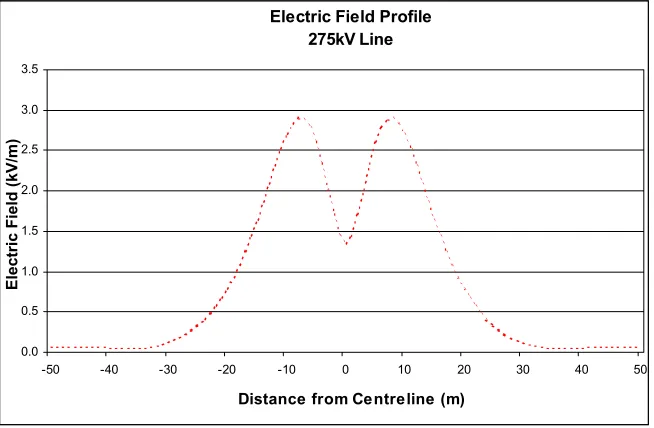
Figure 1 - Electrical Field under High Voltage Power Lines
[image:3.595.111.438.144.358.2](Source: Pers. Comms. June 2001, Transmission Environment Branch, Powerlink Queensland)
Figure one from displays the strength of the electrical field produced from a 250 kV transmission line in relation to a ground distance at right angles to the lines away from a point directly beneath the centre of the transmission lines. It indicates that at
approximately 30 metres from the centre line most of the electrical field influences are minimal.
Magnetic Field Profile 275kV Line
0 10 20 30 40 50 60 70 80 90
-100 -90 -80 -70 -60 -50 -40 -30 -20 -10 0 10 20 30 40 50 60 70 80 90 100
Distance from Centreline (m)
[image:3.595.110.440.492.683.2]Magnetic Field (mG)
Figure 2 - Magnetic Field under High Voltage Power Lines
(Source: Pers. Comms. June 2001, Transmission Environment Branch, Powerlink Queensland)
Figure two displays the strength of the magnetic field produced from a 250 kV
approximately 60 metres from the centre line most of the magnetic field influences are minimal.
Both graphs are based on nominal wire height with a minimum height above the ground of seven metres and maximum height of 18 metres (Powerlink Queensland).
TEST METHODOLOGY
The testing involved the use of the Trimble 4700 GPS Real-Time Kinematic system which incorporates a dual frequency GPS receiver with an integrated radio modem. The system features OTF initialisation and includes mulitbit signal processing and multipath suppression techniques. According to the manufacturer's specifications the system provides users with accuracy in the order of ±(1cm+2ppm of baseline length) in horizontal, and ±(2cm+2ppm of baseline length) in vertical under ideal conditions (Trimble, 4700 Operation Manual, p.B-2).
To evaluate the integrity of initialisation of the Trimble 4700 RTK receivers (and firmware v1.2), a large amount of data from individual initialisations was collected and statistically analysed. The data was collected with a minimum of human intervention. Purpose written software running on a lap top computer was used to automatically control the serial port and initialisation process, and to record position information in NMEA format to a file.
The base station for all testing was set in a clear area that was free of obstructions and, since a ground plane was used at the base antenna, was considered free of multipath (although this assumption was not verified). All rover test sites were within 2.7 kilometres of the base station.
Initially two rover test sites were chosen. Test site One represented 'ideal' site
conditions. Since no multipath was expected at this site, and there were no obstructions to the satellite window, it was expected that very few incorrect initialisations would be recorded at this site.
Upon start-up, the receiver automatically attempted an OTF initialisation. At this site, data was logged for 90 seconds. After 90 seconds, the software turned the receiver off for 10 seconds and then back on again, thus forcing a further attempt at OTF
initialisation. Data was logged for a further 90 seconds, and so the sequence continued. Data was logged for a total of 531 OTF initialisations.
wires 6.3 m
Leg of Transmission
Tower 9.9 m
[image:5.595.122.396.83.234.2]
Tower Leg of Transmission Tower
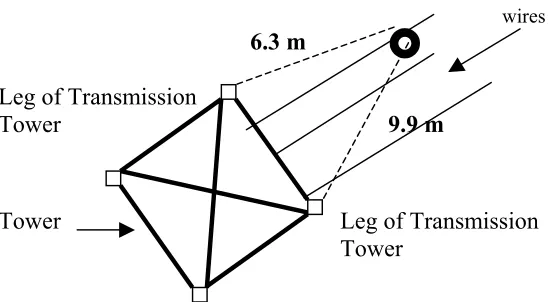
Figure 3 - Test Site Two – under High Voltage Powerlines
At this site, data was logged in a similar manner to test site One except that the logging continued for 180 seconds instead of 90 seconds. Logging was continued for a longer period at this site because it was anticipated that initialisations could take longer. Data was logged for a total 91 OTF initialisations at test site Two.
Subsequent analysis of the results from test site two revealed some inconsistencies with respect to the quality of initialisations. It was expected that these were most likely caused by multipath from the tower or electromagnetic radiation from the wires. Consequently, further testing was carried out to isolate the possible cause of these anomalies.
A further six test sites (three to eight) were subsequently chosen. Data from each of these sites was logged for 180 seconds. It should be noted that both the GPS receiver and communications firmware were upgraded to the latest versions (v1.3 GPS and v1.43 comms firmware) before the subsequent tests were carried out.
Test Sites Three and Four were directly beneath un-energised overhead wires. There were a total of 18 overhead wires. These were made up of three parallel sets: eight above the test site, and 5 on towers immediately adjacent to the test site.
Test Site Three was approximately 10 metres away from a transmission tower structure. Results from this site would provide evidence of any possible disturbance caused by multipath from the tower or the wires themselves.
Test Site Four was approximately 50 metres away from the transmission tower
structure. This was considered far enough to eliminate any possible multipath from the tower (although this was not verified). Results from this site would provide evidence of any possible disturbance from the overhead wires alone.
Test Sites Five to Eight were directly beneath energised overhead wires. There were 16 overhead wires (eight on each of two towers) each carrying 110 kV.
communications firmware. It was considered that results from this site compared with results from test site three would provide evidence of any possible disturbance caused by electromagnetic radiation from the high voltage wires.
Test Site Six was identical to test site five except that the GPS receiver was placed inside a car during the testing. Results from this site compared with results from test site five would provide evidence of any shielding of the receiver from electromagnetic disturbance by the car roof.
Test Site Seven was approximately 80 metres away from the transmission tower structure (in the middle of a span between towers). This was considered far enough to eliminate any possible multipath from the towers (although this was not verified). This was similar to test site four except that the wires were now energised with high voltage. Again, results from this site compared with results from test site four would provide evidence of any possible disturbance caused by electromagnetic radiation from the high voltage wires.
Test Site Eight was identical to test site seven except that the GPS receiver was placed inside a car during the testing. Results from this site compared with results from test site seven would provide evidence of any shielding of the receiver from electromagnetic disturbance by the car roof.
RESULTS OF TESTS
Throughout the analysis, reference is made to the 'true' position to which relative accuracy is referenced. These positions were determined by taking the mean coordinates of points from each of the 'fixed' OTF initialisations.
To determine if an initialisation was 'bad', coordinate variations from the true position for each logging period recording a fixed solution were compared against the
manufacturer's specifications.
Test Site One - Ideal Conditions
The average time to gain initialisation at test site One was 50 seconds. Note that the latest version of receiver firmware has improved the OTF search engines and it is therefore expected that time to initialise would be significantly reduced in this latest version.
The average variation between computed position coordinates compared with the true position was 9mm in Easting and 10mm in Northing. All of the initialisations were within manufacturer's accuracy specifications.
Test Site Two - HV Powerlines
The average time to gain initialisation at test site Two was 70 seconds.
metres in Northing. For the remaining 84 initialisations, the mean variation from true position was 11mm in Easting and 16mm in Northing.
In each case of a bad initialisation, the RTK engine detected the fact that the
initialisation was suspect and corrected itself within the remaining logging time. In one instance of a bad initialisation, the receiver corrected itself within 5 seconds.
Test Sites Three to Eight
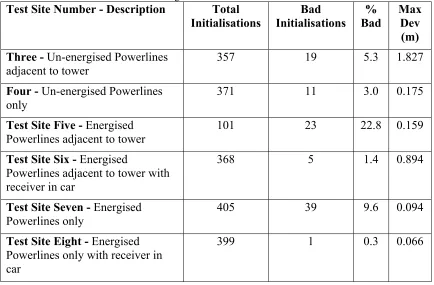
The following table summarises results for Test Sites Three to Eight. Each test site is cited with:
• its corresponding total number of initialisations taken at that site,
• the number of these that were bad (outside manufacturers specifications against the mean position),
• this number of bad initialisations quoted as a percentage of total initialisations, and
[image:7.595.79.513.347.632.2]• the maximum deviation of the measured point at the time of initialisation (or fix) compared with the true position.
Table 1 - Results of Test Sites Three to Eight
Test Site Number - Description Total Initialisations
Bad Initialisations
% Bad
Max Dev (m) Three - Un-energised Powerlines
adjacent to tower 357 19 5.3 1.827
Four - Un-energised Powerlines only
371 11 3.0 0.175
Test Site Five - Energised Powerlines adjacent to tower
101 23 22.8 0.159
Test Site Six - Energised
Powerlines adjacent to tower with receiver in car
368 5 1.4 0.894
Test Site Seven - Energised Powerlines only
405 39 9.6 0.094
Test Site Eight - Energised Powerlines only with receiver in car
399 1 0.3 0.066
ANALYSIS
Comparison - Test Site One vs Test Site Two
A comparison of test site one against test site two provides evidence that bad
initialisations can be experienced under high voltage powerlines. Three theories are presented to explain these bad initialisations.
The first theory is that multipath from the overhead wires or the transformer tower caused spurious results. The average time to initialise at this site (70 seconds) was increased in comparison to test site one (50 seconds). Previous research by Alison et al
(1994) has identified an increase in initialisation times as a consequence of multipath.
The second theory is that electrical interference (often referred to as 'Radio Frequency' or RF) may be preventing the GPS receiver from successfully tracking the GPS signal. Potential sources of RF have been identified as including microwave towers, radio repeaters and high voltage powerlines (Natural Resources Canada, 1995). Advice received from Trimble representatives in Christchurch, New Zealand suggests that it is unlikely that the electromagnetic field around the powerlines caused a shearing of the GPS signal or introduced some kind of noise into the signal.
The third theory, and the one considered by the authors to be most likely, is that the electromagnetic fields generated by the overhead powerlines could be affecting the receiver's instrumentation. Introducing test sites three to six further tested this theory.
From the results obtained at test site Two, it could be assumed that if lock is maintained for a period of approximately 3 minutes after initialisation, then the Trimble 4700 would correct any bad initialisations. Although this was found to be the case with the data collect during the test, further testing is required to make any definitive statements in this respect.
Comparison - Test Site Two vs Test Site Five
A comparison of results from test site two and test site five provide an independent validation of testing and substantiation that bad initialisations can be experienced under high voltage powerlines. Since these two sites were in similar physical environments, it was expected that there would be on significant variation in the results from each site.
However, as can be seen from the results, many more bad initialisations were recorded at test site five. Several possible explanations are offered for this:
• The base and rover receivers had different GPS and communication firmware. (This might only explain why the data sets are different, not why Test Site Five recorded more bad initialisations.)
• If multipath were present, it would be somewhat unpredictable.
• Test site five had more than one tower to cause multipath, whereas test site two only had one tower.
Comparison - Test Site One vs Test Site Four
A comparison of results from test site one against test site four provides evidence as to whether or not the wires themselves are contributing to the bad initialisations.
There were no bad initialisations recorded at test site one while 3% of intialisations were bad at test site 4. No explanation is offered as to why this has occurred and the results have not been investigated further. It is concluded that the wires themselves could contribute around 3% to the bad initialisations.
Comparison - Test Site Three vs Test Site Four, Test Site Five vs Test Site Seven and Test Site Six vs Test Site Eight
A comparison of these sites provides evidence as to whether or not multipath (or other interference) from the tower is contributing to the bad initialisations.
Test Site 3 v 4 5.3% 3.0% 0.0% 1.0% 2.0% 3.0% 4.0% 5.0% 6.0% 3 % Bad 4
Test Site 5 v 7 22.8% 9.6% 0.0% 5.0% 10.0% 15.0% 20.0% 25.0% 5 % Bad 7
[image:9.595.90.496.285.407.2]Test Site 6 v 8 1.4% 0.3% 0.0% 0.2% 0.4% 0.6% 0.8% 1.0% 1.2% 1.4% 1.6% 6 % Bad 8
Figure 4 - Effect of Multipath from Towers
Ignoring the inconsistent results from test site 5, it appears that 1.1% to 2.3% of the bad initialisations could be attributed to multipath from the towers.
Comparison - Test Site Three vs Test Site Five and Test Site Four vs Test Site Seven
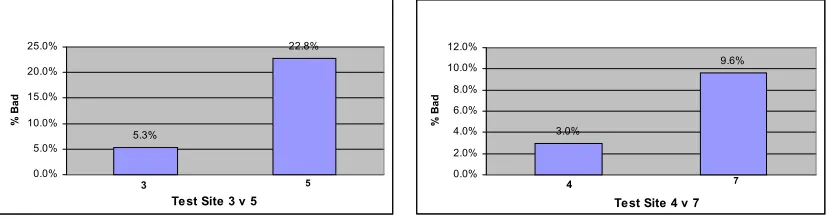
A comparison of these test sites provides evidence as to whether or not interference caused by the High Voltage in the wires is contributing to the bad initialisations.
Test Site 3 v 5
5.3% 22.8% 0.0% 5.0% 10.0% 15.0% 20.0% 25.0% 3 % Bad 5
Test Site 4 v 7
[image:9.595.89.504.560.670.2]3.0% 9.6% 0.0% 2.0% 4.0% 6.0% 8.0% 10.0% 12.0% 4 % Bad 7
Figure 5 - Effect of High Voltage in the Wires
If an average of 1.7% can be attributed to multipath from the towers and 6.6% from the high voltage, we have a combined effect of 8.3%. This means that we would expect to get somewhere around 8.3% of bad initialisations from a set up under energised wires and about 10 metres from a tower. We actually measured 7% at test site 2, which is consistent with this reasoning and the findings of Gibbings and Manuel (2001). As explained earlier, we would logically expect a similar percentage of bad initialisations from test site five, but results from this site seem to be inconsistent with the others. Possible explanations for this have previously been offered.
Comparison - Test Site Five vs Test Site Six and Test Site Seven vs Test Site Eight
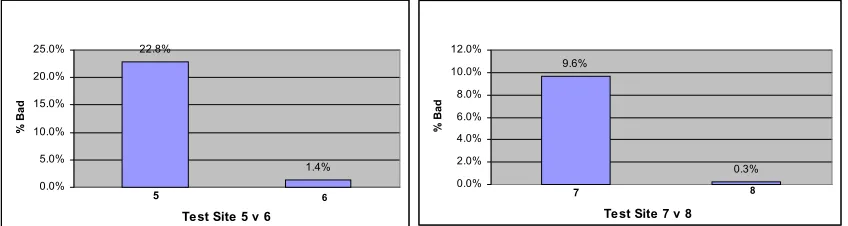
A comparison of these test sites answers the question that, assuming the GPS receiver is being affected by the high voltage in the wires, is the receiver being shielded by placing it in the car? This also provides solid evidence of what effect shielding the receiver might have on the integrity of the initialisations.
Test Site 5 v 6
22.8%
1.4% 0.0%
5.0% 10.0% 15.0% 20.0% 25.0%
5
% Ba
d
6
Test Site 7 v 8
9.6%
0.3% 0.0%
2.0% 4.0% 6.0% 8.0% 10.0% 12.0%
7
% Bad
[image:10.595.88.512.332.445.2]8
Figure 6 - Effect of Shielding the Receiver from High Voltage in the Wires
In each case, fewer bad initialisations were recorded when the receiver was placed inside the car thereby shielding some of the electromagnetic radiation. It was concluded that the electromagnetic radiation was indeed affecting the initialisations.
However, the 4700 receiver is designed to be a good Faraday cage. It is made of metal and the gaskets are carbon loaded for conductivity. Furthermore, Trimble uses SuRF multi-bit technology coupled with SAW filters to minimise such conditions.
Consequently, putting the receiver in and out of a vehicle (another Faraday cage) should not have any effect. The fact that it does make a difference may suggest that radiation is getting in by means of a poorly shielded data cable or power cable. Further testing is required to confirm this.
Further tests would also be required to ascertain if the antenna, or the Trimble controllers (TSC1) that are usually used on RTK surveys, might also be affected by electromagnetic radiation.
CONCLUSION
This article has presented an empirical estimate of the percentage of bad OTF
initialisation that may be expected with the Trimble 4700 RTK in ideal conditions and beneath high voltage power lines. These operational guidelines require further detailed research to formulate definitive methodological instructions.
In ideal conditions at Test Site One, with no obstructions and minimal multipath, no initialisation failures were recorded. At test site Two, under high voltage power lines and adjacent to a transformer tower, 7% of initialisations produced incorrect
coordinates, even though the receiver was indicating that the initialisation process had been completed and the ambiguities were 'fixed'.
In each of these cases, the receiver managed to discard the incorrect initialisation within the 3 minutes logging interval used in the testing. This is evidence of the effectiveness of the in-built mechanisms within the system for detecting erroneous initialisations. However, coordinate measurements taken before this error was detected by the receiver, could contain significant errors (from decimetre level to several metres).
Further testing revealed that multipath from towers approximately 10 metres away could account for 1.1% to 2.3% of initialisations being outside manufacturer's
specifications. It was also found that the high voltage in the wires accounted for about 6.6% (and possibly as much as 17.5%) of initialisations being outside manufacturer's specifications.
It seems most likely that the high voltage is causing electromagnetic radiation, which is affecting the GPS receiver or other components in some way. This conclusion is consistent with assumptions made by Gibbings and Manuel (2001). It also appears that most, if not all, of this effect can be eliminated by shielding the receiver and cables.
These results should serve as a caution to anyone planning to carry out RTK
observations under high voltage power lines. They should be of particular benefit to those making decisions on what types of measurements might be suitable for different physical environments.
This research has highlighted the need for surveyors to build redundancy and other independent checks into any GPS survey to facilitate the detection of anomalous data. Further research and publications on this matter will be carried out at the USQ in the near future. In particular, further analysis and statistical testing will be conducted on existing data sets. Information on this analysis will be available from USQ towards the end of this year.
BIBLIOGRAPHY
Allison, T., Griffoen, P. & Talbot, N. (1994), 'Acceptance of Real-Time Kinematic by the Professional Surveyor', Proceedings of the Seventh International Technical Meeting of the Satellite Division of the Institute of Navigation, Salt Lake City, Utah, USA.
Fish, P.J., (1994): 'Electronic Noise and Low Noise Design.', The Macmillan Press, Hampshire London.
Green, J.A., (1997): 'Electromagnetic Radiation: Fundamentals and Applications.', Greenwood Research, USA.
Gibbings, P. & Manuel, B., (2001), 'The Effect of High Voltage Powerlines on RTK GPS', The Queensland Surveyor, vol. 2001, no. 1 (February 2001).
Manuel, unpub., 2000, 'Testing the Integrity of Real-Time Kinematic Global Positioning System Initialisation', Undergraduate Dissertation, USQ.
Natural Resources Canada (July 1995), 'GPS Positioning Guide', (3rd Printing), A publication of Natural Resources Canada.