Condie, Rae and Seagraves, Liz and Fee, J. and Henry, Jacqueline (2009) Continuing professional development of early years managers and practitioners working with children under 3 years of age: technical report.
[Report]
http://strathprints.strath.ac.uk/26618/
Strathprints is designed to allow users to access the research output of the University of Strathclyde. Copyright © and Moral Rights for the papers on this site are retained by the individual authors and/or other copyright owners. You may not engage in further
distribution of the material for any profitmaking activities or any commercial gain. You may freely distribute both the url (http://strathprints.strath.ac.uk) and the content of this paper for research or study, educational, or not-for-profit purposes without prior
permission or charge. You may freely distribute the url (http://strathprints.strath.ac.uk) of the Strathprints website.
___________________________________________________________________________________________
Continuing Professional Development of
Early Years Managers and Practitioners
working with Children under 3 years of age
Technical Report
Professor Rae Condie and Liz Seagraves
Department of Educational and Professional Studies
and
Jacqué Fee and Jackie Henry
Department of Childhood and Primary Studies
___________________________________________________________________________________________
Disclaimer
The findings and recommendations of this report are those of the authors and not necessarily those of Learning and Teaching Scotland.
Members of the research team
The research was carried out by staff from the Faculty of Education in the University of Strathclyde. The principal investigator was Professor Rae Condie of the Department of Educational and Professional Studies. The key researchers were Jacqué Fee, Assistant Director within the Childhood and Families Research and Development Centre; Jackie Henry, lecturer and member of the Early Years team in the Department of Childhood and Primary Studies; and Liz Seagraves, Senior Researcher in the Department of Educational and Professional Studies.
Acknowledgements
The researchers would like to thank all local authority officers who supplied information to enable the research to be carried out and who completed questionnaires. Our thanks go to the many centre managers and practitioners who took the time to complete quite lengthy questionnaires and provided useful and vital information. Additionally we would thank the local authority officials, centre managers and practitioners who agreed to our visits to the centres and who were willing to be interviewed. We acknowledge also the valuable input, hard work and support of the Early Years team and the researchers at Learning and Teaching Scotland.
Faculty of Education University of Strathclyde 76 Southbrae Drive Jordanhill
___________________________________________________________________________________________
Contents
Glossary vii
Executive Summary viii
1. Introduction………... 1
2. Literature Review………. 3
3. Research Methods ………. 11
4. Findings………. 15
4.1 Local authority survey ……… 15
4.1.1 Nature of care provided ……….. 15
4.1.2 Planning, budgets and guidance materials ………. 18
4.1.3 CPD provision supported by the local authorities ……….. 20
4.1.4 Examples of good practice ……… 24
4.1.5 Non-partner providers ………. 25
4.1.6 Summary ……….. 25
4.2 Survey of early years centres ………... 28
4.2.1 Information about centres and respondents ………... 28
4.2.2 Policy and resources used ………. 30
4.2.3 Managers’ and practitioners’ views of their experience of CPD ……….. 35
Managers’ views on their experiences of CPD……… 35
Managers’ views on CPD for their staff………. 41
Practitioners’ views on their experiences of CPD……… 50
4.2.4 Priorities and preferences for CPD ……….. 56
Managers’ priorities in relation to their own CPD ………. 56
Managers’ priorities in relation to CPD for their staff………... 61
Practitioners’ priorities in relation to their CPD ………. 64
Summary of preferences……….. 69
4.2.5 Access to CPD and barriers ……….. 72
Access to CPD………... 72
Barriers to participation ……… 76
4.2.6 Qualifications obtained and usefulness of qualifications ……….. 79
Managers’ own qualifications……….. 79
Managers’ views on qualifications for staff ……… 83
Practitioners’ qualifications ……….. 86
___________________________________________________________________________________________
4.3 Case studies ……… 97
4.3.1 Background on case study authorities ………….……….. 97
4.3.2 Local authorities and a framework for early years practice ………. 98
4.3.3 CPD policy and practice ………. 100
4.3.4 Preferences and priorities ……….. 104
4.3.5 Barriers to access and participation ………. 106
4.3.6 Parents’ perspectives……….. 108
4.3.7 Quality Assurance ………... 108
4.3.8 Key lessons ……….. 109
5. Discussion, key findings and recommendations……….……….……….. 111
5.1 Key messages from documentary analysis and literature review ……….. 111
5.2 CPD for early years managers and practitioners………... 113
5.2.1 Definitions of CPD and perceptions of effective CPD ………...………… 113
5.2.2 Areas addressed in CPD and their effectiveness ………..……… 115
5.2.3 Gaps in current CPD provision ………. 116
5.2.4 CPD priorities ………... 116
5.2.5 Effective and preferred types of CPD ……….. 117
5.2.6 Effective and preferred systems of CPD delivery ……….. 118
5.2.7 Access and barriers to participation in CPD ………... 119
5.2.8 Qualifications ……… 120
5.3 Use of national ‘Birth to Three’ guidance materials ……….. 121
5.4 Key findings and recommendations ……… 122
6. Examples of good practice ……… 126
References……… 129
Appendices Appendix 1 Table: The early childhood workforce in selected EU countries ….. 132
Appendix 2 Sampling process for centre surveys ………..…. 133
___________________________________________________________________________________________
List of Tables
Chapter 4: Local authority survey
Table 4.1: The different types of centres reported by the 27 local authorities ……… 16
Table 4.2: Categorisation of the 27 local authorities by size and location ………... 17
Table 4.3: Types of centres that take children from birth, by location ……….. 17
Table 4.4: Number of authorities making explicit reference in planning documents to CPD for those working with children under 3 years of age, by location ………. 18
Table 4.5: Number of authorities using various guidance materials to support CPD for those working with children under 3 years of age, by location ……….. 20
Table 4.6: CPD opportunities supported by local authorities ………. 21
Table 4.7: CPD providers across the 27 local authorities ……….. 22
Table 4.8: Most used sources of information in identifying CPD needs ………... 23
Chapter 4: Centres’ survey Table 4.9: Manager and practitioner questionnaire returns ……… 28
Table 4.10: Questionnaire returns by sector ……….. 29
Table 4.11: Number of centres with children in two age bands: under 3 and 3 to 5 ……… 29
Table 4.12: Number of centres with children under 3 years, by year group ……….. 30
Table 4.13: Number of practitioners engaged in working with different age groups ……… 30
Table 4.14: Percentage of time practitioners working with children under 3 years of age in the previous year ………... 30
Table 4.15: Percentage of centres with plans and budgets relating specifically to children under 3 years of age ……….. 31
Table 4.16: Guidelines in use as reported by managers ……….. 31
Table 4.17: Managers’ views on the frequency of use of guidance materials ……….. 32
Table 4.18: Managers’ views on the effectiveness of guidance materials ………. 32
Table 4.19: Guidelines in use as reported by practitioners ……….. 33
Table 4.20: Practitioners’ views on the frequency of use of guidance materials ……….. 34
Table 4.21: Practitioners’ views on the effectiveness of guidance materials ……… 34
Table 4.22: CPD opportunities experienced by managers ……….. 36
Table 4.23: CPD providers of events in which managers participated ……….. 37
Table 4.24: Managers’ views of quality of CPD experienced, by provider ……… 38
Table 4.25: Managers’ views of relevance of CPD experienced, by provider ……….. 38
Table 4.26: Centre managers’ participation in CPD, by topic ……….. 39
Table 4.27: Managers’ perceptions of effectiveness of the CPD experienced ………. 40
Table 4.28: CPD opportunities experienced by practitioners (as reported by managers) …….. 42
Table 4.29: CPD providers that offered CPD in which practitioners participated (as reported by managers) ……….. 43
Table 4.30: Quality of CPD offered to practitioners by the providers (as reported by the managers) ……… 44
Table 4.31: Relevance of CPD offered to practitioners by the providers (as reported by managers) ……… 44
Table 4.32: Topics related to working with children under 3 covered through CPD by practitioners (as reported by managers) ………. 45
Table 4.33: Managers’ views of the effectiveness of the CPD experiences of their staff, by topic ……….. 46
Table 4.34: Managers’ views on the adequacy of current CPD provision for their staff ……….. 48
Table 4.35: Managers’ views on adequacy of support for selected CPD topics by sector ……. 49
___________________________________________________________________________________________
Table 4.37: CPD providers experienced by practitioners ………. 51
Table 4.38: Practitioners’ views on the quality of CPD experienced, by provider ……… 52
Table 4.39: Practitioners’ perceptions of the relevance of CPD offered, by provider ………….. 53
Table 4.40: Topics related to working with children under 3 covered through CPD by practitioners ………. 54
Table 4.41: Practitioners’ perceptions of effectiveness of CPD on topics related to working with children under 3 years old ………. 55
Table 4.42: Percentage of managers indicating that each topic is extremely important for managers’ professional development ………. 57
Table 4.43: Centre Managers’ preferences for topics that they would like to engage with as part of their CPD ………. 58
Table 4.44: Centre Managers’ preferences for type of CPD they would like to take part in ….. 59
Table 4.45: Centre Managers’ preferences for the providers they would like to deliver their CPD ……….. 60
Table 4.46: Managers’ preferences for type of CPD they would like their staff take part in …... 62
Table 4.47: Centre Managers’ preferences for the providers they would like to deliver the CPD for their staff ………... 63
Table 4.48: Percentage of practitioners indicating that a topic is extremely important for their professional development ………. 65
Table 4.49: Practitioners’ preferences for topic they would like to engage with as part of their CPD ……….. 66
Table 4.50: Practitioners’ preferences for type of CPD they would like to take part in ………… 67
Table 4.51: Practitioners’ preferences for the providers they would like to deliver their CPD … 68 Table 4.52: CPD topics – preferences by managers for own CPD ……… 69
Table 4.53: Type of CPD provision – preferences by managers for own CPD ………. 70
Table 4.54: CPD providers – preferences by managers for own CPD ……….. 70
Table 4.55: Type of CPD provision – managers’ preferences for staff CPD ………. 71
Table 4.56: CPD providers–managers’ preferences for staff CPD ……… 71
Table 4.57: CPD topics – practitioners’ preferences for own development ………... 71
Table 4.58: CPD – types of provision preferred by practitioners ………. 72
Table 4.59: CPD providers – practitioners’ preferences ……… 72
Table 4.60: Managers’ views on convenience of types of CPD in relation to their own experience ………... 73
Table 4.61: Managers’ views on convenience of types of CPD in relation to the staff in their centres ……….. 74
Table 4.62: Practitioners’ views on convenience of types of CPD ……….. 75
Table 4.63: Managers’ perceptions of barriers to their own participation ……….. 76
Table 4.64: Managers’ perceptions of barriers to participation of their staff in CPD ……… 77
Table 4.65: Practitioners’ perceptions of barriers to participation in CPD ………. 78
Table 4.66: The highest level of general qualifications held by managers, by sector …………. 80
Table 4.67: Early education and/or childcare qualifications held by managers, by sector ……. 80
Table 4.68: Managers’ perceptions of how well early education/ childcare qualifications prepared them to work with children under 3 years of age ………. 81
Table 4.69: Qualifications currently being worked towards by managers, by sector …………... 82
Table 4.70: Percentage of managers reporting the early education/childcare qualifications held by practitioners, by sector ………. 83
___________________________________________________________________________________________ Table 4.72: Percentage of managers reporting qualifications currently being worked towards
by practitioners, by sector ………. 85 Table 4.73: The highest level of general qualifications held by practitioners, by sector ………. 86 Table 4.74: Early education and/or childcare qualifications held by practitioners, by sector …. 87 Table 4.75: Practitioners’ perceptions of how well early education/ childcare qualifications
___________________________________________________________________________________________
Glossary
ASN Additional Support Needs
CPD Continuing Professional Development CSP Children’s Services Plan
DCSF Department for Children, Schools and Families EIP Education Improvement Plan
FE Further Education
HE Higher Education
HMIE Her Majesty’s Inspectorate of Education
LA Local Authority
LTS Learning and Teaching Scotland NNEB Nursery Nurse Examination Board
NSPCC National Society for the Prevention of Cruelty to Children
OU Open University
PEEP Peer Early Education Partnership
PP Partner Providers
PPP Private Partner Providers QIO Quality Improvement Officers
SNNEB Scottish Nursery Nurse Examination Board SQA Scottish Qualifications Authority
SSSC Scottish Social Services Council VPP Voluntary Partner Provider
Qualifications:
B Ed Batchelor of Education BA Batchelor of Arts
HNC Higher National Certificate HND Higher National Diploma
MBA Master in Business Administration MSc Master of Science
NC National Certificate
___________________________________________________________________________________________
Continuing Professional Development of Early Years Managers and
Practitioners working with children under 3 years of age
Executive Summary
1. Introduction
The Faculty of Education at the University of Strathclyde was commissioned by Learning and Teaching Scotland to undertake research into the continuing professional development provision (CPD) for early years practitioners and managers across Scotland, specifically focusing on provision for those working with children under 3 years of age. The aim of the research was to identify ways in which those working in early years centres might be better supported through effective CPD opportunities, designed to meet the needs of children and their families. The research was carried out between April and September 2008.
2. Context
This research into CPD provision for those working with children under 3 years of age was undertaken in the context of the National Review of the Early Years and Childcare Workforce (Scottish Executive, 2006) and the Scottish Parliamentary response (2006) which emphasised that:
‘the area which requires most urgent investment is improving the skills level of the workforce, and that although further investment is required in the 3-5 sector, the under 3 sector is the most immediate priority’ (SPEC, 2006, para 16).
The findings of the research are interpreted in the light of the Standard for Childcare Practice (QAA, 2007) and the more recently published Early Years Framework (Scottish Government, 2008). The Early Years Framework defines early years as pre-birth to 8 years, though it highlights the need for ‘a renewed focus on 0-3’ (p5).
3. Research aims and objectives
This research was commissioned to determine developments in the provision of CPD for those working in early years centres and, more specifically, to:
1. undertake a review of the relevant existing information on the CPD needs of staff working with very young children (birth to 3), including reports from the Care Commission and other sources, and to include a discussion on definitions of CPD;
___________________________________________________________________________________________ definitions of CPD and their perceptions of effective CPD
areas of birth to 3 years work where CPD is undertaken and is considered to be effective for early years practitioners and managers
gaps that exist in current provision for CPD for early years practitioners and managers
priorities for CPD for early years practitioners and managers
effective and preferred types of CPD for early years and practitioners and managers
effective and preferred systems of the delivery of CPD for early years practitioners and managers
access and barriers to participation in CPD for early years practitioners and managers
qualifications obtained and perceived usefulness in preparation for their roles;
3. measure the extent to which the national birth to 3 guidance document and the staff support pack are used and to explore the ways in which these documents are used by each of the three stakeholder groups (practitioners, managers and local authority officials);
4. identify examples of good practice.
4. Research Methods
The research was undertaken using documentary analysis and literature review, followed by two phases of evidence gathering from local authority officers, practitioners and their managers.
The first phase consisted of a survey of local authority officers with responsibility for children under 3 years of age, centre managers and practitioners from local authority centres and local authority partner providers from the private and voluntary/not-for-profit sectors.1 Surveys were sent to all centres that made provision for children under 3 years of age in 20 local authorities, selected to represent a range of rural, urban and city contexts, and size, determined in terms of the number of centres within the authority. Twenty-seven local authority (LA) officers returned completed questionnaires, as did 340 practitioners and 122 centre managers. A total of 171 centres were represented in the survey (39% of the centres targeted).
The second phase of data gathering involved interviews in 3 local authorities including local authority officers, centre managers, practitioners and, in some cases, parents. A total of 9 centres were visited: 5 local authority centres, 2 private partner centres and 2 voluntary partner centres. Additionally, interviews were undertaken with local authority officers where there were substantial remote and rural communities.
1
___________________________________________________________________________________________
5. Key findings and recommendations
The findings of this research indicate the need for particular attention to be given to those working with children under 3 years of age.
1. The Review of the Early Years and Childcare Workforce and wider literature identify that historically the status of early years workers has been low compared with those working in the other education sectors. This study shows that while managers and practitioners were, on the whole, positive about the CPD they had experienced, opportunities that directly addressed the needs of those working with children under 3 were limited and support for many topics directly addressing working with this age group was not adequate. While the current emphasis on up-skilling of early years workers has been accepted by many practitioners, concerns were expressed regarding the implementation of the new Standards and Framework. Some authorities have given priority to the needs of those working with children under 3, but in many cases, both at authority and centre level, there was no clear focus on the needs of this group as distinct from older children.
It is recommended that an Early Years (birth to 3) ‘Champion’ be appointed at national level, with the remit to promote the profile of those working with the youngest children and to lead in the ongoing development of a coherent and co-ordinated programme of pre-service and continuing development in line with the Scottish Standard for Childcare Practice and the Early Years Framework. (The strategies used in the ‘Assessment is for Learning’ programme could serve as a model (Condie, Livingstone and Seagraves, 2005)).
2. The findings of the research indicate that wide use was made of the national guidance documents (Birth to Three, LTS) and to a lesser extent Birth to Three Matters (DfES/DCFS). Around half of the local authorities reported having developed their own frameworks for birth to 3 year olds and, where these were available, they were used frequently and considered more practical in their support than the Birth to Three (LTS) materials. However, there was evidence that the existence of such a range of guidance documentation was confusing for many practitioners. It was also unclear whether these were intended to be policy documents or support materials and practitioners were unclear as to their origins or authority.
It is recommended that, as part of developing a coherent framework for qualification and professional development, the national guidance documents (Birth to Three, LTS) be reviewed with a particular focus given to practical applications that support the guidelines and which complement local authority developed frameworks.
___________________________________________________________________________________________ children under 3 as a discrete element and that there was a lack of placement opportunities working with this age group. The content of pre-service programmes does not therefore currently meet the national priorities and expectations for the workforce as expressed in the Standard for Childhood Practice (2007) and the Early Years Framework (2008).
It is recommended that, when present qualifications are being revised, they take full account of national priorities and expectations for the workforce. In particular, a specific focus on working with very young children under 3 years should be a required element including placement experience. A post-qualifying stage, such as the probationary year for newly qualified teachers, which requires experience across all age ranges for the purposes of registration, should be considered.
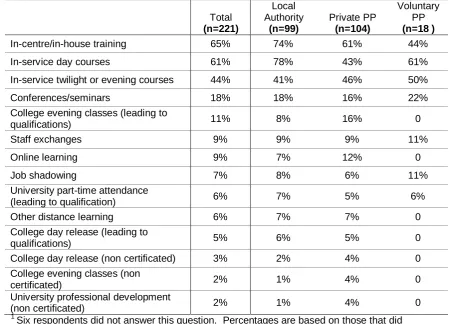
4. The research showed that CPD provision was dominated by short-term provision such as day, twilight and evening in-service courses. These were the types of provision most supported by local authorities, the most frequently experienced by managers and practitioners and were highly ranked in terms of preferred types of CPD. However, practitioners also expressed the view that one-off sessions were insufficient to change practice. The research also indicated that well-supported, in-house development opportunities with peers, more experienced colleagues, practitioners from other centres and specialist support were valued and seen to be effective. Such approaches can generate locally relevant professional development and are supported in the literature as both engaging and empowering practitioners in the development process. It is, however, important to ensure that locally developed and supported opportunities are underpinned by sound knowledge of relevant pedagogy and child development.
It is recommended that particular focus be given to developing sustainable learning communities for the early years workforce, supported by expert mentoring as appropriate within the local context. Individual and local development should be aligned to the national Early Years Framework.
5. Professional development led by professionals from other agencies, such as health and social work were valued as were opportunities to take part in shared training events. Some local authorities had developed multi-agency training, though it was not clear to what extent this focused specifically on the needs of children under 3. Inter-professional and inter-agency working is a key element in the provision of children’s services; it is emphasised in both the Early Years Framework (2008) and in the skills required in the Standard for Childhood Practice (2007).
___________________________________________________________________________________________ 6. Distance/online learning, staff exchanges and job shadowing were less
experienced forms of staff development but were seen as accessible and valued by those who had experienced them. Distance and online learning approaches are valuable for those living in rural areas; the distance and time required to travel to courses and to meet with others was seen as a barrier by those living in rural communities.
It is recommended that currently less-used approaches such as distance and online learning, staff exchanges and job shadowing be encouraged and supported. Glow2, the Scottish national intranet for education, provides the infrastructure to enable online learning and the exchange of ideas and practices to support virtual learning communities.
7. Areas of CPD where managers and practitioners reported gaps in provision included staff needs analysis for managers, and working with parents and developing home links, which was highlighted as a priority for development by both managers and practitioners. The Standard for Childhood Practice identifies the ability to support and develop the workforce as key for lead practitioners and emphasises the importance of supporting and working with parents for all practitioners. Working with and supporting families is a crucial element of the Early Years Framework.
It is recommended that pre-service programmes and ongoing CPD at authority and centre level be aligned to national priorities and, in particular, that priority be given to working with families and supporting parents.
8. The research identified that the majority of provision for children under 3 years of age is within the private sector. While some authorities sought to work closely with their partner3 providers in respect to provision for children under 3, others did not; indeed some did not hold information about the partners’ provision for this age group. The research revealed that those working in the private sector were less likely to participate in CPD, to have access to local authority resources and information about CPD opportunities. Managers from private centres were more likely than those in local authority centres to say that current support for areas of CPD was not adequate. Interviews at local authority level and in centres confirmed the view that participation in CPD events was more difficult for the private sector. There are few centres in the voluntary sector that make provision for children from birth to 3 years but they likewise found it difficult to access CPD.
It is recommended that a review be undertaken of the relationship between authorities and partner provider centres, in respect of their provision for children under 3 years of age. This should include consideration of the role of different bodies, such as the Care
2
For information on Glow see: http://www.ltscotland.org.uk/glowscotland/index.asp 3
___________________________________________________________________________________________ Commission, HMIE and Scottish Social Services Council (SSSC), in relation to standards and ensuring partner centres can provide quality CPD for their staff.
9. The present study focused on CPD for those working in local authority centres and centres in partnership with the local authority. Provision is also made for children under 3 years of age in non-partner provider centres and by childminders. In rural areas in particular, if there are centres, they tend to found in more populated areas and not in the dispersed communities. The current opportunities for CPD for these groups are not known.
It is recommended that research be undertaken to investigate the CPD needs and opportunities of non-partner provider centres and childminders and to identify ways of ensuring that national priorities and standards are being addressed. The needs of rural and remote areas in particular should be addressed.
10. Small numbers of managers and practitioners reported already holding degree level awards in early education and childcare although this was more common amongst those working in local authority centres. The numbers who reported that they were working towards degrees at the time of the survey were also low, though unsurprisingly more managers than practitioners reported this. While HNC was the most common qualification, many reported holding SVQs, most commonly at level 3. At the time of the research, some participants perceived that the commitment to undertake degree level study was a personal choice and financial support was serendipitous.
However, from 2011 registration with the Social Services Council as a manager/lead practitioner will require a qualification that is recognised at level 9 on the Scottish Credit and Qualification Framework. This has implications for policy, relating to the need to support existing staff progress towards SCQF level 9 awards.
6. Conclusion
___________________________________________________________________________________________ assist greatly in developing a framework that has relevance for all those working in the early years sector.
References
Condie, R., Livingston, K. and Seagraves, L. (2005) The Assessment is for Learning Programme: an evaluation. Edinburgh: Scottish Executive Education Department.
DfES (2002) Birth to Three Matters: A framework to support children in their earliest years. Nottingham: DCSF
Learning and Teaching Scotland (2005) Birth to Three: Supporting Our Youngest Children.Glasgow: LTS
QAA Scotland (2007) Scottish subject benchmark statement: The Standard for Childhood Practice.Glasgow: QAA
Scottish Executive (2006) National review of the Early Years and Childcare Workforce. Edinburgh: Scottish Executive
Scottish Government (2008)Early Years Framework.Edinburgh: Scottish Government Scottish Parliament Education Committee (2006) Education Report, 7th Report.
____________________________________________________________________________________________
Continuing Professional Development of Early Years Managers and
Practitioners working with children under 3 years of age
1. Introduction
The Faculty of Education at the University of Strathclyde was commissioned by Learning and Teaching Scotland to undertake research into the continuing professional development provision (CPD) for early years practitioners and managers across Scotland, specifically focusing on provision for those working with children under 3 years of age. The aim of the research was to identify ways in which those working in early years centres might be better supported through effective CPD opportunities, designed to meet the needs of children and their families.
Recent Scottish Government figures indicate that 37,750 children under the age of 3 years were registered in day-care and pre-school centres in January 2007 (Scottish Government, 2007a), with similar figures (37,550) reported for January 2008 (Scottish Government, 2008a). However, the literature reveals a picture of a predominantly young, female, shifting workforce, with nearly one third lacking appropriate qualifications. Various reviews of the literature have highlighted both the dearth of research into the competencies and qualities required of practitioners working with children under 3 and of the availability of continuing professional development. (Melhuish, 2004; Trevarthen et al, 2003; David et al, 2003; British Educational Research Association’s Early Years Special Interest Group, 2003).
In 2006, the Scottish Parliament Education Committee acknowledged these findings and argued that ‘the area which requires most urgent investment is improving the skills level of the workforce, and that although further investment is required in the 3-5 sector, the under 3 sector is the most immediate priority’ (SPEC, 2006, para 16).
This research was commissioned to determine developments in the provision of CPD for those working in early years centres and, more specifically, to:
1. undertake a review of the relevant existing information on the CPD needs of staff working with very young children (birth to 3), including reports from the Care Commission and other sources and to include a discussion on definitions of CPD;
2. compare and contrast the perspectives of early years practitioners, centre managers and appropriate local authority officers, in the following areas:
definitions of CPD and their perceptions of effective CPD
areas of birth to 3 years work where CPD is undertaken and is considered to be effective for early years practitioners and managers
____________________________________________________________________________________________ priorities for CPD for early years practitioners and managers
effective and preferred types of CPD for early years and practitioners and managers
effective and preferred systems of the delivery of CPD for early years practitioners and managers
access and barriers to participation in CPD for early years practitioners and managers
qualifications obtained and perceived usefulness in preparation for their roles;
3. measure the extent to which the national birth to 3 guidance document and the staff support pack are used and to explore the ways in which these documents are used by each of the three stakeholders (practitioners, managers and local authority officials);
4. identify examples of good practice.
____________________________________________________________________________________________
2. Literature
Review
‘Managers/lead practitioners value themselves and others by taking responsibility for their own professional learning and development and that of the workers for whom they are responsible. They……….show a commitment to reflection, critical self evaluation and continuing professional development as means of improving practice and broadening expertise..’ (QAA 2007:12)
The new Scottish Standard for Childhood Practice sets out a body of knowledge and skills for the childhood practitioner. In addition to the skills and knowledge gained through pre-service or work-based training, there is an ongoing need to provide continuing professional development that builds on and complements skills and understanding already gained. The purpose of the research on which this report is based was to delineate how continuing professional development might be interpreted for childhood practitioners working with children under 3 years of age.
There has been a range of research undertaken into the meaning of professional development for related professions, particularly teaching (Hargreaves et al, 1996; Dall’Alba & Sandberg, 2006; Newman et al, 1989; Moon 1996). For example in their research, Dall'Alba, and Sandberg explicitly define professional development as: ‘formal courses and programmes in professional education and .... the formal and informal development of professional skill that occurs in the workplace’ (2006:383) However perhaps Leach’s (1996) argument that professional development should be centrally grounded in social and personal practice is of the most use when considering the needs of practitioners working with children under three.
Leach suggests a model whereby support for professional development not only builds on theory but also mirrors what is expected of best practice within the practitioners’ own setting. The model is based on a study of teacher professional development but can be extrapolated to other vocational and professional areas. Leach makes particular use of a case study of Albanian teacher training, which has in common with the context of practitioners working in Scotland with children aged under 3 years that there is no standardised training or national assessment policy (specific to the age group).
The components of her model are:
1. Support should provide model learning environments
2. Support should build on existing frameworks as far as possible and be consonant with the culture in which it is developed
3. Support should be developmental and exploratory, providing experience of a wide variety of teaching and learning opportunities
____________________________________________________________________________________________ 5. Support should acknowledge both the private and professional aspects of
learners' experiences and their interconnectedness in the development of learning
6. Support should have a firm base in schools and classrooms. (Leach 1996:123)
Moon (1996) would argue that there is a crucial role for a mentor to support continuing professional development in the workplace. Many early childhood professionals will be familiar with the work of Vygotsky in relation to 'scaffolding' young children’s learning and development (Vygotsky, 1978; Bruner, 1986; Newman et al, 1989). Those who have studied the concept will know that the 'zone of proximal development' highlights their role in supporting the young children in their care; however, it can also be applied to their own continuing professional development. In their best evidence synthesis for the New Zealand Ministry of Education, Mitchell and Cubey (2003) define what they believe to be the eight characteristics of effective continuing professional development for practitioners working with very young children:
1. The professional development incorporates participants’ own aspirations, skills, knowledge and understanding into the learning context
2. The professional development provides theoretical and content knowledge and information about alternative practices
3. Participants are involved in investigating pedagogy within their own early childhood settings
4. Participants analyse data from their own settings. Revelation of discrepant data is a mechanism to invoke revised understanding
5. Critical reflection enabling participants to investigate and challenge assumptions and extend their thinking is a core aspect
6. Professional development supports educational practice that is inclusive of diverse children, families and wh nau4
7. Professional development helps participants to change educational practice, beliefs, understanding and/or attitudes
8. Professional development helps participants to gain awareness of their own thinking, actions, and influence.
(2003: xii)
This synthesis formed the basis of the Te Wh riki approach discussed later in the current review. However, in order to frame their professional development we need to understand the needs of children and the context in which the (birth to 3) childhood practitioners are working.
The first three years of life are often viewed as a unique stage. Learning and Teaching Scotland’s own document (2005) acknowledges that, from birth, learning is a complex process which should focus on children as individuals who develop at their own pace and with their own interests rather than be guided by their chronological age. This early period is the one of most rapid physiological growth (Bee, 2000) and recent advances in neuroscience have resulted in significant differences in the ways in which children’s competencies are perceived
4
____________________________________________________________________________________________ (Barron and Holmes, 2005, cited in Abbot and Langston, 2005). Traditional understandings of developmental psychology have been questioned in recent years in light of the growing recognition that the way in which children are viewed is largely a social and cultural construct. In the past the main knowledge base for early years’ courses was often compartmentalised into children’s physical, emotional, social, cognitive, moral and aesthetic development which is not always compatible with understanding the child in the context of their family and community. Medical models of childcare have also tended to stress hygiene and the avoidance of disease and illness, particularly for very young children. A post modern perspective5 (Dahlberg et al 1999) argues that Western scientific approaches with their focus on purely technical and managerial issues of expert knowledge and measurement can neglect more relevant themes for early childhood such as the sociology of childhood, philosophy and ethics.
Bornstein (1999, as cited by David et al, 2003) highlights the importance of infancy experiences in forming the adult but does not view them as being the sole determinant of future development. However, neurological findings suggest that there are sensitive periods for development in the first 3 years of life and scientists stress that positive early experiences can have an impact on brain development (David et al, 2003). Elferet al (2003) note that very young children struggle to make meaning of adult communications and need adults who are attuned and responsive to children’s attempts at interaction. The need for this nurturing role is affirmed by Shonkoff and Phillips (2000; 2001). However, while they have drawn on scientific research to demonstrate the influence early experiences can have on brain development, they also argue that a disproportionate focus on ‘birth to three’ can often begin too late and end too soon. They would argue that a more holistic approach that supports the whole child: physically, socially, emotionally and cognitively within the context of the family and community as well as addressing social policy is likely to have a more sustained impact. This would suggest that any continued professional development for practitioners working with children under 3 should include topics such as working with parents and community development. Research evidence from Carr et al. (2000) would support the view that approaches which enable practitioners to find out about a child’s thinking, family experiences and competence can challenge deficit models, particularly related to ethnicity, and also strengthen home links.
A recent report on mental health in infancy (as cited in North Lanarkshire, 2005) suggests that the mental health needs of babies and toddlers must be recognised and argues that very young children need adults with whom they have a secure bond and, who respond to them with love and empathy, if their mental health is to be assured. Lindon (2000) also highlights the role of close relationships, care, daily routines, and the fostering of communication, physical skills and exploratory play in promoting babies and toddlers’ development and learning. Key to all of these, she argues, is the role of the adult and emphasises that the differing
5
Gammage’s definition of post modernism can be found in the literature review for Birth to Three Matters:
____________________________________________________________________________________________ traditions of ‘care’ and ‘education’ have been a barrier to ensuring quality provision for children under three years, leading to competing priorities or emphases within services rather than the holistic approach needed by young children (Lindon, 2000). This is the philosophy that is embedded in the Learning and Teaching Scotland guidance where the key features for effective practice in caring for children aged birth to three are seen as relationships, responsive care and respect (2005).
The Scottish Parliament (2006) stated that they wished to see more cognitively challenging experiences for children aged from birth to 3 years. However, it has been argued that the notion of learning for the youngest children cannot be directly compared with the provision of a curriculum for older children: ‘Infant appropriate pedagogies are pedagogies of listening, of looking, and loving’ (Nutbrown and Page, 2008:15).
Robinson (2003) notes that professionals working with young children and their families are providing a secure base outwith the home and that nurturing of children is a key concern of these practitioners. Cohen (2008) suggests that a new profession which encompasses children’s learning is needed to work with young children in a holistic way. This is in keeping with European approaches (see Appendix 1) and there is an extensive range of European literature which highlights that Scotland is not alone in recognising the urgent need to review the continuing professional development of practitioners working with our youngest children (Penn, 1997; OECD, 2006).
The Scottish Parliament (2006:113) noted that, in relation to the broader early years’ workforce, there is a need for a new type of early years professional whose training would incorporate the pedagogical skills associated with teachers within a broader training. However, they found an immediate need amongst those working with the very youngest children:
‘We will therefore argue that the area which requires most urgent investment is improving the skills level of the workforce, and that although further investment is required in the 3-5 sector, the under 3 sector is the most immediate priority’
(Scottish Parliament Education Committee, 2006: 16).
There could however be an issue for capacity building among the trainers themselves as a common concern raised in the consultation for the Early Years and Childcare Workforce review was that both Further Education and Higher Education institutions have staff delivering training who have had little, if any experience of working with children aged under three years (Scottish Executive, 2007).
____________________________________________________________________________________________ innovative ways of supporting families with children under three and this has often involved developing the existing skill set of staff (Cunningham-Burley et al, 2005). The Review of the Scottish Early Years and Childcare Workforce (Scottish Executive, 2006) argued that the most important factor in improving quality was raising the skill of the sector and, within that, the area most in need of improvement is the 0 to 3 sector. The introduction of the Early Years Framework (Scottish Government, 2008b) has further emphasised the need for support to very young children and their families and has highlighted the need to maintain and improve the quality of services through training.
Although there are significant numbers of children registered in day-care and pre-school centres across Scotland, there is evidence that the workforce is predominantly young, female and shifting, with around a third lacking appropriate qualifications. Various literature reviews have highlighted both the dearth of research into the competencies and qualities required of practitioners working with children under three and of the availability of continuing professional development (Melhuish, 2004; Trevarthenet al, 2003; David, Tet al, 2003; British Educational Research Association’s Early Years Special Interest Group, 2003). Nutbrown and Page (2008) note that there is still a need for evidence that all qualified staff working with young babies are equipped for all aspects of the job. They highlight the need for such practitioners to have the opportunities for
‘…further professional development, to study for award-bearing courses, to read recent research, to attend conferences and to think and discuss research and practice together’
(Nutbrown and Page, 2008:173)
____________________________________________________________________________________________ The National Review of the Early Years and Childcare Workforce6 (Scottish Executive, 2006) clearly sets out the differentiated roles and responsibilities of the Scottish early years and childcare workforce. However, these are a generic set of knowledge, skills and competencies for working with children. Practitioners caring for very young children require competencies in the context of working with children under 3 years of age and their families. Unfortunately, it is possible to qualify, register and practice as an early years practitioner without any specific training in working with the very young age group. For example, within SVQ levels 2, 3 and 4 Children’s Care, Learning and Development (SQA, 2008) and the NC and HNC Early Education and Childcare (SQA, 2004), there are no mandatory units on working with very young children (birth to 3) and neither do students necessarily have a practice placement in a setting serving children in this age range. Penn (1999) argues that reliance on assessing workers on workplace competence does not give breadth of training or opportunities for reflection – a quality stressed in the Scottish Standard for Childhood Practice (QAA 2007) – beyond the immediate workplace. She also notes that in some European countries practitioners have specific time set aside on a weekly basis for continuous professional development. Within Scotland, early year workers have identified the lack of career development opportunities as a key concern (Scottish Executive, 2006; 3.2) with little evidence of staff moving across sector barriers. The review further identified the need to ensure that practitioners had accessible routes through CPD to build on existing qualifications and to develop additional professional skills (Scottish Executive, 2006:29).
In recent years, guidance for staff working with very young children has proliferated. The Birth to Three Matters Framework in England (DfES, 2002) has proved popular with those working with children under the age of 3 years in Scotland. The parallel guidance developed by Learning and Teaching Scotland (LTS, 2005) is less prescriptive, setting out three key features of good practice: relationships, responsive care and respect. It links directly with the key principles of the Curriculum Framework 3-5 (SCCC, 1999) and is in line with the key capacities of the Curriculum for Excellence (Scottish Executive, 2004). Both prior to the publication of Birth to Three and subsequently, individual local authorities have developed their own guidance and CPD materials (e.g. South Lanarkshire, 1999; Inverclyde, 2001; North Lanarkshire Council 2005; Edinburgh Council, 2008). This is reflected in the second Sure Start mapping exercise where many local authorities reported that training had developed considerably since funding was introduced in 2000 (Cunningham-Burley,et al 2005).
HMIE also developed a self-evaluation guide, Child at the Centre, for effective practice in early childhood centres (HMIE, 2000; HMIE, 2007). Although targeted
6 The consultation for the National Review of the Early Years and Childcare Workforce in Scotland was
____________________________________________________________________________________________ at services for 3 to 5 year olds, it was also considered appropriate for use by services for children under 3 years. HMIE is one of the three regulatory bodies for early years and related services in Scotland alongside the Care Commission and the Scottish Social Services Council. Each places a differing emphasis on the competencies and qualities required of early years practitioners and managers and how these should be supported.
The case studies within the current research (2008) highlight that while practitioners greatly appreciate a shared philosophy and clear written guidelines they also need practical guidance from an experienced mentor who can demonstrate the link between the underpinning theory and its application. The work of Munton et al (1996) uses an analysis of Kolb’s (1984) model of experiential learning to suggest that this is an effective approach to adopt with early years practitioners’ CPD. A developed example of this can also be found in New Zealand where professional development to support the implementation of Te Wh riki has been implemented. Within this there is an evidence and inquiry-based culture that informs teaching and learning practices and supports the growth of professional learning communities (NZ Ministry of Education, 2008). There are similarities with the Scottish vision in that the Te Wh riki curriculum aspires for children to grow as competent learners and communicators, healthy in mind, body and spirit, secure in their sense of belonging and in the knowledge that they make a valued contribution to society.
Programmes for continued professional development invite early childhood centres to identify their own focus of interest and then, in partnership with experienced facilitators, programmes are designed that can promote the importance of context specific professional learning. Programmes offered include: Whole centre professional learning and development programmes, which can be likened to the 0-3 frameworks and related training developed by individual local authorities in Scotland (e.g. North Lanarkshire and Edinburgh) and
Cluster programmes, which again offer potential to Scottish local authorities serving remote and rural communities, some of whom are already basing their CPD support for practitioners working with children under 3 years on a community school cluster model (e.g. Aberdeenshire).
All CPD is grounded in the principles of Te Wh riki and supported by action research and the self-review process, a reflective approach that is very much in keeping with the new Scottish Standard for Childhood Practice (QAA 2007).
As seen above, central tenets of the New Zealand model are that it is contextualised and collective (including partnership with the home environment); however, perhaps more importantly, the Ministry of Education offers a funded contract for provision of professional development for early childhood services and centres to strengthen learning outcomes for infants, toddlers and young children. This is achieved through:
supporting, building and enhancing early childhood educators’ capability and inquiry based practices
____________________________________________________________________________________________ ‘…early childhood development is typically viewed through highly personalized and sharply politicized lenses’
(Shonkoff &Phillips, 2001:6)
____________________________________________________________________________________________
3. Research
Methods
The research was undertaken using documentary analysis, followed by two phases of evidence gathering from local authority officers, practitioners and their managers.
Phase 1: Literature review
In the first phase, the team analysed a range of documents from the UK and Europe, including policy statements, Care Commission reports, HMIE reports, local authority CPD catalogues and materials, local guidance on working with very young children, academic review papers and the relevant ‘grey’ literature, such as conference proceedings. The findings subsequently informed the design of the data gathering procedures used in the second phase of the review.
Phase 2: Survey of local authorities and centres
The first step in carrying out the fieldwork was to secure the participation of local authorities. Initially, the team contacted all 32 local authorities in Scotland, inviting them to participate in the research, to provide information on the numbers and kinds of early years centres within their authority and to complete a questionnaire. Not all did both: 24 provided information and completed the survey, a further 3 provided information only and 3 more completed the survey but omitted to provide the required information. Two authorities did not participate at all.
Of the authorities who agreed to participate, 20 were identified for further investigation on the basis that they provided appropriate geographical variation, i.e. reflected a range of rural, urban and city contexts, and size, determined in terms of the number of centres within the authority. The range of early years provision – local authority, private, voluntary/not for profit – was also taken into consideration. (Details of the sampling process are given in Appendix 2.)
Once identified, all centres that made provision for the full age range from birth up to a child’s third birthday within the 20 authorities were then approached to participate in a survey (see Appendix 3 for copy of questionnaires).
Three questionnaires, one for each of the three groups of participants, practitioners, managers and local authority officers, were developed. The questionnaires sought information on the nature and extent of CPD provision, views on its effectiveness, perceptions of the strengths and shortcomings and views on the barriers to accessing CPD. Additionally the questionnaires sought feedback on the extent to which the Birth to Three Guidance and support materials were used and, if possible, brief examples of what respondents considered to have been effective CPD. Background information such as gender, age, length of experience of working in early years, prior training and qualifications, was also sought. (As noted earlier, the lack of qualifications amongst early years staff has been identified as a key concern in recent years, therefore this was a key theme within the study.)
____________________________________________________________________________________________ for children from birth up to their third birthday within their authorities; about budgets available for CPD for those working with this age group; in particular, local authority respondents were asked to identify examples of good practice that might be investigated in the third phase of the review.
Twenty-seven local authority (LA) officers returned completed questionnaires, as did 340 practitioners and 122 centre managers. The questionnaires were sent out by mail to centres and were also provided online. Most participants chose to complete and return the hard copy version.
The quantitative data generated by the survey provides a picture of CPD provision across Scotland, which is presented in Section 4 of this report, and highlights issues for further exploration in the third, case study, phase.
Phase 3: The case studies
The case study phase of the review identified 3 local authorities that, from the questionnaire responses and discussions with Learning and Teaching Scotland, were identified as demonstrating an approach to early years CPD that was already producing results i.e. examples of good practice were noted, and where there was a coherent policy or operational plan underpinning developments. These 3 local authorities were each asked to identify up to 4 centres that they considered to be examples of good practice or that were in the process of improving practice as a result of CPD experience. Subsequently, a total of 9 centres were visited in 3 local authorities (5 local authority centres, 2 private partner centres and 2 voluntary partner centres). It was not always possible to visit the local authority officer and in some instances, these were undertaken by telephone. In an attempt to investigate whether remote and rural communities faced particular problems in accessing appropriate CPD, contact was made with local authority officers in two authorities. The feedback from these authorities has been integrated into the text of the report.
During each centre visit, a member of the project team interviewed the centre manager and a number of staff, either as a group or on an individual basis, depending on the circumstances and the availability of staff. Where possible, interviews were also conducted with individual or groups of parents. Semi-structured interview schedules were designed for this phase, focusing on some of the issues raised in the literature and the survey data, such as links between policy and practice, effective provision and future needs. (See Appendix 3 for copies of interview schedules.)
Analysis of the evidence
____________________________________________________________________________________________ which sought additional examples of, for example, CPD opportunities, types of delivery, barriers and further general comments. The responses from these were collated and analysed for emerging themes; the manager and practitioner open comments at times repeated or put additional emphasis on some of the points included in the structured part of the questions. In reporting, these have been noted, but focus in particular is given to new or additional perspectives. Content analysis was used to identify important themes in the interview evidence. Together, these three sources of evidence (documents, questionnaires and interviews), provide the basis for the findings and recommendations presented in this report.
Inferential statistics
Statistical measures of association have been calculated using chi-square for nominal or categorical data such as when a question pre-supposes a ‘yes’ or ‘no’ response as in, for example, questions that ask whether participants have used certain materials or taken part in a certain kind of CPD event. To investigate if respondents from different sectors were more or less likely to have nominated these items the data were investigated using chi-square. Based on the total sample and the number of respondents in each category, the test calculates expected frequencies as if there were no differences in responses by category. Where the actual responses deviate substantially from the expected, it may be inferred that the groups of respondents are reporting different views.
Non-parametric Kruskal-Wallis (KW) and Mann-Whitney (MW) tests have been used to investigate differences in responses for the different categories of respondent for rating scales and questions that required ranking. Non-parametric statistics make no assumptions about the distribution of the data, i.e. the data do not require to be normally distributed; they are more appropriate for small sample sizes and for comparing groups of unequal size; and are appropriate to use with ordinal data. The responses to questions in the centre surveys were positively skewed, in some cases numbers were small and the categories of respondent being investigated were of different sizes. Therefore, non-parametric tests are more appropriate for our data set than parametric tests such as t-test and analysis of variance.
Kruskal-Wallis and Mann-Whitney tests rank order responses and then calculate a mean rank for each category of respondent. Variations in mean ranks indicate that there are differences in the views of the respondents. Mann-Whitney calculates a statistic called U (based on the number of participants in each group and the sum of ranks) and is used to compare two groups; Kruskal-Wallis calculates ‘chi-square’ and is used when more than two groups are compared; KW only shows that there are differences but not where the differences lie; a statistically significant result is therefore followed by paired comparisons using Mann-Whitney to identify which groups are responding differently.
____________________________________________________________________________________________ statistical significance while the detail of the statistical tests are reported in footnotes. For economy of reporting the results of KW have not been reported, but only of the MW tests as these indicate where the differences lie. The significance level for chi-square and KW tests is set at p<0.05. As multiple testing on the same data increases the likelihood of low probability levels, the significance level for the pairwise comparisons undertaken using MW has been set at p<0.02. This means that the association or difference that is evident in the data is unlikely to have occurred by chance or by sampling error. (For more information on statistical analyses see Dancey and Reidy, 2002.)
Manager and practitioner responses were compared and any differences have been reported in the sections reporting practitioner results. Caution is advised as there are some centres where only managers responded and others where only practitioners did so, making a direct comparison problematic.
Note on presentation of data in sections 4.2.2 onwards
____________________________________________________________________________________________
4. Findings
The findings are presented in three sub-sections: the survey of local authorities (LAs); the survey of early years centres; and, the case studies. The section concludes by drawing together the key findings and themes from each of these sub-sections.
4.1 Local authority survey
Key contacts for Early Years provision in local authorities were asked to complete questionnaires which requested information on the nature of the care provided for children under 3 years of age in the authority and the CPD provision made by the authority for those working with that age group. Responses were received from 27 of the 32 authorities; 2 of the remaining 5 authorities declined to participate and one authority indicated that, due to the very limited provision for children under 3 in centres, the questionnaire was not relevant. A further 2 local authorities gave no explanation for their non-response.
4.1.1 Nature of care provided
Two key questions were asked. The first sought information on the number of centres for children from birth or a few months old up to a child’s third birthday (many of which made provision for older children too, of course) while the second focused on centres that offered provision for children aged 2 and older. Local authorities were also asked to identify which of these were authority-run and which were private or voluntary7 partner providers and, if possible, to provide, the numbers of children in those centres that had not yet reached their 3rd birthday.
Local authorities varied in the amount of information they were able to supply, with some reporting that they did not collect much, if any, information from partner providers (PPs). A few contacts indicated they had specifically contacted centres to get the information for the purpose of this survey.8 Table 4.1 shows the distribution of types of centres across the 27 authorities.
7
The term ‘voluntary’ is used throughout to mean ‘voluntary and not for profit organisations’.
8
____________________________________________________________________________________________
Table 4.1: The different types of centres reported by the 27 local authorities
Total
Local authority
Private Partner Provider
Voluntary Partner Provider
Provision for children from birth 587 110 436 37
Provision for children from 2 years 346 38 70 238
Total 933 148 506 275
The majority of provision occurred in private partner provider (PPP) centres. The number of voluntary partner provider (VPP) centres taking children from the age of 2 included playgroups, which take children mainly from two and a half or just prior to their third birthday.
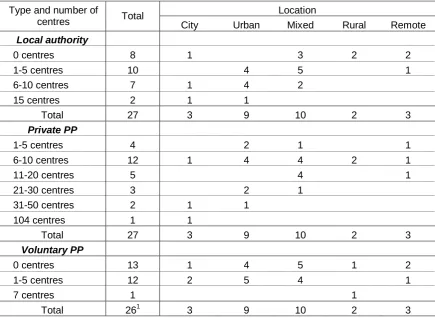
There was considerable variation in the provision across authorities. For example, local authority provision for children from birth ranged from no centres at all (in 8 LAs) while the other authorities reported up to 15 centres (2 LAs). Similarly, the number of authorities with private partner provider centres taking children from birth, ranged from between 1 and 5 centres (4 LAs) to over 100 (in one city LA). Thirteen local authorities had no voluntary partner providers for this age group while 12 had between one and five, and one reported 7 such centres.
In order to identify authorities to participate in the subsequent phases of the review, it was necessary to categorise them by the number and geographical location of centres providing care for children under 3 years of age. In terms of size, the categorisation adopted was:
Large (more than 100 centres) 1 authority Medium to large (35 to 50 centres) 5 authorities Small to medium (15 to 34 centres) 7 authorities Very small (<15 centres) 14 authorities
Location was based broadly on the categories of the Scottish Executive’s Urban Rural Classification (six-fold) (2003-04). Authorities that were designated as more than 90% large urban, were categorised as ‘cities’ for the purposes of sampling and authorities that represented a range of types of location, were categorised as ‘mixed’. The 27 authorities were therefore categorised as:
City 3 authorities Urban 9 authorities Mixed 10 authorities Rural 2 authorities Remote 3 authorities
____________________________________________________________________________________________
Table 4.2: Categorisation of the 27 local authorities by size and location
Size Total Location
City Urban Mixed Rural Remote
Large 1 1
Medium to large 5 1 3 1
Small to medium 7 2 4 1
Very small 14 1 4 5 2 2
Total 27 3 9 10 2 3
[image:33.595.80.516.364.682.2]The figures show a slight tendency for city and urban local authorities to make more provision than rural and remote authorities, but it is not a strong relationship and, as a result of the method used, one city was categorised as ‘very small’ (it had no local authority supported centres for children under 3 years of age). Further enquiry indicated that in authorities with remote and rural communities, including the rural/remote areas of ‘mixed’ authorities, childminders are more likely to be used to support care for children under 3 years of age. Table 4.3 sets out the distribution of types of centres against geographical location.
Table 4.3: Types of centres that take children from birth by location
Type and number of
centres Total
Location
City Urban Mixed Rural Remote
Local authority
0 centres 8 1 3 2 2
1-5 centres 10 4 5 1
6-10 centres 7 1 4 2
15 centres 2 1 1
Total 27 3 9 10 2 3
Private PP
1-5 centres 4 2 1 1
6-10 centres 12 1 4 4 2 1
11-20 centres 5 4 1
21-30 centres 3 2 1
31-50 centres 2 1 1
104 centres 1 1
Total 27 3 9 10 2 3
Voluntary PP
0 centres 13 1 4 5 1 2
1-5 centres 12 2 5 4 1
7 centres 1 1
Total 261 3 9 10 2 3
1