City, University of London Institutional Repository
Citation
:
Dawes, M., Summerskill, W., Glasziou, P., Cartabellotta, A., Martin, J. S.,
Hopayian, K., Porzsolt, F., Burls, A. & Osborne, J. (2005). Sicily statement on
evidence-based practice.. BMC Medical Education, 5(1), doi: 10.1186/1472-6920-5-1
This is the draft version of the paper.
This version of the publication may differ from the final published
version.
Permanent repository link:
http://openaccess.city.ac.uk/13422/
Link to published version
:
http://dx.doi.org/10.1186/1472-6920-5-1
Copyright and reuse:
City Research Online aims to make research
outputs of City, University of London available to a wider audience.
Copyright and Moral Rights remain with the author(s) and/or copyright
holders. URLs from City Research Online may be freely distributed and
linked to.
Open Access
Debate
Sicily statement on evidence-based practice
Martin Dawes*
1, William Summerskill
2, Paul Glasziou
3,
Antonino Cartabellotta
4, Janet Martin
5, Kevork Hopayian
6, Franz Porzsolt
7,
Amanda Burls
8and James Osborne
9Address: 1Department of Family Medicine. McGill University, Montreal, Canada, 2The Lancet, Jamestown Road, London, UK, 3Department of Primary Health Care, Centre for Evidence-Based Practice, Oxford University, Oxford, UK, 4Gruppo Italiano per la Medicina Basata sulle Evidenze (GIMBE), Passaggio L. da Vinci, 16 – 90145 Palermo, Italy, 5London Health Sciences Centre, Department of Physiology & Pharmacology, University of Western Ontario, London, Ontario, Canada, 6School of Medicine, Health Policy and Practice, University of East Anglia Norwich, UK, 7University Hospital Ulm, Clinical Economics, Ulm, Germany, 8Department Public Health and Epidemiology, University of Birmingham, Birmingham UK and 9United Bristol Healthcare Trust, Bristol, UK
Email: Martin Dawes* - [email protected]; William Summerskill - [email protected]; Paul Glasziou - [email protected]; Antonino Cartabellotta - [email protected]; Janet Martin - [email protected];
Kevork Hopayian - [email protected]; Franz Porzsolt - [email protected]; Amanda Burls - [email protected]; James Osborne - [email protected]
* Corresponding author
Abstract
Background: A variety of definitions of evidence-based practice (EBP) exist. However, definitions are in themselves insufficient to explain the underlying processes of EBP and to differentiate between an evidence-based process and evidence-based outcome. There is a need for a clear statement of what Evidence-Based Practice (EBP) means, a description of the skills required to practise in an evidence-based manner and a curriculum that outlines the minimum requirements for training health professionals in EBP. This consensus statement is based on current literature and incorporating the experience of delegates attending the 2003 Conference of Evidence-Based Health Care Teachers and Developers ("Signposting the future of EBHC").
Discussion: Evidence-Based Practice has evolved in both scope and definition. Evidence-Based Practice (EBP) requires that decisions about health care are based on the best available, current, valid and relevant evidence. These decisions should be made by those receiving care, informed by the tacit and explicit knowledge of those providing care, within the context of available resources.
Health care professionals must be able to gain, assess, apply and integrate new knowledge and have the ability to adapt to changing circumstances throughout their professional life. Curricula to deliver these aptitudes need to be grounded in the five-step model of EBP, and informed by ongoing research. Core assessment tools for each of the steps should continue to be developed, validated, and made freely available.
Summary: All health care professionals need to understand the principles of EBP, recognise EBP in action, implement evidence-based policies, and have a critical attitude to their own practice and to evidence. Without these skills, professionals and organisations will find it difficult to provide 'best practice'.
Published: 05 January 2005
BMC Medical Education 2005, 5:1 doi:10.1186/1472-6920-5-1
Received: 03 October 2004 Accepted: 05 January 2005 This article is available from: http://www.biomedcentral.com/1472-6920/5/1
© 2005 Dawes et al; licensee BioMed Central Ltd.
BMC Medical Education 2005, 5:1 http://www.biomedcentral.com/1472-6920/5/1
Background
The Sicily statement on evidence-based practice
"Knowing is not enough; we must apply. Willing is not enough, we must do" [1]
Health care delivered in ignorance of available research evidence, misses important opportunities to benefit patients and may cause significant harm [2-4]. Providing evidence-based care is recognised as a key skill for health care workers from diverse professions and cultures [5-10]. The ability to deliver evidence-based practice promotes individualisation of care and assures the quality of health care for patients today as well as those of tomorrow [11].
A variety of definitions of evidence-based practice (EBP) have been proposed. However, definitions are in
them-selves insufficient to explain the underlying processes of
EBP and to differentiate between an evidence-based
proc-ess and evidence-based outcome.
Towards this goal, we propose three points to clarify and promote the realisation of EBP:
1) A clear statement of what EBP means.
2) A description of the minimum skill set required to prac-tise in an evidence-based way.
3) A curriculum that outlines the minimum standard edu-cational requirements for training health professionals in EBP.
This statement was conceived by the delegates of the sec-ond international conference of Evidence-Based Health Care Teachers and Developers held in Sicily in September 2003 ("Signposting the future of EBHC", [12]). In response to a request from the delegates at this confer-ence's final plenary session the steering committee pre-pared the first draft. The proposed statement and a topic questionnaire were then circulated to all 86 attendees of the Sicily conference for suggestions and clarifications. Eighteen professions allied to health from 18 countries were represented. Suggestions were incorporated and a final paper approved by consensus.
Discussion
Increase in medical information
During the last century there has been an exponential growth of research and knowledge [13,14]. The growth of health care information has been particularly rapid in diagnostic and therapeutic technologies. The volume of medical papers published doubles every 10 to 15 years [15]. Electronic searching of this expanding evidence base was initiated by the National Library of Medicine in 1966 [16]. Electronic access to full text articles and journals
started to become available in 1998 [17]. Increasingly, specialist databases of utility for health professionals are being developed, such as the Physiotherapy Evidence Database [18] and the C2-SPECTR [19]. Regular use of these resources is identified as one marker for lifelong learning among physicians [20], but the process is not easy [21]. Identification of the best methods to under-stand and integrate patient values, such as decision aids or patient-centred consultations, is still at the early stages of development [22].
With this expansion of information, our knowledge should be greater and our practice should be more effec-tive. Unfortunately this is too often not the case [23]. This recognised gap between best evidence and practice is one of the driving forces behind the development of EBP.
Clinical decision making
Good practice including effective clinical decision making – step 4 of the EBP process – requires the explicit research evidence and non-research knowledge (tacit knowledge or accumulated wisdom). Clinical decision making is the end point of a process that includes clinical reasoning, problem solving, and awareness of patient and health care context [24]. This process is uncertain and frequently no
"correct" decision exists. EBP can help with some of the
uncertainties in this decision process by using the explicit knowledge obtainable from research information. But to do so the research information must be transformed into clinicians' knowledge. Information can be defined as data that has been sorted, analysed, & displayed and commu-nicated through language, graphic displays, or numeric tables. Explicit knowledge is then the meaning people cre-ate using this information and its application through action in specific settings [25]. For example clinician's knowledge should include the need to evaluate quickly the patient with chest pain to take advantage of the research proven window of opportunity for treatment of acute coronary syndrome. Step 4 also requires the tacit knowledge which comes from the wisdom of experience, informed by evidence and outcomes, and which is conse-quently harder to share. An example is the recognition of a sick child. Research may develop a list of clinical features that, when present, denote severe illness in a child. While this list will help the inexperienced junior doctor, nurse, or midwife, the experienced health practitioner has a tacit knowledge of "sickness" in a child that comes from both knowledge of the features list and assimilation with expe-rience, thereby speeding up the recognition of "sickness" in a child.
Principles & development of evidence-based practice
and importance of evidence before applying it to day-to-day clinical problems" [27,28]. The initial definition of evidence-based practice was within the context of medi-cine, where it is well recognised that many treatments do not work as hoped [29]. Since then, many professions allied to health and social care have embraced the advan-tages of an evidence-based approach to practice and learn-ing [5-8,30]. Therefore we propose that the concept of evidence-based medicine be broadened to evidence-based practice to reflect the benefits of entire health care teams and organisations adopting a shared evidence-based approach. This emphasises the fact that evidence-based practitioners may share more attitudes in common with other evidence-based practitioners than with non evi-dence-based colleagues from their own profession who do not embrace an evidence-based paradigm.
EBP evolved from the application of clinical epidemiol-ogy and critical appraisal to explicit decision making within the clinician's daily practice, but this was only one part of the larger process of integration of evidence into practice. Initially there was a paucity of tools and pro-grammes to help health professionals learn evidence-based practice. In response to this need, workshops evidence-based on those founded at McMaster by Sackett, Haynes, Guyatt and colleagues were set up around the world. During this period several textbooks on EBP were published accompa-nied by the development of on-line supportive materials.
The initial focus on critical appraisal led to debate on the practicality of the use of evidence within patient care. In particular, the unrealistic expectation that evidence
should be tracked down and critically appraised for all
knowledge gaps led to early recognition of practical limi-tations and disenfranchisement amongst some practition-ers [31]. The growing awareness of the need for good evidence also led to awareness of the possible traps of rapid critical appraisal. For example problems, such as inadequate randomisation or publication bias, may cause a dramatic overestimation of therapeutic effectiveness [32]. In response, pre-searched, pre-appraised resources, such as the systematic reviews of the Cochrane
Collabora-tion [33], the evidence synopses of Clinical Evidence [34]
and secondary publications such as Evidence Based Med-icine [35] have been developed [36], though these cur-rently only cover a small proportion of clinical questions.
Process of Evidence Based Practice
The five steps of EBP were first described in 1992 [37] and most steps have now been subjected to trials of teaching effectiveness (indicated by references)
1. Translation of uncertainty to an answerable question [38]
2. Systematic retrieval of best evidence available [39]
3. Critical appraisal of evidence for validity, clinical rele-vance, and applicability [40]
4. Application of results in practice [41]
5. Evaluation of performance [42]
This five-step model forms the basis for both clinical prac-tice and teaching EBP, for as Rosenberg and Donald observed, "an immediate attraction of evidence-based medicine is that it integrates medical education with clin-ical practice" [43].
Curricula outline of minimum standard educational requirements
Different practitioners at different levels of responsibility within evidence-based organisations will require different skills for EBP and different types of evidence. It is a mini-mum requirement that all practitioners understand the principles of EBP, implement evidence-based policies, and have a critical attitude to their own practice and to evi-dence. Without these skills and attitidues, health care pro-fessionals will find it difficult to provide 'best practice'. Teachers, commissioners, and those in positions of lead-ership will require appraisal skills that come with higher training and continued use [44].
The wider knowledge and use of these skills will help health professionals meet some of Hurd's list of desired educational outcomes [45] in being able to:
• distinguish evidence from propaganda (advertisement)
• probability from certainty
• data from assertions
• rational belief from superstitions
• science from folklore
Curricula that outline the minimum standard educational requirements for practitioners
BMC Medical Education 2005, 5:1 http://www.biomedcentral.com/1472-6920/5/1
Learning has three components: knowledge, skills and attitudes. It is said that "attitudes are caught, not taught" [48]. Attitudes, such as comfort with managing uncer-tainty and reflective learning, provide the psychological framework in which evidence is appraised and applied,
described by Sackett as "the conscientious, explicit and
judi-cious use of current best evidence in making decisions about the care of individual patients" [49]. This presents a challenge, as EBP is rarely taught well [50] and is applied (and observed) irregularly at the point of patient contact [51] where professional attitudes are formed, and stu-dents learn to incorporate theory into practical skills for patient care. Patient involvement in decision making is part of the process of being an effective practitioner. The degree of involvement and the methods by which this is achieved will depend on the setting, the patients and the practitioner.
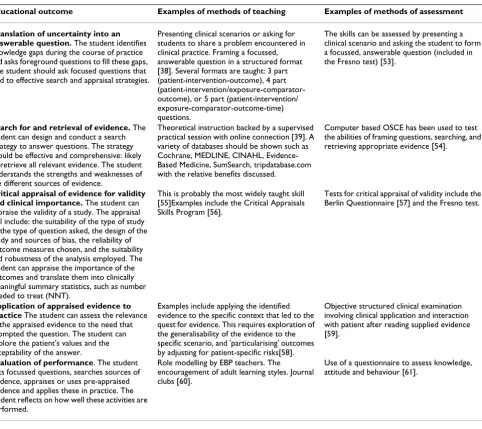
The curriculum framework for EBP should consider the importance of all steps shown in Table 1. Often courses focus on one of these elements, most commonly critical appraisal, but a balance of skills in each of the steps is needed to take a student from question through to appli-cation. Indeed, the most difficult step (sometimes dubbed "step 0") is to get students and colleagues to recognise and admit uncertainties. As Table 1 suggests, learning should be focused on educational outcome, which in turn needs to reflect the clinical setting. This practical orientation means that EBP teaching and assessment needs to con-sider the real-time setting of practice, and hence searching and appraisal need to be done in minutes rather than hours or days. Table 1 provides examples of established methods of teaching and assessment for each step, but fur-ther compilation, innovation, development, and testing are needed. Future research should be informed by the movement in best evidence medical education (BEME) [52].
Recommendations
The term 'EBM' has evolved into a larger phenomenon, as increasing numbers of practitioners in various disciplines recognise the importance of evidence to inform all types of health care decisions. Furthermore, greater patient choice and complexity of care mean that many profes-sionals practise as a team. In recognition of the impor-tance of a united commitment to the principles of 'best practice', we propose that the term 'evidence-based prac-tice' (EBP) be used to describe all aspects of this discipline.
To ensure that future health care users can be assured of receiving 'best practice' regardless of the type or location of the care received, we make the following recommenda-tions for education:
1. The professions and their colleges should incorporate the necessary knowledge, skills and attitudes of EBP into their training and registration requirements.
2. Curricula to deliver these competencies should be grounded in the "five-step model" (Table 1).
3. Further research into the most effective and efficient methods for teaching each step should be fostered, and linked with ongoing systematic reviews on each step.
4. Core assessment tools for each of the steps should be developed, validated, and made freely available internationally.
5. Courses that claim to teach EBP should have effective
methods for teaching and evaluating all components.
Evidence-Based Practice (EBP) requires that decisions about health care are based on the best available, current, valid and relevant evidence. These decisions should be made by those receiving care, informed by the tacit and explicit knowledge of those providing care, within the context of available resources.
Finally, EBP requires a health care infrastructure commit-ted to best practice, and able to provide full and rapid access to electronic databases at the point of care delivery. We believe that without the skills and resources for all the relevant components of this framework, the practice of a health care professional, or a health care organisation, cannot be said to provide their users with evidence-based care.
Summary
1. This consensus statement is from an international working group representing both organisations and indi-vidual teachers and developers of evidence-based practice.
2. Evidence-Based Practice (EBP) requires that decisions about health care are based on the best available, current, valid and relevant evidence. These decisions should be made by those receiving care, informed by the tacit and explicit knowledge of those providing care, within the context of available resources.
3. All health care professionals need to understand the principles of EBP, recognise it in action, implement evi-dence-based policies, and have a critical attitude to their own practice and to evidence. Without these skills profes-sionals will find it difficult to provide 'best practice'.
how to incorporate these skills with their own life-long learning and patient care.
Competing interests
All of the authors have received honoraria for teaching EBP FP is a consultant of Lilly Deutschland GmbH. The International Conferences of EBHC Teachers and Devel-opers do not accept sponsorship from health technologies (including pharmaceutical) manufacturers.
Authors contributions
MD, WS & PG wrote the original draft. AC, JM, KH, FP, AB & JO contributed to the concept and all revised drafts of the statement.
Acknowledgements
Contributions by the following conference delegates are greatly valued and helped to make this statement representative of different health profes-sions and healthcare systems: Andrew Booth, Rosalie Bennett, Thierry Christiaens, Mark Cooke, Madelon Finkel, Simon French, Frances Gardner, Amit Ghosh, Michel Labrecque, Elizabeth Meerabeau, Felice Musicco, Claire Parkin, Nancy Spector, Mel Stewart, Katharine Wylie. Dr. Badri Badrinath helped to search the literature
References
1. Goethe JW: "Denken und Tun".Maximen und Reflexionen 1833. 2. Dopson S, Mant J, Hicks N: Getting research into practice:
fac-ing the issues.J Manag Med 1994, 8:4-12.
3. Ordonez GA, Phelan PD, Olinsky A, Robertson CF: Preventable factors in hospital admissions for asthma.Arch Dis Child 1998,
78:143-147.
[image:6.612.68.550.97.526.2]4. Venturini F, Romero M, Tognoni G: Patterns of practice for acute myocardial infarction in a population from ten countries.Eur J Clin Pharmacol 1999, 54:877-886.
Table 1: Description of evidence for aspects of Evidence-Based Practice teaching and assessment
Educational outcome Examples of methods of teaching Examples of methods of assessment
Translation of uncertainty into an answerable question. The student identifies knowledge gaps during the course of practice and asks foreground questions to fill these gaps, The student should ask focused questions that lead to effective search and appraisal strategies.
Presenting clinical scenarios or asking for students to share a problem encountered in clinical practice. Framing a focussed, answerable question in a structured format [38]. Several formats are taught: 3 part (patient-intervention-outcome), 4 part (patient-intervention/exposure-comparator-outcome), or 5 part (patient-intervention/ exposure-comparator-outcome-time) questions.
The skills can be assessed by presenting a clinical scenario and asking the student to form a focussed, answerable question (included in the Fresno test) [53].
Search for and retrieval of evidence. The student can design and conduct a search strategy to answer questions. The strategy should be effective and comprehensive: likely to retrieve all relevant evidence. The student understands the strengths and weaknesses of the different sources of evidence.
Theoretical instruction backed by a supervised practical session with online connection [39]. A variety of databases should be shown such as Cochrane, MEDLINE, CINAHL, Evidence-Based Medicine, SumSearch, tripdatabase.com with the relative benefits discussed.
Computer based OSCE has been used to test the abilities of framing questions, searching, and retrieving appropriate evidence [54].
Critical appraisal of evidence for validity and clinical importance. The student can appraise the validity of a study. The appraisal will include: the suitability of the type of study to the type of question asked, the design of the study and sources of bias, the reliability of outcome measures chosen, and the suitability and robustness of the analysis employed. The student can appraise the importance of the outcomes and translate them into clinically meaningful summary statistics, such as number needed to treat (NNT).
This is probably the most widely taught skill [55]Examples include the Critical Appraisals Skills Program [56].
Tests for critical appraisal of validity include the Berlin Questionnaire [57] and the Fresno test.
Application of appraised evidence to practice The student can assess the relevance of the appraised evidence to the need that prompted the question. The student can explore the patient's values and the acceptability of the answer.
Examples include applying the identified evidence to the specific context that led to the quest for evidence. This requires exploration of the generalisability of the evidence to the specific scenario, and 'particularising' outcomes by adjusting for patient-specific risks[58].
Objective structured clinical examination involving clinical application and interaction with patient after reading supplied evidence [59].
Evaluation of performance. The student asks focussed questions, searches sources of evidence, appraises or uses pre-appraised evidence and applies these in practice. The student reflects on how well these activities are performed.
Role modelling by EBP teachers. The encouragement of adult learning styles. Journal clubs [60].
BMC Medical Education 2005, 5:1 http://www.biomedcentral.com/1472-6920/5/1
5. Culham E: Evidence based practice and professional credibil-ity (editorial).Physiotherapy Theory and Practice 1998, 14:65-67. 6. NMC: Nursing & Midwifery Council (2002) Code of
Profes-sional Conduct. 2002:8.
7. Dawes MG: On the need for evidence-based general and fam-ily practice.Evidence-Based Medicine 1996, 1:68-69.
8. Richards D, Lawrence A, Sackett DL: Bringing an evidence-base to dentistry.Community Dent Health 1997, 14:63-65.
9. Geddes JR: On the need for evidence-based psychiatry. Evi-dence-Based Medicine 1996, 1:199-200.
10. CSP: Standards of Physiotherapy Practice.Chartered Society of Physiotherapy 2000.
11. Group EBMW: Evidence-based medicine. A new approach to teaching the practice of medicine.JAMA 1992, 268:2420-2425. 12. GIMBE: http://www.ebhc.org. .
13. Humphreys BL, McCutcheon DE: Growth patterns in the National Library of Medicine's serials collection and in Index Medicus journals, 1966-1985.Bull Med Libr Assoc 1994, 82:18-24. 14. Arndt KA: Information excess in medicine. Overview, rele-vance to dermatology, and strategies for coping.Arch Dermatol
1992, 128:1249-1256.
15. Hook O: Scientific communications. History, electronic jour-nals and impact factors.Scand J Rehabil Med 1999, 31:3-7. 16. Wilson MP DCDKDF: Extramural programs of theNational
Library of Medicine: program objectives and present status. Bull Med Libr Assoc 1966, 54:293-310.
17. Delamothe T, Smith R: The BMJ's website scales up.BMJ 1998,
316:1109-1110.
18. PEDro: http://www.pedro.fhs.usyd.edu.au/index.html. . 19. C2-SPECTR: http://www.campbellcollaboration.org. . 20. Hojat M, Nasca TJ, J E, Frsiby A, Veloski J, Gonnella J: An
opera-tional measure of physician lifelong learning:its develop-ment, components and preliminary psychometric data.Med Teach 2003, 25:433-437.
21. Ely JW, Osheroff JA, Ebell MH, Chambliss ML, Vinson DC, Stevermer JJ, Pifer EA: Obstacles to answering doctors' questions about patient care with evidence: qualitative study. BMJ 2002,
324:710.
22. Montgomery AA, Fahey T, Peters TJ: A factorial randomised con-trolled trial of decision analysis and an information video plus leaflet for newly diagnosed hypertensive patients.Br J Gen Pract 2003, 53:446-453.
23. Walker A, Grimshaw J, Johnston M, Pitts N, Steen N, Eccles M:
PRIME PRocess modelling in ImpleMEntation research: selecting a theoretical basis for interventions to change clin-ical practice.BMC Health Serv Res 2003, 19:1-12.
24. Maudsley G S: 'Science', 'critical thinking' and 'competence' for Tomorrow's Doctors. A review of terms and concepts. J:Med Educ 2000, 34:53-60.
25. Stenmark D: "Information vs. Knowledge: The Role of intran-ets in Knowledge Management". IEEE Press, Hawaii, January 7-10, 2002; 2002.
26. Guyatt G: Evidence-Based Medicine.ACP J Club 1991, A-16:114. 27. Oxman AD, Sackett DL, Guyatt GH: Users' guides to the medical
literature. I. How to get started. The Evidence-Based Medi-cine Working Group.JAMA 1993, 270:2093-2095.
28. Guyatt GH, Rennie D: Users' guides to the medical literature [editorial].JAMA 1993, 270:2096-2097.
29. Doust JA, Del Mar CB: Why do doctors use treatments that do not work?BMJ 2004, 328:474-475.
30. Gambrill E: Evidence-based practice: Sea change or emperor's new clothes?J Social Work Educ 2003, 39:3-23.
31. McAlister FA, Graham I, Karr GW, Laupacis A: Evidence-based medicine and the practicing clinician.J Gen Intern Med 1999,
14:236-242.
32. Juni P, Egger M: Allocation concealment in clinical trials.JAMA
2002, 288:2407-8; discussion 2408-9.
33. Cochrane-Collaboration: http://www.cochrane.org. . 34. Clinical-Evidence: http://www.clinicalevidence.com. . 35. Evidence-Based-Medicine: http://ebm.bmjjournals.com. . 36. Haynes RB: Of studies, syntheses, synopses, and systems: the
"4S" evolution of services for finding current best evidence. ACP J Club 2001, 134:A11-3.
37. Cook DJ, Jaeschke R, Guyatt GH: Critical appraisal of therapeu-tic interventions in the intensive care unit: human mono-clonal antibody treatment in sepsis. Journal Club of the
Hamilton Regional Critical Care Group.J Intensive Care Med
1992, 7:275-282.
38. Richardson WS, Wilson MC, Nishikawa J, Hayward RS: The well-built clinical question: a key to evidence-based decisions [editorial].ACP J Club 1995, 123:A12-3.
39. Rosenberg WM, Deeks J, Lusher A, Snowball R, Dooley G, Sackett D:
Improving searching skills and evidence retrieval.J R Coll Phy-sicians Lond 1998, 32:557-563.
40. Parkes J, Hyde C, Deeks J, Milne R: Teaching critical appraisal skills in health care settings. Cochrane Database Syst Rev
2001:CD001270.
41. Epling J, Smueny J, Patil A, Tudiver F: Teaching evidence-based medicine skills through a residency developed guideline. Fam-ily Medicine 2002, 34:646-648.
42. Jamtvedt G, Young JM, Kristoffersen DT, Thomson O'Brien MA, Oxman AD: Audit and feedback: effects on professional prac-tice and health care outcomes. Cochrane Database Syst Rev
2003:CD000259.
43. Rosenberg W, Donald A: Evidence based medicine: an approach to clinical problem-solving.BMJ 1995, 310:1122-1126. 44. Guyatt G, Meade MO, Jaeschke R, Cook DJ, Haynes B:
Practition-ers of evidence based care.BMJ 2000, 320:934-935.
45. Hurd PDH: Scientific Literacy: New Minds for a Changing World.Science Education 1998, 82:407-416.
46. GMC: Tomorrow's Doctors. London, General Medical Council; 2002.
47. Shin JH, Haynes B, Johnston M: Effect of problem-based, self directed undergraduate education on life-long learning.CMAJ
1993, 141:969-976.
48. Reece I, Walker S: Teaching and training in Learning. 4th edi-tion. Sunderland, Business Education Publishers, Ltd.,; 2002. 49. Sackett DL, Rosenberg WM, Gray JA, Haynes RB, Richardson WS:
Evidence based medicine: what it is and what it isn't.BMJ
1996, 312:71-72.
50. Grad R, Macaulay AC, Warner M: Teaching evidence-based med-ical care: description and evaluation. Fam Med 2001,
33:602-606.
51. Dobbie AE, Schneider FD, Anderson AD, Littlefield J: What evi-dence supports teaching evievi-dence-based medicine?Acad Med
2000, 75:1184-1185.
52. BEME G: Best evidence medical education(BEME): report of meeting 3-5 December 1999, London, UK.Medical Teacher
2000, 22:242-245.
53. Ramos KD, Schafer S, Tracz SM: Validation of the Fresno test of competence in evidence based medicine. BMJ 2003,
326:319-321.
54. Fliegel JE, Frohna JG, Mangrulkar RS: A computer-based OSCE station to measure competence in evidence-based medicine skills in medical students.Acad Med 2002, 77:1157-1158. 55. Green ML: Evidence-based medicine training in graduate
medical education: past, present and future.J Eval Clin Pract
2000, 6:121-138.
56. CASP: http://www.phru.nhs.uk/casp. .
57. Fritsche L, Greenhalgh T, Falck-Ytter Y, Neumayer HH, Kunz R: Do short courses in evidence based medicine improve knowl-edge and skills? Validation of Berlin questionnaire and before and after study of courses in evidence based medicine.BMJ
2002, 325:1338-1341.
58. Straus SE, Sackett DL: Applying evidence to the individual patient.Ann Oncol 1999, 10:29-32.
59. Bradley P, Humphris G: Assessing the ability of medical stu-dents to apply evidence in practice: the potential of the OSCE.Med Educ 1999, 33:815-817.
60. Sackett DL, Straus S, Richardson WS, Rosenberg W, Haynes B: Evi-dence-Based Medicine. How to Practice and Teach EBM.
Edinburgh, Churchill Livingstone; 2000.
61. Johnston JM, Leung GM, Fielding R, Tin KYK, Ho LM: The develop-ment and validation of a knowledge, attitude and behaviour questionnaire to assess undergraduate evidence-based prac-tice teaching and learning.Med Educ 2003, 37:992-1000.
Pre-publication history
Publish with BioMed Central and every scientist can read your work free of charge
"BioMed Central will be the most significant development for disseminating the results of biomedical researc h in our lifetime."
Sir Paul Nurse, Cancer Research UK
Your research papers will be:
available free of charge to the entire biomedical community
peer reviewed and published immediately upon acceptance
cited in PubMed and archived on PubMed Central
yours — you keep the copyright
Submit your manuscript here:
http://www.biomedcentral.com/info/publishing_adv.asp
BioMedcentral