City, University of London Institutional Repository
Citation
:
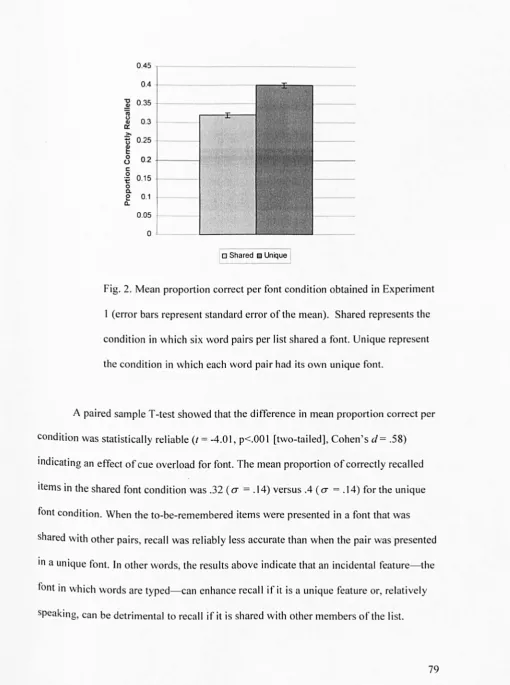
Fowler, James (2011). Discrimination problems in context-dependent memory. (Unpublished Doctoral thesis, City University, London)This is the draft version of the paper.
This version of the publication may differ from the final published
version.
Permanent repository link:
http://openaccess.city.ac.uk/17607/Link to published version
:
Copyright and reuse:
City Research Online aims to make research
outputs of City, University of London available to a wider audience.
Copyright and Moral Rights remain with the author(s) and/or copyright
holders. URLs from City Research Online may be freely distributed and
linked to.
Discrimination Problems in
Context-Dependent Memory
James Fowler
Thesis submitted in fulfilment of the requirements for the degree of
Doctor of Philosophy
Department of Psychology City University, London
Table of Contents
Table of contents ... 2
List of tables & figures ... 4
Acknowledgements ... 5
Declaration ... 6
Abstract ... " ... 7
Chapter 1: General Introduction .••••••.•••••••••••••••••••••••••••••••.•••••••.•••••••.•. 10 1.1: Encoding specificity ... 11
1.2: Encoding-retrieval match ...•...•.•...•...•...•. 20
1.3: Cue-overload ...•..•... 28
1.4: Memory as discrimination ... 33
1.5: Outline of the thesis ... 39
Chapter 2: Diagnostic retrieval and interactive contexts .•••••••••••••.••••••••••••• .42 2.1: Introduction ... 43
2.2: Experiment 1 ... 50
2.2.1: Results & discussion ...•...•... 55
2.3: Experiment 2 ...•••.•••.•.••.•.•.•••.•....•...•••.••••.•••..•....•..•...••..••.• 58
2.3.1: Results & discussion ... 59
2.4: Experiment 3 ... 62
2.4.1: Results & discussion ... 62
2.5: General discussion ...•...•... 65
Chapter 3: Discrimination problems and incidental context •••••.••••••••••••••••• 69 3.1: Introduction ... 70
3.2: Experiment 1 ...•..•.•...••..•....••.••.•.•.•.••.•.•..•..••...••••..•..• 74
3.2.1: Results & discussion ... 78
3.3: Experiment 2 ...•...• 80
3.3.1: Results & discussion .•.•..••.••••.•....•••••••••••••••.••••••••••.••.••••.••••• 81
3.4: Experiment 3 ...•...••...• 85
3.4.1: Results & discussion .•.•.•••..•••.•••••••.••..•••••••••••.••.••••.••.••••.••.•. 86
3.5: General discussion ... 89
Chapter 4: Encoding-retrieval match and cue-overload in response time ••.•••••. 92 4.1: Introduction ... 93
4.1.1: Cue-overload (model) •.•..•.••••....•••••.•••.•.•.•....•..•..•••.•.•••..•.•..• 96
4.1.2: Encoding-retrieval match (model) .•.•..•.•..•.•.••..••.•..•.••...•..•...•.•• 97
4.2: Experiment 1 ... 100
4.2.1: Results ... 107
4.3: Case studies ..••.••...•..•••.••..••.•.••.•••.•.•..••••••.••.••••.•••..••.•••••••••• 114
4.4: General results & discussion .•••.••.••.••..•••••••.•....••.••.••••.•••••.••••.• 122
4.4.1: Summary ... 128
5.1: Introduction ... 130
5.2: Computational comparison ...•...•... 133
5.3: Retrieval model ... 136
5.4: Numeric example ... 147
5.5: Qualitative fit to data ... 151
5.6: Discussion ... 157
Chapter 6: Conclusion ... 162
6.1: Reflections on the aim of the thesis ... 163
6.2: Review of empirical work ...•... ~ ... 164
6.3: Review of theoretical work ... 170
6.4: Summary ... 175
List of Tables and Figures
Chapter 2 ... Figure 1 ...•... ~ ...•...••..•....•.••..••••.... •...•..• 52
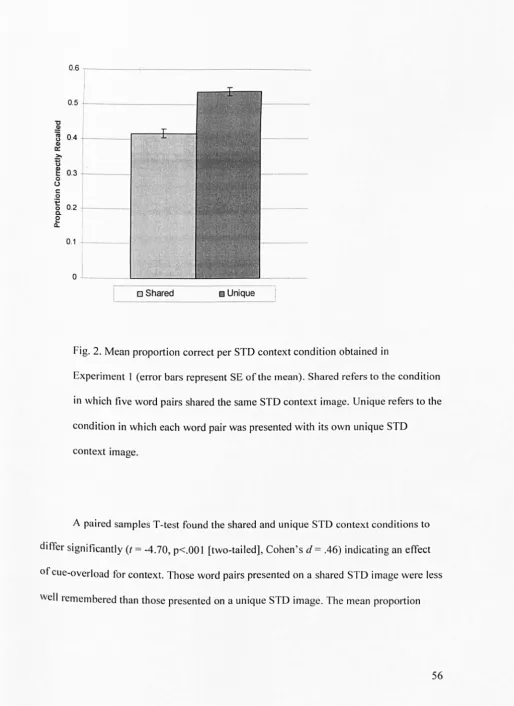
Chapter 2 ... Figure 2 ... 56
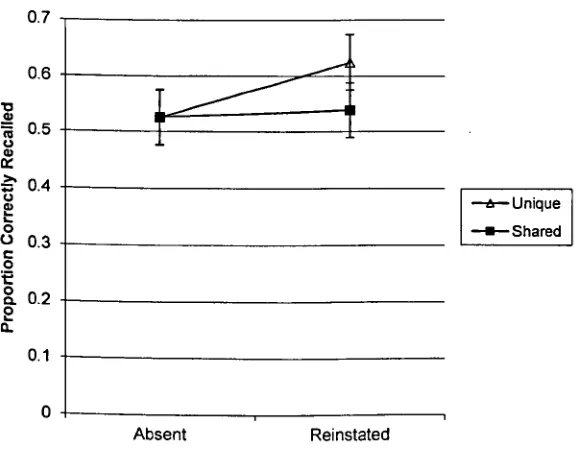
Chapter 2 ... Figure 3 ... 59
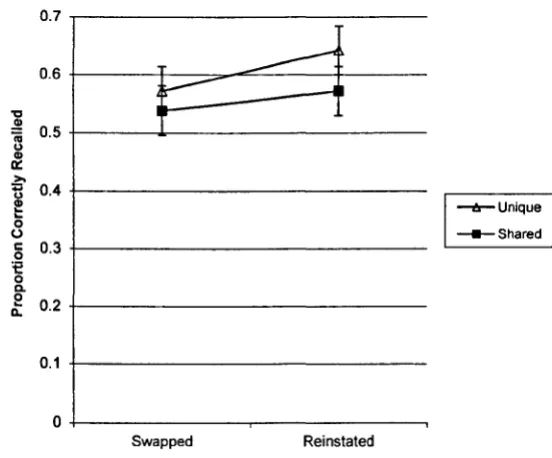
Chapter 2 ... Figure 4 ... 64
Chapter 3 ... Figure 1 ... 76
Chapter 3 ... Figure 2 ... 79
Chapter 3 ... Figure 3 ... 83
Chapter 3 ... Figure 4 ... 87
Chapter 4 ... Figure 1 ... 101
Chapter 4 ... Figure 2 ... 104
Chapter 4 ... Figure 3 ... 106
Chapter 4 ... Figure 4 ... 108
Chapter 4 ... Figure 5 ... 109
Chapter 4 ... Figure 6 ... 112
Chapter 4 ... Figure 7 ... 115
Chapter 4 ... Figure 8 ... 118
Chapter 4 ... Figure 9 ... 121
Chapter 4 ... Figure 10 ... 124
Chapter 4 ... Figure 11 ... 127
Chapter 4 ... Table 1 ... 117
Chapter 4 ... Table 2 ... 120
Chapter 4 ... Table 3 ... 122
Chapter 5 ... Figure 1 ... 140
Chapter 5 ... Figure 2 ... 141
Chapter 5 ... Figure 3 ... 142
Chapter 5 ... Figure 4 ... 144
Chapter 5 ... Figure 5 ... 146
Chapter 5 ... Figure 6 ... 153
Chapter 5 ... Figure 7 ... 155
Chapter 5 ... Figure 8 ... 156
Chapter 5 ... Table 1 ... 148
Chapter 5 ... Table 2 ... 150
Acknowledgements
First and foremost I would like to extend my thanks for my supervisor Marie Poirier as it was she who gave me the opportunity to move from Atlanta, Georgia in the United States to City University London and begin my academic career. Marie invested great effort in to my development and I am ever grateful.
I wish to thank my wife Patricia MacCormack, for a greater inspiration there could never be. I also thank Charlotte, may she rest in peace, for keeping me company during what should have been long hours of writing.
With the support and wisdom of my colleagues at City University London I have gone further in my understanding than I had thought possible. To my fellow members of the memory research unit - Kiriaki Koutmeridou and Silvio
Declaration
I grant powers of discretion to the University Librarian to allow this thesis to be copied in
Abstract & Foreword
This thesis investigates the validity of a view of memory retrieval that insists on
the diagnostic relationship between a target memory and a retrieval cue. The widely
accepted principle of encoding-retrieval match proposes that retrieval performance is
related to the degree to which the cues at the time of retrieval are compatible with those at the time of encoding (Tulving, 1979, 1983). The effect of cue-overload, another
well-documented effect, stipulates that memory retrieval performance is expected to decrease
as the number of potential targets in memory subsumed under a retrieval cue increases (Watkins & Watkins, 1975). With these two effects interacting, a variety of outcomes are possible. The memory as discrimination view investigated as part ofthis thesis suggests
that factors such as cue-overload, distinctiveness, context, and potentially others
contribute to a process of memory retrieval where diagnosticity is central (Nairne, 2002). Under such a view encoding-retrieval match cannot be relied upon to generate
predictions. Under a diagnostic retrieval system, retrieval is most likely to be successful
when a cue specifies a target in memory while excluding other potential candidates. Other memory as discrimination views do exist. However, within this thesis the above view is the only one being considered.
The studies presented as part of this thesis investigate the memory as discrimination hypothesis by studying the interaction between cue-overload and
encoding-retrieval match. Empirical investigations are included in which proportion of
time and probability of correct recall data are called upon. Chapter 1 reviews the relevant
literature in the field, while chapters 2 and 3 report empirical investigations testing the predictions of the memory as discrimination hypothesis. In chapters 2 and 3, paired
associate learning tasks were used. In such a task, participants are presented with pairs of
words under the instruction that they will later be asked to remember one member of a
given pair using the other member as a retrieval cue. Chapters 2 and 3 present the results
of studies where the encoding context was manipulated to investigate the roles of encoding-retrieval match and cue-overload in retrieval. This was achieved by using
contexts that were unique to a target or associated with multiple targets and then
orthogonally manipulating encoding-retrieval match and cue-overload. The experiments reported in chapter 2 used interactive contexts in the form of spot the difference images; participants were asked to spot the difference between two images; each time they were
successful, they were provided a pair of words to associate. Cue-overload was manipulated by varying the number of word pairs associated with a given spot the difference image. At test, the first word of each pair was presented and participants were
required to provide the correct second item. The reinstatement or non-reinstatement of the background images at test was employed as a means of manipulating encoding-retrieval
match. Using fonts as context, the experiments reported in chapter 3 varied the number of word pairs per list that shared a font, and manipulated the reinstatement of originally
viewed fonts to further test the findings of chapter two. The general prediction of the memory as discrimination view across experiments in chapters 2 and 3 is that a reduction
null, or beneficial effect on retrieval performance depending on the presence of a cue-overload effect.
Chapters 4 and 5 offer mathematical representations of cue-overload,
encoding-retrieval match, and possible interactions between the two in accordance with a memory
. as discrimination view. The predictions from these formal representations are
qualitatively compared to the data from experiments that manipulated encoding-retrieval
match and overload. Formal representations of encoding-retrieval match and
overload in chapter 4 predict the contributions of encoding-retrieval match and
cue-overload in response time. A formal model of the probability of correct retrieval is
offered in chapter 5. The essential feature of the model presented in chapter 5 is in its
generation of predictions in which the effect of encoding-retrieval match can be reversed by changes in cue-overload. The present thesis concludes that the effect of encoding-retrieval match is highly dependent on cue-overload in several ways and can be seen as
Chapter 1:
In the following pages, the main concepts relating to encoding-retrieval match and
cue-overload will be introduced and the key studies in the field will be reviewed. This
includes the main concepts relating to the memory as discrimination view, namely that
that memory retrieval performance is related to the degree to which a retrieval cue
specifies a single memory for retrieval to the exclusion of all others. This brief review highlights the implications of the memory as discrimination view and provides the
background to the empirical and more formal chapters that follow. Without being
exhaustive, the literature review concentrates on a number of seminal contributions, ideas
and findings that were instrumental in establishing some of the core principles typically
associated with memory retrieval.
1.1: Encoding-specificity
First proposed by Tulving and Osler in 1968, the encoding-specificity principle states that a retrieval cue can only be effective ifit was part of the original encoding (e.g.
Tulving & Osler, 1968; Tulving & Psotka, 1971). This principle continues to be
influential in memory research (Braisby & Gellatly, 2005). Encoding-specificity rests at the very core of this thesis in that the concepts under investigation (encoding-retrieval match, cue-overload, and memory as discrimination) all rely on encoding-specificity
(Nairne, 2002). This section of the thesis concentrates on the history of encoding-specificity from the research climate during the 1960s to the research papers introducing
encoding-retrieval match and cue-overload may be established in subsequent sections of the thesis.
Although much earlier work on memory of course existed (e.g. Ebbinghaus,
1885/1913; McGeoch, 1932; von Restorff, 1933), interest in the subject did not bloom until the 1960s, when research into the processing and organization of memory was a
very new field. During the 1960s a great deal of research centred on answering the
question 'what has become of those things we have forgotten?' Trace decay theory was
among the more popular modes of explaining why memories may be inaccessible at the
time of retrieval (e.g. Brown, 1958), essentially suggesting that over time memories lose
those features which compose their details, eventually making those memories unavailable or completely lost. Memory displacement was another possibility under
investigation during that time (Waugh & Norman, 1965). Under a displacement view of forgetting, previously learned items are relocated in the memory system when new items are stored, thus making them unavailable. In the case of either a decay or a displacement theory of forgetting, the memory trace can be seen as being unavailable at the time of attempted retrieval (Tulving & Pearlstone, 1966). By unavailable it is meant that the memory trace cannot (or may never be) retrieved in its original form - as opposed to it being momentarily inaccessible, but potentially available given an appropriate retrieval cue. At the time ofTulving and Pearlstone's article the decay and displacement theories
of forgetting were considered applicable to long-term memory (see Tulving & Pearlstone, 1966). However, the current view is that there is little support for a decay theory of
provided the hypothesis that at the time of attempted retrieval the memory may be available, but inaccessible due to the memory system's inability to locate it in a vast and
growing network of memories (Tulving & Pearlstone, 1966). It was Feigenbaum's (1961)
view that Tulving and colleagues (beginning with Tulving & Pearlstone, 1966) investigated and ultimately championed.
Tulving and Pearlstone (1966) reported an experiment in which participants
learned categorized words in lists. The list length (12, 24 & 48 items) and number of items per category (I, 2 & 4) were manipulated as well as the type of retrieval cue used at
testing. When tested participants were either asked to write down as many words as they
could remember (free recall), or were cued by the names of the categories used in the list.
This experiment was testing the hypothesis that having a cue could empower participants to remember something that they would not otherwise have remembered; this would be in
line with the idea memories may be available without being accessible until a cue is presented (e.g. Capaldi & Neath, 1995; McGeoch, 1932). Tulving and Pearlstone (1966) supported this view as their data indicated that recall was better with category-cues than without. The manipulations of list length and number of items per category demonstrated
that the size of the effect oftest type (cued versus free recall) was related to list length by
an increasing function and to the number of items per category by a decreasing function. As the lists became longer, the amount of assistance participants received from cues increased; in other words, all else being equal, the longer the list the bigger the difference
between cued and non-cued recall. Also, the data ofTulving and Pearlstone (1966)
a view stating that a cue supports retrieval based on the degree to which a memory is
specified by the cue. After all, a category cue for a category with one member specifies a candidate for memory retrieval to a greater degree than a category cue for a category with
four members.
Results arising from earlier studies (e.g. Mandler, 1967; Melton, 1963; Tulving &
Pearlstone, 1966) allowed Tulving and Osler (1968) to begin with an assumption: that
successful retrieval depends on the availability of items in memory and the availability of
appropriate retrieval cues at the time of attempted retrieval. At this time the most widely
recognized views of remembering concerned an associative continuity hypothesis,
originally offered by Fox, Blick, and Bilodeau (1964), by which to-be-remembered items are stored in memory in such a way that they are connected to other memories containing features commonly associated with the features of the to-he-remembered item. In this
way, under an associative continuity hypothesis, memories may be retrieved by associates even ifthose associates were not present at the time of memory encoding. Tulving and Osler designed an experiment to answer four very specific questions (paraphrased from
Tulving & Osler): 1) can words be cued successfully for recall using only another, weakly associated word? 2) Can a retrieval cue that would be effective if presented hoth
at the time oflearning and the time of testing be effective ifit is only presented at the
time oftesting? 3) If a word presented at the time of learning would be effective as a retrieval cue at the time of testing, would a similar replacement word be equally effective? 4) Are two equally well associated retrieval cues better than one?
These questions were designed to shed light on the subject of memory retrieval
24 words to participants. The words were either presented with no cue word, with a weak
associate, or with two weak associates. At test, participants were either provided with a
weak associate, with both weak associates, or were asked to recall as many words and cues as possible in free recall. The results ofTulving and Osler indicate that weak
associates may be effective as cues when presented with the target word at both learning and test but not when they are only presented at test. The use of an alternate associate at
test was also shown to be detrimental. Two associates were not shown to be better than
one. The Tulving and Osler data suggested that retrieval cues are only effective if they
are stored with the to-be-remembered item at the time of learning (in the case of explicit,
episodic memory) because only those associates which had been presented during the learning phase were effective. The data indicating that alternative associates presented at
test were less effective in retrieving the appropriate target than free recall suggested that these cues were retrieving items from outside of the list. Two cues not being more
effective than one may have shown reliance on one ofthe cues that had been presented during the learning phase, with the other being superfluous. In this regard, the evidence suggested that when a new memory is formed it is not associated to memories outside of the episode in which it is established --except what might be brought to mind by within
episode retrieval-- even if it could be logically expected that associations would form by virtue ofthe relevant concepts being similar, used in like circumstances, etc.
This led Tulving and Osler to define encoding-specificity as the effect by which memories can only be retrieved via retrieval cues that were part of the episode in which
the memories were encoded. These results conform to what would be expected following
presented in a situation differing from the original learned episode, may not be expected
to elicit the same result. However, an important distinction relates to what are known as
nominal and functional cues. A retrieval cue seen as being important by the experimenter
can only be considered a nominal retrieval cue as all of the cues present at the point of
encoding will determine what the main features of the memory will be. The environment
and target items can be considered the functional retrieval cue (Capaldi & Neath, 1995; Neath, 1998; Postman, Stark & Fraser, 1968).
Tulving and Osler's (1968) paper was met with 'vehement objections' when
reviewed for publication. These criticisms centred on the implication raised by Tulving
and Osler's results that" ... participants' pre-experimental histories cannot be effectively
utilized [by experimenters] ... " (Thomson & Tulving [1970, page 255] quoting an anonymous reviewer). Thomson and Tulving responded directly to this criticism by
investigating the role of strong pre-experimental associates in the paradigm utilized by Tulving and Osler (1968). Across three experiments -words were either presented alone, with a weak associate, or with a strong associate, then later tested either with free recall, with the same weak associate, or with a different associate (weak and strong being
swapped). The results indicated that strong pre-experimental associates did not facilitate
retrieval ofthe target word unless that associate had been presented with the word in the learning phase. However, when a strong associate had been presented at both learning and testing, that condition resulted in greater retrieval performance than the condition in
which participants had been provided a weak associate at both learning and testing. This lead Thomson and Tulving to conclude that although the encoding-specificity principle
greater retrieval performance when those associates were presented at both learning and testing.
While responding to proponents of the associative continuity hypothesis Tulving
and colleagues placed encoding-specificity in a category of hypotheses attempting to
explain the effectiveness of extra-list retrieval cues. Tulving and Thomson (1973) present
encoding-specificity as an explanation for the lack of effectiveness of strong
pre-experimental associates as retrieval cues in contrast to other theories from the literature of the time. Tulving and Thomson's proposal was that not only is encoding-specificity the
only explanation for the superiority of weak associates presented during learning and
testing over strong associates only presented at test, but also the best explanation for the superiority of strong associates over weak associates when both are presented at learning and testing. At the time, other hypotheses attempting to explain the effectiveness of
various cues (as introduced in Tulving and Thomson, 1973) included: 1) Convergence of episodic and semantic associations: Under this view the experimental context present at both learning and testing acts as one cue while pre-experimental associations act as another; the combination ofthese two allows for a greater probability of recall than either
experimental context alone (free recall) or that plus a weak associate (Bilodeau, 1967; Bilodeau & Blick, 1965) 2) Increments in trace strength: this view suggests that
pre-experimental associates are associated because they occurred together repeatedly. Repeated cueing of items increases their 'trace strength,' and as such pre-experimental
associates have similar trace strength from having been cued together previously (Broadbent, 1973); 3) Restricted search set: Cueing creates a search set through which
that the search set in recognition is smaller than that in recall (Atkinson & Shiffrin, 1968; Yntema & Trask, 1963).4) Mediation by input-generated implicit associative processes: pre-experimental associations are updated during the experiment (Freund & Underwood,
1970). In this way, when a pair of associates is presented at the time of learning both
members ofthe pair naturally cue related items in memory. When the first member ofa
pair is read an implicit response is activated in the participant and some (probably strong)
associates are brought to mind. These input-generated, implicit, associative processes are more likely to coincide with a strong associate being paired with the word at learning
than a weak associate. 5) Generate-recognize: A two stage view in which there is implicit
generation of possible response alternatives and recognition of one of the generated
alternatives as meeting certain criteria of acceptability. In this way recall will be a subset of the items available for recognition (e.g. Mandler, 1972). According to Tulving and
Thomson the most popular views for explaining recognition and recall of the time were the generate-recognize models. An essential prediction of these models was that because recall happens within the confines of recognition, recall performance cannot exceed that of recognition performance on the same material. Tulving and Thomson (1973)
challenged the generate-recognize model by challenging this prediction and providing data explainable through encoding-specificity alone.
In Tulving and Thomson (1973) participants were presented with paired
associates to learn. Then they were asked to produce free association responses to strong
extra-list associates of the target words from the list. They were then asked to identify those items in their associations that had been in the to-be-remembered list. Participants
retrieval cues. Across three experiments Tulving and Thomson presented results in which
the paired associate presented at the time of learning elicited a greater proportion of
correct responses than did a copy of the target (i.e. recognition). Following a criticism by
Santa and Lamwers (1974) that the participants in Tulving and Thomson's (1973)
experiments were confused, Tulving and Thomson's experiments were replicated in Wiseman and Tulving (1975) controlling for participants' familiarity with the task
requirements. Wiseman and Tulving (1975) were able to demonstrate a similar pattern of
results to Tulving and Thomson (1973) after having adjusted the task to avoid confusion.
Additional criticisms were in the form of suggesting that participants do not actually
recall what they fail to recognize, they simply have a higher proportion of recalled words
than recognized words and that the words recalled were not words that went
unrecognized. This too was addressed in Wiseman and Tulving (1975) in that the authors
report the conditional probability of a word being recalled but not recognized as being 36% in a given list. The series of findings regarding the recognition failure of recallable words continued with Wiseman and Tulving (1976) in which the general trend of results was replicated using unrelated words as cues in the cued recall condition. Tulving and
Thomson suggest that only encoding-specificity can explain the superiority of recall over recognition. They propose that when a memory is encoded it is encoded in such a way
that it can only be retrieved through cues composed of items from that specific episode. Fo1\owing that they suggest that items stored as cues at the time of learning are better
equipped to retrieve a target than a copy of the target itself because the target had not be stored under the context of being used in a recognition task. Tulving and Thomson
of papers in the following quote: "Specific encoding operations performed on what is perceived determine what is stored, and what is stored determines what retrieval cues are
effective in providing access to what is stored" (Tulving & Thomson, 1973). Through this the authors suggest that what is most effective in accessing what is stored are the specific
encoding operations originally performed. In the case of recognition failure of recallable
words: a copy of the target fails to elicit a recognition response because the specific
encoding operations did not prepare that memory trace to be accessed via recognition, but by recall using the appropriate cue instead. Subsequent work capitalized on this
statement, such as transfer-appropriate processing (Morris, Bransford & Franks, 1977). Transfer-appropriate processing remains linked to encoding-specificity today (Braisby &
Gellatly,2005). The recognition failure of recallable words is counter-intuitive and remains an extreme example of encoding-specificity (Wiseman & Tulving, 1975). The existence of the effect lends support to another hypothesis as well: that approximating the learning conditions as much as possible leads to better retrieval performance.
1.2: Encoding-retrieval match
The encoding-retrieval match principle stipulates that retrieval performance is causally and monotonically related to the degree of match between the conditions at the
time of encoding and conditions at the time of retrieval (e.g. Melton, 1963; Tulving, 1983; Tulving & Osler, 1968; Tulving & Thomson, 1973). The principle of encoding-retrieval match is often considered the primary determinant of memory encoding-retrieval
2009). Although the encoding-retrieval match principle is most often attributed to Endel
Tulving (e.g. Tulving, 1983), it was first offered by Hollingworth (1928), then by Melton (1963) and credited by Tulving and Osler (1968). Following Tulving and Osler's (1968)
assertion that encoding-specificity may support Melton's (1968) theory that retrieval
depends on the completeness of the reinstatement of original stimuli, authors suggested encoding-specificity may be an underlying mechanism of what would later be called
encoding-retrieval match (Tulving & Osler, 1968).
Yet, it is helpful to note that these two principles are different. The
encoding-specificity principle states that a retrieval cue must be related to the original learning
episode to be effective as a cue for that episode. If a cue possesses no feature present at
the time of a given episode's original encoding, then the cue cannot contribute to retrieval from that episode. In this way - memories cannot be retrieved under conditions with zero
encoding-retrieval match. However, the definition of encoding-specificity offered by Tulving and colleagues (Le. Tulving & Pearlstone, 1966; Tulving & Osler, 1968;
Thomson & Tulving, 1970; Flexser & Tulving, 1978) offers nothing related to the degree of encoding-retrieval match sufficient for retrieval, only that it must be present.
Following a strict definition of encoding-specificity as offered by Tulving and colleagues, the relationship between encoding-specificity and retrieval is a binary function relating to
whether or not retrieval may take place at all: (0) the present retrieval cue does not contain features that were present at the time of original encoding or (1) the present retrieval cue contains features present at the time of original encoding. The principle of
encoding-retrieval match would be better described as a non-binary function related to
number and appropriateness of retrieval cues" (Tulving, 1983, page 232). The concept that retrieval may be related to the degree of match between the time of encoding and the
time of retrieval is superfluous to the encoding-specificity principle, and indeed stands on
its own as a separate assertion.
Independent of encoding-specificity, the encoding-retrieval match principle is considered by many to be of central importance (e.g. Toth & Hunt, 1999). An intuitive interpretation of encoding-retrieval match suggests that any memory task must have some degree of match between conditions at the time of memory encoding and retrieval. Any
change in conditions between encoding and retrieval represents a manipulation of
encoding-retrieval match; with that in mind, the amount of available literature involving
encoding-retrieval match is vast to the point of being practically impossible to cite. It should be noted that not all manipulations of encoding-retrieval match are meaningful to
the point of being expected to elicit an effect (such as a change in the font size of words between learning and testing). However, some phenomena do stand out as being particularly important in support of encoding-retrieval match. For example, the
encoding-retrieval match has been used to explain state or mood dependent memory, as a
change in state or mood between encoding and retrieval constitutes a reduction in match (e.g. Eich, 1995). Tulving and colleagues point to a variety of context effects in support
of both encoding-specificity and encoding-retrieval match (Wiseman & Tulving, 1975). The non-reinstatement of a learned context element at the time of testing constitutes a reduction in encoding-retrieval match. In that regard each beneficial effect of context
reinstatement is at least partially in support of the encoding-retrieval match principle. The
in information modality between encoding and retrieval have been put forward as a possible source of the effect, however there are numerous other explanations for the
misinformation effect (Campbell, Edwards, Horswill, & Helman, 2007).
In order to clearly define the impact of state or mood on memory performance,
Eich (1995) reviewed the literature on the subject and identified four essential factors within the phenomenon. Eich pointed to the distinction between internal and external
events first under the hypothesis that changes in state or mood will have a greater effect
on internal events (those conditions produced by the participant themselves through
mental processes) than external events (manipulations imposed by an experimenter) as
suggested by Eich and Metcalfe (1989). Eich and Metcalfe tested participants' memory
for items that the participants either generated themselves or read from a list provided via
the generate/read paradigm (Slamecka & Graf, 1978). In this way, Eich and Metcalfe tested material that had a source of an internal event (generate) or external event (read)
and found that the effect of varying mood in this task had a significantly greater effect on material generated by an internal event than an external. Eich (1995) then described evidence suggesting that the nature of the retrieval task also plays a role in determining
the size of an effect of mood dependence. Again citing Eich and Metcalfe (1989), Eich presented evidence that greater effects of mood dependence are present in free recall
tasks than old/new recognition tasks. This data supports a general set of hypotheses which include the idea that mood dependence is most easily demonstrated in free recall tasks (e.g. Bower, 1981; Leight & Ell is, 1981; Ucros, 1989). Perhaps unsurprisingly, Eich mentioned that the strength of mood dependence depends on the intensity of the moods
differ greatly, and the conditions are each clearly represented by intense moods, then an effect of mood manipulation is unlikely to occur (Bower, 1992). The fourth and final
point utilized by Eich (1995) regarded changes of affect involved in changes of mood. If
participants are involved in an experimental condition in which they must learn items in
one mood condition and then retrieve them in another, then the change in mood may also
bring about a change in 'affective space' (Russel, Weiss, & Mendelsohn, 1989). In other
words, some people may be able to move from a 'pleasant' mood condition to an
'unpleasant' mood condition without a change in arousal, but others may find the change
to be generally distressing, resulting in arousal which constitutes its own set of variables.
Presumably the participants greatly aroused by the change in mood should be excluded
from the final data set in order to ensure a controlled manipulation of mood. This goes to demonstrate that the functional retrieval cue when manipulating encoding-retrieval match
may contain any number of processes beyond the obvious. Although the existence of mood dependence effects generally supports the principle of encoding-retrieval match, these four points regarding state or mood dependent memory in Eich's (1995) article suggest that other factors are also at work. According to Eich it appears that there is a
'best' way of achieving effects of state or mood manipulation in an experiment: I) test material that is produced by participants' 'internal events' or processes; 2) test the
material using free recall or minimal cued recall; 3) ensure that the moods utilized in the manipulation are as intense as possible, and that they differ between contrasting
conditions as much as possible. So, at least in the case of mood manipulations it could be
The misinformation effect pertains to the effect by which exposure to
contradictory information following an event has a detrimental effect on memory for the
original event (e.g. Loftus, 1975). Recent evidence has suggested that the
encoding-retrieval match principle may be employed to explain this phenomenon. Campbell,
Edwards, Horswill, & Helman (2007) investigated this possibility by showing
participants a video of a mock crime. Participants were then provided either auditory or
written narratives of the events in the mock crime that included reinstated, neutral, or
misleading items of information. A forced-choice recognition test was then administered
to participants in which they were asked to respond with what they remembered seeing in
the video. In one of two varieties of recognition test participants were presented with
original and misleading items or original and novel items (i.e. items that did not appear in
either the source video or subsequent written or audio information). The critical
prediction that encoding-retrieval match may explain the misinformation effect was
expected by Campbell and colleagues to present an interaction. This interaction was
predicted between information modality (text versus auditory) and information type
(reinstated versus neutral versus misleading). Specifically it was predicted that in the
condition in which participants were presented with written information following the
source video, and were then tested with reinstated, neutral and misleading items in the
recognition test - reinstated would be expected to exhibit higher performance than
neutral, which would exhibit higher performance than misleading items. This was only
predicted by Campbell and colleagues to be present for the written information condition,
allowing for an interaction. The explanation offered by Campbell and colleagues for the
written) the auditory modality did not match the written modality of the test. A
significant interaction between information modality and information type was found in Campbell, Edwards, Horswill, & Helman's (2007) experiments, suggesting that
encoding-retrieval match may playa role in the misinformation effect. The modality
manipulation of auditory and written information could be seen as a manipulation of
context. Campbell and colleagues refer to it as a context manipulation at times in the
article as well. This is representative of a large amount of encoding-retrieval match evidence which centres around manipulations of context (see Wiseman & Tulving, 1975).
It should be noted, however, that in modality effect literature (i.e. matching or
mismatching modality) the manipulation does not necessarily lead to these results (see Mulligan & Osborn, 2009 for a review).
Smith and Vela's (2001) meta-analysis reviewed investigations of context effects
in memory within the specific area of incidental, environmental context. Incidental context typically refers to elements of the encoding or retrieval environment that are not central to the task at hand, or the primary focus of attention. Smith and Vela attempted to
address the question of whether or not incidental context effects were reliable. The area of enquiry chosen by Smith and Vela appears to be due to what they perceived as a
well-established amount of research in other areas of context related memory. Previous research regarding non-global context (context pertaining to a specific portion of the environment) (e.g. Murnane & Phelps, 1993, 1994, 1995), non-incidental contexts
(context which is the focus of attention during the task) (Tulving & Thomson, 1973), and
internal states (e.g. Eich, 1995) was regarded by Smith and Vela (200 I) as being 'not in
environmental context effects are reliable, barring any excluding effects such as
overshadowing (the environmental context is suppressed for some reason at the time of encoding, likely due to demands elsewhere) or outshining (the environmental context is
suppressed at the time of retrieval, likely due to the presence of an effective,
non-contextual retrieval cue). Smith and Vela's meta-analysis concludes that effects of
incidental context can be reliable, and as such lends support to encoding-retrieval match.
However, it is clear through the provisos attached to this conclusion that other factors beyond encoding-retrieval match are at work. In order to demonstrate an effect of
encoding-retrieval match for incidental context in the experiments reviewed by Smith and
Vela the effects of overshadowing and outshining must be controlled for. In other words, encoding-retrieval match is reliable in these experiments so long as the task is not too
demanding at the time of encoding and there are not more effective cues available at the time of retrieval.
There are those who suggest that the encoding-retrieval match may not be monotonically related to retrieval performance when counter-acting effects such as cue-overload are present (e.g. Capaldi & Neath, 1995; Craik & Jacoby, 1979; Nairne, 2002). Watkins and Watkins (1975), possibly the most frequently cited example of cue-overload,
defined cue-overload as the effect by which retrieval performance decreases as the number of items in memory associated with the functional retrieval cue increases. An
increase in encoding-retrieval match may also be accompanied by the addition of a cue-overload effect. The rationale for this is simple - an increase in encoding-retrieval match
means an increase in similarity between the retrieval cue and a particular learned episode,
then an increase in cue-overload is also evident. In this regard there are circumstances in which the well-documented effects of encoding-retrieval match and cue-overload are at odds with one another.
1.3: Cue Overload
Cue-overload was investigated by Watkins and Watkins' (1975) through the use of category names. Participants were presented with lists of categorized words as
Brown-Peterson trials (Brown, 1958; Brown-Peterson & Peterson, 1959). In a typical Brown-Peterson trial, participants would listen to lists of3 or 4 items and be asked to write those items in
the original order following a distraction task. In Watkins and Watkins' (1975) study participants were presented with 20 Brown-Peterson trials with the first and last trials
being used as 'buffer trials' that were not analysed. For the tested 18 trials the Brown-Peterson paradigm was altered slightly in that 15 of the 18 trials did not end in a memory test (i.e. only a distracter task). For the remaining 3 critical trials (and the 2 buffer trials), participants were tested following the distraction task (using category names as cues), as
per a typical Brown-Peterson trial. Three lists from each of 6 categories were shown to participants. Participants were tested for all of the words of the experiment at the end.
Watkins and Watkins' (1975) investigated the possibility of the build-up of proactive inhibition being explainable through the cue-overload effect. Proactive inhibition was
defined as the effect by which performance generally decreases as the number of successive study/test cycles increases without a category change. In 1975, a typical
followed by a recall test - within a few trials, it would be expected that performance would decrease with each list until the build-up of proactive inhibition was released (e.g.
Keppel & Underwood, 1962). This could be achieved through a change in category type (Wickens, Dalezman & Eggemeier, 1976). Watkins and Watkins (1975) included this procedure in their experiment while also allowing 75% of the study lists to go initially
untested. A typical effect of the build-up of proactive inhibition was demonstrated in
Watkins and Watkins (1975) for tested lists. More specifically, their results showed that as the experimental session went on, participants' performance reduced. However, at the
end of the experiment all lists were tested, including the initially untested ones. If
retrieval performance for lists consistently declined as the experiment went on, then the
reduction in performance could be attributable to the position of the list in the experiment. This would be indicative of proactive inhibition. However, although
performance may decline across successive lists when each list is tested immediately after the distraction task, that decline in performance may not be due to the list's position in the experiment per se, but rather the number of lists drawn from a single category. It
was shown that recall performance was independent of list position. In the final test,
involving all lists, recall performance was evenly distributed across all lists of a category,
pointing to a cue-overload explanation for the build-up of proactive inhibition effect. Experiment 2 of Watkins and Watkins (1975) varied the number of items per category and found a decline in effectiveness of category names as retrieval cues as the number of
subsumed under a cue at the time of testing could be responsible for retrieval
performance to a much greater degree than previously considered.
When considering effects of multiple memories being associated with a functional
retrieval cue, cue-overload might be the principle most likely to come to mind. However,
another classic effect (presented a year earlier) is similar. Anderson (1974) presented a
series of propositions to participants ofthe form the [person] was in the [place], with the
number oftimes certain people or places appeared in propositions varying. Participants
would later be given a recognition task in the form of true/false questions concerning the studied propositions as well as lures, with response time measured. Anderson (1974)
found that response time for correct recognitions increased as the number of occurrences of the person or place increased. This finding became known as the 'fan effect'.
Using sentences in the form of propositions as retrieval cues for facts concerning the people and places represented a novel means of cueing. The results of Anderson's (1974) experiment revealed a decline in retrieval performance as the number of items in memory (facts) associated with a given functional retrieval cue (people or places)
increased. It is perhaps surprising that given the similarity between the fan effect and cue-overload that these two have been considered separate in the literature. Since the
introduction of the fan effect into the literature its line of enquiry developed as a contrast to the multiple mental models explanation of memory (Radvansky, Spieler, & Zacks, 1993). This was done through the development of the ACT-R model (Anderson & Reder, 1999). It can be speculated that perhaps if the fan effect and cue-overload had been
studied as one single principle the impact of that single principle may have been greater
In a strict definition of cue-overload as described by Watkins and Watkins (1975), only the number of items in memory associated with the retrieval cue is important (i.e.
the strength of association or the depth of initial processing may not be important). A
large amount of work prior to 1975 was concerned with memory encoding (or learning)
processes (e.g. Craik & Lockhart, 1972). Craik and Lockhart'shighly influential article concerning the effects of deep versus shallow processing at the time of encoding is an
iconic example of such work which relied on the encoding process as an explanation for later memory performance. After evidence began to amass that the retrieval process was
dependent not only on the effectiveness of prior encoding processes but also on the
properties of cues at the time of retrieval, Moscovitch and Craik (1976) continued to
investigate such effects by comparing retrieval cues of various levels of hypothesized effectiveness. Across three experiments Moscovitch and Craik examined the
effectiveness of depth of processing orthogonally across conditions of cue uniqueness. Experiment 1 of Moscovitch and Craik's study examined depth of processing in a similar way to Craik and Lockhart (1972), with depth of processing manipulated by use of one of three possible encoding questions. These encoding questions came in the form of 1) Does
it rhyme with _ ? 2) Is it in the category _ ? 3) Does it fit in the sentence_?
Moreover, the list length and number of items per category were manipulated at learning. When tested participants were either tested with free recall, or in a cued recall task with category names as retrieval cues. The findings of experiment 1 indicated (perhaps
unsurprisingly) that both the effects of depth of processing and cue availability (i.e. cued recall versus free recall) were significant, showing an advantage for cued recall and/or
recall group of Moscovitch and Craik (1976) were the encoding questions used to process the targets originally in their respective depth condition, and those questions were unique
to each target. Experiment 2 followed the same format, except that the manipulation of
cue availability was removed (Le. cued recall was used throughout) and the encoding
questions were then shared amongst ten targets. For example, the encoding question
'does it rhyme with fog' would be used for ten target words. Moscovitch and Craik were
then able to compare the results ofthe cued recall condition of Experiment 1 directly to experiment 2 as a manipulation of cue overload. The results suggested that independent
of the number of items to be remembered in an experimental session, the number of items
associated with a specific retrieval cue was the indicator of a cue overload effect. Further,
that the effect of cue overload may have a link to the effectiveness of the cue in that the less effective cues (shallow processing condition) exhibited less of an effect of cue
overload than the more effective cues (deep processing). Moscovitch and Craik (1976) concluded that uniqueness and depth of processing were similar due to their positive interaction. However, it may have merely been that the cue-overload effect is facilitated by the enhanced effectiveness of retrieval cues. Increasing the effectiveness of a retrieval
cue associated with many potential candidates resulted in enhanced recall of many
potential retrieval candidates, effectively reducing performance. An important finding of Moscovitch and Craik (1976), mentioned by the authors but perhaps with much less enthusiasm than it deserved, was that cues in the shared (increased cue overload)
1.4: Memory as Discrimination
In the presence of cue-overload the ability to select the appropriate candidate for
memory retrieval is the ability to discriminate between the appropriate candidates. In this
way, for each act of remembering in the presence of any amount of cue-overload, memory is a discrimination problem. The greater the level of cue-overload present at the
time of retrieval the greater the discrimination problem. However, it is not only the number of candidates associated with the cue at the time of retrieval (i.e. a strict
interpretation of cue-overload) that matters. The likelihood of each of those potential
candidates for retrieval is also important. The memory as discrimination view as offered
by Nairne (2002) stipulates that memory retrieval performance depends on a diagnostic
relationship between the cue and the target. In that regard it is the greatest amount of match to the target coupled with the least amount of match to competing memory traces
which matters in optimizing retrieval likelihood (Poirier et aI, in Press; Nairne, 2002). It is Nairne's (2002) memory as discrimination view that is under investigation within the present thesis. Under that view it is proposed that encoding-retrieval match is irrelevant to generating predictions of retrieval performance. This accords with Nairne's previous
views in that within the feature model some manipulations of encoding-retrieval match,
with cue-overload remaining constant, can result in a variety of outcomes (see Nairne, 2001; Surprenant & Neath, 2009). Under a memory as discrimination view the presence of cue-overload plays an important role in determining the likelihood of correct retrieval in that an increase in cue-overload leads to an increase in the number of potential candidates (Capaldi & Neath, 1995). What separates the memory as discrimination view
the number of potential retrieval candidates which matters, whereas under a memory as
discrimination view the likelihood of each of those candidates as a choice for retrieval is also important (Poirier et ai, in Press; Nairne, 2002). Anything that would allow a
retrieval candidate to stand out, or otherwise increase its likelihood of selection for
retrieval should be considered when making predictions under a memory as
discrimination view. These factors could be seen as distinctiveness effects (e.g. Hunt, 2003).
Previous work regarding cue-overload (e.g. Watkins & Watkins, 1975) and distinctiveness (e.g. von Restorff, 1933; Eysenck, 1979; Hunt, 2003; Nairne, 2006) has
lead to the suggestion that discrimination problems may occur within the memory
retrieval process. Hunt (2003) defines distinctiveness as ' ... the processing of difference within the context of similarity.' Distinctiveness effects allow one memory to stand out,
relative to surrounding items, allowing less of a discrimination problem for that specific item. According to Hunt (2003) the idea that memories are distinctive because the items or some component of the items themselves are distinctive is insufficient, since drawing on the observable qualities ofthe items themselves does not describe the cognitive
processes involved in the effect. Instead, Hunt (2003) suggests that the differences
between to-be-remembered items are not sufficient to generate an effect of distinctiveness at the time of retrieval - it is the distinctive processing of those items relative to their
context which matters. Similarity between items in the environment generates a context within which the differences between those items and the distinctive item may be
perceived, but a relative difference at the time of learning may not be sufficient for
with isolation lists (i.e. one ofthe items in the list is separate from the others by an
interval) in which the isolate appeared early in the list or halfway through the list. Following each item participants were asked to judge how likely they would be to later
remember the item. The results of Dunlosky, Hunt and Clark (2000) indicated that
participants underestimated their ability to later remember isolates presented early in the
list, but did not underestimate their ability to remember isolates presented halfway
through the list. This accords with earlier evidence (i.e. von Restorff, 1935). These results
can be interpreted to suggest that whether or not one is aware of an item as being
distinctive at the time of learning is not an adequate predictor of a distinctiveness effect at
the time of retrieval. This could be seen as an indication that distinctiveness effects are effects of retrieval processes rather than learning processes.
The memory as discrimination view suggests that memory retrieval performance
relates to the degree to which a retrieval cue is effective in specifying a candidate to the exclusion of other candidates (Nairne, 2002). Under a memory as discrimination view a
manipulation of encoding-retrieval match between the cue and the target may be of benefit insofar as it specifies a single candidate, but it may have no effect if it also allows
for an increase in similarity to other retrieval candidates, and may even be detrimental to
the retrieval process if it coincides with a large enough increase in similarity to competing candidates (Nairne, 2002; Poirier et aI, 20 II). Hence, under a memory as discrimination view, the encoding-retrieval match is not only insufficient for explaining
the retrieval process; it cannot be relied upon for generating predictions and should be
considered irrelevant. The encoding-retrieval match has no place within the memory as
considered (i.e. a mechanism in which a memory trace is specified to the exclusion of
others regardless of the level of match).
What the encoding-retrieval match principle stipulates is specific; it describes the
effect by which memory performance is expected to increase as the degree of match
between those features present at the time of encoding and those present at the time of retrieval also increases (e.g. Tulving 1982). Under encoding-retrieval match a single
memory is more likely to be retrieved as the retrieval cue more closely resembles the
features present when the memory was originally formed. Intuitively however, it's
simple to consider the possibility that when prompted by a retrieval cue (such as a
question) it is possible to confuse two potential answers and respond incorrectly. That
does not necessarily mean that the question more specifically targeted the incorrect answer. It may be that a chance configuration of conditions resulted in a bias that generated the incorrect response. Features matching between the time of encoding and the time of retrieval do not necessarily preclude the possibility of conditions at retrieval also matching conditions at some other time of encoding. Those 'other times of encoding'
may allow for competing memory traces to be included as potential retrieval candidates, allowing them to be confused with the correct response.
When remembering occurs correctly it does so in spite of a possibility of confusion. With each memory retrieval scenario there is a possibility of confusing the
'correct' memory to be retrieved and some other memory. When a participant confuses a memory for the correct one and selects an inappropriate target for retrieval forgetting via
discrimination failure has occurred. Ifforgetting is discrimination failure then
problem, one in which each retrieval cue searches through those candidates brought in to the search by the features of the cue (Nairne, 2002). Ifa cue consists of features
indicative of only a small number of potential memories then it can be thought that
perhaps that small number represents the number of competitors that would be relevant
for a given memory search. Likewise, if a cue consists of features related to many
memories then the number of competitors for retrieval would be relatively larger. If a
memory is available for inclusion in a search then it stands that it may be retrieved and
possibly used as a response. The more competing memories in a search, the greater the
chance that the correct target will be confused with one of those competitors.
This is not to suggest that the only contributing factor to memory retrieval
performance is the number of potential retrieval candidates (i.e. cue-overload).
Assuming that the only factor of retrieval performance is the number of potential retrieval
candidates is suggesting that all memory traces are equal, or at least that the relationship between a cue and potential retrieval candidate is the same for all potential retrieval candidates. If a trace is more similar to a cue than its competitors it may be the most likely candidate for retrieval, but there are many gradients of this. There could be a most
likely candidate, a second most likely, a third, etc.
If the principle of encoding-retrieval match is to be accepted it should not be assumed that the only relationship to be considered at the time of retrieval is that between the encoding and retrieval environments for one single target. If one holds to the idea
that memory relies not only on the retrieval of a single candidate, but also the rejection of
other possible candidates then the following may be suggested: The principle of
retrieval, and the many times of encoding previous episodes which now warrant consideration by virtue of the features present in the retrieval environment (e.g. Hunt,
2003; Nairne, 2002). In this way, the principle of encoding-retrieval match may be
accurate while simultaneously self-defeating when there are multiple instances of match
vying for retrieval selection.
To provide a simple numerical example, if encoding-retrieval match were
described as a percentage of similarity between a trace and a cue, and if one trace-cue
relationship had a similarity percentage of 50%, and the trace-cue relationship for any
other competitor was 40% then one would expect that the former trace would be the more
likely to be retrieved. Yet to continue the example, if the difference were much
greater-if one trace-cue relationship had a similarity percentage of 90%, and the trace-cue relationship for any other competitor was 20% then again the former cue would be expected to be the most likely candidate for retrieval, but this time to a much greater
degree than in the earlier comparison. In this regard it is not merely the number of competitors possible at the time of retrieval but the likelihood that those competitors could be retrieved that should be considered in determining the likelihood of retrieving
the appropriate target under the memory as discrimination view. To take the example
further: if an increase in encoding-retrieval match led to an increase in cue-overload (effectively adding new retrieval candidates), and those new candidates now have a 40%
similarity to the cue, then it should be clear that a situation could arise such that the likelihood of retrieving the correct target could become less likely than it would have
in which an increase in encoding-retrieval match results in a decrease in predicted
retrieval performance under a memory as discrimination view.
This thesis will investigate the possible modes of interaction between (or
contributions of) the well-established effects of cue-overload and encoding-retrieval
match within the context of a memory as discrimination argument. The methods utilized
involve the orthogonal manipulation of encoding-retrieval match and cue-overload across
conditions in an effort to identify the contributions of each. Mathematical models of the processes involved in the memory as discrimination view are developed and examined against empirical data.
1.5: Outline of the Thesis
Chapter 2 provides empirical support for the memory as discrimination hypothesis
through three paired-associate learning experiments while including interactive,
environmental contexts. The memory as discrimination view is investigated in Chapter 2
across three experiments calling upon 'spot the difference' puzzles which are used as background images / context for paired-associate learning.
Chapter 3 extends the results of chapter 2 by building on Park, Arndt and Reder's (2006) 'font fan' effect. The experiments in chapter 3 offer the first data in which font is
utilized to generate an effect of cue-overload, as well as the first data supporting the
experiments of Chapters 2 and 3 were included based on the idea that previous evidence regarding the memory as discrimination view has been in the form of response time
measures. Chapters 2 and 3 present novel, empirical paradigms to test the memory as
discrimination view in the proportion of correct responses.
Chapter 4 of this thesis investigates the roles of cue-overload and encoding-retrieval match in the encoding-retrieval process by providing regression models of both effects as
they may pertain to the response times of participants. Three regression models are fit to
data previously reported in Poirier et af (in Press); one model assumes that only cue-overload has an impact on retrieval performance, one represents a strict application of
encoding-retrieval match as the only factor and one represents an equal contribution of both. The aim of the analysis offered in Chapter 4 is to determine the contributions and
possible interactions of the effects of cue-overload and encoding-retrieval match in the
response time data of experiments designed to test one ofthe more counterintuitive predictions ofthe memory as discrimination view: under certain circumstances increasing the encoding retrieval match can lead to a decrement in performance.
Chapter 5 continues the mathematical investigation of the effects of cue-overload
and encoding-retrieval match through the use of mathematical models to predict the
probability of correctly recalling a target given a retrieval cue. Chapter 5 offers an application of Shepard's (1987) similarity scaling algorithm in an effort to model the processes involved in a memory discrimination task. The parameters of Chapter 5's
retrieval model are explored in reference to the predictions of the memory as
Chapter 2:
Diagnostic Retrieval
2.1: Introduction
If one were to make the statement 'I can't find my coat,' a frequent reply might be
'Where did you see it last?' or 'Where did you last wear it?' It may be that returning to the location the coat was seen would help remember what became of the coat. It may also be that merely thinking about the last place it was worn would be helpful. Reinstatement
of the location in which an episode took place is commonly thought to have beneficial effects on memory retrieval- but can it also be harmful? The present article will
investigate the effects of context through a paradigm that allows for the possibility that
context reinstatement may be associated with a variety of effects from the beneficial to
the detrimental.
A context can be considered a portion of the retrieval environment which is not
the focus of attention during a given task (e.g. Smith, 1979; Smith & Vela, 2001). This does not prohibit the possibility of context being a retrieval cue, or at least a portion of a retrieval cue, in a later retrieval attempt. In this regard the cue-overload effect (Watkins
& Watkins, 1975) should apply to context as well. In the cue-overload effect retrieval
performance declines as the number of items subsumed under a retrieval cue increases.
For example, Fowler, Poirier, Koutmeridou, and Davelaar (submitted) demonstrated a cue-overload effect in a paired associates recall task where fonts were used as context;
words printed in a unique font were better recalled than words that were printed in a font that was used for multiple items. Park, Arndt, and Reder (2006) had previously
Context reinstatement effects have frequently been reported in the literature (e.g. Smith & Vela, 2001). In a context reinstatement effect, performance improves when the context that was presented at study is also made available at the point of test, relative to a
situation where the said context is not reinstated. The principle of encoding-retrieval
match has often been used to explain these context reinstatement effects (Smith & Vela, 2001; Wiseman & Tulving, 1975). Under the encoding-retrieval match principle retrieval performance is considered to be causally related to the degree of match between the conditions at the time of encoding and the conditions at the time of retrieval (Nairne,
2002). Hence according to the encoding-retrieval match view, an attempt at retrieval
without the original study context would be considered detrimental to retrieval
performance as compared to that same attempt being made with the context reinstated (Tulving, 1983). Yet, a meta-analysis by Smith and Vela (2001) established that context
effects are reliable only under certain circumstances, as many factors can contribute to an apparent null effect.
The memory as discrimination view offered by Nairne (2002) suggests that
memory retrieval performance relates to the degree to which a retrieval cue specifies a
target for retrieval. Under a memory as discrimination view, an increase in encoding-retrieval match can lead to a variety of outcomes, and may only lead to an increase in performance if the increase in match raises the diagnosticity of the cue. Hence, the
memory as discrimination view further suggests that an increase in encoding-retrieval match can be accompanied by an increase in cue-overload. This can happen if the
elements that are adding to the match are also recruiting competing candidates for