Copyright © 1993,AmericanSocietyforMicrobiology
A New
Regulatory Element That Augments the Tax-Dependent
Enhancer of
Human
T-Cell
Leukemia Virus Type 1 and
Cloning of
cDNAs
Encoding
Its
Binding Proteins
AKIRATANIMURA,"12 HISAKO TESHIMA,1 JUN-ICHI FUJISAWA,1 ANDMITSUAKI
YOSHIDA`*
Departmentof Cellularand MolecularBiology, Instituteof Medical
Science,'
andLaboratory of BiologicalChemistry, Department of
Agricultural
Chemistry,2
TheUniversity
of Tokyo, Minato-ku,
Tokyo 108, Japan Received 6 April 1993/Accepted 15 June 1993The Tax protein of human T-cell leukemia virus type 1 (HTLV-1) trans activates the 21-bp enhancer of
HTLV-1.A sequenceofmorethantwocopies of the 21-bp enhanceris
efficiently
activated by Tax, butone copyis notactivatedextensively.Another sequence(TRE-2, positions -163to-117) adjacenttothe 21-bpenhancer
in the long terminal repeat of HTLV-1 can enhance a single copy of the 21-bp enhancer activity in trans
activation by Tax. This sequence contains motifs related to the Ets- and NF-KB-binding sequences, but mutationsatthesesitesindicated that neither is responsivetocooperation with the 21-bp enhancer.A deletion
mutation ofTRE-2 identified 25 bases atpositions -158 to -134 (TRE-2S) as an essential sequence, and
TRE-2Swassufficienttogive maximum cooperation withonecopyof the 21-bp enhancerin transactivationby
Taxprotein. Using TRE-2S as a probe, we screened a cDNAlibrary of HUT102 cells by the Southwestern (DNA-protein) procedure and isolated two cDNAclones, THP-1 and -2. Thesetwo clonesencode TRE-2S-binding proteins, and they differ byonlyan extra 17 amino acidsinTHP-2. BothTHPproteins contain fivezinc
fingermotifs whicharestrikinglysimilar tothose of theGLIfamily,anamplifiedgeneproductinglyomacells.
The binding site of THP-1 and -2 was GAACCACCCA in TRE-2S, which is highly homologous to the
GLI-binding site. Theseresults suggestthatbindingofTHP toTRE-2Smaybe involved incooperation with
onecopyof the21-bp enhancerin respondingtoTaxtransactivation.
Human T-cellleukemiavirustype 1
(HTLV-1)
(34, 43)isanetiologicagentof adult T-cell leukemia
(44). Transcription
from the viral long terminal repeat
(LTR)
is activated intransby its owngene product, Taxprotein (7, 11, 40, 41).
Fortransactivation of the LTR ofHTLV-1,directrepeatsof
a 21-bp sequence are responsive (12, 33, 37). The Tax protein also activates the expression of several cellular
genes,suchasinterleukin-2receptorasubunit (IL-2Rcx) (6,
26, 38), granulocyte macrophage-colony-stimulating factor
(28),c-fos(9),andc-jun(8).TheNF-KB-bindingsequencein theIL-2Rageneand CArG boxes in the
c-fos
geneare alsoresponsive to trans activation by Tax
(10,
21,22).
Thus,three structurally unrelated
enhancers,
the LTR21-bp
se-quence, the NF-KB site, and the CArG boxes, are trans
activated by Tax
protein.
But Taxprotein
does not binddirectly totheseenhancer
DNAs,
suggesting
theparticipa-tionof host cell factors
(1,
14,30, 32, 45,
47).
Infact,
Taxproteinwaspreviouslyshowntobindto two21-bp
enhancer-binding proteins, CREB
(cyclic
AMP-responsive
element-binding
protein)
and CREM(cyclic
AMPresponsive
ele-ment-modulator), andto associate with the enhancer DNA
(42,48).Taxwasalso showntointeractwith
serum-respon-sivefactor, which bindsto the CArG box
(10).
The 21-bp enhancer contains a
tax-responsive
element(TRE-1)(13),andatleasttwo
copies
of the21-bp
enhancerare transactivatedbyTax.However,onecopyof the21-bp
enhancer was not activated
extensively
(13, 37).
This isconsistent with
findings
onmanyother enhancers that haverepeating units. Brady et al.
(5) reported
that a deletionmutant of the LTR
containing
one copy of the21-bp
en-hancerwas strongly activated byTax
protein
and that the* Correspondingauthor.
sequence (TRE-2) located at positions -163 to -117
be-tweentwo21-bpsequencesenhancesone copyof the 21-bp
enhancer intrans activation by Tax. But thissequencehad
no homology to that of the 21-bp enhancer. Binding of protein factorstothe TRE-2 region have been analyzed,and
Ets-1, Ets-2 (3, 16), TIF-1 (25), and NF-KB (29) have previously been proposed to be associated withtrans acti-vationby Tax protein. However,nofurther studiesontheir
functional significance in trans activation have been
re-ported.
We have focused on the cooperative sequence TRE-2, since the cooperation of two unrelated sequences in Tax trans activation may represent a new mechanism of trans activation byTaxprotein. Inthis report, we show that the
Ets-1-,Ets-2-, and NF-KB-binding sitesweredispensable but
that a newelement, a25-bpsequence (TRE-2S), is required
for cooperation with the 21-bp enhancer. We isolated two
human cDNA clones for TRE-2S-binding proteins (THP-1 and -2). These two proteins contain five zinc finger motifs whicharestrikinglysimilartothose of GLI family proteins
(19). The TRE-2 holding protein (THP) bindstoTRE-2S at
the sitehomologoustotheGLIbinding site (20), suggesting that THP-1 and/or THP-2 is responsive to cooperative
en-hancement ofonecopyof the 21-bp enhancer in the LTR in
respondingtoTax-mediatedtrans activation.
MATERIALS ANDMETHODS
Cells and plasmids. FLcells, a human amnion cell line, were maintained in Dulbeccomodified Eagle medium with
5%fetal calfserum.Ahuman T-cellline, Jurkat;an HTLV-1-infected T-cell line, HUT102; and the human B-cell lines Raji, Namalva, and BJAB were maintained in RPMI 1640 with 10%fetal calfserum.
5375
on November 9, 2019 by guest
http://jvi.asm.org/
To constructreporter plasmids for testing enhancer
activ-ity, we inserted synthesized oligonucleotides upstream of the promoter in pUCdN55-CAT (12) or pUCdN111-CAT
(13).
pUCdN55-CATcontains the enhancerless promoter of HTLV-1 linked to the CAT gene and a polylinker sequence atthe5' end of the promoter (-55 bp from the mRNA start site of the HTLV-1 LTR). pUCdN111-CAT is analogous topUCdN55-CAT but contains the sequence up to position
-111carrying one copy of the 21-bp enhancer. Each plasmid
was cleaved by XbaI andHindIII or
Sall
at the polylinker and blunted with the Klenow fragment of DNA polymeraseI, and a monomeric or multimeric oligonucleotide was
inserted. cDNAs of Ets-1 and -2 were amplified by
poly-merase chain reaction from a HUT102cDNA library and
were inserted into the pCG expression vector (14). The
constructedplasmids, pCG-Ets-1 and pCG-Ets-2, were used
forexpression ofEts-1 and -2, respectively. For expression
of Tax protein, pCG-Tax (14) was used. The expression
plasmids of the fusion proteins GST-THP-1 and -2 were
constructed byinserting cDNA coding 1 to 300 and 1 to 317 amino acids, respectively, into a vector, pGEX (39).
Transfection and CATassay. The calcium phosphate
pre-cipitation
technique was used for transfection of 5 x10⁵
FL cells with 10,ug of DNA, and the DEAE-dextran procedurewasappliedfor transfection of 106 Jurkat, Raji, Namalva, or
BJAB cells with 5 ,ug of DNA as described previously (11,
12). The total DNAconcentration was adjusted with salmon sperm DNA. For expression of Tax or Ets protein, 0.1
,ug
each of pCG-Tax or pCG-Ets-1 or -2 was used.
12-0-Tetradecanoylphorbol-13-acetate (TPA) was added at a final
concentration of 40 ng/ml, and the calcium ionophore A23187 was added at a final concentration of 0.5
,uM
25 h after transfection (that is, 15 h before cell harvesting). The cellswere harvested 40 h aftertransfection and assayed forchloramphenicol acetyltransferase (CAT) activity as
de-scribed previously (11, 12). Under the conditions used, the
activitywaslinearlyproportional tothe incubation time and
theproteinconcentration. The assays were repeated at least
three times to confirm reproducibility. CAT activity was
definedaspercentacetylation of chloramphenicol per 100
,ug
ofprotein in 30 min at 37°C.
Gel retardation assay.Whole-cell extracts of HUT102 cells
werepreparedby themethod of Manley et al. (23). Samples
of 5 p,g ofprotein werepreincubatedin a total volume of 10
,l ofbuffer containing 12 mM
N-2-hydroxyethylpiperazine-N'-2-ethanesulfonic acid (HEPES) (pH 7.5), 0.6 mM EDTA, 0.6 mM dithiothreitol, 60 mMKCl, 12% glycerol, and 2.5
,ug
of
poly(dI-dC)
with orwithout competitor DNA at 25°C for 10 min. Then radiolabelled oligonucleotide probe (5 x10⁴
cpm; 1ng)was added, and the mixtures were incubated for 15 minat25°C and then analyzed by electrophoresis in a 4%
nondenaturingpolyacrylamide gel.
Isolation of THPcDNA and sequencing.An amplifiedXgtll
cDNAlibrary prepared fromHUT102cells (45) was infected
into Eschenchia coli Y1090, and f-galactosidase fusion
proteinswere induced bytreating with isopropyl
thiogalac-toside as described by Huynh et al. (17). Recombinant
phages
(2 x10⁶)
were screened with a 32P-labelled DNAprobe, seven repeats of the double-stranded TRE-2S
se-quence,
CCGGGAAGCCACCGGGAACCACCCA.
The re-combinant DNA from positive clones was cleaved by EcoRI, and the insert was subcloned into pBluescript KS+ andsequencedby the dideoxy method (45).
Nucleotide sequenceaccessionnumbers. The sequences of THP-1and -2 have beensubmitted to DDBJ under accession numbers D14827 and D14828.
-200 -100 +1
-163 -117
GACCTCGG CA I
Etsbindingsite( )
GAGAAGT
CCcc ccNF-icB bindingsite( - )
GGGGATTTCC
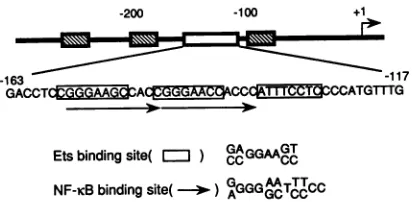
FIG. 1. Region responsive to cooperative activation of one copy of 21-bp enhancer in responding to Tax protein. The diagram shows an alignment of motifs in the LTR of HTLV-1: three direct repeats of the 21-bp enhancer (hatched boxes) and the TRE-2 sequence (open box). Motifs homologous to Ets- and
NF-KcB-binding
sitesaremarked with boxes and arrows on the sequence, respectively. The consensus sequence for each binding site is shown.
RESULTS
Sequence essential for cooperation with one copy of the
21-bp enhancer. The region between positions -163 and
-117 (TRE-2) located between two 21-bp enhancers in the LTRof HTLV-1 cooperates synergistically with one copy of the 21-bp sequence in responding to Tax trans activation
(Fig. 1) (5, 24). This sequencehas no similarity tothe 21-bp
sequence but has several motifs homologous to Ets- and
NF-KB-binding sites. To understand the mechanism of
co-operation of this sequence with one copy of the 21-bp enhancer, we tried to identify the minimum sequence essen-tial for cooperative function. For this, we prepared a series
of external deletion mutants from the 5' or 3' terminus. The
fragments of these deletion mutants were inserted upstream
of the promoter containing one copy of the 21-bpenhancerin
pUCdN111-CAT,
which contained the sequence from posi-tions-111 to+320(theCAPsite is position+1) of the LTR.These mutant sequences were alsoinserted intotheHTLV-1
promoter in pUCdN55-CAT, which did not contain any
21-bp enhancer. Each plasmid was transfected into the
human cellline FL with or without Tax expression plasmid
pCG-Tax, and CAT activity was assayed on day 2 after
transfection (Fig. 2).
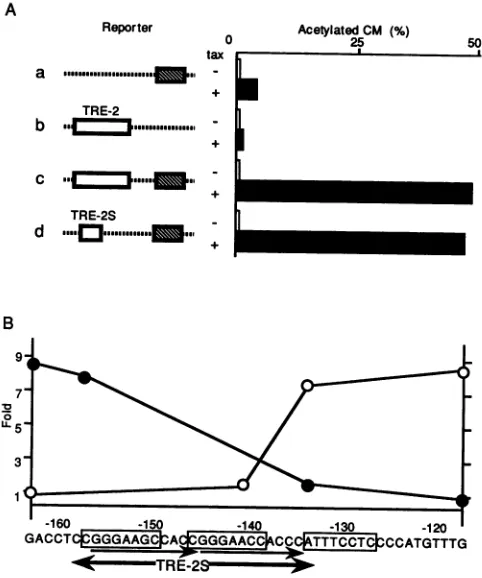
As described previously (5, 12, 24, 37), one copy of the
21-bp enhancer alone showed only 11- to 12-fold activation
by Tax, and TRE-2 by itself showed no activation (Fig.2A,
rows a and b). But insertions of these two sequences
together augmented CATexpression97-fold in the presence
ofTax(Fig. 2A, rowc). Therefore, TRE-2wasconfirmedto
cooperatively activate one copy of the 21-bp enhancer. The
3' deletion of this fragment up to position -134 did not reduce its enhancing activity, but further deletion of 7 nucleotides up to position -140 abolished its activity
com-pletely (Fig. 2B). Therefore, the 3' boundary of the respon-sive element should be located at positions -140 to -134. On the other hand, a 5' deletion up to position -158 reduced the activity only slightly, while further deletion to position -134 resulted in complete inactivation, confirming the
re-sults of 3' deletions. These results indicate that at leastthe
region between positions -158 and -134 is essential. In fact, a fragment containing positions -158 to -134 was found to
be almost as active as the original TRE-2 (Fig. 2A, rowd).
Therefore, the 25-bp sequence (TRE-2S) of positions -158 to -134 was concluded to be essential and sufficient for cooperative activation of the 21-bp enhancer in responding to Tax.
on November 9, 2019 by guest
http://jvi.asm.org/
[image:2.612.328.537.72.173.2]A
AcetylatedCM (%)
0 ~~~25 50
x a
mutant:---AAATT
B Reporter
a.
TRE-2
b . .
0 tax eta
-
+ +-+ +-
+ +-+ +c --rmt ... +
+ +
[image:3.612.324.561.67.277.2] [image:3.612.61.302.75.364.2]-160 -150 -140 -130 -120 1
GACCTC|G
AAACtAGGGAACCICgC,WTTTCCTCtCCATGTTTG
< RE-2S ^
FIG. 2. Identification of minimum element(TRE-2S) responsive to cooperative activation of one copy of 21-bp enhancer. (A) Enhancing activityof TRE-2 and TRE-2S. CATconstructs contain-ingonecopyof the21-bpenhancer(a),TRE-2(b),TRE-2plusthe 21-bpenhancer (c),and TRE-2Splus the21-bpenhancer(d)were
transfected into FL cells with (+) orwithout (-) Tax expression plasmid. CATactivitywasassayed2daysafter transfection. CM, chloramphenicol. (B) Summaryof deletionmutantsof TRE-2. Each deletion mutantwas inserted upstream of the 21-bp enhancer of pUCdN111-CAT andwascotransfected with Taxexpression plas-mid.Opencirclesrepresent deletions(map positions, -117, -134, -141, and -163) from the 3' end, and closed circles represent deletions (map points, -163, -158, -134, and -117) from the 5' end.
The c-Ets-binding site in TRE-2S is dispensable for the
activity.Bosselutetal.(3) reportedthat both Ets-1 and Ets-2
bound specifically to two sites in TRE-2 (the first and last
sites inFig.1 and3A).Thenewlydefined TRE-2Ssequence
contains one of the functional binding sequences, so we
tested the possible contribution of Ets protein binding to
Tax-mediatedtransactivation. Thesamemutationsusedby
Bosselutetal.(3)wereintroduced intoTRE-2 todestroythe
Ets-binding activities: two repeats of CCTCC at positions
-130to -126 and -161 to -157,which partly overlapthe
Ets-binding sites, were replaced by AAATT (Fig. 3). The
wild and mutant types of the fragment were inserted
up-streamof the21-bpenhancerinpUCdN111-CAT,and their
effects on CATexpressionwere assayed. Ets-1expression
caused three-tofivefold stimulation of thewild-typeTRE-2
but hadnoeffectonthemutant.Therefore,Ets-1contributes
to the activation of TRE-2 to some extent, as previously
described (3); however, asimilar effectwas observed
with-outthe21-bp sequence(Fig. 3B, rowb), indicatingthat the
effect of Ets-1 protein was independent of the 21-bp
en-hancer. The mutant fragment was effectively activated by
mutant
d as* * Ill |._
+ +
AcetylatedCM (%)
25 50
FIG. 3. Effects of mutationsatthe Ets-binding siteson
enhanc-ing activity of TRE-2. The asterisks in panel B show the locations of the mutations illustrated in panel A. The constructwas cotrans-fected withorwithout Taxand/or Ets expression plasmid into FL cells, and CAT activitywasassayed. CM, chloramphenicol.
Tax protein in a manner similar to that for the wild-type
TRE-2 incooperation withone copyof the 21-bpsequence,
but coexpression of Ets-1 didnotaffect thetransactivation,
evenwithincreasingdosesupto10-fold that of the standard
assay (see Materials and Methods). Similar results were
obtained with Ets-2 (data not shown). Therefore, it was
concluded that neitherEts-1norEts-2playsacritical role in
thecooperative activationofonecopyof the 21-bp enhancer
in responsetothe Taxprotein.
The NF-KB sequence is not involved in TRE-2 function.
TRE-2S also containstwo imperfectrepeats ofa sequence
homologous to the NF-KB-binding motif (Fig. 1). Its 3' region overlapsthe 3'boundary of thesequenceessential for
thecooperative function of TRE-2S (Fig. 2B). In fact, these
twodirectrepeatswereshownbyNumataetal. (29)tobind
the NF-KB protein and to contribute to the activation of
transcription. To confirm their results, we compared the responses ofTRE-2S and the authentic NF-KB-binding site to Taxtrans activation and TPAstimulation. TRE-2S was
multimerized seven times and inserted upstream of the
promoter into pUCdN55-CAT, which has no 21-bp
en-hancer. As a control experiment, the NF-KB-binding
se-quence of the IL-2Ra gene was multimerized and inserted
into the same vector. The heptamer of TRE-2S was not
significantlyactivated eitherbyTaxproteinorbyTPA and
the calcium ionophore A23187 (Fig. 4). In contrast, the
NF-KB-bindingsequencewasstronglyactivatedbyTax and
also responded efficiently toTPAtreatment, as previously
reported (6, 18, 21, 22, 26). Therefore, TRE-2S did not
function in a manner similar to that of the NF-KB-binding
sequence of the IL-2Ra gene. These observations are not
consistent with thosereportedbyNumataetal.(29).
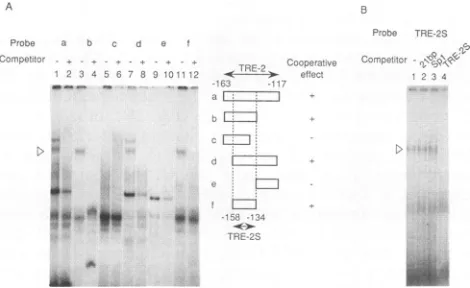
ProteinbindingtoTRE-2S. The DNAsequenceof TRE-2
gaveseveral bands inagelretardation assaywith anuclear
extractfromHUT102cells in which Taxtrans activation is
taking place (Fig. 5A).Toidentifythe band that is correlated
with the function ofTRE-2,weexaminedaseries of deletion
mutantsby gelretardation assay. Each fragmentgave
sev-A
Reporter
taw
a .
TRE-2
b 85. l
+
TRE-2S
d
sonom
...B
-.01
%-..TRE-2
GACCTCICGGGAA-G73.,AC...CCC...CCATGTTTG
on November 9, 2019 by guest
http://jvi.asm.org/
Reporter
tax TPA
a I I I I I I ..,,,,++
=:TRE-2S
b
*.*+
-Acetylated CM (%)
10
:NF-icB site +
CAACGGCAGGGGAATCTCCCTCTCCTT
FIG. 4. Comparison of enhancer activities ofTRE-2S and NF-KB-binding sequences. A heptamer of TRE-2S (row a) or the
NF-KB-binding site of the IL-2Ra promoter (row b)was inserted
upstream of a promoter without the 21-bp enhancer (pUCdN55-CAT). The arrowrepresents theconsensus of the NF-KB-binding
site. In experiments with TPA, transfected cellswere treatedwith
(TPA+)orwithout(TPA-)TPA(40ng/ml)and A23187(0.5,uM)as
described inMaterialsand Methods.The effects of Tax andTPAon
CATexpressionwereassayed withJurkatcells.CM, chloramphen-icol.
eral shiftedbands, and someof themwere cancelledbythe
sameunlabelled sequence, indicating specific protein
bind-ing. One ofthese bandswas observed tobe specific to the
mutantfragmentsa,b, d,andfcontainingTRE-2S (Fig.5A), whichwereall active in cooperative activation ofone copy ofthe21-bpenhancer(Fig. 2B).Moreover, this specificband
was not affected by the excess of the 21-bp sequence or
Spl-bindingsite (Fig. 5B), thus indicating that the Spl-like
binding site inTRE-2wasnotinvolved. Toconfirm thatthe
Probe a b c d e Competitor +
2 3 4 5 6 7 8 91C
il.I
*. WE,,.*
I,#io OR F'
011 12,+ TRE-2, Coopera!ivp 11 12 -- e01cC
o33
-117 ca
c
C_,-e m
= -t.
*3 -1-8 -134
TRE-23
P!obo TRE-2S cDem;tor I9*"O9g,<
4
FIG. 5. GelretardationassayofTRE-2S-bindingprotein. (A) Gel
retardation with various fragments of TRE-2. At the right, open
boxes represent probes and pluses and minuses represent their cooperative activity with one copy of the 21-bp enhancer. The
double-headedarrowsatthe topandbottomrepresentthe region of
the TRE-2 and the minimum region (TRE-2S) for cooperative
activation, respectively. Atthe left, each 32P-radiolabelled mutant
probewas incubatedwithHUT102 nuclear extractin the absence
(-) or presence (+) ofa 20-fold excess of the same fragmentas competitorandanalyzed by gel retardationassay. Thearrowhead
representsthe bandobserved onlywith the cooperatively
respon-sive fragment. (B) Competitionof TRE-2S and Spl or 21-bp se-quence.TRE-2SwasincubatedwithHUT102nuclearextractsinthe
absence(lane 1)orpresence(lane 2) ofa20-foldexcessof the21-bp
enhancer,theSpl-bindingsite(GGGCGGGGCGGGT-TAGAC[15]) (lane 3), andTRE-2S (lane 4). D, bands that correspondtothose
markedsimilarlyinpanelA.
specific protein binding is detected in cells used for the
transfection assays,wetestednuclearextracts ofthe human cell lines FL and Jurkat and obtained results similartothose in Fig.
5A.
These results suggest that a specificprotein(s)
binds to the TRE-2S sequence in various cell lines and
possibly mediates thecooperative activation ofonecopyof
the 21-bp enhancer in the presence of Taxprotein. Wecall
this protein(s) THP
(TRE-2
holdingprotein).
Isolation and sequencing of cDNA clones ofTHP proteins.
Toisolate cDNA clones encoding TRE-2S-bindingproteins,
a randomly primed
Xgtll
cDNA library prepared fromHUT102
cellswasscreened witha double-strandedoligonu-cleotide of
TRE-2S
by the Southwestern(DNA-protein)
procedure (45). The TRE-2S sequence was multimerized
seven times and was used a probe. Eleven clones were
isolated from about 2 x
106
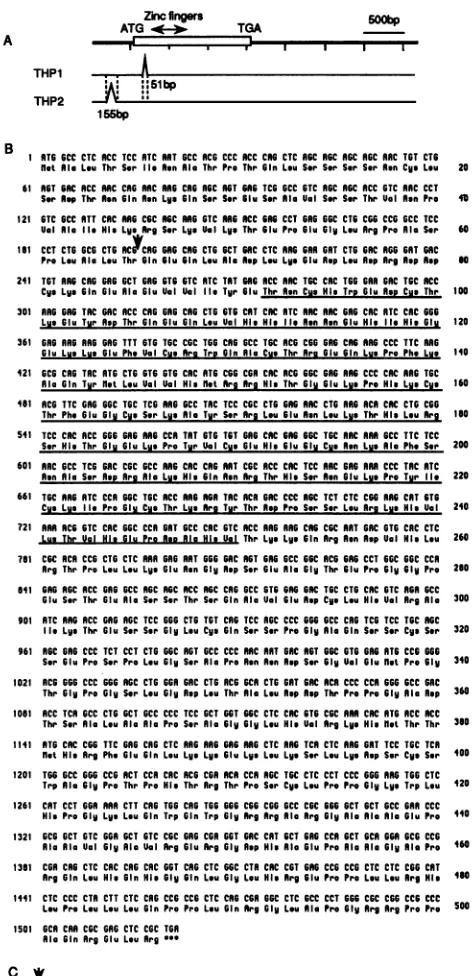
recombinant phages. Bypartialsequencing, clones were classified into two groups: six clones in type 1 and five clones in type 2. Sequence analysis
of the longest clones in each group showed that both types wereidentical except for aninsertionof 51bp in type 2 inthe
coding sequence (Fig. 6A).
By using the 5' and 3' fragments of the longest clone,
cDNA clonescovering about 4kbp were isolated. The size of THP mRNAwas about 4.3 kb; thus, these cDNA clones shouldcover nearlythe full lengthof the mRNA sequence. The general features of the cDNAs are illustrated in Fig. 6A,
althoughthepoly(A) siteis stillmissing. The initiation codon for an openreading frame wasidentifiedby a preceding stop codon at position -197 in frame. The sequences of these clones allow ustoidentifytwotypesof THP cDNA: THP-1 has an open reading frame coding for 506 amino acids, and THP-2 has one coding for 523 amino acids and having an
insertion of 51 bp at position + 196 (Fig. 6B and C). These proteins are calculated to have molecular masses of 55.6 and
57.4 kDa, respectively. In addition to this, THP-2 has a
deletion of 155 bp at position -316 (Fig. 6A).
The deducedaminoacid sequences of THP containedfive repeats of the zinc finger motif, Cys-Cys-His-His (C2H2) (2, 27). These zinc finger motifs are very similar to those ofthe human GLI gene (20) and the GLI3 gene (35), with the similarity greater than 80% (Fig. 7). They were also similar to those in Drosophila cubitus interruptus Dominant
(ciD)
(31) and thetra-1 gene (46). However, sequence other than the zincfinger motifs showed almost no homology, indicat-ing that THP-1 and -2 are new DNA bindindicat-ing proteins ofthe GLI family.THP-binding site in TRE-2S sequence. The sequence con-servation of the zinc finger motifs between THP and GLI suggested that their binding sequences may be similar to each other. In fact, the sequence GAACCACCCA of
TRE-2S
at the 3' boundary is highly homologous to the GLI-binding site GGACCACCCA (Fig. 8A). A syntheticnucleotide, GACCACCCA(GLI-Bl),which has been previ-ously identified as a binding sequence of GLI (20),competed efficiently with
TRE-2S
in binding to a nuclear factor(s)(Fig. 8B). Conversely,TRE-2S
competed with the GLI-Blse-quence, indicating that the GLI-binding motif in
TRE-2S
is responsive to the specific protein binding. THP-1 and -2 proteins were expressed in E. coli in the fusion form with GST and purified for testing DNA binding capability. Both GST-THP-1 and -2 were demonstrated to bind toTRE-2S
andGLI-Bl(Fig. 8C). Moreover, these proteins did not bind
to a mutant
(TRE-2S-M)
that was inactive in cooperative trans activation of the 21-bp enhancer. These observations suggest that THP-1 and -2 are the nuclear factorsshowing specific binding toTRE-2S
and are involved incooperative9
on November 9, 2019 by guest
http://jvi.asm.org/
[image:4.612.59.295.74.183.2] [image:4.612.57.292.422.566.2]Zincfingers
ATG e(- TGA
I . I I I I r
::51bp
1SSbp
500bp FINGER I1:
THP TN HWE T DT LEOLVH NNEIHGEKKE
GllI T R SEF D EQlVH NS f. HGESIE Gll3
TDHWEG
A EFDTEOLVHIN HGEKKE FINGER 2THP FV N
REOKPFKAOYMLVV
MRR TREKPGil
FVSREdrPFKAOYMLVV
MRR TGE K P G6LI13 FV tbl SREOKPFKAOYMLVV MRR T6GEIKPB
61 121 101
241 301
361
421
*A1 541 601
661
RTG6CC CTC RCC TCC RTCART 6CCRCGCCC RCCCAG CTC R6C R6CRAC RAC RACTOTCTO
SotRlo Lou Thr SerlieRAnRlo Thr Pro ThrGinLouSetr Str Ser SerRAnCgs Lou
AOT6ACRCC RRCCAG RRCRAA CR6 R6CRAT 6A6TC66CC 6TCRGC R6C RCC 6TC RRCCCT
StrRepThrRAn6in RonLAg61nStr SerSI1 SerRlo Val Str Ser Thr UolRAnPro 6TCGCCRTT CRCRA6C6CRACRAR GTCRRA RCCBRA CCT 6R G6C CT6 C66 CC6 6CC TCC UalRlo lieHAl LV.RrgSerLV.Vol LVu Thr 6lu ProAlu61g Lou Arg ProRl.Ser CCTCT66CGCTGAC7CRA 6SA6CR6CT6SCT6BCCTCRAG 6R 6RT CTG 6RCRAS GRT6RC Pro LouRleLou ThrBinSIu 6SnLouRlaAepLouLip 6lu Rep LouRApRrgRep Rep TOTRAG CR6SAG GCT GAB 6T6 6TC RTC TRT6RB RCCRAC T6C CRCTGO6AR 6RC T6CACC CVuLV.Gin6luRl.6lu Ual Uol 11 TAr6lu Thr RSn CueHAl TrpSluRepCu.Thr RR6SAGTRC GRC RCC CR6GRGCRA CTOGT6CRTCACRTCRRC RRC6RG CRC RTC CRC 666 Lys GluTyrRepThrGlnSluGin LouUVl Hl. Hl. lie RonRAn6luHl. IIe HAl Glu GRA RSA RO6 ORO TTT OTO T6C C6CTOGCR6 6CC T6C RC6CGG GRA CA6AAGCCC TTCSRA
GluLu. Lu.GluPheUalCu.RrA TrpGinRl. Cu. ThrRr. Glu61nLuy ProPheLuy
6C6CAOTRC RTG CTG 6T6 6T6CRC RT6 C66 CON CRC RC6 66C6SGAA6CCC CRC RR6 T6C Rla6Sn Ttr SetLouUolUGl Hlu SetArg Art Hls ThrSly61uLV PtroHAl Lu.Cgu
RCG TTCSRG66CTGCTC6RRA 6CC TRC TCC C6CCT6 6R6 RRCCTG RRG RCR CRC CTG C66 Thr PheBlu61g Cg.SorLy.RloTVrSerRrgLou6luRon LouLV.ThrHAl LouRrg TCCCRC RCCG66 GA6RR6 CCRTATOTG15T SRA CRCGRA 66C T6C RRCRNA 6CC TTC TCC SerHAl Thr61g Glu Lu.ProTyrUolCg.SluHl.6lu 61uCueRonLy.RloPh.Ser RRC6CC TC66SCC6CBCC RAA CRC CR6 RRT C6C RCC CRC TCCRAC RG RSMCCCTAC RTC
RAnRla SerRep Rrg RloLue HAl 6In Ron Rrg ThrHAlSerRAn 61S Ly.ProTyrle T6CRAG RTC CCR SACT6C RCCRRS A0RTRC RCRSACCCCA6CTCT CTCCOGRRS CRT 6T6
Cgu Ly. le Pro 61g Cgs ThrLu.RrgT,rThr RepPro SorSea Lou RrgL. HAl Uaol
721 AARACB 6SC CRC66C CCR SATGCC CRC STC ACC SRGRRG CA6 C6C RRT GRC GTG CRCCTC
LusThrVal Hi. SluPt. Aon A. ThrLV_LAgGln Rrg Ron Rep UalHis Lou
701 CGC RCR CCGCT6 CTCRRR GSG RRT666 SACRATGAS 6CCG6CRC6GAB CCT GOC66C CCR RrgThr Pro Lou Lou LAs Glu RonGl_ RSp SerGluRla G1u Thr6u Pro 61A G61 Pro
041 GAS SOC RCCGAS 6CCRGCRACACCRACCRG6CC 6RG6SCTOC CTGCRCGTCABA 6CC GluSorThrGlu Rla Seo Ser Thr Seo SInRlu Uol 61uRApCgsLouHl. UolRrgRlo
901 RTCRAGACCGSG SOC TCC 060 CTGT1TCA6 TCC RGCCCC6G6 6CCCRG TCG TCC TGC RGC
II. LAO ThrGluSer Ser61u Lou CAs SInSer SerPro61VRlo GSn Str Ser C_. Seo 961 SOCGAO CCCTCTCCTCTO G6C RGT GCC CCC RRC RRT SRC R6T G6C 6TG 56S ANTCCG6SG
Ser Olu Pro Str Pro Lou61 SetrRla Pro Ron RonRep Ser Uol 01. notPro6l_
1021 RCS G6G CCC 066 AGCCTO GAR SRC CTG RC6 6CA CTG SRT 6RC RCR CCC CCR 6G0 6CC 6SC Thr 61A Pro61u SerLouG01 RApLouThr Rlo Lou RepRep Thr ProProGIVRAl Rop
1051 RCCTCA 0CCCTO 6CTGCC CCCTCCGCT G0T 66C CTC CRC 6TG C6CRRR CRC RT6RCC ACC Thr SerRloLouRl. RlS Pro SerRSi GIA GIA LouHl. Uol RrgLVo HAl nStThr Thr
1141 RTS CRCC66 TTC AG1 CRG CTC RA6RA6 6A6 RAG CTC RRS TCA CTCRA6 6RT TCC TGC TCR SotHAl RrgPh. Glu SInLou LA. LA.61uLV. LouLA.Str Lou LA.RepSer CA. Ser 1201 TGO 0CC 066 CCG ACT CCR CRC KCG COR RCR CCR ROC T6C CTC CCTCCC6SO RAGTGG CTC
Trp Rla G6A Pro Thr Pro HAl ThrRrgThr Pro Ser C_. LouPro ProGIA LAuTrpLou
1261 CRT CCTG6RRRR CTTCRG T1G CRGT1G 066 COGCOO 6CCC6C 666 BCT BCT 6CC 6RRCCC Hla Pro61A LA. Lou6InTrpGinTrp61VRrgArgRl. RrgGlu RloAl.RAl Glu Pro
1321 6C6GCT STC 6GA GCT GTC C6C SAGCGR GGTGACCRT6CT 6BG CCR 6CT GCR G6R6C6CC6 Rl. RAl U.l 61VRSo UolRrg GluArg6lu RepHl. Rl. Glu Pro RAl RloG6_RloPro 1301 CGR CR6CTCCRC CRG CRCGGT CRGCTC66C CTR CRCCOT6RGCCG CCGCTC CTCCGGCRT Rrg 01nLouHl. GinHAl GIV61n LouG1u LouHla RrgOluProProLou LouRrgHla 1441 CTCCCCCTRCTTCTC CRG CCGCC6CTCCAOCBS G6C CTC6CC CCT S66 CGC COO CC6CCC Lou Pro Lou Lou Lou SInProProLouGinRrgGSI LouRloPro61A RrgRrgProPro
1501 GCR CAR CGC GAS CTC CGC TIS
Rlo SInRrgGluLouRrgA0
20
410
FINGER THP
Gll
FINGER
THP GLI
GLI3
60
100 120
140 160
ISA
200 220
240 260 200
300
320 340 360 300
400 420
440 460 IS0
500
33:
HlKTFEGE SIAYSRLENLKT LRSTGEKP
HlK4TFEG: YSR ENLKT LRS TGEKP
HK T FE 1TKAYSRLENLKT IL RS fT6GEIKP
I4 :
IYV)EHEG NKAFSNASDRAK QNRT SW tE KP
TYrSE G6 KAFSNASDRAIQNRT S N EI
Y
ViE
HE611KAFSIIASDRAK QIIRT SIIE PIFIINGER 5:
THP 7 KI
TRYTDPSSLRK
P VKTV GPDAHVIGil
YTK3PG
TKRYTDPSSLRKVETV
GPDAHVGl13YV|¢ PGTKRYTDPSSLRK V TVGP
FIG. 7. Comparisonof zincfinger motifs ofTHPwith those of
GLI and GLI-3. Identicalresidues areboxed. Cysteine and
histi-dine,whichareessentialfor the zinc finger motifs,areshaded.
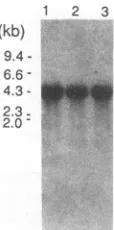
majorband of 4.3-kb mRNA in various types of cell lines.
The size of the mRNA indicated that our cDNA clones
covered most of the region of the mRNA, and ubiquitous
expression is consistent with Tax trans activation of one
A
TRE-2S: CCGGGAAGCCACCGGGAACCACCCA GLIbindingsite; CGTGGACCACCCAAGA
TRE-2S-M:
.AAATT--B C
Probe 2S GL
Competitor -2SGL -2S GL
1 2 3 4 5 6
VWOr
CRG GOC CRG GTG CTG SRC RCG GCT CRT GTG GOTGTG CCC TICCCCTCTCCC SlnG01 GinUo. LouRSpThrRb HAl UalG61 UalProPheProSorPro
FIG. 6. cDNAand amino acidsequencesof THP-1 and THP-2. (A)Illustration of THP-1and-2cDNAs.(B) Sequenceof THP-1.
The zincfingerdomain is underlined. (C) Sequence unique to the THP-2 that is insertedatthesitemarked with thearrowinpanelB.
Probe 2S 2S-M GL
12 3 4 5 6 7 8 9
4 a46 *.
c,*,, C7,r^F **^
A, OA>8l
trans activation ofonecopy of the 21-bp enhancerbyTax protein.
Expression of THP in various cells. As described in the previous section, TRE-2 cooperativelyenhanced Taxtrans
activation ofonecopyofthe21-bp enhancer in various cell
lines. To determine how the expression of THP and
tran-scriptional enhancementcorrespond, we examined the
[image:5.612.64.300.68.556.2]ex-pressionof THP in mRNAsinHUT102, Jurkat,and FLcells (Fig. 9). Northern (RNA) blot analysis detected a single
FIG. 8. CompetitionofTRE-2S andGLI-bindingsequencesingel retardationassay.(A) Comparisonof TRE-2S andGLI-bindingsite. Nucleotidesidenticaltothose in TRE-2Sareindicatedbydotsonthe
sequence. TRE-2S-M has a mutated sequence of AAATT at the
CCACCsequence.(B)TRE-2S(2S) (lanes1 to3)ortheGLI-binding
sequence (GL) (lanes4to 6)wasincubated withHUT102 nuclear extractinthe absence(lanes1and4)orpresence(lanes 2, 3, 5,and 6) ofcompetitorsin 20-foldexcess. (C) DNAbindingactivities of
GST-THPfusionproteins. GST, glutathioneS-transferase.>,bands showingthespecific binding.
A
THP1
THP2
Ir.
on November 9, 2019 by guest
http://jvi.asm.org/
[image:5.612.367.520.74.267.2] [image:5.612.348.543.378.628.2]1 2 3
5,,.z :;.,. .,, ,:^,
_i_ X ...;:<., ,:& .,
(kb) 9.4
-6.6
-4.3
[image:6.612.147.204.75.190.2]- 2.3-2.0
FIG. 9. Expression of THP in various cell lines. Total RNA from different cell lines was analyzed byRNA blotting with cDNA of THP-1as aprobe. Lanes: 1,HUT102; 2, Jurkat; 3,FL. Molecular sizesare onthe left.
copy of the 21-bp enhancer cooperating with TRE-2 in
varioustypesof cell lines.
DISCUSSION
In thisarticle,wehave definedanewcis-acting
transcrip-tional element, TRE-2S, in the LTR of HTLV-1. TRE-2
responds to Tax trans activation cooperatively with one
copyof the21-bp enhancer; however,it is almost inactiveby
itself. Therefore, TRE-2 can substitute the second copyof
the direct repeatofthe 21-bp enhancer,whichis efficiently activated by Tax. Generally, multicopies of an enhancer
sequence result in activation of transcription. However, TRE-2 hasno sequencesimilaritytothe 21-bpenhancer and isnot anenhancer by itself,evenin its multimerized form;
therefore, a combination of two different sequences
en-hances thetranscription inrespondingtoTax.
The Ets- and NF-KcB-binding sites in TRE-2were
previ-ously proposedascandidates for thecooperativeactivation
of one copy of the 21-bp sequence (3, 29). The TRE-2S
defined here still contains sequences homologous to these
bindingsites.However, mutagenesisatthese sites indicated
that neither siteplaysanycrucial role. Previously,Numata
et al. (29) reported that a region almost identical to our
TRE-2S binds theNF-KB and is activated with Taxprotein
and TPAbyitself. However,wefound thatprotein binding
to TRE-2S did not compete with the NF-KB-binding site
(datanotshown); furthermore,TRE-2S itselfwasinactiveas
anenhancer. Thereasonforourresultsbeing differentfrom
theirs is unknown, but it might be because of sequence
differences at two bases in TRE-2S (see reference 29).
Nevertheless, bothourand their sequences were active in
cooperativeactivation ofonecopyof the21-bp enhancerin
respondingtoTax. Thus, these small sequence differences
had no significance in the activity under discussion. Thus,
weconcludethatTRE-2S servedas a newcis-acting element
distinct fromtheEts- and NF-KB-bindingsites. Our results
arebasedonsyntheticpromoter constructsand thusmaynot
exclude the possibility that the Ets and/or NF-KB protein
contributesto the control of the LTRactivity.
We isolated two types of cDNA clones, THP-1 and -2,
encoding the TRE-2S-binding proteins. Although TRE-2S
containsmotifsrelatedtotheNF-KB- andMyb-binding sites
and the bindingof Myb protein tothis sequence has been reported previously (4), no cDNA clones related to these
factorswere isolated.This result might reflect the fact that
THPs were the main components of TRE-2S-binding
pro-teins in HeLa cells. Sequence analysis of these clones
showed that THPs have five zinc fingers, which are con-served in GLI family proteins. A GLI is an oncogene amplified in glyoma cell lines (19) that transformsratembryo fibroblasts in cooperating with adenovirus ElA (36) and binds to the DNA sequence GACCACCCA (20). A highly homologous sequence, GAACCACCCA, is present in TRE-2S for the binding of GLI family proteins (20, 36). In fact, a synthetic oligonucleotide with this sequence
com-peted with THP bindingtoTRE-2S.Moreover, themutantof TRE-2S thatcannot bind to THP-1 and -2was inactive to
activate the transcription. These binding properties were identical to those observed in the gel shift assay with a
nuclear extract of HUT102 cells, thus strongly suggesting
that THP proteins are identical to those detected in the
nuclear extract.
The binding properties of THP proteins to the mutant
probes suggest that THPbindingto the GLI-bindingsite is important to activate one copy of the 21-bp enhancer in
respondingtoTaxtrans activation. We have triedto
evalu-ate the effect of THP-1 and -2 on Taxtrans activation by cotransfection with Tax expression plasmid; however, the maximum trans activationwasobtained by Taxalone, and
expressionof THP-1or-2reduced thetransactivation(data
notshown). These resultswereexpected,since various cell lines used for this assay expressed the THP gene constitu-tively; thus,the exogenously suppliedTHP proteinswould
notbe ableto giverise to additional activation and instead might result inasuppressiveeffectthroughsquelchingofan
essentialfactor(s).
We and others have previouslyshown that Tax binds to
the CREBorCREMprotein,which binds tomulticopiesof the 21-bp enhancer (42, 47). Therefore, it is possible that THP-1 and/or -2 binds to TRE-2S andmight interact with Tax orCREB and CREMproteinsforcooperative activation
of one copy of the 21-bp enhancer. This is an interesting
hypothesis to be studied. In this regard, Marriott et al.
reportedaprotein(TIF)of36 kDa that bindstothe sequence
containingTRE-2 (25). Interestingly, theyalso showed that
Taxproteinbinds to thisTIFprotein. However, the
differ-ence in molecularmassshows that THPsare notthe TIF.
ACKNOWLEDGMENTS
WethankKazukiyo Onodera, Laboratory of Biological
Chemis-try, DepartmentofAgricultural Chemistry, The Universityof
To-kyo, for valuable discussionandsupervision ofA.T.
This workwassupported inpartby agrant forSpecial Project
Research, Cancer Bioscience, from the Ministry of Education,
CultureandScienceofJapan.
REFERENCES
1. Beraud,C.,G.Lombard-Platet,Y.Michal,and P.Jalinot.1991.
Binding of theHTLV-1Taxltransactivatortotheinducible21
bp enhancer is mediatedby the cellular factor HEB1. EMBO J. 10:3795-3803.
2. Berg, J. 1986. Potentialmetal-bindingdomains innucleic acid
binding proteins. Science 232:485-487.
3. Bosselut, R., J. F.Duvall,A.Gegonne,M.Bailly,A.Hemar, J.
Brady, and J. Ghysdael. 1990. The product of the c-ets-1 proto-oncogene and the related Ets2protein act as
transcrip-tional activators of the long terminal repeat of human T cell
leukemia virusHTLV-1. EMBO J. 9:3137-3144.
4. Bosselut, R., F. Lim, P. C.Romond, J. Frampton, J. Brady,and
J. Ghysdael. 1992. Mybprotein binds to multiple sites inthe
human T celllymphotropic virustype 1long terminalrepeatand
transactivates LTR-mediated expression. Virology
186:764-769.
5. Brady, J.,K.-T.Jeang,J.
Duvali,
andG.Khoury.1987.Identi-fication of p4Ox-responsive regulatory sequences within the
on November 9, 2019 by guest
http://jvi.asm.org/
human T-cell leukemia virus type I long terminal repeat. J.
Virol. 61:2175-2181.
6. Cross, S. L., M. B. Feinberg, J. B. Wolf, N. J. Holbrook, F.
Wong-Staal, and W.J.Leonard. 1987. Regulation of the human
interleukin-2 receptor alpha chain promoter: activation of a nonfunctional promoter by thetransactivator gene of HTLV-1.
Cell 49:47-56.
7. Felber, B. K., H. Paskalis, D.Kleinman-Ewing, F.Wong-Staal, and G. N. Pavlakis. 1985. The pX protein of HTLV-1 is a
transcriptional activator of its long terminal repeat. Science 229:675-679.
8. Fujii, M., T. Niki, T. Mori, T. Matsuda, M.Matsui,N.Nomura, and M.Seiki.1991. HTLV-1 Tax induces expression of various immediate early serum responsive genes. Oncogene 6:1023-1029.
9. Fujii, M., P. Sassone-Corsi, and I. M. Verma. 1988. c-fos
promotertrans-activation by
tax,
proteinofhumanT-cellleu-kemiavirus type I. Proc. Natl. Acad. Sci.USA85:8526-8530.
10. Fujii, M., H.Tsuchiya, T. Chuhjo, T.Akizawa, and M. Seiki. 1992. Interaction of HTLV-1 Taxl with p67s'r causes the
aberrant induction of cellular immediate early genes through
CArGboxes. Genes Dev. 6:2066-2076.
11. Fujisawa, J., M. Seiki, T. Kiyokawa, and M. Yoshida. 1985.
Functional activation of the long terminal repeat of human
T-cellleukemia virus type 1 by a trans-actingfactor.Proc.Natl. Acad. Sci. USA 82:2277-2281.
12. Fujisawa, J., M. Seiki, M. Sato, and M. Yoshida. 1986. A
transcriptional enhancersequence of HTLV-1 is responsible for
transactivationmediated byp40"of HTLV-1. EMBO J. 5:713-718.
13. Fujisawa, J., M. Toita, and M. Yoshida. 1989. A unique en-hancer elementfor the trans activator(p40wx)ofhuman T-cell leukemia virus type I that is distinct from cyclic AMP- and 12-O-tetradecanoylphorbol-13-acetate-responsive elements. J. Virol.63:3234-3239.
14. Fujisawa, J., M. Toita, T.Yoshimura, and M. Yoshida. 1991. The indirect association of human T-cell leukemia virus tax proteinwith DNA results intranscriptional activation. J. Virol.
65:4525-4528.
15. Gegonne, A., R. Bosselut, R. Bailly, and J. Ghysdael. 1993.
Synergistic activation of the HTLV-1 LTREts-responsive
re-gion bytranscriptionfactor Etsl and Spl. EMBO J.
12:1169-1178.
16. Gitlin, S. D., R. Bosselut, A. Gegonne, J. Ghysdael, and J. N. Brady. 1991. Sequence-specificinteraction of the Etsl protein with the longterminalrepeat of the humanT-lymphotropic virus typeI. J. Virol.65:5513-5523.
17. Huynh, T. V., R. A. Young, and R. W. Davis. 1985.Constructing andscreening cDNA libraries in AgtlO and Agtll, p. 49-78. In D.M.Glover(ed.),DNAcloning-a practical approach, vol.I. IRL Press, Oxford.
18. Inoue, J., M. Seild, T. Taniguchi, S. Tsuru, and M. Yoshida. 1986. Induction of interleukin 2 receptor gene expression by p40"encodedby humanT-cellleukemia virus typeI. EMBO J. 5:2883-2888.
19. Kinzler,K. W., S. H.Bigner, D. D. Bigner, J. M.Trent, M. L. Law, S. J. O'Brien, A. J. Wong, and B. Vogelstein. 1987.
Identification ofanamplified,highlyexpressedgenein a human
glyoma. Science236:70-73.
20. Kinzier,K.W.,and B.Vogelstein.1990. The GLI gene encodes anuclearprotein whichbindsspecificsequences in the human genome. Mol. Cell. Biol. 10:634-642.
21. Leung, K., and G. J. Nabel. 1988. HTLV-1 transactivator induces interleukin-2 receptor expression through an NF-KB-like factor. Nature(London)333:776-778.
22. Lowenthal, J. W., E. B0hnlein,D. W.Ballard, and W.Greene. 1988.Regulationofinterleukin2receptor a subunit (Tac or CD25
antigen)geneexpression:bindingof induciblenuclear proteins to discrete promoter sequences correlates withtranscriptional acti-vation. Proc. Natl.Acad. Sci. USA85:4468-4472.
23. Manley, J. L., A. Fire, M. Samuels, and P. A. Sharp. 1983. In vitrotranscription:whole cell extract. Methods Enzymol. 101: 568-582.
24. Marriott, S. J., I. Boros, J. F. Duvall, and J. N. Brady. 1989.
Indirectbindingof human T-cell leukemia virus type I
tax,
to aresponsive element inthe viral long terminal repeat. Mol. Cell.
Biol. 9:4152-4160.
25. Marriott,S. J., P. F. Lindholm, K. M. Brown, S. D. Gitlin, J. F.
Duvall, M. F. Radonovich, and J. N. Brady. 1990. A
36-kilodalton cellular transcription factor mediates an indirect
interaction of human T-cell leukemia/lymphoma virus type I
TAX1 with a responsive element in the viral long terminal
repeat. Mol. Cell. Biol. 10:4192-4201.
26. Maruyama, M., H. Shibuya, H. Harada, M. Hatakeyama, M. Seiki, T. Fujita, J. Inoue, M. Yoshida, and T. Taniguchi. 1987.
Evidence for aberrant activation of the interleukin-2 autocrine
loop byHTLV-Iencoded byp40"andT3/Ti complex triggering.
Cell48:493-500.
27. Miller, J., A. D. McLauchlan, and A. Klug. 1985. Repetitive
zinc-binding domains in the protein transcription factorIIIA
fromXenopus oocytes. EMBO J. 4:1509-1614.
28. Miyatake, S., M. Seiki, R. D.Malefijt, T. Heike, J.
Fujisawa,
Y.Takebe, J. Nishida, J.Shlomai,T.Yokota, M. Yoshida, K. Arai,
and N. Arai. 1988. Activation of T cell-derived lymphokine
genes in T cells andfibroblasts: effects of human T cell leukemia
virus type Ip40"protein andbovinepapilloma virus encoded E2
protein. NucleicAcidsRes. 16:6547-6566.
29. Numata, N., K. Ohtani, M. Niki, M. Nakamura, and K.
Sug-amura. 1991. Synergismbetween twodistinct elements of the
HTLV-I enhancer during activation by the trans-activator of
HTLV-I. New Biol. 3:896-906.
30. Nyborg, J. K., W. S.Dynan, I.S. Y. Chen, and W.Wachsman.
1988. Bindingofhost-cell factors to DNA sequences in the long
terminal repeat of humanT-cellleukemia virus typeI:
implica-tions for viral gene expression. Proc. Natl. Acad. Sci. USA 85:1457-1461.
31. Orenic, T. V., D. C. Slusarski, K. L. Kroll, and R. A. Holmgren. 1990. Cloning andcharacterization of thesegment polarity gene
cubitus interruptus Dominant of Drosophila. Genes Dev.
4:1053-1067.
32. Park,R. D., W. A. Haseltine, and C. A.Rosen. 1988. A nuclear
factor isrequired for transactivation of HTLV-1 gene expres-sion. Oncogene3:275-279.
33. Paskalis, H., B. K. Felber, and G. N. Pavlakis. 1986. cis-acting sequences responsible for the transcriptional activation of a
human T-cell leukemia virus type I constitute a conditional enhancer. Proc. Natl. Acad. Sci. USA83:6558-6562.
34. Poiesz, B. J., R. W.Ruscetti,A. F.Gazdar, P. A. Bunn,J. D. Minna, andR. C. Gallo. 1980. Detection and isolationoftheC retrovirus from fresh and cultured lymphocytes of apatient with T celllymphoma. Proc. Natl.Acad. Sci. USA77:7415-7419. 35. Ruppert, J. M., B.Vogelstein, K. Arheden, and K. W. Kinzier.
1991. GLI3 encodes a 190-kilodalton protein with multiple regions of GLIsimilarity. Mol. Cell. Biol. 11:1724-1728. 36. Ruppert, J. M., B. Vogelstein, and K. W.Kinzier.1991. Thezinc
finger protein GLI transforms primary cells in cooperation with adenovirus ElA. Mol. Cell. Biol. 11:1724-1728.
37. Shimotohno, K., M.Takano, T. Teruuchi, and M. Miwa. 1986.
Requirement of multiple copies of a 21-nucleotide sequence in the U3regions of human T-cell leukemia virus type I and type II longterminal repeats fortrans-acting activation of transcription. Proc. Natl.Acad. Sci. USA83:8112-8116.
38. Siekevitz, M., M. B. Feinber, N. Holbrook, F.Wong-Staal,and W. C.Greene. 1987.Activation of interleukin 2 andinterleukin 2receptor (Tac)promoter expression by thetrans-activator (tat) gene product of human T-cell leukemia virus type I. Proc. Natl. Acad. Sci. USA84:5389-5393.
39. Smith, D. B., and K. S.Johnson. 1988. Single-step purification of polypeptides expressed in Escherichia coli as fusions with glutathioneS-transferase. Gene 67:31-40.
40. Sodroski, J. G., C. A. Rosen, W. C. Goh, and W. A. Haseltine. 1984.trans-actingtranscriptional activation of the long terminal repeat of human T lymphotropic viruses in infected cells. Science226:177-179.
41. Sodroski, J. G., C. A. Rosen, W. C. Goh, and W. A.Haseltine. 1985. Atranscriptional activator protein encoded by the x-lor
on November 9, 2019 by guest
http://jvi.asm.org/
region of the human T-cell leukemia virus. Science 228:1430-1434.
42. Suzuki, T., J. Fujisawa, M. Toita, and M. Yoshida. 1993. The trans-activator Tax of human T-cell leukemiavirus type 1 (HTLV-1) interacts withcAMP-responsive element (CRE) bind-ingand CRE modulator proteins that bind tothe21-base-pair enhancer of HTLV-1. Proc. Natl. Acad. Sci. USA 90:610-614. 43. Yoshida, M., I.Miyoshi, and Y. Hinuma. 1982. Isolation and characterization of retrovirus from cell lines of human adult T-cell leukemia and its implication in the disease. Proc. Natl. Acad. Sci. USA79:2031-2035.
44. Yoshida, M., M. Seiki, K.Yamaguchi, and K. Takatsuki. 1984. Monoclonal integration of HTLV in all primarytumorsof adult T-cellleukemiasuggestscausativerole of HTLV in the disease. Proc. Natl. Acad. Sci. USA 81:2534-2537.
45. Yoshimura, T., J. Fujisawa, and M. Yoshida. 1990. Multiple
cDNA clones encoding nuclear proteins that bind tothe
tax-dependent enhancer of HTLV-1: all contain a leucine zipper
structureandbasic amino acid domain. EMBO J. 9:2537-2542. 46. Zarkower, D.,andJ. Hodgkin.1992. Molecularanalysis of the C.eleganssex-determininggenetra-1:ageneencodingtwozinc finger proteins. Cell 70:237-249.
47. Zhao, L., and C. Giam. 1991. Interaction of the human T cell lymphotropic virus type I (HTLV-I) transcriptional activator Tax withcellular factors that bindspecificallyto the
21-base-pair repeatsin the HTLV-I enhancer. Proc. Natl. Acad. Sci. USA88:11445-11449.
48. Zhao, L.,andC. Giam. 1992. Human T-celllymphotropic virus typeI(HTLV-I) transcriptional activator, Tax, enhances CREB binding to HTLV-I 21-base-pair repeats by protein-protein interaction.Proc. Natl. Acad. Sci. USA 89:7070-7074.